
India Sports Analytics Market Size, Share, Trends and Forecast by Component, Analysis Type, Sport, and Region, 2026-2034
India Sports Analytics Market Summary:
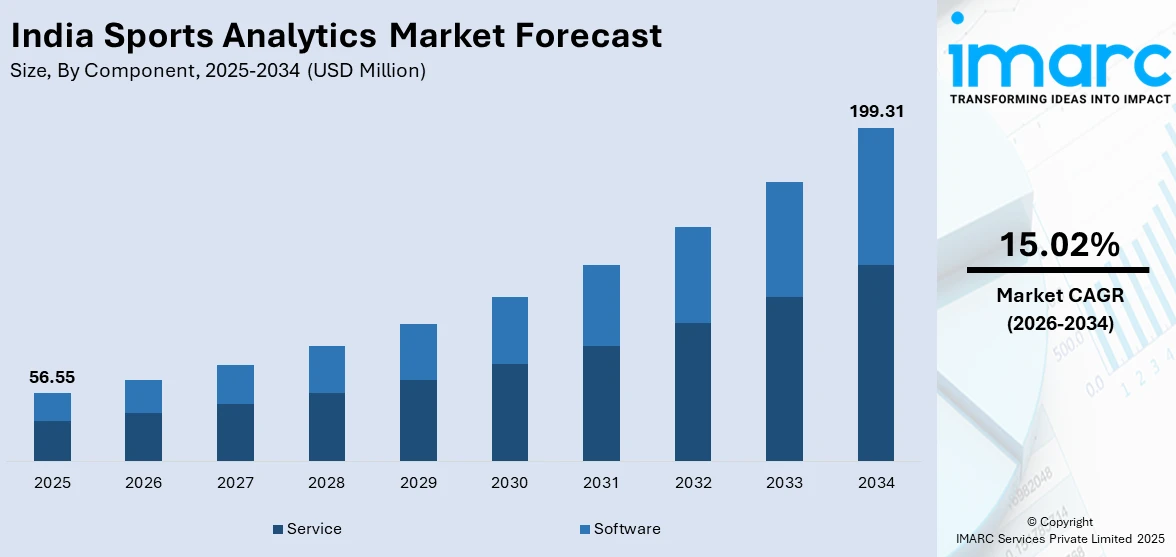
The India sports analytics market grew from USD 56.55 Million in 2025 to USD 65.06 Million in 2026 and is projected to reach USD 199.31 Million by 2034, growing at a compound annual growth rate of 15.02% from 2026-2034.
The India sports analytics market is witnessing strong growth, fueled by the adoption of artificial intelligence, machine learning, and advanced data processing solutions. Professional sports leagues, especially cricket, are increasingly leveraging data-driven insights to enhance player performance, refine team strategies, and improve overall competitiveness. Accelerating digital transformation in sports, rising audience engagement, and expanding investments in sports technology infrastructure are further supporting market expansion. These trends are driving the modernization of sports management and analytics across India, creating opportunities for technology providers and professional sporting organizations alike.
Key Takeaways and Insights:
- By Component: Service dominates the market with a share of 55% in 2025, driven by the increasing demand for consulting, implementation, and managed analytics services among professional sports organizations and franchises seeking specialized expertise.
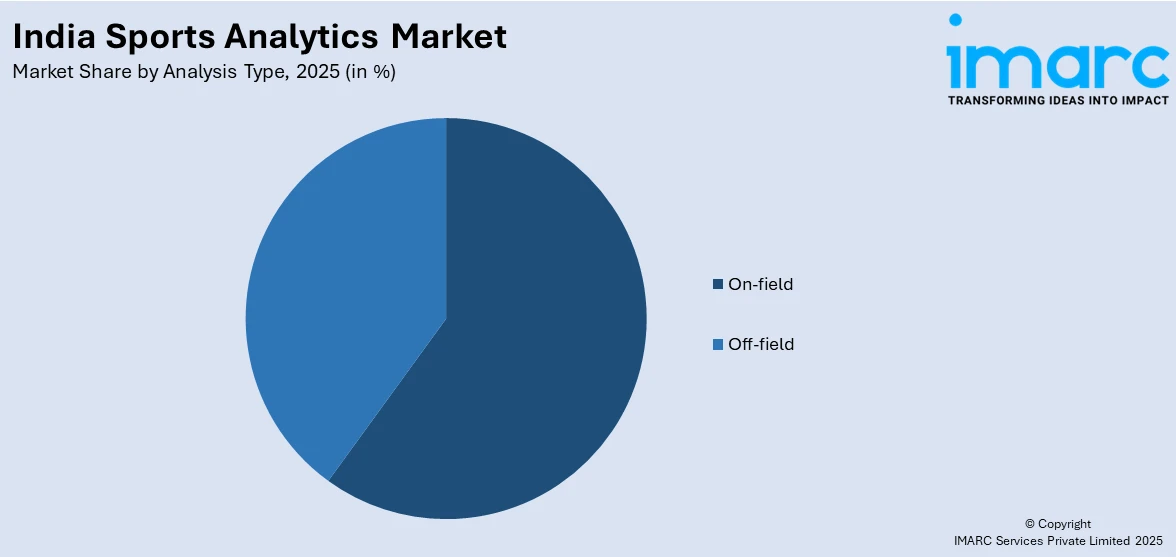
- By Analysis Type: On-field leads the market with a share of 60% in 2025, attributed to the growing adoption of real-time performance tracking, player biomechanics analysis, and video analytics solutions by coaches and team management.
- By Sport: Cricket represents the largest segment with a market share of 34% in 2025, owing to the massive popularity of the Indian Premier League and the widespread adoption of analytics tools for player selection, match strategy, and fan engagement.
- By Region: North India dominates the market with a share of 29% in 2025, supported by the concentration of major sports franchises, technology hubs in Delhi-NCR, and presence of key sporting infrastructure in the region.
- Key Players: The India sports analytics market exhibits moderate competitive intensity, with established technology corporations competing alongside innovative domestic startups across performance analysis, fan engagement, and data visualization segments. Major participants leverage strategic partnerships with sports federations and franchise teams to strengthen market positioning.
To get more information on this market Request Sample
The India sports analytics market is witnessing transformative growth propelled by the increasing adoption of data-driven decision-making across professional leagues and sports organizations. Technology integration has fundamentally altered how teams approach player development, injury prevention, and strategic planning. The Indian Premier League catalyzes innovation, with franchises investing substantially in advanced analytics platforms to gain competitive advantages. For instance, teams like Rajasthan Royals have deployed IoT-enabled bat sensors and AI-powered performance tracking systems to analyze player metrics, including bat speed, sweet spot accuracy, and back-lift angle in real time. For instance, in October 2024, Str8bat secured Series A funding to expand its AI-driven cricket analytics solutions, with clients including Rajasthan Royals and Cricket Australia utilizing sensor technology for player performance optimization. Government initiatives such as the Khelo India Rising Talent Identification program are leveraging artificial intelligence and machine learning algorithms to identify grassroots sporting talent through standardized assessments. The convergence of affordable digital infrastructure, increasing smartphone penetration, and growing sports viewership creates a fertile environment for analytics adoption across both professional and amateur sporting levels.
India Sports Analytics Market Trends:
Integration of Artificial Intelligence and Machine Learning in Performance Analysis
Professional sports teams across India are rapidly integrating artificial intelligence and machine learning technologies to revolutionize player performance analysis. Advanced algorithms process vast datasets encompassing historical performance metrics, biomechanical patterns, and physiological indicators to generate actionable insights for coaching staff. Wearable sensors and biometric tracking systems continuously monitor athlete movements, heart rates, and fatigue levels, enabling data-driven training optimization. The collaborative research between academic institutions demonstrates this trend, with studies employing deep learning models achieving significant accuracy in predicting player movements and deceptive actions in cricket. These technological advancements facilitate the transition from intuition-based coaching to evidence-backed performance management strategies. For instance, in April 2023, Indian sports tech start-up StanceBeam partnered with wearables leader boAt to launch StanceOS, featuring smart sensors and AI-driven motion analysis in smartwatches. Timed with the IPL and upcoming World Cup, the platform offers young players access to cricket analytics, supporting performance tracking, skill development, and identifying emerging talent for the next generation of Indian cricketers.
Expansion of Data-Driven Fan Engagement Platforms
Sports organizations are increasingly deploying sophisticated analytics platforms to create personalized fan experiences and strengthen audience engagement. Digital platforms analyze engagement patterns to understand preferences for content, merchandise, and events, enabling customized interactions including exclusive content delivery and gamified experiences. Social media analytics tools measure fan sentiment in real-time, allowing teams to adjust communication strategies and respond proactively to public reactions regarding team performances and management decisions. Interactive technologies including AI-driven chatbots and augmented reality experiences create immersive pathways for fans to connect with favorite teams, ensuring relationships evolve continuously to match changing consumer expectations and viewing preferences.
Rise of Predictive Analytics for Injury Prevention and Recovery Management
The adoption of predictive analytics for injury prevention represents a significant trend reshaping sports medicine practices across Indian sporting organizations. Machine learning models analyze historical injury data, training loads, and physiological indicators to forecast potential injury risks before they materialize. Teams utilize these insights for strategic decisions regarding player rotation, recovery protocols, and workload management during intensive tournament schedules. The integration of computer vision technologies enables detailed biomechanical analysis, identifying movement patterns that may predispose athletes to specific injuries. This proactive approach to athlete health management minimizes downtime, extends playing careers, and optimizes team performance throughout competitive seasons. For instance, in October 2025, Former Indian cricketer and Gujarat Titans assistant coach Parthiv Patel joined Bangalore-based SportzEngage Technology, marking his debut as a tech investor. The startup uses AI to transform cricket analytics, and this move represents Parthiv’s first foray into entrepreneurship in the sports technology space.
Market Outlook 2026-2034:
The outlook for India’s sports analytics market remains positive as digital transformation advances across the sporting ecosystem. Government programs are emphasizing the integration of technology to enhance talent identification and support athlete development. Growth in professional leagues beyond cricket, including football, kabaddi, and hockey, is increasing demand for advanced analytics solutions. Academic and research institutions are also investing in sports-tech innovation, focusing on AI and IoT-driven platforms that enhance performance tracking, strategic decision-making, and overall operational efficiency within both professional and grassroots sports. The market generated a revenue of USD 56.55 Million in 2025, which is expected to reach USD 65.06 Million in 2026 and further grow to USD 199.31 Million by 2034, at a compound annual growth rate of 15.02% during 2026-2034.
India Sports Analytics Market Report Segmentation:
|
Segment Category |
Leading Segment |
Market Share |
|
Component |
Service |
55% |
|
Analysis Type |
On-field |
60% |
|
Sport |
Cricket |
34% |
|
Region |
North India |
29% |
Component Insights:
- Software
- Service
Service dominates with a market share of 55% of the total India sports analytics market in 2025.
The service component encompasses consulting, implementation, integration, and managed analytics services that enable sports organizations to leverage data-driven insights without substantial in-house technical expertise. Professional sports franchises and leagues increasingly prefer outsourced analytics services to access specialized knowledge in performance optimization, fan engagement strategies, and revenue analytics. Service providers offer customized solutions addressing specific organizational requirements, from real-time match analytics to long-term player development programs. The dominance of this segment reflects the nascent stage of analytics adoption where organizations prioritize expert guidance over standalone software procurement.
The growing complexity of analytics applications and the shortage of skilled data scientists within sports organizations further strengthen demand for service-based solutions. Major analytics providers deploy dedicated teams to work alongside coaching staff and management, translating complex statistical models into actionable recommendations. Cloud-based service delivery models reduce infrastructure requirements while enabling scalable analytics capabilities that adjust to seasonal tournament demands. This segment benefits from recurring revenue models as organizations maintain long-term partnerships with service providers for continuous performance monitoring and strategic advisory.
Analysis Type Insights:
Access the comprehensive market breakdown Request Sample
- On-field
- Player and Team Analysis
- Video Analysis
- Health Assessment
- Off-field
- Fan Engagement
- Ticket Pricing
On-field leads with a share of 60% of the total India sports analytics market in 2025.
On-field analytics encompasses player performance tracking, team strategy optimization, video analysis, and health assessment applications that directly influence competitive outcomes. Professional franchises invest heavily in real-time data collection systems utilizing wearable sensors, high-speed cameras, and GPS tracking devices to capture granular performance metrics. Video analysis platforms enable frame-by-frame examination of player techniques, opponent strategies, and match situations, providing coaching staff with evidence-based insights for tactical adjustments. Health assessment analytics monitor physiological parameters including heart rate variability, sleep quality, and recovery metrics to optimize training loads and prevent overtraining injuries.
The primacy of on-field analytics reflects the fundamental value proposition of sports analytics in enhancing competitive performance. Indian Premier League franchises exemplify this trend, deploying sophisticated tracking systems and AI-powered analysis tools to gain marginal advantages in player selection and match strategy. The integration of computer vision technologies enables automated event detection and pattern recognition, reducing manual analysis workloads while improving insight quality. Coaches increasingly rely on predictive models for opponent profiling, enabling data-informed tactical preparations that maximize team strengths while exploiting competitor weaknesses.
Sport Insights:
- Football
- Cricket
- Hockey
- Basketball
- American Football
- Others
Cricket exhibits clear dominance with a 34% share of the total India sports analytics market in 2025.
Cricket dominates the India sports analytics landscape owing to the sport's unparalleled popularity and the substantial commercial investments flowing through leagues such as the Indian Premier League. The data-intensive nature of cricket, with its discrete events and statistical measurability, creates ideal conditions for advanced analytics applications. Franchise teams deploy comprehensive analytics ecosystems encompassing player auction valuations, match strategy optimization, injury prediction, and fan engagement personalization. The availability of extensive historical datasets enables sophisticated machine learning models for performance prediction and opponent analysis.
The professionalization of cricket analytics has established industry benchmarks that other sports increasingly emulate. Ball-by-ball tracking systems, hawk-eye technology for umpiring decisions, and real-time broadcast analytics demonstrate sophisticated technology integration throughout the cricket ecosystem. Fantasy sports platforms centered on cricket have driven consumer-facing analytics adoption, familiarizing millions of fans with statistical analysis and performance metrics. This broad analytics literacy creates receptive markets for premium content and data products, further reinforcing cricket's leadership in the sports analytics domain. For instance, in October 2025, IBM launched the world’s first AI-driven cricket activation, combining advanced analytics and generative AI with sports innovation. Unveiled at IBM Think Mumbai 2025, the initiative positions the company at the forefront of cricket’s digital transformation, aiming to collaborate with top Indian cricket organizations, including IPL franchises, to enhance fan engagement and performance insights.
Region Insights:
- North India
- South India
- East India
- West India
North India dominates the market with a 29% share of the total India sports analytics market in 2025.
North India's market leadership stems from the concentration of major sporting infrastructure, technology companies, and corporate headquarters in the Delhi-NCR region. The availability of leading franchises in the IPL, national sport federations, and stadiums of international standards generates a great need for analytics solutions. High-tech infrastructure of the region, with a variety of sports-tech start-ups and analytics service providers, enables the adoption of innovative solutions within a short period of time. Sports development programs by the government, such as heavy investments in Khelo India programs and State Centres of Excellence, also contribute to the adoption of analytics in the region.
Delhi-NCR is the hub of major sporting events and the headquarters of many national sports bodies; therefore, deciding on the authority as well as the analytics budget. The region has educational institutions such as IITs and sports management training to provide skilled professionals to the analytics sector, and their research contributes to the knowledge of the domain. The region's digital infrastructure, including widespread high-speed connectivity and cloud service availability, supports the deployment of sophisticated analytics platforms requiring real-time data processing capabilities.

Market Dynamics:
Growth Drivers:
Why is the India Sports Analytics Market Growing?
Proliferation of Professional Sports Leagues and Commercial Investments
The rapid expansion of professional sports leagues across multiple disciplines drives substantial demand for analytics solutions that deliver competitive advantages. The Indian Premier League's commercial success has catalyzed similar franchise-based leagues in kabaddi, football, hockey, and badminton, each requiring sophisticated data infrastructure for performance optimization. Franchise owners recognize analytics as essential for maximizing return on player investments, optimizing team compositions within salary constraints, and enhancing fan monetization strategies. The increasing professionalization of Indian sports creates organizational structures capable of absorbing and acting upon analytical insights, transforming raw data into tangible competitive and commercial outcomes.
Government Initiatives Supporting Sports Technology Adoption
Government programs explicitly incorporating technology and analytics into sports development strategies provide significant market impetus. The Khelo India initiative encompasses systematic talent identification utilizing AI-driven assessments, the establishment of State Centres of Excellence with modern analytics infrastructure, and the development of digital platforms for athlete management. Budget allocations supporting sports ministry programs demonstrate governmental commitment to technology-enabled sports development. The recently announced Khelo India Mission aims to incorporate sports science and technology systematically, creating demand for analytics solutions across grassroots to elite performance levels. Public-private partnership frameworks encourage technology companies to collaborate with sports bodies, accelerating solution deployment nationwide.
Digital Transformation and Technology Infrastructure Advancement
The broader digital transformation across Indian industries facilitates sports analytics adoption by establishing foundational infrastructure and organizational capabilities. Widespread smartphone penetration, affordable data connectivity, and cloud computing availability enable collection, storage, and analysis of sporting data at unprecedented scales. Venture capital investment in sports technology startups accelerates innovation, with dedicated funds targeting analytics, fan engagement, and performance optimization solutions. Academic institutions establishing specialized centers for sports science and analytics create knowledge resources and skilled talent pipelines. The convergence of digital infrastructure maturity, entrepreneurial innovation, and institutional support creates favorable conditions for sustained market expansion across professional, amateur, and recreational sporting domains. For instance, in November 2023, Tech Mahindra partnered with AWS to create a sports cloud platform, enhancing digital capabilities for sports organizations and delivering personalized fan experiences. The collaboration provides Tech Mahindra access to AWS resources and enables joint go-to-market initiatives, aiming to strengthen connections between sports institutions and their audiences while driving innovation and growth.
Market Restraints:
What Challenges the India Sports Analytics Market is Facing?
Limited Availability of Skilled Analytics Professionals
The shortage of professionals combining sports domain expertise with advanced data science capabilities constrains market growth and solution effectiveness. Sports analytics requires specialized knowledge spanning statistical modeling, programming, and deep understanding of sporting contexts that few educational programs adequately address. Organizations struggle to recruit and retain qualified analysts, creating talent competition that inflates costs and limits adoption among resource-constrained entities.
Data Privacy and Security Concerns
The collection and processing of sensitive athlete performance and biometric data raises substantial privacy and security challenges requiring careful management. Implementation of Digital Data Protection Rules creates compliance obligations for sports organizations handling personal information, potentially limiting certain analytics applications. The risk of data breaches exposing competitive strategies or personal health information necessitates robust cybersecurity investments that increase the total cost of analytics ownership.
Budget Constraints Among Regional Sports Organizations
Smaller teams and organizations in regional sports leagues face significant budget constraints limiting their ability to implement sophisticated analytics technologies. The substantial investment required for data infrastructure, analytics platforms, and skilled personnel exceeds the financial capabilities of many sporting entities outside elite professional leagues. This resource disparity creates a widening analytics gap between well-funded franchises and resource-limited organizations, potentially distorting competitive balance.
Competitive Landscape:
The India sports analytics market exhibits a fragmented competitive structure characterized by diverse participant categories including global technology corporations, specialized analytics providers, and innovative domestic startups. Established technology companies leverage comprehensive platform capabilities and brand recognition to secure enterprise-scale deployments with major leagues and franchises. Specialized analytics firms differentiate through deep domain expertise in specific sports and proprietary algorithmic approaches, delivering superior predictive accuracy. Domestic startups capitalize on local market knowledge and cost advantages to penetrate price-sensitive segments while pioneering solutions tailored to Indian sporting contexts. Competition intensifies as market growth attracts new entrants while incumbent players expand service portfolios through organic development and strategic acquisitions. Partnership strategies dominate market approaches, with analytics providers aligning with sports federations, franchise teams, and broadcasters to establish market positioning and demonstrate solution effectiveness.
Recent Developments:
- In February 2025, the Federation of Indian Fantasy Sports (FIFS) announced the 'Sports Data Gameathon,' an AI challenge integrating artificial intelligence and machine learning into sports analytics, featuring teams from over thirty premier institutes competing for substantial prize money.
- In July 2024, IIT Madras announced plans to invest up to INR 5 Crore in Indian sports-tech startups over five years through its Centre of Excellence in Sports Science and Analytics (CESSA), targeting AI and IoT-driven innovations.
- In May 2024, Stupa Sports Analytics secured Rs 28 Crore in pre-series A funding from PeerCapital and Centre Court Capital to enhance AI-driven sports solutions and expand into emerging sports including pickleball and padel.
India Sports Analytics Market Report Coverage:
| Report Features | Details |
|---|---|
| Base Year of the Analysis | 2025 |
| Historical Period | 2020-2025 |
| Forecast Period | 2026-2034 |
| Units | Million USD |
| Scope of the Report |
Exploration of Historical Trends and Market Outlook, Industry Catalysts and Challenges, Segment-Wise Historical and Future Market Assessment:
|
| Components Covered | Software, Service |
| Analysis Types Covered |
|
| Sports Covered | Football, Cricket, Hockey, Basketball, American Football, Others |
| Regions Covered | North India, South India, East India, West India |
| Customization Scope | 10% Free Customization |
| Post-Sale Analyst Support | 10-12 Weeks |
| Delivery Format | PDF and Excel through Email (We can also provide the editable version of the report in PPT/Word format on special request) |
Frequently Asked Questions About the India Sports Analytics Market Report
The India sports analytics market size increased from USD 56.55 Million in 2025 to USD 65.06 Million in 2026.
The India sports analytics market is expected to grow at a compound annual growth rate of 15.02% from 2026-2034 to reach USD 199.31 Million by 2034.
Cricket dominated the market with a 34% share in 2025, driven by the immense popularity of the Indian Premier League, extensive data availability for performance analysis, and widespread adoption of analytics tools by franchise teams for player selection, match strategy optimization, and fan engagement initiatives.
Key factors driving the India sports analytics market include the proliferation of professional sports leagues with substantial commercial investments, government initiatives supporting sports technology adoption through programs like Khelo India, digital transformation advancing technology infrastructure, and increasing demand for data-driven performance optimization and fan engagement solutions.
Major challenges include limited availability of skilled analytics professionals combining sports domain expertise with data science capabilities, data privacy and security concerns related to sensitive athlete information, budget constraints among regional sports organizations, infrastructure limitations at grassroots levels, and regulatory compliance requirements under evolving data protection frameworks.
Need more help?
- Speak to our experienced analysts for insights on the current market scenarios.
- Include additional segments and countries to customize the report as per your requirement.
- Gain an unparalleled competitive advantage in your domain by understanding how to utilize the report and positively impacting your operations and revenue.
- For further assistance, please connect with our analysts.
 Request Customization
 Speak to an Analyst
 Request Brochure
 Inquire Before Buying
Benefits of Customization
- Personalize this research
- Triangulate with your data
- Get data as per your format and definition
- Gain a deeper dive into a specific application, geography, customer, or competitor
- Any level of personalization
Get in Touch With Us
UNITED STATES
Phone: +1-201-971-6302
INDIA
Phone: +91-120-433-0800
UNITED KINGDOM
Phone: +44-753-714-6104
Email: [email protected]
Client Testimonials




.webp)




.webp)













Related Reports

Choose your plan
*Please note that the prices mentioned below are starting prices for each bundle type. Kindly contact our team for further details.*
Single User License
- 1 User License, Access on 2 Devices
- PDF Report + Excel Dataset (Password Protected)
- Lifetime Access
- No Printing Rights
- 10% Free Report Customization
- 10–12 Weeks of Analyst Support
Five User License
- Access for 5 Users, 2 Devices per User
- PDF Report + Excel Dataset (Password Protected)
- Lifetime Access
- Dedicated Account Manager
- 12–14 Weeks of Analyst Support
- No Printing Rights
- 15% Free Report Customization
- 25% Discount on Your Next Purchase
Corporate User License
- Unlimited User Access (Within Your Organization)
- PDF Report + Excel Dataset
- Lifetime Access
- Dedicated Account Manager
- 14–20 Weeks of Analyst Support
- No Printing Rights
- 20% Free Report Customization
- 30% Discount on Your Next Purchase
Essential Insights
What's included:
3 reports
- Lifetime Access
- PDF Reports
- Excel Datasets
- 2 Weeks of Free Analyst Support
- 2 User Licenses
- Access on 2 Devices
- Printing Rights
- Complimentary PowerPoint (PPT) Version
- Complimentary License Upgrade
Professional Access
What's included:
5 reports
- Lifetime Access
- PDF Reports
- Excel Datasets
- 8 Weeks of Free Analyst Support
- 2 User Licenses
- Access on 2 Devices
- Printing Rights
- Complimentary PowerPoint (PPT) Version
- Complimentary License Upgrade
Business Advantage
What's included:
8 reports
- Lifetime Access
- PDF Reports
- Excel Datasets
- 14 Weeks of Free Analyst Support
- 2 User Licenses
- Access on 2 Devices
- Printing Rights
- Complimentary PowerPoint (PPT) Version
- Complimentary License Upgrade
Enterprise Intelligence
What's included:
10 reports
- Lifetime Access
- PDF Reports
- Excel Datasets
- 20 Weeks of Free Analyst Support
- 2 User Licenses
- Access on 2 Devices
- Printing Rights
- Complimentary PowerPoint (PPT) Version
- Complimentary License Upgrade