
India Spray Dried Foods Market Size, Share, Trends and Forecast by Type, Distribution Channel, and Region, 2026-2034
India Spray Dried Foods Market Summary:
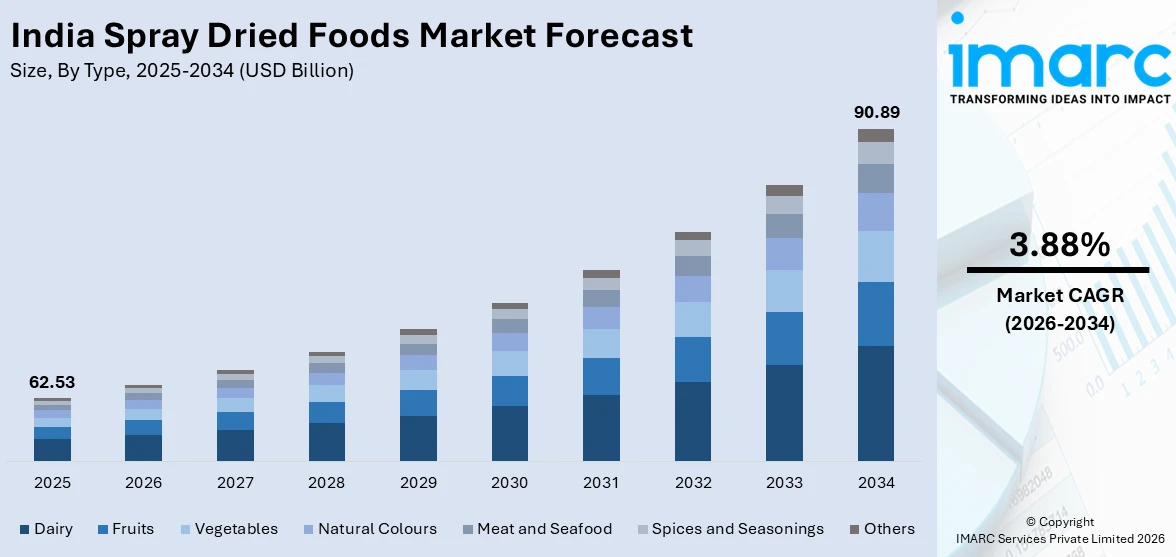
The India spray dried foods market grew from USD 62.53 Billion in 2025 to USD 67.04 Billion in 2026 and is projected to reach USD 90.89 Billion by 2034, growing at a compound annual growth rate of 3.88% from 2026-2034.
India's spray dried foods market is experiencing sustained expansion driven by rapid urbanization, the proliferation of dual-income households, and a growing appetite for convenient, shelf-stable food products. The thriving food processing industry, supported by robust government schemes such as the PMFME and PMKSY, is accelerating value addition across agricultural produce. Rising health consciousness, demand for functional food ingredients in B2B channels, and expanding organized retail infrastructure collectively shape the India spray dried foods market share.
Key Takeaways and Insights:
- By Type: Dairy dominates the market with a share of 68.1% in 2025, owing to India's massive milk production base, well-established cooperative spray drying networks, and extensive applications across infant nutrition, bakery, and confectionery sectors.
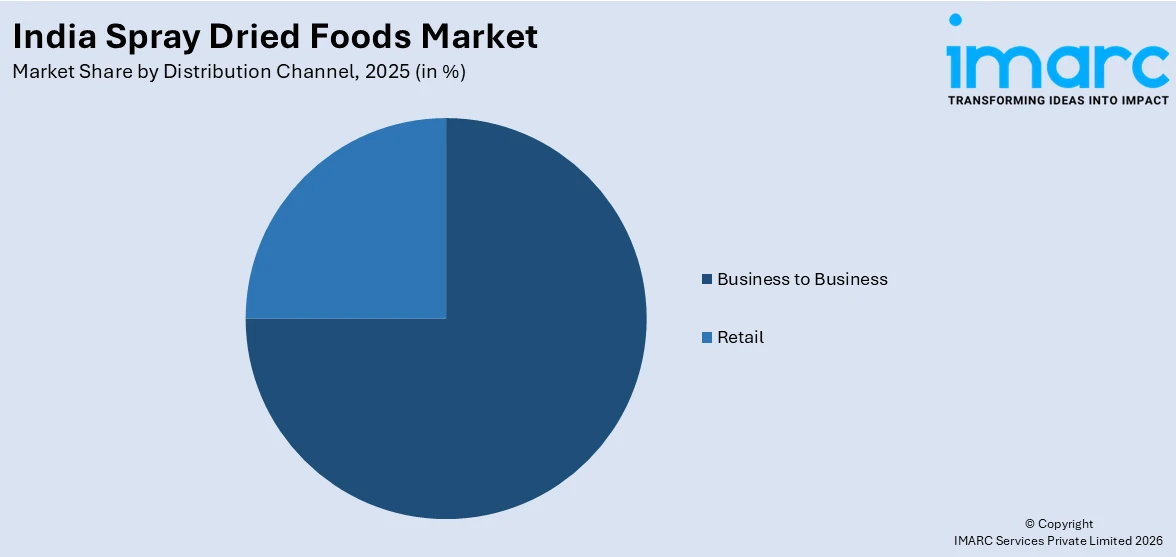
- By Distribution Channel: Business to business leads the market with a share of 72.5% in 2025, driven by large-scale procurement from food manufacturers, bakeries, beverage producers, and institutional food-service operators requiring consistent ingredient supply.
- By Region: West and Central India represents the largest revenue share of 32.5% in 2025, reflecting the region's concentration of organized food processing clusters, dairy cooperatives, and robust industrial and consumer demand.
- Key Players: The India spray dried foods market exhibits a moderately fragmented competitive structure, with established domestic manufacturers and global ingredient suppliers competing across type-specific sub-segments. Players across the value chain are investing in processing technology upgrades and expanding production capacities to meet growing institutional demand.
To get more information on this market Request Sample
India's spray dried foods market occupies a pivotal role in the broader food processing ecosystem, serving as a critical enabler of shelf-stable, nutrient-retaining ingredient supply for a wide spectrum of industries. The market is underpinned by India's status as the world's largest milk-producing nation, providing an abundant feedstock for the dominant dairy spray drying segment. Supportive government initiatives aimed at strengthening the food processing sector are encouraging modernization, capacity expansion, and greater formalization within the spray dried foods industry. These policies are helping small and medium processors adopt improved technologies and enhance value-added food production. At the same time, demand from business-to-business buyers across industries such as bakery, confectionery, nutraceuticals, and instant beverages continues to grow. Changing consumer preferences, rising disposable incomes, and increasing interest in convenient and premium food products are further supporting the long-term expansion of the spray dried foods market in India.
India Spray Dried Foods Market Trends:
Rising Demand for Functional and Fortified Spray Dried Ingredients
Growing consumer emphasis on health and nutrition is prompting food and beverage manufacturers across India to increasingly incorporate functional and fortified spray dried ingredients into their product formulations. Spray dried dairy powders enriched with vitamins and minerals, spray dried fruit powders with antioxidant profiles, and encapsulated bioactives are gaining adoption in nutraceuticals, infant nutrition, and health-supplement applications. The growth of India’s middle-class population is increasing demand for premium and nutrition-focused food products. This shift in consumer preferences is driving consistent demand for high-quality spray-dried ingredients used in the production of convenient, value-added, and fortified food formulations.
Growth of the Instant Beverage and Ready-to-Cook Segment
India's rapidly growing instant beverage and ready-to-cook food segment is emerging as a significant demand driver for spray dried ingredients. Spray dried tea, coffee premixes, dairy whiteners, and flavor-enhancing powders are witnessing strong uptake from both institutional vending operators and household consumers. For instance, in July 2025, Food Empire invested USD 37 million to expand its spray-dried soluble coffee production facility in Andhra Pradesh, increasing capacity by 60%, underscoring strong commercial confidence in India's spray dried instant beverage category. This trend is reinforced by urbanization and the growing prevalence of vending machine culture across workplaces, educational institutions, and transport hubs.
Technological Advancement in Spray Drying Processes
Indian food processors and ingredient manufacturers are increasingly adopting advanced spray drying technologies, including encapsulation, agglomeration, and microencapsulation, to improve product quality, enhance solubility, and extend shelf life. These innovations are particularly valuable for sensitive applications such as probiotic powders, spice oleoresins, and natural colour concentrates, where conventional drying methods fail to preserve volatile compounds. The adoption of SCADA-enabled process monitoring is also gaining traction; in December 2024, Milma's newly established milk powder facility in Malappuram, Kerala, became the first in the state to integrate real-time SCADA systems, setting a benchmark for process precision in cooperative dairy spray drying operations.
Market Outlook 2026-2034:
India’s spray dried foods industry is expected to experience stable growth during the forecast period, driven by several structural demand factors. Rapid urbanization, increasing purchasing power, and the ongoing modernization of the food processing sector are encouraging greater adoption of spray dried ingredients. Food manufacturers are increasingly sourcing these ingredients in bulk to support efficient production. At the same time, expanding applications across segments such as dairy products, instant beverages, nutraceutical formulations, and natural colour solutions are expected to sustain long-term demand and support the market’s continued development. The market generated a revenue of USD 62.53 Billion in 2025, which is expected to reach USD 67.04 Billion in 2026 and further grow to USD 90.89 Billion by 2034, at a compound annual growth rate (CAGR) of 3.88% during 2026-2034.
India Spray Dried Foods Market Report Segmentation:
| Segment Category | Leading Segment | Market Share |
|---|---|---|
|
Type |
Dairy |
68.1% |
|
Distribution Channel |
Business to Business |
72.5% |
|
Region |
West and Central India |
32.5% |
Type Insights:
- Fruits
- Vegetables
- Dairy
- Natural Colours
- Meat and Seafood
- Spices and Seasonings
- Others
Dairy dominates with a market share of 68.1% of the total India spray dried foods market in 2025.
India's outsized dairy segment is anchored in the country's unparalleled milk production infrastructure, with India consistently ranking as the world's leading milk producer. Spray dried dairy products, encompassing skimmed milk powder, whole milk powder, dairy whiteners, and whey, serve as indispensable ingredients across bakery, confectionery, infant formula, beverages, and ice cream manufacturing. The depth and scale of India's cooperative dairy network ensure reliable raw material supply and vertically integrated spray drying capacity. For instance, in January 2024, GCMMF launched Sagar Skimmed Milk Powder across India, reflecting ongoing investment in expanding branded spray dried dairy product reach into new consumer markets.
The dairy segment is supported by the combined momentum of rising domestic consumption and increasing export demand. Growing health awareness among consumers is encouraging the use of high-protein, calcium-rich skimmed milk powders as part of nutritional diets. At the same time, the expansion of organized food service and HORECA establishments is creating steady bulk demand for dairy whiteners and full-cream milk powder. Strong milk availability and well-developed dairy processing infrastructure further support consistent skimmed milk powder production, strengthening long-term raw material security and enabling scalable manufacturing capacity.
Distribution Channel Insights:
Access the comprehensive market breakdown Request Sample
- Business to Business
- Retail
- Offline
- Online
Business to business leads the market with a share of 72.5% of the total India spray dried foods market in 2025.
The B2B distribution channel dominates the India spray dried foods market by commanding the bulk of procurement volumes through industrial and institutional buyers. Food manufacturers, dairy processors, bakeries, confectionery makers, instant beverage producers, and nutraceutical companies purchase spray dried ingredients in large quantities to support continuous production requirements. The scale and operational efficiency of this channel are reinforced by India's expanding organized food processing sector, which the Ministry of Food Processing Industries has supported through capital subsidy schemes under PMKSY, adding 28.48 lakh MT of processing and preservation capacity through 94 operationalized projects in 2025 alone.
B2B procurement is further driven by consistent quality specifications, traceability requirements, and long-term supply agreements that favor established ingredient suppliers over fragmented retail channels. The growing adoption of spray dried premixes in institutional vending machine operations, QSR chains, and airline catering has amplified bulk B2B demand. India's food export growth with processed food exports constituting approximately 20.4% of total agricultural exports of USD 49.4 billion in FY2024-25, is translating into heightened B2B sourcing of export-grade spray dried ingredients from domestic producers.
Regional Insights:
- North India
- West and Central India
- South India
- East India
West and Central India represents the largest share with a 32.5% of total of the India spray dried foods market in 2025.
West and Central India's market leadership is underpinned by the concentration of India's organized food processing and dairy manufacturing clusters in states such as Maharashtra, Gujarat, and Madhya Pradesh. Gujarat, home to GCMMF — the world's largest dairy cooperative — hosts extensive spray drying infrastructure that produces milk powder, skimmed milk powder, and dairy whitener for national distribution and export. Maharashtra's robust food processing industrial zones in Pune and Nashik further anchor the region's position as a hub for high-volume spray dried ingredient manufacturing.
West and Central India also benefits from strong agro-industrial linkages, with proximity to large sugar and fruit processing belts generating consistent feedstocks for spray dried natural colours, fruit powders, and flavour ingredient production. The region's well-developed logistics connectivity and presence of large food conglomerates drive sustained B2B demand. Government support under the Mega Food Park and Agro-Processing Cluster schemes has catalyzed private investment in food processing infrastructure across the region, further reinforcing its dominant position in the spray dried foods market.

Market Dynamics:
Growth Drivers:
Why is the India Spray Dried Foods Market Growing?
Expanding Food Processing Industry and Government Policy Support
India’s food processing sector has become one of the most strongly supported industries in the national economy, creating a favorable environment for the growth of spray dried ingredients. Government-led initiatives focused on strengthening food processing infrastructure, encouraging micro-enterprise development, and expanding manufacturing capabilities are accelerating sectoral modernization. These policy frameworks are enabling small and medium processors to upgrade production technologies and adopt advanced processing methods such as spray drying. As processing capacity expands, institutional demand for spray dried ingredients across bakery, confectionery, dairy, and ready-to-eat product manufacturing continues to strengthen, supporting sustained market growth.
Rising Urbanization, Changing Lifestyles, and Convenience Food Demand
India's rapid urbanization is fundamentally reshaping food consumption patterns in ways highly favorable to spray dried foods. Dual-income households, time-constrained urban schedules, and the growing prevalence of nuclear family structures have elevated demand for convenient, quick-preparation food products that leverage spray dried ingredients, including instant soups, ready-to-cook mixes, dairy whiteners, and flavored beverage premixes. The expanding middle class in India is contributing significantly to the rising demand for branded and packaged food products, supported by improving purchasing power and evolving consumption preferences. This demographic transition is strengthening consistent demand for spray dried food ingredients used across a wide range of processed foods. As consumption of convenience and value-added products increases, both retail and institutional B2B segments are generating steady procurement requirements, reinforcing the long-term growth prospects for spray dried ingredients in the country’s food processing industry.
Growing Export Potential of Processed Food Products
India’s rising prominence as a global exporter of processed foods is creating additional demand for high-quality spray dried ingredients. Strong international interest in processed fruits, vegetables, dairy derivatives, spices, and flavoring ingredients is encouraging manufacturers to expand production of spray dried inputs that offer longer shelf life and easier transport. Government initiatives aimed at strengthening agricultural value chains and improving raw material availability are further supporting ingredient manufacturers. At the same time, global preference for clean-label products and competitively priced natural ingredients is encouraging producers to upgrade processing capabilities, quality standards, and export-oriented manufacturing capacity across the spray dried foods value chain.
Market Restraints:
What Challenges the India Spray Dried Foods Market is Facing?
High Capital Investment Requirements for Spray Drying Infrastructure
Establishing and maintaining spray drying facilities requires substantial upfront capital investment in specialized equipment, energy systems, and quality control infrastructure. These high entry barriers limit market participation to well-capitalized enterprises, restricting competitive depth and capacity expansion pace among small and mid-sized food processors. Energy cost intensity of the spray drying process further elevates operational expenditure, potentially constraining profitability during periods of elevated energy price volatility.
Competition from Alternative Drying Technologies
Spray dried food products face intensifying competition from freeze-dried and vacuum-dried alternatives, which offer superior nutrient retention and product quality characteristics for premium applications. As consumer and industrial buyer willingness to pay for higher-quality preservation methods increases, particularly in nutraceutical and infant nutrition segments, spray drying may cede market share in high-value application tiers, limiting pricing power and long-term margin potential for spray dried ingredient manufacturers.
Fragmented Agricultural Supply Chains and Raw Material Variability
Fragmentation in India’s agricultural supply chain creates challenges in maintaining consistent raw material quality and availability for spray-dried food ingredient production. A large portion of agricultural output comes from small and marginal farms, which can lead to variations in supply reliability and product uniformity. Seasonal fluctuations in the availability of fruits, vegetables, and dairy inputs further contribute to instability in procurement and processing schedules. These conditions increase operational uncertainty for spray-drying facilities, affecting production planning and making it more difficult for manufacturers to consistently meet long-term business contracts with standardized product specifications.
Competitive Landscape:
The India spray dried foods market exhibits a moderately fragmented structure, with a combination of domestic ingredient manufacturers and international companies operating processing facilities within the country. Firms compete across various product categories including dairy powders, fruit and vegetable powders, natural colors, and functional food ingredients. Competitive differentiation is largely based on processing capabilities, consistency in product quality, production scale, and access to reliable raw material supply. Producers focused on dairy ingredients benefit from integrated procurement networks, while those specializing in plant-based powders leverage the country’s agricultural diversity. Rising export demand is also encouraging manufacturers to expand capacity and adopt internationally recognized quality standards.
Recent Developments:
- December 2024: Milma's Malabar Regional Cooperative Milk Producers Union established Kerala's first milk powder production facility in Moorkkanadu, Malappuram, with a daily capacity of 10 metric tonnes. The facility, utilizing spray-drying technology, is the first in Kerala to integrate SCADA-enabled real-time monitoring systems, setting a new benchmark for cooperative dairy processing in South India.
India Spray Dried Foods Market Report Coverage:
| Report Features | Details |
|---|---|
| Base Year of the Analysis | 2025 |
| Historical Period | 2020-2025 |
| Forecast Period | 2026-2034 |
| Units | Billion USD |
| Scope of the Report |
Exploration of Historical Trends and Market Outlook, Industry Catalysts and Challenges, Segment-Wise Historical and Future Market Assessment:
|
| Types Covered | Fruits, Vegetables, Dairy, Natural Colours, Meat and Seafood, Spices and Seasonings, Others |
| Distribution Channels Covered |
|
| Region Covered | North India, East India, West and Central India, South India |
| Customization Scope | 10% Free Customization |
| Post-Sale Analyst Support | 10-12 Weeks |
| Delivery Format | PDF and Excel through Email (We can also provide the editable version of the report in PPT/Word format on special request) |
Frequently Asked Questions About the India Spray Dried Foods Market Report
The India spray dried foods market size increased from USD 62.53 Billion in 2025 to USD 67.04 Billion in 2026.
The India spray dried foods market is expected to grow at a compound annual growth rate of 3.88% from 2026-2034 to reach USD 90.89 Billion by 2034.
Dairy held the largest share in the India spray dried foods market, accounting for 68.1% of total market revenue in 2025, driven by India's massive milk production infrastructure, established cooperative spray drying networks, and diverse B2B applications across bakery, infant nutrition, confectionery, and beverages.
Key factors driving the India spray dried foods market include the expansion of India's food processing industry supported by government schemes like PMFME and PLISFPI, rising urbanization and demand for convenient food products, growing B2B ingredient procurement from food manufacturers, expanding processed food export volumes, and increasing adoption of functional and fortified spray dried ingredients.
Major challenges include high capital investment requirements for spray drying infrastructure, competition from alternative drying technologies such as freeze drying and vacuum drying, fragmented agricultural supply chains leading to raw material variability, energy cost intensity of spray drying operations, and maintaining consistent product quality standards for B2B and export requirements.
Need more help?
- Speak to our experienced analysts for insights on the current market scenarios.
- Include additional segments and countries to customize the report as per your requirement.
- Gain an unparalleled competitive advantage in your domain by understanding how to utilize the report and positively impacting your operations and revenue.
- For further assistance, please connect with our analysts.
 Request Customization
 Speak to an Analyst
 Request Brochure
 Inquire Before Buying
Benefits of Customization
- Personalize this research
- Triangulate with your data
- Get data as per your format and definition
- Gain a deeper dive into a specific application, geography, customer, or competitor
- Any level of personalization
Get in Touch With Us
UNITED STATES
Phone: +1-201-971-6302
INDIA
Phone: +91-120-433-0800
UNITED KINGDOM
Phone: +44-753-714-6104
Email: [email protected]
Client Testimonials




.webp)




.webp)













Related Reports

Choose your plan
*Please note that the prices mentioned below are starting prices for each bundle type. Kindly contact our team for further details.*
Single User License
- 1 User License, Access on 2 Devices
- PDF Report + Excel Dataset (Password Protected)
- Lifetime Access
- No Printing Rights
- 10% Free Report Customization
- 10–12 Weeks of Analyst Support
Five User License
- Access for 5 Users, 2 Devices per User
- PDF Report + Excel Dataset (Password Protected)
- Lifetime Access
- Dedicated Account Manager
- 12–14 Weeks of Analyst Support
- No Printing Rights
- 15% Free Report Customization
- 25% Discount on Your Next Purchase
Corporate User License
- Unlimited User Access (Within Your Organization)
- PDF Report + Excel Dataset
- Lifetime Access
- Dedicated Account Manager
- 14–20 Weeks of Analyst Support
- No Printing Rights
- 20% Free Report Customization
- 30% Discount on Your Next Purchase
Essential Insights
What's included:
3 reports
- Lifetime Access
- PDF Reports
- Excel Datasets
- 2 Weeks of Free Analyst Support
- 2 User Licenses
- Access on 2 Devices
- Printing Rights
- Complimentary PowerPoint (PPT) Version
- Complimentary License Upgrade
Professional Access
What's included:
5 reports
- Lifetime Access
- PDF Reports
- Excel Datasets
- 8 Weeks of Free Analyst Support
- 2 User Licenses
- Access on 2 Devices
- Printing Rights
- Complimentary PowerPoint (PPT) Version
- Complimentary License Upgrade
Business Advantage
What's included:
8 reports
- Lifetime Access
- PDF Reports
- Excel Datasets
- 14 Weeks of Free Analyst Support
- 2 User Licenses
- Access on 2 Devices
- Printing Rights
- Complimentary PowerPoint (PPT) Version
- Complimentary License Upgrade
Enterprise Intelligence
What's included:
10 reports
- Lifetime Access
- PDF Reports
- Excel Datasets
- 20 Weeks of Free Analyst Support
- 2 User Licenses
- Access on 2 Devices
- Printing Rights
- Complimentary PowerPoint (PPT) Version
- Complimentary License Upgrade