
India Supply Chain Analytics Market Size, Share, Trends and Forecast by Component, Deployment Mode, Enterprise Size, Industry Vertical, and Region, 2026-2034
India Supply Chain Analytics Market Summary:
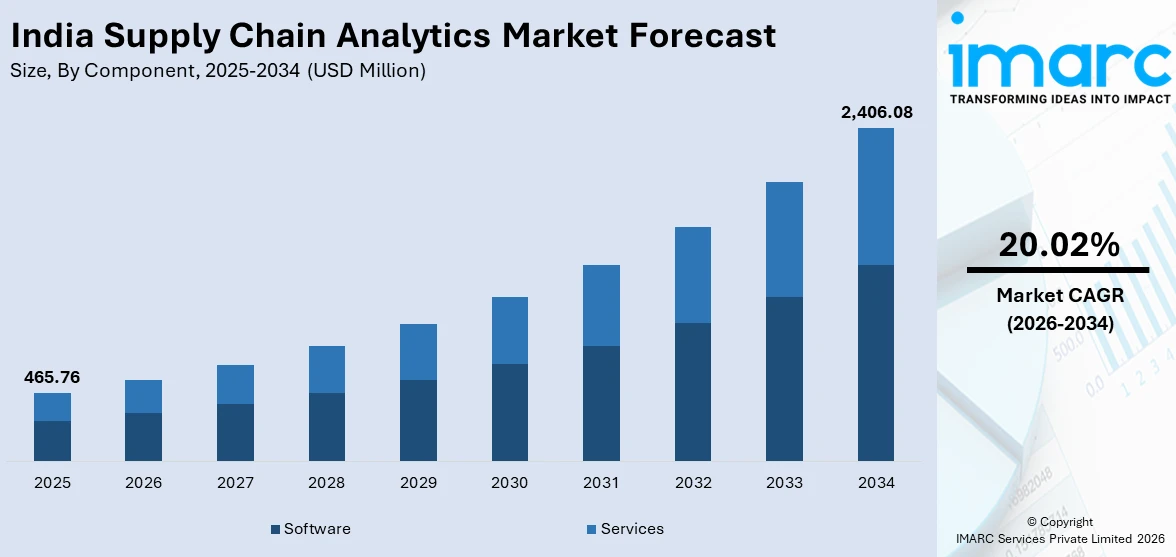
The India supply chain analytics market size was valued at USD 465.76 Million in 2025 and is projected to reach USD 2,406.08 Million by 2034, growing at a compound annual growth rate of 20.02% from 2026-2034.
The India supply chain analytics market is expanding rapidly as enterprises across diverse industries prioritize data-driven decision-making to navigate increasingly complex supply chain networks. Rising adoption of artificial intelligence, machine learning, and cloud-based platforms is enabling organizations to enhance operational visibility, optimize inventory management, and strengthen demand forecasting capabilities. Government-backed digital transformation programs, the growing e-commerce ecosystem, and diverse manufacturing operations are further accelerating the integration of advanced analytics solutions, thereby expanding the India supply chain analytics market share.
Key Takeaways and Insights:
- By Component: Software dominates the market with a share of approximately 64% in 2025, driven by the rising enterprise demand for integrated analytics platforms that deliver real-time supply chain visibility, predictive demand insights, and automated decision-support capabilities.
- By Deployment Mode: Cloud-based deployment leads the market with a share of approximately 65% in 2025, owing to its scalability, cost-efficiency, and seamless integration with enterprise resource planning systems that enable businesses to access analytics on demand.
- By Enterprise Size: Large enterprises hold the largest share at approximately 54% in 2025, reflecting their complex multi-tier supply chains and significant investment capacity for adopting advanced analytics and AI-powered optimization tools.
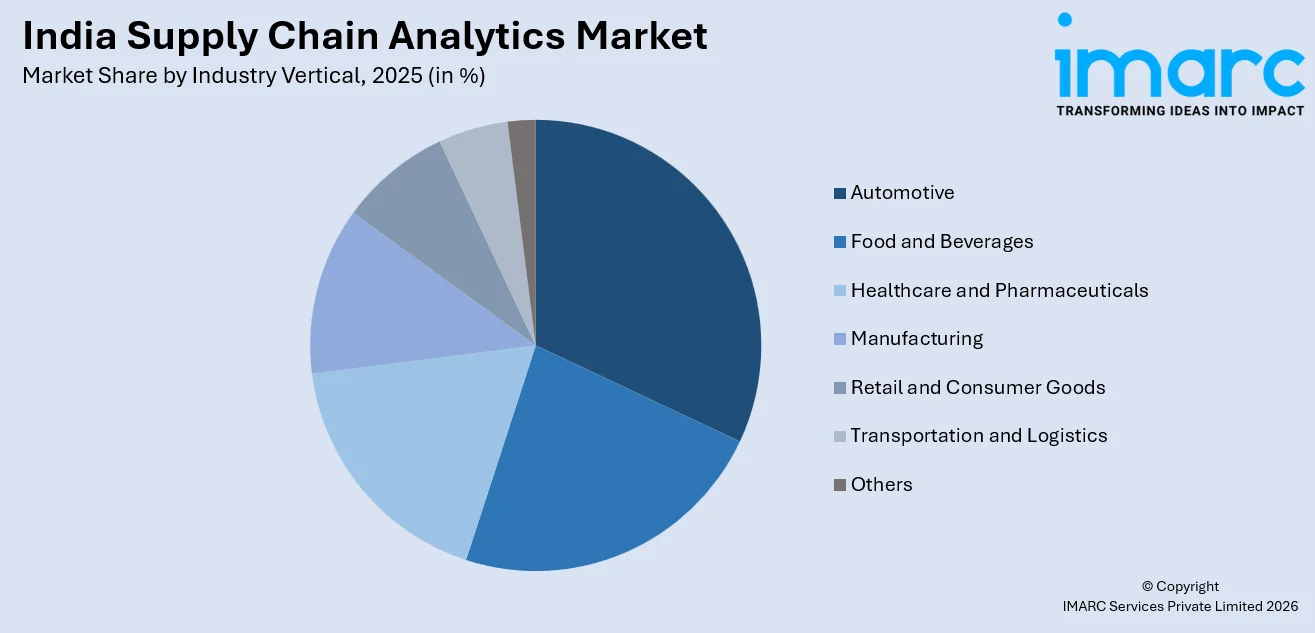
- By Industry Vertical: Automotive accounts for the largest share at approximately 18% in 2025, supported by just-in-time manufacturing requirements, intricate supplier networks, and increasing integration of predictive analytics for production planning and logistics coordination.
- By Region: North India represents the largest regional segment with approximately 30% market share in 2025, underpinned by the concentration of major industrial corridors, technology hubs, and enterprise headquarters in the Delhi-NCR region and surrounding states.
- Key Players: The India supply chain analytics market features intense competition among global technology firms and domestic IT service providers, all investing in AI-driven platforms, cloud-native architectures, strategic partnerships, and vertical-specific solutions to strengthen market positioning and capture enterprise adoption.
To get more information on this market Request Sample
The supply chain analytics industry in India is moving forward with entities from various industries such as manufacturing, retail, automobile, and healthcare adopting data-driven approaches for supply chain transformation. A combination of these technologies such as artificial intelligence, cloud computing, and Internet of Things (IoT) technologies is fueling innovations ranging from procurement to tracking. In the year 2024, Google invested almost $350 million in Flipkart. Google promoted itself to become a prominent backer of this Indian e-commerce business owned by Walmart. The manufacturer of Android devices also agreed to provide Flipkart with cloud services. The investment from Google forms part of an almost $1 billion round of funding that Flipkart announced in the year 2023. Walmart has proceeded to lead the funding round, adding $600 million to the round at the end of last year. (Microsoft also invests in the company). Government initiatives such as the "Make in India" and the "Production Linked Incentive" strategy have resulted in robust demand for analytics solutions that improve supply chain visibility. In addition to the expansion of the e-commerce space and the growth of exports, increasing sophistication of the logistics space has resulted in the requirement for supply chain intelligence solutions.
India Supply Chain Analytics Market Trends:
Integration of Generative AI and Agentic Intelligence in Supply Chain Operations
Indian enterprises are increasingly embedding generative AI and agentic intelligence into their supply chain workflows to automate complex decision-making and improve operational agility. These AI systems can independently analyze multi-source data, generate scenario-based recommendations, and execute actions across procurement, planning, and logistics processes. This comprehensive outlook is similarly showcased in NITI Aayog's report, AI for Inclusive Societal Development (October 2025). The report illustrates how AI can enable India’s 490 million informal workers by enhancing access to healthcare, education, skill development, and financial inclusion.
Rapid Expansion of Cloud-Native Analytics Platforms
The shift toward cloud-native supply chain analytics platforms is gaining significant momentum across Indian industries as organizations seek scalable, subscription-based solutions that eliminate heavy upfront infrastructure costs. Cloud deployment enables seamless integration with enterprise resource planning systems, real-time data processing, and remote accessibility across distributed supply chain networks. For instance, in 2024, HCLTech announced a strategic collaboration with SAP to enhance innovation and accelerate the adoption of generative AI for supply chain management through cloud-based solutions, emphasizing the growing enterprise appetite for flexible digital platforms.
Rising Adoption of Predictive Analytics for Supply Chain Risk Mitigation
Predictive analytics is emerging as a critical capability for Indian businesses seeking to anticipate disruptions, manage supplier risks, and optimize inventory across volatile global trade environments. Enterprises are leveraging machine learning models to forecast demand fluctuations, detect anomalies in logistics performance, and proactively address potential bottlenecks. For instance, in March 2024, the Government of India launched the IndiaAI Mission with an allocation of approximately USD 1.25 billion over five years to accelerate AI ecosystem development, including applications in supply chain optimization, precision agriculture, and industrial analytics.
Market Outlook 2026-2034:
India's supply chain analytics market is poised for robust expansion, driven by accelerating digital transformation, expanding manufacturing ecosystems, and growing enterprise investment in AI-powered intelligence platforms. The market generated a revenue of USD 465.76 Million in 2025 and is projected to reach a revenue of USD 2,406.08 Million by 2034, growing at a compound annual growth rate of 20.02% from 2026-2034. Rising cloud adoption among small and medium-sized enterprises, increasing complexity of multi-tier supply networks, and government-backed digital infrastructure programs are expected to sustain strong demand for advanced analytics solutions across industry verticals. The growing integration of generative AI, agentic intelligence, and digital twin technologies into supply chain workflows is expected to unlock new levels of operational visibility and autonomous decision-making. As enterprises across automotive, pharmaceuticals, retail, and logistics sectors deepen their investments in predictive and prescriptive analytics capabilities, the market is expected to witness sustained high-growth momentum throughout the forecast period.
India Supply Chain Analytics Market Report Segmentation:
|
Segment Category |
Leading Segment |
Market Share |
|
Component |
Software |
64% |
|
Deployment Mode |
Cloud-based |
65% |
|
Enterprise Size |
Large Enterprises |
54% |
|
Industry Vertical |
Automotive |
18% |
|
Region |
North India |
30% |
Component Insights:
- Software
- Demand Analysis and Forecasting
- Supplier Performance Analytics
- Spend and Procurement Analytics
- Inventory Analytics
- Transportation and Logistics Analytics
- Services
- Professional
- Support and Maintenance
Software dominates with a market share of 64% of the total India supply chain analytics market in 2025.
The software segment’s dominance reflects the growing preference among Indian enterprises for integrated analytics platforms that consolidate demand forecasting, inventory optimization, supplier performance monitoring, and logistics planning into unified solutions. Organizations across automotive, retail, and manufacturing sectors are increasingly deploying AI-enabled software tools to automate routine procurement decisions, improve demand prediction accuracy, and enhance real-time visibility across multi-tier supply networks. The shift from standalone legacy systems to cloud-native software suites is further strengthening adoption, as enterprises seek scalable platforms capable of processing vast volumes of transactional and operational data generated across complex supply chain ecosystems. The ability of modern analytics software to deliver prescriptive recommendations and automated workflow execution is becoming a critical differentiator for businesses navigating volatile market conditions.
Continuous innovation in machine learning algorithms, natural language processing interfaces, and embedded business intelligence capabilities is expanding the functional depth of supply chain analytics software. Indian IT firms and global technology providers are actively developing vertical-specific solutions tailored to industries such as pharmaceuticals, consumer goods, and automotive manufacturing, enabling more granular and actionable insights that drive operational efficiency and competitive advantage. The incorporation of generative AI copilots and agentic decision-support features within analytics software is further enhancing user experience, enabling supply chain professionals to interact with complex datasets through conversational interfaces and receive context-aware recommendations in real time. These advancements are broadening the addressable user base beyond technical specialists to include operational managers and business leaders across enterprise functions.
Deployment Mode Insights:
- On-premises
- Cloud-based
Cloud-based leads with a share of 65% of the total India supply chain analytics market in 2025.
Cloud-based analytics deployment has become the preferred model for Indian enterprises seeking agility, cost-effectiveness, and rapid scalability in their supply chain operations. The subscription-based pricing structure eliminates the need for significant upfront capital expenditure, making advanced analytics accessible to organizations of varying sizes. Cloud platforms enable real-time data synchronization across geographically dispersed operations, facilitate seamless integration with third-party logistics providers, and support remote collaboration among supply chain stakeholders. The ability to rapidly deploy analytics modules, scale computing resources on demand, and access continuous software updates without service disruptions is positioning cloud-based solutions as the foundational architecture for modern supply chain intelligence across Indian industries.
The growing maturity of India’s cloud infrastructure, expansion of hyperscale data centers, and increasing enterprise confidence in cloud security frameworks are further accelerating this shift. Small and medium-sized enterprises are particularly benefiting from cloud deployment, as it allows them to leverage sophisticated analytics capabilities previously available only to large corporations, thereby democratizing access to supply chain intelligence across the Indian business landscape. The integration of edge computing with cloud analytics is also emerging as a significant trend, enabling organizations to process time-sensitive supply chain data closer to operational points while maintaining centralized visibility and governance through cloud-based platforms. Multi-cloud and hybrid deployment strategies are gaining traction as enterprises seek to optimize performance, ensure redundancy, and maintain compliance with evolving data sovereignty regulations.
Enterprise Size Insights:
- Large Enterprises
- Small and Medium-sized Enterprises
Large enterprises exhibit a clear dominance with a 54% share of the total India supply chain analytics market in 2025.
Large enterprises account for the majority of supply chain analytics adoption in India, driven by the complexity of their multi-tier supplier networks, high transaction volumes, and extensive distribution operations. These organizations possess the financial capacity and technical infrastructure necessary to implement comprehensive, enterprise-wide analytics platforms that integrate planning, procurement, manufacturing, and logistics functions. The need for real-time visibility across global sourcing operations and compliance with international trade regulations further necessitates advanced analytics investment. Large enterprises are also at the forefront of deploying control tower solutions and digital twin technologies that provide a centralized, real-time view of supply chain performance, enabling proactive identification and resolution of disruptions before they escalate into operational bottlenecks or customer service failures.
Major Indian conglomerates and multinational corporations operating in the country are deploying AI-powered analytics to optimize working capital, reduce inventory carrying costs, and enhance supplier collaboration. The integration of digital twin technologies, control tower solutions, and prescriptive analytics is enabling large enterprises to simulate supply chain scenarios, anticipate disruptions, and make data-driven strategic decisions at scale. These organizations are also increasingly investing in sustainability analytics to track and reduce carbon emissions across their supply chain networks, driven by growing regulatory requirements and stakeholder expectations for environmental transparency. The ability of large enterprises to fund pilot programs and scale successful analytics implementations across global operations positions them as the primary driver of innovation and adoption within the India supply chain analytics market.
Industry Vertical Insights:
Access the comprehensive market breakdown Request Sample
- Automotive
- Food and Beverages
- Healthcare and Pharmaceuticals
- Manufacturing
- Retail and Consumer Goods
- Transportation and Logistics
- Others
Automotive leads with a share of 18% of the total India supply chain analytics market in 2025.
The automotive industry leads vertical adoption of supply chain analytics in India, reflecting the sector’s reliance on just-in-time production systems, complex multi-tier supplier ecosystems, and stringent quality requirements. Automakers and tier-one suppliers are leveraging predictive analytics to optimize parts procurement, reduce production downtime, and improve logistics coordination across assembly plants and distribution networks. The ongoing transition toward electric vehicle manufacturing is creating additional complexity that necessitates advanced analytics for battery sourcing, new component integration, and reconfigured supply chains. Furthermore, the increasing globalization of automotive supply networks and the need to manage geopolitical risks, raw material price volatility, and regulatory compliance across multiple jurisdictions are driving deeper adoption of scenario planning and risk analytics tools among automotive enterprises operating in India.
India’s automotive sector is also benefiting from government initiatives such as the Production Linked Incentive scheme for automobiles and auto components, which is encouraging domestic manufacturing expansion and attracting global supply chain investments. The integration of IoT sensors, telematics data, and advanced machine learning (ML) models is enabling automotive companies to achieve end-to-end supply chain transparency, predictive maintenance of logistics assets, and real-time demand responsiveness. Connected vehicle technologies and smart factory implementations are generating massive volumes of operational data, further intensifying the need for analytics platforms capable of processing, contextualizing, and acting upon real-time information streams across the entire automotive value chain from raw material sourcing to dealer distribution networks.
Regional Insights:
- North India
- West and Central India
- South India
- East and Northeast India
North India exhibits a clear dominance with a 30% share of the total India supply chain analytics market in 2025.
North India’s leadership in the supply chain analytics market is underpinned by the concentration of major corporate headquarters, industrial corridors, and technology parks in the Delhi-NCR region, Uttar Pradesh, and Haryana. The region hosts a significant share of India’s manufacturing, automotive, and consumer goods enterprises, all of which are actively investing in digital supply chain capabilities. The presence of well-established logistics networks, dedicated freight corridors, and proximity to major consumption centers creates strong demand for analytics solutions that optimize distribution, warehouse management, and last-mile delivery. The Delhi-NCR region’s status as a technology and innovation hub attracts a high concentration of analytics talent, system integrators, and consulting firms, further supporting the ecosystem for supply chain analytics deployment and ongoing optimization across the northern industrial belt.
Additionally, the expansion of government-led infrastructure projects, including the Delhi-Mumbai Industrial Corridor and the Eastern Dedicated Freight Corridor, is creating new opportunities for supply chain analytics providers to support industrial planning, logistics optimization, and trade facilitation. The growing establishment of technology centers and Global Capability Centers in the region is further strengthening the analytics talent pool and accelerating innovation in supply chain intelligence. The development of multi-modal logistics parks and inland container depots across northern states is also increasing the complexity and scale of supply chain operations, generating strong demand for analytics tools that can coordinate and optimize freight movement, inventory positioning, and demand fulfillment across interconnected transportation and warehousing networks within the region.

Market Dynamics:
Growth Drivers:
Why is the India Supply Chain Analytics Market Growing?
Accelerating Digital Transformation Across Indian Enterprises
India is experiencing a sweeping wave of digital transformation as enterprises across sectors prioritize the modernization of legacy supply chain systems. The convergence of Industry 4.0 technologies, including the IoT, robotic process automation, and advanced analytics, is reshaping how organizations manage procurement, production, and distribution workflows. Businesses are recognizing that data-driven supply chain management is essential for maintaining competitiveness in an increasingly globalized economy. The Indian government's Digital India initiative and related programs have created a supportive policy environment for enterprise digitalization. The push for cashless transactions, digital trade documentation, and connected logistics networks is encouraging organizations to invest in analytics infrastructure that can process large volumes of operational data. As supply chains become more interconnected and data-intensive, the demand for sophisticated analytics platforms that provide actionable insights continues to intensify. In 2025, Commerce and Industry Minister unveiled a trade intelligence portal designed to assist stakeholders in tracking and assessing the use of free trade agreements (FTA) that have been signed, mapping global demand trends, overseeing global supply chains, pinpointing emerging products, identifying export opportunities, and facilitating prompt strategic actions. The platform offers immediate, engaging insights on India and international trade, commodities and sector analytics, market intelligence featuring export potentials and competitor evaluations. The portal features automated trade reports and monitors trade trends for sectors linked to production incentives (PLI) and essential minerals.
Expanding Manufacturing and Industrial Base Under Government Initiatives
India's manufacturing sector is undergoing significant expansion, driven by government programs such as Make in India and the Production Linked Incentive scheme, which aim to position the country as a global manufacturing hub. As domestic and multinational firms scale up production facilities across electronics, pharmaceuticals, automotive, and chemicals sectors, the complexity of supply chain operations increases substantially, necessitating advanced analytics for supplier management, inventory optimization, and logistics coordination. The establishment of industrial corridors, dedicated freight corridors, and special economic zones is further amplifying the need for analytics solutions that support site selection, capacity planning, and multi-modal transportation optimization. As India's share of global manufacturing output grows, enterprises are investing in end-to-end supply chain analytics to achieve the visibility, agility, and cost-efficiency required to compete on the international stage. In 2025, Esri India, a Geographic Information Systems (GIS) company, unveiled “Bharat ENVI,” a new software for image processing and analysis aimed at broadening access to satellite data analytics for organizations nationwide.
Rapid Growth of E-Commerce and Omnichannel Fulfillment Networks
India's e-commerce sector is expanding at an extraordinary pace, with hundreds of millions of online shoppers driving unprecedented demand for agile and responsive supply chain systems. The proliferation of online marketplaces, quick-commerce platforms, and direct-to-consumer brands is creating complex fulfillment requirements that span warehousing, inventory management, last-mile delivery, and returns processing. These dynamics are compelling retailers and logistics providers to adopt advanced analytics solutions. The need for real-time demand sensing, dynamic inventory allocation, and route optimization across distributed fulfillment networks is a powerful catalyst for supply chain analytics adoption. E-commerce companies are also leveraging analytics to manage seasonal demand surges, optimize seller onboarding, and improve customer satisfaction through faster delivery and accurate order tracking. The continued penetration of e-commerce into tier-two and tier-three cities is further expanding the geographic scope and analytical complexity of supply chain operations. IMARC Group predicts that the India e-commerce market is projected to attain USD 651.10 Billion by 2034.
Market Restraints:
What Challenges the India Supply Chain Analytics Market is Facing?
Shortage of Skilled Analytics Professionals
The India supply chain analytics market faces a significant constraint in the limited availability of professionals who combine deep supply chain domain expertise with advanced data science and AI skills. While India possesses a large technology workforce, the intersection of supply chain management knowledge and analytics proficiency remains relatively narrow, creating talent bottlenecks that slow enterprise-wide implementation and limit the ability of organizations to fully leverage their analytics investments.
Data Integration Challenges Across Fragmented Systems
Many Indian enterprises operate with fragmented IT landscapes comprising legacy enterprise resource planning systems, disparate warehouse management solutions, and siloed departmental databases. Integrating these heterogeneous data sources into a unified analytics platform presents considerable technical and organizational challenges, often resulting in delayed implementations, incomplete data visibility, and suboptimal analytics outcomes that limit the potential value of supply chain intelligence investments.
Data Privacy and Security Concerns
Growing regulatory scrutiny around data privacy, coupled with rising cybersecurity threats, presents challenges for supply chain analytics adoption in India. Organizations handling sensitive supplier, customer, and logistics data must navigate evolving compliance requirements, including India's Digital Personal Data Protection Act, while ensuring robust security frameworks across cloud-based analytics environments. These concerns can slow adoption, particularly among risk-averse industries such as healthcare and financial services.
Competitive Landscape:
The India supply chain analytics market is characterized by intense competition among global enterprise software providers and domestic technology firms. Market participants are differentiating through investments in AI-powered capabilities, cloud-native platform architectures, and industry-specific solution templates. Strategic partnerships between technology companies and system integrators are enabling broader market reach and faster implementation cycles. Companies are also competing on the strength of their consulting and managed services offerings, as enterprises increasingly seek end-to-end support for analytics-driven supply chain transformation. The market landscape continues to evolve as mergers, acquisitions, and technology alliances reshape competitive dynamics.
Recent Developments:
- In April 2025, Bosch has introduced its Supply Chain Studio, a cloud platform aimed at optimizing India's disjointed logistics processes. The declaration was made at the company's inaugural Mobility Platform and Solutions (MPS) Summit 2025 in Bengaluru. The updated platform provides digital tools for transport reservations, inventory control, and B2B distribution, tackling shortcomings in India’s supply chain system, which continues to depend on manual methods and lacks immediate visibility.
India Supply Chain Analytics Market Report Coverage:
| Report Features | Details |
|---|---|
| Base Year of the Analysis | 2025 |
| Historical Period | 2020-2025 |
| Forecast Period | 2026-2034 |
| Units | Million USD |
| Scope of the Report | Exploration of Historical Trends and Market Outlook, Industry Catalysts and Challenges, Segment-Wise Historical and Future Market Assessment:
|
| Components Covered |
|
| Deployment Modes Covered | On-premises, Cloud-based |
| Enterprise Sizes Covered | Large Enterprises, Small and Medium-sized Enterprises |
| Industry Verticals Covered | Automotive, Food and Beverages, Healthcare and Pharmaceuticals, Manufacturing, Retail and Consumer Goods, Transportation and Logistics, Others |
| Regions Covered | North India, West and Central India, South India, East and Northeast India |
| Customization Scope | 10% Free Customization |
| Post-Sale Analyst Support | 10-12 Weeks |
| Delivery Format | PDF and Excel through Email (We can also provide the editable version of the report in PPT/Word format on special request) |
Frequently Asked Questions About the India Supply Chain Analytics Market Report
The India supply chain analytics market size was valued at USD 465.76 Million in 2025.
The market is expected to grow at a compound annual growth rate of 20.02% from 2026-2034 to reach USD 2,406.08 Million by 2034.
Software, holding the largest market share of 64% in 2025, remains pivotal for India's supply chain analytics adoption, providing integrated demand forecasting, inventory optimization, and logistics planning capabilities that drive enterprise-wide operational efficiency.
Key factors driving the India supply chain analytics market include accelerating digital transformation across enterprises, expanding manufacturing under government initiatives, rapid e-commerce growth, rising AI and cloud adoption, and increasing complexity of multi-tier supply networks.
Major challenges include a shortage of skilled analytics professionals, data integration difficulties across fragmented legacy systems, evolving data privacy regulations, cybersecurity concerns, and limited analytics readiness among small and medium-sized enterprises.
Need more help?
- Speak to our experienced analysts for insights on the current market scenarios.
- Include additional segments and countries to customize the report as per your requirement.
- Gain an unparalleled competitive advantage in your domain by understanding how to utilize the report and positively impacting your operations and revenue.
- For further assistance, please connect with our analysts.
 Request Customization
 Speak to an Analyst
 Request Brochure
 Inquire Before Buying
Benefits of Customization
- Personalize this research
- Triangulate with your data
- Get data as per your format and definition
- Gain a deeper dive into a specific application, geography, customer, or competitor
- Any level of personalization
Get in Touch With Us
UNITED STATES
Phone: +1-201-971-6302
INDIA
Phone: +91-120-433-0800
UNITED KINGDOM
Phone: +44-753-714-6104
Email: [email protected]
Client Testimonials




.webp)




.webp)













Related Reports

Choose your plan
*Please note that the prices mentioned below are starting prices for each bundle type. Kindly contact our team for further details.*
Single User License
- 1 User License, Access on 2 Devices
- PDF Report + Excel Dataset (Password Protected)
- Lifetime Access
- No Printing Rights
- 10% Free Report Customization
- 10–12 Weeks of Analyst Support
Five User License
- Access for 5 Users, 2 Devices per User
- PDF Report + Excel Dataset (Password Protected)
- Lifetime Access
- Dedicated Account Manager
- 12–14 Weeks of Analyst Support
- No Printing Rights
- 15% Free Report Customization
- 25% Discount on Your Next Purchase
Corporate User License
- Unlimited User Access (Within Your Organization)
- PDF Report + Excel Dataset
- Lifetime Access
- Dedicated Account Manager
- 14–20 Weeks of Analyst Support
- No Printing Rights
- 20% Free Report Customization
- 30% Discount on Your Next Purchase
Essential Insights
What's included:
3 reports
- Lifetime Access
- PDF Reports
- Excel Datasets
- 2 Weeks of Free Analyst Support
- 2 User Licenses
- Access on 2 Devices
- Printing Rights
- Complimentary PowerPoint (PPT) Version
- Complimentary License Upgrade
Professional Access
What's included:
5 reports
- Lifetime Access
- PDF Reports
- Excel Datasets
- 8 Weeks of Free Analyst Support
- 2 User Licenses
- Access on 2 Devices
- Printing Rights
- Complimentary PowerPoint (PPT) Version
- Complimentary License Upgrade
Business Advantage
What's included:
8 reports
- Lifetime Access
- PDF Reports
- Excel Datasets
- 14 Weeks of Free Analyst Support
- 2 User Licenses
- Access on 2 Devices
- Printing Rights
- Complimentary PowerPoint (PPT) Version
- Complimentary License Upgrade
Enterprise Intelligence
What's included:
10 reports
- Lifetime Access
- PDF Reports
- Excel Datasets
- 20 Weeks of Free Analyst Support
- 2 User Licenses
- Access on 2 Devices
- Printing Rights
- Complimentary PowerPoint (PPT) Version
- Complimentary License Upgrade