
India Sustainable Packaging Market Size, Share, Trends and Forecast by Material, Type, Packaging Format, Process, Application, and Region, 2026-2034
India Sustainable Packaging Market Size, Share, Trends & Forecast (2026-2034)
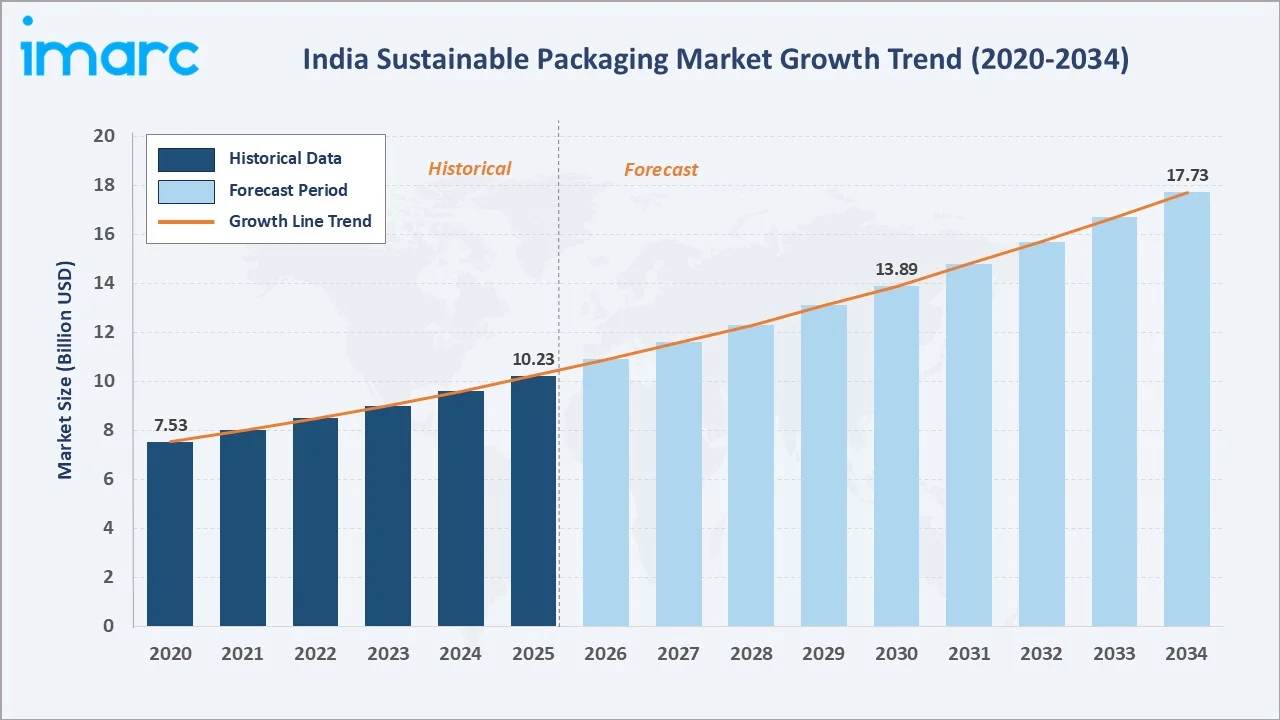
The India sustainable packaging market grew from USD 10.23 Billion in 2025 to USD 10.87 Billion in 2026 and is projected to reach USD 17.73 Billion by 2034, expanding at a CAGR of 6.31% during 2026-2034. Stringent regulatory mandates including Extended Producer Responsibility (EPR) and recycled content norms, rising corporate and consumer demand for eco-friendly alternatives, and government-backed R&D initiatives such as the CSIR National Mission on Sustainable Packaging Solutions are the primary growth catalysts.
Market Snapshot
|
Metric |
Value |
|
Base Year Market Size (2025) |
USD 10.23 Billion |
| Market Size (2026) | USD 10.87 Billion |
|
Forecast Market Size (2034) |
USD 17.73 Billion |
|
CAGR (2026-2034) |
6.31% |
|
Base Year |
2025 |
|
Historical Period |
2020-2025 |
|
Forecast Period |
2026-2034 |
West and Central India leads the national sustainable packaging landscape, holding a 33.8% share in 2025, anchored by the region's concentration of FMCG manufacturing and packaging conversion capacity. Paper and paperboard commands the largest share of the material segment at 38.6%, reflecting sustained demand across food and beverage, personal care, and e-commerce applications amid regulatory pressure to phase out single-use plastics.
To get more information on this market, Request Sample
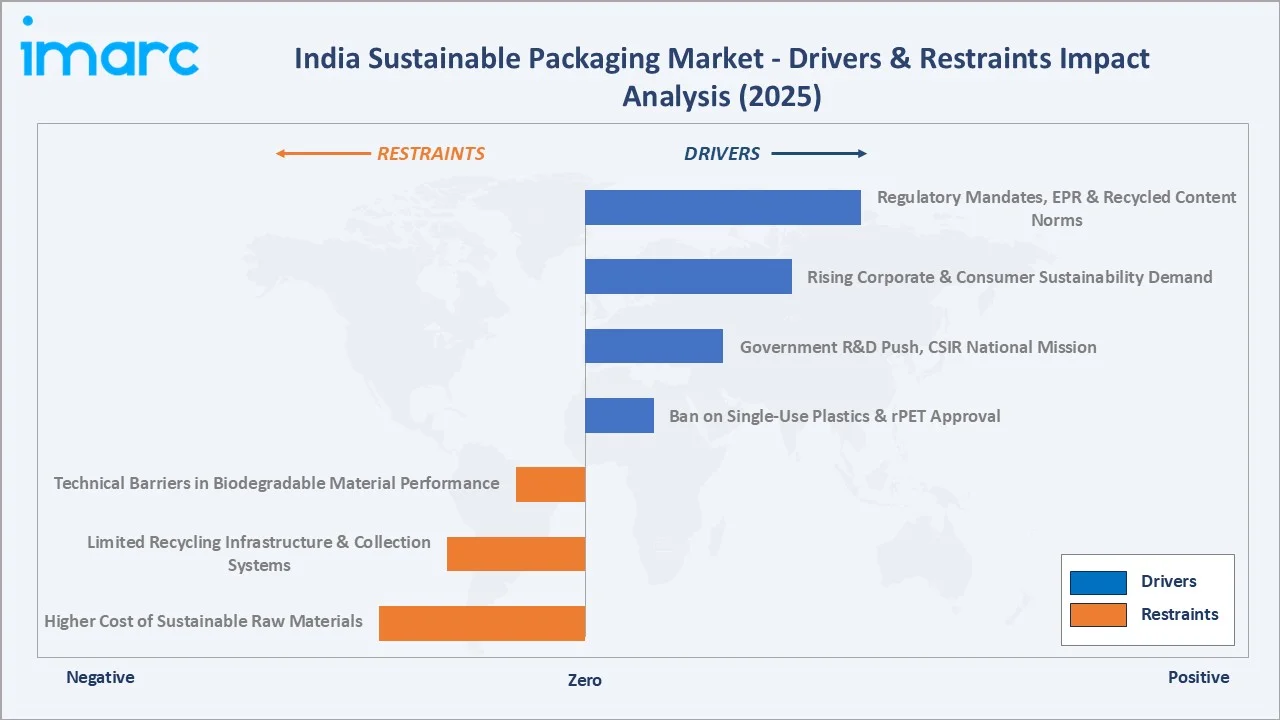
The India sustainable packaging market is underpinned by three structural forces: regulatory mandates on recycled content and Extended Producer Responsibility, rising corporate and consumer sustainability demand, and government-backed R&D initiatives promoting biodegradable materials. Each force independently reinforces category growth, sustaining steady CAGR expansion through 2034 despite the higher cost of sustainable raw materials relative to conventional packaging.
Executive Summary
The India sustainable packaging market is experiencing robust expansion, driven by regulatory mandates on recycled content, rising corporate and consumer demand for eco-friendly alternatives, and government-backed R&D initiatives. The market expanded from USD 10.23 Billion in 2025 to USD 10.87 Billion in 2026 and is forecast to reach USD 17.73 Billion by 2034, growing at a CAGR of 6.31%.
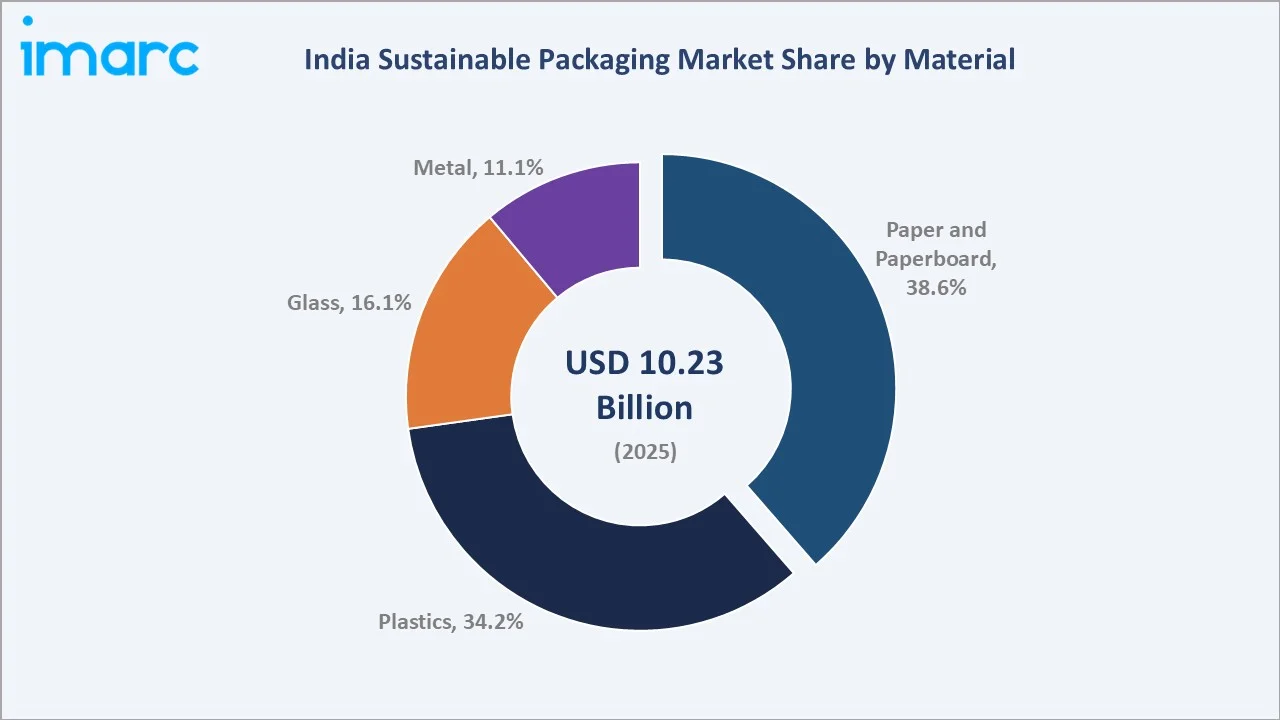
Paper and paperboard dominates the material segment with a 38.6% share in 2025, encompassing food and beverage, personal care, and e-commerce applications, while plastics (largely recyclable and rPET-based) accounts for 34.2%, glass contributes 16.1%, and metal makes up the remaining 11.1%.
Rigid packaging leads the type segment at 57.8% share, supported by sustained demand across food, beverage, and personal care containers, while flexible packaging accounts for the remaining 42.2%, serving lightweight and cost-efficient packaging needs. West and Central India leads regionally at 33.8%, anchored by the region's concentration of FMCG manufacturing and packaging conversion capacity.
Key Market Insights
|
Insight |
Data |
|
Largest Material Segment |
Paper and Paperboard – 38.6% share (2025) |
|
Fastest Growing Material Segment |
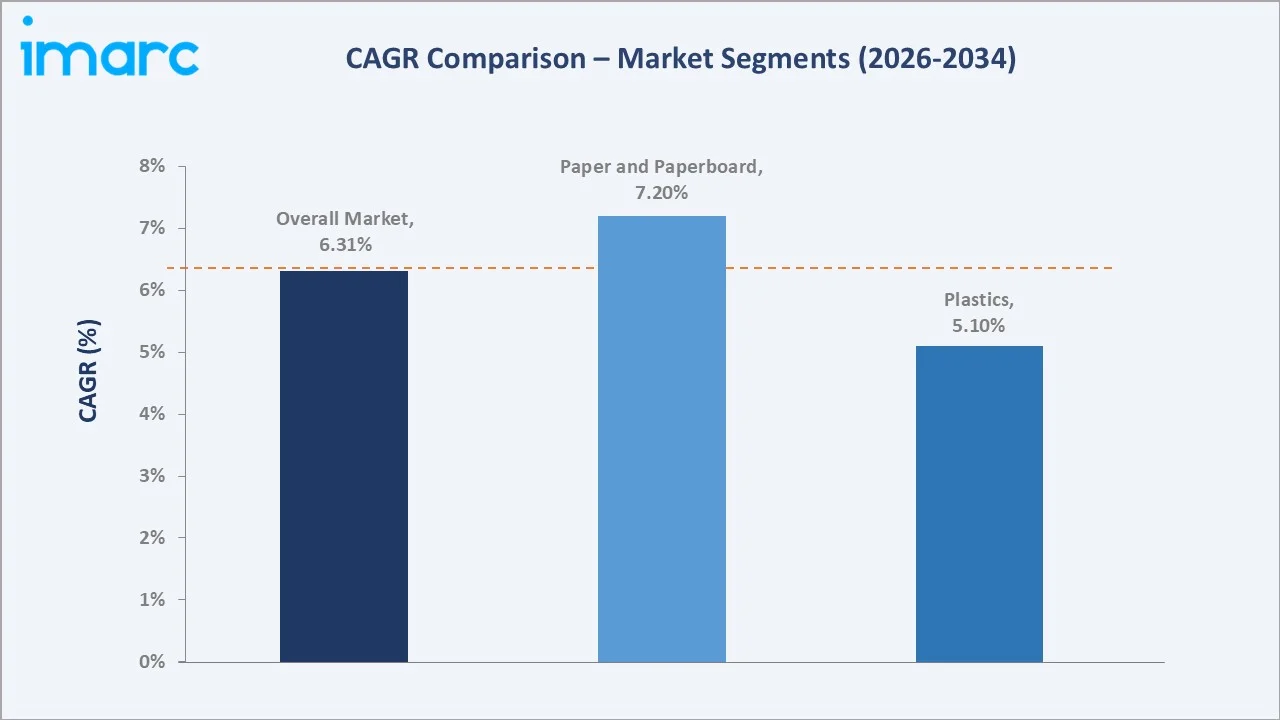
Paper and Paperboard – ~7.2% CAGR (2026-2034) |
|
Largest Type Segment |
Rigid – 57.8% share (2025) |
|
Leading Region |
West and Central India – 33.8% share (2025) |
|
Top Companies |
ITC Limited, UFlex Limited, Cosmo First Limited, Huhtamäki Oyj, EPL Limited |
Key Analytical Observations Supporting The Above Data:
- Paper and paperboard accounts for 38.6% of the India sustainable packaging market in 2025. This dominance reflects rapid substitution of single-use plastics with recyclable paper-based formats across food and beverage applications.
- Rigid packaging remains the leading type segment at 57.8% share (2025), supported by sustained demand across food, beverage, and personal care rigid containers.
- Plastics packaging is transitioning steadily toward recycled and rPET-based formats at 34.2% share (2025), as brand owners commit to 100% recyclable packaging targets.
- West and Central India's 33.8% share (2025) reflects the region's concentration of FMCG manufacturing and packaging conversion capacity.
- Rising adoption of QR code traceability and recycled content mandates is broadening the addressable market across food, beverage, and personal care applications.
India Sustainable Packaging Market Overview
The India sustainable packaging market encompasses recyclable, reusable, and biodegradable packaging solutions across paper and paperboard, plastics, glass, and metal materials, offering primary, secondary, and tertiary packaging formats for food and beverage, personal care, and healthcare applications. The India sustainable packaging ecosystem spans raw material suppliers, packaging design and engineering specialists, and an expanding distribution network across brand owners, retailers, and e-commerce channels.
Macroeconomic drivers include stringent regulatory mandates on recycled content and Extended Producer Responsibility, rising demand from FMCG and e-commerce sectors, and supportive programs including the CSIR National Mission on Sustainable Packaging Solutions. Manufacturers are simultaneously investing in biodegradable material R&D and traceability technology to improve compliance and reduce environmental impact, positioning the India sustainable packaging sector for continued innovation-led growth through 2034 despite the higher cost of sustainable raw materials.
Market Dynamics
To evaluate market opportunities, Request Sample
Market Drivers
- Regulatory Mandates, EPR & Recycled Content Norms: For 2025–26, rigid plastic packaging (Category I) must include at least 30% recycled content, increasing to 60% by 2028–29. The requirement for flexible plastics (Category II) will rise from 10% to 20%, while multi-layered plastics (Category III) must increase recycled content from 5% to 10%.
- Rising Corporate & Consumer Sustainability Demand: Growing consumer awareness, particularly among millennials and Gen Z, and corporate commitments to 100% recyclable packaging are accelerating category adoption. In August 2025, Marico announced its aims to make 100% of its packaging recyclable by 2030.
- Government R&D Push, CSIR National Mission: India’s Council of Scientific and Industrial Research (CSIR) launched the National Mission on Sustainable Packaging Solutions to develop eco-friendly materials, advanced recycling and reuse technologies, and reliable testing systems. Led by CSIR-NIIST, the initiative targets alternatives to multilayer packaging, PET and glass bottles, while promoting bio-based and biodegradable packaging for a net-zero future.
- Ban on Single-Use Plastics & rPET Approval: The 2022 nationwide ban on single-use plastics and the 2025 Food Safety Authority approval of rPET in food contact materials are expanding the addressable market for recycled and biodegradable alternatives.
Market Restraints
- Higher Cost of Sustainable Raw Materials: Sustainable and biodegradable raw materials often carry a cost premium over conventional plastics and packaging materials, impacting manufacturer margins.
- Limited Recycling Infrastructure & Collection Systems: Inadequate recycling infrastructure and fragmented waste collection systems constrain the scalability of closed-loop packaging models.
- Technical Barriers in Biodegradable Material Performance: Biodegradable materials can face performance limitations in barrier protection and shelf-life compared to conventional packaging, limiting adoption in certain applications.
Market Opportunities
- QR Code Traceability & Digital Tracking Solutions: Rising regulatory demand for traceability presents opportunities for manufacturers investing in QR code and digital tracking packaging technology.
- Biodegradable Bottle & Paper Carton Innovation: Growing manufacturer focus on biodegradable bottles and paper cartons in beverages creates opportunities for material science innovators.
- Healthcare & Personal Care Sustainable Packaging Expansion: Expanding healthcare and personal care sustainability commitments offer packaging companies new specialty format opportunities.
Market Challenges
- Balancing Cost and Compliance: Manufacturers must balance raw material and compliance costs with the need to deliver sustainable packaging competitively priced against conventional alternatives.
- Addressing Recycling Infrastructure Gaps: Ensuring consistent collection and recycling capability across India requires ongoing infrastructure investment and regulatory coordination.
Emerging Market Trends
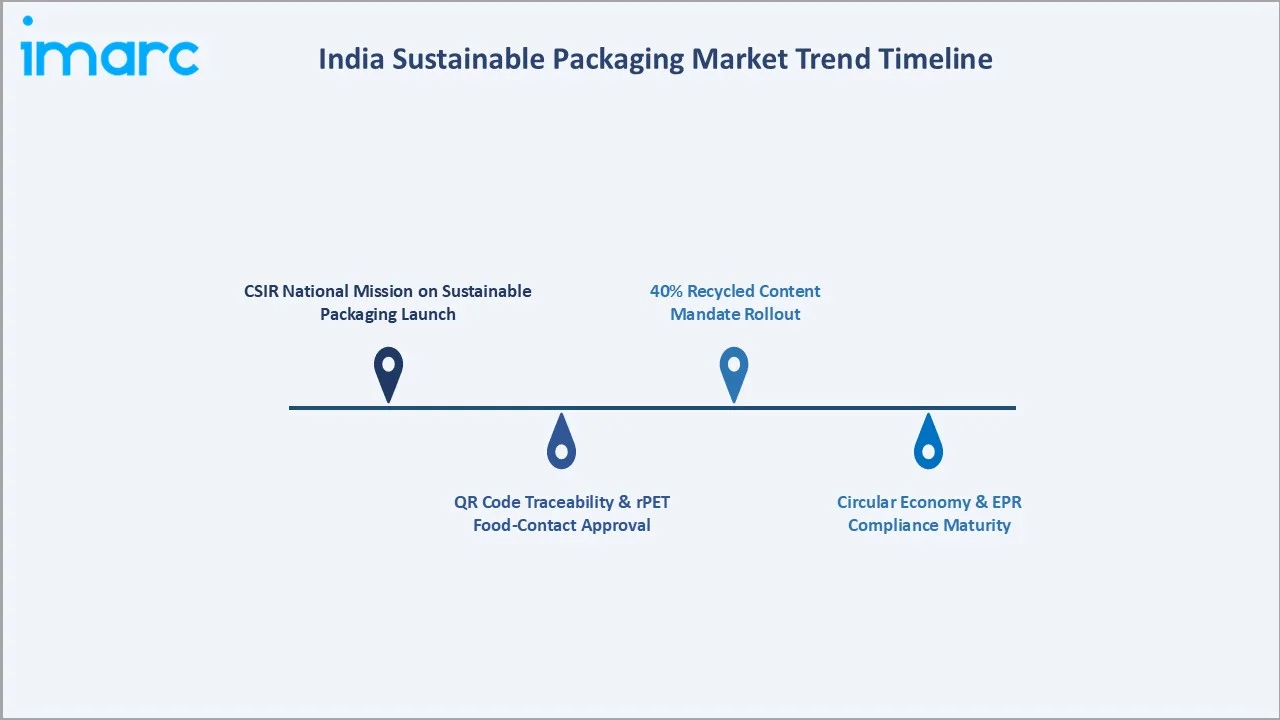
1. CSIR National Mission on Sustainable Packaging Launch
Government-backed research programs are increasingly supporting sustainable packaging manufacturers with financial incentives and R&D infrastructure investment, accelerating biodegradable material development across the sector. In January 2026, the government announced a CSIR-NIIST Innovation, Technology and Entrepreneurship Hub at Kerala’s Bio-360 Life Sciences Park to advance deep-tech research, commercialization, and entrepreneurship.
2. QR Code Traceability & rPET Food-Contact Approval
Growing regulatory investment in QR code traceability mandates and the approval of rPET in food-contact materials is driving adoption of higher-transparency, recycled-content packaging processes across manufacturing facilities. India mandated that all plastic carry bags and multilayered packaging must display a barcode or QR code from July 1, 2025. The code must provide manufacturer and regulatory details, improving packaging traceability and strengthening enforcement of plastic-waste rules.
3. 40% Recycled Content Mandate Rollout
India mandated a minimum of 40% recycled content in food-contact PET packaging from April 1, 2026, while requiring unresolved 2025–26 targets to be met gradually over three years.
Recycled packaging must comply with IS 14534:2023, carry appropriate labeling, and meet FSSAI requirements for food-contact applications.
4. Circular Economy & EPR Compliance Maturity
Leading manufacturers are expanding circular economy initiatives and Extended Producer Responsibility compliance systems to improve packaging collection rates and reduce landfill dependency across the value chain.
Industry Value Chain Analysis
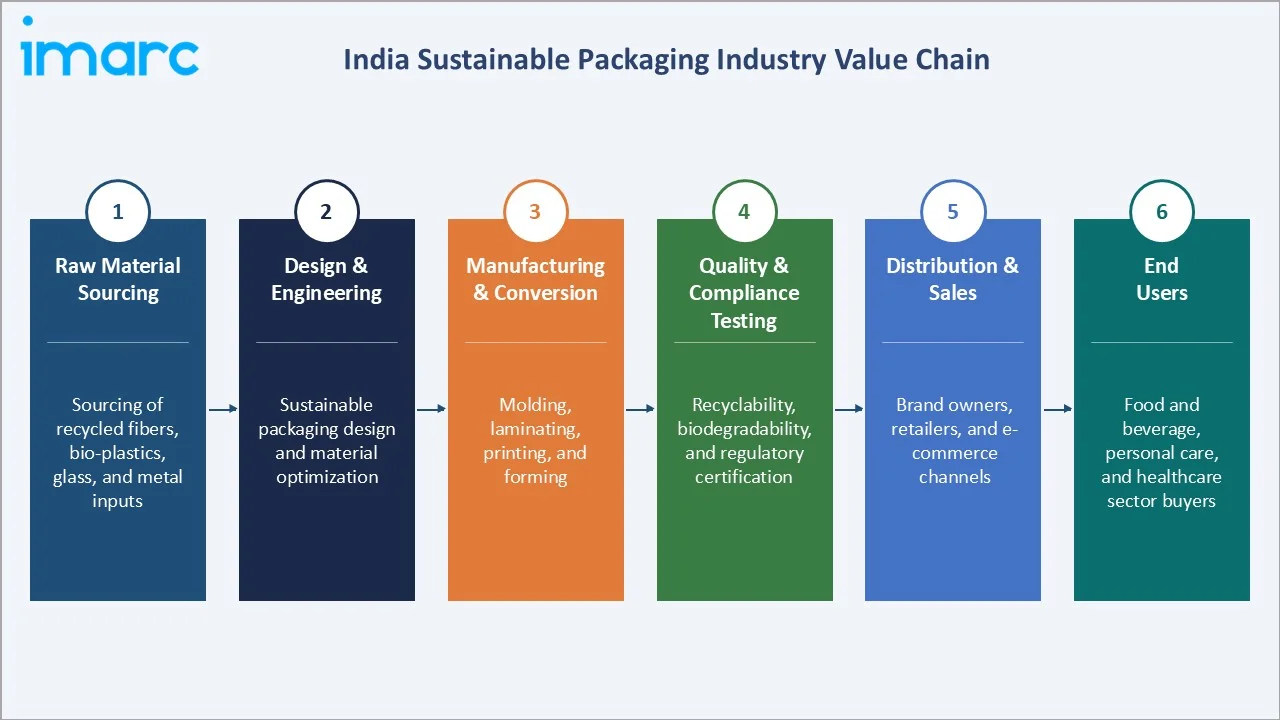
The India sustainable packaging value chain spans raw material sourcing through end-user delivery, with each stage occupied by specialized raw material suppliers, design and manufacturing specialists, and distribution partners whose performance directly influences packaging recyclability, compliance, and cost efficiency.
|
Stage |
Key Activities |
|
Raw Material Sourcing |
Sourcing of recycled fibers, bio-plastics, glass, and metal inputs |
|
Design & Engineering |
Sustainable packaging design and material optimization |
|
Manufacturing & Conversion |
Molding, laminating, printing, and forming |
|
Quality & Compliance Testing |
Recyclability, biodegradability, and regulatory certification |
|
Distribution & Sales |
Brand owners, retailers, and e-commerce channels |
|
End Users |
Food and beverage, personal care, and healthcare sector buyers |
Technology Landscape in the India Sustainable Packaging Industry
Biodegradable Bottle & Paper Carton Technology
Manufacturers are advancing biodegradable bottle and paper carton formats to improve recyclability, supporting broader adoption among beverage and food facilities. Polylactic acid-based bottle constructions and FSC-certified paperboard carton formats with water-based barrier coatings are being validated by Indian FMCG and beverage brands as alternatives to conventional PET and multi-layer laminate packaging.
Recycled Plastics & rPET Development
Growing investment in rPET and recycled plastics technology is expanding food-contact-safe packaging capabilities, addressing rising demand for recyclable flexible and rigid formats. Indian packaging manufacturers are investing in food-grade rPET processing infrastructure to produce recycled content bottles and trays meeting the 30% minimum recycled content thresholds mandated under India's EPR obligations for plastic packaging producers and brand owners.
QR Code Traceability & Digital Tracking Systems
Providers are engineering QR code traceability and digital tracking systems to extend compliance across demanding regulatory and export-oriented packaging applications. Serialized QR code integration across primary and secondary packaging layers is enabling Indian exporters to satisfy European Union Deforestation Regulation and US FDA traceability requirements by providing end-to-end supply chain visibility.
Sustainable & Recyclable Material Innovation
Expanding research into biodegradable materials and recyclable content formulations is strengthening sustainability performance, supporting premium positioning across environmentally conscious brand use cases. Seaweed-derived packaging films, sugarcane bagasse molded fiber trays, and compostable corn-starch pouches are being piloted by Indian sustainable packaging startups and FMCG co-packers as premium alternatives to conventional single-use plastic formats.
Market Segmentation Analysis
The report covers the following segments:
|
Segment Category |
Leading Segment |
Market Share |
Year |
|
Material |
Paper and Paperboard |
38.6% |
2025 |
|
Type |
Rigid |
57.8% |
2025 |
|
Packaging Format |
🔒 |
🔒 |
2025 |
|
Process |
🔒 |
🔒 |
2025 |
|
Application |
🔒 |
🔒 |
2025 |
|
Region |
West and Central India |
33.8% |
2025 |

By Material
Paper and Paperboard dominates with a 38.6% share in 2025. This segment encompasses food and beverage, personal care, and e-commerce applications, supported by sustained demand for recyclable, biodegradable alternatives to conventional plastics.
To access detailed market analysis, Request Sample
Plastics represent 34.2% (2025) of the market, reflecting an ongoing transition toward recycled and rPET-based formats as brand owners commit to recyclable packaging targets, a segment expected to evolve steadily as regulatory mandates tighten. Glass contributes 16.1% and metal accounts for the remaining 11.1%, serving specialty and premium packaging needs.
By Type
Rigid packaging leads the type segment at 57.8% share (2025), supported by sustained demand across food, beverage, and personal care rigid containers.
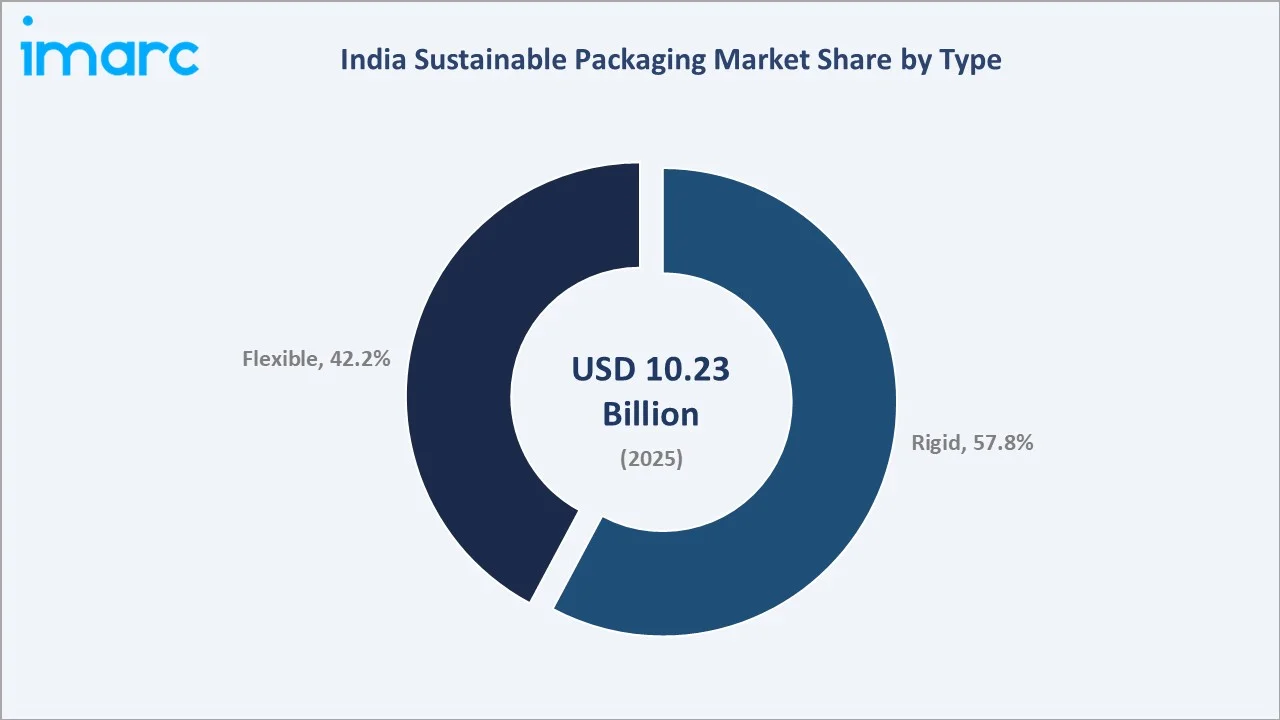
Flexible packaging accounts for the remaining 42.2% (2025), serving lightweight, cost-efficient packaging needs across e-commerce and personal care applications, with growing adoption of recyclable flexible film formats as manufacturers respond to single-use plastic regulations.
Regional Market Insights
West and Central India's market leadership (33.8%, 2025) reflects the region's concentration of FMCG manufacturing and packaging conversion capacity across food, beverage, and personal care sectors. Growing e-commerce penetration and expanding export-oriented manufacturing combine to sustain its dominant position through 2034.
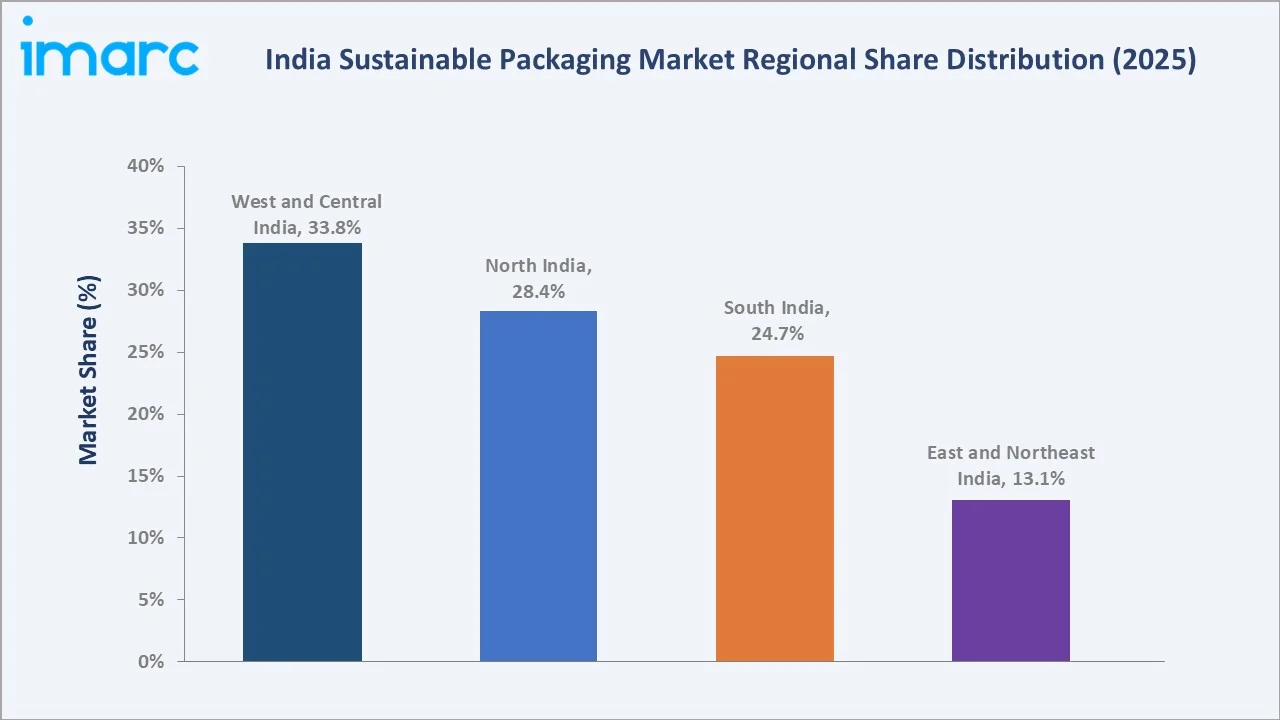
North India at 28.4% (2025) represents the second-largest sustainable packaging market nationally. Rising e-commerce penetration and expanding food processing infrastructure are sustaining steady growth, positioning the region as a key contributor alongside West and Central India through the forecast period.
|
Region |
Share (2025) |
Key Growth Drivers |
|
West and Central India |
33.8% |
Concentration of FMCG manufacturing and packaging conversion capacity |
|
North India |
28.4% |
Rising e-commerce penetration and expanding food processing infrastructure |
|
South India |
24.7% |
Strong presence of IT-enabled brand owners and personal care manufacturing |
|
East and Northeast India |
13.1% |
Emerging industrialization and expanding packaging infrastructure |
Competitive Landscape
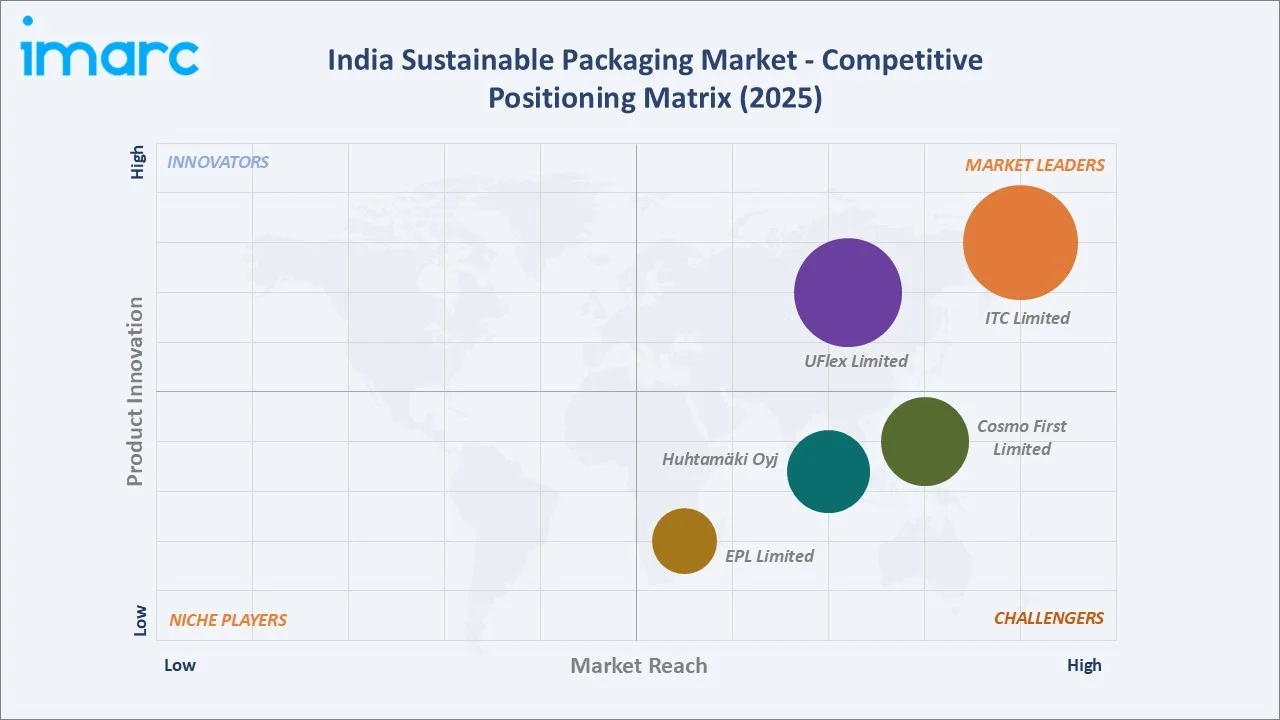
The India sustainable packaging market exhibits moderate concentration, with leading manufacturers collectively holding a significant share of market revenue in 2025, reflecting sustained investment in sustainable material innovation and distribution reach.
|
Company Name |
Brands/ Products |
Market Position |
Core Strength |
|
ITC Limited |
Filo Series, IndoBowl, BioSeal, WrapWell, TribeKraft |
Market Leader |
Integrated paperboard manufacturing and sustainable packaging innovation |
|
UFlex Limited |
Uflex |
Market Leader |
Flexible packaging leadership and recyclable film technology |
|
Cosmo First Limited |
Cosmo Films |
Strong Challenger |
Specialty BOPP films and sustainable packaging solutions |
|
Huhtamäki Oyj |
Huhtamaki |
Strong Challenger |
Global sustainability roadmap and fiber-based packaging expertise |
|
EPL Limited |
Platina, Platina Pro, r-Platina, Platina ME, Platina Vision, Etain, Green Maple Leaf |
Challenger |
Laminated tube packaging and recyclable material innovation |
ITC Limited and UFlex Limited dominate through comprehensive integrated manufacturing and extensive national distribution capacity, supported by continuous R&D investment. Cosmo First Limited, Huhtamaki Oyj, and EPL Limited compete through targeted premium positioning, global sustainability heritage, and specialty material differentiation, respectively.
Key Company Profiles
ITC Limited
ITC Limited's Packaging & Printing division is a leading national paperboard and sustainable packaging conglomerate with an extensive manufacturing capacity spanning paperboard, cartons, and flexible packaging distributed across a vast national customer base.
- Product Portfolio: Paperboard, folding cartons, flexible packaging, and sustainable paper bottle solutions under the Filo Series, IndoBowl, BioSeal, WrapWell, and TribeKraft.
- Recent Developments: In May 2026, ITC Limited reported Q4 FY2026 standalone gross revenue growth of 17.5% year over year, while EBITDA rose 7.3%. For FY2026, gross revenue reached INR 80,867 crore, up 10.1%, and EBITDA increased 4.9% to INR 25,208 crore.
- Strategic Focus: Strengthening integrated paperboard capacity; expanding sustainable packaging innovation across emerging categories.
UFlex Limited
UFlex Limited is a leading provider of flexible packaging solutions with a strong recyclable film technology portfolio serving food, beverage, and personal care sectors across India and international markets.
- Product Portfolio: Flexible packaging films, laminates, and recyclable mono-material packaging solutions.
- Recent Developments: In February 2026, UFlex Limited launched F-HSS, a high-seal-strength, transparent PET film designed to enable recyclable mono-material PET packaging for food, beverage, and FMCG applications. The FDA-compliant film offers strong sealing, high clarity, and compatibility with APET, RPET, CPET, and PVDC for trays, pouches, and dry-snack packaging.
- Strategic Focus: Scaling recyclable film manufacturing capabilities; deepening FMCG and export-oriented distribution partnerships.
Market Concentration Analysis
The India sustainable packaging market exhibits moderate concentration, with ITC Limited, UFlex Limited, and Cosmo First Limited collectively accounting for a significant share of total category revenue in 2025, reflecting sustained R&D investment, brand loyalty, and extensive manufacturing infrastructure nationwide.
Consolidation pressure remains limited as leading manufacturers maintain distinct strategic positioning: ITC Limited and UFlex Limited through comprehensive multi-category portfolios, Cosmo First Limited and Huhtamaki Oyj through specialty film and global sustainability positioning, and EPL Limited through laminated tube, premium carton, and polyester film differentiation, rather than pursuing direct M&A consolidation.
Investment & Growth Opportunities
Fastest Growing Segments
Paper and paperboard (~7.2% CAGR) represents the highest-growth investment vector through 2034, driven by accelerating substitution of single-use plastics and continuous innovation across biodegradable and recyclable material technologies. This subcategory addresses a rapidly expanding addressable market within the national sustainable packaging ecosystem.
Emerging Market Expansion
East and Northeast India and South India collectively represent an incremental growth opportunity beyond West and Central India and North India by 2034, as rising e-commerce penetration and expanding food processing infrastructure accelerate category penetration in these regional markets.
Venture and Institutional Investment Trends
- Manufacturer investment toward biodegradable material R&D and traceability technology is creating opportunities for technology vendors serving the sustainable packaging sector.
- Growing healthcare and personal care sustainability commitments are sustaining institutional interest in specialty sustainable packaging platforms.
- Recycled content and circular economy innovation, led by major manufacturers, is opening opportunities for material science and recycling infrastructure vendors serving the national packaging industry.
Future Market Outlook (2026-2034)
The India sustainable packaging market is positioned for robust, regulation-driven expansion through 2034. From a base of USD 10.23 Billion in 2025 to USD 10.87 Billion in 2026, the market is projected to reach USD 17.73 Billion by 2034, representing substantial incremental value creation at a CAGR of 6.31%. This growth is underpinned by regulatory mandates on recycled content, rising corporate and consumer sustainability demand, and government-backed R&D initiatives.
The material segment will continue evolving through 2034, with Paper and Paperboard gaining further share as single-use plastic substitution accelerates. This shift creates opportunities for manufacturers investing in biodegradable material R&D, recycled content technology, and traceability systems to capture the next phase of the India sustainable packaging market growth.
Research Methodology
Primary Research
Primary research comprised structured interviews with industry participants across 2024-2025, including packaging manufacturer executives, brand owner procurement managers, sustainability specialists, and regulatory affairs analysts across India. Expert input validated market sizing, segmentation trends, and regional consumption patterns.
Secondary Research
Secondary research encompassed manufacturer annual reports, sustainable packaging industry association publications, and regulatory trade press covering material innovation, EPR compliance trends, and regional packaging dynamics across major markets.
Forecasting Models
Market size estimations were derived using top-down and bottom-up forecasting, incorporating material and type segment transitions and manufacturer capacity disclosures. A base-case CAGR of 6.31% reflects consensus estimates validated against announced regulatory timelines and manufacturer strategic investment plans.
India Sustainable Packaging Market Report Coverage:
| Report Features | Details |
|---|---|
| Base Year of the Analysis | 2025 |
| Historical Period | 2020-2025 |
| Forecast Period | 2026-2034 |
| Units | Billion USD |
| Scope of the Report |
Exploration of Historical Trends and Market Outlook, Industry Catalysts and Challenges, Segment-Wise Historical and Future Market Assessment:
|
| Materials Covered | Plastics, Paper and Paperboard, Glass, Metal |
| Types Covered | Rigid, Flexible |
| Packaging Formats Covered | Primary Packaging, Secondary Packaging, Tertiary Packaging |
| Processes Covered | Recyclable, Reusable, Biodegradable |
| Applications Covered | Food and Beverages, Personal Care and Cosmetics, Healthcare, Others |
| Regions Covered | North India, West and Central India, South India, East and Northeast India |
| Companies Covered | ITC Limited, UFlex Limited, Cosmo First Limited, Huhtamäki Oyj, EPL Limited, etc. |
| Customization Scope | 10% Free Customization |
| Post-Sale Analyst Support | 10-12 Weeks |
| Delivery Format | PDF and Excel through Email (We can also provide the editable version of the report in PPT/Word format on special request) |
Key Benefits for Stakeholders:
- IMARC's industry report offers a comprehensive quantitative analysis of various market segments, historical and current market trends, market forecasts, and dynamics of the India sustainable packaging market from 2020-2034.
- The research report provides the latest information on the market drivers, challenges, and opportunities in the India sustainable packaging market.
- Porter's five forces analysis assist stakeholders in assessing the impact of new entrants, competitive rivalry, supplier power, buyer power, and the threat of substitution. It helps stakeholders to analyze the level of competition within the India sustainable packaging industry and its attractiveness.
- Competitive landscape allows stakeholders to understand their competitive environment and provides an insight into the current positions of key players in the market.
Frequently Asked Questions About the India Sustainable Packaging Market Report
The India sustainable packaging market size is estimated at USD 10.87 Billion in 2026 and is projected to reach USD 17.73 Billion by 2034.
The market is expected to grow at a CAGR of 6.31% during 2026-2034, driven by regulatory mandates on recycled content and rising corporate and consumer sustainability demand.
West and Central India leads with a 33.8% share in 2025, anchored by the region's concentration of FMCG manufacturing and packaging conversion capacity.
Paper and paperboard dominates with a 38.6% share in 2025, driven by sustained demand across food and beverage, personal care, and e-commerce applications.
Rigid packaging leads with a 57.8% share in 2025, supported by sustained demand across food, beverage, and personal care containers.
Some of the key players include ITC Limited, UFlex Limited, Cosmo First Limited, Huhtamäki Oyj, and EPL Limited.
Paper and paperboard is growing fastest at an estimated 7.2% CAGR as single-use plastic substitution accelerates.
Key challenges include the higher cost of sustainable raw materials, limited recycling infrastructure and collection systems, and technical barriers in biodegradable material performance.
QR code traceability and digital tracking solutions, biodegradable bottle and paper carton innovation, and healthcare and personal care sustainable packaging expansion represent leading investment opportunities.
Plastics, at 34.2% share, is transitioning steadily toward recycled and rPET-based formats as brand owners commit to 100% recyclable packaging targets.
Need more help?
- Speak to our experienced analysts for insights on the current market scenarios.
- Include additional segments and countries to customize the report as per your requirement.
- Gain an unparalleled competitive advantage in your domain by understanding how to utilize the report and positively impacting your operations and revenue.
- For further assistance, please connect with our analysts.
 Request Customization
 Speak to an Analyst
 Request Brochure
 Inquire Before Buying
Benefits of Customization
- Personalize this research
- Triangulate with your data
- Get data as per your format and definition
- Gain a deeper dive into a specific application, geography, customer, or competitor
- Any level of personalization
Get in Touch With Us
UNITED STATES
Phone: +1-201-971-6302
INDIA
Phone: +91-120-433-0800
UNITED KINGDOM
Phone: +44-753-714-6104
Email: [email protected]
Client Testimonials




.webp)




.webp)













Related Reports

Choose your plan
*Please note that the prices mentioned below are starting prices for each bundle type. Kindly contact our team for further details.*
Single User License
- 1 User License, Access on 2 Devices
- PDF Report + Excel Dataset (Password Protected)
- Lifetime Access
- No Printing Rights
- 10% Free Report Customization
- 10–12 Weeks of Analyst Support
Five User License
- Access for 5 Users, 2 Devices per User
- PDF Report + Excel Dataset (Password Protected)
- Lifetime Access
- Dedicated Account Manager
- 12–14 Weeks of Analyst Support
- No Printing Rights
- 15% Free Report Customization
- 25% Discount on Your Next Purchase
Corporate User License
- Unlimited User Access (Within Your Organization)
- PDF Report + Excel Dataset
- Lifetime Access
- Dedicated Account Manager
- 14–20 Weeks of Analyst Support
- No Printing Rights
- 20% Free Report Customization
- 30% Discount on Your Next Purchase
Essential Insights
What's included:
3 reports
- Lifetime Access
- PDF Reports
- Excel Datasets
- 2 Weeks of Free Analyst Support
- 2 User Licenses
- Access on 2 Devices
- Printing Rights
- Complimentary PowerPoint (PPT) Version
- Complimentary License Upgrade
Professional Access
What's included:
5 reports
- Lifetime Access
- PDF Reports
- Excel Datasets
- 8 Weeks of Free Analyst Support
- 2 User Licenses
- Access on 2 Devices
- Printing Rights
- Complimentary PowerPoint (PPT) Version
- Complimentary License Upgrade
Business Advantage
What's included:
8 reports
- Lifetime Access
- PDF Reports
- Excel Datasets
- 14 Weeks of Free Analyst Support
- 2 User Licenses
- Access on 2 Devices
- Printing Rights
- Complimentary PowerPoint (PPT) Version
- Complimentary License Upgrade
Enterprise Intelligence
What's included:
10 reports
- Lifetime Access
- PDF Reports
- Excel Datasets
- 20 Weeks of Free Analyst Support
- 2 User Licenses
- Access on 2 Devices
- Printing Rights
- Complimentary PowerPoint (PPT) Version
- Complimentary License Upgrade