
India Taxi Services Market Size, Share, Trends and Forecast by Type, Application, and Region, 2026-2034
India Taxi Services Market Summary:
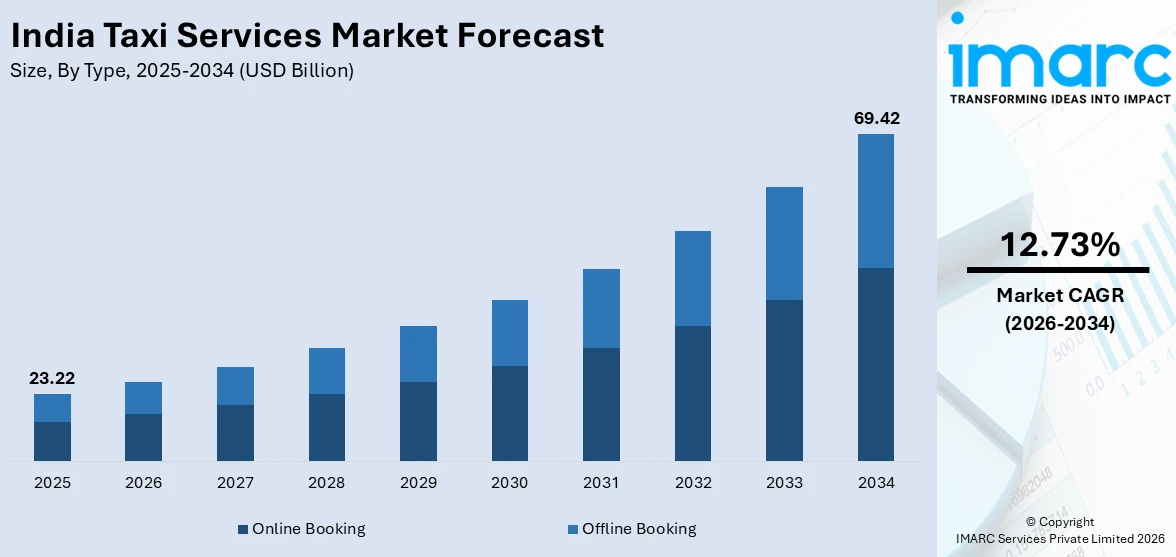
The India taxi services market size increased from USD 23.22 Billion in 2025 to USD 26.62 Billion in 2026 and is projected to reach USD 69.42 Billion by 2034, growing at a compound annual growth rate of 12.73% from 2026-2034.
The India taxi services market is witnessing sustained expansion, driven by rapid urbanization, rising smartphone penetration, and the growing adoption of app-based mobility platforms. Increasing middle-class aspirations, rising disposable incomes, and consumer preference for convenient and reliable door-to-door transportation solutions are reshaping commuter behavior across major metropolitan areas and emerging tier-2 cities, further strengthening the market share.
Key Takeaways and Insights:
- By Type: Online booking dominates the market with a share of 62.4% in 2025, driven by widespread smartphone adoption, seamless digital payment integration, and the growing preference for app-based mobility across urban and semi-urban India.
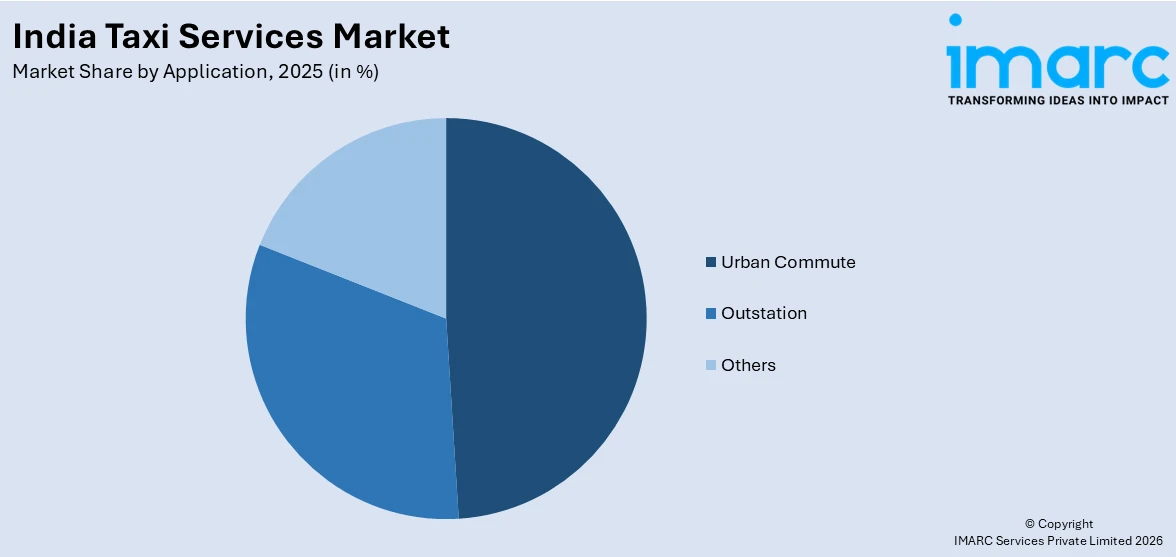
- By Application: Urban commute leads the market with a share of 48.5% in 2025, reflecting the increasing reliance on taxi services for daily intra-city travel, driven by rising congestion and the persistent inadequacy of public transport infrastructure.
- By Region: West India comprises the largest region with 38.3% share in 2025, underpinned by the concentration of commercial activity and high-density urban populations in cities, such as Mumbai and Pune.
- Key Players: Key players in the India taxi services market drive growth by continuously expanding service offerings, enhancing fleet technology, optimizing pricing models, and extending reach into underserved tier-2 and tier-3 cities to capture rising mobility demand.
To get more information on this market Request Sample
The India taxi services market has emerged as one of the most dynamic segments of the country’s transportation landscape, shaped by converging forces of urbanization, technology adoption, and shifting commuter behavior. Rising smartphone ownership and affordable mobile internet have accelerated the shift towards app-based mobility platforms, transforming how passengers book and experience transportation. As per the Comprehensive Modular Survey: Telecom, 2025, in India, roughly 85.5% of households had at least one smartphone. Rapid urbanization is amplifying passenger volumes across metropolitan corridors, with the growing urban population creating consistent demand for on-demand and flexible mobility solutions. The expansion of ride-hailing platforms into tier-2 and tier-3 cities has extended organized transportation access, offering standardized safety features, real-time tracking, and cashless payment options to a broader user base. Improving road infrastructure, government smart city investments, and rising consumer expectations around service quality further reinforce the India taxi services market’s sustained growth momentum.
India Taxi Services Market Trends:
Rise of App-Based Digital Booking Platforms
The growing adoption of smartphones and affordable mobile data is transforming the booking experience for taxi services in India. Consumers are increasingly abandoning traditional phone-based or walk-up hailing in favor of app-driven platforms that offer instant ride matching, route tracking, and digital payment capabilities. This behavioral shift is particularly pronounced among younger, tech-savvy urban populations. Enhanced user interfaces, multi-vehicle category options, and subscription-based fare models are further entrenching digital booking as the default mode of transportation access across Indian cities, reshaping the competitive dynamics of the sector.
Integration of EVs into Taxi Fleets
The India taxi services sector is witnessing a notable shift towards EV adoption, driven by government incentive programs and growing environmental awareness among fleet operators. Ride-hailing platforms are increasingly incorporating EVs to reduce operational costs and align with national sustainability goals. As per IMARC Group, the India EV market size was valued at USD 3,712.15 Million in 2025. Dedicated EV policy frameworks, including subsidies for commercial vehicle purchase and the development of charging infrastructure, are accelerating fleet electrification, particularly in major metropolitan areas. This transition is reshaping urban mobility dynamics and strengthening the long-term environmental and commercial sustainability profile of organized taxi services in India.
Expansion into Tier-2 and Tier-3 Cities
The India taxi services market is increasingly extending its reach beyond major metropolitan centers into rapidly growing tier-2 and tier-3 cities. Improving road connectivity and the availability of affordable internet in smaller urban centers are enabling organized taxi platforms to establish a viable presence in previously underserved regions. This geographic expansion is broadening the consumer base for app-based taxi services, stimulating demand for reliable, on-demand transportation among populations that previously depended primarily on unorganized local taxi operators.
Market Outlook 2026-2034:
The India taxi services market is poised for robust and sustained growth over the forecast period, underpinned by the deepening integration of digital technology across the transportation sector, rising urban mobility demand, and favorable demographic trends. As India continues its rapid urbanization trajectory, the demand for organized, tech-enabled taxi services is expected to rise significantly across both metropolitan and emerging urban areas. The market generated revenue of USD 23.22 Billion in 2025, which is expected to reach USD 26.62 Billion in 2026 and further grow to USD 69.42 Billion by 2034, at a compound annual growth rate (CAGR) of 12.73% from 2026-2034. Government investments in smart city infrastructure, multimodal transit integration, and supportive EV policies are creating a conducive environment for long-term market expansion.
India Taxi Services Market Report Segmentation:
| Segment Category | Leading Segment | Market Share |
|---|---|---|
|
Type |
Online Booking |
62.4% |
|
Application |
Urban Commute |
48.5% |
|
Region |
West India |
38.3% |

Type Insights:
- Online Booking
- Offline Booking
Online booking dominates with a market share of 62.4% of the total India taxi services market in 2025.
Online booking leads the market, due to the extensive use of ride-hailing apps on smartphones that provide ease of use, real-time tracking, and clear pricing. Online booking is now the most popular way to get taxi services in India due to the extensive use of smartphones and reasonably priced internet services. With features like immediate ride matching, clear fee estimates, real-time tracking, and cashless payment options that appeal to the nation's expanding digital consumer base, app-based platforms have completely changed the traveler experience.
The ongoing spread of app-based taxi platforms into smaller cities and semi-urban areas, fueled by better road infrastructure and growing digital literacy, is another factor contributing to the steady growth of online booking. The convenience and transparency that were formerly associated with metropolitan services are becoming more and more demanded by consumers in these rising countries. Sedans, hatchbacks, bikes, and autorickshaws are just a few of the vehicle categories that have been integrated into single, unified platforms. This has increased appeal across a variety of demographic segments by allowing users to choose options that suit their budget, comfort needs, and commuting habits. This has deepened platform stickiness and accelerated user adoption.
Application Insights:
Access the comprehensive market breakdown Request Sample
- Urban Commute
- Outstation
- Others
Urban commute leads with a share of 48.5% of the total India taxi services market in 2025.
Urban commute is the most popular application in India's taxi services ecosystem, which is fueled by chronic gaps in public transit facilities and increasing population density in urban areas. In order to navigate crowded city hallways with predictability, comfort, and time efficiency, residents, students, and daily office commuters are depending more on organized taxi platforms. In India's financial and commercial centers, where there is a persistent need for private transportation alternatives to the overburdened public transit system, demand is especially concentrated.
The urban commute segment is further bolstered by the rapid adoption of multimodal mobility solutions, with ride-hailing platforms increasingly integrating with metro rail and bus transit systems to provide seamless first-mile and last-mile connectivity. This integration reduces commuter friction by enabling single-platform booking across transport modes. The growing deployment of diverse vehicle categories, including premium sedans, economy hatchbacks, bike taxis, and EVs, ensures that urban commuters across income groups can access suitable transportation options. As Indian cities continue to expand outward, the geographic coverage of organized taxi services is broadening, sustaining consistent growth within the urban commute application segment.
Regional Insights:
- North India
- South India
- East India
- West India
West India exhibits a clear dominance with a 38.3% share of the total India taxi services market in 2025.
West India prevails the India taxi services market, anchored by Mumbai’s financial dominance and Pune’s thriving technology ecosystem. Dense corporate activity, a large commuter population, and strong smartphone penetration drive consistent demand for organized mobility solutions. The Maharashtra State Transport Authority provisionally granted bike taxi licenses to three aggregators, Ola, Uber, and Rapido, under Maharashtra Bike Taxi Rules 2025 in September 2025, marking a significant regulatory step towards formalizing the region’s rapidly expanding ride-hailing landscape.
Beyond Mumbai and Pune, cities such as Ahmedabad and Surat are witnessing growing adoption of app-based taxi services, driven by improving infrastructure and rising disposable incomes. The region’s favorable business environment, high tourism activity, and increasing airport traffic create diverse mobility demand streams. West India’s EV-friendly regulatory landscape, coupled with strong consumer appetite for sustainable transportation, positions the region as a key growth driver within the India taxi services market.
Market Dynamics:
Growth Drivers:
Why is the India Taxi Services Market Growing?
Rapid Urbanization and Expanding Metropolitan Populations
India’s accelerating urbanization represents one of the most consequential structural forces driving growth in the taxi services market. According to the Economic Survey 2023-24, it is anticipated that over 40% of India's population will reside in urban regions by 2030. As millions of residents migrate from rural and semi-urban areas to cities in search of employment, education, and improved living standards, demand for reliable, affordable, and on-demand transportation grows correspondingly. Urban migration creates pressure on existing transit systems, which often lack the capacity, frequency, and geographic breadth to serve expanding commuter populations adequately. This infrastructure gap generates persistent demand for organized taxi services as a practical and accessible alternative to public transportation. The dynamics of urbanization are particularly pronounced in India’s rapidly expanding tier-2 and tier-3 cities, where industrial investment, digital commerce, and infrastructure development are creating new commuter populations with mobility needs unmet by traditional transport providers. App-based platforms offer consistent pricing, standardized safety features, and real-time service access that align with the expectations of an increasingly discerning urban population.
Rising Smartphone Penetration and Digital Payment Adoption
The rapid proliferation of smartphones and the widespread adoption of digital payment infrastructure have fundamentally transformed the consumer experience within the India taxi services market. App-based platforms have leveraged these technological tailwinds to deliver seamless, real-time transportation access to hundreds of millions of users across the country. The ease of booking, transparent fare estimation, and cashless transaction capabilities offered by digital platforms have made organized taxi services accessible and appealing across a wide cross-section of Indian society, from working professionals in metropolitan areas to first-time app users in tier-2 cities. India’s strong digital payments ecosystem, driven by the Universal Payments Interface infrastructure, has eliminated friction in fare collection and enhanced earnings transparency for drivers while delivering a frictionless payment experience for passengers. As per IMARC Group, the India digital payment market size reached USD 6.8 Billion in 2025. The continued rollout of affordable mobile data and the expansion of high-speed internet connectivity in smaller urban centers are further extending the reach of digital taxi platforms.
Government Initiatives and Infrastructure Development
Government-led initiatives across transportation, digital infrastructure, and electric mobility are creating a highly conducive regulatory and operational environment for the India taxi services market. The Smart Cities Mission and associated urban infrastructure investments have significantly improved road quality, traffic management systems, and multimodal transit integration across key metropolitan areas, directly enhancing the operational efficiency of organized taxi services. In the EV space, dedicated policy frameworks offering purchase subsidies and charging infrastructure funding are accelerating the transition of taxi fleets toward sustainable operations, reducing long-term cost pressures for operators. The government’s ambitious airport expansion program, targeting the development and activation of new airport facilities across secondary cities, is generating new demand corridors for organized taxi services, particularly in airport connectivity and premium transfer segments. Regulatory developments signal an evolving and supportive government stance towards organized mobility, reinforcing investor and operator confidence in the India taxi services market’s long-term growth trajectory throughout the forecast period.
Market Restraints:
What Challenges the India Taxi Services Market is Facing?
Driver Attrition and Welfare Concerns
High driver attrition remains a persistent structural challenge within the India taxi services market, undermining service reliability and quality. Concerns around commission structures, unpredictable incentive policies, and declining net earnings have fueled dissatisfaction among driver-partners, resulting in strikes and service interruptions across major cities. The absence of formal social security benefits, health coverage, and income stability mechanisms for gig-economy drivers increases platform vulnerability to workforce disruptions, making consistent fleet availability difficult to maintain and complicating long-term operational planning for service providers.
Regulatory Fragmentation Across States
The absence of a unified national regulatory framework for taxi and ride-hailing services creates significant operational complexity for platform operators. Each state maintains distinct licensing requirements, commission caps, surge pricing limits, and vehicle eligibility rules, multiplying compliance burdens and increasing costs for companies seeking nationwide scale. Inconsistent regulations, such as varying bike-taxi policies across states, lead to service disruptions and fleet underutilization, impeding organized market growth and deterring new platform entrants from committing to pan-India operations.
Rising Fuel Costs and Operational Expenses
Volatility in fuel prices significantly impacts driver earnings and overall trip economics within the India taxi services market. As fuel costs rise, drivers experience margin compression, often leading to reduced platform engagement or demands for higher fares. This creates friction between drivers and platforms, while fare increases can dampen consumer demand and shift ridership towards alternative modes of transport, limiting market growth.
Competitive Landscape:
The India taxi services market exhibits a moderately concentrated competitive structure, characterized by the dominance of a few large app-based aggregators alongside a fragmented base of smaller regional and local operators. The market has evolved from a duopoly into a multi-player environment, with newer entrants disrupting established pricing and commission models through subscription-based revenue structures that improve driver economics and reduce fare costs for passengers. Airport connectivity, premium vehicle categories, and intercity travel are emerging as key differentiation battlegrounds. Corporate mobility solutions and EV integration are increasingly influencing competitive positioning. The entry of government-backed cooperative platforms is introducing a new structural dimension to competition, focused on driver ownership and zero-commission operations. Regional players continue to hold ground in tier-2 and tier-3 markets, where local knowledge, established driver networks, and competitive fares provide defensible market positions.
Recent Developments:
- In February 2026, Union Home and Cooperation Minister Shri Amit Shah officially inaugurated India’s inaugural cooperative taxi service ‘Bharat Taxi’ in New Delhi. Over 1,200 ‘Sarathis’ (driver partners) from different states took part in this landmark initiative, showcasing widespread backing for Bharat Taxi’s cooperative-ownership and driver-empowerment model.
India Taxi Services Market Report Coverage:
| Report Features | Details |
|---|---|
| Base Year of the Analysis | 2025 |
| Historical Period | 2020-2025 |
| Forecast Period | 2026-2034 |
| Units | Billion USD |
| Scope of the Report |
Exploration of Historical Trends and Market Outlook, Industry Catalysts and Challenges, Segment-Wise Historical and Future Market Assessment:
|
| Types Covered | Online Booking, Offline Booking |
| Applications Covered | Urban Commute, Outstation, Others |
| Regions Covered | North India, South India, East India, West India |
| Customization Scope | 10% Free Customization |
| Post-Sale Analyst Support | 10-12 Weeks |
| Delivery Format | PDF and Excel through Email (We can also provide the editable version of the report in PPT/Word format on special request) |
Frequently Asked Questions About the India Taxi Services Market Report
The India taxi services market size increased from USD 23.22 Billion in 2025 to USD 26.62 Billion in 2026.
The India taxi services market is expected to grow at a compound annual growth rate of 12.73% from 2026-2034 to reach USD 69.42 Billion by 2034.
Online booking dominated the market with a share of 62.4%, driven by widespread smartphone adoption, seamless digital payment integration, and the growing preference for app-based transportation solutions across urban and semi-urban India.
Key factors driving the India taxi services market include rapid urbanization, rising smartphone and internet penetration, growing disposable incomes, government infrastructure investments, and increasing consumer preference for app-based, cashless, and tech-enabled transportation solutions.
Major challenges include regulatory fragmentation across states creating operational complexity, persistent driver attrition due to declining earnings and welfare concerns, and significant infrastructure gaps hindering the widespread adoption and scalability of EV fleets within the organized taxi segment.
Need more help?
- Speak to our experienced analysts for insights on the current market scenarios.
- Include additional segments and countries to customize the report as per your requirement.
- Gain an unparalleled competitive advantage in your domain by understanding how to utilize the report and positively impacting your operations and revenue.
- For further assistance, please connect with our analysts.
 Request Customization
 Speak to an Analyst
 Request Brochure
 Inquire Before Buying
Benefits of Customization
- Personalize this research
- Triangulate with your data
- Get data as per your format and definition
- Gain a deeper dive into a specific application, geography, customer, or competitor
- Any level of personalization
Get in Touch With Us
UNITED STATES
Phone: +1-201-971-6302
INDIA
Phone: +91-120-433-0800
UNITED KINGDOM
Phone: +44-753-714-6104
Email: [email protected]
Client Testimonials




.webp)




.webp)













Related Reports

Choose your plan
*Please note that the prices mentioned below are starting prices for each bundle type. Kindly contact our team for further details.*
Single User License
- 1 User License, Access on 2 Devices
- PDF Report + Excel Dataset (Password Protected)
- Lifetime Access
- No Printing Rights
- 10% Free Report Customization
- 10–12 Weeks of Analyst Support
Five User License
- Access for 5 Users, 2 Devices per User
- PDF Report + Excel Dataset (Password Protected)
- Lifetime Access
- Dedicated Account Manager
- 12–14 Weeks of Analyst Support
- No Printing Rights
- 15% Free Report Customization
- 25% Discount on Your Next Purchase
Corporate User License
- Unlimited User Access (Within Your Organization)
- PDF Report + Excel Dataset
- Lifetime Access
- Dedicated Account Manager
- 14–20 Weeks of Analyst Support
- No Printing Rights
- 20% Free Report Customization
- 30% Discount on Your Next Purchase
Essential Insights
What's included:
3 reports
- Lifetime Access
- PDF Reports
- Excel Datasets
- 2 Weeks of Free Analyst Support
- 2 User Licenses
- Access on 2 Devices
- Printing Rights
- Complimentary PowerPoint (PPT) Version
- Complimentary License Upgrade
Professional Access
What's included:
5 reports
- Lifetime Access
- PDF Reports
- Excel Datasets
- 8 Weeks of Free Analyst Support
- 2 User Licenses
- Access on 2 Devices
- Printing Rights
- Complimentary PowerPoint (PPT) Version
- Complimentary License Upgrade
Business Advantage
What's included:
8 reports
- Lifetime Access
- PDF Reports
- Excel Datasets
- 14 Weeks of Free Analyst Support
- 2 User Licenses
- Access on 2 Devices
- Printing Rights
- Complimentary PowerPoint (PPT) Version
- Complimentary License Upgrade
Enterprise Intelligence
What's included:
10 reports
- Lifetime Access
- PDF Reports
- Excel Datasets
- 20 Weeks of Free Analyst Support
- 2 User Licenses
- Access on 2 Devices
- Printing Rights
- Complimentary PowerPoint (PPT) Version
- Complimentary License Upgrade