
India Tomato Seed Market Size, Share, Trends and Forecast by Type, Product, Growing Technology, and Region, 2026-2034
India Tomato Seed Market Summary:
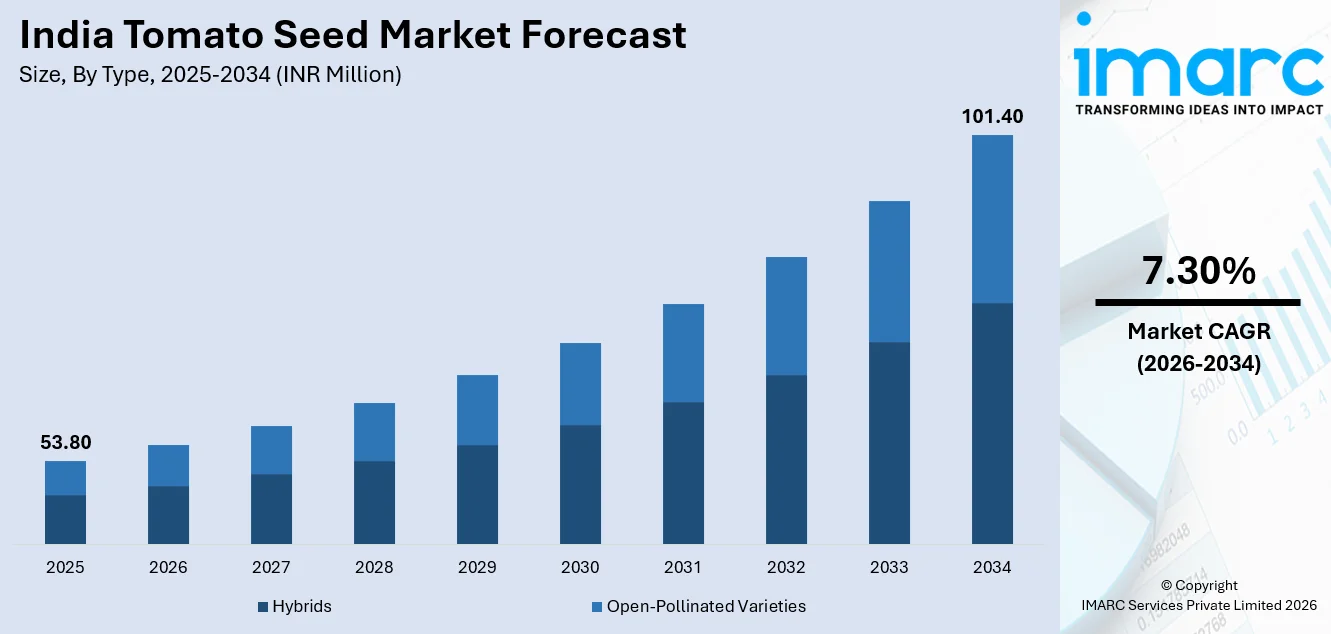
The India tomato seed market size was valued at INR 53.80 Million in 2025 and is projected to reach INR 101.40 Million by 2034, growing at a compound annual growth rate of 7.30% from 2026-2034.
The market is driven by rising demand for high-yield, disease-resistant varieties amid expanding horticulture activities and farmer adoption of quality inputs. Growth is supported by increased investment in seed research, improved distribution channels and enhanced awareness of hybrid seeds’ benefits. Continued focus on innovation and tailored varietal development is expected to sustain market expansion.
Key Takeaways and Insights:
- By Type: Hybrids dominate the market with a share of 65% in 2025, driven by their superior yield potential, disease resistance, and uniformity compared to open-pollinated alternatives.
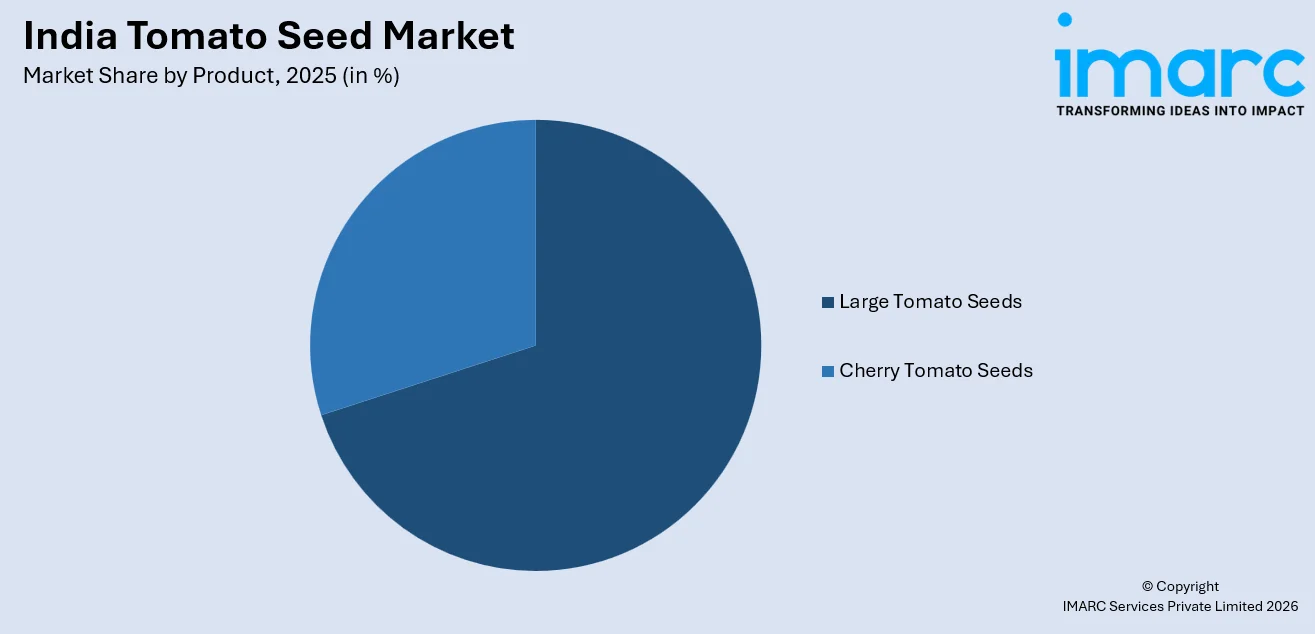
- By Product: Large tomato seeds lead the market with a share of 70% in 2025, reflecting the strong consumer and commercial preference for standard-sized tomatoes in fresh and processed food applications.
- Key Players: The India tomato seed market is moderately fragmented with both multinational and domestic seed companies competing through extensive R&D, robust distribution networks, and farmer outreach programs to strengthen their positions across diverse regional markets.
To get more information on this market Request Sample
The India tomato seed market is shaped by the growing need to improve crop productivity, quality consistency, and resilience across diverse agro-climatic zones. Increasing adoption of hybrid and improved open-pollinated varieties reflects farmers’ focus on higher yields, uniform fruit size, and better resistance to pests and diseases. For instance, World Vegetable Center is advancing tomato breeding in India through heat- and disease-resistant varieties using gene pyramiding, multi-location trials, and market-aligned research, aiming to boost productivity, processing potential, and farmer profitability amid rising climate and disease pressures. Demand is further supported by the expansion of commercial vegetable farming, contract cultivation, and year-round tomato production to serve fresh consumption and processing needs. Seed companies are investing in localized varietal development to address challenges related to heat stress, erratic rainfall, and soil variability. At the same time, farmers remain sensitive to input costs, influencing purchasing decisions and varietal selection. Strengthening extension services, improved access to certified seeds, and ongoing innovation in breeding programs are expected to play a critical role in supporting the steady development of the India tomato seed market over the medium term.
India Tomato Seed Market Trends:
Rising Adoption of Hybrid Seeds
Growing preference for hybrid varieties is reshaping the India tomato seed market as farmers prioritize higher yields, uniform fruit quality, and improved resistance to diseases. Hybrids support better productivity per acre and more predictable harvests, which is critical for commercial cultivation. Seed developers are focusing on traits such as shelf life, transport tolerance, and adaptability to varied climates. Indian Agricultural Research Institute introduced high-yielding tomato varieties Pusa Rakshit, Pusa Tomato Hybrid-1, Pusa Cherry-1, and Pusa Golden Cherry Tomato-2, enabling Indian farmers using protected cultivation to earn up to INR 1.3 Lakh from 1,000 square metres through extended harvest cycles, disease tolerance, and premium market access. This shift enhances farm incomes, supports supply stability, and encourages wider adoption of advanced seed technologies across regions and modern farming practices.
Growth Of Protected Cultivation Practices
The expansion of protected cultivation is also positively impacting the India tomato seed market. There is a rising demand for tomato varieties that are used in polyhouses and greenhouses. Seeds that have consistent growth patterns, disease resistance, and fruiting cycles are in demand in these controlled environments. This is helping to promote productivity, reducing the impact of adverse weather conditions, and improving resource utilization. Seed manufacturers are now developing special hybrids that are designed to perform in these environments, allowing farmers to produce premium quality output and gain better prices for their produce in these areas that have high demand.
Region Focused Breeding Strategies Development
Increased focus on region-specific breeding is strengthening the India tomato seed market by addressing diverse climatic and soil conditions. Seed producers are tailoring varieties to local growing cycles, pest pressures, and water availability. This approach improves crop performance, reduces yield volatility, and enhances farmer confidence. Localized breeding also supports faster adoption among small and medium growers. For instance, Scientists at Bihar Agricultural University, Bhagalpur, have developed open-field cherry tomato varieties suited to eastern Indo-Gangetic climates. Designed for affordability and scalability, the high-value tomatoes support crop diversification, target domestic and export markets, and aim to bridge the gap between lab research and farmer adoption through wider field trials. Over time, this trend contributes to sustainable productivity gains, balanced regional supply, and improved resilience of tomato cultivation systems across key producing regions.
Market Outlook 2026-2034:
The India tomato seed market outlook remains positive, supported by rising vegetable consumption, expanding protected cultivation, and increasing adoption of hybrid and disease-resistant seeds. Climate variability and yield risks are encouraging farmers to invest in improved genetics. Government support for horticulture, better seed distribution networks, and growing processing demand is expected to sustain steady market growth over the medium term. The market generated a revenue of INR 53.80 Million in 2025 and is projected to reach a revenue of INR 101.40 Million by 2034, growing at a compound annual growth rate of 7.30% from 2026-2034.
India Tomato Seed Market Report Segmentation:
| Segment Category | Leading Segment | Market Share |
|---|---|---|
|
Type |
Hybrids |
65% |
|
Product |
Large Tomato Seeds |
70% |
Type Insights:
- Hybrids
- Open-Pollinated Varieties
The hybrids dominate with a market share of 65% of the total India tomato seed market in 2025.
Hybrid varieties dominate the India tomato seed market due to their superior yield potential, uniform fruit quality, and stronger resistance to diseases compared to open-pollinated seeds. Commercial growers increasingly prefer hybrids to achieve higher productivity per hectare, predictable harvest cycles, and better market realization. The ability of hybrid seeds to perform consistently under varied climatic conditions further supports their widespread adoption across both open-field and protected cultivation systems in major producing regions.
The dominance of hybrids is also reinforced by rising demand from processing units, organized retail, and export-oriented supply chains that require standardized size, color, and shelf life. Seed companies continue to invest in region-specific hybrid development to address local pest pressures and soil conditions. This has improved farmer confidence, accelerated replacement rates, and strengthened the commercial seed ecosystem, making hybrids the largest and most commercially viable segment in the market.
Product Insights:
Access the comprehensive market breakdown Request Sample
- Large Tomato Seeds
- Cherry Tomato Seeds
Large tomato seeds lead with a share of 70% of the total India tomato seed market in 2025.
Large tomato seeds lead the India tomato seed market due to their widespread use in commercial farming and processing-oriented cultivation. These varieties are preferred for their higher yield potential, uniform fruit size, and compatibility with long-distance transportation. Large tomatoes are extensively used in fresh consumption, food service, and processing applications such as sauces and purees, supporting consistent demand across domestic supply chains and organized retail markets.
The segment’s leadership is further strengthened by strong adoption among medium and large-scale growers seeking predictable output and stable pricing. Seed developers continue to focus on improving disease tolerance, shelf life, and stress resistance in large tomato varieties. This ongoing innovation aligns with the needs of wholesalers, processors, and exporters, reinforcing the dominance of large tomato seeds as the most commercially significant segment in the India tomato seed market.
Growing Technology Insights:
- Open-Field
- Protected Cultivation
Open-field cultivation remains the most widely adopted growing technology in the India tomato seed market due to low capital requirements and suitability for small and marginal farmers. It supports large cultivation areas, seasonal production cycles, and broad regional adoption, though yields remain highly exposed to climate variability, pests, and price fluctuations.
Protected cultivation is gaining traction in the India tomato seed market as farmers seek higher productivity and income stability. Polyhouses and net houses enable year-round production, improved disease control, and better fruit quality. This technology supports premium tomato varieties, off-season supply, and stronger integration with organized retail and export channels.
Regional Insights:
- North India
- West and Central India
- South India
- East India
North India plays a vital role in the India tomato seed market, supported by strong demand from Uttar Pradesh, Haryana, Punjab, and Rajasthan. Seasonal cultivation dominates, with rising adoption of hybrids for higher yields. Price volatility, climate stress, and post-harvest losses continue influencing farmer seed selection decisions nationwide trends.
West and Central India represent a major production belt in the India tomato seed market, led by Maharashtra, Madhya Pradesh, and Gujarat. Hybrid seed penetration is high due to commercial farming practices. Access to irrigation, processing demand, and organized markets supports acreage expansion and steady adoption of improved tomato varieties.
South India is an advanced region within the India tomato seed market, anchored by Andhra Pradesh, Karnataka, and Tamil Nadu. Farmers actively adopt hybrid and disease resistant seeds. Favorable climate, multiple growing seasons, and strong processing demand enable high productivity, making the region a key contributor to national tomato output.
East India remains an emerging segment of the India tomato seed market, with Bihar, West Bengal, and Odisha as key contributors. Open field cultivation dominates, though hybrid adoption is rising. Improving irrigation access, market linkages, and awareness of quality seeds is enhancing yields and commercial viability for regional tomato growers.
.jpeg)
Market Dynamics:
Growth Drivers:
Why is the India Tomato Seed Market Growing?
Expanding Tomato Consumption Demand
Rising consumption of tomatoes across fresh, processed, and foodservice segments is a core growth driver for the India tomato seed market. India remains the world’s second-largest tomato producer, contributing over 11 percent of domestic vegetable output. In 2024–25, production reached 194.68 lakh tonnes across 7.37 lakh hectares. Urbanization, changing diets, and expanding quick-service restaurants are increasing year-round demand. This consumption growth pushes farmers to expand acreage and improve cropping intensity, directly supporting higher seed usage. Processing demand for sauces, pastes, and ready-to-eat foods further stabilizes offtake expectations, encouraging planned cultivation cycles and consistent seed purchasing decisions among commercial and semi-commercial growers across emerging regional vegetable supply chains and modern retail networks.
Increasing Private Investment and Commercialization
With the increase in private sector investments in the Indian market, the India tomato seed market is moving at a fast pace. The entry of seed companies into the Indian seed industry helps in the availability of products and supply. Competitive brand presence and strong dealer networks help in building farmer confidence. At the same time, the increase in export demand for fresh and processed tomatoes is creating quality requirements for the Indian seed industry. This commercialization of the Indian seed industry encourages farmers to use certified seeds, thereby fueling growth and creating revenue visibility for seed companies.
Supportive Agricultural Infrastructure and Policies
Improving agricultural infrastructure and policy support are driving sustained expansion of the India tomato seed market. Investments in irrigation coverage, cold storage, and rural logistics reduce post-harvest losses and improve farm level profitability. As production risks decline, growers are more willing to invest in quality seeds each season. Extension programs and digital advisory platforms also strengthen agronomic awareness, enabling better crop planning. For instance, Union Minister Ravneet Singh Bittu called for collaboration between Ministry of Food Processing Industries, Punjab Agricultural University, Punjab Agro, and Hindustan Unilever Limited to boost tomato production and local paste manufacturing in Punjab, improving farmer incomes and reducing import dependence. This supportive ecosystem encourages repeat seed purchases, expands organized distribution channels, and reinforces long term confidence in commercial tomato cultivation across diverse producing states nationwide consistently overall.
Market Restraints:
What Challenges the India Tomato Seed Market is Facing?
Climate Variability and Production Risk
Climate variability remains a major challenge for the India tomato seed market, as irregular rainfall, heat stress, and sudden temperature shifts directly affect germination and crop performance. Unpredictable weather increases yield risk, discouraging investment in premium seeds. Frequent crop losses also disrupt planting cycles, reduce farmer confidence, and complicate long term demand planning for seed producers across diverse growing regions.
Farmer Price Sensitivity Constraints
High price sensitivity among small and marginal farmers constrains growth of the India tomato seed market. Limited purchasing power encourages reuse of saved seeds or lower quality alternatives. This behavior restricts adoption of improved varieties, slows volume expansion, and creates demand volatility. Seed companies face pressure to balance affordability with investment recovery, affecting innovation pace and distribution reach nationwide operations.
Supply Chain and Access Limitations
Fragmented supply chains and uneven access to quality inputs present challenges for the India tomato seed market. Inconsistent dealer coverage and limited cold storage reduce seed availability in remote areas. Weak extension supports further limits proper usage. These gaps result in uneven performance outcomes, lower repeat purchases, and slower market penetration across less developed agricultural regions with persistent structural inefficiencies.
Competitive Landscape:
The competitive landscape of the India tomato seed market is moderately fragmented, with a mix of multinational seed companies, domestic players, and regional breeders competing across hybrid and open pollinated segments. Competition is driven by product differentiation, localized varietal portfolios, and agronomic support services rather than price alone. Companies focus on strengthening dealer networks, farmer engagement programs, and trial demonstrations to build brand loyalty. Continuous investment in breeding capabilities and intellectual property protection is essential to maintain market positioning and defend share against emerging regional competitors.
Recent Developments:
- In February 2026, Mysuru hosted the three-day 6th Kisan Swaraj Sammelan, showcasing India’s seed biodiversity through rare tubers, traditional grains, and colourful tomato varieties. Over 50 seed conservers, organic stalls, and live demonstrations highlighted chemical-free farming, urban gardening, traditional foods, and indigenous practices, drawing farmers, tourists, and sustainability advocates from across the country.
- In October 2025, Scientists at Chaudhary Sarwan Kumar Himachal Pradesh Krishi Vishvavidyalaya, Palampur, have developed two wilt-resistant tomato varieties, Him Palam Tamatar-1 and Tamatar-2. Designed to combat bacterial wilt, the high-yielding varieties are expected to revive tomato cultivation, improve farmer incomes, and strengthen Himachal Pradesh’s vegetable economy once approved for release.
India Tomato Seed Market Report Coverage:
| Report Features | Details |
|---|---|
| Base Year of the Analysis | 2025 |
| Historical Period | 2020-2025 |
| Forecast Period | 2026-2034 |
| Units | Million INR |
| Scope of the Report |
Exploration of Historical Trends and Market Outlook, Industry Catalysts and Challenges, Segment-Wise Historical and Future Market Assessment:
|
| Types Covered | Hybrids, Open-Pollinated Varieties |
| Products Covered | Large Tomato Seeds, Cherry Tomato Seeds |
| Growing Technologies Covered | Open-Field, Protected Cultivation |
| Region Covered | North India, West and Central India, South India, East India |
| Customization Scope | 10% Free Customization |
| Post-Sale Analyst Support | 10-12 Weeks |
| Delivery Format | PDF and Excel through Email (We can also provide the editable version of the report in PPT/Word format on special request) |
Frequently Asked Questions About the India Tomato Seed Market Report
The India tomato seed market size was valued at INR 53.80 Million in 2025.
The India tomato seed market is expected to grow at a compound annual growth rate of 7.30% from 2026-2034 to reach INR 101.40 Million by 2034.
Hybrids held the largest market share at 65%, driven by their superior yield potential, enhanced disease resistance, and improved fruit uniformity demanded by both commercial growers and food processors across India.
Key factors driving the India tomato seed market include surging demand from the food processing industry, government subsidies and quality initiatives, expanding protected cultivation, adoption of precision farming technologies, and rising domestic consumption.
Major challenges include the high cost of hybrid seeds for smallholder farmers, a fragmented supply chain with distribution inefficiencies, persistent pest and disease pressure, and limited awareness among farmers in remote regions.
Need more help?
- Speak to our experienced analysts for insights on the current market scenarios.
- Include additional segments and countries to customize the report as per your requirement.
- Gain an unparalleled competitive advantage in your domain by understanding how to utilize the report and positively impacting your operations and revenue.
- For further assistance, please connect with our analysts.
 Request Customization
 Speak to an Analyst
 Request Brochure
 Inquire Before Buying
Benefits of Customization
- Personalize this research
- Triangulate with your data
- Get data as per your format and definition
- Gain a deeper dive into a specific application, geography, customer, or competitor
- Any level of personalization
Get in Touch With Us
UNITED STATES
Phone: +1-201-971-6302
INDIA
Phone: +91-120-433-0800
UNITED KINGDOM
Phone: +44-753-714-6104
Email: [email protected]
Client Testimonials




.webp)




.webp)













Related Reports

Choose your plan
*Please note that the prices mentioned below are starting prices for each bundle type. Kindly contact our team for further details.*
Single User License
- 1 User License, Access on 2 Devices
- PDF Report + Excel Dataset (Password Protected)
- Lifetime Access
- No Printing Rights
- 10% Free Report Customization
- 10–12 Weeks of Analyst Support
Five User License
- Access for 5 Users, 2 Devices per User
- PDF Report + Excel Dataset (Password Protected)
- Lifetime Access
- Dedicated Account Manager
- 12–14 Weeks of Analyst Support
- No Printing Rights
- 15% Free Report Customization
- 25% Discount on Your Next Purchase
Corporate User License
- Unlimited User Access (Within Your Organization)
- PDF Report + Excel Dataset
- Lifetime Access
- Dedicated Account Manager
- 14–20 Weeks of Analyst Support
- No Printing Rights
- 20% Free Report Customization
- 30% Discount on Your Next Purchase
Essential Insights
What's included:
3 reports
- Lifetime Access
- PDF Reports
- Excel Datasets
- 2 Weeks of Free Analyst Support
- 2 User Licenses
- Access on 2 Devices
- Printing Rights
- Complimentary PowerPoint (PPT) Version
- Complimentary License Upgrade
Professional Access
What's included:
5 reports
- Lifetime Access
- PDF Reports
- Excel Datasets
- 8 Weeks of Free Analyst Support
- 2 User Licenses
- Access on 2 Devices
- Printing Rights
- Complimentary PowerPoint (PPT) Version
- Complimentary License Upgrade
Business Advantage
What's included:
8 reports
- Lifetime Access
- PDF Reports
- Excel Datasets
- 14 Weeks of Free Analyst Support
- 2 User Licenses
- Access on 2 Devices
- Printing Rights
- Complimentary PowerPoint (PPT) Version
- Complimentary License Upgrade
Enterprise Intelligence
What's included:
10 reports
- Lifetime Access
- PDF Reports
- Excel Datasets
- 20 Weeks of Free Analyst Support
- 2 User Licenses
- Access on 2 Devices
- Printing Rights
- Complimentary PowerPoint (PPT) Version
- Complimentary License Upgrade