
India Vertical Farming Market Size, Share, Trends and Forecast by Component, Structure, Growth Mechanism, Application, and Region, 2026-2034
India Vertical Farming Market Summary:
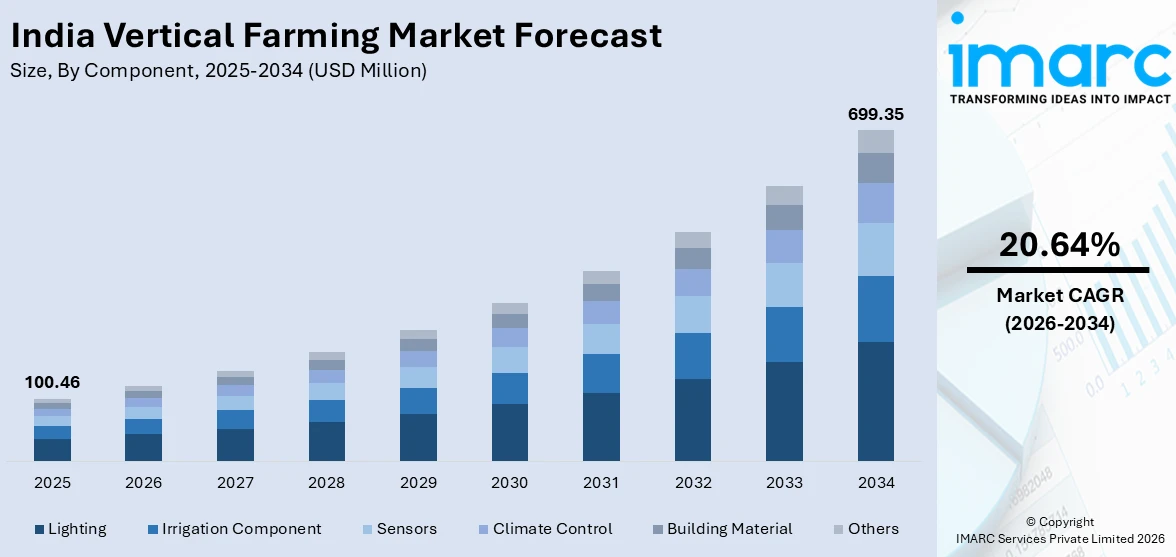
The India vertical farming market size was valued at USD 100.46 Million in 2025 and is projected to reach USD 699.35 Million by 2034, growing at a compound annual growth rate of 20.64% during 2026-2034.
The India vertical farming market is driven by increasing pressure on agricultural land, rising urban food demand, and the need for efficient farming systems that use fewer natural resources. Vertical farming enables year-round crop production with controlled environments, optimized water usage, and reduced dependence on seasonal conditions. The growing interest in pesticide-free produce, urban agriculture initiatives, and technological advancements in hydroponics and light-emitting diode (LED) lighting are encouraging the adoption of vertical farming solutions across commercial agriculture and urban food supply systems in India.
Key Takeaways and Insights:
- By Component: Lighting dominates the market with a share of 29.0% in 2025, driven by widespread adoption of energy-efficient LED grow lights delivering precise light spectrums that optimize plant growth cycles across controlled indoor farming environments throughout India.
- By Structure: Building-based vertical farms lead the market with a share of 64.0% in 2025, owing to their superior scalability, seamless integration with climate control infrastructure, and capacity to support large-scale commercial crop production within urban and peri-urban settings.
- By Growth Mechanism: Hydroponics represents the largest segment with a market share of 58.0% in 2025, attributed to its water-use efficiency, high crop yield potential, and cost-effectiveness in delivering precisely calibrated nutrients directly to plant root zones without requiring soil.
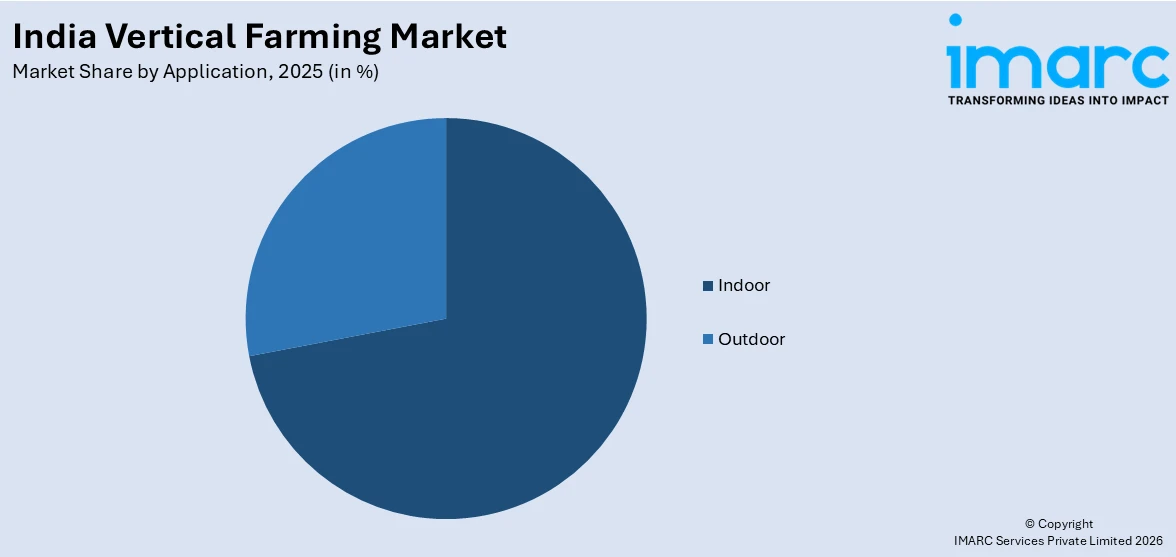
- By Application: Indoor dominates the market with a share of 72.0% in 2025. This dominance is because of year-round production capability, independence from external climate conditions, and the ability to maintain precise environmental controls for consistent crop quality.
- By Region: South India leads the market with a share of 36.0% in 2025, supported by a thriving agri-tech startup ecosystem concentrated in Bengaluru, Hyderabad, and Chennai, alongside well-developed technological infrastructure and high urban consumer awareness of sustainable produce.
- Key Players: The India vertical farming market features a moderately competitive landscape, comprising domestic agri-tech startups and internationally backed enterprises advancing hydroponic, aeroponic, and building-based farming technologies across major urban centers.
To get more information on this market Request Sample
The vertical farming sector in India is gaining substantial momentum as the country confronts pressing agricultural challenges including shrinking arable land, water scarcity, and escalating food demand from a rapidly expanding urban population. Rapid urbanization is reducing cultivable land around major cities while consumer demand for fresh, pesticide-free produce continues to rise. Vertical farming addresses these pressures by enabling high-density crop cultivation in controlled environments that use significantly less land and water compared to conventional farming methods. The technology also supports year-round production, reducing dependence on seasonal cycles and improving supply stability for urban markets. Government support is further strengthening adoption. In 2024, the Government of India planned to expand the Mission for Integrated Development of Horticulture (MIDH) by adding hydroponics, aquaponics, vertical farming, and precision agriculture. The move aimed to promote modern cultivation techniques and strengthen production of fruits, vegetables, and other horticulture crops. The agriculture ministry also initiated revisions to MIDH guidelines and cost norms, proposing higher financial assistance to encourage farmers and agritech companies to adopt advanced farming systems nationwide.
India Vertical Farming Market Trends:
Rising Development of Affordable Farm Automation Technologies
The increasing development of affordable automation technologies is supporting the operational efficiency and scalability of vertical farming systems in India. Automated control systems that regulate climate conditions, irrigation cycles, nutrient delivery, and lighting help maintain stable growing environments while reducing manual intervention. These technologies improve crop productivity, optimize resource usage, and minimize operational errors in controlled-environment agriculture. Lower-cost automation solutions designed specifically for local farming conditions are also making advanced cultivation systems more accessible to startups and commercial growers. As automation becomes more affordable and adaptable to Indian agricultural settings, it is encouraging wider adoption of vertical farming technologies across urban farming operations. For instance, in 2025, Indian startup 4Climate introduced cost-efficient automation systems for vertical farms and greenhouses that use IoT technology to automatically manage climate, irrigation, and nutrient levels within controlled cultivation environments.
Increasing Government Financial Support for Advanced Farming Infrastructure
Government-backed financial assistance programs are encouraging the adoption of vertical farming technologies by reducing the capital barriers associated with establishing controlled-environment agriculture systems. Modern farming infrastructure, such as hydroponic setups, aeroponic systems, and climate-controlled vertical farms, often require significant initial investment in equipment and facilities. Financial incentives, subsidized loans, and infrastructure development programs help farmers, startups, and agripreneurs access the resources required to adopt these advanced farming models. Supportive policy initiatives also aim to improve agricultural productivity, strengthen food security, and promote sustainable farming practices. In line with this, in 2025, the Government of India extended financial support for vertical farming under the Agriculture Infrastructure Fund (AIF), offering loans up to INR 2 Crore with a 3% interest subsidy. The scheme supported investments in vertical farming, hydroponics, aeroponics, and polyhouse systems to encourage modern and sustainable agriculture. The initiative aimed to help farmers, startups, and agripreneurs adopt advanced farming technologies and improve agricultural productivity.
Growing Investment in Controlled-Environment Agriculture Ventures
Venture capital funding and private investments are enabling companies to develop advanced farming infrastructure, adopt new cultivation technologies, and expand production capacity. Controlled-environment agriculture allows producers to cultivate high-value crops under optimized growing conditions, which helps maintain consistent quality and supply throughout the year. Investments also support research, technology development, and the expansion of distribution networks for vertically farmed produce. For example, in 2025, Fragaria Fruits secured USD 2 Million in seed funding to expand premium berry production in India using controlled-environment agriculture. The company grew strawberries through vertical hydroponic farming systems and planned to scale operations in Bengaluru while adding blueberries and raspberries to its portfolio. The expansion aimed to strengthen year-round domestic supply of high-quality, sustainably grown fruits while improving production capacity and distribution across the Indian market.
Market Outlook 2026-2034:
The India vertical farming market is projected to record robust revenue growth throughout the forecast period owing to increasing investment in controlled environment agriculture and the growing demand for high-quality, locally produced fresh vegetables in urban areas. The market generated a revenue of USD 100.46 Million in 2025 and is projected to reach a revenue of USD 699.35 Million by 2034, growing at a compound annual growth rate of 20.64% from 2026-2034. The rising awareness about sustainable farming practices, efficient water use, and consistent crop yields is encouraging agritech companies and startups to adopt vertical farming technologies across major metropolitan regions in India.
India Vertical Farming Market Report Segmentation:
| Segment Category | Leading Segment | Market Share |
|---|---|---|
|
Component |
Lighting |
29.0% |
|
Structure |
Building-based Vertical Farms |
64.0% |
|
Growth Mechanism |
Hydroponics |
58.0% |
|
Application |
Indoor |
72.0% |
|
Region |
South India |
36.0% |
Component Insights:
- Irrigation Component
- Lighting
- Sensors
- Climate Control
- Building Material
- Glass Greenhouse
- Plastic Greenhouse
- Others
Lighting dominates with a market share of 29.0% of the total India vertical farming market in 2025.
The lighting segment holds the biggest market share as LED grow lights constitute one of the most critical and frequently upgraded components in vertical farming operations. These systems deliver the precise wavelengths required by plants across different growth stages, ranging from seed germination through to harvest, enabling farm operators to customize light intensity and photoperiod duration for specific crop varieties. The adoption of full-spectrum LED technology significantly improves crop quality and accelerates growth cycles. India's rapidly expanding commercial vertical farm base is generating consistent and increasing demand for advanced lighting solutions that combine spectral precision with energy efficiency.
The increasing adoption of energy-efficient LED lighting systems is supporting the operational viability of vertical farming in India by reducing electricity usage and improving crop productivity. Lighting represents a major cost component in indoor farming operations, making energy-efficient technologies essential for long-term scalability. In 2025, Polymatech Electronics introduced its Ravaye™ horticulture LED product range designed for greenhouse and vertical farming applications, offering full-spectrum lighting that supports faster photosynthesis, improved plant health, and enhanced crop nutrition. The entry of domestic technology manufacturers into the horticulture lighting segment is helping reduce equipment costs while encouraging wider adoption of LED-based cultivation systems across commercial and modular vertical farms.
Structure Insights:
- Building-based Vertical Farms
- Container-based Vertical Farms
Building-based vertical farms lead with a market share of 64.0% of the total India vertical farming market in 2025.
Building-based vertical farms maintain their leading market position by offering the highest degree of scalability and infrastructure integration for commercial-scale food production. These facilities are constructed within repurposed warehouses, dedicated agricultural buildings, and purpose-built structures that accommodate multi-story growing systems, advanced climate control equipment, and large-scale hydroponic or aeroponic installations. India's growing availability of underutilized commercial real estate in peri-urban areas is supporting the conversion of such spaces into productive vertical farming facilities, effectively lowering infrastructure development costs for market entrants and enabling accessible market participation.
Building-based vertical farms also enable operators to implement fully integrated production ecosystems encompassing crop cultivation, processing, packaging, and storage within a single controlled facility. This end-to-end operational model reduces post-harvest losses, minimizes transportation costs, and ensures superior produce freshness for urban consumers. The Mission for Integrated Development of Horticulture (MIDH) framework supports greenhouse and protected cultivation structures through credit-linked subsidies, further incentivizing investment in building-based vertical farming infrastructure. As capital availability improves and construction costs moderate, this segment is expected to sustain its dominant market position.
Growth Mechanism Insights:
- Hydroponics
- Aeroponics
- Aquaponics
Hydroponics exhibits a clear dominance with a 58.0% share of the total India vertical farming market in 2025.
Hydroponics commands the largest share of India's vertical farming market owing to its technological maturity, cost-effectiveness, and well-established agronomic applications across a wide range of crop varieties. The system delivers nutrients directly to plant root zones through precisely calibrated water-based solutions, eliminating soil requirements while achieving high water-use efficiency. India's chronic water scarcity challenges and declining arable land availability make hydroponic systems particularly well-suited to the national agricultural context, enabling high-value crop production, including leafy greens, herbs, and tomatoes, with significantly reduced environmental impact across diverse geographic settings.
The growing adoption of hydroponic cultivation systems is supporting the expansion of vertical farming in India due to their scalability, efficient resource use, and compatibility with controlled-environment agriculture technologies. Hydroponic systems integrate effectively with automated nutrient delivery and monitoring technologies, allowing producers to maintain consistent crop growth and optimize production efficiency. In 2025, Chaudhary Sarwan Kumar Himachal Pradesh Krishi Vishvavidyalaya launched a hydroponics training program under the Rashtriya Krishi Vikas Yojna (RKVY) to promote sustainable vegetable cultivation and year-round production. Such initiatives are strengthening technical awareness and encouraging farmers and agripreneurs to adopt hydroponic farming systems across the country.
Application Insights:
Access the comprehensive market breakdown Request Sample
- Indoor
- Outdoor
Indoor dominates with a market share of 72.0% of the total India vertical farming market in 2025.
Indoor leads the market attributed to the high need for enclosed, climate-controlled environments to enable year-round crop production entirely independent of external weather conditions and seasonal variations. This is particularly valuable in India, where monsoon variability and extreme heat events can significantly disrupt traditional agricultural production cycles. Indoor vertical farms ensure consistent crop output throughout the year, supporting stable supply chains for urban food retailers, restaurant chains, and direct-to-consumer (DTC) delivery platforms. The controlled environment eliminates pesticide requirements, enabling operators to produce premium, chemical-free produce commanding higher price points in health-conscious urban markets.
The indoor application segment additionally benefits from India's expanding urban consumer base, which increasingly demands fresh, locally sourced, and traceable food products. Indoor vertical farms located within or adjacent to urban centers dramatically shorten farm-to-table supply chains, ensuring superior produce freshness compared to conventionally transported agricultural products. The progressive integration of advanced automation technologies, including robotic harvesting systems and AI-driven environmental controls, within indoor vertical farming installations is reducing operational costs and improving production efficiency, making the indoor application model commercially viable across a growing range of scale points in cities, such as Mumbai, Delhi, and Bengaluru.
Regional Insights:
- North India
- West and Central India
- South India
- East India
South India leads with a market share of 36.0% of the total India vertical farming market in 2025.
South India dominates the market owing to its strong presence of agritech startups, advanced greenhouse infrastructure, and higher adoption of modern farming technologies. States, such as Karnataka, Tamil Nadu, and Telangana, are becoming important hubs for controlled environment agriculture supported by research institutions and technology incubators. Urban centers in the region are witnessing higher demand for fresh, pesticide-free vegetables, encouraging entrepreneurs to establish indoor farms close to usage areas. Favorable climatic conditions for year-round production and better access to skilled technical workforce also support the adoption of hydroponic and aeroponic systems. These factors collectively strengthen South India’s position as a key region for vertical farming development.
The region’s leadership is further supported by rapid urbanization and rising consumer awareness regarding sustainable and locally grown food products. Large metropolitan cities, including Bengaluru, Hyderabad, and Chennai, have dense populations with the growing demand for premium quality leafy greens and specialty crops. Vertical farming operations allow producers to supply these products directly to urban markets while reducing transportation time and post-harvest losses. In addition, the presence of technology-driven agricultural startups and venture capital interest in agritech innovation is encouraging the expansion of indoor farming facilities. Government initiatives promoting water-efficient agriculture and smart farming solutions also support the establishment of vertical farming systems across South India’s major urban corridors.

Market Dynamics:
Growth Drivers:
Why is the India Vertical Farming Market Growing?
Rapid Urbanization Driving Demand for Localized Food Production
India's accelerating urbanization is creating an urgent need for space-efficient food production systems capable of meeting the nutritional demands of densely populated metropolitan areas. The World Bank data indicated that approximately 36.87% of India’s total population resided in urban areas in 2024, making the localization of food production increasingly critical for sustaining urban food supply chains. Traditional agriculture, typically located in rural hinterlands, faces mounting logistical challenges in servicing urban markets efficiently and consistently throughout the year. Vertical farming addresses this structural demand gap by enabling high-yield crop production within or adjacent to urban centers, dramatically shortening farm-to-table distances and reducing post-harvest wastage.
Growing Integration of Digital and Smart Agriculture Technologies
The integration of digital technologies into agriculture is strengthening the technological foundation of vertical farming in India. Tools such as artificial intelligence, Internet of Things sensors, remote monitoring platforms, and data analytics systems enable farmers to monitor crop health, track environmental conditions, and manage farm operations with greater precision. These technologies improve decision-making by providing real-time insights into plant growth, nutrient levels, and resource consumption. Digital systems also support predictive maintenance and optimized resource allocation, which enhances operational efficiency within controlled farming environments. The growing use of smart agriculture technologies is enabling vertical farming operators to improve productivity and maintain consistent crop quality. In 2024, the Telecommunication Engineering Centre of the Department of Telecommunications, in collaboration with ICAR, hosted a workshop on digital agriculture and highlighted the role of AI, IoT, and smart greenhouse technologies in modern farming systems.
Rising Demand for Fresh and High-Quality Produce
Changing dietary patterns and the growing health awareness among urban consumers are catalyzing the demand for fresh, pesticide-free, and nutritionally rich fruits and vegetables. Consumers are increasingly prioritizing food safety, quality, and traceability, particularly in metropolitan areas where traditional supply chains often involve long transportation periods and multiple intermediaries. Vertical farming enables controlled cultivation conditions that reduce exposure to pests, contaminants, and chemical inputs. This approach supports the production of consistent and high-quality crops throughout the year. The ability to supply fresh produce directly to nearby markets also helps maintain product freshness and nutritional value, making vertical farming an attractive solution for meeting evolving consumer preferences.
Market Restraints:
What Challenges the India Vertical Farming Market is Facing?
High Initial Capital Expenditure Limiting Market Entry
Establishing commercial vertical farms requires substantial upfront investment in LED lighting systems, hydroponic or aeroponic equipment, climate control infrastructure, sensor networks, and building structures. These capital requirements present significant entry barriers for small and medium-scale entrepreneurs, particularly in smaller Indian cities where financing access is more constrained. Despite available MIDH subsidies covering a portion of costs, the residual capital burden continues to restrict broader market participation and entrepreneurial diversification throughout India's vertical farming sector.
Energy Dependency Creating Operational Cost Pressures
Vertical farming operations are inherently energy-intensive, with lighting and climate control systems constituting the largest components of recurring operational expenditure. In India, where electricity supply reliability varies significantly across regions and energy tariffs remain relatively elevated, this dependency creates persistent cost pressures that can adversely affect the profitability of vertical farming ventures. The challenge is particularly pronounced in locations outside major metropolitan centers where grid infrastructure is less stable and energy costs are less predictable.
Skill Gap and Technical Expertise Shortage Constraining Industry Scaling
Effective vertical farm operation requires specialized multidisciplinary expertise spanning agronomy, automation engineering, data analytics, climate systems management, and plant science. India currently faces a shortage of trained professionals with this integrated skill set, limiting the operational quality and scaling capacity of vertical farming enterprises. The absence of structured educational and vocational training programs specifically designed for controlled-environment agriculture is exacerbating this expertise gap, presenting a meaningful structural constraint on accelerated market expansion.
Competitive Landscape:
The India vertical farming market features a moderately fragmented competitive structure, encompassing domestic agri-tech startups, internationally affiliated technology partners, and diversified agricultural enterprises. Market participants are differentiating through proprietary hydroponic system designs, AI-integrated crop management platforms, and geographic expansion of urban farm networks. The Bengaluru and Hyderabad corridors serve as primary innovation hubs, hosting pioneering vertical farming enterprises that have introduced modular, scalable farming models tailored to Indian urban consumers. Competitive strategies increasingly emphasize direct-to-consumer subscription models, farm-to-table delivery commitments, and sustainability credentials to capture premium market segments while managing infrastructure costs.
Recent Developments:
- October 2025: IIT Madras hosted the ‘Ideas to Impact’ challenge where student teams presented eco-friendly innovations, including vertical tower farming systems designed for urban food production. The initiative, led by the Sustainability Venture Studio, supported young innovators in converting sustainability ideas into practical technologies addressing environmental challenges. Selected teams receive funding, mentorship, and incubation support to further develop solutions such as vertical farming, solar technologies, and biodegradable materials.
- February 2025: The Government of Goa introduced the Goa State Amrit Kaal Agricultural Policy 2025 to revitalise the state’s farming sector and encourage youth and women participation. The policy promoted climate-resilient farming methods, modern techniques, such as hydroponics and integrated farming, and supports cultivation of high-value crops. It also aimed to strengthen supply chains, develop agri-tourism, and improve farmer welfare and income sustainability.
India Vertical Farming Market Report Coverage:
| Report Features | Details |
|---|---|
| Base Year of the Analysis | 2025 |
| Historical Period | 2020-2025 |
| Forecast Period | 2026-2034 |
| Units | Million USD |
| Scope of the Report |
Exploration of Historical Trends and Market Outlook, Industry Catalysts and Challenges, Segment-Wise Historical and Future Market Assessment:
|
| Components Covered |
|
| Structures Covered | Building-based Vertical Farms, Container-based Vertical Farms |
| Growth Mechanisms Covered | Hydroponics, Aeroponics, Aquaponics |
| Applications Covered | Indoor, Outdoor |
| Region Covered | North India, West and Central India, South India, East India |
| Customization Scope | 10% Free Customization |
| Post-Sale Analyst Support | 10-12 Weeks |
| Delivery Format | PDF and Excel through Email (We can also provide the editable version of the report in PPT/Word format on special request) |
Frequently Asked Questions About the India Vertical Farming Market Report
The India vertical farming market size was valued at USD 100.46 Million in 2025.
The India vertical farming market is expected to grow at a compound annual growth rate of 20.64% during 2026-2034 to reach USD 699.35 Million by 2034.
Lighting leads the market with a revenue share of 29.0% in 2025, driven by widespread adoption of energy-efficient LED grow lights delivering precise light spectrums that optimize plant growth cycles across controlled indoor farming environments throughout India.
Key factors driving the India vertical farming market include increasing venture capital funding and private investments supporting controlled-environment agriculture expansion. These investments enable advanced farming infrastructure and technology adoption. For example, in 2025, Fragaria Fruits secured USD 2 million in seed funding to scale vertical hydroponic berry production in Bengaluru.
Major challenges facing the India vertical farming market include high initial capital expenditure requirements for infrastructure setup, significant energy dependency creating operational cost pressures particularly in regions with unstable grid supply, and a shortage of trained technical professionals with the multidisciplinary expertise required for effective controlled-environment agriculture management.
Need more help?
- Speak to our experienced analysts for insights on the current market scenarios.
- Include additional segments and countries to customize the report as per your requirement.
- Gain an unparalleled competitive advantage in your domain by understanding how to utilize the report and positively impacting your operations and revenue.
- For further assistance, please connect with our analysts.
 Request Customization
 Speak to an Analyst
 Request Brochure
 Inquire Before Buying
Benefits of Customization
- Personalize this research
- Triangulate with your data
- Get data as per your format and definition
- Gain a deeper dive into a specific application, geography, customer, or competitor
- Any level of personalization
Get in Touch With Us
UNITED STATES
Phone: +1-201-971-6302
INDIA
Phone: +91-120-433-0800
UNITED KINGDOM
Phone: +44-753-714-6104
Email: [email protected]
Client Testimonials




.webp)




.webp)













Related Reports

Choose your plan
*Please note that the prices mentioned below are starting prices for each bundle type. Kindly contact our team for further details.*
Single User License
- 1 User License, Access on 2 Devices
- PDF Report + Excel Dataset (Password Protected)
- Lifetime Access
- No Printing Rights
- 10% Free Report Customization
- 10–12 Weeks of Analyst Support
Five User License
- Access for 5 Users, 2 Devices per User
- PDF Report + Excel Dataset (Password Protected)
- Lifetime Access
- Dedicated Account Manager
- 12–14 Weeks of Analyst Support
- No Printing Rights
- 15% Free Report Customization
- 25% Discount on Your Next Purchase
Corporate User License
- Unlimited User Access (Within Your Organization)
- PDF Report + Excel Dataset
- Lifetime Access
- Dedicated Account Manager
- 14–20 Weeks of Analyst Support
- No Printing Rights
- 20% Free Report Customization
- 30% Discount on Your Next Purchase
Essential Insights
What's included:
3 reports
- Lifetime Access
- PDF Reports
- Excel Datasets
- 2 Weeks of Free Analyst Support
- 2 User Licenses
- Access on 2 Devices
- Printing Rights
- Complimentary PowerPoint (PPT) Version
- Complimentary License Upgrade
Professional Access
What's included:
5 reports
- Lifetime Access
- PDF Reports
- Excel Datasets
- 8 Weeks of Free Analyst Support
- 2 User Licenses
- Access on 2 Devices
- Printing Rights
- Complimentary PowerPoint (PPT) Version
- Complimentary License Upgrade
Business Advantage
What's included:
8 reports
- Lifetime Access
- PDF Reports
- Excel Datasets
- 14 Weeks of Free Analyst Support
- 2 User Licenses
- Access on 2 Devices
- Printing Rights
- Complimentary PowerPoint (PPT) Version
- Complimentary License Upgrade
Enterprise Intelligence
What's included:
10 reports
- Lifetime Access
- PDF Reports
- Excel Datasets
- 20 Weeks of Free Analyst Support
- 2 User Licenses
- Access on 2 Devices
- Printing Rights
- Complimentary PowerPoint (PPT) Version
- Complimentary License Upgrade