
India Video Analytics Market Size, Share, Trends and Forecast by Component, Deployment Type, Application, Architecture Type, Organization Size, End User, and Region, 2026-2034
India Video Analytics Market Summary:
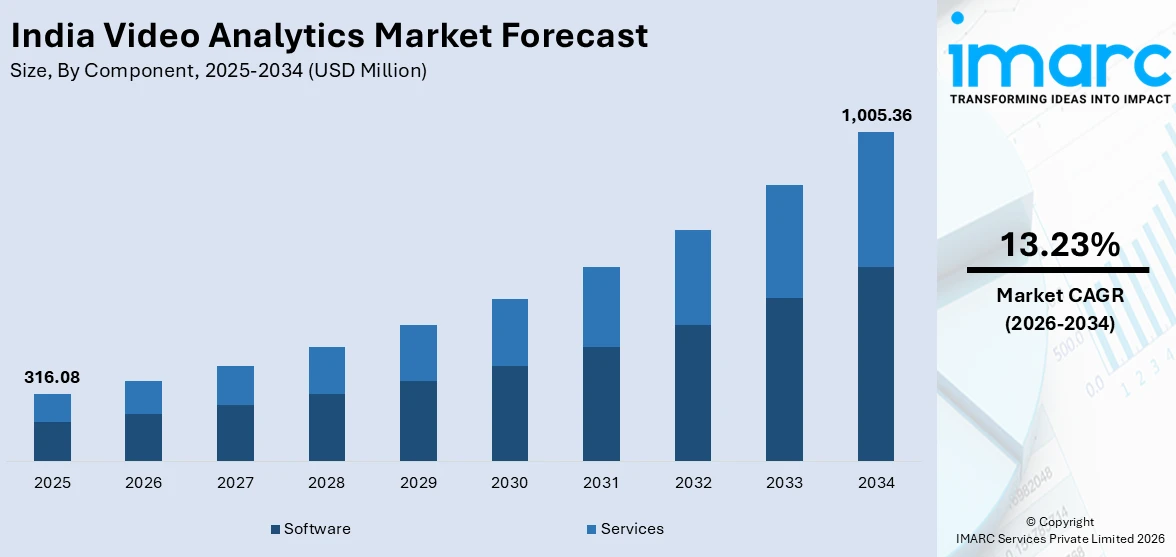
The India video analytics market size was valued at USD 316.08 Million in 2025 and is projected to reach USD 1,005.36 Million by 2034, growing at a compound annual growth rate of 13.23% from 2026-2034.
The market is driven by escalating demand for intelligent surveillance solutions, real-time monitoring capabilities, and data-driven security management across public and private sectors. Growing urbanization, heightened security awareness, and government-led digital infrastructure programs are collectively accelerating adoption of advanced video intelligence platforms. The increasing density of connected camera networks and enterprise focus on operational efficiency continue to reinforce momentum across the India video analytics market share.
Key Takeaways and Insights:
- By Component: Software dominates the market with a share of 72.0% in 2025, driven by intelligent video processing, real-time event detection, and actionable analytics critical for enterprise and government surveillance deployments.
- By Deployment Type: On-premises leads the market with a share of 68.0% in 2025, owing to data sovereignty priorities, compliance mandates, and enterprise preference for localized infrastructure ensuring uninterrupted surveillance operations
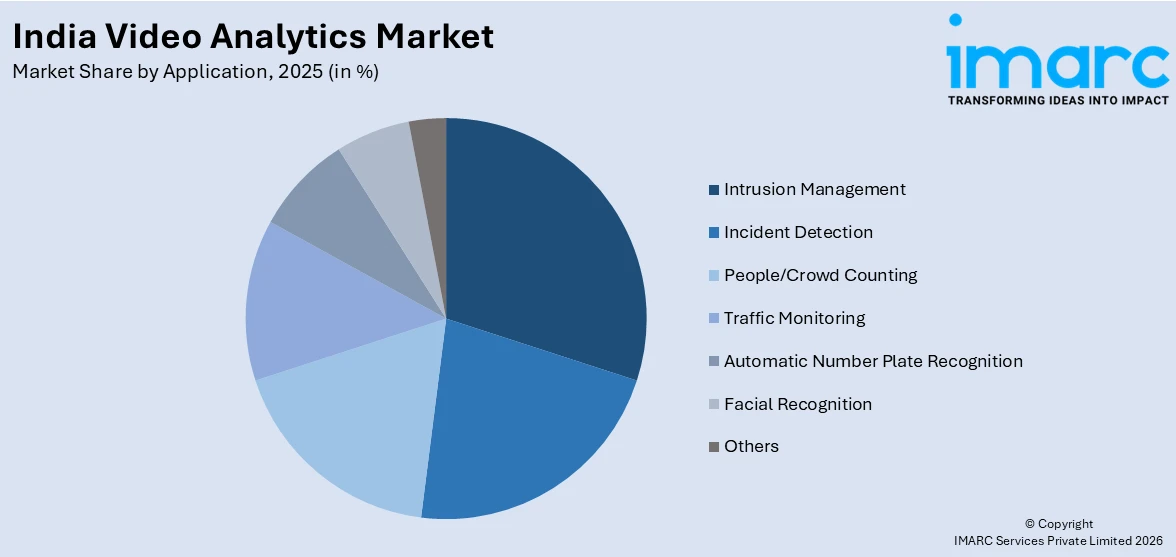
- By Application: Intrusion management represents the largest segment with a market share of 24.0% in 2025, driven by growing organizational focus on perimeter security, unauthorized access prevention, and automated threat detection across critical infrastructure.
- By Architecture Type: Edge-based dominates the market with a share of 55.0% in 2025, owing to low-latency processing needs, reduced bandwidth demands, and privacy compliance advantages of performing analytics within distributed surveillance environments.
- By Organization Size: Large enterprises represent the market with a share of 62.0% in 2025, driven by expansive surveillance infrastructures, considerable technology budgets, and sophisticated security demands requiring advanced multi-site camera management platforms.
- By End User: Traffic management leads the market with a share of 23.0% in 2025, owing to smart city initiatives, intelligent transportation deployments, and government demand for automated video intelligence enhancing urban mobility.
- By Region: West and Central India dominates the market with a share of 34.0% in 2025, driven by by dense industrial activity, commercial infrastructure, and metropolitan centers requiring advanced surveillance and intelligent operational monitoring solutions.
- Key Players: The India video analytics market features a mix of global technology providers and domestic solution vendors competing across specialized verticals. Vendors differentiate through artificial intelligence (AI) capabilities, edge computing expertise, vertical-specific solutions, and flexible deployment models serving enterprise, government, and industrial clients.
To get more information on this market Request Sample
The India video analytics market is experiencing robust expansion driven by a convergence of technological, regulatory, and operational forces reshaping surveillance and intelligence strategies across sectors. The rapid proliferation of camera networks across public and private domains is generating vast volumes of video data demanding intelligent automated processing. In July 2025, Delhi Police announced deployment of 3,500 AI-enabled surveillance cameras with facial recognition, automatic number-plate recognition, and real-time alert systems under the Safe City Project to strengthen urban monitoring and emergency response capabilities. Government-backed urban development frameworks are embedding video analytics as a core pillar of infrastructure planning, while enterprises across diverse verticals are adopting real-time intelligence platforms to strengthen security postures and streamline operations. Growing awareness of the operational value delivered by advanced analytics beyond conventional security applications is progressively broadening the buyer universe, creating diversified and sustained demand that reinforces the market's long-term growth trajectory across India's evolving economic landscape.
India Video Analytics Market Trends:
Artificial Intelligence Enhancing Real-Time Surveillance Intelligence
The integration of AI into video analytics platforms is redefining how organizations interpret and respond to surveillance data. Advanced machine learning (ML) models enable behavioral pattern recognition, anomaly detection, and predictive threat identification that transform passive camera networks into proactive intelligence systems. As per sources, in December 2025, CP Plus partnered with Qualcomm to launch AI-enabled video surveillance solutions in India using on-device edge AI processors and the Qualcomm Insight platform to deliver real-time video analytics for industrial and public safety applications.
Smart City Infrastructure Driving Widespread Video Analytics Adoption
India's urban development agenda is emerging as a powerful structural catalyst for sustained video analytics deployment across public infrastructure. Municipal authorities are embedding intelligent video platforms within transportation networks, public spaces, and civic facilities to enhance safety, optimize mobility, and streamline emergency response coordination. In January 2025, the Prayagraj Municipal Corporation deployed over 2,700 CCTV cameras, including more than 400 AI-enabled systems, to manage traffic, crowd movement, sanitation, and public safety during the Mahakumbh event. Interconnected camera networks generate continuous data requiring advanced analytics, while successful smart city models encourage smaller municipalities to adopt intelligent surveillance systems.
Edge Computing Transforming Distributed Video Analytics Architectures
The shift toward edge computing is fundamentally reshaping how video analytics platforms are architected and deployed across India. Processing video data at the point of capture rather than routing it to centralized servers delivers lower latency, reduced bandwidth consumption, and stronger privacy compliance essential for time-sensitive applications. In December 2025, Sparsh CCTV introduced its SQ Series cyber-secure cameras and a Qualcomm-powered Edge AI Box at IFSEC India 2025, enabling real-time video analytics such as facial recognition and behavioral detection directly on devices without relying on cloud processing. As edge hardware and efficient AI models advance, organizations are adopting distributed surveillance systems delivering reliable analytics across diverse locations with varying connectivity conditions.
Market Outlook 2026-2034:
The India video analytics market is poised for sustained and accelerating growth through the forecast period, supported by deepening technology adoption across government, enterprise, and industrial sectors. Expanding smart city programs, growing private sector security investments, and the continued maturation of edge and cloud-native analytics platforms are expected to consistently drive market expansion. As organizations increasingly recognize video analytics as a strategic operational intelligence tool rather than a purely security-oriented investment, the market's long-term growth potential continues to strengthen considerably. The market generated a revenue of USD 316.08 Million in 2025 and is projected to reach a revenue of USD 1,005.36 Million by 2034, growing at a compound annual growth rate of 13.23% from 2026-2034.
India Video Analytics Market Report Segmentation:
| Segment Category | Leading Segment | Market Share |
|---|---|---|
|
Component |
Software |
72.0% |
|
Deployment Type |
On-premises |
68.0% |
|
Application |
Intrusion Management |
24.0% |
|
Architecture Type |
Edge-based |
55.0% |
|
Organization Size |
Large Enterprises |
62.0% |
|
End User |
Traffic Management |
23.0% |
|
Region |
West and Central India |
34.0% |
Component Insights:
- Software
- Services
Software dominates with a market share of 72.0% of the total India video analytics market in 2025.
Software leads the India video analytics market, serving as the core intelligence layer that transforms raw video feeds into meaningful operational insights. Software platforms encompass real-time analytics engines, event detection algorithms, and integration frameworks that connect surveillance outputs with enterprise decision-making systems. In December 2024, the Ministry of Housing and Urban Affairs reported that all 100 Smart Cities in India operate Integrated Command and Control Centres supported by data analytics and over 84,000 CCTV cameras for urban monitoring and public safety.
Software solutions are increasingly being embedded across diverse operational contexts beyond traditional security applications, driving adoption among organizations seeking productivity improvements, compliance automation, and risk management capabilities. The flexibility of modern software architecture enables seamless integration with existing camera infrastructure, reducing adoption barriers and accelerating deployment timelines. As AI model libraries continue expanding and software platforms become progressively more intuitive, the segment's leadership is expected to strengthen further, establishing software as the primary value driver across the India video analytics market.
Deployment Type Insights:
- On-premises
- Cloud-based
On-premises leads with a share of 68.0% of the total India video analytics market in 2025.
On-premises dominates the India video analytics market, favored by organizations that prioritize complete data control, low-latency processing, and operational independence from external network infrastructure. This segment's dominance is particularly pronounced among government agencies, defense establishments, financial institutions, and critical infrastructure operators subject to strict data localization and compliance requirements. In May 2025, the Government of India mandated security testing and source-code verification for all internet-connected CCTV cameras sold domestically, reinforcing national data security and encouraging controlled, locally managed surveillance deployments.
On-premises further appeals to organizations managing high-density surveillance environments where continuous cloud data transmission would introduce prohibitive bandwidth costs and unacceptable latency. The ability to customize infrastructure configurations, enforce granular access controls, and maintain complete audit visibility over video data processing reinforces enterprise confidence in on-premises architectures. As organizations balance evolving security requirements with regulatory obligations, on-premises deployment continues to represent the most trusted and operationally dependable model for large-scale video analytics implementations across India's government and enterprise landscape.
Application Insights:
Access the comprehensive market breakdown Request Sample
- Incident Detection
- Intrusion Management
- People/Crowd Counting
- Traffic Monitoring
- Automatic Number Plate Recognition
- Facial Recognition
- Others
Intrusion management exhibits a clear dominance with a 24.0% share of the total India video analytics market in 2025.
Intrusion management leads the India video analytics market by application, reflecting the foundational importance of unauthorized access prevention across virtually every sector deploying intelligent surveillance solutions. Organizations across government facilities, financial institutions, industrial complexes, and commercial real estate rely on automated perimeter monitoring with immediate alert generation to protect assets, personnel, and sensitive operations. Advanced detection algorithms enabling zone-specific monitoring, virtual boundary enforcement, and multi-camera object tracking consistently enhance intrusion management effectiveness, reinforcing segment leadership across both greenfield deployments and infrastructure upgrade programs.
Intrusion management applications are evolving beyond basic perimeter detection toward sophisticated behavioral analysis that identifies suspicious patterns before security incidents materialize. Integration with access control systems, alarm management platforms, and emergency response frameworks is expanding the operational scope of intrusion management deployments, delivering comprehensive security ecosystems rather than isolated surveillance functions. This deepening integration capability and the universal relevance of perimeter security across all industry verticals ensures the segment retains its leading position throughout the India video analytics market's continued expansion.
Architecture Type Insights:
- Edge-based
- Server-based
Edge-based leads with a market share of 55.0% of the total India video analytics market in 2025.
Edge-based dominates the India video analytics market, driven by compelling operational advantages that centralized processing models cannot replicate. Processing video data directly at the point of capture delivers minimal latency, reduced bandwidth consumption, and enhanced privacy compliance by limiting unnecessary data movement across networks. These characteristics are essential for applications demanding immediate automated responses, including perimeter breach detection, traffic incident identification, and retail operational monitoring, where delays introduced by remote processing would fundamentally compromise the effectiveness of surveillance and response operations.
Progressive improvements in edge processing hardware and the miniaturization of AI inference capabilities are steadily expanding the range of sophisticated analytics functions executable at distributed capture points. Organizations are restructuring surveillance architectures around edge intelligence models that deliver consistent performance across geographically dispersed locations regardless of network connectivity quality. The combination of operational resilience, cost efficiency, and privacy compliance advantages positions edge-based architecture as the preferred long-term deployment model for organizations building scalable, future-proof video analytics infrastructures across India's diverse operational environments.
Organization Size Insights:
- Small and Medium-sized Enterprises
- Large Enterprises
Large enterprises dominate with a market share of 62.0% of the total India video analytics market in 2025.
Large enterprises lead the India video analytics market, possessing the financial capacity, technical expertise, and operational scale that make comprehensive analytics deployments both feasible and strategically impactful. These organizations manage extensive multi-site surveillance networks spanning manufacturing facilities, corporate campuses, logistics operations, and retail networks, requiring sophisticated centralized platforms capable of processing and correlating intelligence across complex distributed environments. In October 2024, Thales partnered with Adani Airport Holdings to implement an Airport Operation Control Centre platform using AI, big data analytics, and automation to enhance security monitoring and operational intelligence across seven Indian airports.
Large enterprises are also driving innovation adoption within the market by piloting emerging capabilities including predictive analytics, integrated access management, and cross-platform intelligence correlation at scale. Their substantial procurement influence shapes vendor development priorities, accelerating the refinement of enterprise-grade features that subsequently filter across the broader market. As large organizations deepen their video analytics investments and expand deployments across additional facilities and use cases, their continued dominance reinforces market growth momentum while establishing best practices that progressively influence adoption patterns among smaller organizations throughout India.
End User Insights:
- BFSI
- Retail
- Critical Infrastructure
- Traffic Management
- Transportation and Logistics
- Hospitality and Entertainment
- Defense and Security
- Others
Traffic management leads with a share of 23.0% of the total India video analytics market in 2025.
Traffic management dominates the India video analytics market by end user, propelled by the scale and urgency of government urban mobility programs embedding video intelligence as a core operational tool for transportation infrastructure management. Video analytics platforms enable automated incident detection, congestion monitoring, vehicle classification, and adaptive signal management across expanding road networks in major Indian cities. These capabilities address critical urban mobility challenges, generating substantial and sustained procurement demand from transportation authorities and urban planning bodies committed to building efficient, data-driven city infrastructure.
Traffic management deployments are growing in sophistication beyond basic monitoring toward predictive traffic modeling, integrated multimodal transportation management, and real-time public communication systems informed by video intelligence outputs. The scale of infrastructure investment associated with intelligent transportation programs creates durable, long-term demand for analytics platforms, maintenance services, and capability upgrades that provide consistent revenue streams. As urbanization accelerates and traffic complexity intensifies across India's cities, the traffic management segment's leadership position is expected to strengthen, anchoring the end-user landscape throughout the forecast period.
Regional Insights:
- North India
- West and Central India
- South India
- East and Northeast India
West and Central India dominates with a market share of 34.0% of the total India video analytics market in 2025.
West and Central India leads the regional landscape of the India video analytics market, underpinned by the dense concentration of commercial and industrial activity across major urban centers that generates substantial and diversified surveillance and intelligence demand. The region's prominence reflects both the scale of private sector security investments and the ambition of smart infrastructure programs being implemented across metropolitan areas. Extensive manufacturing corridors, logistics networks, and financial district concentrations create particularly strong demand for integrated analytics platforms managing complex, multi-site surveillance environments at enterprise and government scale.
The region's leadership is further reinforced by proactive municipal adoption of intelligent transportation and public safety platforms that are embedding video analytics across urban infrastructure at meaningful scale. Strong technology ecosystem presence and established systems integration capabilities within the region accelerate deployment timelines and support more sophisticated analytics implementations compared to other geographies. As urban expansion continues and industrial activity deepens across West and Central India, the region's dominant market position is expected to be sustained, maintaining its leadership throughout the forecast period.

Market Dynamics:
Growth Drivers:
Why is the India Video Analytics Market Growing?
Escalating Demand for Public Safety and Security Infrastructure
Growing concerns around public safety and asset protection are compelling government bodies and private organizations to invest in advanced video intelligence platforms capable of delivering proactive, automated security management. The increasing complexity of security environments across urban centers, industrial zones, and critical infrastructure facilities is driving demand for solutions that extend beyond conventional surveillance toward intelligent threat anticipation. In June 2025, authorities in Puri deployed AI-based CCTV surveillance systems and integrated monitoring infrastructure during the Rath Yatra festival to manage large crowds, traffic movement, and public safety operations in real time.
Rapid Digital Transformation Accelerating Intelligent Surveillance Adoption
India's broad digital transformation wave is fundamentally reshaping organizational approaches to security, operations, and decision-making, creating fertile conditions for video analytics adoption across sectors. Enterprises modernizing legacy infrastructure are increasingly incorporating intelligent surveillance as a core component of digitally integrated operational frameworks. In October 2025, Visakhapatnam Port Authority commissioned a Rs 37.53 crore smart video surveillance project with AI/ML‑based video analytics, IoT sensors, and an Integrated Command Control Centre to enhance maritime security and operational monitoring. The growing availability of scalable, cloud-compatible analytics platforms is reducing deployment complexity and enabling organizations to embed video intelligence within broader digital ecosystems.
Growing Awareness of Operational Intelligence Beyond Security Applications
Organizations across India are progressively recognizing that video analytics platforms deliver value well beyond traditional security monitoring, driving adoption among verticals previously unexposed to intelligent surveillance solutions. Retail operators leveraging footfall analytics, manufacturers using video for quality control, and logistics providers monitoring warehouse efficiency are discovering measurable productivity and cost management benefits from video intelligence deployments. This expanding appreciation of operational intelligence applications is diversifying demand drivers, reducing market dependence on security-focused procurement cycles, and establishing video analytics as a broad-based enterprise productivity and decision-support tool.
Market Restraints:
What Challenges the India Video Analytics Market is Facing?
High Implementation and Integration Costs
Comprehensive video analytics deployments require substantial upfront investment spanning software licensing, hardware infrastructure, network upgrades, and professional integration services. These combined costs create meaningful adoption barriers, particularly for organizations operating under constrained capital budgets. Extended return-on-investment timelines associated with infrastructure-intensive deployments can further delay procurement decisions, tempering market penetration across otherwise receptive segments of India's potential customer base.
Data Privacy and Regulatory Compliance Complexity
Evolving data privacy regulations and governance frameworks introduce significant complexity for video analytics deployments, particularly those involving behavioral monitoring and recognition capabilities. Organizations face uncertainty navigating compliance requirements, acceptable use boundaries, and data retention obligations that slow deployment decisions and increase implementation costs. This regulatory complexity disproportionately affects smaller organizations lacking dedicated compliance resources, creating hesitation around committing to advanced surveillance investments.
Shortage of Skilled Technical Expertise
Effective deployment and optimization of advanced video analytics platforms demand specialized expertise spanning AI, computer vision, and network architecture that remains scarce across India's enterprise landscape. Organizations struggle to recruit and retain professionals capable of maximizing platform value, resulting in underutilized capabilities and suboptimal configurations. This talent gap extends implementation timelines, reduces realized returns on investment, and diminishes organizational confidence in pursuing further analytics expansion.
Competitive Landscape:
The India video analytics market features a dynamic competitive environment shaped by the coexistence of global technology providers and domestically rooted solution vendors, each pursuing differentiated positioning across specialized verticals and deployment contexts. Competition is principally structured around AI capability depth, edge computing efficiency, platform scalability, and the breadth of vertical-specific application offerings tailored to India's diverse industry requirements. Vendors are actively forging ecosystem partnerships with hardware manufacturers, systems integrators, and cloud platform providers to deliver comprehensive end-to-end solutions. Flexible deployment models, seamless integration with existing surveillance infrastructure, and responsive localized support are increasingly decisive factors influencing enterprise and government procurement decisions across the market.
Recent Developments:
- In June 2025, Honeywell launched its first-ever locally designed and produced 50 Series CCTV cameras in India, featuring intelligent video analytics, gyro-based image stabilization, and robust cybersecurity. Developed in Bengaluru with VVDN Technologies, the portfolio addresses critical infrastructure security across government, healthcare, education, transport, commercial, and real estate sectors.
- In April 2025, Vidopix launched its AI-powered video analytics platform in India, featuring InstaVidIQ and SurveyCine for real-time insights, behavioral analysis, and multilingual support across retail, healthcare, FMCG, and media sectors, enabling enterprises to extract actionable intelligence and enhance operational efficiency.
India Video Analytics Market Report Coverage:
| Report Features | Details |
|---|---|
| Base Year of the Analysis | 2025 |
| Historical Period | 2020-2025 |
| Forecast Period | 2026-2034 |
| Units | Million USD |
| Scope of the Report | Exploration of Historical Trends and Market Outlook, Industry Catalysts and Challenges, Segment-Wise Historical and Future Market Assessment:
|
| Components Covered | Software, Services |
| Deployment Types Covered | On-premises, Cloud-based |
| Applications Covered | Incident Detection, Intrusion Management, People/Crowd Counting, Traffic Monitoring, Automatic Number Plate Recognition, Facial Recognition, Others |
| Architecture Types Covered | Edge-based, Server-based |
| Organization Sizes Covered | Small and Medium-sized Enterprises, Large Enterprises |
| End Users Covered | BFSI, Retail, Critical Infrastructure, Traffic Management, Transportation and Logistics, Hospitality and Entertainment, Defense and Security, Others |
| Regions Covered | North India, West and Central India, South India, East and Northeast India |
| Customization Scope | 10% Free Customization |
| Post-Sale Analyst Support | 10-12 Weeks |
| Delivery Format | PDF and Excel through Email (We can also provide the editable version of the report in PPT/Word format on special request) |
Frequently Asked Questions About the India Video Analytics Market Report
The India video analytics market size was valued at USD 316.08 Million in 2025.
The India video analytics market is expected to grow at a compound annual growth rate of 13.23% from 2026-2034 to reach USD 1,005.36 Million by 2034.
Software held the largest India video analytics market share, driven by its concentration of commercial and industrial activity across major metropolitan centers that generates substantial demand for advanced surveillance and intelligent video analytics platforms across enterprise and government deployments.
Key factors driving the India video analytics market include government-led smart city programs, AI integration across enterprise security infrastructure, expanding high-definition camera network proliferation, growing public safety requirements, and edge computing architectures enabling efficient real-time video intelligence across distributed deployments.
Major challenges include privacy and data governance regulatory complexity, high upfront implementation and integration investment requirements, specialized technical talent scarcity, interoperability constraints across heterogeneous surveillance infrastructure, inconsistent network connectivity across semi-urban deployments, and organizational resistance to transitioning from conventional passive surveillance systems.
Need more help?
- Speak to our experienced analysts for insights on the current market scenarios.
- Include additional segments and countries to customize the report as per your requirement.
- Gain an unparalleled competitive advantage in your domain by understanding how to utilize the report and positively impacting your operations and revenue.
- For further assistance, please connect with our analysts.
 Request Customization
 Speak to an Analyst
 Request Brochure
 Inquire Before Buying
Benefits of Customization
- Personalize this research
- Triangulate with your data
- Get data as per your format and definition
- Gain a deeper dive into a specific application, geography, customer, or competitor
- Any level of personalization
Get in Touch With Us
UNITED STATES
Phone: +1-201-971-6302
INDIA
Phone: +91-120-433-0800
UNITED KINGDOM
Phone: +44-753-714-6104
Email: [email protected]
Client Testimonials




.webp)




.webp)













Related Reports

Choose your plan
*Please note that the prices mentioned below are starting prices for each bundle type. Kindly contact our team for further details.*
Single User License
- 1 User License, Access on 2 Devices
- PDF Report + Excel Dataset (Password Protected)
- Lifetime Access
- No Printing Rights
- 10% Free Report Customization
- 10–12 Weeks of Analyst Support
Five User License
- Access for 5 Users, 2 Devices per User
- PDF Report + Excel Dataset (Password Protected)
- Lifetime Access
- Dedicated Account Manager
- 12–14 Weeks of Analyst Support
- No Printing Rights
- 15% Free Report Customization
- 25% Discount on Your Next Purchase
Corporate User License
- Unlimited User Access (Within Your Organization)
- PDF Report + Excel Dataset
- Lifetime Access
- Dedicated Account Manager
- 14–20 Weeks of Analyst Support
- No Printing Rights
- 20% Free Report Customization
- 30% Discount on Your Next Purchase
Essential Insights
What's included:
3 reports
- Lifetime Access
- PDF Reports
- Excel Datasets
- 2 Weeks of Free Analyst Support
- 2 User Licenses
- Access on 2 Devices
- Printing Rights
- Complimentary PowerPoint (PPT) Version
- Complimentary License Upgrade
Professional Access
What's included:
5 reports
- Lifetime Access
- PDF Reports
- Excel Datasets
- 8 Weeks of Free Analyst Support
- 2 User Licenses
- Access on 2 Devices
- Printing Rights
- Complimentary PowerPoint (PPT) Version
- Complimentary License Upgrade
Business Advantage
What's included:
8 reports
- Lifetime Access
- PDF Reports
- Excel Datasets
- 14 Weeks of Free Analyst Support
- 2 User Licenses
- Access on 2 Devices
- Printing Rights
- Complimentary PowerPoint (PPT) Version
- Complimentary License Upgrade
Enterprise Intelligence
What's included:
10 reports
- Lifetime Access
- PDF Reports
- Excel Datasets
- 20 Weeks of Free Analyst Support
- 2 User Licenses
- Access on 2 Devices
- Printing Rights
- Complimentary PowerPoint (PPT) Version
- Complimentary License Upgrade