
India Virtual Reality Market Size, Share, Trends and Forecast by Device Type, Technology, Component, Application, and Region, 2026-2034
India Virtual Reality Market Size and Share:
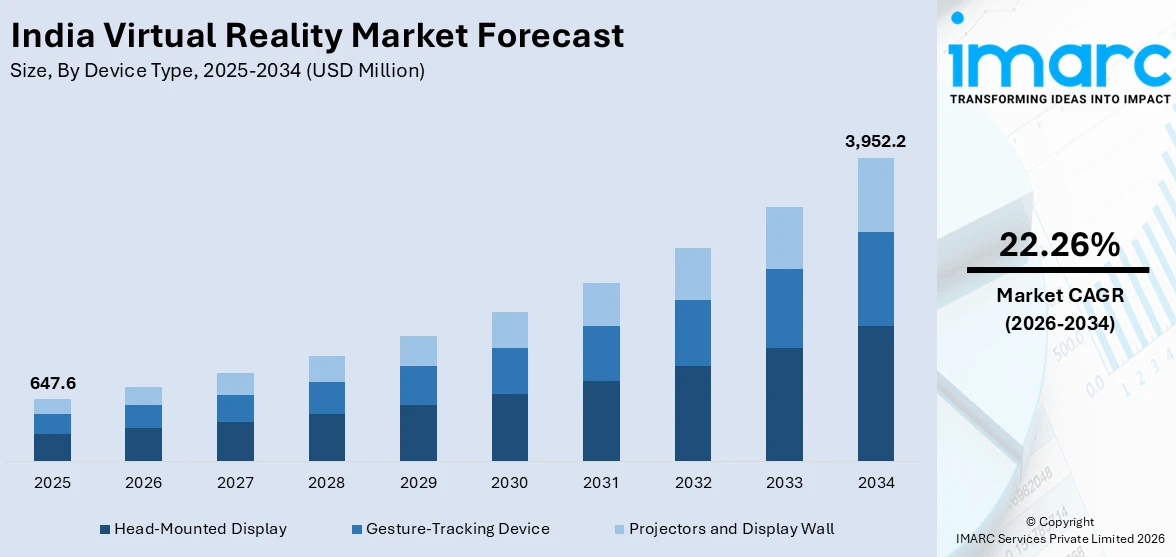
The India virtual reality market size reached USD 647.6 Million in 2025. The market is expected to reach USD 3,952.2 Million by 2034, exhibiting a growth rate (CAGR) of 22.26% during 2026-2034. Market growth can be attributed to a number of factors including the advancements in technology providing a basis for more immersive and realistic VR experiences; the increasing demand for VR applications in various industries, including healthcare, education, and entertainment. The improved accessibility and affordability of VR devices, catering to a larger user base, the involvement of the gaming industry, and an increase in investment in R&D by key industry stakeholders are further driving innovation.
Market Insights:
- On the basis of region, the market has been divided into North India, West and Central India, South India, and East and Northeast India.
- On the basis of device type, the market has been divided into head-mounted display, gesture-tracking device, and projectors and display wall.
- On the basis of technology, the market has been divided into semi and fully immersive and non-immersive.
- On the basis of component, the market has been divided into hardware and software.
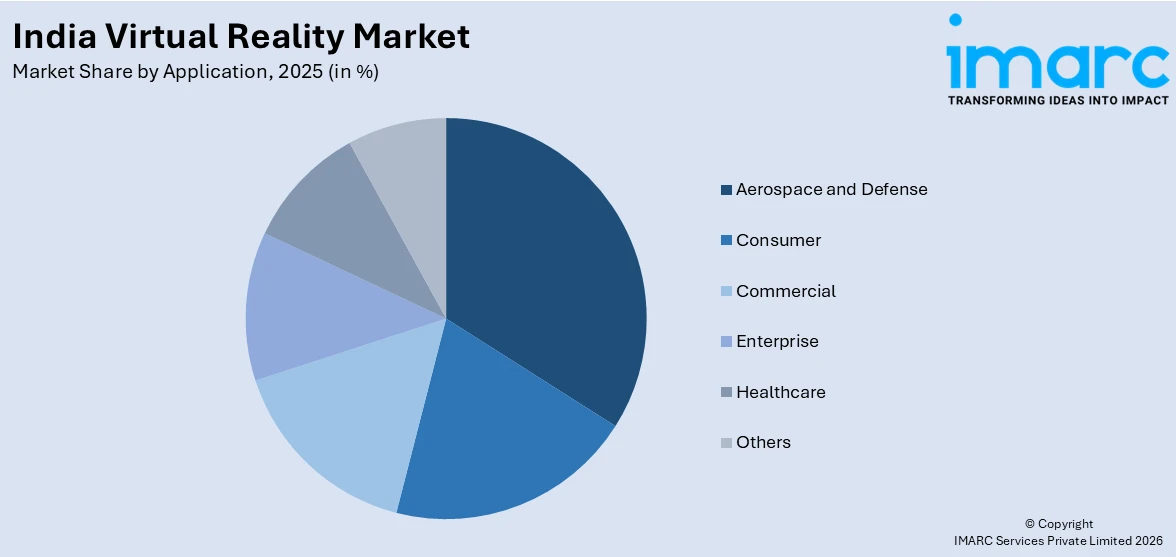
- On the basis of application, the market has been divided into aerospace and defense, consumer, commercial, enterprise, healthcare, and others.
Market Size and Forecast:
- 2025 Market Size: USD 647.64 Million
- 2034 Projected Market Size: USD 3952.24 Million
- CAGR (2026-2034): 22.26%
Virtual reality (VR) is a computer-generated simulation that immerses users in a three-dimensional, interactive environment, replicating real or imagined experiences. Through specialized headsets or devices, users can visually and sometimes audibly engage with a digital world, feeling a sense of presence and interaction. VR often employs sensors to track head and body movements, enhancing the feeling of immersion. Applications range from gaming and entertainment to training simulations, education, and therapeutic interventions. VR has the potential to revolutionize various industries by offering unprecedented levels of engagement and realism. As technology advances, VR continues to evolve, providing increasingly realistic and immersive experiences that transcend the boundaries of traditional screens and bring new dimensions to human-computer interaction.
To get more information on this market Request Sample
The virtual reality market in India is experiencing robust growth, propelled by a confluence of factors. Firstly, advancements in technology have paved the way for increasingly immersive and realistic VR experiences. With the integration of cutting-edge hardware and software, VR solutions now offer users an unprecedented level of engagement. Furthermore, the escalating demand for VR applications in diverse industries, from healthcare to education and entertainment, serves as a driving force. In addition, the growing accessibility and affordability of VR devices have expanded the user base, democratizing access to this transformative technology. Concurrently, the gaming industry's embrace of VR has significantly contributed to market expansion, enticing a broader audience with captivating virtual worlds and interactive experiences. Moreover, the increasing investment in R&D by key industry players fosters innovation, ensuring a continuous evolution of VR capabilities. In summary, the VR market in India is thriving due to technological breakthroughs, widespread industry applications, enhanced accessibility, and sustained investment, collectively propelling the market toward unprecedented growth.
India Virtual Reality Market Trends:
Immersive Education and Training
In India, virtual reality technology is reshaping education and training methods by introducing interactive and engaging learning experiences. Educational institutions, including primary and secondary schools, universities, and vocational training centers, are increasingly implementing VR-based learning experiences, allowing students to learn through visualization and experiential learning of higher-order cognition, which is expanding the India virtual reality market share. Science classrooms allow students to explore human anatomy in a three-dimensional environment, experiment with virtual chemistry without the risk of an explosion or hazardous chemicals, and travel through the solar system and planetary systems to explore astronomical ideas. History lessons can engage students on a virtual field trip to historical places and civilizations that would be impossible to explore otherwise and brings book learning to life. Medical students can practice surgical procedures in simulated surgical environments with no risk, and engineering students can engage with highly complex machines and systems in a simulated environment. Professional training programs across different sectors can implement VR into their programs for skills training, safety training, and getting to know equipment, which reduces the cost of training while increasing knowledge retention and procedural competency resulting in India virtual reality market growth.
Gaming and Entertainment Surge & Retail and E-Commerce Integration
The gaming and entertainment industry is the largest contributing industry to VR adoption in India - with growth in content creation and gaming engagement expanding exponentially. VR gaming studios and developers are producing localized VR gaming experiences that speak to residents in India, in addition to international titles gaining great popularity. The proliferation of VR gaming cafes and arcades in metropolitan areas is making the technology more accessible to consumers who cannot afford personal VR equipment, creating a shared social gaming culture, and a positive India virtual reality market outlook. Simultaneously, the retail and e-commerce sectors are leveraging VR technology to revolutionize the shopping experience. Major online retailers and fashion brands are implementing virtual showrooms where customers can visualize products in three-dimensional space before purchasing. Furniture retailers enable customers to place virtual furniture in their homes using VR, while real estate developers offer immersive property tours, allowing prospective buyers to explore properties remotely and make informed decisions without physical visits.
Growth, Opportunities, and Challenges in the India Virtual Reality Market
- Growth Drivers of the India Virtual Reality Market: The virtual reality industry in India is experiencing significant expansion driven by technological advancements in hardware and software, resulting in more affordable and high-performance VR devices. Rising smartphone penetration and improved internet infrastructure, particularly 5G deployment, are enhancing accessibility and enabling seamless VR experiences. Government initiatives promoting digital literacy, skill development, and technology adoption are creating a supportive regulatory environment for VR implementation across sectors. These combined factors are attracting investors and encouraging startups to explore VR innovations.
- Opportunities in the India Virtual Reality Market: According to the India virtual reality market forecast, substantial opportunities exist in untapped sectors including healthcare for surgical training and therapy, real estate for virtual property tours, and tourism for immersive destination experiences. The education sector presents massive potential with the increasing adoption of VR-based learning in schools and vocational training institutes. Enterprise applications in areas such as remote collaboration, product design, as well as employee training represent significant revenue opportunities for VR solution providers across the country.
- Challenges in the India Virtual Reality Market: As per the India virtual reality market analysis, the market faces several challenges including high initial investment costs for quality VR equipment which limit adoption among price-sensitive consumers. Technical issues such as VR-induced motion sickness, limited battery life, and inadequate content localization in regional languages hinder user experience. Insufficient awareness about VR applications, shortage of skilled content developers, and concerns regarding data privacy and cybersecurity in immersive environments pose additional obstacles to market growth.

India Virtual Reality Market Segmentation:
IMARC Group provides an analysis of the key trends in each segment of the market, along with forecasts at the country level for 2026-2034. Our report has categorized the market based on device type, technology, component, and application.
Device Type Insights:
- Head-Mounted Display
- Gesture-Tracking Device
- Projectors and Display Wall
The report has provided a detailed breakup and analysis of the market based on the device type. This includes head-mounted display, gesture-tracking device, and projectors and display wall.
Technology Insights:
- Semi and Fully Immersive
- Non-Immersive
A detailed breakup and analysis of the market based on the technology have also been provided in the report. This includes semi and fully immersive and non-immersive.
Component Insights:
- Hardware
- Software
The report has provided a detailed breakup and analysis of the market based on the component. This includes hardware and software.
Application Insights:
Access the comprehensive market breakdown Request Sample
- Aerospace and Defense
- Consumer
- Commercial
- Enterprise
- Healthcare
- Others
A detailed breakup and analysis of the market based on the application have also been provided in the report. This includes aerospace and defense, consumer, commercial, enterprise, healthcare, and others.
Regional Insights:
- North India
- West and Central India
- South India
- East and Northeast India
The report has also provided a comprehensive analysis of all the major regional markets, which include North India, West and Central India, South India, and East and Northeast India.
Competitive Landscape:
The market research report has also provided a comprehensive analysis of the competitive landscape. Competitive analysis such as market structure, key player positioning, top winning strategies, competitive dashboard, and company evaluation quadrant has been covered in the report. Also, detailed profiles of all major companies have been provided.
Latest News and Developments:
- January 2025: Housing.com launched a next-generation suite of 3D, augmented reality, and virtual reality tools including DigiAR and Digitour, enabling property buyers to experience immersive property visualization, AR-powered 3D prototypes, and virtual walkthroughs, revolutionizing the real estate exploration experience in India.
- February 2025: Lothar MetaWorlds introduced next-generation virtual reality gaming experiences integrating artificial intelligence, augmented reality, VR, and spatial computing technologies. The innovation enhances user engagement, expands virtual economies, and drives India's VR gaming industry growth through immersive gameplay and digital fashion integration.
- March 2025: The XR Creator Hackathon, organized by the Ministry of Information and Broadcasting in partnership with Wavelaps, engaged over 2,200 participants from 150+ cities across India, showcasing transformative XR potential in healthcare, education, gaming, and tourism through innovative projects and collaborative development.
India Virtual Reality Market Report Coverage:
| Report Features | Details |
|---|---|
| Base Year of the Analysis | 2025 |
| Historical Period | 2020-2025 |
| Forecast Period | 2026-2034 |
| Units | Million USD |
| Scope of the Report | Exploration of Historical and Forecast Trends, Industry Catalysts and Challenges, Segment-Wise Historical and Predictive Market Assessment:
|
| Device Types Covered | Head-Mounted Display, Gesture-Tracking Device, Projectors and Display Wall |
| Technologies Covered | Semi and Fully Immersive, Non-Immersive |
| Components Covered | Hardware, Software |
| Applications Covered | Aerospace and Defense, Consumer, Commercial, Enterprise, Healthcare, Others |
| Regions Covered | North India, West and Central India, South India, East and Northeast India |
| Customization Scope | 10% Free Customization |
| Post-Sale Analyst Support | 10-12 Weeks |
| Delivery Format | PDF and Excel through Email (We can also provide the editable version of the report in PPT/Word format on special request) |
Key Benefits for Stakeholders:
- IMARC’s industry report offers a comprehensive quantitative analysis of various market segments, historical and current market trends, market forecasts, and dynamics of the India virtual reality market from 2020-2034.
- The research report provides the latest information on the market drivers, challenges, and opportunities in the India virtual reality market.
- Porter's five forces analysis assist stakeholders in assessing the impact of new entrants, competitive rivalry, supplier power, buyer power, and the threat of substitution. It helps stakeholders to analyze the level of competition within the India virtual reality industry and its attractiveness.
- Competitive landscape allows stakeholders to understand their competitive environment and provides an insight into the current positions of key players in the market.
Frequently Asked Questions About the India Virtual Reality Market Report
The virtual reality market in India was valued at USD 647.6 Million in 2025.
Rapid digitization, increased smartphone adoption, and enhancements in internet connectivity, particularly with 5G implementation, are promoting the utilization of virtual reality tools. Moreover, companies are using virtual reality for online conferences, product showcases, and engaging with customers. Startups and technology firms are also wagering on virtual reality content creation, helping to drive market innovation.
The India virtual reality market is projected to exhibit a CAGR of 22.26% during 2026-2034, reaching a value of USD 3,952.2 Million by 2034.
Need more help?
- Speak to our experienced analysts for insights on the current market scenarios.
- Include additional segments and countries to customize the report as per your requirement.
- Gain an unparalleled competitive advantage in your domain by understanding how to utilize the report and positively impacting your operations and revenue.
- For further assistance, please connect with our analysts.
 Request Customization
 Speak to an Analyst
 Request Brochure
 Inquire Before Buying
Benefits of Customization
- Personalize this research
- Triangulate with your data
- Get data as per your format and definition
- Gain a deeper dive into a specific application, geography, customer, or competitor
- Any level of personalization
Get in Touch With Us
UNITED STATES
Phone: +1-201-971-6302
INDIA
Phone: +91-120-433-0800
UNITED KINGDOM
Phone: +44-753-714-6104
Email: [email protected]
Client Testimonials




.webp)




.webp)













Related Reports

Choose your plan
*Please note that the prices mentioned below are starting prices for each bundle type. Kindly contact our team for further details.*
Single User License
- 1 User License, Access on 2 Devices
- PDF Report + Excel Dataset (Password Protected)
- Lifetime Access
- No Printing Rights
- 10% Free Report Customization
- 10–12 Weeks of Analyst Support
Five User License
- Access for 5 Users, 2 Devices per User
- PDF Report + Excel Dataset (Password Protected)
- Lifetime Access
- Dedicated Account Manager
- 12–14 Weeks of Analyst Support
- No Printing Rights
- 15% Free Report Customization
- 25% Discount on Your Next Purchase
Corporate User License
- Unlimited User Access (Within Your Organization)
- PDF Report + Excel Dataset
- Lifetime Access
- Dedicated Account Manager
- 14–20 Weeks of Analyst Support
- No Printing Rights
- 20% Free Report Customization
- 30% Discount on Your Next Purchase
Essential Insights
What's included:
3 reports
- Lifetime Access
- PDF Reports
- Excel Datasets
- 2 Weeks of Free Analyst Support
- 2 User Licenses
- Access on 2 Devices
- Printing Rights
- Complimentary PowerPoint (PPT) Version
- Complimentary License Upgrade
Professional Access
What's included:
5 reports
- Lifetime Access
- PDF Reports
- Excel Datasets
- 8 Weeks of Free Analyst Support
- 2 User Licenses
- Access on 2 Devices
- Printing Rights
- Complimentary PowerPoint (PPT) Version
- Complimentary License Upgrade
Business Advantage
What's included:
8 reports
- Lifetime Access
- PDF Reports
- Excel Datasets
- 14 Weeks of Free Analyst Support
- 2 User Licenses
- Access on 2 Devices
- Printing Rights
- Complimentary PowerPoint (PPT) Version
- Complimentary License Upgrade
Enterprise Intelligence
What's included:
10 reports
- Lifetime Access
- PDF Reports
- Excel Datasets
- 20 Weeks of Free Analyst Support
- 2 User Licenses
- Access on 2 Devices
- Printing Rights
- Complimentary PowerPoint (PPT) Version
- Complimentary License Upgrade