
India Voltage Stabilizer Market Size, Share, Trends and Forecast by Type, Application, Controller, and Region, 2026-2034
India Voltage Stabilizer Market Summary:
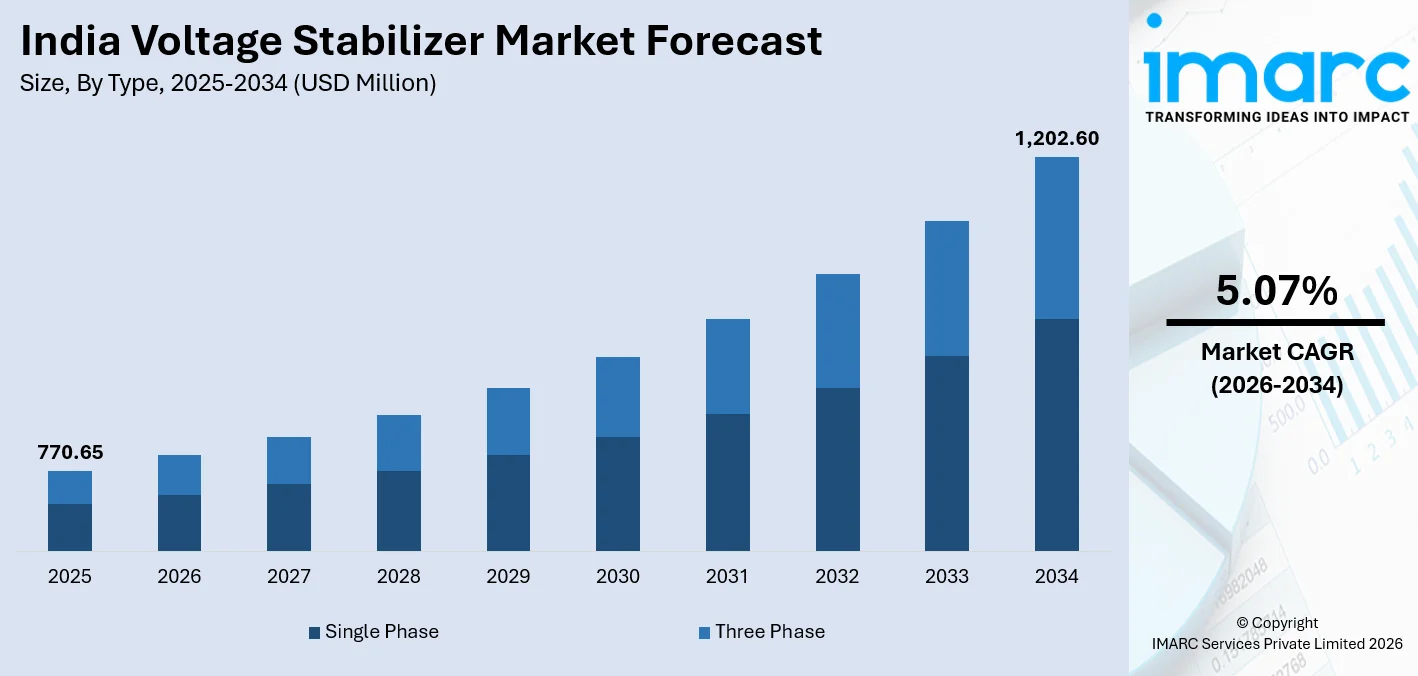
The India voltage stabilizer market size was valued at USD 770.65 Million in 2025 and is projected to reach USD 1,202.60 Million by 2034, growing at a compound annual growth rate of 5.07% from 2026-2034.
The India voltage stabilizer market is driven by persistent voltage fluctuations across urban and rural power grids, rising consumer appliance penetration, and accelerating industrial automation. The proliferation of energy-sensitive devices, such as air conditioners, refrigerators, and smart electronics, has heightened demand for reliable voltage protection solutions. Government-led rural electrification programs and smart infrastructure initiatives are further expanding access and fueling adoption across all end-use sectors, reinforcing the market share.
Key Takeaways and Insights:
- By Type: Single phase dominates the market with a share of 67% in 2025, reflecting widespread residential and small commercial use of single phase electrical appliances, such as refrigerators, air conditioners, and televisions that require consistent voltage protection across India.
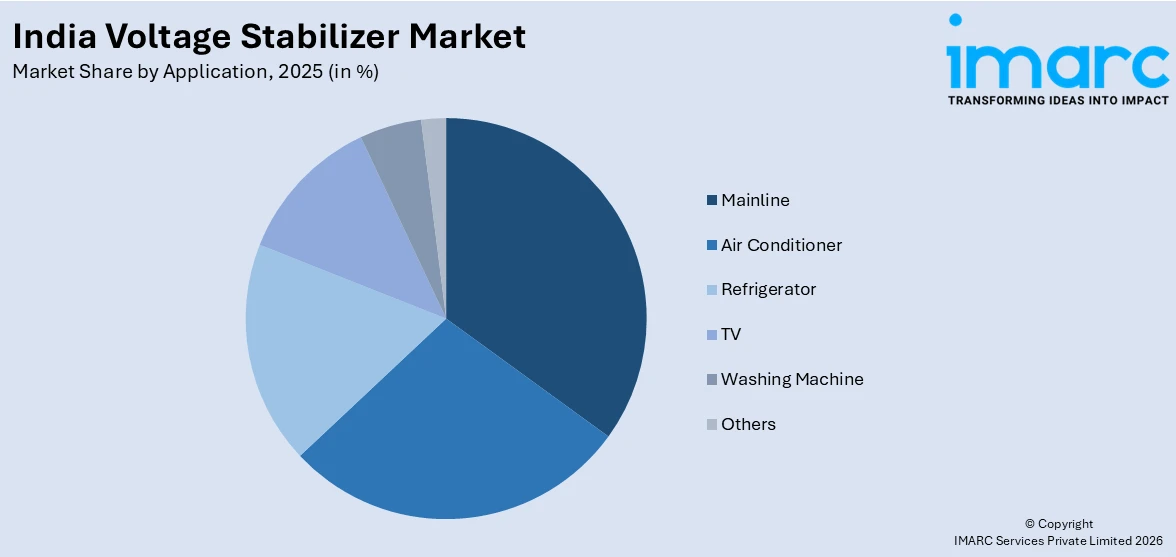
- By Application: Mainline leads the market with a share of 32% in 2025, driven by its ability to provide centralized voltage regulation for all appliances simultaneously, offering cost-effective protection that reduces the need for individual unit-level stabilizers.
- By Controller: Static exhibits a clear dominance in the market with 60% share in 2025, owing to its faster response time, minimal maintenance requirements, and superior performance in information technology (IT), telecom, and commercial environments that demand instantaneous voltage correction.
- Key Players: Key players drive the India voltage stabilizer market by expanding product portfolios, integrating smart and Internet of Things (IoT)-enabled features, and strengthening nationwide distribution networks. Their focus on energy efficiency innovations, competitive pricing strategies, and partnerships with appliance manufacturers boost awareness, accelerate adoption, and ensure consistent product availability across residential, commercial, and industrial segments throughout India.
To get more information of this market Request Sample
The India voltage stabilizer market continues to grow robustly, underpinned by accelerating urbanization and expanding middle-class purchasing power. As of 2025, India's middle class represents 31% of the population, creating a significant consumer base for premium household appliances that require voltage protection. The residential sector alone accounts for a majority of stabilizer demand, with high-rise housing complexes and individual households increasingly relying on stabilizers to safeguard expensive electronics. Government infrastructure programs are simultaneously modernizing grid infrastructure and intensifying demand for compatible voltage regulation devices. Rural electrification schemes, such as the Deen Dayal Upadhyaya Gram Jyoti Yojana, are bringing electricity to millions of previously unconnected households, creating entirely new market segments for affordable stabilizers. Additionally, the rising penetration of air conditioners, refrigerators, and smart home appliances is further increasing the need for reliable voltage stabilization solutions across Indian households.
India Voltage Stabilizer Market Trends:
Rise of Intelligent and IoT-Enabled Stabilizers
The India voltage stabilizer market is witnessing a decisive shift towards intelligent, connectivity-driven products. Manufacturers are integrating digital displays, microprocessor-based controls and mobile app interfaces that allow remote monitoring and real-time fault diagnostics. Stabilizers equipped with IoT technology offer predictive maintenance notifications and energy usage monitoring, attracting tech-oriented urban buyers who are investing in smart home systems. This technology trend is reshaping product differentiation strategies as established brands race to capture premium residential and commercial buyers seeking automation-compatible power management solutions.
Growing Industrial and Commercial Sector Demand
India's accelerating industrial automation and rapid growth of data centers, IT parks, retail spaces, and hospitality facilities are generating significant incremental demand for high-capacity voltage stabilizers. In October 2025, Google announced its plan to invest USD 15 Billion over five years to establish an artificial intelligence (AI) data center in Andhra Pradesh. As manufacturing plants adopt advanced robotics, computer numerical control (CNC) machinery, and precision equipment, the requirement for stable, uninterrupted power supply becomes critical to avoiding costly production downtime. The commercial sector, including hotels, hospitals, and office complexes, is also investing heavily in power quality infrastructure to protect sensitive electronics and ensure operational continuity, driving sustained demand across both three-phase industrial and single phase commercial stabilizer categories.
Expansion of Smart Power Infrastructure and Grid Modernization
The India voltage stabilizer market is also benefiting from the ongoing modernization of the country’s power distribution infrastructure. In March 2024, under the Smart Meter National Program (SMNP), the Government of India revealed plans to substitute 25 Crore traditional electricity meters with prepaid smart meters and enhance power distribution systems, which encompassed feeders and transformers. As electricity distribution becomes increasingly digitized, households and commercial establishments are placing greater emphasis on maintaining stable voltage conditions to protect connected devices and smart electrical systems. This transition towards efficient energy management is encouraging the adoption of advanced voltage stabilizers capable of supporting modern electrical infrastructure.
Market Outlook 2026-2034:
The India voltage stabilizer market is positioned for steady and sustained expansion throughout the forecast period, underpinned by structural demand drivers that show no signs of abating. Rapid urbanization, growing middle-class appliance ownership, and the deepening penetration of electricity into rural areas will continue to generate consistent incremental demand across all stabilizer segments. Industrial growth, smart city development, and digitalization of commercial infrastructure will further broaden the addressable market. The market generated a revenue of USD 770.65 Million in 2025 and is projected to reach a revenue of USD 1,202.60 Million by 2034, growing at a compound annual growth rate of 5.07% from 2026-2034. Technological advancement towards smart and energy-efficient stabilizers will drive premiumization, while affordable product innovation will unlock rural market opportunities and sustain volume growth across diverse consumer and industrial segments.
India Voltage Stabilizer Market Report Segmentation:
| Segment Category | Leading Segment | Market Share |
|---|---|---|
|
Type |
Single Phase |
67% |
|
Application |
Mainline |
32% |
|
Controller |
Static |
60% |
Type Insights:
- Single Phase
- Three Phase
Single phase dominates with a market share of 67% of the total India voltage stabilizer market in 2025.
Single phase commands the largest share of the India voltage stabilizer market, owing to its indispensable role in protecting single phase residential and light commercial appliances. India's household appliance ecosystem is overwhelmingly single phase in nature, with air conditioners, refrigerators, televisions, and washing machines requiring individual or mainline stabilization. The accessibility of single phase stabilizers in terms of price, ease of installation, and availability across both online and offline retail channels further cements their dominance across urban, semi-urban, and rural households throughout the country.
Beyond residential applications, single phase stabilizers are equally prevalent in small commercial and retail establishments, including shops, small offices, clinics, and educational institutions that depend on single phase power supply. Their compact form factor and wall-mount designs make them practical for space-constrained environments. The growing e-commerce penetration in tier II, III, and IV cities, where platforms receive a large share of appliance orders, has further democratized access to single phase stabilizers. Manufacturers are responding with a broadening range of capacities to serve diverse end use requirements, ensuring this segment maintains its commanding position throughout the forecast period.
Application Insights:
Access the comprehensive market breakdown Request Sample
- Mainline
- Air Conditioner
- Refrigerator
- TV
- Washing Machine
- Others
Mainline leads with a share of 32% of the total India voltage stabilizer market in 2025.
Mainline holds the largest application segment share in the India voltage stabilizer market, due to its centralized approach to voltage regulation. By stabilizing power at the point of entry into a home or commercial establishment, mainline units eliminate the need for individual appliance-level stabilizers, reducing overall purchase and maintenance costs for consumers. This cost-effectiveness is particularly appealing to households operating multiple high-value appliances simultaneously, as a single mainline unit provides comprehensive protection.
The mainline segment also benefits from rising demand in residential high-rise developments and new construction projects where centralized power management is built into the infrastructure from the outset. In commercial applications, offices, retail spaces, and hospitality establishments are increasingly adopting mainline stabilization to protect their entire electrical ecosystems from a single, easy-to-manage unit. The expansion of rural electrification, where voltage fluctuations are typically more severe and frequent than in urban centers, is further boosting mainline stabilizer uptake as newly electrified households seek comprehensive voltage protection solutions rather than piecemeal appliance-level units.
Controller Insights:
- Servo
- Static
Static exhibits a clear dominance with a 60% share of the total India voltage stabilizer market in 2025.
Static prevails the controller segment of the India voltage stabilizer market, due to its superior response speed, solid-state construction, and minimal maintenance requirements. Unlike servo stabilizers that rely on mechanical motor-driven autotransformers, static stabilizers use power electronics, such as thyristors, to achieve near-instantaneous voltage correction, typically within milliseconds. This capability makes them ideally suited for IT environments, data centers, telecommunications infrastructure, and commercial applications where even brief voltage deviations can disrupt sensitive electronic operations. The absence of moving parts also translates into higher reliability, longer operational lifespans, and lower lifecycle costs for end users.
Static stabilizers are also increasingly preferred in residential premium segments and modern smart home installations due to their silent operation and compact designs. As India's digital infrastructure expands and the country advances its Industry 4.0 adoption goals, the demand for high-speed static voltage regulation is set to increase further. Manufacturers are responding with new-generation static stabilizers, featuring digital displays, programmable settings, and remote monitoring capabilities that align with the market's broader trend of employing intelligent power management solutions across both consumer and industrial applications.
Regional Insights:
- North India
- South India
- East India
- West India
North India represents a major and rapidly growing market for voltage stabilizers, encompassing densely populated states, including Uttar Pradesh, Rajasthan, Delhi, Haryana, and Punjab. The region's extreme climate, characterized by intense summers driving high air conditioner adoption, contributes significantly to stabilizer demand in both residential and commercial segments.
South India is a significant region in the India voltage stabilizer market, led by states, such as Tamil Nadu, Karnataka, Andhra Pradesh, Telangana, and Kerala. The concentration of manufacturing and technology industries in cities like Bengaluru, Chennai, and Hyderabad drives substantial demand for three-phase and high-capacity stabilizers to support industrial and commercial operations.
East India, encompassing states, such as West Bengal, Odisha, Bihar, and Jharkhand, represents an emerging market with significant growth potential as rural electrification programs expand electricity access to previously unserved communities. Ongoing infrastructure development, industrialization in mining and manufacturing hubs, and rising urban household appliance penetration are driving incremental stabilizer demand.
West India, including Maharashtra, Gujarat, Madhya Pradesh, and Goa, is a significant stabilizer market anchored by major industrial and commercial activity in Mumbai, Pune, Ahmedabad, and Surat. The region's large manufacturing base, encompassing automotive, chemicals, pharmaceuticals, and textiles, generates substantial industrial stabilizer demand.
Market Dynamics:
Growth Drivers:
Why is the India Voltage Stabilizer Market Growing?
Rising Consumer Appliance Penetration and Voltage Sensitivity
India's rapidly expanding middle class and accelerating household income growth are driving unprecedented adoption of power-sensitive consumer appliances across both urban and rural markets. Households are increasingly investing in air conditioning systems, high-capacity refrigerators, large-screen smart televisions, fully automatic washing machines, and microwave ovens, which are highly sensitive to voltage fluctuations. As per IMARC Group, the India air conditioning market size was valued at USD 6.15 Billion in 2025. This surge in appliance ownership, particularly in tier II, III, and IV cities where grid stability is less reliable than in metropolitan areas, makes voltage stabilizers indispensable for protecting expensive consumer investments. Simultaneously, the growth of smart home systems and IoT-enabled appliances introduces new voltage sensitivity requirements, as interconnected devices demand stable, continuous power for seamless operation. The convergence of higher appliance values and greater sensitivity to power quality is therefore creating a structural, long-term demand driver that will sustain market growth throughout the forecast period.
Industrial Automation and Expansion of Digital Infrastructure
India's manufacturing sector is undergoing a profound transformation through Industry 4.0 adoption, with digital technologies projected to account for 40% of total manufacturing expenditure by 2025, up from 20% in 2021, according to the NASSCOM report. This rapid digitalization of factory operations, incorporating advanced robotics, CNC machinery, programmable logic controllers, and industrial IoT devices, creates stringent requirements for stable, uninterrupted power supply at all times. Voltage fluctuations can halt automated production lines, damage precision equipment calibrated to specific operating voltages, and cause costly downtime that disrupts supply chains. The expansion of data centers, telecommunications infrastructure, and commercial IT facilities across India similarly generates intense demand for high-performance static and servo voltage stabilizers capable of providing millisecond-level voltage correction. Investment in new manufacturing facilities by both domestic and multinational companies under Make in India and Production Linked Incentive schemes is adding further industrial capacity that will require comprehensive voltage management infrastructure.
Expansion of Renewable Energy and Distributed Power Systems
The growing integration of renewable energy sources and distributed power systems is also contributing to increased demand for voltage stabilizers in India. As solar rooftop installations, hybrid energy systems, and small-scale power generation units become more common across residential, commercial, and industrial facilities, managing voltage stability within localized electrical networks becomes increasingly important. Renewable energy systems can introduce fluctuations in voltage output due to variations in generation and load balancing requirements. Voltage stabilizers help regulate these inconsistencies and protect connected appliances and equipment from sudden voltage variations. With the government actively promoting renewable energy adoption and decentralized power generation, particularly through rooftop solar programs and net-metering policies, the need for reliable voltage management solutions is expected to grow steadily across diverse consumer segments.
Market Restraints:
What Challenges the India Voltage Stabilizer Market is Facing?
Proliferation of Stabilizer-Free Appliance Technology
A growing number of appliance manufacturers are incorporating built-in wide-range voltage tolerance into their products, enabling operation across voltages from 135V to 290V without external stabilizers. Brands offer stabilizer-free refrigerators and air conditioners, directly reducing the need for aftermarket voltage protection devices. As this technology becomes more mainstream and cost-competitive, it poses a structural challenge to standalone stabilizer demand, particularly in the residential segment, where appliance-bundled voltage protection increasingly substitutes traditional stabilizer purchases and constrains volume growth in price-sensitive consumer categories.
Fragmented Market with Unorganized Competition
The India voltage stabilizer market is characterized by a high degree of fragmentation, with a large number of unorganized local manufacturers competing aggressively on price, particularly in rural and semi-urban markets. These unorganized players offer low-cost stabilizers that undercut established brands, eroding margins and creating quality perception challenges for the broader market. The prevalence of substandard products also increases the risk of appliance damage and customer dissatisfaction, undermining overall market credibility and slowing adoption among price-sensitive consumer segments that have limited ability to distinguish quality differentiation.
Volatility in Raw Material Costs
Voltage stabilizer manufacturing relies on key raw materials, including copper, aluminum, silicon, and electronic components, such as transformers and thyristors, which are subject to significant price volatility in global commodity markets. Fluctuations in raw material costs compress manufacturer margins, particularly for smaller players with limited hedging capabilities and negotiating power with suppliers. Rising input costs can translate into higher stabilizer prices that dampen demand in cost-sensitive consumer segments, while stringent quality standards and evolving Bureau of Indian Standards regulatory requirements impose additional compliance costs that further challenge profitability and operational flexibility for manufacturers across the supply chain.
Competitive Landscape:
The India voltage stabilizer market is highly competitive, featuring a blend of established national brands, international players, and a significant unorganized sector. Leading domestic players compete on the basis of product quality, energy efficiency, technology innovation, distribution reach, and after-sales service capabilities. The market is witnessing intensifying competition as manufacturers invest in research and development (R&D) to differentiate through smart connectivity features, wider voltage input ranges, and energy-saving designs. Distribution network depth and brand trust remain critical competitive factors, particularly in tier II and III markets where consumer awareness and service infrastructure vary significantly across regions.
India Voltage Stabilizer Market Report Coverage:
| Report Features | Details |
|---|---|
| Base Year of the Analysis | 2025 |
| Historical Period | 2020-2025 |
| Forecast Period | 2026-2034 |
| Units | Million USD |
| Scope of the Report | Exploration of Historical Trends and Market Outlook, Industry Catalysts and Challenges, Segment-Wise Historical and Future Market Assessment:
|
| Types Covered | Single Phase, Three Phase |
| Applications Covered | Mainline, Air Conditioner, Refrigerator, TV, Washing Machine, Others |
| Controllers Covered | Servo, Static |
| Regions Covered | North India, South India, East India, West India |
| Customization Scope | 10% Free Customization |
| Post-Sale Analyst Support | 10-12 Weeks |
| Delivery Format | PDF and Excel through Email (We can also provide the editable version of the report in PPT/Word format on special request) |
Frequently Asked Questions About the India Voltage Stabilizer Market Report
The India voltage stabilizer market size was valued at USD 770.65 Million in 2025.
The India voltage stabilizer market is expected to grow at a compound annual growth rate of 5.07% from 2026-2034 to reach USD 1,202.60 Million by 2034.
Single phase dominated the market with a share of 67%, driven by widespread residential and small commercial appliance ownership, affordable pricing, and high availability across distribution channels throughout urban and rural India.
Key factors driving the India voltage stabilizer market include rising consumer appliance penetration, persistent voltage fluctuations across urban and rural grids, government rural electrification initiatives, industrial automation, and the expansion of data centers and smart city infrastructure across India.
Major challenges include the proliferation of stabilizer-free appliance technology from leading brands, intense competition from unorganized low-cost manufacturers, volatility in raw material prices, and evolving regulatory compliance requirements that increase operational costs for stabilizer producers across India.
Need more help?
- Speak to our experienced analysts for insights on the current market scenarios.
- Include additional segments and countries to customize the report as per your requirement.
- Gain an unparalleled competitive advantage in your domain by understanding how to utilize the report and positively impacting your operations and revenue.
- For further assistance, please connect with our analysts.
 Request Customization
 Speak to an Analyst
 Request Brochure
 Inquire Before Buying
Benefits of Customization
- Personalize this research
- Triangulate with your data
- Get data as per your format and definition
- Gain a deeper dive into a specific application, geography, customer, or competitor
- Any level of personalization
Get in Touch With Us
UNITED STATES
Phone: +1-201-971-6302
INDIA
Phone: +91-120-433-0800
UNITED KINGDOM
Phone: +44-753-714-6104
Email: [email protected]
Client Testimonials




.webp)




.webp)













Related Reports

Choose your plan
*Please note that the prices mentioned below are starting prices for each bundle type. Kindly contact our team for further details.*
Single User License
- 1 User License, Access on 2 Devices
- PDF Report + Excel Dataset (Password Protected)
- Lifetime Access
- No Printing Rights
- 10% Free Report Customization
- 10–12 Weeks of Analyst Support
Five User License
- Access for 5 Users, 2 Devices per User
- PDF Report + Excel Dataset (Password Protected)
- Lifetime Access
- Dedicated Account Manager
- 12–14 Weeks of Analyst Support
- No Printing Rights
- 15% Free Report Customization
- 25% Discount on Your Next Purchase
Corporate User License
- Unlimited User Access (Within Your Organization)
- PDF Report + Excel Dataset
- Lifetime Access
- Dedicated Account Manager
- 14–20 Weeks of Analyst Support
- No Printing Rights
- 20% Free Report Customization
- 30% Discount on Your Next Purchase
Essential Insights
What's included:
3 reports
- Lifetime Access
- PDF Reports
- Excel Datasets
- 2 Weeks of Free Analyst Support
- 2 User Licenses
- Access on 2 Devices
- Printing Rights
- Complimentary PowerPoint (PPT) Version
- Complimentary License Upgrade
Professional Access
What's included:
5 reports
- Lifetime Access
- PDF Reports
- Excel Datasets
- 8 Weeks of Free Analyst Support
- 2 User Licenses
- Access on 2 Devices
- Printing Rights
- Complimentary PowerPoint (PPT) Version
- Complimentary License Upgrade
Business Advantage
What's included:
8 reports
- Lifetime Access
- PDF Reports
- Excel Datasets
- 14 Weeks of Free Analyst Support
- 2 User Licenses
- Access on 2 Devices
- Printing Rights
- Complimentary PowerPoint (PPT) Version
- Complimentary License Upgrade
Enterprise Intelligence
What's included:
10 reports
- Lifetime Access
- PDF Reports
- Excel Datasets
- 20 Weeks of Free Analyst Support
- 2 User Licenses
- Access on 2 Devices
- Printing Rights
- Complimentary PowerPoint (PPT) Version
- Complimentary License Upgrade