
India Writing Instruments Market Size, Share, Trends and Forecast by Product, Application, Distribution Channel, and Region, 2026-2034
India Writing Instruments Market Summary:
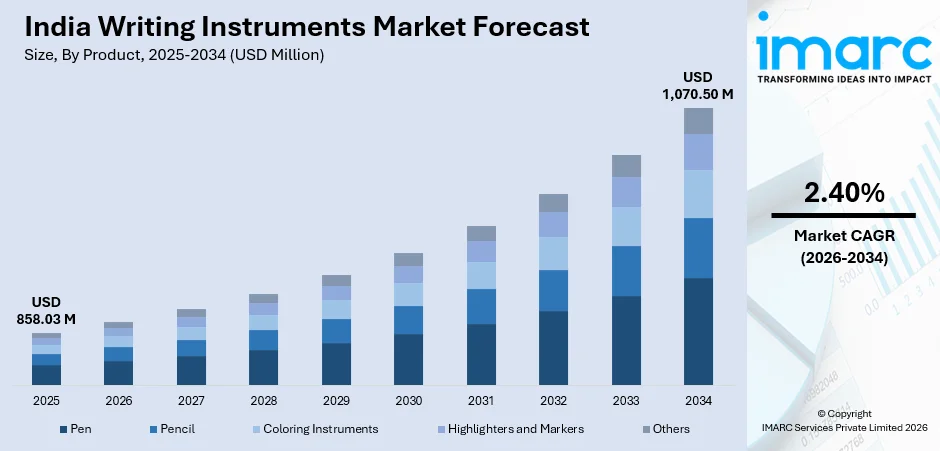
The India writing instruments market size was valued at USD 858.03 Million in 2025 and is projected to reach USD 1,070.50 Million by 2034, growing at a compound annual growth rate of 2.40% from 2026-2034.
The India writing instruments market is propelled by a large and growing student population, rising literacy rates, and consistent government investments in education infrastructure. The widespread use of ball point pens and other stationery across schools, colleges, and offices sustains steady demand. Growing awareness about eco-friendly products, expanding e-commerce channels, and product innovation are further shaping consumption patterns and enhancing the market share.
Key Takeaways and Insights:
- By Product: Pen dominates the market with a share of 65.0% in 2025, due to affordability, everyday school and office usage, refillable options, wide availability, and consumer familiarity across students and professionals.
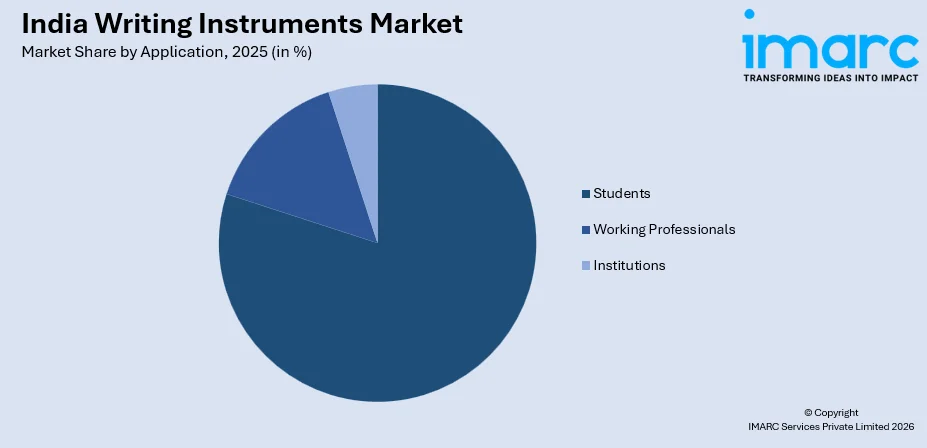
- By Application: Students lead the market with a share of 80.0% in 2025. This is driven by the large and continuously growing school enrollment base in India, supported by government education initiatives and rising parental spending on writing and school supplies.
- By Distribution Channel: Stationeries represent the largest segment with a market share of 48.5% in 2025, reflecting the strong consumer preference for purchasing writing instruments from dedicated shops that offer personal service and extensive product variety.
- By Region: West India comprises the largest region with 30.0% share in 2025, driven by the concentration of educational institutions and commercial establishments in major urban centers, such as Mumbai and Pune.
- Key Players: Key players drive the India writing instruments market by expanding product portfolios, introducing eco-friendly materials, and strengthening distribution networks. Their investments in product innovation, branding campaigns, and e-commerce channels boost market penetration, accelerate adoption, and ensure consistent availability across diverse consumer segments.
To get more information on this market Request Sample
The India writing instruments market reflects the country's strong emphasis on education and literacy. The sector is underpinned by a vast student population that relies on everyday stationery tools for academic activities ranging from note-taking to formal examinations. According to the Economic Survey 2024-25, India's school education system catered to 24.8 Crore students across 14.72 Lakh schools, underscoring the enormous and sustained demand for writing instruments across all levels of education. Beyond the student segment, working professionals and institutional buyers contribute meaningfully to overall market volumes, particularly through purchases of premium pens, markers, and coloring instruments. The shift towards branded and ergonomically designed products reflects evolving consumer preferences, driven by quality consciousness and aspirational spending. Simultaneously, the emergence of sustainable and refillable writing tools is reshaping the competitive landscape, encouraging manufacturers to invest in biodegradable materials and innovative product designs.
India Writing Instruments Market Trends:
Rising Demand for Eco-Friendly and Sustainable Writing Instruments
Growing environmental awareness among Indian consumers is reshaping product preferences in the writing instruments market. Manufacturers are increasingly incorporating biodegradable materials, recycled components, and refillable mechanisms into their product lines to meet rising sustainability expectations. In May 2024, Saurabh H Mehta, the owner of bioQ and based in New Delhi, introduced the world's first entirely biodegradable pen, called the NOTE pen. This pen has a refill made from recycled paper, uses non-toxic ink, and offers a choice of metal, paper, or bamboo casings, designed to minimize plastic waste.
Premiumization and Growth of Luxury Writing Instruments
The India writing instruments market is witnessing a notable premiumization trend, driven by rising disposable incomes and evolving consumer aspirations. Increasingly, urban buyers are seeking high-quality fountain pens, limited-edition writing tools, and branded stationery as lifestyle accessories and corporate gifting solutions. Curated shopping experiences are emerging to cater to this expanding group of selective consumers who appreciate quality and uniqueness. This trend is elevating average transaction values and creating meaningful new revenue streams for manufacturers and retailers operating in the premium stationery space.
Expansion of E-Commerce as a Key Distribution Channel
The rapid growth of digital commerce is transforming how Indian consumers discover and purchase writing instruments. Online platforms offer access to a broader selection of products across multiple brands, price points, and specifications that may not be available in local stores. As per IMARC Group, the India e-commerce market size was valued at USD 129.72 Billion in 2025, reflecting strong potential for digitally distributed writing instruments, particularly among consumers in Tier II and Tier III cities seeking greater product variety and convenience.
Market Outlook 2026-2034:
The India writing instruments market is poised for steady growth during the forecast period, supported by a consistently expanding student population, rising literacy levels, and ongoing government investment in education. The proliferation of Tier II and Tier III city markets, growing acceptance of premium stationery, and the rapid expansion of e-commerce platforms are collectively broadening the consumer base. The market generated a revenue of USD 858.03 Million in 2025 and is projected to reach a revenue of USD 1,070.50 Million by 2034, growing at a compound annual growth rate of 2.40% from 2026-2034. Innovations in sustainable product lines and strategic investments by both domestic and international brands are expected to create new opportunities.
India Writing Instruments Market Report Segmentation:
| Segment Category | Leading Segment | Market Share |
|---|---|---|
|
Product |
Pen |
65.0% |
|
Application |
Students |
80.0% |
|
Distribution Channel |
Stationeries |
48.5% |
|
Region |
West India |
30.0% |
Product Insights:
- Pen
- Ball Point Pen
- Gel Pen
- Fountain Pen
- Others
- Pencil
- Graphite Pencil
- Mechanical Pencil
- Coloring Instruments
- Highlighters and Markers
- Others
Pen dominates with a market share of 65.0% of the total India writing instruments market in 2025.
Pen leads the India writing instruments market, mainly because of its widespread use in offices, education, and daily paperwork requirements. Due to India's large student population and growing school enrollment, there is a constant need for reasonably priced writing supplies for everyday academic tasks, including taking notes, taking tests, and completing assignments. The use of basic writing instruments has further risen as a result of government education programs that support access to education.
Another important factor supporting pen dominance is the wide variety of product formats available in the market, including ball point, gel, and roller pens, catering to different writing preferences. In particular, ball point pens are very well-liked because of their affordability, extended ink life, and durability, which make them ideal for mass use. Easy product availability is further guaranteed by the vast distribution network that includes supermarkets, school supply stores, and neighborhood retail establishments. Regular product innovation, enhanced ink technology, and eye-catching designs contribute to the pens' robust market presence.
Application Insights:
Access the comprehensive market breakdown Request Sample
- Students
- Working Professionals
- Institutions
Students lead the market with a share of 80.0% of the total India writing instruments market in 2025.
Students account for the overwhelming majority of writing instrument consumption in India, reflecting the country's massive and continuously expanding education sector. The consistent demand from school and college students for pens, pencils, coloring tools, and markers during the academic year creates a stable and recurring volume base for manufacturers. The Economic Survey 2024-25, presented by Union Finance Minister Nirmala Sitharaman in Parliament on January 31, 2025, showed a 13.8% increase in higher education institutions (HEIs). Higher student enrolments point to significant long-term growth in the demand for writing instruments from this application segment.
The segment's dominance is further reinforced by the purchasing patterns of parents and guardians who prioritize affordability and quality when selecting stationery for their children. Seasonal demand spikes coinciding with the beginning of academic terms generate significant sales volumes for distributors and retailers. Growing awareness of ergonomic writing instruments designed specifically for children, combined with the introduction of colorful, themed, and character-inspired stationery, continues to attract younger buyers and sustain the segment's commanding market leadership across all regions of India.
Distribution Channel Insights:
- Stationeries
- Hypermarket/Supermarket
- Departmental Stores
- Others
Stationeries represent the leading segment with a market share of 48.5% of the total India writing instruments market in 2025.
Stationeries hold the largest share of writing instrument distribution in India, driven by their deep community presence, specialized product assortments, and the enduring trust they have cultivated with loyal consumer bases across generations. Consumers seeking specific pen variants, refills, or specialty items regularly rely on neighborhood stationery outlets for availability and personalized service. India has several schools across the country, each supporting consistent footfall and purchasing activity at shops located in their surrounding areas throughout the academic year.
The sustained relevance of stationeries as the dominant distribution channel is supported by their strategic proximity to educational institutions, coaching centers, and residential neighborhoods. These outlets typically offer a curated range of products from multiple brands at varying price points, allowing consumers to compare and select instruments based on their budget and preferences. They maintain personalized relationships with their clientele, offering recommendations and stocking locally preferred brands. This trusted community role continues to make them the first point of purchase for the majority of writing instrument buyers across India.
Regional Insights:
- North India
- South India
- East India
- West India
West India exhibits a clear dominance with a 30.0% share of the total India writing instruments market in 2025.
West India leads the market due to its high concentration of educational institutions, corporate offices, and large consumer populations in Maharashtra and Gujarat. The region's robust urban infrastructure across Mumbai, Pune, and Ahmedabad supports consistent stationery consumption in academic and professional settings. In February 2025, the Maharashtra government revealed plans to improve its educational facilities by creating 73 new schools, comprising 65 English-medium ones and eight that could use Marathi as the medium of instruction, further expanding the region's student base and reinforcing demand for writing instruments across the segment.
The region benefits from a well-established network of stationery retailers and institutional procurement channels that support efficient distribution across urban and semi-urban markets. The growing middle class in Maharashtra and Gujarat increasingly favors branded and premium writing instruments, reflecting improving income levels and aspirational consumption habits. The presence of significant manufacturing capacity in Gujarat also ensures strong product availability and competitive pricing, reinforcing West India's continued market leadership in the India writing instruments sector.

Market Dynamics:
Growth Drivers:
Why is the India Writing Instruments Market Growing?
Expanding Education Sector and Rising School Enrollment
India's education sector is one of the largest and most dynamic in the world, encompassing millions of students enrolled across primary, secondary, and higher education institutions nationwide. The consistent growth in school and college enrollment, supported by robust government programs designed to make education universally accessible and inclusive, has created an expanding and reliable consumer base for writing instruments. Government initiatives aimed at improving both the quality and geographic reach of education, including infrastructure investments in schools and the introduction of student-centric financial support programs, are encouraging more children to attend school regularly and engage in structured written academic activities. This increased participation directly translates to sustained higher consumption of writing instruments, including ballpoint pens, gel pens, pencils, and specialty stationery items. Rising participation of girls and students from economically marginalized communities in the formal education system further broadens the addressable consumer base. According to the District Information System for Education Plus 2024-25 report, published by the Ministry of Education, the enrollment of girls in schools increased in India, attaining 48.3%.
Growing Demand for Premium and Ergonomic Writing Instruments
India's expanding middle class and rising disposable incomes are fueling a notable shift in consumer preferences towards premium, branded, and ergonomically designed writing instruments. Consumers are increasingly willing to invest in higher-quality stationery that offers superior writing comfort, stylish aesthetics, and longer durability, moving away from purely price-driven purchase decisions. This premiumization trend is particularly visible in urban markets where working professionals seek fountain pens, rollerball pens, and specialty writing tools for both daily use and gifting purposes. Manufacturers are responding by expanding their premium product portfolios, introducing limited-edition collections, and investing in more sophisticated packaging to appeal to aspirational buyers. The corporate gifting segment is also driving demand for branded writing instruments as companies seek to present personalized and high-quality gifts to employees, clients, and business partners on special occasions.
Expansion of E-Commerce and Digital Retail Channels
The rapid growth of e-commerce and digital retail platforms is significantly reshaping how writing instruments are purchased and distributed across India. Online marketplaces have dramatically expanded the range of products accessible to consumers in Tier II and Tier III cities and rural areas, where the availability of branded stationery through physical stores may be limited. Consumers can browse and purchase from an extensive catalogue of writing instruments, spanning multiple brands, price ranges, and product specifications, often with the benefit of detailed product reviews and competitive pricing. The increasing adoption of affordable mobile internet and digital payment infrastructure across India is enabling a growing segment of the population to shop for stationery products online with convenience and confidence. Regional language interfaces and simplified user experiences on popular e-commerce platforms are further lowering barriers to online purchasing among non-urban consumer groups. Writing instrument manufacturers are capitalizing on this trend by investing in direct-to-consumer (D2C) channels, optimizing their digital presence, and partnering with major e-commerce platforms to enhance product visibility.
Market Restraints:
What Challenges the India Writing Instruments Market is Facing?
Intense Price Competition and Market Fragmentation
The India writing instruments market is characterized by intense price competition among a large number of domestic and international brands competing across similar product categories. The presence of numerous unorganized and low-cost manufacturers, particularly in the budget segment, creates persistent margin pressure for established players seeking to differentiate on quality and branding. This fragmented market structure makes it challenging for manufacturers to maintain premium pricing, invest in sustained innovation, and build long-term consumer loyalty across India's diverse and geographically dispersed markets.
Raw Material Price Volatility and Supply Chain Disruptions
Fluctuations in the prices of key raw materials, such as plastics, resins, and specialty inks, represent a persistent operational challenge for writing instrument manufacturers in India. These cost pressures are frequently difficult to pass on to price-sensitive consumers, particularly in the budget segment that constitutes the bulk of the market. Additionally, disruptions in global supply chains affecting the availability of specialized components can impair production timelines and inventory management, reducing the ability of manufacturers to meet seasonal demand peaks during critical academic calendar periods throughout the year.
Increasing Digitization and Adoption of Electronic Devices
The widespread adoption of smartphones, tablets, and laptops in educational and professional settings poses a meaningful challenge to the writing instruments market. As digital note-taking applications, e-learning platforms, and paperless office workflows gain traction, the habitual use of physical writing tools declines among younger and tech-savvy consumer segments. Schools and higher education institutions increasingly integrating digital tools into their curricula further reduce dependency on traditional stationery, creating headwinds for long-term demand growth across the market.
Competitive Landscape:
The India writing instruments market features a competitive landscape comprising a mix of well-established domestic manufacturers, global brands with strong distribution networks, and a significant presence of small-scale unorganized producers. Leading domestic players have built their competitive positions through extensive geographic distribution, strong brand recognition, and the ability to offer quality products at accessible price points tailored to the Indian consumer. International brands are increasingly targeting the premium and aspirational segments through product innovation, strategic retail partnerships, and digital marketing campaigns. Competitive strategies across the market include product portfolio diversification, the introduction of eco-friendly and sustainable product lines, investments in ergonomic design, and the development of digital-first distribution channels. Companies are also exploring collaborations and joint ventures with global writing instrument specialists to leverage international manufacturing expertise and expand product offerings.
Recent Developments:
- In October 2025, Linc Limited and Mitsubishi Pencil Co., Ltd. announced the commercial launch of their joint venture, UNI LINC INDIA PRIVATE LIMITED, in the India writing instruments sector. Production commenced at a manufacturing facility in Gujarat, with an initial focus on ball point pens tailored to Indian consumers, while plans were disclosed to expand into higher-value writing instrument categories under the Uni brand.
India Writing Instruments Market Report Coverage:
| Report Features | Details |
|---|---|
| Base Year of the Analysis | 2025 |
| Historical Period | 2020-2025 |
| Forecast Period | 2026-2034 |
| Units | Million USD |
| Scope of the Report |
Exploration of Historical Trends and Market Outlook, Industry Catalysts and Challenges, Segment-Wise Historical and Future Market Assessment:
|
| Products Covered |
|
| Applications Covered | Students, Working Professionals, Institutions |
| Distribution Channels Covered | Stationaries, Hypermarket/Supermarket, Departmental Stores, Others |
| Regions Covered | North India, South India, East India, West India |
| Customization Scope | 10% Free Customization |
| Post-Sale Analyst Support | 10-12 Weeks |
| Delivery Format | PDF and Excel through Email (We can also provide the editable version of the report in PPT/Word format on special request) |
Frequently Asked Questions About the India Writing Instruments Market Report
The India writing instruments market size was valued at USD 858.03 Million in 2025.
The India writing instruments market is expected to grow at a compound annual growth rate of 2.40% from 2026-2034 to reach USD 1,070.50 Million by 2034.
Pen dominated the market with a share of 65.0%, owing to widespread availability, strong familiarity among consumers, regular use in schools and offices, cost-effectiveness, and convenient refillable formats.
Key factors driving the India writing instruments market include a large and increasing student population, expanding school enrollment, rising disposable incomes, growing preference for premium stationery, and the broadening reach of e-commerce distribution channels.
Major challenges include increasing adoption of digital devices and e-learning platforms, intense price competition from unorganized manufacturers, raw material cost volatility, and the gradual decline of physical writing in digitally integrated educational and professional environments.
Need more help?
- Speak to our experienced analysts for insights on the current market scenarios.
- Include additional segments and countries to customize the report as per your requirement.
- Gain an unparalleled competitive advantage in your domain by understanding how to utilize the report and positively impacting your operations and revenue.
- For further assistance, please connect with our analysts.
 Request Customization
 Speak to an Analyst
 Request Brochure
 Inquire Before Buying
Benefits of Customization
- Personalize this research
- Triangulate with your data
- Get data as per your format and definition
- Gain a deeper dive into a specific application, geography, customer, or competitor
- Any level of personalization
Get in Touch With Us
UNITED STATES
Phone: +1-201-971-6302
INDIA
Phone: +91-120-433-0800
UNITED KINGDOM
Phone: +44-753-714-6104
Email: [email protected]
Client Testimonials




.webp)




.webp)













Related Reports

Choose your plan
*Please note that the prices mentioned below are starting prices for each bundle type. Kindly contact our team for further details.*
Single User License
- 1 User License, Access on 2 Devices
- PDF Report + Excel Dataset (Password Protected)
- Lifetime Access
- No Printing Rights
- 10% Free Report Customization
- 10–12 Weeks of Analyst Support
Five User License
- Access for 5 Users, 2 Devices per User
- PDF Report + Excel Dataset (Password Protected)
- Lifetime Access
- Dedicated Account Manager
- 12–14 Weeks of Analyst Support
- No Printing Rights
- 15% Free Report Customization
- 25% Discount on Your Next Purchase
Corporate User License
- Unlimited User Access (Within Your Organization)
- PDF Report + Excel Dataset
- Lifetime Access
- Dedicated Account Manager
- 14–20 Weeks of Analyst Support
- No Printing Rights
- 20% Free Report Customization
- 30% Discount on Your Next Purchase
Essential Insights
What's included:
3 reports
- Lifetime Access
- PDF Reports
- Excel Datasets
- 2 Weeks of Free Analyst Support
- 2 User Licenses
- Access on 2 Devices
- Printing Rights
- Complimentary PowerPoint (PPT) Version
- Complimentary License Upgrade
Professional Access
What's included:
5 reports
- Lifetime Access
- PDF Reports
- Excel Datasets
- 8 Weeks of Free Analyst Support
- 2 User Licenses
- Access on 2 Devices
- Printing Rights
- Complimentary PowerPoint (PPT) Version
- Complimentary License Upgrade
Business Advantage
What's included:
8 reports
- Lifetime Access
- PDF Reports
- Excel Datasets
- 14 Weeks of Free Analyst Support
- 2 User Licenses
- Access on 2 Devices
- Printing Rights
- Complimentary PowerPoint (PPT) Version
- Complimentary License Upgrade
Enterprise Intelligence
What's included:
10 reports
- Lifetime Access
- PDF Reports
- Excel Datasets
- 20 Weeks of Free Analyst Support
- 2 User Licenses
- Access on 2 Devices
- Printing Rights
- Complimentary PowerPoint (PPT) Version
- Complimentary License Upgrade