
India Yogurt Market Size, Share, Trends and Forecast by Product Type, Flavor, Distribution Channel, and Region, 2026-2034
India Yogurt Market Summary:
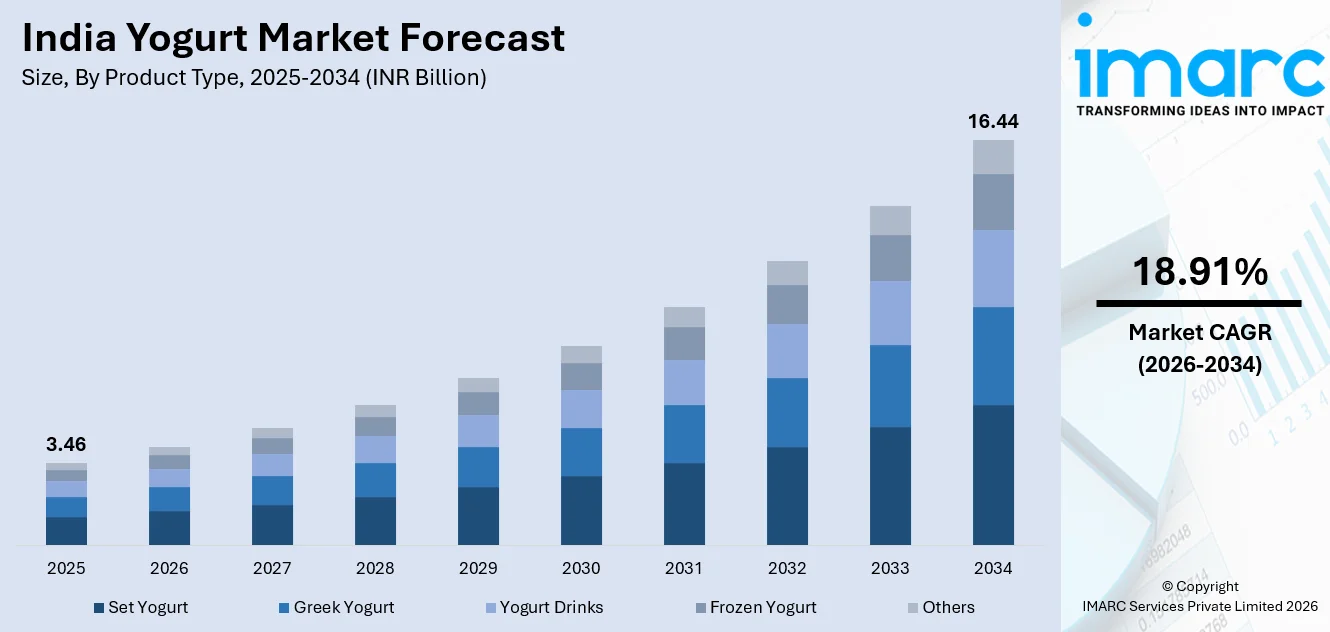
The India yogurt market size was valued at INR 3.46 Billion in 2025 and is projected to reach INR 16.44 Billion by 2034, growing at a compound annual growth rate of 18.91% from 2026-2034.
The yogurt market in India is expanding at a fast pace owing to the increasing awareness about health among consumers and the growing acceptance of probiotic-enriched dairy products. The growing urbanization, changing food habits, and the cultural shift towards healthy snacking options are driving the demand for the product. The development of retail infrastructure, new packaging solutions, and the availability of different variants of the product are further increasing the market reach in the urban and tier-two cities of the country.
Key Takeaways and Insights:
- By Product Type: Set yogurt dominated the market with a share of 32% in 2025, driven by deep-rooted consumer preference for traditional fermented dairy products and their widespread culinary applications across Indian households.
- By Flavor: Plain yogurt leads the market with a share of 30% in 2025, supported by its versatile usage in cooking, direct consumption, and as a base ingredient for various traditional Indian preparations.
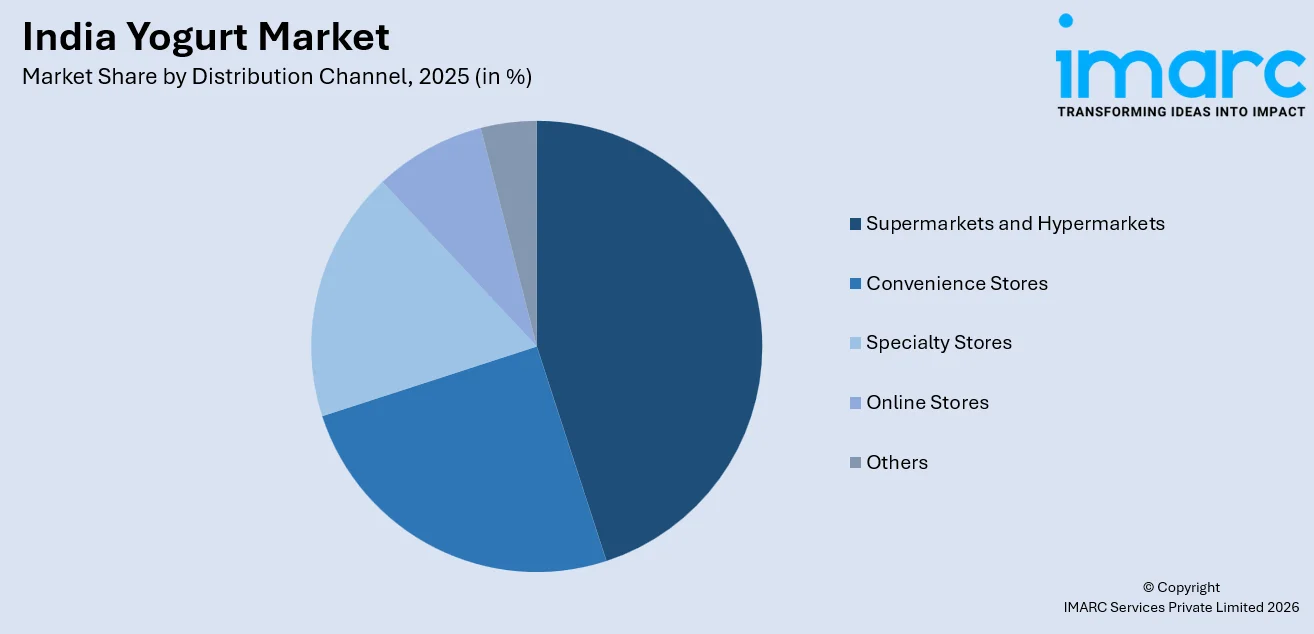
- By Distribution Channel: Supermarkets and hypermarkets hold the largest share of 43% in 2025, owing to their extensive product assortments, cold chain capabilities, and one-stop shopping convenience for consumers.
- By Region: North India represents the leading market with a share of 29% in 2025, attributable to strong dairy consumption traditions, favorable climatic conditions, and established distribution networks.
- By Key Players: The India yogurt market exhibits a moderately competitive landscape, with leading dairy cooperatives and private manufacturers competing through product innovation, flavor diversification, premium positioning, and expanding distribution networks across organized retail and digital commerce channels. Some of the key players operating in the market Amul (Gujarat Co-operative Milk Marketing Federation Limited), Britannia Industries Limited, Cocoberry Retail Pvt. Ltd., Drums Food International Private Limited, Heritage Novandie Foods Private Limited, Karnataka Milk Federation, Milky Mist Dairy, Mother Dairy Fruit & Vegetable Private Limited, Nestlé India Limited and Parag Milk Foods.
To get more information on this market Request Sample
The India yogurt market is advancing rapidly as health-conscious consumers increasingly incorporate probiotic and protein-rich dairy products into their daily diets. Rising disposable incomes and expanding urban populations are fueling demand for convenient, ready-to-eat nutritious food options. The growing awareness of gut health benefits associated with yogurt consumption is encouraging wider adoption across diverse demographic segments. In February 2025, Amul announced a ₹600 crore investment to establish the world’s largest curd (dahi) manufacturing plant in Kolkata, significantly expanding its fermented dairy production capacity and strengthening nationwide supply. Manufacturers are investing in innovative product development, introducing Greek yogurt, plant-based alternatives, and functional variants fortified with vitamins and minerals to capture evolving consumer preferences. The proliferation of modern retail formats and the expanding reach of e-commerce platforms are further enhancing product accessibility and visibility. Additionally, aggressive promotional campaigns and strategic brand positioning are driving consumer engagement and market penetration across India’s yogurt market share.
India Yogurt Market Trends:
Rising Demand for Functional and Probiotic Yogurt
Indian consumers are increasingly gravitating toward yogurt products enriched with probiotics, prebiotics, and added functional ingredients that promote digestive health and overall wellness. The growing awareness of gut microbiome health and its connection to immunity is reshaping purchasing decisions. According to reports, Nestlé India expanded its NESTLÉ a+ GREKYO range with the launch of Blueberry Greek Yoghurt and Greek Style Curd, positioning these products as high-protein, calcium-rich, and low-fat options tailored for health-conscious Indian consumers. This shift is encouraging manufacturers to develop innovative formulations that combine traditional fermentation techniques with modern nutritional science, positioning yogurt as a functional food staple beyond its conventional dietary role in Indian households and contributing to India yogurt market growth.
Expansion of Greek and Premium Yogurt Varieties
The premium yogurt segment, particularly Greek yogurt, is gaining significant traction among urban and health-focused consumers seeking high-protein, low-sugar dairy alternatives. This trend reflects a broader shift toward clean-label products with minimal additives and superior nutritional profiles. In April 2025, Parag Milk Foods expanded its premium dairy portfolio under its Pride of Cows brand by launching new Greek yogurt variants in flavors such as Fig & Honey, Blueberry, Pineapple, and Mixed Berry, each formulated with no added sugar and enriched with protein to target health-conscious metropolitan consumers. Manufacturers are launching diverse flavor combinations and texture innovations to differentiate their offerings and capture the growing appetite for indulgent yet nutritious dairy experiences in metropolitan markets across India.
Growing Popularity of Plant-Based and Dairy-Free Yogurt Options
The emergence of plant-based yogurt alternatives made from soy, oat, coconut, and almond milk is reshaping the Indian yogurt landscape. This trend is driven by rising lactose intolerance awareness, growing vegan and flexitarian dietary preferences, and increasing environmental consciousness among younger consumers. Moreover, Bengaluru-based plant-based dairy startup GoodMylk raised USD 1 million to expand its portfolio of vegan yogurt (peanut curd) and dairy alternatives, supporting wider distribution across Indian cities. Brands are actively developing dairy-free formulations that replicate the taste and texture of traditional yogurt while offering distinct nutritional benefits tailored to evolving consumer lifestyles.
Market Outlook 2026-2034:
The India yogurt market is positioned for sustained growth over the forecast period, underpinned by evolving consumer health priorities, expanding retail infrastructure, and continuous product innovation. Increasing penetration of organized retail and digital commerce platforms is expected to broaden market accessibility across semi-urban and rural regions. Rising demand for probiotic-enriched, high-protein, and plant-based yogurt variants is anticipated to attract new consumer segments. The integration of traditional Indian flavors into contemporary yogurt formats and the expansion of cold chain logistics across tier-two and tier-three cities are further expected to strengthen distribution efficiency and consumption frequency. The market generated a revenue of INR 3.46 Billion in 2025 and is projected to reach a revenue of INR 16.44 Billion by 2034, growing at a compound annual growth rate of 18.91% from 2026-2034.
India Yogurt Market Report Segmentation:
|
Segment Category |
Leading Segment |
Market Share |
|
Product Type |
Set Yogurt |
32% |
|
Flavor |
Plain |
30% |
|
Distribution Channel |
Supermarkets and Hypermarkets |
43% |
|
Region |
North India |
29% |
Product Type Insights:
- Set Yogurt
- Greek Yogurt
- Yogurt Drinks
- Frozen Yogurt
- Others
The set yogurt dominates with a market share of 32% of the total India yogurt market in 2025.
Set yogurt remains at the top of the India yogurt market, as the cultural affinity of Indian consumers towards the traditionally made curd-based dairy product has remained unaltered. The product’s usage in daily meals, religious rituals, and home cooking practices has ensured a steady market demand. The product’s known taste, low price, and easy preparation at both the household and industrial scales have ensured the market leader’s continued dominance in the market.
The rising availability of set yogurt in branded and hygienic packaging options through organized retailing is further increasing the product’s customer base among quality-demanding consumers. The industry is witnessing the introduction of value-added set yogurt products containing probiotics and essential nutrients to meet the growing health awareness among consumers. Furthermore, the rising cold chain infrastructure in tier-two and tier-three cities is ensuring improved product shelf life and distribution, thereby facilitating increased market reach and consumption.
Flavor Insights:
- Strawberry Blend
- Vanilla
- Plain
- Strawberry
- Peach
- Others
The plain yogurt leads with a share of 30% of the total India yogurt market in 2025.
Plain yogurt maintains its market leadership owing to its versatile application in Indian cuisine, where it serves as a fundamental ingredient in preparations such as raita, lassi, kadhi, and marinades. The product’s neutral flavor profile and adaptability make it a household staple consumed directly or used as a base for both savory and sweet culinary creations. Its cost-effectiveness and widespread cultural acceptance across all income segments further reinforce its dominant position.
Rising health consciousness is also increasing the demand for plain yogurt as consumers are increasingly turning to minimally processed and low-sugar dairy products that fit into clean eating diets. The fact that plain yogurt is being made available in various packaging sizes to suit the needs of individuals, families, and commercial sectors is also increasing accessibility. Plain yogurt is also being marketed as a superfood that is rich in probiotics.
Distribution Channel Insights:
Access the comprehensive market breakdown Request Sample
- Supermarkets and Hypermarkets
- Convenience Stores
- Specialty Stores
- Online Stores
- Others
The supermarkets and hypermarkets dominate with a market share of 43% of the total India yogurt market in 2025.
Supermarkets and hypermarkets serve as the primary retail channel for yogurt distribution in India, offering consumers an extensive range of branded products under temperature-controlled conditions. The ability of these large-format retail outlets to maintain proper cold chain management ensures product freshness and quality, which are critical considerations for perishable dairy items. Their wide geographic footprint and established consumer trust drive consistent foot traffic and yogurt purchasing volumes.
The expansion of organized retail chains across tier-two and tier-three cities is further consolidating the market leadership of supermarkets and hypermarkets. These outlets provide dedicated refrigerated display sections, promotional pricing strategies, and product sampling opportunities that enhance consumer engagement and encourage trial purchases. The bundling of yogurt products with complementary dairy offerings and loyalty program incentives also stimulates repeat buying behavior and fosters brand loyalty among regular shoppers.
Regional Insights:
- North India
- West and Central India
- South India
- East India
North India exhibits a clear dominance with a 29% share of the total India yogurt market in 2025.
North India commands the largest regional share of the India yogurt market, driven by a deeply embedded dairy consumption culture and strong consumer preference for curd and yogurt-based products in daily diets. The region’s favorable climatic conditions, which stimulate higher consumption during extended summer months, further bolster seasonal and year-round demand. The presence of well-established dairy processing infrastructure and cooperative networks ensures consistent supply and wide product availability.
The concentration of major metropolitan centers such as Delhi-NCR, Jaipur, and Lucknow provides a large urban consumer base with higher disposable incomes and greater exposure to branded yogurt products. The rapid expansion of modern retail outlets and e-commerce delivery services in the region is improving product accessibility in both urban and semi-urban areas. Additionally, strong local dairy traditions and the growing integration of yogurt into contemporary meal patterns are sustaining robust demand dynamics across North India.
Market Dynamics:
Growth Drivers:
Why is the India Yogurt Market Growing?
Increasing Health Consciousness and Wellness-Oriented Dietary Shifts
The rapid rise in health consciousness among Indian consumers is serving as a primary catalyst for yogurt market expansion. Growing awareness of yogurt’s nutritional benefits, including its high protein content, probiotic cultures, and essential mineral composition, is encouraging consumers to incorporate it into daily dietary routines. In August 2025, Yakult Danone India stated that rising demand for probiotic and gut-health products is positioning India as a potential top-10 global market for the company, reflecting growing consumer focus on digestive health and immunity-boosting nutrition. The shifting preference from calorie-dense snacks toward nutrient-rich alternatives is directing consumer spending toward yogurt and fermented dairy products. This wellness-driven trend is particularly pronounced among urban millennials who prioritize gut health, immune support, and weight management.
Expanding Product Innovation and Flavor Diversification
Continuous product innovation represents a significant growth driver for the India yogurt market. Manufacturers are actively diversifying their portfolios by introducing an extensive range of flavored, functional, and premium yogurt variants to capture evolving consumer tastes. According to reports, in September 2025, Indian dairy company Hatsun Agro plans to launch new protein-enriched dairy products in response to rising consumer demand for health-focused and high-protein nutrition, reflecting the industry’s innovation push toward functional dairy offerings. The development of exotic flavor profiles, protein-enriched formulations, and sugar-free alternatives is broadening product appeal beyond traditional consumers. Innovative packaging formats including single-serve cups, squeezable pouches, and drinkable bottles are enhancing on-the-go convenience and driving impulse purchases across diverse consumer demographics.
Rapid Expansion of Organized Retail and E-Commerce Platforms
The proliferation of organized retail infrastructure and digital commerce platforms is significantly enhancing yogurt market accessibility across India. The expansion of supermarkets, hypermarkets, and convenience store chains with dedicated refrigerated sections is ensuring wider product visibility and proper cold chain management. Reflecting this digital shift, the India e-commerce market was valued at USD 129.72 billion in 2025 and is projected to reach USD 651.10 billion by 2034, growing at a compound annual growth rate of 19.63% from 2026 to 2034, underscoring the rapid expansion of online retail channels that support wider product distribution. Simultaneously, the rapid growth of grocery e-commerce and quick-commerce platforms is creating additional distribution pathways offering doorstep delivery with temperature-controlled logistics, enabling consumers in underserved regions to access a broader range of yogurt products.
Market Restraints:
What Challenges the India Yogurt Market is Facing?
Cold Chain Infrastructure Limitations
Inadequate cold chain infrastructure across significant portions of rural and semi-urban India poses a considerable challenge to yogurt distribution and market expansion. Yogurt’s perishable nature demands uninterrupted temperature-controlled storage and transportation, and gaps in refrigeration facilities along the supply chain result in product spoilage, reduced shelf life, and limited geographic reach, constraining the market’s ability to penetrate underserved regions effectively.
Competition from Traditional Homemade Curd
The long-established Indian practice of home production of fresh curd is a major competitive hurdle for the branded yogurt market. A large number of Indian households have been preferring home-made curd over the branded yogurt due to perceived freshness, economy, and familiarity of the product. The home preparation habit has been a major constraint in shifting consumers of traditional curd to packaged yogurt products.
Price Sensitivity Among Mass-Market Consumers
Adoption among price-conscious consumer segments is limited by the comparatively higher cost of branded and premium yogurt products when compared to conventional unpackaged curd. It is difficult for producers to defend premium pricing for yogurt varieties with added value because a sizable section of the Indian population is still very cost-conscious when making dairy purchases. The growth of premium and functional yogurt categories across consumer demographics with limited financial resources is restricted by this pricing barrier.
Competitive Landscape:
The yogurt market in India is marked by an increasingly competitive scenario where the traditional dairy co-ops, multinational companies, and new-age private players are competing for market share by innovating, differentiating, and expanding their distribution reach. The competitive scenario is driven by a focus on product diversification, where companies are launching new Greek yogurt lines, probiotic-enhanced variants, and plant-based yogurt options to appeal to the changing consumer preferences. Research and development, branding, and marketing initiatives are helping companies to improve their positioning in the value and premium segments. Partnerships with modern retail chains, quick-commerce platforms, and food service establishments are helping companies to expand their reach and improve product visibility. The market is witnessing a balance between the traditional dairy companies, which are leveraging their existing supply chain networks, and the new-age companies, which are introducing innovative product offerings in new formats and digital go-to-market approaches to appeal to the younger and health-conscious consumer segments.
Some of the key players include:
- Amul (Gujarat Co-operative Milk Marketing Federation Limited)
- Britannia Industries Limited
- Cocoberry Retail Pvt. Ltd.
- Drums Food International Private Limited
- Heritage Novandie Foods Private Limited
- Karnataka Milk Federation (KMF)
- Milky Mist Dairy
- Mother Dairy Fruit & Vegetable Private Limited
- Nestlé India Limited
- Parag Milk Foods
Recent Developments:
- In May 2025, V-Rich introduced Yogurt Alley, a clean-label, sugar-free yogurt brand designed for kids, parents, and fitness-focused consumers. The range emphasizes traceable farm-sourced ingredients, high protein content, and zero adulteration, aligning with India’s growing demand for gut-health, natural nutrition, and wellness-oriented dairy products. The launch strengthens V-Rich’s position in the premium functional yogurt segment.
India Yogurt Market Report Coverage:
| Report Features | Details |
|---|---|
| Base Year of the Analysis | 2025 |
| Historical Period | 2020-2025 |
| Forecast Period | 2026-2034 |
| Units | Billion INR |
| Scope of the Report |
Exploration of Historical Trends and Market Outlook, Industry Catalysts and Challenges, Segment-Wise Historical and Future Market Assessment:
|
| Product Types Covered | Set Yogurt, Greek Yogurt, Yogurt Drinks, rozen Yogurt, Others |
| Flavors Covered | Strawberry Blend, Vanilla, Plain, Strawberry, Peach, Others |
| Distribution Channels Covered | Supermarkets and Hypermarkets, Convenience Stores, Specialty Stores, Online Stores, Others |
| Region Covered | North India, West and Central India, South India, East India |
| Companies Covered | Amul (Gujarat Co-operative Milk Marketing Federation Limited), Britannia Industries Limited, Cocoberry Retail Pvt. Ltd., Drums Food International Private Limited, Heritage Novandie Foods Private Limited, Karnataka Milk Federation, Milky Mist Dairy, Mother Dairy Fruit & Vegetable Private Limited, Nestlé India Limited and Parag Milk Foods |
| Customization Scope | 10% Free Customization |
| Post-Sale Analyst Support | 10-12 Weeks |
| Delivery Format | PDF and Excel through Email (We can also provide the editable version of the report in PPT/Word format on special request) |
Frequently Asked Questions About the India Yogurt Market Report
The India yogurt market size was valued at INR 3.46 Billion in 2025.
The India yogurt market is expected to grow at a compound annual growth rate of 18.91% from 2026-2034 to reach INR 16.44 Billion by 2034.
Set yogurt, holding the largest share of 32%, remains the dominant product type in the India yogurt market, driven by strong cultural preference for traditional fermented dairy products and their extensive culinary applications across Indian households.
Key factors driving the India yogurt market include rising health consciousness, growing demand for probiotic and functional dairy products, expanding organized retail infrastructure, increasing product innovation, and the proliferation of e-commerce and quick-commerce delivery platforms.
Major challenges include inadequate cold chain infrastructure in rural areas, strong competition from traditional homemade curd, price sensitivity among mass-market consumers, limited shelf life of yogurt products, and the need for consumer education regarding branded yogurt benefits.
Need more help?
- Speak to our experienced analysts for insights on the current market scenarios.
- Include additional segments and countries to customize the report as per your requirement.
- Gain an unparalleled competitive advantage in your domain by understanding how to utilize the report and positively impacting your operations and revenue.
- For further assistance, please connect with our analysts.
 Request Customization
 Speak to an Analyst
 Request Brochure
 Inquire Before Buying
Benefits of Customization
- Personalize this research
- Triangulate with your data
- Get data as per your format and definition
- Gain a deeper dive into a specific application, geography, customer, or competitor
- Any level of personalization
Get in Touch With Us
UNITED STATES
Phone: +1-201-971-6302
INDIA
Phone: +91-120-433-0800
UNITED KINGDOM
Phone: +44-753-714-6104
Email: [email protected]
Client Testimonials




.webp)




.webp)













Related Reports

Choose your plan
*Please note that the prices mentioned below are starting prices for each bundle type. Kindly contact our team for further details.*
Single User License
- 1 User License, Access on 2 Devices
- PDF Report + Excel Dataset (Password Protected)
- Lifetime Access
- No Printing Rights
- 10% Free Report Customization
- 10–12 Weeks of Analyst Support
Five User License
- Access for 5 Users, 2 Devices per User
- PDF Report + Excel Dataset (Password Protected)
- Lifetime Access
- Dedicated Account Manager
- 12–14 Weeks of Analyst Support
- No Printing Rights
- 15% Free Report Customization
- 25% Discount on Your Next Purchase
Corporate User License
- Unlimited User Access (Within Your Organization)
- PDF Report + Excel Dataset
- Lifetime Access
- Dedicated Account Manager
- 14–20 Weeks of Analyst Support
- No Printing Rights
- 20% Free Report Customization
- 30% Discount on Your Next Purchase
Essential Insights
What's included:
3 reports
- Lifetime Access
- PDF Reports
- Excel Datasets
- 2 Weeks of Free Analyst Support
- 2 User Licenses
- Access on 2 Devices
- Printing Rights
- Complimentary PowerPoint (PPT) Version
- Complimentary License Upgrade
Professional Access
What's included:
5 reports
- Lifetime Access
- PDF Reports
- Excel Datasets
- 8 Weeks of Free Analyst Support
- 2 User Licenses
- Access on 2 Devices
- Printing Rights
- Complimentary PowerPoint (PPT) Version
- Complimentary License Upgrade
Business Advantage
What's included:
8 reports
- Lifetime Access
- PDF Reports
- Excel Datasets
- 14 Weeks of Free Analyst Support
- 2 User Licenses
- Access on 2 Devices
- Printing Rights
- Complimentary PowerPoint (PPT) Version
- Complimentary License Upgrade
Enterprise Intelligence
What's included:
10 reports
- Lifetime Access
- PDF Reports
- Excel Datasets
- 20 Weeks of Free Analyst Support
- 2 User Licenses
- Access on 2 Devices
- Printing Rights
- Complimentary PowerPoint (PPT) Version
- Complimentary License Upgrade