
Indonesia Connected Healthcare Market Size, Share, Trends and Forecast by Type, Function Type, Application Type, and Region, 2026-2034
Indonesia Connected Healthcare Market Summary:
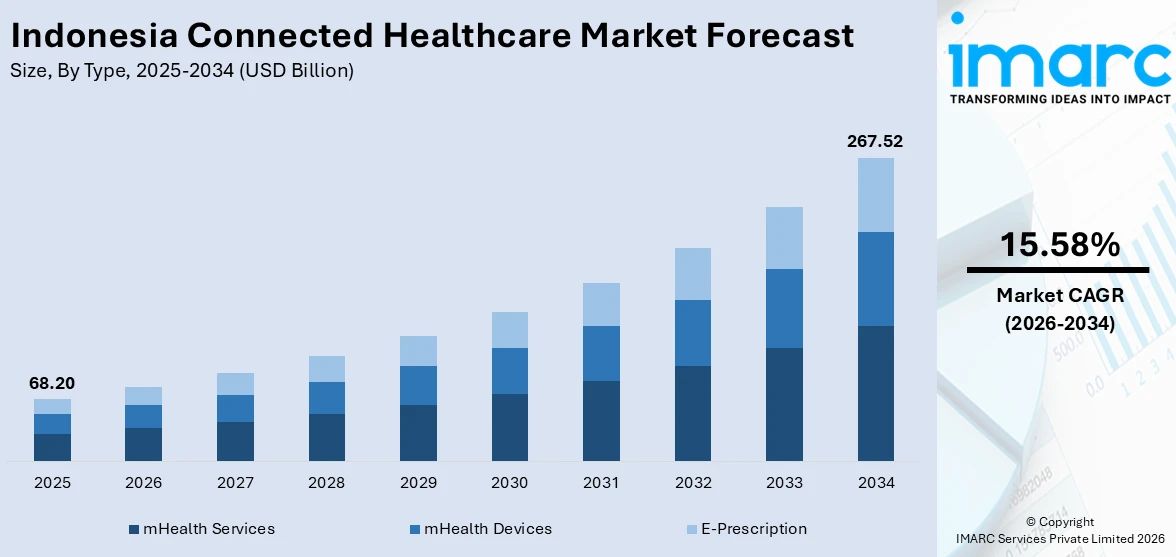
The Indonesia connected healthcare market size was valued at USD 68.20 Billion in 2025 and is projected to reach USD 267.52 Billion by 2034, growing at a compound annual growth rate of 15.58% from 2026-2034.
The Indonesia connected healthcare market is experiencing significant momentum as the nation embraces digital transformation across its healthcare ecosystem. Rising smartphone penetration, expanding internet connectivity, and growing demand for accessible medical services are accelerating adoption of connected health solutions. Government-led initiatives promoting digital health infrastructure and telemedicine integration are reinforcing market expansion. Increasing prevalence of chronic diseases and a shift toward preventive care models are reshaping healthcare delivery across the archipelago.
Key Takeaways and Insights:
- By Type: mHealth services dominate the market with a share of 44.8% in 2025, driven by widespread smartphone adoption, expanding telemedicine platforms, and rising consumer preference for mobile-based health consultations and prescription services.
- By Function Type: Remote patient monitoring leads the market with a share of 31.6% in 2025, owing to increasing chronic disease prevalence, growing integration of wearable health devices, and government support for digital monitoring across remote island communities.
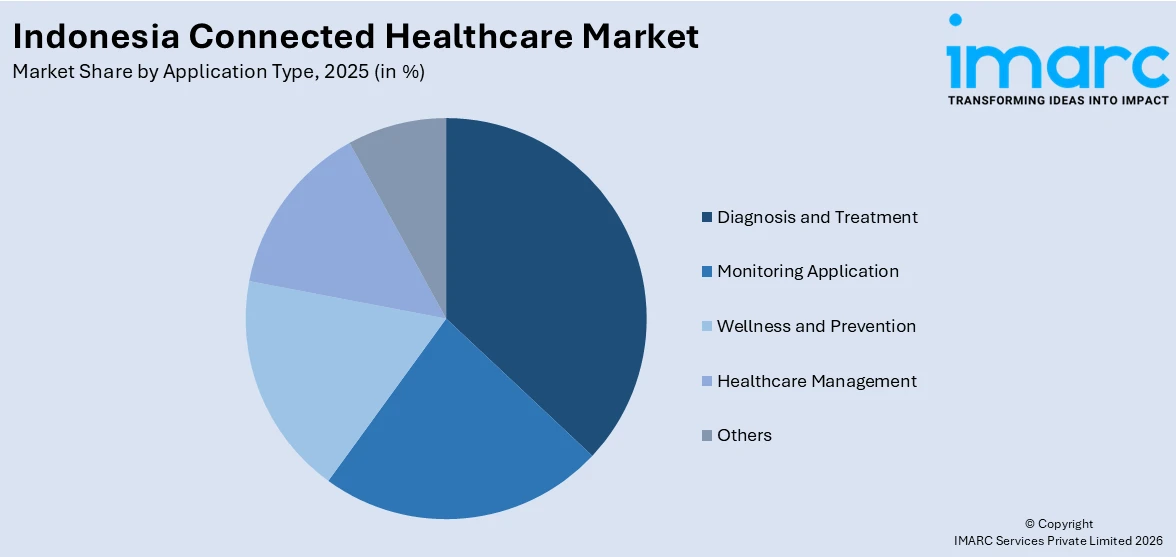
- By Application Type: Diagnosis and treatment represents the biggest segment with a market share of 28.9% in 2025, reflecting strong demand for AI-assisted diagnostic tools, connected imaging solutions, and digital clinical decision support systems across Indonesian healthcare facilities.
- By Region: Java is the largest region with 57.3% share in 2025, driven by superior healthcare infrastructure concentration, high population density, advanced digital adoption in Jakarta and Surabaya metropolitan areas, and leading hospital networks.
- Key Players: Key players drive the Indonesia connected healthcare market by expanding digital health ecosystems, improving telemedicine accessibility, investing in AI-powered diagnostic platforms, and strengthening partnerships with government health agencies to boost adoption and ensure consistent service delivery across diverse geographic regions.
To get more information on this market Request Sample
The Indonesia connected healthcare market is advancing rapidly as the nation undergoes a comprehensive digital health transformation aimed at bridging healthcare access gaps across its vast and geographically dispersed archipelago. The government's commitment to universal healthcare digitization is creating a robust foundation for connected health solutions, with national electronic medical records platforms now integrated across the vast majority of healthcare institutions nationwide, establishing a unified digital infrastructure that enhances care coordination and streamlines clinical workflows. Rising urbanization and the expanding middle class are fueling demand for convenient, technology-enabled healthcare services that reduce reliance on traditional facility-based care. The proliferation of affordable smartphones and improving broadband connectivity, particularly in densely populated urban centers, are enabling millions of citizens to access telemedicine consultations, remote monitoring, and digital prescription services. Strategic investments by domestic and international stakeholders in health technology innovation, combined with supportive regulatory frameworks that formalize telemedicine and establish data governance standards, are strengthening the ecosystem and positioning Indonesia as a leading connected healthcare market in Southeast Asia. The convergence of public-sector digital mandates with private-sector innovation is accelerating the development of interoperable health platforms that support population-level health management.
Indonesia Connected Healthcare Market Trends:
Accelerating Adoption of Artificial Intelligence in Clinical Workflows
The integration of artificial intelligence into clinical operations is reshaping healthcare delivery across Indonesia. Healthcare facilities are increasingly deploying AI-powered systems for automated documentation, diagnostic imaging analysis, and clinical decision support. These intelligent platforms reduce administrative burdens on medical professionals while improving diagnostic accuracy and treatment planning. The convergence of machine learning algorithms with electronic health records is enabling predictive analytics that support early disease detection and personalized care pathways, fundamentally transforming how clinicians interact with patient data across hospital networks.
Expansion of Government-Led Digital Health Infrastructure
Indonesia is witnessing a significant expansion of government-driven digital health infrastructure aimed at unifying fragmented healthcare systems across the archipelago. National platforms for electronic medical records integration are connecting hospitals, clinics, pharmacies, and laboratories into cohesive data-sharing ecosystems. The emphasis on interoperability standards and data governance frameworks is ensuring secure information exchange between public and private providers. This infrastructure development is laying the groundwork for population-level health surveillance, real-time resource allocation, and evidence-based policymaking that strengthens the overall healthcare delivery system.
Growing Integration of Wearable Health Devices with Telehealth Platforms
The convergence of wearable health monitoring devices with telehealth platforms is gaining considerable traction across Indonesia. Consumers and healthcare providers are increasingly leveraging smartwatches, biosensors, and fitness trackers that synchronize with mobile health applications to enable continuous vital sign monitoring. This integration supports preventive healthcare models by providing real-time physiological data that facilitates early intervention for chronic conditions. The trend reflects a broader shift toward patient-centric care delivery, empowering individuals to actively participate in managing their health outcomes through connected devices and digital health ecosystems.
Market Outlook 2026-2034:
The Indonesia connected healthcare market is poised for substantial expansion over the forecast period, underpinned by sustained government investment in digital health infrastructure, rising chronic disease burden, and accelerating technology adoption across urban and rural healthcare settings. Expanding telemedicine accessibility, increasing integration of artificial intelligence in diagnostic workflows, and growing deployment of remote patient monitoring systems are expected to drive transformative growth. The market generated a revenue of USD 68.20 Billion in 2025 and is projected to reach a revenue of USD 267.52 Billion by 2034, growing at a compound annual growth rate of 15.58% from 2026-2034. Progressive regulatory frameworks, strengthening public-private partnerships in healthcare technology, enhanced internet connectivity across the archipelago, and rising health awareness among the population are collectively establishing favorable conditions for sustained market expansion throughout the forecast period.
Indonesia Connected Healthcare Market Report Segmentation:
|
Segment Category |
Leading Segment |
Market Share |
|
Type |
mHealth Services |
44.8% |
|
Function Type |
Remote Patient Monitoring |
31.6% |
|
Application Type |
Diagnosis and Treatment |
28.9% |
|
Region |
Java |
57.3% |
Type Insights:
- mHealth Services
- mHealth Devices
- E-Prescription
mHealth services dominate with a market share of 44.8% of the total Indonesia connected healthcare market in 2025.
mHealth Services commands the largest share of the Indonesia connected healthcare market, reflecting the nation's rapid embrace of mobile-based health solutions driven by extensive smartphone penetration and expanding internet access across the archipelago. The segment encompasses telemedicine consultations, mobile health applications, digital prescription services, and wellness management platforms that collectively address critical healthcare accessibility challenges throughout the country. Rising consumer preference for convenient, on-demand medical consultations and digital pharmacy services is reinforcing the segment's leadership position. The growing integration of multiple healthcare functionalities within unified mobile platforms is creating seamless user experiences that encourage sustained engagement and long-term adoption among diverse population segments. Increasing collaboration between digital health platforms and national health insurance systems is further broadening the addressable consumer base and strengthening the relevance of mobile health services within the formal healthcare delivery framework.
The proliferation of mHealth Services is particularly significant in bridging the urban-rural healthcare divide that characterizes Indonesia's geographically dispersed population. Mobile health platforms enable patients in remote island communities to access specialist consultations and chronic disease management programs that were previously unavailable or required extensive travel to urban medical centers. The integration of electronic pharmacy services, appointment booking systems, and health information portals within unified mobile applications is creating comprehensive digital health ecosystems that serve diverse consumer needs across socioeconomic segments. Growing partnerships between technology providers and healthcare facilities are expanding service reach while improving care coordination and patient engagement.

Function Type Insights:
- Remote Patient Monitoring
- Clinical Monitoring
- Telemedicine
- Others
Remote patient monitoring leads with a share of 31.6% of the total Indonesia connected healthcare market in 2025.
Remote patient monitoring holds the leading share within the function type segment, driven by the growing need for continuous health surveillance solutions tailored to Indonesia's vast geographic landscape. The segment benefits from increasing deployment of connected biosensors, wearable vital sign monitors, and IoT-enabled health tracking devices that transmit clinical data to healthcare providers in real time. The rising burden of chronic conditions including diabetes and cardiovascular diseases is accelerating adoption of remote monitoring protocols across both urban hospitals and rural healthcare centers. The convergence of sensor technology with cloud-based analytics platforms is enabling healthcare professionals to monitor larger patient populations more efficiently while maintaining clinical accuracy.
The expansion of remote patient monitoring infrastructure is transforming chronic disease management practices across Indonesian healthcare networks and delivery systems. Cloud-based monitoring platforms integrated with hospital information systems enable physicians to track patient vitals continuously, identify deteriorating conditions promptly, and initiate timely interventions without requiring in-person visits. The convergence of artificial intelligence with remote monitoring devices is enhancing predictive capabilities, allowing healthcare providers to anticipate potential complications and deliver proactive care before conditions worsen.
Application Type Insights:
Access the comprehensive market breakdown Request Sample
- Diagnosis and Treatment
- Monitoring Application
- Wellness and Prevention
- Healthcare Management
- Others
Diagnosis and treatment exhibits a clear dominance with a 28.9% share of the total Indonesia connected healthcare market in 2025.
Diagnosis and treatment represents the leading application segment, underpinned by growing deployment of connected diagnostic tools, AI-assisted clinical decision support systems, and digital imaging technologies across Indonesian healthcare facilities. The segment is benefiting from a substantial modernization wave in hospital infrastructure, reflecting increasing investment in advanced diagnostic equipment and connected clinical technologies that improve accuracy and efficiency. Connected imaging solutions, point-of-care diagnostic devices, and telemedicine-enabled consultation platforms are enabling faster and more accurate disease identification, particularly in healthcare facilities serving densely populated urban centers and underserved rural regions across the archipelago.
The growing emphasis on early disease detection and precision medicine is strengthening demand for connected diagnostic and treatment solutions throughout Indonesia's healthcare system. Healthcare providers are integrating digital pathology, remote radiology, and AI-powered screening tools into clinical workflows to improve diagnostic throughput and significantly reduce turnaround times for test results. The interoperability mandates established through national electronic health record platforms are facilitating seamless data exchange between diagnostic devices and hospital information systems across the country. This enhanced connectivity enables comprehensive patient profiling that supports more informed treatment decisions and coordinated care delivery across multiple healthcare facilities, specialist networks, and referral pathways.
Regional Insights:
- Java
- Sumatra
- Kalimantan
- Sulawesi
- Others
Java represents the leading region with 57.3% share of the total Indonesia connected healthcare market in 2025.
Java commands the largest regional share of the Indonesia connected healthcare market, driven by its concentration of advanced healthcare infrastructure, high population density, and superior digital connectivity networks. The island hosts the majority of Indonesia's tertiary care hospitals and technology-driven medical facilities, with the country recording 3,155 hospitals in 2023, including 1,181 public and 1,974 private facilities, a substantial proportion of which are concentrated in Java's major metropolitan areas including Jakarta, Surabaya, and Bandung. The region benefits from strong internet penetration, a tech-savvy consumer base, and proximity to government policymakers who pilot digital health initiatives in Java before nationwide implementation.
The dominance of Java in the connected healthcare landscape is further reinforced by the presence of leading hospital networks that serve as early adopters of cutting-edge digital health technologies and innovation. Advanced electronic health record systems, AI-powered diagnostic platforms, and integrated telemedicine services are widely deployed across Java's healthcare facilities, establishing performance benchmarks that guide technology adoption in other regions. The concentration of venture capital funding, health technology startups, and academic research institutions on the island creates a vibrant innovation ecosystem that continuously drives the development, commercialization, and scaling of connected healthcare solutions throughout the broader Indonesian market.
Market Dynamics:
Growth Drivers:
Why is the Indonesia Connected Healthcare Market Growing?
Government-Led Digital Health Transformation Initiatives
The Indonesian government's comprehensive commitment to healthcare digitization represents a primary growth driver for the connected healthcare market. National-level mandates requiring healthcare facilities to adopt electronic medical records and integrate with centralized health data platforms are creating a standardized digital infrastructure that facilitates widespread adoption of connected health solutions. The establishment of health special economic zones and regulatory frameworks that encourage foreign investment in healthcare technology are attracting international expertise and capital into the market. Progressive health legislation has formalized telemedicine services, established data privacy standards, and aligned electronic health records requirements with broader personal data protection regulations, providing healthcare stakeholders with clear compliance pathways and predictable operating environments. The government's preventive healthcare programs, including nationwide free health screening initiatives delivered through digital platforms, are accelerating citizen engagement with connected health services and building familiarity with technology-enabled care models. Public-private partnership models that leverage commercial telehealth platforms for national health programs demonstrate the government's willingness to collaborate with technology providers, strengthening the overall digital health ecosystem and creating sustainable demand for connected healthcare solutions across both urban and rural communities throughout the vast Indonesian archipelago.
Rising Chronic Disease Burden and Preventive Healthcare Demand
The increasing prevalence of chronic diseases including diabetes, cardiovascular conditions, and hypertension across Indonesia's population is generating substantial demand for connected healthcare solutions that enable continuous monitoring and proactive disease management. The demographic shift toward an aging population combined with lifestyle changes associated with rapid urbanization are contributing to higher incidence rates of non-communicable diseases that require ongoing medical supervision and long-term treatment protocols. This epidemiological transition is driving healthcare providers and patients toward digital health tools that facilitate remote monitoring, medication adherence tracking, and virtual consultations with specialists across multiple medical disciplines. The growing recognition among Indonesian consumers that preventive healthcare is more effective and cost-efficient than reactive treatment is reshaping health-seeking behaviors and increasing engagement with wellness applications and connected monitoring devices. Healthcare insurers are also recognizing the value of connected health technologies in reducing hospitalization rates, improving patient outcomes, and managing claims costs, further incentivizing adoption across the entire healthcare value chain. This convergence of clinical necessity, rising health consciousness, and economic incentives is establishing a strong and sustainable growth foundation for connected healthcare services and solutions.
Expanding Digital Infrastructure and Smartphone Penetration
Indonesia's rapidly expanding digital infrastructure, characterized by increasing internet connectivity and widespread smartphone adoption, is creating the essential technological foundation for connected healthcare market growth. The nation's position as one of the largest and fastest-growing internet economies in Southeast Asia provides a massive addressable consumer base for mobile health applications and digital health platforms. Improving broadband coverage in previously underserved regions, supported by government-backed telecommunications expansion programs, is extending the reach of telemedicine services and remote monitoring solutions to populations that traditionally lacked access to quality healthcare. The affordability of smartphones and declining mobile data costs are lowering barriers to entry for digital health consumers across diverse socioeconomic segments throughout the archipelago. The growing comfort of Indonesian citizens with digital transactions and online services, reinforced by widespread adoption of digital payment ecosystems, is translating into higher adoption rates for health-related mobile applications and virtual consultation platforms. Cloud computing infrastructure expansion is simultaneously enabling healthcare providers to deploy scalable connected health solutions without significant upfront capital investment, facilitating the transition from traditional care delivery models to technology-enabled healthcare ecosystems that improve accessibility, reduce costs, and enhance patient outcomes across the country.
Market Restraints:
Digital Infrastructure Disparities Across Remote Regions
Despite notable progress in expanding internet connectivity, significant digital infrastructure gaps persist across Indonesia's remote island communities and rural areas. Inconsistent broadband coverage, limited access to reliable electricity supplies, and inadequate telecommunications infrastructure in outer islands create substantial barriers to connected healthcare adoption. These persistent geographic disparities prevent equitable deployment of telemedicine services and remote monitoring solutions, leaving vulnerable populations in underserved regions without access to the digital health innovations that are readily available in major urban centers, ultimately constraining overall market penetration beyond Java and other more developed island regions.
Data Privacy and Cybersecurity Concerns
Growing reliance on digital health platforms and electronic medical records raises significant concerns about patient data security and privacy protection across Indonesia's healthcare ecosystem. The increasing volume of sensitive health information transmitted through connected devices and cloud platforms creates expanded attack surfaces for sophisticated cyber threats and unauthorized data access. Healthcare organizations face persistent challenges in implementing robust data protection measures while maintaining system usability and cross-platform interoperability. Insufficient cybersecurity awareness among healthcare workers and patients, combined with evolving regulatory requirements, complicates compliance efforts and can substantially erode public trust in connected health solutions.
Limited Digital Health Literacy Among Healthcare Workers and Patients
Inadequate digital literacy levels among both healthcare professionals and patients represent a persistent challenge to connected healthcare market expansion in Indonesia. Many healthcare workers, particularly those in rural and semi-urban facilities, lack sufficient training in utilizing electronic health records, telehealth platforms, and connected monitoring devices effectively in daily clinical practice. Similarly, patient populations in lower socioeconomic segments and elderly demographics often struggle with navigating digital health applications and understanding connected device functionalities. This digital literacy gap slows overall adoption rates and diminishes the effectiveness of connected healthcare implementations across the country.
Competitive Landscape:
The Indonesia connected healthcare market features a dynamic and increasingly competitive landscape characterized by a diverse mix of established multinational technology providers and rapidly growing domestic digital health platforms. Competition is intensifying as market participants expand service portfolios, enhance platform interoperability, and invest in artificial intelligence capabilities to differentiate their offerings and capture larger market shares. Strategic partnerships between technology companies and healthcare facility networks are reshaping competitive dynamics, with players focusing on end-to-end solution delivery spanning telemedicine, electronic health records, remote monitoring, and e-pharmacy services. The emphasis on compliance with national health data interoperability standards is becoming a critical competitive differentiator, as healthcare providers prioritize platforms that seamlessly integrate with government-mandated digital infrastructure. Domestic startups are leveraging deep local market understanding and established consumer bases to capture engagement, while international players contribute advanced technological capabilities, global clinical best practices, and substantial research investment to drive innovation and elevate overall market standards. Market consolidation through mergers, acquisitions, and strategic alliances is accelerating as players seek to strengthen their competitive positioning across the value chain.
Indonesia Connected Healthcare Market Report Coverage:
|
Report Features |
Details |
|
Base Year of the Analysis |
2025 |
|
Historical Period |
2020-2025 |
|
Forecast Period |
2026-2034 |
|
Units |
Billion USD |
|
Scope of the Report |
Exploration of Historical Trends and Market Outlook, Industry Catalysts and Challenges, Segment-Wise Historical and Future Market Assessment:
|
|
Types Covered |
mHealth Services, mHealth Devices, E-Prescription |
|
Function Types Covered |
Remote Patient Monitoring, Clinical Monitoring, Telemedicine, Others |
|
Application Types Covered |
Diagnosis and Treatment, Monitoring Application, Wellness and Prevention, Healthcare Management, Others |
|
Regions Covered |
Java, Sumatra, Kalimantan, Sulawesi, Others |
|
Customization Scope |
10% Free Customization |
|
Post-Sale Analyst Support |
10-12 Weeks |
|
Delivery Format |
PDF and Excel through Email (We can also provide the editable version of the report in PPT/Word format on special request) |
Frequently Asked Questions About the Indonesia Connected Healthcare Market Report
The Indonesia connected healthcare market size was valued at USD 68.20 Billion in 2025.
The Indonesia connected healthcare market is expected to grow at a compound annual growth rate of 15.58% from 2026-2034 to reach USD 267.52 Billion by 2034.
mHealth services dominated the market with a share of 44.8%, driven by widespread smartphone adoption, expanding telemedicine platforms, mobile health application proliferation, and rising consumer preference for accessible digital healthcare consultations and prescription services.
Key factors driving the Indonesia connected healthcare market include government-led digital health transformation initiatives, rising chronic disease prevalence, expanding smartphone penetration, improving internet connectivity, supportive regulatory frameworks, and increasing investment in healthcare technology infrastructure.
Major challenges include digital infrastructure disparities across remote island regions, data privacy and cybersecurity concerns, limited digital health literacy among healthcare workers and patients, interoperability complexities, and high initial implementation costs for connected health solutions.
Need more help?
- Speak to our experienced analysts for insights on the current market scenarios.
- Include additional segments and countries to customize the report as per your requirement.
- Gain an unparalleled competitive advantage in your domain by understanding how to utilize the report and positively impacting your operations and revenue.
- For further assistance, please connect with our analysts.
 Request Customization
 Speak to an Analyst
 Request Brochure
 Inquire Before Buying
Benefits of Customization
- Personalize this research
- Triangulate with your data
- Get data as per your format and definition
- Gain a deeper dive into a specific application, geography, customer, or competitor
- Any level of personalization
Get in Touch With Us
UNITED STATES
Phone: +1-201-971-6302
INDIA
Phone: +91-120-433-0800
UNITED KINGDOM
Phone: +44-753-714-6104
Email: [email protected]
Client Testimonials




.webp)




.webp)













Related Reports

Choose your plan
*Please note that the prices mentioned below are starting prices for each bundle type. Kindly contact our team for further details.*
Single User License
- 1 User License, Access on 2 Devices
- PDF Report + Excel Dataset (Password Protected)
- Lifetime Access
- No Printing Rights
- 10% Free Report Customization
- 10–12 Weeks of Analyst Support
Five User License
- Access for 5 Users, 2 Devices per User
- PDF Report + Excel Dataset (Password Protected)
- Lifetime Access
- Dedicated Account Manager
- 12–14 Weeks of Analyst Support
- No Printing Rights
- 15% Free Report Customization
- 25% Discount on Your Next Purchase
Corporate User License
- Unlimited User Access (Within Your Organization)
- PDF Report + Excel Dataset
- Lifetime Access
- Dedicated Account Manager
- 14–20 Weeks of Analyst Support
- No Printing Rights
- 20% Free Report Customization
- 30% Discount on Your Next Purchase
Essential Insights
What's included:
3 reports
- Lifetime Access
- PDF Reports
- Excel Datasets
- 2 Weeks of Free Analyst Support
- 2 User Licenses
- Access on 2 Devices
- Printing Rights
- Complimentary PowerPoint (PPT) Version
- Complimentary License Upgrade
Professional Access
What's included:
5 reports
- Lifetime Access
- PDF Reports
- Excel Datasets
- 8 Weeks of Free Analyst Support
- 2 User Licenses
- Access on 2 Devices
- Printing Rights
- Complimentary PowerPoint (PPT) Version
- Complimentary License Upgrade
Business Advantage
What's included:
8 reports
- Lifetime Access
- PDF Reports
- Excel Datasets
- 14 Weeks of Free Analyst Support
- 2 User Licenses
- Access on 2 Devices
- Printing Rights
- Complimentary PowerPoint (PPT) Version
- Complimentary License Upgrade
Enterprise Intelligence
What's included:
10 reports
- Lifetime Access
- PDF Reports
- Excel Datasets
- 20 Weeks of Free Analyst Support
- 2 User Licenses
- Access on 2 Devices
- Printing Rights
- Complimentary PowerPoint (PPT) Version
- Complimentary License Upgrade