
Indonesia Construction Equipment Market Size, Share, Trends and Forecast by Solution Type, Equipment Type, Type, Application, Industry, and Region, 2026-2034
Indonesia Construction Equipment Market Summary:
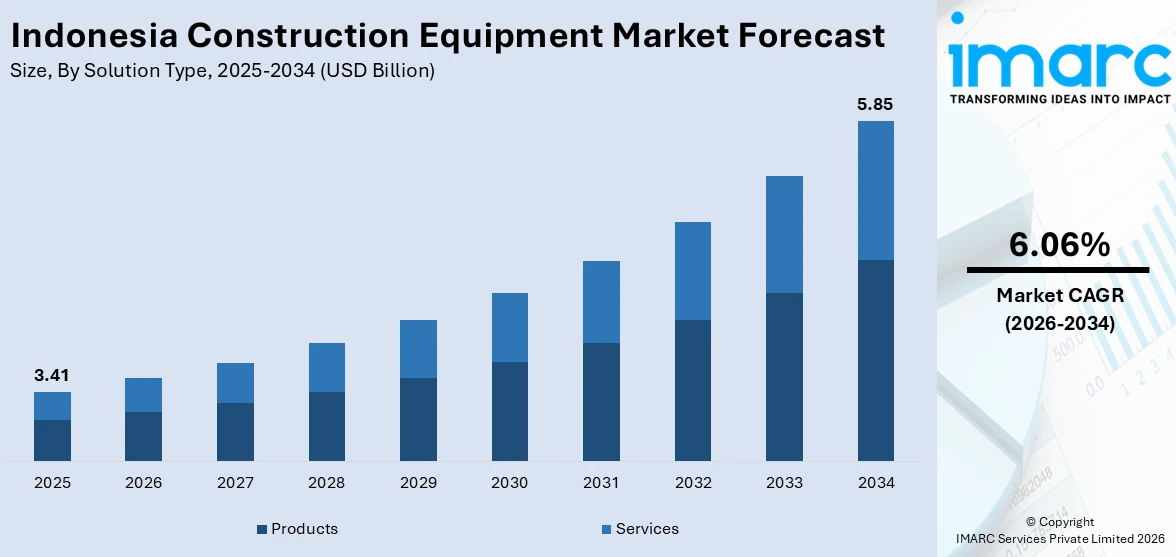
The Indonesia construction equipment market size was valued at USD 3.41 Billion in 2025 and is projected to reach USD 5.85 Billion by 2034, growing at a compound annual growth rate of 6.06% from 2026-2034.
The Indonesia construction equipment market is gaining pace as the country is moving ahead with rapid infrastructure development, urbanization, and industrialization. Increased investment in the development of transportation infrastructure, energy, and public utilities is driving steady growth in demand for modern construction equipment. Urbanization, mining activities, and foreign direct investment inflows are further propelling the market growth trajectory. The adoption of modern technology in construction activities and the development of new industrial corridors are changing the dynamics of equipment purchases, making Indonesia a prime destination for construction equipment demand in the Southeast Asia construction equipment market share.
Key Takeaways and Insights:
- By Solution Type: Products dominate the market with a share of 72.5% in 2025, driven by sustained procurement of construction machinery across infrastructure, mining, and urban development projects nationwide.
- By Equipment Type: Heavy construction equipment leads the market with a share of 64.1% in 2025, owing to large-scale earthmoving, mining, and infrastructure construction activities demanding high-capacity machinery.
- By Type: Excavators represent the largest segment with a share of 29.6% in 2025, reflecting their versatile application across excavation, mining, material handling, and site preparation operations.
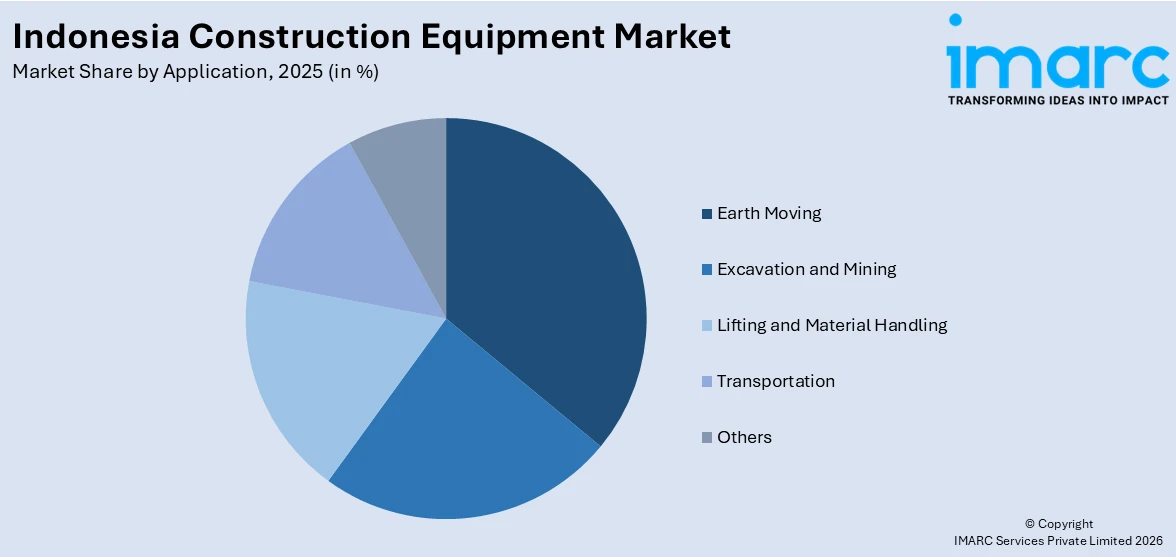
- By Application: Earth moving dominates the market with a share of 33.8% in 2025, supported by extensive land clearing, grading, and site preparation requirements for ongoing infrastructure projects.
- By Industry: Construction and infrastructure leads the market with a share of 36.9% in 2025, propelled by government-led transportation, urban development, and public works initiatives across the archipelago.
- By Region: Java dominates the market with a share of 57.4% in 2025, driven by concentrated economic activity, dense population centers, and major industrial and infrastructure developments.
- Key Players: The Indonesia construction equipment market exhibits a moderately competitive landscape, with established global manufacturers and regional players competing through product diversification, dealer networks, after-sales services, and localized manufacturing strategies.
To get more information on this market Request Sample
The Indonesia construction equipment market is moving ahead with a steady pace as the country is embarking on a revolutionary infrastructure development and economic transformation process. Major equipment manufacturers are also expanding local operations. For example, PT Komatsu Indonesia inaugurated a new smart assembly plant in Cibitung in October 2025 to strengthen production efficiency and support rising demand for heavy equipment in infrastructure and mining projects. Government-led projects to develop the transportation infrastructure, establish new urban areas, and enhance public utilities are generating continuous demand for a wide variety of heavy and compact construction equipment. The mining industry, a backbone of the Indonesian economy, is also requiring specialized excavation and material handling equipment to support the mining and processing operations. The rising urbanization and population are also generating a growing need for new residential and commercial construction, thereby adding to the demand for equipment. Foreign investments, development of industrial corridors, and adoption of advanced construction technology are all together creating a favorable market environment, making Indonesia one of the most vibrant construction equipment markets in Southeast Asia.
Indonesia Construction Equipment Market Trends:
Growing Adoption of Electric and Hybrid Construction Machinery
The construction equipment industry in Indonesia is slowly adopting electric and hybrid technology as part of their sustainability initiatives. For instance, Volvo Construction Equipment delivered Indonesia’s first L120 Electric wheel loader in December 2025, marking the first commercial deployment of a mid‑size electric machine in the country and reflecting growing customer readiness to embrace low‑emission solutions. The construction equipment industry is witnessing the launch of electric and hybrid excavators, loaders, and compact equipment by equipment manufacturers to reduce emissions and lower operating costs. The government's initiative to become carbon neutral is slowly encouraging the adoption of cleaner construction methods, as companies are looking for energy-efficient alternatives that consume less fuel and are quieter in operation.
Rising Demand for Equipment Rental Services
The construction equipment rental segment is expanding across Indonesia as contractors and developers seek cost-effective alternatives to outright equipment purchases. For example, in November 2023, Marubeni and Rent launch PT. Max Rent Indonesia construction machinery rental services in partnership with PT. EXXA Capital, aiming to provide a broader range of rental equipment for industrial and infrastructure projects across the country. Rental services provide access to modern, well-maintained machinery without significant upfront capital investment, making them attractive for short-term and project-based operations. The growing availability of diverse rental fleets across major islands is enabling smaller contractors to participate in large-scale projects, improving overall market accessibility and operational flexibility.
Integration of Digital Technologies and Telematics
Digital transformation is reshaping Indonesia’s construction equipment landscape as operators increasingly adopt telematics, fleet management systems, and remote monitoring solutions. For example, technology provider TransTRACK showcased comprehensive smart fleet and heavy equipment tracking systems at Mining Indonesia 2025, enabling real‑time monitoring of fleet performance, fuel usage, and maintenance scheduling to reduce downtime and improve operational efficiency across mining and construction fleets. These technologies enable real-time tracking of equipment performance, fuel consumption, and maintenance needs, enhancing operational efficiency and reducing downtime. The growing emphasis on data-driven decision-making and predictive maintenance is helping construction firms optimize equipment utilization and improve overall productivity across diverse project environments.
Market Outlook 2026-2034:
Indonesia's construction equipment market is poised for sustained growth, supported by continued government investment in infrastructure modernization, urban expansion, and industrial development. Rising foreign direct investment, expanding mining operations, and the establishment of new economic corridors are expected to generate consistent demand for both heavy and compact construction machinery. The growing emphasis on mechanized construction practices, equipment fleet modernization, and improved operational efficiency is further reinforcing long-term market prospects. Additionally, the expansion of rental services, strengthening dealer networks, and increasing adoption of technologically advanced machinery are expected to create new growth opportunities across the archipelago. The market generated a revenue of USD 3.41 Billion in 2025 and is projected to reach a revenue of USD 5.85 Billion by 2034, growing at a compound annual growth rate of 6.06% from 2026-2034.
Indonesia Construction Equipment Market Report Segmentation:
|
Segment Category |
Leading Segment |
Market Share |
|
Solution Type |
Products |
72.5% |
|
Equipment Type |
Heavy Construction Equipment |
64.1% |
|
Type |
Excavator |
29.6% |
|
Application |
Earth Moving |
33.8% |
|
Industry |
Construction and Infrastructure |
36.9% |
|
Region |
Java |
57.4% |
Solution Type Insights:
- Products
- Services
The products dominates with a market share of 72.5% of the total Indonesia construction equipment market in 2025.
The products category includes the direct sales of construction machinery, such as excavators, loaders, cranes, dozers, and forklifts, which act as the main revenue-generating source in the Indonesian construction equipment market. Rising investments in country-wide infrastructure development projects, mining activities, and urban construction development are creating a consistent demand for various types of equipment. The rising demand for high-performance and fuel-efficient equipment is encouraging companies to invest in new equipment types with enhanced capabilities, which will offer better productivity and lower operating costs.
Equipment suppliers are expanding their product lines to meet the varied demands of construction and mining projects in Indonesia. The launch of technologically advanced equipment with improved hydraulic systems, enhanced operator comfort, and lower emission levels is attracting more customers. Improved dealership networks and country-wide assembly facilities are further helping to make equipment more accessible, with timely delivery and after-sales services in the geographically dispersed and challenging project sites of the Indonesian archipelago.
Equipment Type Insights:
- Heavy Construction Equipment
- Compact Construction Equipment
The heavy construction equipment leads with a share of 64.1% of the total Indonesia construction equipment market in 2025.
Heavy construction equipment, including large excavators, bulldozers, wheel loaders, and cranes, is a leading segment in the Indonesian construction equipment market. The leading position of this market is supported by the country's large-scale infrastructure development projects, such as road development, bridge construction, and port development. Mining operations, especially in coal, nickel, and other minerals, also support the demand for heavy equipment with the capability to perform heavy earthmoving and material handling tasks.
The increasing focus on mechanized construction methods and the development of industrial corridors in the major islands of Indonesia are expected to support the requirement for heavy construction equipment. Government spending on transportation infrastructure, energy infrastructure, and urban development is expected to continue to create strong demand for heavy equipment. The development of financing options, equipment leasing, and the expansion of the dealer network are making heavy equipment more attractive to contractors and project developers in the Indonesian archipelago.
Type Insights:
- Loader
- Cranes
- Forklift
- Excavator
- Dozers
- Others
The excavators dominates with a market share of 29.6% of the total Indonesia construction equipment market in 2025.
Excavators are the most widely used type of construction equipment in Indonesia, due to their versatility in construction, mining, and infrastructure development activities. In fact, in 2025, major players such as Volvo Construction Equipment and its Indonesian dealer PT Indotruck Utama introduced the New Generation EC210 excavator to the Indonesian market, with a fleet of 25 units deployed on a large plantation project in Sorong, highlighting the strong demand for excavators in diverse and challenging operations. Excavators are a critical requirement for excavation, trenching, grading, demolition, and material handling activities, making them an absolute necessity in almost all major construction and mining ventures. The presence of different excavator models, from compact excavators used in urban projects to ultra-large hydraulic excavators used in deep mining operations, has facilitated their widespread use in different operating environments across the country.
The growing mining industry in Indonesia, especially in the production of coal and nickel, has generated a constant demand for medium and large excavators with high earthmoving capacity. Infrastructure development schemes, such as road development, dam construction, and land reclamation schemes, are also fueling the demand for excavators in the Indonesian archipelago. The increasing focus on equipment upgradation and the replacement of old equipment with new and more efficient models with improved hydraulic systems and fuel efficiency is also contributing to the continued growth of this critical equipment type in the Indonesian market.
Application Insights:
Access the comprehensive market breakdown Request Sample
- Excavation and Mining
- Lifting and Material Handling
- Earth Moving
- Transportation
- Others
The earth moving leads with a share of 33.8% of the total Indonesia construction equipment market in 2025.
Earth moving applications hold the leading revenue position in the construction equipment market in Indonesia, owing to the country's focused efforts on land development, site clearing, and terrain modification for infrastructure and construction activities. Functions like grading, leveling, trenching, and embankment formation demand the use of specialized earthmoving equipment like excavators, bulldozers, and wheel loaders. The construction of highway networks, toll roads, railway lines, and urban development projects across various islands continues to fuel the demand for earthmoving activities.
The government's efforts to enhance connectivity through road and rail infrastructure development, along with the establishment of new urban developments and industrial areas, continue to fuel the use of earthmoving equipment. Mining activities, which involve substantial overburden stripping and extensive site development, also contribute to the leading position of this segment. The rising mechanization of construction processes and the adoption of advanced earthmoving equipment with enhanced efficiency, enhanced operator safety, and superior productivity performance are further strengthening the position of this application segment in the overall market.
Industry Insights:
- Oil and Gas
- Construction and Infrastructure
- Manufacturing
- Mining
- Others
The construction and infrastructure dominates with a market share of 36.9% of the total Indonesia construction equipment market in 2025.
The construction and infrastructure sector serves as the primary demand driver in Indonesia's construction equipment market, fueled by the government's ambitious development agenda encompassing roads, bridges, airports, ports, railways, and urban modernization projects. National programs aimed at improving inter-island connectivity, reducing logistics costs, and supporting economic growth across the archipelago are generating substantial equipment demand. The development of new capital city projects, toll road networks, and public transportation systems further amplifies the need for diverse construction machinery categories.
Private sector investment in commercial real estate, residential housing, industrial estates, and technology infrastructure is complementing public infrastructure spending and broadening equipment demand. The growing emphasis on modernizing construction practices, improving project execution timelines, and enhancing workplace safety standards is encouraging the adoption of advanced construction equipment across the industry. As Indonesia continues to prioritize infrastructure-led economic growth, this sector is expected to remain the foremost demand driver for construction equipment throughout the forecast period.

Regional Insights:
- Java
- Sumatra
- Kalimantan
- Sulawesi
- Others
Java exhibits a clear dominance with a 57.4% share of the total Indonesia construction equipment market in 2025.
Java serves as the dominant region in Indonesia's construction equipment market, driven by its status as the country's economic, administrative, and industrial center. The island hosts the majority of Indonesia's population, industrial activity, and commercial infrastructure, creating intensive demand for construction equipment across residential, commercial, and public infrastructure projects. Major urban centers on Java are undergoing significant expansion, with ongoing developments in transportation networks, industrial estates, and mixed-use commercial complexes driving substantial equipment procurement.
The concentration of manufacturing facilities, logistics hubs, and construction equipment dealerships on Java further reinforces its market leadership position. Government-led infrastructure projects, including toll road expansions, railway developments, and port upgrades, contribute significantly to the region's equipment demand. The presence of well-established equipment distribution networks and service centers ensures efficient machinery supply and maintenance support, enabling Java to maintain its dominant position as the primary market for construction equipment procurement in Indonesia.
Market Dynamics:
Growth Drivers:
Why is the Indonesia Construction Equipment Market Growing?
Accelerating Government-Led Infrastructure Development
The Indonesian government’s continued efforts in developing large-scale infrastructure projects are the key factors driving the demand for construction equipment. In 2025, the government showcased a pipeline of 46 major infrastructure projects valued at nearly Rp 200 trillion, spanning transportation networks such as extended MRT lines, airports, port access railways, and toll road links, to both domestic and foreign investors at the International Conference on Infrastructure. Various national projects aimed at developing infrastructure such as toll roads, highways, railways, ports, and airports are generating massive demands for heavy and specialized construction equipment. The development of new cities and the expansion of existing ones are also increasing demands for various types of equipment, including earthmoving equipment and material handling equipment. Such projects are being developed across various islands, including Java, and new economic zones in Sumatra, Kalimantan, and Sulawesi. The Indonesian government’s efforts to improve connectivity between islands and lower logistics costs are ensuring that there is a continuous stream of construction projects that require equipment deployment.
Expanding Mining and Natural Resource Extraction Activities
Indonesia’s position as a major global producer of coal, nickel, bauxite, and other minerals makes the mining sector a significant driver of construction equipment demand. Indonesia produced approximately 1.6 million tonnes of nickel in 2023, accounting for about 65 % of global output, making it the world’s largest nickel supplier and supporting the expansion of mining operations across Sulawesi and other islands. Mining operations require substantial volumes of heavy machinery for excavation, overburden removal, material transport, and site preparation activities. The growing global demand for critical minerals, particularly nickel for electric vehicle battery production, is encouraging the expansion of mining operations across the Indonesian archipelago. This mineral extraction growth is generating sustained procurement requirements for ultra-large hydraulic excavators, rigid dump trucks, bulldozers, and wheel loaders designed for demanding mining environments. Additionally, the government’s emphasis on downstream mineral processing and the establishment of smelting facilities are creating new construction projects that further contribute to equipment demand.
Rising Foreign Direct Investment and Economic Modernization
Indonesia’s improving investment climate and regulatory reforms are attracting significant foreign direct investment into construction-intensive sectors, including industrial manufacturing, energy infrastructure, and real estate development. For example, in 2025, Indonesia signed a major cooperation deal with China’s State Construction Engineering Corporation to develop the Batang Industropolis Special Economic Zone, projected at around Rp 60 trillion, to accelerate investment in manufacturing, logistics, and high‑technology sectors, supporting construction and industrial capacity expansions. The government’s efforts to streamline permitting processes, offer investment incentives, and establish special economic zones are encouraging multinational corporations to establish manufacturing facilities, data centers, and logistics hubs across the country. This influx of investment is generating new construction projects that require modern equipment for site preparation, building construction, and infrastructure development. The growing involvement of international investors in Indonesia’s construction sector is also facilitating technology transfer and the introduction of advanced construction methodologies that rely on sophisticated machinery and equipment solutions.
Market Restraints:
What Challenges the Indonesia Construction Equipment Market is Facing?
Volatile Commodity and Building Material Prices
Fluctuations in global commodity prices, particularly for coal, nickel, and other minerals, directly impact mining investment levels and consequently construction equipment demand. Rising costs of essential building materials such as cement, steel, and asphalt further increase overall project expenditures, leading to potential delays or scaling back of construction activities. This price volatility creates uncertainty in equipment procurement planning and can reduce capital allocation for machinery purchases across both mining and construction sectors.
Implementation of New Tax Policies on Heavy Equipment
The introduction of value-added tax adjustments and heavy equipment-specific taxes is increasing the overall cost of acquiring construction machinery in Indonesia. These additional tax burdens raise equipment prices for contractors and project developers, potentially slowing purchase decisions and encouraging a shift toward used equipment or rental alternatives. The varying implementation of heavy equipment tax regulations across different provinces creates further complexity and uncertainty in the market, affecting procurement strategies and investment planning.
Shortage of Skilled Equipment Operators and Technicians
Indonesia faces a persistent shortage of adequately skilled construction equipment operators and maintenance technicians, which limits the effective utilization of modern machinery. The gap between the industry’s growing demand for trained personnel and the available workforce hampers operational efficiency and increases equipment downtime. Insufficient training infrastructure and the challenges of deploying skilled workers to remote project locations across the archipelago further compound this constraint, affecting overall productivity and market growth potential.
Competitive Landscape:
The Indonesia construction equipment market has a moderately fragmented and competitive environment, with a wide range of established global brands, local equipment manufacturers, and new entrants from different markets. The competition in the market is fueled by factors such as equipment prices, product quality and longevity, dealership and distribution networks, service capabilities, financing solutions, and the capacity to provide technologically advanced solutions. The players are trying to enhance their presence in the country by increasing their dealership networks, establishing local assembly and manufacturing facilities, and improving their service and spare parts availability across the country. The increasing focus on product differentiation with advanced features such as fuel efficiency, telematics integration, and lower emissions is further increasing the competitiveness in the market. Partnerships with local distributors, investment in training centers for operators and technicians, and the adoption of flexible purchasing and rental solutions are further influencing the competitive scenario in the Indonesia construction equipment market.
Recent Developments:
-
In September 2025, Volvo Construction Equipment unveiled its New Generation A60 articulated hauler and SD120 soil compactor at Inspire 2025 in Indonesia, spotlighting advanced efficiency, tech features and deeper customer partnerships for heavy‑duty earthmoving and compaction markets.
Indonesia Construction Equipment Market Report Coverage:
|
Report Features |
Details |
|
Base Year of the Analysis |
2025 |
|
Historical Period |
2020-2025 |
|
Forecast Period |
2026-2034 |
|
Units |
Billion USD |
|
Scope of the Report |
Exploration of Historical Trends and Market Outlook, Industry Catalysts and Challenges, Segment-Wise Historical and Future Market Assessment:
|
|
Solution Types Covered |
Products, Services |
|
Equipment Types Covered |
Heavy Construction Equipment, Compact Construction Equipment |
|
Types Covered |
Loader, Cranes, Forklift, Excavator, Dozers, Others |
|
Applications Covered |
Excavation and Mining, Lifting and Material Handling, Earth Moving, Transportation, Others |
|
Industries Covered |
Oil and Gas, Construction and Infrastructure, Manufacturing, Mining, Others |
|
Regions Covered |
Java, Sumatra, Kalimantan, Sulawesi, Others |
|
Customization Scope |
10% Free Customization |
|
Post-Sale Analyst Support |
10-12 Weeks |
|
Delivery Format |
PDF and Excel through Email (We can also provide the editable version of the report in PPT/Word format on special request) |
Frequently Asked Questions About the Indonesia Construction Equipment Market Report
The Indonesia construction equipment market size was valued at USD 3.41 Billion in 2025.
The Indonesia construction equipment market is expected to grow at a compound annual growth rate of 6.06% from 2026-2034 to reach USD 5.85 Billion by 2034.
Products, holding the largest share of 72.5%, dominate the Indonesia construction equipment market, driven by sustained procurement of construction machinery across infrastructure development, mining operations, and urban construction projects.
Key factors driving the Indonesia construction equipment market include accelerating government-led infrastructure development, expanding mining and natural resource extraction activities, rising foreign direct investment, growing urbanization, and increasing adoption of modern construction technologies.
Major challenges include volatile commodity and building material prices, implementation of new tax policies on heavy equipment, skilled labor shortages, supply chain constraints, regulatory complexities across provinces, and fluctuating mining sector investments.
Need more help?
- Speak to our experienced analysts for insights on the current market scenarios.
- Include additional segments and countries to customize the report as per your requirement.
- Gain an unparalleled competitive advantage in your domain by understanding how to utilize the report and positively impacting your operations and revenue.
- For further assistance, please connect with our analysts.
 Request Customization
 Speak to an Analyst
 Request Brochure
 Inquire Before Buying
Benefits of Customization
- Personalize this research
- Triangulate with your data
- Get data as per your format and definition
- Gain a deeper dive into a specific application, geography, customer, or competitor
- Any level of personalization
Get in Touch With Us
UNITED STATES
Phone: +1-201-971-6302
INDIA
Phone: +91-120-433-0800
UNITED KINGDOM
Phone: +44-753-714-6104
Email: [email protected]
Client Testimonials




.webp)




.webp)













Related Reports

Choose your plan
*Please note that the prices mentioned below are starting prices for each bundle type. Kindly contact our team for further details.*
Single User License
- 1 User License, Access on 2 Devices
- PDF Report + Excel Dataset (Password Protected)
- Lifetime Access
- No Printing Rights
- 10% Free Report Customization
- 10–12 Weeks of Analyst Support
Five User License
- Access for 5 Users, 2 Devices per User
- PDF Report + Excel Dataset (Password Protected)
- Lifetime Access
- Dedicated Account Manager
- 12–14 Weeks of Analyst Support
- No Printing Rights
- 15% Free Report Customization
- 25% Discount on Your Next Purchase
Corporate User License
- Unlimited User Access (Within Your Organization)
- PDF Report + Excel Dataset
- Lifetime Access
- Dedicated Account Manager
- 14–20 Weeks of Analyst Support
- No Printing Rights
- 20% Free Report Customization
- 30% Discount on Your Next Purchase
Essential Insights
What's included:
3 reports
- Lifetime Access
- PDF Reports
- Excel Datasets
- 2 Weeks of Free Analyst Support
- 2 User Licenses
- Access on 2 Devices
- Printing Rights
- Complimentary PowerPoint (PPT) Version
- Complimentary License Upgrade
Professional Access
What's included:
5 reports
- Lifetime Access
- PDF Reports
- Excel Datasets
- 8 Weeks of Free Analyst Support
- 2 User Licenses
- Access on 2 Devices
- Printing Rights
- Complimentary PowerPoint (PPT) Version
- Complimentary License Upgrade
Business Advantage
What's included:
8 reports
- Lifetime Access
- PDF Reports
- Excel Datasets
- 14 Weeks of Free Analyst Support
- 2 User Licenses
- Access on 2 Devices
- Printing Rights
- Complimentary PowerPoint (PPT) Version
- Complimentary License Upgrade
Enterprise Intelligence
What's included:
10 reports
- Lifetime Access
- PDF Reports
- Excel Datasets
- 20 Weeks of Free Analyst Support
- 2 User Licenses
- Access on 2 Devices
- Printing Rights
- Complimentary PowerPoint (PPT) Version
- Complimentary License Upgrade