
Indonesia Flexible Packaging Market Size, Share, Trends and Forecast by Product Type, End Use Industry, and Region, 2026-2034
Indonesia Flexible Packaging Market Size, Share, Trends & Forecast (2026-2034)
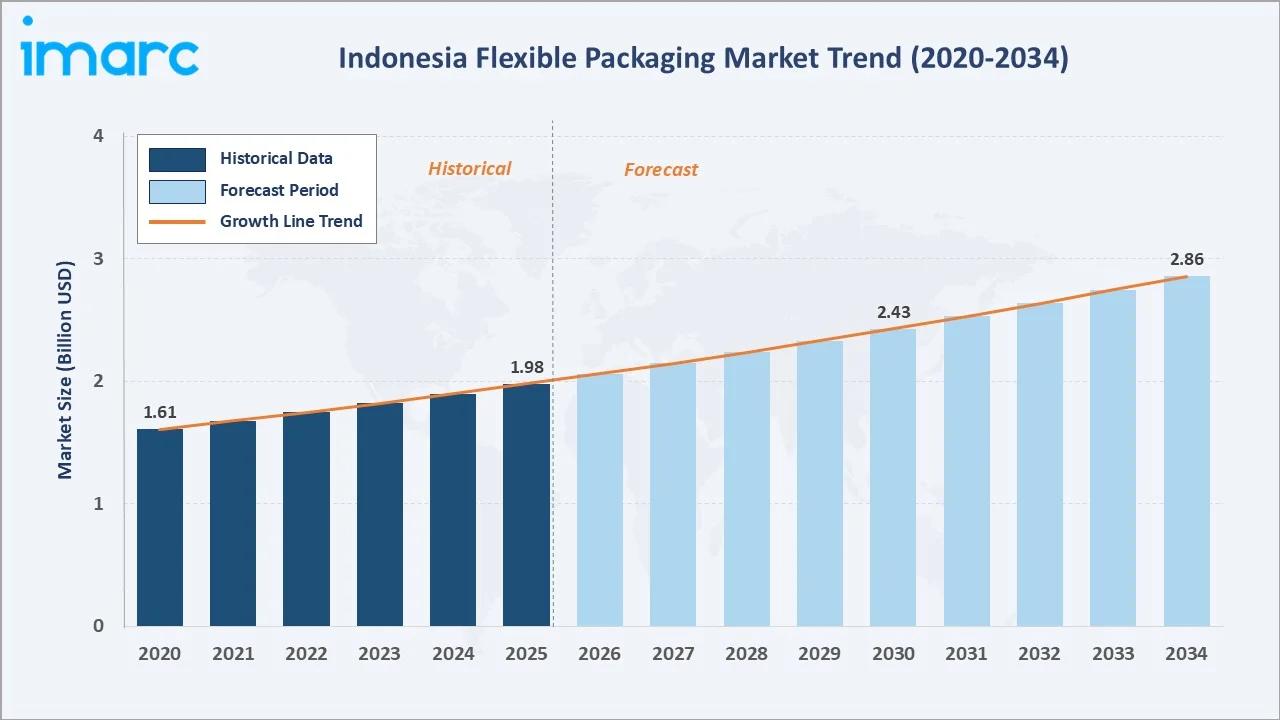
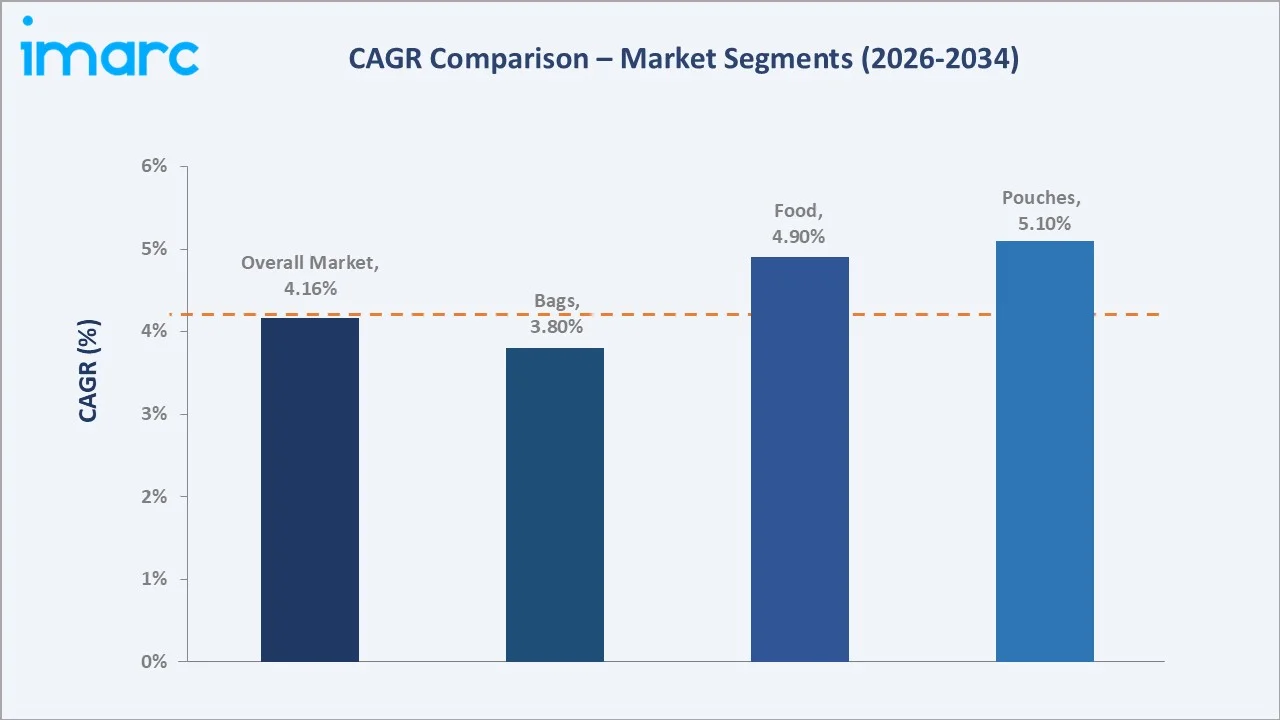
The Indonesia flexible packaging market grew from USD 1.98 Billion in 2025 to USD 2.06 Billion in 2026 and is projected to reach USD 2.86 Billion by 2034, growing at a CAGR of 4.16% during 2026-2034. The market is driven by growing demand for convenient and sustainable packaging, rapid e-commerce expansion, and rising adoption of flexible formats across the food and beverage sector. Packaging Films lead at 46.8% of the 2025 market. Food end-use dominates at 45.6%. Java commands 58.4% of national market share.
Market Snapshot
|
Metric |
Value |
|
Base Year Market Size (2025) |
USD 1.98 Billion |
| Market Size (2026) | USD 2.06 Billion |
|
Forecast Market Size (2034) |
USD 2.86 Billion |
|
CAGR (2026-2034) |
4.16% |
|
Base Year |
2025 |
|
Historical Period |
2020-2025 |
|
Forecast Period |
2026-2034 |
|
Dominant Product Type |
Packaging Films (46.8%, 2025) |
|
Dominant End Use Industry |
Food (45.6%, 2025) |
|
Leading Region |
Java (58.4%, 2025) |
The market expanded from USD 1.61 Billion in 2020 to USD 1.98 Billion in 2025 and an estimated USD 2.06 Billion in 2026, anchored at USD 2.43 Billion in 2030 and forecast to reach USD 2.86 Billion by 2034. Rising urbanization, expanding modern trade retail, and rapid e-commerce growth drive consistent demand for flexible packaging formats across Indonesia's archipelago economy.
To get more information on this market, Request Sample
Packaging Films at 46.8% dominate through widespread use across food, beverage, and consumer goods. The Food segment at 45.6% leads end-use demand through Indonesia's expanding packaged food market. Java at 58.4% commands regional leadership through concentrated manufacturing, population, and modern retail.
Executive Summary
The Indonesia flexible packaging market, which increased from USD 1.98 Billion in 2025 to an estimated USD 2.06 Billion in 2026, driven by a growing middle class, rapid urbanization, and expanding food and beverage retail. The market is projected to reach USD 2.86 Billion by 2034, exhibiting a CAGR of 4.16%.
Packaging Films at 46.8% dominate the product type segment through versatile application across all flexible packaging end uses. Food end-use at 45.6% leads through Indonesia's large and growing packaged food consumption. Java at 58.4% leads regionally through its concentration of manufacturing, retail, and population.
Key Market Insights
|
Insight |
Data |
|
Dominant Product Type |
Packaging Films – 46.8% share (2025) |
|
Dominant End Use Industry |
Food – 45.6% market share (2025) |
|
Leading Region |
Java – 58.4% market share (2025) |
|
Market Opportunity |
Sustainable packaging, stand-up pouches, barrier films, pharmaceutical flexible packaging |
Key Analytical Observations Supporting the Above Data:
- Packaging Films at 46.8%: Packaging films dominate as they serve as the foundational substrate for all flexible packaging formats. Their versatility across PE, BOPET, BOPP, CPP, and PVC variants enables broad application across food, beverage, and consumer product packaging. Indonesia's growing FMCG sector and export-oriented food manufacturers require high-performance film substrates for lamination and conversion.
- Food at 45.6%: Indonesia's large and growing packaged food market drives demand across snack pouches, stand-up bags, retort packaging, and laminated films. Rising modern trade penetration and consumer preference for packaged over loose food reinforce segment leadership. The country's expanding middle class increasingly purchases packaged, branded food products across modern retail formats.
- Java at 58.4%: Java dominates through its concentration of manufacturing activity, population density, modern retail infrastructure, and food processing industry. Greater Jakarta, Surabaya, and Bandung are the primary demand centers. Outer island market development represents a structurally growing opportunity for flexible packaging volume expansion over the forecast period.
Indonesia Flexible Packaging Market Overview
The Indonesia flexible packaging market encompasses the manufacture and supply of all flexible packaging formats including packaging films, pouches, bags, and specialty flexible formats used across food, beverage, pharmaceutical, household, and personal care industries across Indonesia's archipelago market.
The ecosystem integrates resin and raw material suppliers, film and laminate manufacturers, pouch and bag converters, printing service providers, brand owners and FMCG companies, retail and modern trade distributors, and regulatory bodies setting food contact and environmental standards. Macroeconomic factors include rising per capita income, expanding urbanization, modern trade growth, and evolving sustainability regulations.
Market Dynamics
To evaluate market opportunities, Request Sample
Market Drivers
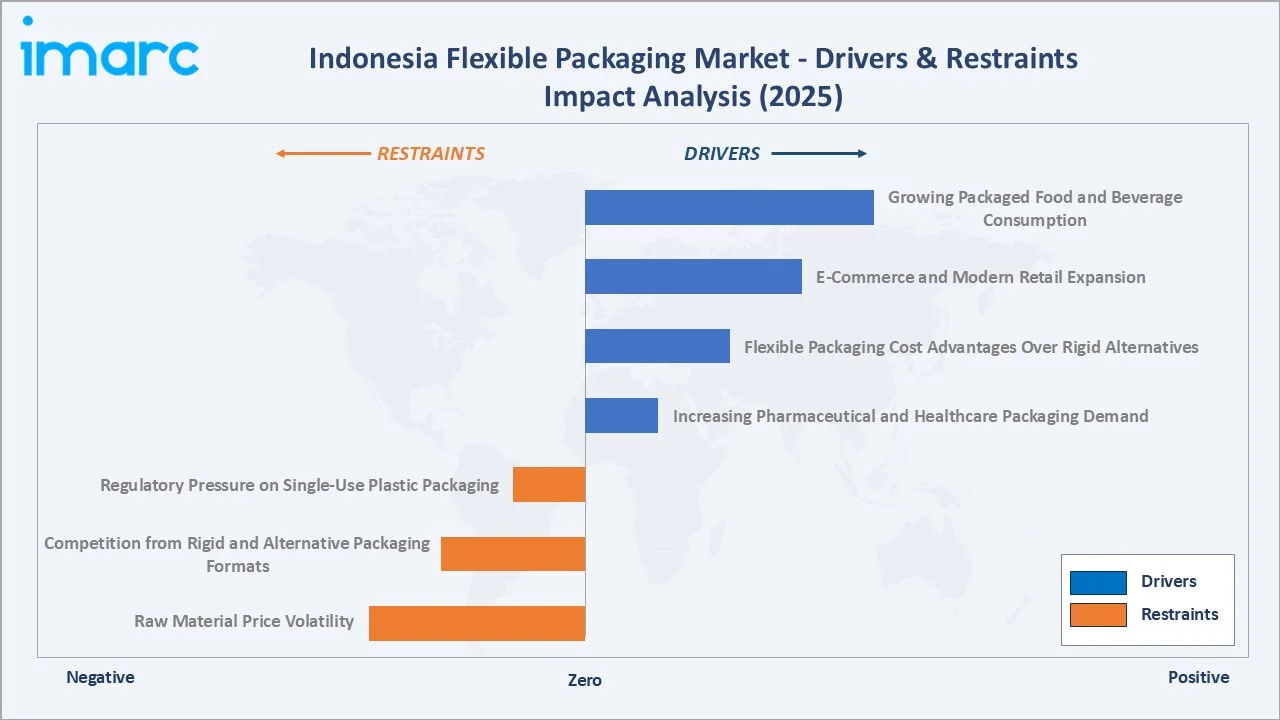
- Growing Packaged Food and Beverage Consumption: Indonesia's rapidly expanding FMCG sector drives demand for flexible packaging across snack foods, beverages, dairy, and instant meals. Rising modern trade penetration, urbanization, and growing middle class income accelerate packaged product adoption, directly increasing flexible packaging demand. Indonesia's fast-moving consumer goods market is among Southeast Asia's largest by volume. Government investments in cold chain infrastructure are further expanding the reach of packaged perishable food products into secondary cities across the archipelago.
- E-Commerce and Modern Retail Expansion: Indonesia's e-commerce growth, led by platforms such as Tokopedia and Shopee, is driving demand for lightweight, durable, and cost-efficient flexible packaging for direct-to-consumer delivery. Modern retail channel expansion across hypermarkets, supermarkets, and convenience stores increases the requirement for branded, attractive flexible packaging. Indonesia's internet penetration and smartphone adoption continue accelerating e-commerce adoption across Tier 2 and Tier 3 cities. The shift from traditional warungs to modern retail formats creates new flexible packaging demand pools beyond the Java core market.
- Flexible Packaging Cost Advantages Over Rigid Alternatives: Flexible packaging offers significant cost advantages versus rigid packaging formats including lower material weight, reduced transport costs, superior space utilization in retail and storage, and lower production costs. These economic benefits drive brand owners across food, beverage, and consumer goods to shift from rigid to flexible packaging, supporting sustained volume growth. Flexible formats also generate less packaging waste per unit of content compared to rigid alternatives. The material efficiency of flexible packaging aligns with Indonesia's cost-sensitive consumer market where value-per-unit is a primary purchase driver.
- Increasing Pharmaceutical and Healthcare Packaging Demand: Indonesia's growing pharmaceutical industry drives demand for high-barrier, tamper-evident flexible packaging formats across blister packs, sachets, and unit-dose formats. Rising healthcare awareness, expanding pharmaceutical production, and growing generics exports create a structurally growing demand pool. Government health programs expanding medicine access across the archipelago are increasing pharmaceutical distribution volumes. International pharmaceutical companies establishing Indonesian manufacturing operations require high-quality flexible packaging meeting global regulatory standards.
Market Restraints
- Regulatory Pressure on Single-Use Plastic Packaging: Indonesia's government has implemented extended producer responsibility regulations and plastic waste reduction targets that increase compliance costs for flexible packaging manufacturers. Producers must invest in recyclable and compostable material technologies, increasing R&D and production costs. The regulatory trajectory is toward stricter single-use plastic controls, creating uncertainty for conventional flexible packaging demand. Major retail and FMCG brands are establishing internal sustainability targets that add compliance requirements beyond government mandates for flexible packaging suppliers.
- Raw Material Price Volatility: Flexible packaging production relies heavily on petrochemical-derived resins including polyethylene, polypropylene, and PET, whose prices fluctuate with crude oil and natural gas markets. Raw material price volatility creates margin pressure for flexible packaging converters and can suppress demand when converters pass cost increases to brand owner customers. Indonesia's significant import dependence for specialty resins and barrier materials amplifies exchange rate risk. Supply chain disruptions affecting global resin markets can cause production delays and inventory shortfalls among Indonesian flexible packaging converters.
- Competition from Rigid and Alternative Packaging Formats: Rigid packaging including glass, PET bottles, and cans retains strong consumer preference in premium food and beverage segments. The availability of established rigid packaging manufacturing capacity and consumer perception of quality associated with rigid formats presents ongoing competitive pressure. Premium beverage and food brands may resist flexible packaging migration to protect brand positioning in high-income consumer segments. Glass and metal packaging manufacturers are also investing in lightweighting and sustainability improvements that reduce the environmental differentiation advantage of flexible formats.
Market Opportunities
- Sustainable and Recyclable Flexible Packaging Development: Growing regulatory and consumer sustainability requirements create opportunities for manufacturers offering recyclable mono-material structures, post-consumer recycled content films, and compostable packaging formats. Early movers in sustainable flexible packaging can secure premium pricing and preferred supplier relationships with sustainability-committed FMCG brands. Indonesia's large retail sector is increasingly setting supplier sustainability requirements. Investment in mono-material flexible packaging technology positions converters to serve both domestic sustainability mandates and export markets with stringent packaging regulations.
- Stand-Up Pouch and Premium Format Growth: The stand-up pouch segment is experiencing above-market growth across food, pet food, liquid beverage, and detergent applications, driven by superior consumer convenience and resealability. Premium format flexible packaging creates higher revenue per unit and stronger brand differentiation. Indonesia's growing pet food market is a particularly fast-growing stand-up pouch end-use segment driven by rising pet ownership among urban middle-class consumers. The transition from flat pouches and sachets to stand-up formats represents a structural upgrade opportunity for converters investing in advanced pouch-making equipment.
Market Challenges
- Fragmented Competitive Structure Creating Pricing Pressure: Indonesia's flexible packaging market includes numerous small-to-medium local converters alongside global players, creating intense price competition that compresses margins across the value chain. Smaller converters with lower capital investment can undercut established players on price, making quality-focused manufacturers struggle to sustain premium pricing. This market fragmentation is reinforced by local procurement preferences among domestic food manufacturers. Building differentiation through technology, quality certification, and sustainability credentials is challenging in a market where price remains a primary procurement criterion.
- Complex Multi-Island Logistics Increasing Distribution Costs: Indonesia's archipelago geography creates complex logistics challenges for flexible packaging distribution across its 17,000 islands. Higher inter-island transport costs, variable infrastructure quality across outer regions, and logistical complexity for reaching markets beyond Java and Sumatra increase operational costs. These logistics challenges limit the viability of centralized manufacturing models and create advantages for regional converters with local distribution networks. Investment in logistics infrastructure and digital supply chain management tools is required for manufacturers seeking to serve Indonesia's geographically dispersed market efficiently.
Emerging Market Trends
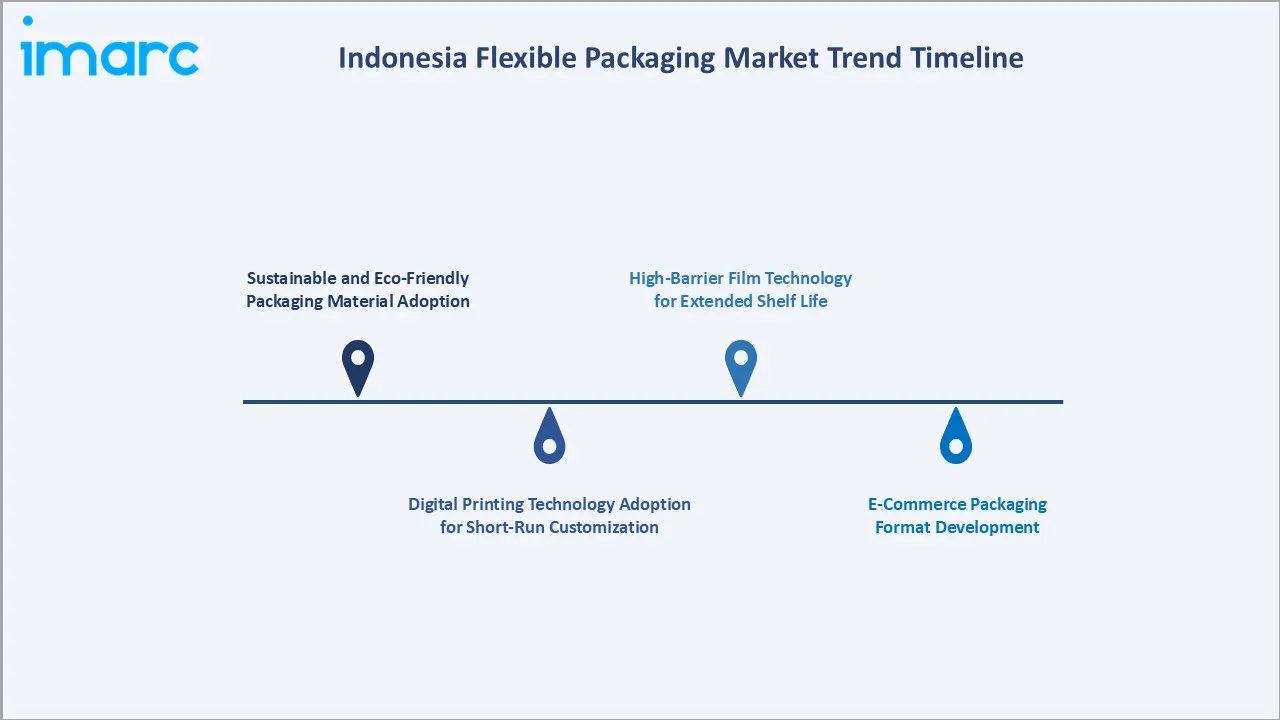
1. Sustainable and Eco-Friendly Packaging Material Adoption
Indonesian flexible packaging manufacturers are investing in recyclable mono-material structures, biodegradable films, and post-consumer recycled content to meet regulatory requirements and brand owner sustainability commitments. Government plastic waste reduction targets and extended producer responsibility frameworks are accelerating the transition to sustainable flexible packaging across the market.
2. Digital Printing Technology Adoption for Short-Run Customization
Digital printing is enabling short-run production, faster time to market, and highly customized packaging designs without conventional plate setup costs. FMCG companies are leveraging digital flexible packaging for seasonal promotions, regional variants, and limited-edition products. PT ePac Flexibles Indonesia is a key operator driving digital printing adoption in the Indonesian market.
3. High-Barrier Film Technology for Extended Shelf Life
Adoption of advanced barrier film technologies including metallized films, EVOH barrier layers, and vacuum-deposited barrier coatings is growing as food manufacturers seek to extend shelf life and reduce food waste. High-barrier flexible packaging commands a price premium and targets processed food, pharmaceutical, and export-oriented food manufacturing segments.
4. E-Commerce Packaging Format Development
Indonesia's rapidly growing e-commerce market is driving development of flexible packaging formats optimized for direct-to-consumer delivery, including tamper-evident mailers, cushioned flexible pouches, and moisture-resistant delivery packaging. The e-commerce packaging segment creates new demand beyond traditional retail channel formats.
Industry Value Chain Analysis
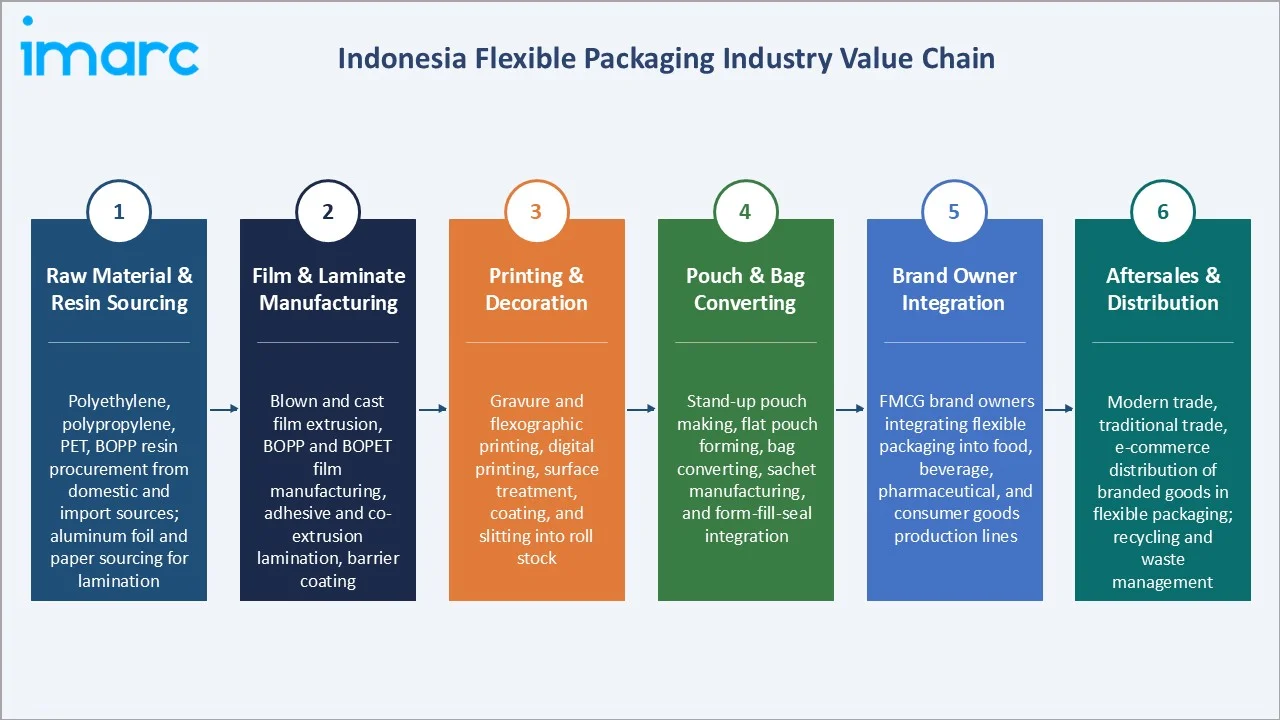
The Indonesia flexible packaging value chain integrates resin and raw material sourcing, film extrusion and laminate manufacturing, printing and decoration, pouch and bag converting, brand owner integration, and retail distribution. The value chain's architecture consolidates toward integrated converting solutions as the primary commercial format.
|
Stage |
Key Participants |
|
Raw Material & Resin Sourcing |
Polyethylene, polypropylene, PET, BOPP resin procurement from domestic and import sources; aluminum foil and paper sourcing for lamination |
|
Film & Laminate Manufacturing |
Blown and cast film extrusion, BOPP and BOPET film manufacturing, adhesive and co-extrusion lamination, barrier coating |
|
Printing & Decoration |
Gravure and flexographic printing, digital printing, surface treatment, coating, and slitting into roll stock |
|
Pouch & Bag Converting |
Stand-up pouch making, flat pouch forming, bag converting, sachet manufacturing, and form-fill-seal integration |
|
Brand Owner Integration |
FMCG brand owners integrating flexible packaging into food, beverage, pharmaceutical, and consumer goods production lines |
|
Aftersales & Distribution |
Modern trade, traditional trade, e-commerce distribution of branded goods in flexible packaging; recycling and waste management |
The raw material sourcing tier depends significantly on imported petrochemical-derived resins and specialty films, making the value chain sensitive to global commodity price movements and exchange rate fluctuations. The converting tier is the most fragmented stage, with hundreds of small-to-medium local operators competing alongside established regional and global converters.
Technology Landscape in the Indonesia Flexible Packaging Industry
Multi-Layer Lamination Technology
Multi-layer lamination technology enables flexible packaging structures combining barrier, structural, and sealing properties into a single composite film. Adhesive lamination and co-extrusion technologies are widely adopted by Indonesian converters for food and pharmaceutical flexible packaging requiring extended shelf life and product protection.
Biodegradable and Compostable Film Technology
Biodegradable and compostable flexible packaging film technologies including PLA-based films, starch-based composites, and PBS-blend materials are gaining traction as regulatory pressure on conventional plastic flexible packaging intensifies. These materials address Indonesia's plastic waste reduction targets while enabling brand owners to meet sustainability commitments.
Smart Packaging and Active Barrier Technology
Active packaging technologies including oxygen scavengers, moisture control layers, and antimicrobial coatings embedded in flexible packaging structures extend shelf life and preserve product quality. Smart packaging features including QR codes, NFC tags, and digital authentication are gaining adoption among premium FMCG brands targeting Indonesia's digitally connected consumer segment.
Market Segmentation Analysis
The report covers the following segments:
|
Segment Category |
Leading Segment |
Market Share |
Year |
|
Product Type |
Packaging Films |
46.8% |
2025 |
|
End Use Industry |
Food |
45.6% |
2025 |
|
Region |
Java |
58.4% |
2025 |

By Product Type
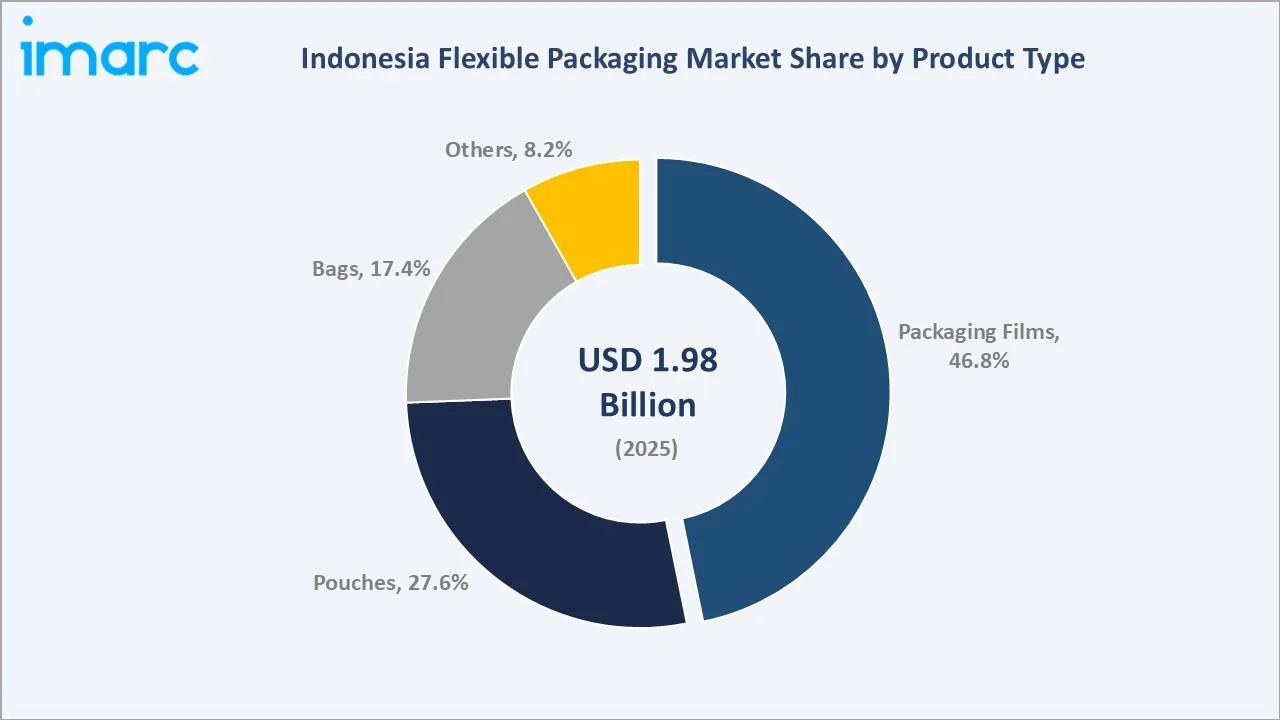
Packaging Films lead at 46.8% in 2025, covering PE, BOPET, BOPP and CPP, PVC, and other specialty film variants used across all flexible packaging end use applications in Indonesia.
To access detailed market analysis, Request Sample
Pouches at 27.6% capture the fast-growing stand-up pouch, spout pouch, and retort pouch segments driven by food and beverage brand owners. Bags at 17.4% serve the bulk food, agricultural, and retail segments. Others at 8.2% includes specialty flexible formats such as lidding films, sachets, and strip packaging.
By End Use Industry
Food dominates at 45.6% through Indonesia's large and growing packaged food market spanning snacks, instant food, dry goods, and frozen food segments across modern and traditional retail channels.
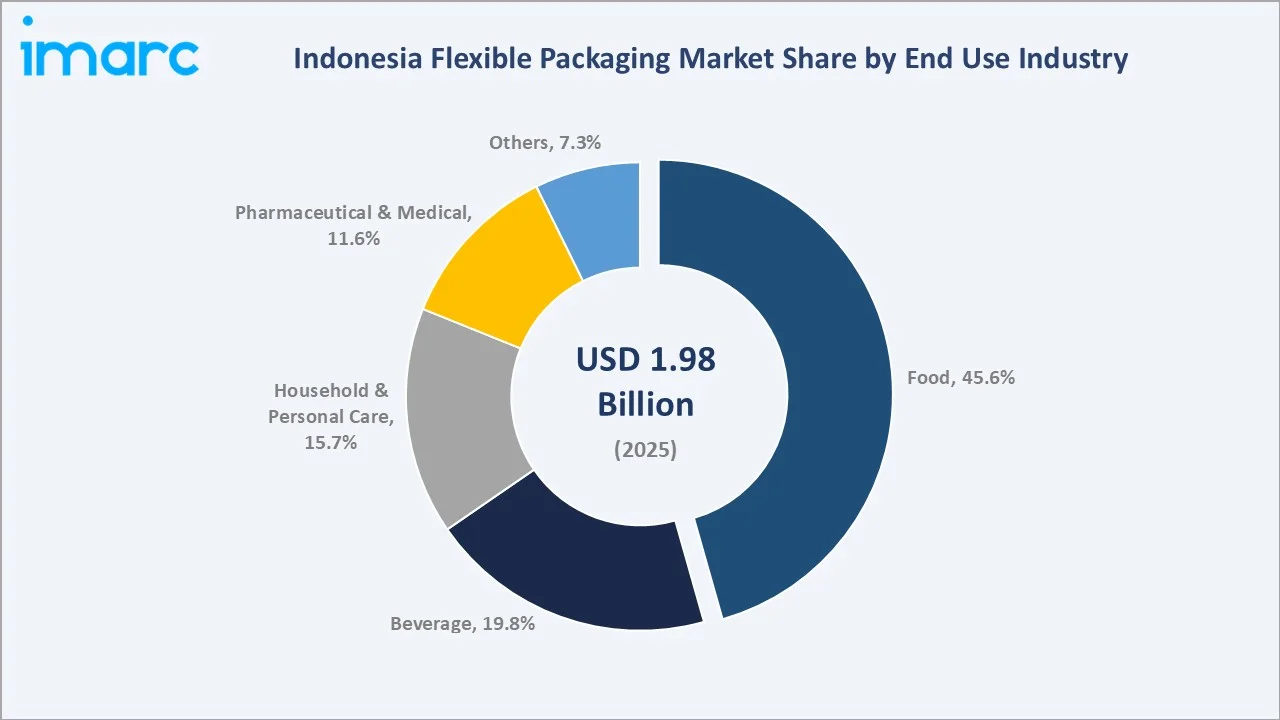
Beverage at 19.8% captures liquid packaging formats including stand-up pouches, sachets, and multilayer barrier films. Household and Personal Care at 15.7% serves detergent, shampoo, and personal care refill pouch packaging. Pharmaceutical and Medical at 11.6% reflects growing blister pack and sterile flexible packaging demand. Others at 7.3% covers agricultural, pet food, and industrial packaging applications.
Regional Market Insights
|
Region |
Share (2025) |
Key Flexible Packaging Market Drivers & Characteristics |
|
Java |
58.4% |
Dominant manufacturing base, concentrated FMCG production, modern retail infrastructure, and highest consumer spending per capita across Indonesia |
|
Sumatra |
18.7% |
Growing food processing and palm oil sector drives demand; major agricultural export hub with increasing packaged goods consumption and retail expansion |
|
Kalimantan |
10.5% |
Driven by resource sector growth and urban populations in Balikpapan and Banjarmasin requiring consumer goods flexible packaging solutions |
|
Sulawesi |
7.1% |
Emerging demand driven by Makassar's growing retail sector, fisheries processing, and expanding regional food and beverage manufacturing |
|
Others |
5.3% |
Includes Bali, Nusa Tenggara, Maluku, and Papua with growing flexible packaging demand driven by tourism and local food production activities |
Java, at 58.4%, leads through its concentration of FMCG manufacturing, food processing, modern retail, and population. Surabaya, Greater Jakarta, and Bandung are the primary demand centers for flexible packaging consumption. Sumatra at 18.7% reflects its growing food processing base, particularly palm oil, rubber, and agricultural product packaging.
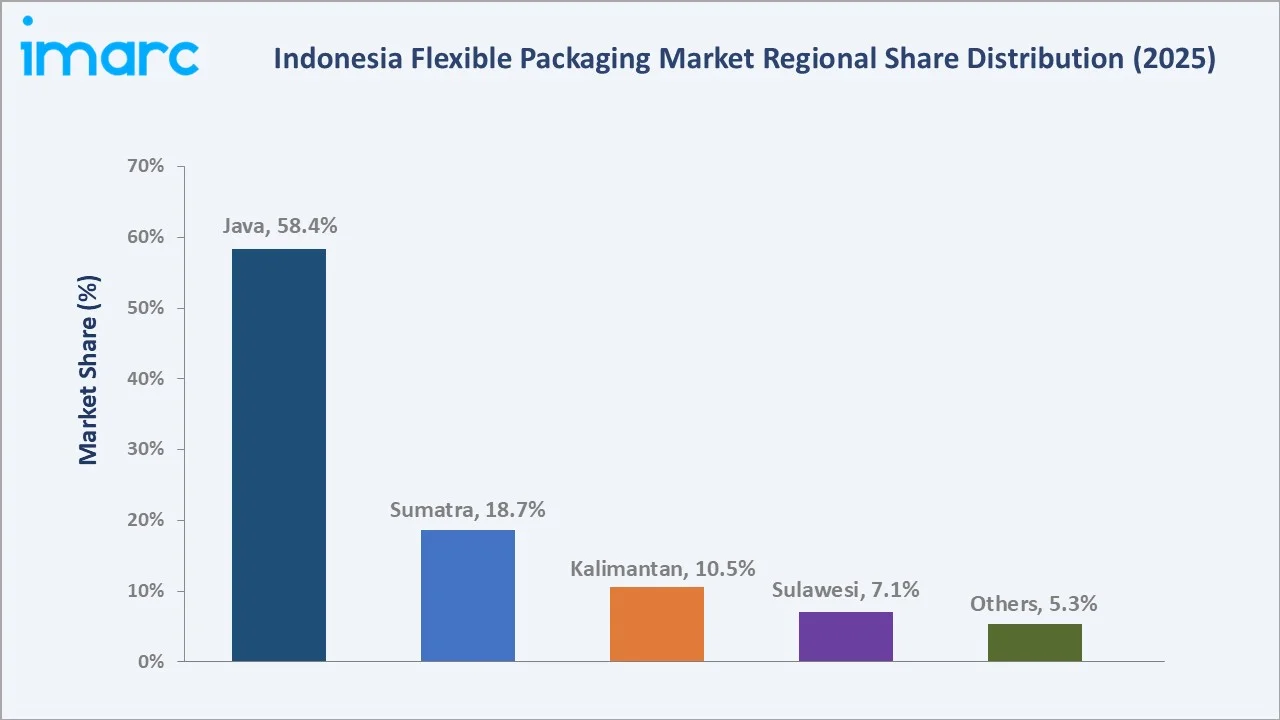
Kalimantan at 10.5% and Sulawesi at 7.1% represent growing markets driven by urbanization, resource sector expansion, and retail infrastructure investment. Others at 5.3%, including Bali, Nusa Tenggara, Maluku, and Papua, represent early-stage but growing flexible packaging markets with significant long-term potential as infrastructure investment improves.
Competitive Landscape
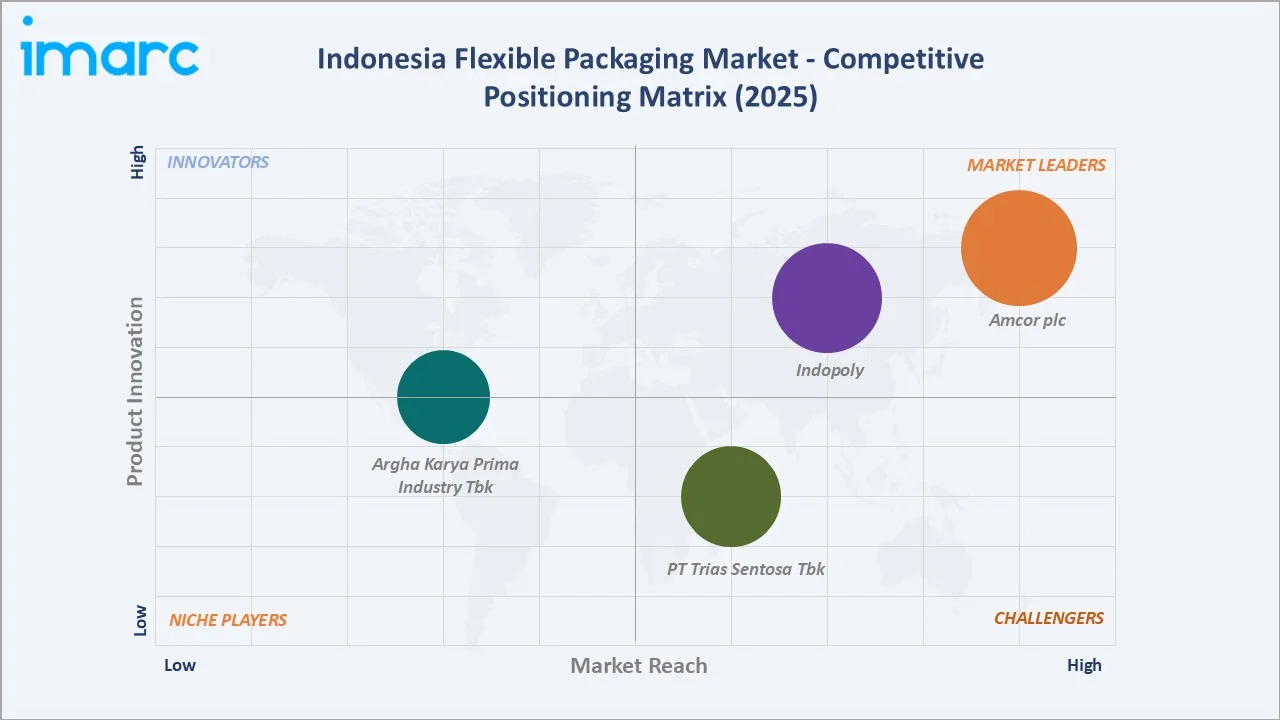
The Indonesia flexible packaging market competitive landscape is moderately fragmented with three distinct competitive tiers: multinational integrated flexible packaging companies, domestic listed film and laminate manufacturers, and smaller local converters serving regional and niche markets.
|
Company Name |
Key Products |
Market Position |
Core Strength |
|
Amcor plc |
Flexible food packaging, barrier film pouches, pharmaceutical flexible packaging |
Market Leader |
Amcor plc is a global flexible packaging leader with strong presence in Indonesia through barrier film and specialty pouch solutions for food and pharmaceutical markets. |
|
Indopoly |
BOPP films, OPP packaging films, lamination films |
Market Leader |
Indopoly is a leading Indonesian BOPP film manufacturer supplying the domestic flexible packaging converting industry. |
|
PT Trias Sentosa Tbk |
BOPP packaging films, flexible packaging laminates |
Strong Challenger |
PT Trias Sentosa Tbk is a major Indonesian BOPP film producer supplying the domestic packaging industry with biaxially oriented polypropylene films. |
|
Argha Karya Prima Industry Tbk |
Flexible packaging films, BOPP films, metallized films |
Emerging Player |
Argha Karya Prima Industry is an established Indonesian flexible packaging film manufacturer producing BOPP and specialty films for domestic conversion. |
Key players include Amcor plc, Indopoly, PT Trias Sentosa Tbk, Argha Karya Prima Industry Tbk, and others.
Key Company Profiles
Amcor plc
Amcor plc is a global flexible packaging manufacturer headquartered in Zurich, Switzerland, with extensive operations across Southeast Asia including Indonesia, serving food, beverage, pharmaceutical, and personal care markets.
- Key Products: Flexible food packaging, barrier film pouches, pharmaceutical flexible packaging, AmFiber paper-based flexible packaging, and reclosable flexible packaging formats.
- Strategic Focus: Expanding sustainable flexible packaging solutions with recycled content films, recyclable mono-material structures, and high-barrier formats for food and pharmaceutical applications. The company is investing in AmFiber paper-based flexible packaging and advanced recyclable film laminates to address sustainability requirements from brand owner customers across Asia-Pacific markets including Indonesia. Amcor's regional manufacturing and innovation footprint supports close collaboration with FMCG brand owners on flexible packaging design and sustainability optimization.
Indopoly
Indopoly is an Indonesia-based manufacturer of biaxially oriented polypropylene (BOPP) films, supplying the domestic flexible packaging converting industry and exporting to regional markets.
- Key Products: BOPP packaging films, OPP films, white opaque films, metallizable BOPP films
- Strategic Focus: Expanding domestic BOPP film production capacity, improving film barrier and optical performance, and developing specialty film variants for the growing Indonesian flexible packaging conversion industry. The company is advancing its product portfolio toward high-value specialty BOPP films including heat-sealable grades, high-barrier metallizable variants, and sustainable film structures with reduced environmental impact. PT Indopoly's domestic manufacturing scale positions it as a preferred local supplier to Indonesian converters seeking shorter lead times and stronger supply chain resilience.
Market Concentration Analysis
The Indonesia flexible packaging market is moderately fragmented, with multinational players and domestic listed manufacturers collectively accounting for approximately 30-40% of national market revenue. Local small-to-medium converters account for the remaining 60-70% by volume.
Market concentration is expected to gradually increase over the forecast period as sustainability investment requirements, digital printing adoption, and quality certification demands favor larger, better-capitalized manufacturers. However, the market's geographic fragmentation sustains a large role for regional and local converters outside the Java core market.
Investment & Growth Opportunities
Highest Growth Segments
Stand-up pouch production (~6% CAGR), pharmaceutical flexible packaging (~5.5% CAGR), sustainable mono-material flexible packaging (~7%+ CAGR from emerging base), high-barrier export food packaging (~5.8% CAGR), and e-commerce flexible packaging (~8% CAGR from small base) represent the highest-growth investment opportunities through 2034.
Emerging Investment Opportunities
Pharmaceutical flexible packaging represents Indonesia's highest per-unit-value emerging opportunity. Blister pack films, sachet packaging, and sterile flexible formats command 2-3x the per-unit revenue of comparable food packaging, with Indonesia's growing pharmaceutical manufacturing base creating a structurally growing demand pool through 2034.
Investment Themes
- Sustainable flexible packaging manufacturing investment: Investments in recyclable mono-material film lines, compostable flexible packaging capabilities, and post-consumer recycled content sourcing position Indonesian converters to serve the growing number of multinational FMCG brands requiring sustainability-certified flexible packaging across the country.
- Stand-up pouch and premium flexible format capacity expansion: Indonesia's food and beverage industry transition from flat pouches and bags to stand-up pouches and premium flexible formats creates opportunity for converters investing in advanced pouch-making and printing capabilities to capture higher revenue per unit and premium brand owner accounts.
Future Market Outlook (2026-2034)
The Indonesia flexible packaging market is projected to grow from USD 1.98 Billion in 2025 to USD 2.06 Billion in 2026 and is forecast to reach USD 2.86 Billion by 2034, delivering a 4.16% CAGR over the forecast period. The market's anchor value of USD 2.43 Billion in 2030 represents a critical sustainability transition inflection point for Indonesia's flexible packaging industry.
Three structural forces define Indonesia flexible packaging market growth through 2034. Indonesia's expanding FMCG consumption base creates a self-reinforcing demand cycle where rising consumer incomes, expanding modern trade retail, and growing packaged food preference simultaneously drive flexible packaging volume growth. The sustainability packaging transition creates both investment demand from manufacturers and premiumization opportunity from brand owners willing to pay premium for certified sustainable flexible packaging. Indonesia's outer island market development creates an additive demand pool above the established Java and Sumatra flexible packaging markets.
Research Methodology
Primary Research
Primary research comprised structured interviews with 45+ industry stakeholders (2025), including flexible packaging plant managers, FMCG procurement leads, retail category managers, sustainable packaging specialists, and regulatory affairs officers across Indonesia's packaging industry.
Secondary Research
Secondary research encompassed company annual reports; Indonesia Ministry of Industry packaging statistics; Association of Indonesian Flexible Packaging Manufacturers data; FMCG retail sales data; government plastic waste regulation documents; food and pharmaceutical industry production reports; and over 55 secondary sources reviewed.
Forecasting Models
Market revenue forecasts developed using bottom-up model: (i) Indonesia GDP and consumer spending growth projections; (ii) modern trade penetration forecast by region; (iii) FMCG sector production volume by segment; (iv) flexible packaging content per unit by product category; (v) sustainability premium adjustment for regulated material transitions.
Indonesia Flexible Packaging Market Report Coverage:
| Report Features | Details |
|---|---|
| Base Year of the Analysis | 2025 |
| Historical Period | 2020-2025 |
| Forecast Period | 2026-2034 |
| Units | Billion USD |
| Scope of the Report |
Exploration of Historical and Forecast Trends, Industry Catalysts and Challenges, Segment-Wise Historical and Predictive Market Assessment:
|
| Product Types Covered |
|
| End Use Industries Covered | Food, Beverage, Pharmaceutical and Medical, Household and Personal Care, Others |
| Regions Covered | Java, Sumatra, Kalimantan, Sulawesi, Others |
| Companies Covered | Amcor plc, Indopoly, PT Trias Sentosa Tbk, Argha Karya Prima Industry Tbk, etc. |
| Customization Scope | 10% Free Customization |
| Post-Sale Analyst Support | 10-12 Weeks |
| Delivery Format | PDF and Excel through Email (We can also provide the editable version of the report in PPT/Word format on special request) |
Key Benefits for Stakeholders:
- IMARC’s industry report offers a comprehensive quantitative analysis of various market segments, historical and current market trends, market forecasts, and dynamics of the Indonesia flexible packaging market from 2020-2034.
- The research report provides the latest information on the market drivers, challenges, and opportunities in the Indonesia flexible packaging market.
- Porter's five forces analysis assist stakeholders in assessing the impact of new entrants, competitive rivalry, supplier power, buyer power, and the threat of substitution. It helps stakeholders to analyze the level of competition within the Indonesia flexible packaging industry and its attractiveness.
- Competitive landscape allows stakeholders to understand their competitive environment and provides an insight into the current positions of key players in the market.
Frequently Asked Questions About the Indonesia Flexible Packaging Market Report
The Indonesia flexible packaging market size is estimated at USD 2.06 Billion in 2026, driven by Packaging Films at 46.8%, Food end-use at 45.6%, Java leading at 58.4%, and the expanding FMCG consumption base across Indonesia's growing middle class and modern retail sector.
The Indonesia flexible packaging market grows at 4.16% CAGR during 2026-2034, reaching USD 2.86 Billion by 2034. This growth reflects FMCG consumption expansion, modern trade penetration, pharmaceutical packaging growth, and the sustainable packaging transition.
Packaging Films lead at 46.8%, serving as the foundational material for all downstream flexible packaging formats including pouches, bags, and specialty flexible packaging across food, beverage, and consumer goods applications in Indonesia.
Food leads at 45.6% through Indonesia's large and growing packaged food market spanning snacks, instant food, dry goods, and frozen food. The food segment drives demand across pouches, bags, sachets, and laminated flexible packaging formats across modern and traditional trade channels.
Java leads at 58.4% through its concentration of FMCG manufacturing, food processing, modern retail, and population. Greater Jakarta, Surabaya, and Bandung are the primary demand centers for flexible packaging consumption and production in Indonesia.
Leading companies include Amcor plc, Indopoly, PT Trias Sentosa Tbk, Argha Karya Prima Industry Tbk, and others.
Three priority investment opportunities: sustainable mono-material flexible packaging manufacturing for regulatory compliance and brand owner mandates, stand-up pouch and premium flexible format capacity expansion, and pharmaceutical flexible packaging development targeting Indonesia's growing pharmaceutical manufacturing sector.
Need more help?
- Speak to our experienced analysts for insights on the current market scenarios.
- Include additional segments and countries to customize the report as per your requirement.
- Gain an unparalleled competitive advantage in your domain by understanding how to utilize the report and positively impacting your operations and revenue.
- For further assistance, please connect with our analysts.
 Request Customization
 Speak to an Analyst
 Request Brochure
 Inquire Before Buying
Benefits of Customization
- Personalize this research
- Triangulate with your data
- Get data as per your format and definition
- Gain a deeper dive into a specific application, geography, customer, or competitor
- Any level of personalization
Get in Touch With Us
UNITED STATES
Phone: +1-201-971-6302
INDIA
Phone: +91-120-433-0800
UNITED KINGDOM
Phone: +44-753-714-6104
Email: [email protected]
Client Testimonials




.webp)




.webp)













Related Reports

Choose your plan
*Please note that the prices mentioned below are starting prices for each bundle type. Kindly contact our team for further details.*
Single User License
- 1 User License, Access on 2 Devices
- PDF Report + Excel Dataset (Password Protected)
- Lifetime Access
- No Printing Rights
- 10% Free Report Customization
- 10–12 Weeks of Analyst Support
Five User License
- Access for 5 Users, 2 Devices per User
- PDF Report + Excel Dataset (Password Protected)
- Lifetime Access
- Dedicated Account Manager
- 12–14 Weeks of Analyst Support
- No Printing Rights
- 15% Free Report Customization
- 25% Discount on Your Next Purchase
Corporate User License
- Unlimited User Access (Within Your Organization)
- PDF Report + Excel Dataset
- Lifetime Access
- Dedicated Account Manager
- 14–20 Weeks of Analyst Support
- No Printing Rights
- 20% Free Report Customization
- 30% Discount on Your Next Purchase
Essential Insights
What's included:
3 reports
- Lifetime Access
- PDF Reports
- Excel Datasets
- 2 Weeks of Free Analyst Support
- 2 User Licenses
- Access on 2 Devices
- Printing Rights
- Complimentary PowerPoint (PPT) Version
- Complimentary License Upgrade
Professional Access
What's included:
5 reports
- Lifetime Access
- PDF Reports
- Excel Datasets
- 8 Weeks of Free Analyst Support
- 2 User Licenses
- Access on 2 Devices
- Printing Rights
- Complimentary PowerPoint (PPT) Version
- Complimentary License Upgrade
Business Advantage
What's included:
8 reports
- Lifetime Access
- PDF Reports
- Excel Datasets
- 14 Weeks of Free Analyst Support
- 2 User Licenses
- Access on 2 Devices
- Printing Rights
- Complimentary PowerPoint (PPT) Version
- Complimentary License Upgrade
Enterprise Intelligence
What's included:
10 reports
- Lifetime Access
- PDF Reports
- Excel Datasets
- 20 Weeks of Free Analyst Support
- 2 User Licenses
- Access on 2 Devices
- Printing Rights
- Complimentary PowerPoint (PPT) Version
- Complimentary License Upgrade