
Indonesia Frozen Food Market Size, Share, Trends and Forecast by Type, Distribution Channel, and Region, 2026-2034
Indonesia Frozen Food Market Size, Share, Trends & Forecast (2026-2034)
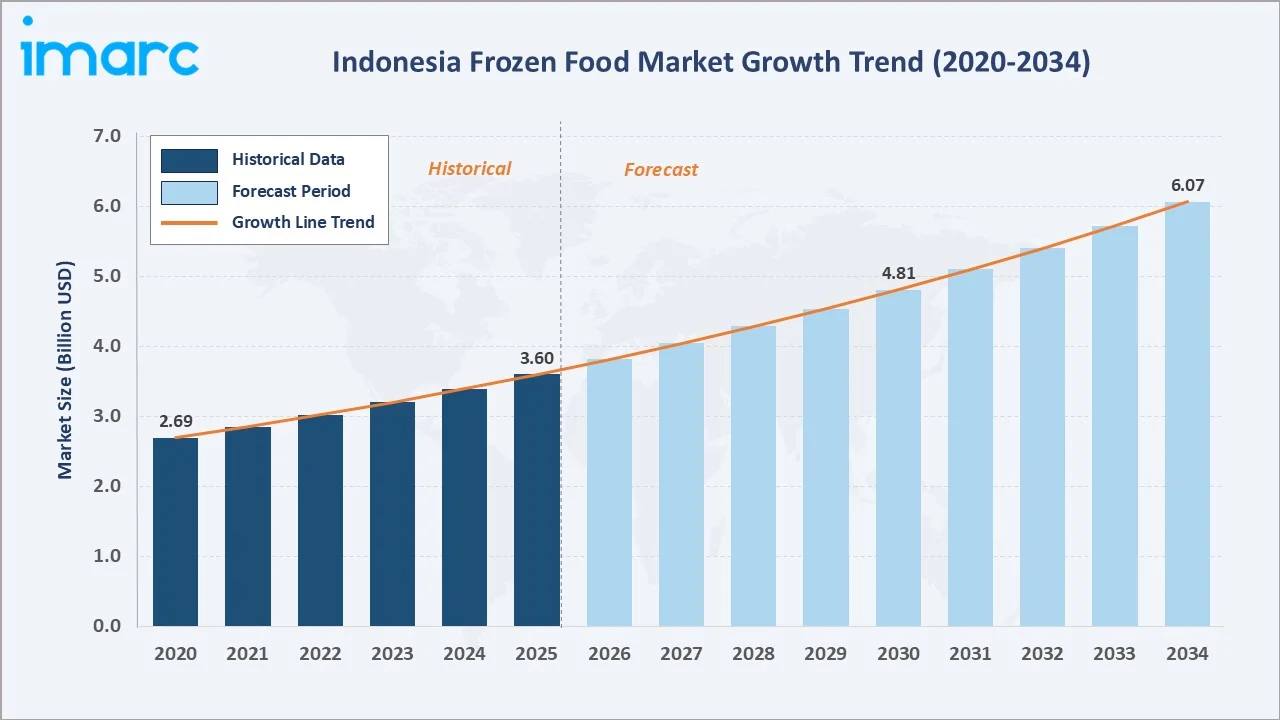
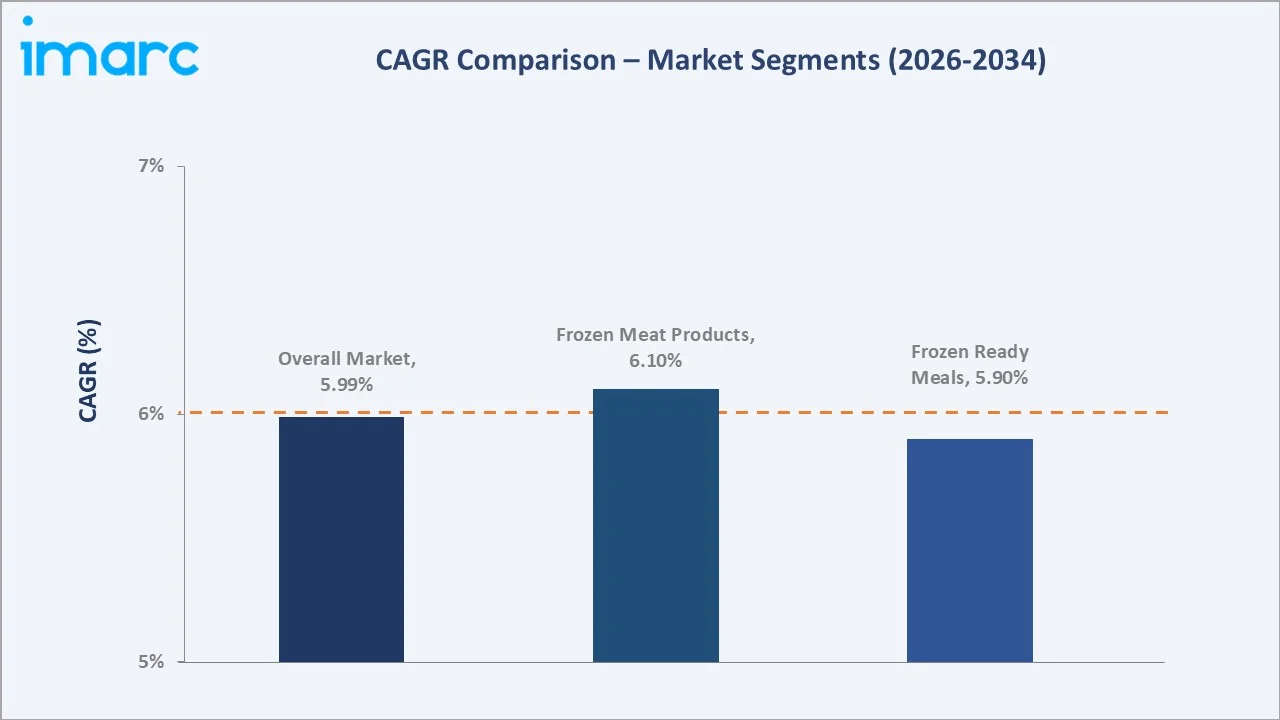
The Indonesia frozen food market size increased from USD 3.60 Billion in 2025 to USD 3.81 Billion in 2026 and is projected to reach USD 6.07 Billion by 2034, growing at a CAGR of 5.99% during 2026-2034. Frozen Meat Products lead at 25.7%. Grocery/Convenience Stores dominate distribution at 42.8%. Java commands 58.7% regional share.
Market Snapshot
|
Metric |
Value |
|
Base Year Market Size (2025) |
USD 3.60 Billion |
| Market Size (2026) | USD 3.81 Billion |
|
Forecast Market Size (2034) |
USD 6.07 Billion |
|
CAGR (2026-2034) |
5.99% |
|
Base Year |
2025 |
|
Historical Period |
2020-2025 |
|
Forecast Period |
2026-2034 |
|
Dominant Type |
Frozen Meat Products (25.7%, 2025) |
|
Dominant Distribution Channel |
Grocery Stores/Convenience Stores (42.8%, 2025) |
|
Leading Region |
Java (58.7%, 2025) |
The market expanded from USD 2.69 Billion in 2020 to USD 3.60 Billion in 2025 and an estimated USD 3.81 Billion in 2026, anchored at USD 4.81 Billion in 2030, and projected to reach USD 6.07 Billion by 2034. Post-pandemic convenience-driven demand, cold-chain expansion, and modern retail growth underpin the structural trajectory.
To get more information on this market, Request Sample
Frozen Meat Products lead at 25.7% through strong poultry and processed meat demand. Grocery/Convenience Stores dominate distribution at 42.8% through extensive minimarket penetration. Java commands 58.7% regional share through population concentration and superior cold-chain infrastructure.
Executive Summary
The Indonesia frozen food market, which increased from USD 3.60 Billion in 2025 to an estimated USD 3.81 Billion in 2026, representing one of Southeast Asia's fastest-growing packaged food segments driven by urbanization, rising middle-class incomes, and a structural shift toward convenient meal solutions across Indonesia's 280+ million population.
Frozen Meat Products at 25.7% dominate through vertically integrated poultry supply chains. Grocery/Convenience Stores at 42.8% lead distribution through Indomaret and Alfamart minimarket networks. Java at 58.7% leads regionally through population density and modern retail infrastructure density.
Key Market Insights
|
Insight |
Data |
|
Dominant Type |
Frozen Meat Products – 25.7% share (2025) |
|
Dominant Distribution Channel |
Grocery Stores/Convenience Stores – 42.8% market share (2025) |
|
Leading Region |
Java – 58.7% market share (2025) |
|
Market Opportunity |
Halal-certified premium frozen meals; plant-based frozen variants; online grocery cold delivery; Sumatra and Kalimantan geographic expansion |
Key Analytical Observations Supporting the Above Data:
- Frozen Meat Products at 25.7%: This segment leads through Indonesia's large poultry processing industry anchored by PT Charoen Pokphand Indonesia Tbk and JAPFA Ltd, which provide vertically integrated supply from feed to retail. Strong consumer preference for processed chicken nuggets, sausages, and ready-to-cook poultry sustains consistent volume demand across modern and traditional trade channels.
- Grocery/Convenience Stores at 42.8%: This channel dominates through Indonesia's extensive Indomaret and Alfamart minimarket networks, which have expanded freezer cabinet installations across urban and peri-urban areas. Minimarkets provide impulse-purchase proximity and cold-chain reliability unavailable in traditional wet markets, making them the primary frozen food access point for Indonesian consumers.
- Java at 58.7%: Java leads through its concentration of over 60% of Indonesia's population, the most developed cold-chain logistics network, and the highest density of modern retail outlets. Jakarta, Surabaya, and Bandung concentrate premium frozen food consumption, while peri-urban Java cities represent the highest-growth incremental volume opportunity within the region.
Indonesia Frozen Food Market Overview
The Indonesia frozen food market encompasses frozen meat products, frozen ready meals, frozen seafood, frozen fruits and vegetables, frozen bakery products, and other frozen categories distributed through hypermarkets, convenience stores, online grocery platforms, and foodservice operators nationwide.
The ecosystem integrates raw material producers, food processors, cold-chain logistics operators, packaging suppliers, modern and traditional retail channels, and digital grocery platforms. Macroeconomic tailwinds include rising disposable incomes, urbanization, increasing female workforce participation, and Indonesia's growing urban middle class.
Market Dynamics
To evaluate market opportunities, Request Sample
Market Drivers
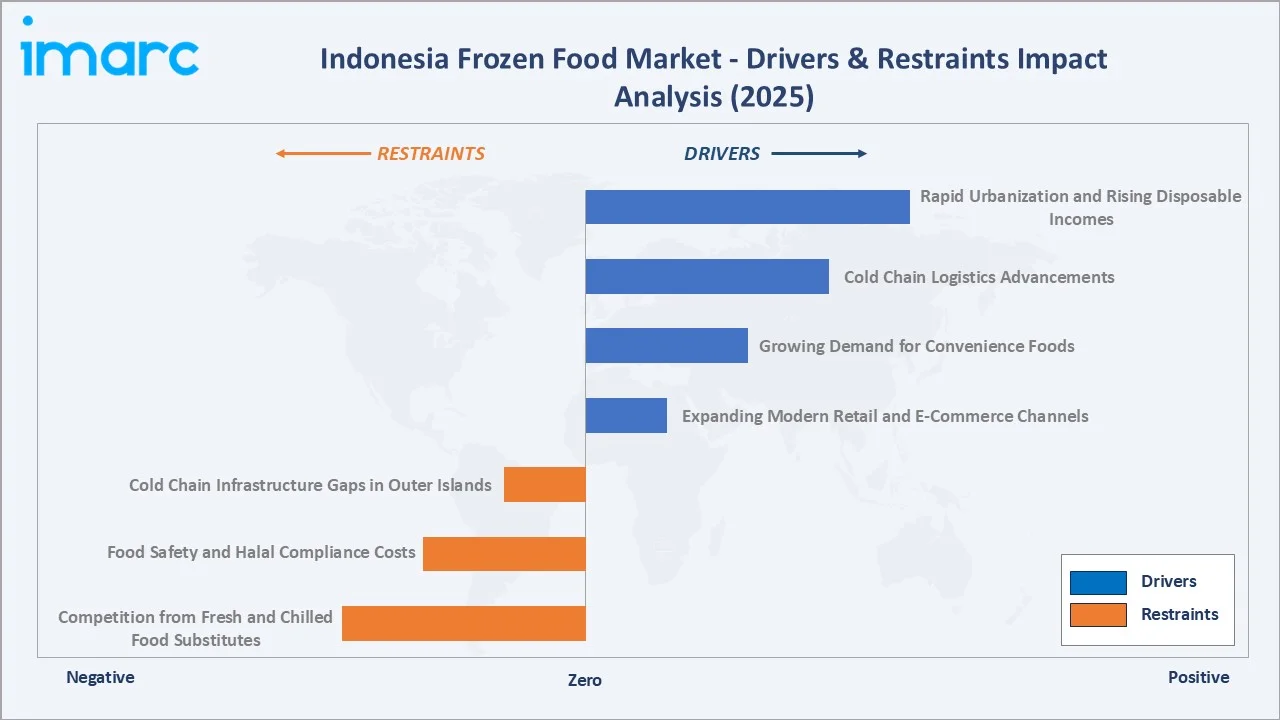
- Rapid Urbanization and Rising Disposable Incomes: Indonesia's urbanization rate exceeding 58% is concentrating consumers in cities where frozen food penetration is highest due to modern retail proximity. Rising household incomes are enabling middle-class consumers to purchase convenience-positioned frozen products at premium price points. Urban dual-income households increasingly prioritize time-efficient meal solutions, driving sustained frozen food volume growth across product categories and distribution channels.
- Cold Chain Logistics Advancements: Significant investment in refrigerated warehousing, temperature-controlled transport, and freezer cabinet installations across the modern retail network has dramatically improved frozen food product availability and quality across Indonesia. Technology upgrades in cold storage facilities, combined with the Dalian Bingshan–Thermo Asri Makmur partnership, are further expanding cold-chain infrastructure capacity to underserved regions beyond Java and Sumatra.
- Growing Demand for Convenience Foods: Busy urban lifestyles, extended working hours, and the increasing participation of women in Indonesia's workforce are accelerating the structural shift toward ready-to-cook and ready-to-eat meal formats. Frozen food satisfies the dual consumer requirement of time efficiency and extended shelf life, making it a preferred category among urban households. The expanding availability of halal-certified frozen meals further broadens the addressable consumer base significantly.
- Expanding Modern Retail and E-Commerce Channels: The rapid proliferation of minimarket formats through Indomaret and Alfamart, combined with freezer cabinet expansion programs, is making frozen food accessible across Indonesian urban and peri-urban areas. Simultaneously, growth of online grocery platforms including Tokopedia, Shopee, and dedicated cold-delivery services is enabling frozen food purchase without physical retail proximity, unlocking new consumer segments and purchase occasions.
Market Restraints
- Cold Chain Infrastructure Gaps in Outer Islands: Inadequate refrigerated logistics outside Java and major Sumatran cities limits frozen food market penetration in Kalimantan, Sulawesi, and eastern Indonesian markets. High investment requirements for refrigerated vehicle fleets and cold storage facilities create significant barriers for organized brands seeking geographic expansion beyond established urban distribution networks.
- Food Safety and Halal Compliance Costs: BPOM registration requirements, mandatory halal certification from MUI, and complex import licensing create significant compliance cost burdens for frozen food manufacturers. International brands face extended market entry timelines of 12-24 months, while domestic producers must segregate production lines to maintain halal-certified and non-certified product streams, increasing operational complexity and capital requirements.
- Competition from Fresh and Chilled Food Substitutes: Indonesia's strong traditional wet market culture means fresh meat, fish, and vegetables remain the preferred choice for a large proportion of consumers, particularly in lower-income segments and outer island markets. Price-sensitive consumers often perceive fresh products as superior in taste and nutritional value, creating ongoing substitution pressure against frozen alternatives.
Market Opportunities
- Halal-Certified Premium Frozen Meal Innovation: Indonesia's Muslim-majority consumer base presents a significant opportunity for halal-certified premium frozen meal products combining Indonesian traditional flavors with modern convenience formats. Brands that successfully develop frozen rendang, soto, and nasi goreng in modern packaging command premium pricing and tap into the growing urban consumer willingness to pay for quality frozen convenience.
- Online Grocery and Cold-Delivery Expansion: Rapid growth of e-commerce platforms offering temperature-controlled frozen food delivery is creating new purchase occasions and consumer segments previously inaccessible to the frozen food category. Digital-native consumers, particularly urban millennials, represent a high-value segment that discovers and purchases frozen products primarily through mobile commerce platforms.
Market Challenges
- Dependence on Imported Raw Materials and Currency Risk: Certain frozen food categories, particularly frozen potato products and some seafood species, rely on imported raw materials, exposing manufacturers to currency exchange rate volatility and global supply chain disruptions. Cost increases from import dependency limit margin management flexibility for producers unable to fully pass input cost increases to price-sensitive Indonesian consumers.
- Power Supply Reliability for Cold Chain Operations: Inconsistent electricity supply in outer Indonesian islands and rural areas creates cold chain interruptions that compromise product quality and safety standards. Cold-chain operators face high generator fuel costs and spoilage risk in regions with unreliable grid infrastructure, limiting the commercial viability of frozen food distribution in underserved markets.
Emerging Market Trends
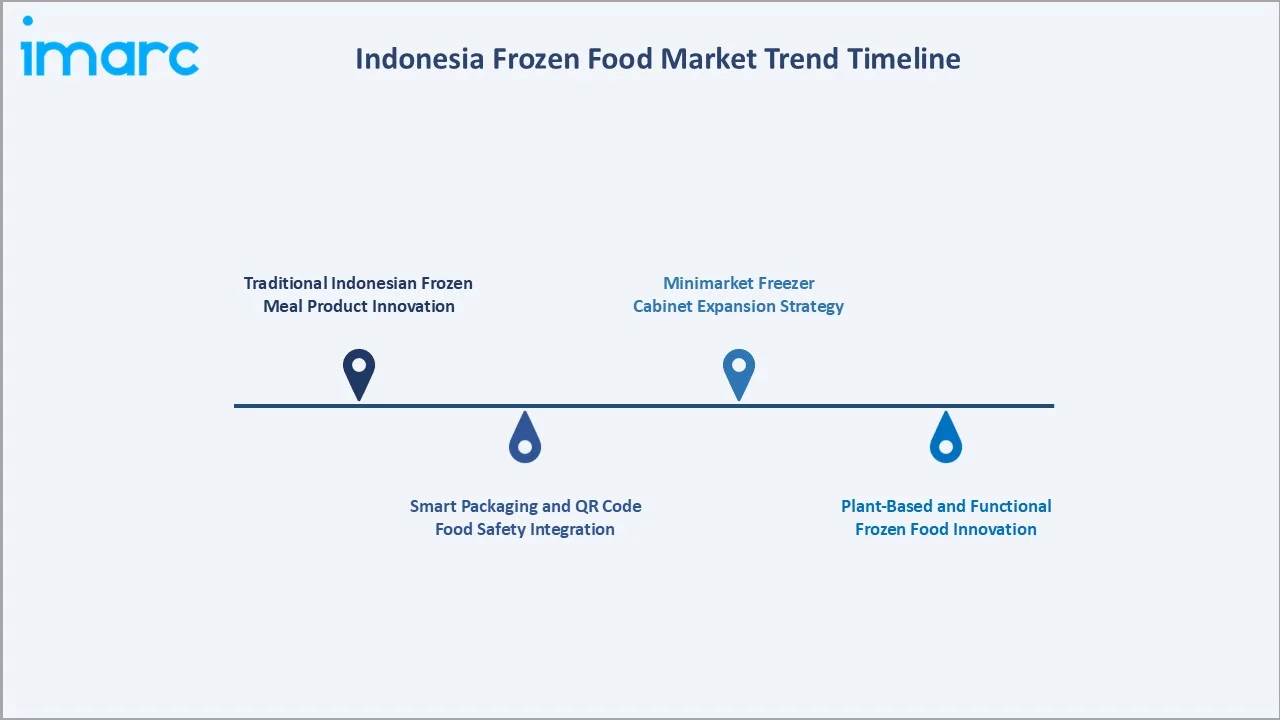
1. Traditional Indonesian Frozen Meal Product Innovation
Manufacturers are launching frozen versions of traditional Indonesian dishes including rendang, soto, bakso, and nasi goreng, targeting urban consumers seeking authentic flavors with modern convenience. These products command premium pricing, benefit from strong cultural relevance, and drive category premiumization beyond commodity frozen meat and seafood segments.
2. Smart Packaging and QR Code Food Safety Integration
Indonesian frozen food manufacturers are adopting smart packaging featuring QR codes and tamper-proof seals to enhance product safety communication and consumer trust. This technology enables supply chain transparency tracking, freshness verification, and halal certification confirmation directly accessible via smartphone scanning.
3. Plant-Based and Functional Frozen Food Innovation
Growing health consciousness among Indonesian urban consumers is driving demand for plant-based frozen alternatives, protein-enriched frozen meals, and low-sodium frozen ready meals. International and domestic manufacturers are launching functional frozen food variants addressing specific dietary needs, positioning frozen as a health-forward category beyond its traditional convenience positioning.
4. Minimarket Freezer Cabinet Expansion Strategy
Leading convenience store chains including Indomaret and Alfamart are systematically expanding their frozen food freezer cabinet footprints across existing and new store locations. This retail infrastructure investment is creating expanded shelf space and consumer touch points for frozen food brands, directly driving volume growth through improved product availability.
Industry Value Chain Analysis
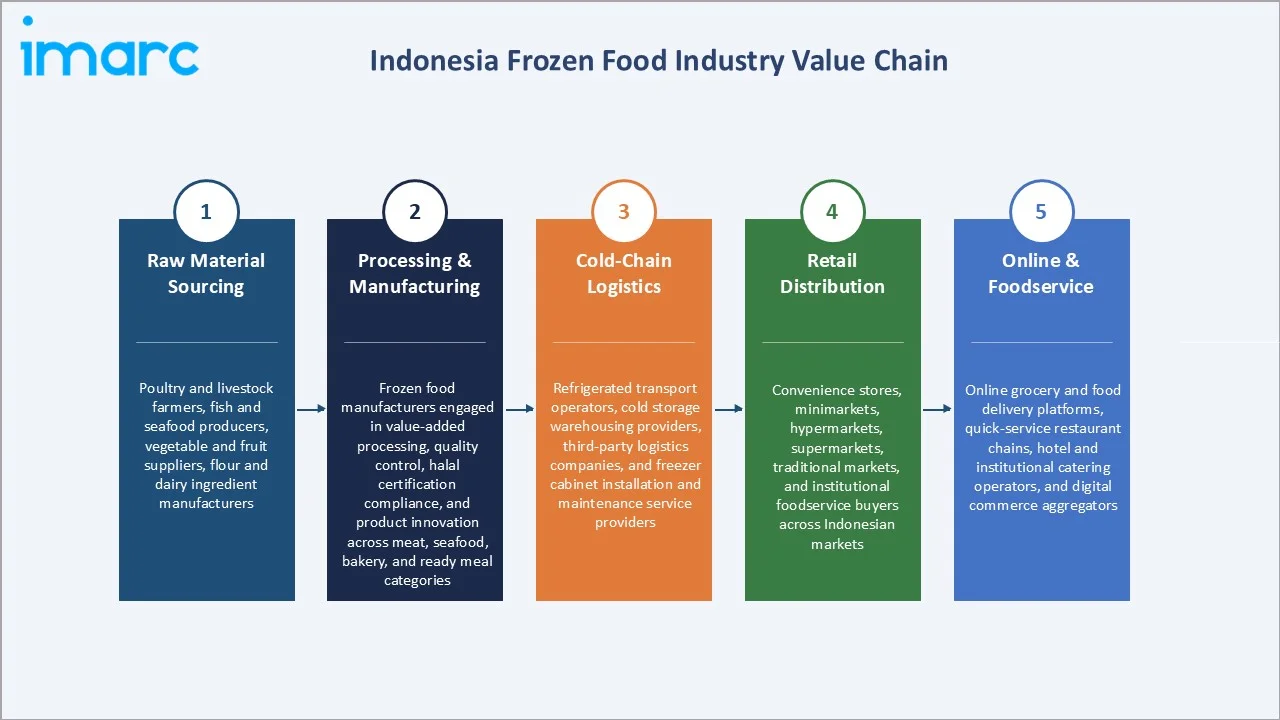
The Indonesia frozen food value chain integrates raw material sourcing, food processing and manufacturing, cold-chain logistics, retail and foodservice distribution, and online grocery commerce. The architecture is progressively evolving as digital grocery platforms complement physical retail distribution channels.
|
Stage |
Key Participants |
|
Raw Material Sourcing |
Poultry and livestock farmers, fish and seafood producers, vegetable and fruit suppliers, flour and dairy ingredient manufacturers |
|
Processing & Manufacturing |
Frozen food manufacturers engaged in value-added processing, quality control, halal certification compliance, and product innovation across meat, seafood, bakery, and ready meal categories |
|
Cold-Chain Logistics |
Refrigerated transport operators, cold storage warehousing providers, third-party logistics companies, and freezer cabinet installation and maintenance service providers |
|
Retail Distribution |
Convenience stores, minimarkets, hypermarkets, supermarkets, traditional markets, and institutional foodservice buyers operating across Indonesian urban and regional markets |
|
Online & Foodservice |
Online grocery and food delivery platforms, quick-service restaurant chains, hotel and institutional catering operators, and digital commerce aggregators serving end consumers |
The processing and manufacturing tier is most commercially significant, with vertically integrated players achieving cost advantages through upstream feed and raw material control. Cold-chain logistics remains the key structural bottleneck limiting geographic expansion beyond Java, representing the industry's highest-priority infrastructure investment requirement.
Technology Landscape in the Indonesia Frozen Food Industry
Individual Quick Freezing (IQF) Technology
Individual Quick Freezing technology enables rapid freezing of individual food pieces without clustering, preserving texture, flavor, and nutritional quality superior to conventional freezing methods. IQF adoption among Indonesian frozen seafood and vegetable processors is improving product quality standards, enabling premium positioning and supporting export market development.
Modified Atmosphere Packaging (MAP) Technology
Advanced modified atmosphere packaging extends frozen food shelf life by controlling the gas composition within packaging to retard oxidation and microbial growth. MAP adoption in Indonesia's frozen meat and ready meal segments is enabling longer distribution windows, reducing spoilage-related losses, and supporting broader geographic distribution beyond established cold-chain coverage areas.
Smart Cold Chain Monitoring and IoT Technology
IoT-enabled temperature monitoring systems integrated across refrigerated trucks, cold storage facilities, and retail freezer cabinets provide real-time supply chain visibility and quality assurance alerts. These technologies reduce spoilage incidents, ensure BPOM compliance, and improve operational efficiency for frozen food distributors operating across Indonesia's complex archipelagic logistics environment.
Market Segmentation Analysis
The report covers the following segments:
|
Segment Category |
Leading Segment |
Market Share |
Year |
|
Type |
Frozen Meat Products |
25.7% |
2025 |
|
Distribution Channel |
Grocery Stores/Convenience Stores |
42.8% |
2025 |
|
Region |
Java |
58.7% |
2025 |

By Type
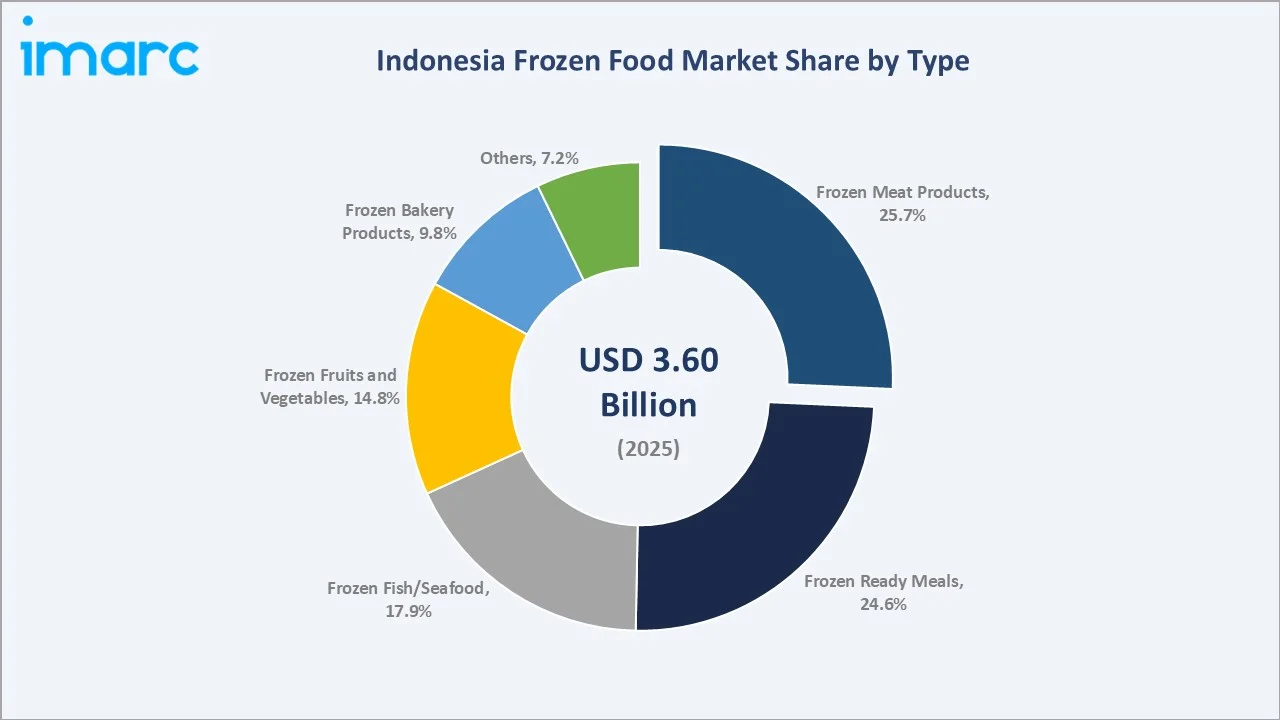
Frozen Meat Products lead at 25.7% in 2025, reflecting Indonesia's dominant poultry processing industry and strong consumer preference for processed chicken products including nuggets, sausages, and ready-to-cook portions distributed across modern and traditional channels.
To access detailed market analysis, Request Sample
Frozen Ready Meals at 24.6% are the fastest-growing type segment through urban convenience demand. Frozen Fish/Seafood at 17.9% benefits from Indonesia's abundant marine resources. Frozen Fruits and Vegetables at 14.8%, Frozen Bakery Products at 9.8%, and Others at 7.2% complete the type landscape.
By Distribution Channel
Grocery Stores/Convenience Stores lead at 42.8% in 2025, driven by the extensive Indomaret and Alfamart minimarket networks that have expanded frozen food freezer cabinet access across urban and peri-urban Indonesia through systematic store expansion programs.
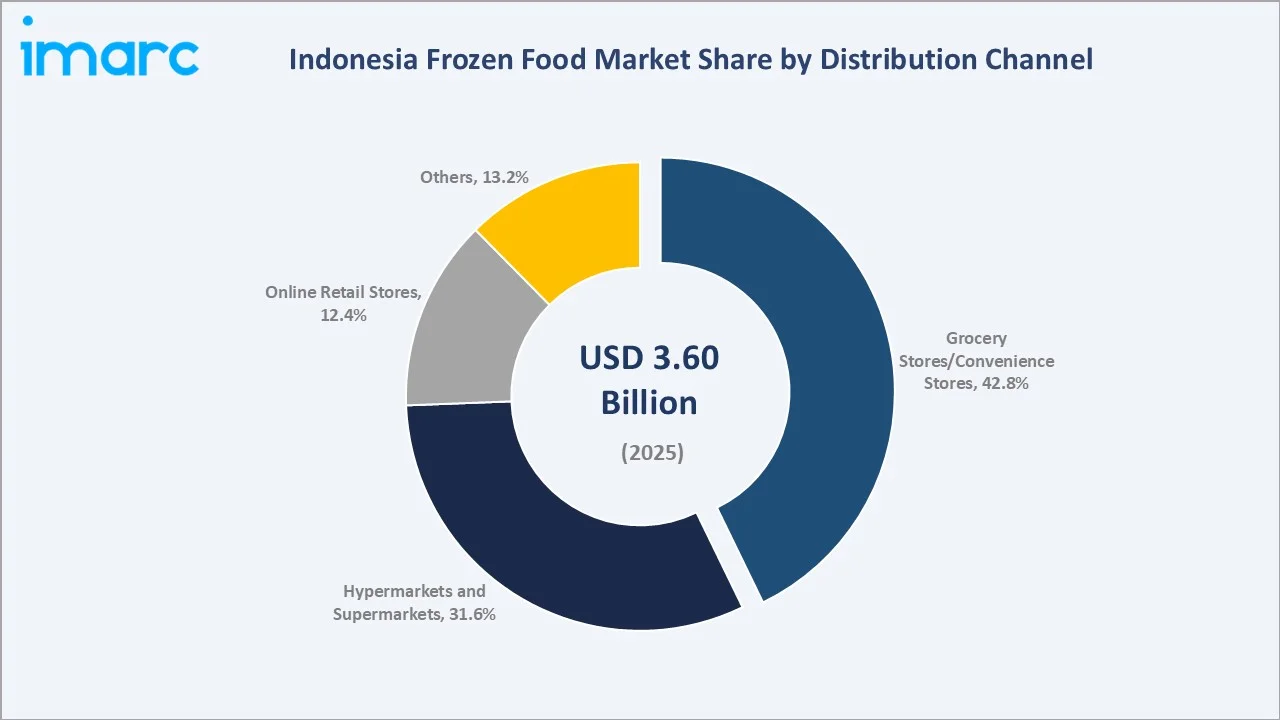
Hypermarkets and Supermarkets at 31.6% serve premium and bulk frozen food purchase occasions. Online Retail Stores at 12.4% represent the fastest-growing channel through cold-delivery platform expansion. Others at 13.2% includes institutional foodservice buyers and traditional trade outlets.
Regional Market Insights
|
Region |
Share (2025) |
Key Frozen Food Market Drivers & Characteristics |
|
Java |
58.7% |
Largest population concentration; highest modern retail and minimarket density; best-developed cold chain; dominant frozen meat and ready meal consumption in Jakarta, Surabaya, and Bandung |
|
Sumatra |
18.9% |
Second-largest regional market; growing urbanization in Medan, Palembang, and Pekanbaru; expanding minimarket networks driving frozen food accessibility; seafood product preference |
|
Kalimantan |
9.1% |
Emerging market supported by IKN capital development and rising urban incomes; cold-chain infrastructure investment expanding; traditional trade still dominant in distribution mix |
|
Sulawesi |
7.6% |
Driven by Makassar urban growth; strong seafood and fish frozen product preference aligned with regional protein culture; modern retail penetration accelerating |
|
Others |
5.7% |
Early-stage markets in Papua, Maluku, and Nusa Tenggara; power supply reliability constraints limit cold-chain viability; traditional fresh market culture dominant |
Java at 58.7% leads through its dense urban population and superior cold-chain network. Sumatra at 18.9% represents the highest-growth frontier as minimarket expansion improves frozen food access.
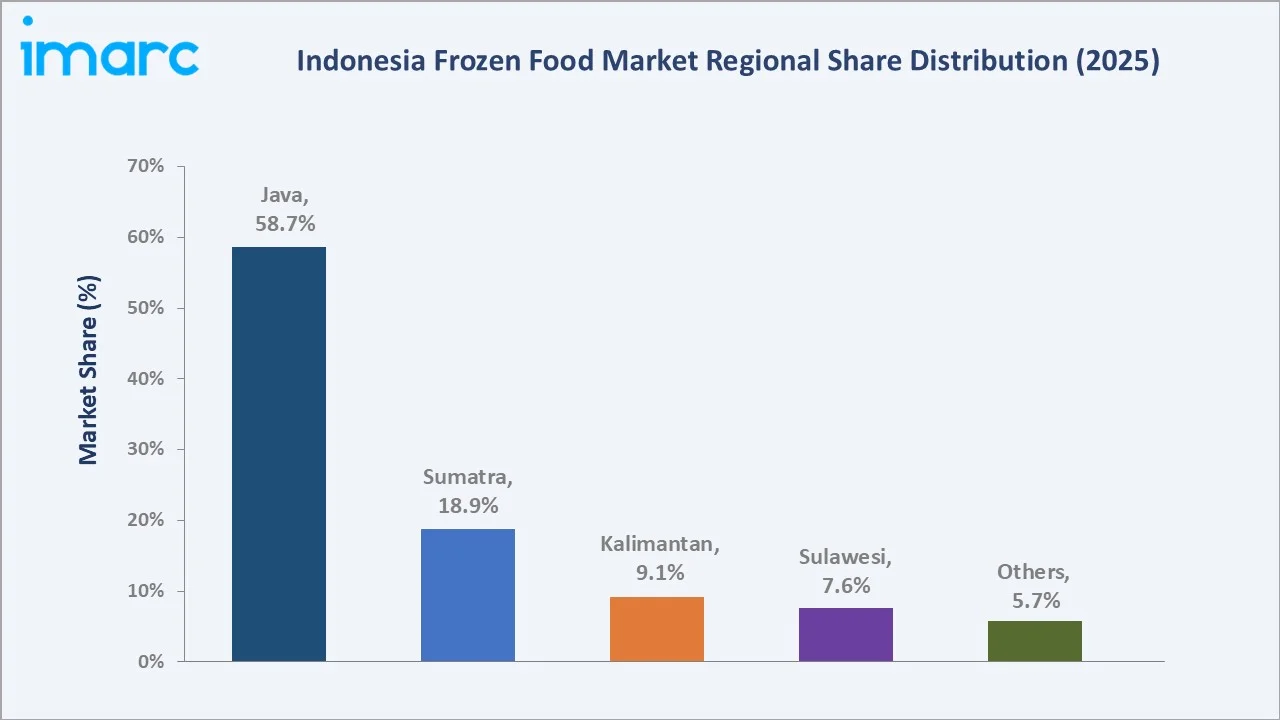
Kalimantan and Sulawesi are rapidly developing markets supported by infrastructure investment and growing urban incomes.
Competitive Landscape
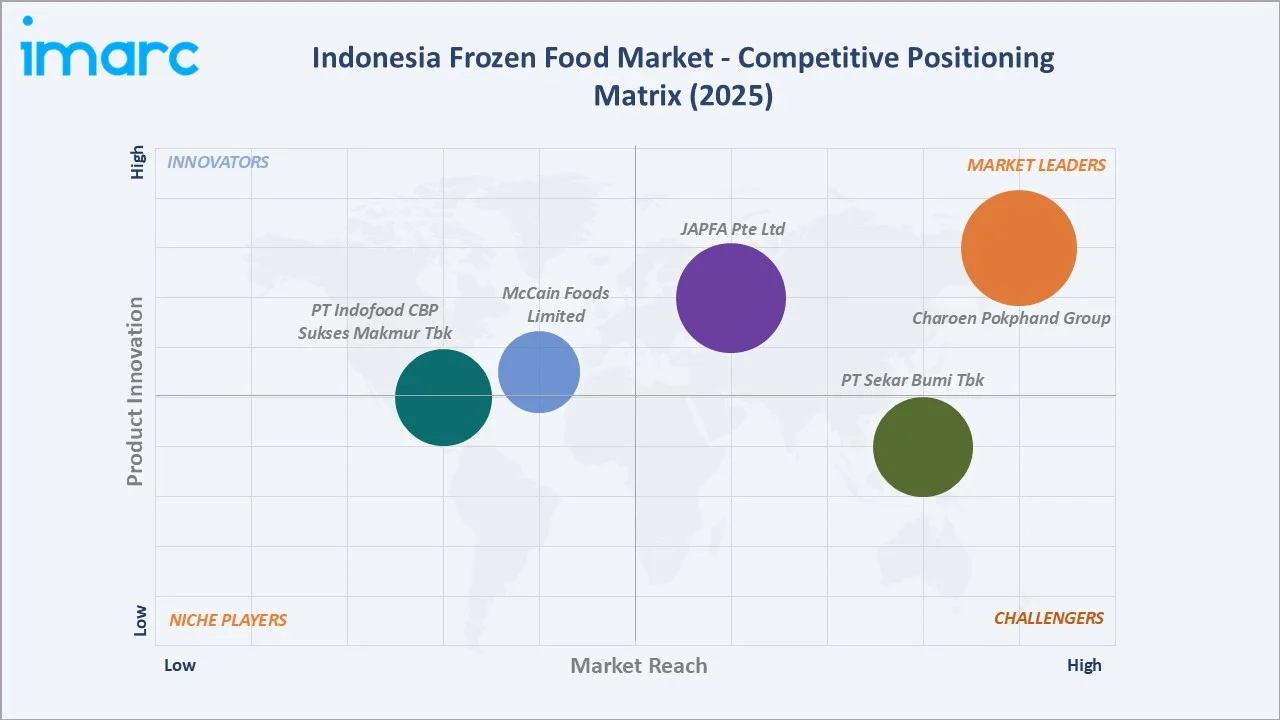
The Indonesia frozen food market competitive landscape is moderately concentrated with vertically integrated domestic operators, regional processors, and international players competing across product type and distribution channel segments.
|
Company Name |
Key Products |
Market Position |
Core Strength |
|
Charoen Pokphand Group |
Champ Nugget, Champ Sausage, Fiesta |
Market Leader |
Vertically integrated poultry operations from feed to retail; dominant frozen chicken category leadership; widest cold-chain distribution network across Indonesia |
|
JAPFA Pte Ltd |
So Good, So Yummy |
Market Leader |
Vertically integrated poultry-to-retail operator; strong So Good and So Yummy brand equity; expanding frozen meal and seafood portfolio across modern trade |
|
PT Sekar Bumi Tbk |
Finna, Bumifood seafood products |
Strong Challenger |
Leading domestic frozen seafood and meat processor; strong export operations; halal-certified production; expanding modern retail and foodservice channel presence |
|
PT Indofood CBP Sukses Makmur Tbk |
Indofood frozen range, Popsicle |
Established Player |
Leverages Indofood group distribution infrastructure; strong brand recognition across Indonesian consumer segments; expanding frozen food product portfolio |
|
McCain Foods Limited |
McCain French Fries, McCain Potato |
Established Player |
Anchors premium frozen potato segment through controlled distribution partnerships with Indonesian hypermarket chains; strong quick-service restaurant foodservice channel |
Key players include Charoen Pokphand Group, JAPFA Pte Ltd, PT Sekar Bumi Tbk, PT Indofood CBP Sukses Makmur Tbk, McCain Foods Limited, and others.
Key Company Profiles
Charoen Pokphand Group
Charoen Pokphand Group is Indonesia's one of the largest integrated poultry company operating from feed production through frozen food retail, dominating the frozen chicken products category.
- Key Products: Champ Nugget, Champ Sausage, Fiesta frozen chicken products, chicken meatballs, and processed poultry food items.
- Strategic Focus: PT Charoen Pokphand Indonesia Tbk is focused on strengthening its vertically integrated supply chain from feed production to retail, expanding its premium frozen ready-to-cook product portfolio, deepening modern retail and minimarket distribution partnerships, and investing in halal-certified production capacity to maintain compliance with Indonesia's mandatory certification requirements across all frozen food product categories.
JAPFA Pte Ltd
JAPFA Ltd is a Singapore-listed agri-food company with significant operations in Indonesia through PT Japfa Comfeed Indonesia Tbk and its frozen food brand PT So Good Food. JAPFA operates a fully integrated poultry business from breeding to retail frozen food products, competing across mass-market and premium frozen segments.
- Key Products: So Good, So Yummy chicken nuggets, sausages, frozen meatballs, and ready-to-cook meal solutions.
- Strategic Focus: JAPFA is focused on expanding its So Good and So Yummy branded frozen food portfolios through product innovation in ready-to-cook and ready-to-eat meal formats, strengthening its cold storage logistics network nationwide, deepening e-commerce channel penetration through digital grocery partnerships, and scaling its Olagud product line to capture urban millennials' convenience food demand.
Market Concentration Analysis
The Indonesia frozen food market is moderately concentrated in the frozen meat segment, with the key players collectively accounting for approximately 40-50% of frozen poultry product revenue. The frozen seafood, bakery, and ready meal segments are more fragmented, with no single player commanding dominant market share across all categories.
Investment & Growth Opportunities
Highest Growth Segments
Frozen Ready Meals (~6.5-7% CAGR), online grocery cold-delivery channel (~12-15% CAGR), halal-certified premium frozen product development (~6-7% CAGR), plant-based frozen meat alternatives (~8-10% CAGR), and Sumatra regional expansion (~6-7% CAGR) represent the highest-growth investment vectors through 2034.
Emerging Investment Opportunities
Cold-chain infrastructure investment in Kalimantan and Sulawesi enabled by IKN capital development and government food security programs creates first-mover distribution advantages for brands establishing refrigerated logistics networks ahead of competitors in these rapidly urbanizing regions.
Investment Themes
- Traditional Indonesian frozen meal development: Creating halal-certified frozen versions of traditional Indonesian dishes targets the aspiration-convenience intersection of urban consumers seeking authentic flavors with modern meal preparation efficiency, commanding sustainable price premiums and strong brand loyalty.
- Minimarket freezer cabinet expansion partnership: Partnering with Indomaret and Alfamart on freezer cabinet expansion programs creates scalable distribution infrastructure for frozen food brands seeking to accelerate geographic penetration across Indonesia's extensive convenience store networks.
Future Market Outlook (2026-2034)
The Indonesia frozen food market is projected to grow from USD 3.60 Billion in 2025 to USD 3.81 Billion in 2026, reaching USD 6.07 Billion by 2034 at a 5.99% CAGR. The mid-period anchor of approximately USD 4.81 Billion in 2030 represents the market at its product premiumization inflection point, where frozen ready meals and value-added frozen products will account for a significantly larger share.
Three structural forces define growth through 2034: continued urbanization expanding the frozen food addressable consumer base; cold-chain infrastructure expansion enabling geographic penetration into Sumatra, Kalimantan, and Sulawesi; and rising middle-class aspirations driving premiumization from commodity frozen meat toward traditional Indonesian frozen meals and value-added formats.
Research Methodology
Primary Research
Primary research comprised structured interviews with 50+ industry stakeholders (2025) including frozen food brand managers, cold-chain logistics specialists, modern retail category buyers, foodservice procurement managers, and e-commerce grocery platform executives across Java, Sumatra, and Kalimantan.
Secondary Research
Secondary research encompassed company annual reports (PT Charoen Pokphand Indonesia Tbk, JAPFA Ltd, PT Sekar Bumi Tbk, PT Mayora Indah Tbk); BPOM food registration databases; Ministry of Industry statistics; Euromonitor frozen food data; Nielsen Indonesia retail audit; and IMARC proprietary frozen food database. Over 55 secondary sources reviewed.
Forecasting Models
Market forecasts used a production-based bottom-up model: (i) frozen food production volume by type category; (ii) average selling price by product type and distribution channel; (iii) geographic market share by region; (iv) adjustments for cold-chain penetration rate, online channel growth, and premiumization assumptions across the 2026-2034 forecast horizon.
Indonesia Frozen Food Market Report Coverage:
| Report Features | Details |
|---|---|
| Base Year of the Analysis | 2025 |
| Historical Period | 2020-2025 |
| Forecast Period | 2026-2034 |
| Units | Billion USD |
| Scope of the Report | Exploration of Historical and Forecast Trends, Industry Catalysts and Challenges, Segment-Wise Historical and Predictive Market Assessment:
|
| Types Covered | Frozen Fruits and Vegetables, Frozen Ready Meals, Frozen Meat Products, Frozen Fish/Sea Food, Frozen Bakery Products, Others |
| Distribution Channels Covered | Hypermarkets and Supermarkets, Grocery Stores/ Convenience Stores, Online Retail Stores, Others |
| Regions Covered | Java, Sumatra, Kalimantan, Sulawesi, Others |
| Companies Covered | Charoen Pokphand Group, JAPFA Pte Ltd, PT Sekar Bumi Tbk, PT Indofood CBP Sukses Makmur Tbk, McCain Foods Limited, etc. |
| Customization Scope | 10% Free Customization |
| Post-Sale Analyst Support | 10-12 Weeks |
| Delivery Format | PDF and Excel through Email (We can also provide the editable version of the report in PPT/Word format on special request) |
Key Benefits for Stakeholders:
- IMARC’s industry report offers a comprehensive quantitative analysis of various market segments, historical and current market trends, market forecasts, and dynamics of the Indonesia frozen food market from 2020-2034.
- The research report provides the latest information on the market drivers, challenges, and opportunities in the Indonesia frozen food market.
- Porter's five forces analysis assist stakeholders in assessing the impact of new entrants, competitive rivalry, supplier power, buyer power, and the threat of substitution. It helps stakeholders to analyze the level of competition within the Indonesia frozen food industry and its attractiveness.
- Competitive landscape allows stakeholders to understand their competitive environment and provides an insight into the current positions of key players in the market.
Frequently Asked Questions About the Indonesia Frozen Food Market Report
The Indonesia frozen food market size is estimated at USD 3.81 Billion in 2026, with Frozen Meat Products leading at 25.7%, Grocery/Convenience Stores dominating distribution at 42.8%, Java commanding 58.7% regional share, driven by urbanization, cold-chain expansion, and rising consumer demand for convenient food solutions.
The market grows at 5.99% CAGR during 2026-2034, reaching USD 6.07 Billion by 2034. Growth reflects urbanization-driven convenience food demand, cold-chain infrastructure expansion, modern retail proliferation, and rising consumer preference for processed and ready-to-cook frozen food products.
Frozen Meat Products leads at 25.7%, driven by Indonesia's vertically integrated poultry processing industry and strong consumer demand for processed chicken products. PT Charoen Pokphand Indonesia Tbk and JAPFA Ltd anchor this segment through integrated feed-to-retail operations delivering cost-competitive frozen poultry products.
Grocery Stores/Convenience Stores lead at 42.8% through Indonesia's extensive Indomaret and Alfamart minimarket networks that have expanded frozen food freezer cabinet installations across urban and peri-urban areas, providing impulse-purchase proximity and cold-chain reliability that is driving consistent volume growth.
Java leads at 58.7% through its concentration of over 60% of Indonesia's population, the highest density of modern retail outlets, and Indonesia's most developed cold-chain logistics network enabling consistent frozen food product availability from production facilities to end consumers.
Leading companies include Charoen Pokphand Group, JAPFA Pte Ltd, PT Sekar Bumi Tbk, PT Indofood CBP Sukses Makmur Tbk, McCain Foods Limited, and others.
The market is projected to reach approximately USD 4.81 Billion by 2030, with frozen ready meals gaining significant market share, online grocery cold-delivery becoming a meaningful distribution channel, and Sumatra and Kalimantan expanding their organized frozen food market contribution as cold-chain infrastructure investment enables geographic market penetration.
Three priority opportunities: traditional Indonesian frozen meal development creating premium brand positioning, cold-chain infrastructure investment in Kalimantan and Sulawesi establishing first-mover distribution advantages, and online grocery cold-delivery channel integration capturing urban millennial convenience food demand growth across Indonesian metropolitan areas.
Need more help?
- Speak to our experienced analysts for insights on the current market scenarios.
- Include additional segments and countries to customize the report as per your requirement.
- Gain an unparalleled competitive advantage in your domain by understanding how to utilize the report and positively impacting your operations and revenue.
- For further assistance, please connect with our analysts.
 Request Customization
 Speak to an Analyst
 Request Brochure
 Inquire Before Buying
Benefits of Customization
- Personalize this research
- Triangulate with your data
- Get data as per your format and definition
- Gain a deeper dive into a specific application, geography, customer, or competitor
- Any level of personalization
Get in Touch With Us
UNITED STATES
Phone: +1-201-971-6302
INDIA
Phone: +91-120-433-0800
UNITED KINGDOM
Phone: +44-753-714-6104
Email: [email protected]
Client Testimonials




.webp)




.webp)













Related Reports

Choose your plan
*Please note that the prices mentioned below are starting prices for each bundle type. Kindly contact our team for further details.*
Single User License
- 1 User License, Access on 2 Devices
- PDF Report + Excel Dataset (Password Protected)
- Lifetime Access
- No Printing Rights
- 10% Free Report Customization
- 10–12 Weeks of Analyst Support
Five User License
- Access for 5 Users, 2 Devices per User
- PDF Report + Excel Dataset (Password Protected)
- Lifetime Access
- Dedicated Account Manager
- 12–14 Weeks of Analyst Support
- No Printing Rights
- 15% Free Report Customization
- 25% Discount on Your Next Purchase
Corporate User License
- Unlimited User Access (Within Your Organization)
- PDF Report + Excel Dataset
- Lifetime Access
- Dedicated Account Manager
- 14–20 Weeks of Analyst Support
- No Printing Rights
- 20% Free Report Customization
- 30% Discount on Your Next Purchase
Essential Insights
What's included:
3 reports
- Lifetime Access
- PDF Reports
- Excel Datasets
- 2 Weeks of Free Analyst Support
- 2 User Licenses
- Access on 2 Devices
- Printing Rights
- Complimentary PowerPoint (PPT) Version
- Complimentary License Upgrade
Professional Access
What's included:
5 reports
- Lifetime Access
- PDF Reports
- Excel Datasets
- 8 Weeks of Free Analyst Support
- 2 User Licenses
- Access on 2 Devices
- Printing Rights
- Complimentary PowerPoint (PPT) Version
- Complimentary License Upgrade
Business Advantage
What's included:
8 reports
- Lifetime Access
- PDF Reports
- Excel Datasets
- 14 Weeks of Free Analyst Support
- 2 User Licenses
- Access on 2 Devices
- Printing Rights
- Complimentary PowerPoint (PPT) Version
- Complimentary License Upgrade
Enterprise Intelligence
What's included:
10 reports
- Lifetime Access
- PDF Reports
- Excel Datasets
- 20 Weeks of Free Analyst Support
- 2 User Licenses
- Access on 2 Devices
- Printing Rights
- Complimentary PowerPoint (PPT) Version
- Complimentary License Upgrade