
Indonesia Ice Cream Market Size, Share, Trends and Forecast by Flavor, Category, Product, Distribution Channel, and Region, 2026-2034
Indonesia Ice Cream Market Size, Share, Trends & Forecast (2026-2034)
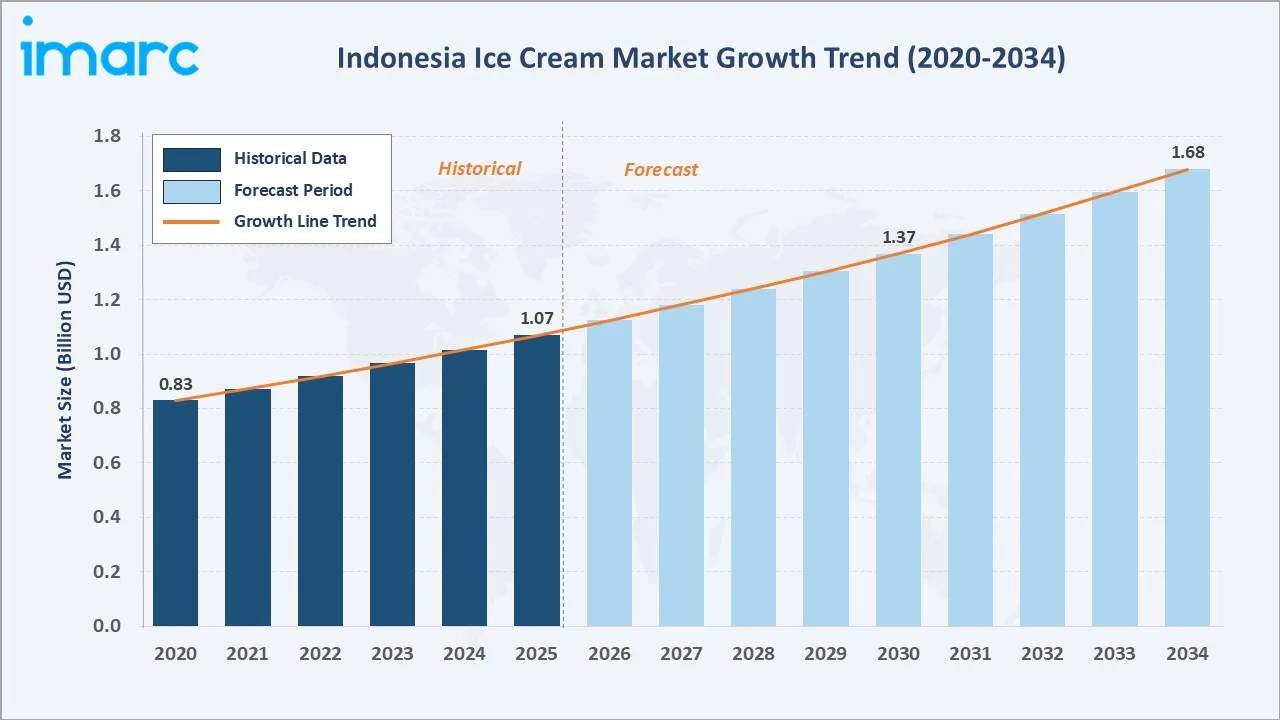
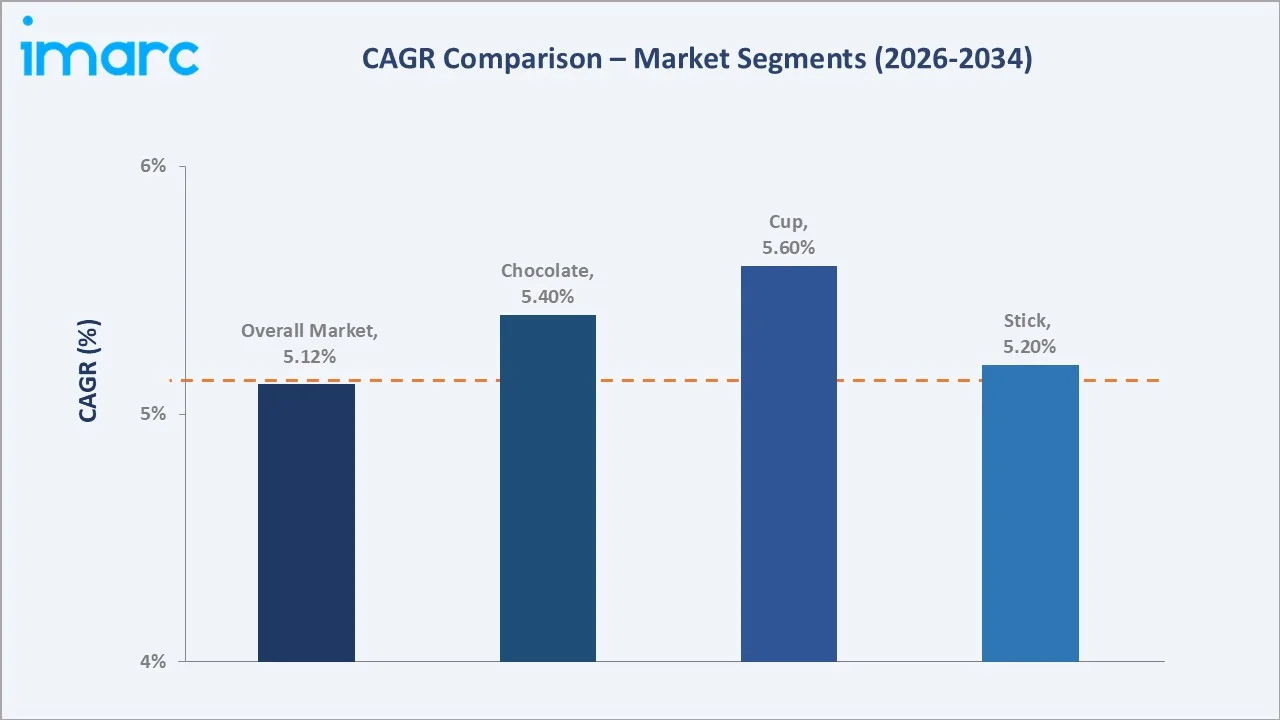
The Indonesia ice cream market grew from USD 1.07 Billion in 2025 to USD 1.12 Billion in 2026 and is projected to reach USD 1.68 Billion by 2034, growing at a CAGR of 5.12% during 2026-2034. The market is driven by rapid urbanization, rising disposable incomes, introduction of exotic and locally-inspired flavors, and expansion of the food service industry. Chocolate leads by flavor at 28.6%. Cup leads by product at 28.4%. Java commands 57.6% of the regional market share.
Market Snapshot
|
Metric |
Value |
|
Base Year Market Size (2025) |
USD 1.07 Billion |
| Market Size (2026) | USD 1.12 Billion |
|
Forecast Market Size (2034) |
USD 1.68 Billion |
|
CAGR (2026-2034) |
5.12% |
|
Base Year |
2025 |
|
Historical Period |
2020-2025 |
|
Forecast Period |
2026-2034 |
|
Dominant Flavor |
Chocolate (28.6%, 2025) |
|
Dominant Product |
Cup (28.4%, 2025) |
|
Leading Region |
Java (57.6%, 2025) |
The market expanded from USD 0.83 Billion in 2020 to USD 1.07 Billion in 2025 and an estimated USD 1.12 Billion in 2026, anchored at USD 1.37 Billion in 2030 and forecast to reach USD 1.68 Billion by 2034. Indonesia's tropical climate, large youth population exceeding 70 million aged 15-34, and rapid modernization of retail channels provide a robust structural demand foundation.
To get more information on this market, Request Sample
Chocolate leads flavor at 28.6% driven by broad demographic appeal across all age groups. Cup leads product at 28.4% through affordability and portability suited to Indonesia's warm climate. Java dominates regionally at 57.6% through high population density and modern retail infrastructure concentration.
Executive Summary
The Indonesia ice cream market expanded from USD 1.07 Billion in 2025 to an estimated USD 1.12 Billion in 2026, representing one of Southeast Asia's most dynamic frozen dessert markets driven by the fundamental demographic and urbanization transformation of Indonesian consumer behavior. Ice cream functions as an accessible, affordable indulgence for Indonesia's large and youthful population. The market is projected to reach USD 1.68 Billion by 2034.
Chocolate at 28.6% dominates by capturing the broadest consumer preference across all demographics. Cup at 28.4% leads through affordable single-serve formats across modern retail and traditional warungs. Java at 57.6% leads regionally through its concentration of urban population, modern trade outlets, and cold-chain infrastructure supporting reliable product availability.
Key Market Insights
|
Insight |
Data |
|
Dominant Flavor |
Chocolate – 28.6% share (2025) |
|
Dominant Product |
Cup – 28.4% market share (2025) |
|
Leading Region |
Java – 57.6% market share (2025) |
|
Market Opportunity |
Premium artisanal segment; plant-based variants; digital quick-commerce; Sumatra and Kalimantan expansion |
Key Analytical Observations Supporting the Above Data:
- Chocolate at 28.6%: Chocolate dominates through the widest demographic reach across all income segments and age groups. Its versatility across cup, stick, and tub formats, combined with consistent new product launches from multinational and domestic brands, reinforces segment leadership. Leading players have expanded chocolate SKUs across convenience stores and minimarts, strengthening category leadership across urban and peri-urban markets.
- Cup at 28.4%: The cup format dominates through affordability, ease of consumption, and suitability for Indonesia's warm climate. Convenience store operators have expanded freezer space for cup SKUs in response to strong impulse demand. Wall's and Campina have launched affordable cup variants to defend market position against Aice Group's aggressive volume strategy.
- Java at 57.6%: Java leads through its 60%+ share of Indonesia's population and the highest density of modern trade including Indomaret and Alfamart. The region has Indonesia's most developed cold-chain logistics network, ensuring consistent product availability. Java's concentration of urban middle-class consumers and food service establishments drives above-average per-capita ice cream consumption.
Indonesia Ice Cream Market Overview
The Indonesia ice cream market encompasses the manufacturing, distribution, and retail sale of packaged frozen dairy and non-dairy desserts across impulse, take-home, and artisanal product categories. The market serves a population exceeding 280 million across five major island regions with diverse consumption patterns and retail maturity levels.
The ecosystem integrates dairy ingredient suppliers, cold-chain logistics providers, packaging manufacturers, modern trade retailers, food service operators, and digital delivery platforms. Macroeconomic factors include rising incomes, expanding modern retail penetration, cold-chain infrastructure investment, and Indonesia's demographic dividend supporting sustained consumer base growth.
Market Dynamics
To evaluate market opportunities, Request Sample
Market Drivers
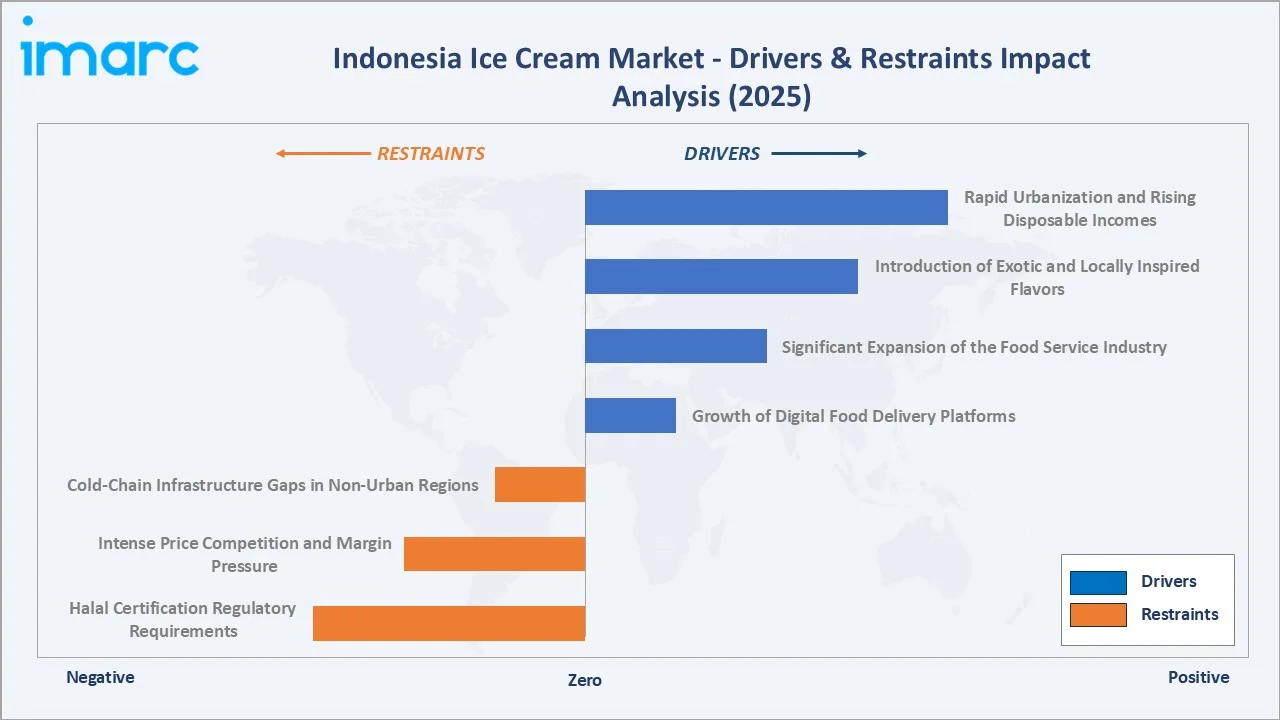
- Rapid Urbanization and Rising Disposable Incomes: Indonesia's urbanization rate exceeds 58%, concentrating consumers in high-income urban areas with greater purchasing power and access to modern retail formats. Rising incomes are enabling premiumization, with consumers trading up from economy cup formats to premium stick bars. Urban households in Java exhibit 2-3x higher ice cream purchase frequency, reflecting the strong structural link between urbanization and category growth. The trend is expected to accelerate as Indonesia's urban population surpasses 60% during the forecast period.
- Introduction of Exotic and Locally Inspired Flavors: Indonesian manufacturers are adapting portfolios with pandan, durian, palm sugar, and tropical fruit flavors, capturing adventurous consumers seeking culturally relevant experiences. Flavor innovation drives trial and repeat purchases by differentiating products beyond standard chocolate and vanilla. Artisanal brands leverage local flavor authenticity for premium positioning, creating price-premium opportunities and expanding the artisanal market segment. Indonesian flavor diversity supports above-average new product launch rates versus other Southeast Asian markets.
- Significant Expansion of the Food Service Industry: Indonesia's growing restaurant, café, and dessert shop sector provides a substantial additional consumption channel for ice cream, with the product increasingly featured across casual dining and café menus nationwide. Food service accounts for a growing share of total ice cream consumption, supplementing modern retail and creating new premium positioning opportunities. Food establishments incorporate customized ice cream desserts into their menus, supporting higher average selling prices and driving branded procurement from food service operators across major Indonesian cities.
- Growth of Digital Food Delivery Platforms: GoFood and GrabFood have integrated ice cream delivery, enabling impulse purchasing without proximity to physical retail and extending brand reach into residential neighborhoods. Digital channel growth is creating new purchasing occasions during home-dining activities previously inaccessible to the ice cream category. Platforms offer temperature-controlled delivery and brand promotional partnerships, increasing purchase frequency and driving digital channel revenue contribution across Indonesian metropolitan areas significantly.
Market Restraints
- Cold-Chain Infrastructure Gaps in Non-Urban Regions: Inadequate refrigerated logistics outside Java and major Sumatran cities limits organized brand penetration into Kalimantan, Sulawesi, and eastern Indonesian markets where traditional trade remains dominant. High last-mile refrigerated delivery costs restrict product availability and shelf-life integrity in remote markets, constraining geographic expansion. Cold storage warehousing and refrigerated vehicle fleet requirements create significant capital barriers for smaller domestic players competing against multinational distribution networks in Indonesia's archipelagic geography.
- Intense Price Competition and Margin Pressure: Aice Group's aggressively low-priced products have significantly compressed average selling prices across the mass-market impulse segment, limiting margin recovery for established players including Unilever Indonesia and PT Campina. Incumbent players face ongoing margin erosion as price-sensitive consumers shift toward the lowest available price point, constraining capital for brand investment and premium format launches. This competitive dynamic limit industry-wide profitability and may slow product innovation investment needed to develop higher-value segments.
- Halal Certification Regulatory Requirements: All ice cream products targeting Indonesian mainstream retail require halal certification from Majelis Ulama Indonesia, adding compliance costs and formulation constraints affecting ingredient selection and production design. International brands must navigate certification and adapt formulations, increasing development lead times and reducing formulation flexibility. Ongoing compliance monitoring creates recurring operational costs for all market participants, particularly affecting smaller artisanal producers with limited regulatory compliance infrastructure and technical resources.
Market Opportunities
- Premiumization and Artisanal Ice Cream Development: Rising middle-class aspirations are creating demand for premium artisanal ice cream at price points 3-5x above mass-market offerings, with gourmet parlors expanding rapidly across Jakarta, Surabaya, and Bali. Indonesian consumers with international exposure are seeking authentic, quality-differentiated experiences beyond standard impulse formats. Brands combining premium positioning, local flavor authenticity, and quality ingredient sourcing can command sustainable price premiums and build loyal urban middle-class consumer bases.
- Geographic Expansion into Sumatra and Kalimantan: Improving cold-chain infrastructure and growing urban middle-class populations in Medan, Palembang, Pekanbaru, and Kalimantan's emerging centers are creating market access opportunities for organized ice cream brands. These regions remain substantially underpenetrated relative to their population and purchasing power, offering first-mover advantages for brands investing in regional cold-chain and channel development. Indomaret and Alfamart network expansion into secondary cities creates an expanding organized retail footprint that manufacturers can leverage for distribution access.
Market Challenges
- Dairy Raw Material Cost Volatility: Indonesia imports significant dairy ingredients including whole milk powder and whey derivatives, exposing manufacturers to global commodity price fluctuations and currency exchange risk. Cost increases cannot always be passed to price-sensitive consumers in the mass-market impulse segment where Aice's competitive pricing limits flexibility. Managing hedging strategies and developing alternative local supply sources requires significant procurement expertise and capital commitment from manufacturers seeking to reduce structural input cost exposure.
- Ramadan Seasonal Demand Fluctuations: Indonesia's Muslim consumer base observes Ramadan fasting, creating predictable demand softening in the ice cream category as purchasing habits shift during daylight hours, requiring careful promotional and inventory management. Brands must plan production schedules and positioning carefully to minimize revenue disruption while capitalizing on evening consumption occasions and post-Ramadan recovery. Misjudging the timing and magnitude of demand recovery creates ongoing operational planning challenges for manufacturers and cold-storage operators managing inventory costs.
Emerging Market Trends
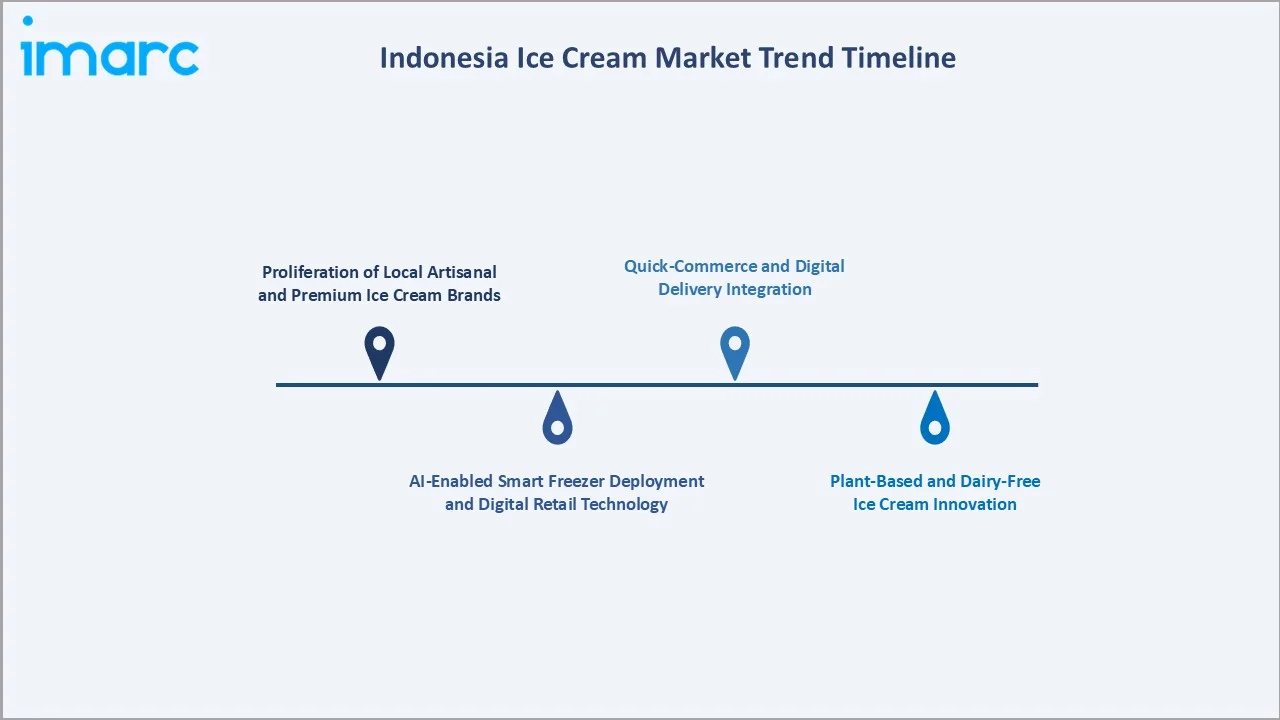
1. Proliferation of Local Artisanal and Premium Ice Cream Brands
Local artisanal ice cream brands are proliferating across Tier-1 cities, differentiating through handcrafted production methods, authentic local flavors including pandan and durian, and premium ingredient sourcing commanding 3-5x mass-market pricing. These brands are establishing ice cream parlors and building digital presence on food delivery platforms. Their growth is expanding total category value and setting premium benchmarks enabling the broader market to trade up progressively.
2. AI-Enabled Smart Freezer Deployment and Digital Retail Technology
Unilever's Wall's brand has deployed over 100,000 AI-enabled smart freezers across Indonesia's convenience store and minimart network, enabling real-time inventory tracking and automated replenishment that has increased sales by up to 30% at deployed locations. Smart freezer technology creates significant route-to-market competitive advantage by ensuring product availability and optimizing SKU mix at the point of sale. Competitors are actively evaluating similar infrastructure investments.
3. Plant-Based and Dairy-Free Ice Cream Innovation
Growing health consciousness among urban Indonesian consumers is driving demand for plant-based ice cream using coconut milk, oat milk, and soy bases aligned with vegan and lactose-intolerant dietary preferences. Manufacturers are investing in formulation technology to replicate conventional dairy texture while meeting halal requirements and positioning products at premium price points. The plant-based segment remains nascent but has meaningful revenue contribution potential in Tier-1 cities by 2030.
4. Quick-Commerce and Digital Delivery Integration
Quick-commerce platforms delivering within 15-30 minutes are creating new impulse consumption occasions outside traditional retail proximity, extending brand reach into residential neighborhoods underserved by modern trade. Cold-chain enabled digital delivery allows brands to capture home-entertainment occasions previously inaccessible to the impulse ice cream category. Platform promotional campaigns introduce consumers to new brands and premium formats, accelerating premiumization beyond physical in-store merchandising reach.
Industry Value Chain Analysis
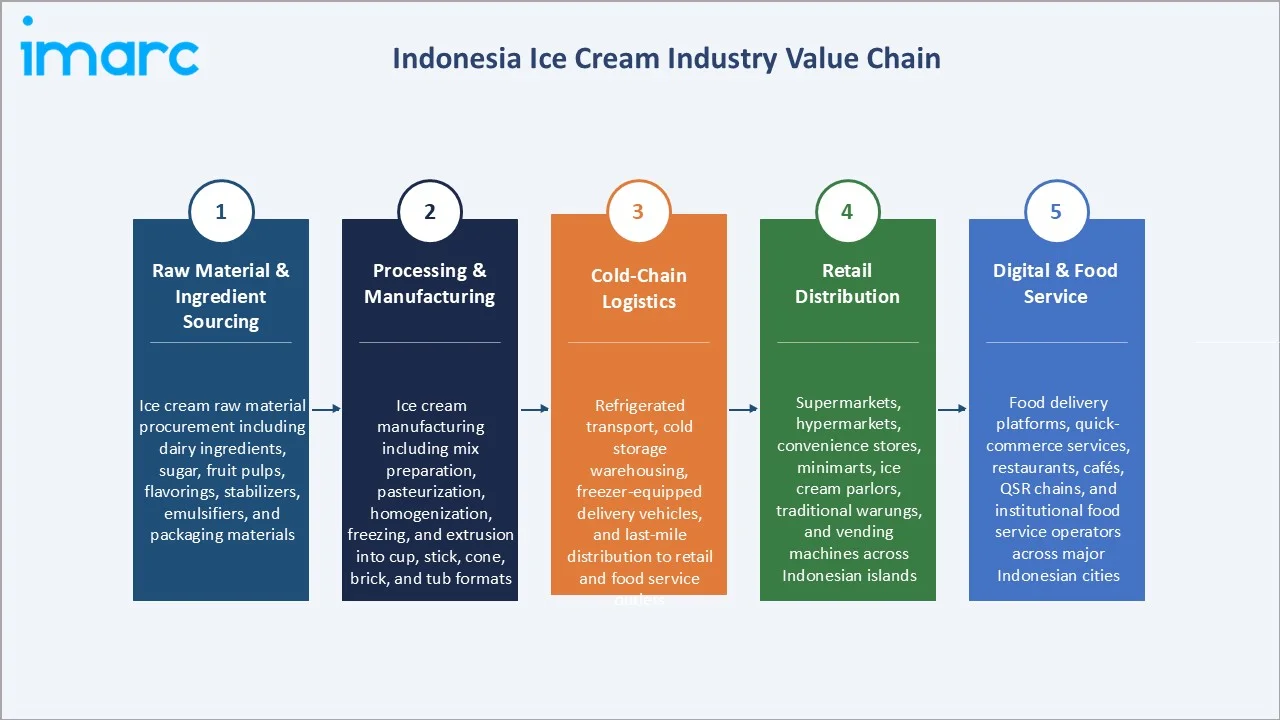
The Indonesia ice cream value chain integrates raw material sourcing, processing and manufacturing, cold-chain logistics, retail distribution, and digital and food service channels. The commercial architecture is progressively evolving toward multi-channel distribution as digital platforms supplement physical retail across Indonesia's major urban centers.
|
Stage |
Key Participants |
|
Raw Material & Ingredient Sourcing |
Ice cream raw material procurement including dairy ingredients, sugar, fruit pulps, flavorings, stabilizers, emulsifiers, and packaging materials |
|
Processing & Manufacturing |
Ice cream manufacturing including mix preparation, pasteurization, homogenization, freezing, and extrusion into cup, stick, cone, brick, and tub formats |
|
Cold-Chain Logistics |
Refrigerated transport, cold storage warehousing, freezer-equipped delivery vehicles, and last-mile distribution to retail and food service outlets |
|
Retail Distribution |
Supermarkets, hypermarkets, convenience stores, minimarts, ice cream parlors, traditional warungs, and vending machines across Indonesian islands |
|
Digital & Food Service |
Food delivery platforms, quick-commerce services, restaurants, cafés, QSR chains, and institutional food service operators across major Indonesian cities |
The manufacturing tier is most commercially significant, with leading players investing in capacity expansion. Cold-chain logistics represents both the key structural bottleneck limiting penetration beyond Java and the most critical long-term investment opportunity enabling expansion across Indonesia's outer islands.
Technology Landscape in the Indonesia Ice Cream Industry
Continuous Freezer and Extrusion Technology
Modern continuous freezer and extrusion systems improve production efficiency and output consistency for large-scale manufacturing. Advanced extrusion technologies enable complex multi-component formats including coated stick bars, layered cups, and novelty shapes that command premium pricing and differentiate brand portfolios in competitive retail environments.
Smart Freezer and IoT-Enabled Distribution Technology
AI-enabled smart freezers with computer vision and real-time inventory connectivity are transforming point-of-sale management across Indonesia's convenience store and minimart network. These systems enable automated replenishment, sales analytics, and SKU optimization at outlet level, creating measurable improvements in product availability and revenue per freezer door that are driving industry-wide adoption.
Plant-Based and Non-Dairy Formulation Technology
New emulsification and texturization technologies enable plant-based formulations using coconut milk, oat milk, and legume proteins that replicate conventional dairy ice cream texture and mouthfeel. These innovations expand the addressable consumer segment for premium non-dairy products while meeting Indonesia's halal certification requirements across formulation and production process dimensions.
Market Segmentation Analysis
The report covers the following segments:
|
Segment Category |
Leading Segment |
Market Share |
Year |
|
Flavor |
Chocolate |
28.6% |
2025 |
|
Category |
🔒 |
🔒 |
2025 |
|
Product |
Cup |
28.4% |
2025 |
|
Distribution Channel |
🔒 |
🔒 |
2025 |
|
Region |
Java |
57.6% |
2025 |

By Flavor
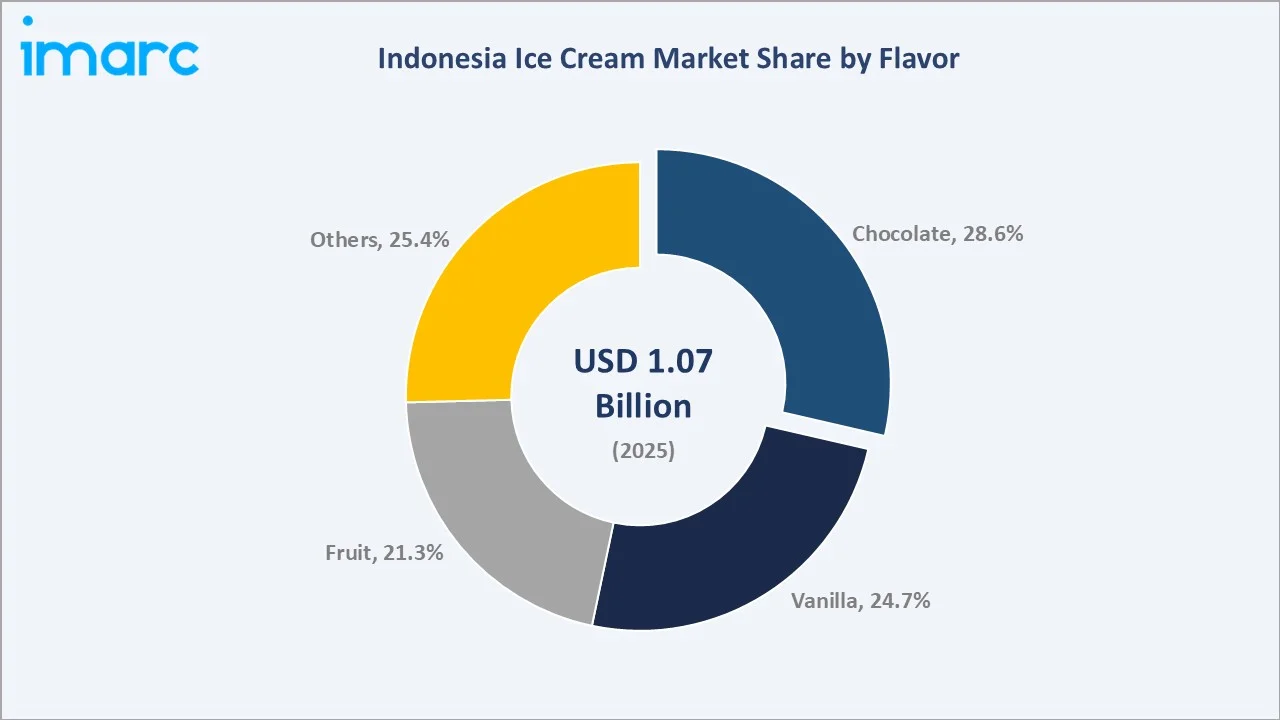
Chocolate leads at 28.6% in 2025, capturing the broadest consumer preference across all age groups and purchase occasions. The flavor's versatility across impulse cups, premium stick bars, and take-home tubs sustains its dominant market position across both mass-market and premium segments.
To access detailed market analysis, Request Sample
Vanilla at 24.7% remains a strong performer as the foundational flavor preferred across premium artisanal and mainstream segments. Fruit at 21.3% benefits from Indonesia's tropical fruit culture and health-conscious positioning among younger consumers. Others at 25.4% captures locally-inspired flavors including pandan, durian, and palm sugar gaining rapid traction.
By Product
Cup leads at 28.4% in 2025, reflecting Indonesia's preference for affordable, single-serve, easily distributable formats suited to all retail channels from modern supermarkets to traditional warungs. Cup's dominance reflects impulse purchase behavior driven by Indonesia's warm tropical climate.
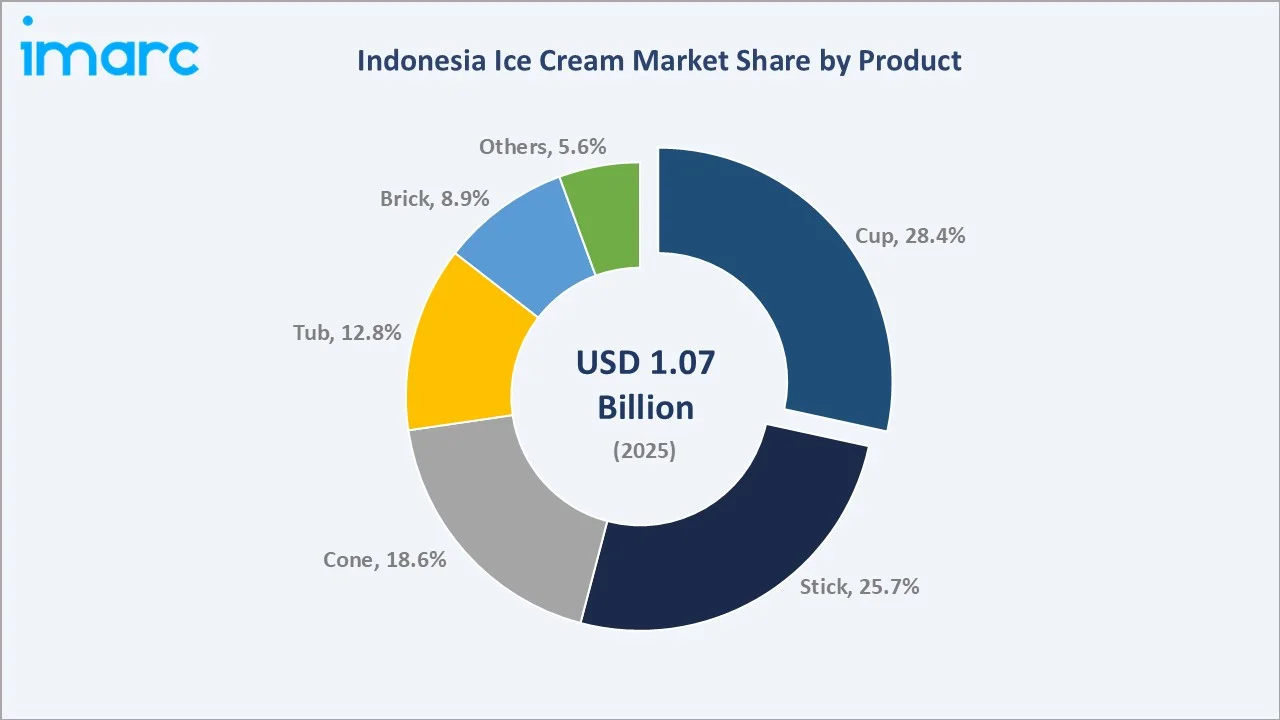
Stick at 25.7% captures on-the-go impulse consumption through coated bar formats popular among school-age and young adult consumers. Cone at 18.6% is established in food service and ice cream parlor channels. Tub at 12.8% and Brick at 8.9% serve the growing take-home segment, while Others at 5.6% includes specialty formats.
Regional Market Insights
|
Region |
Share (2025) |
Key Ice Cream Market Drivers & Characteristics |
|
Java |
57.6% |
Largest population concentration with highest modern retail density; strong impulse consumption driven by urban youth demographics and extensive minimart and convenience store networks |
|
Sumatra |
19.8% |
Second-largest regional market with growing urbanization in Medan, Palembang, and Pekanbaru; improving cold-chain infrastructure enabling organized brand penetration |
|
Kalimantan |
9.3% |
Emerging market with growing urban centers benefiting from IKN capital relocation investment; infrastructure development supporting cold-chain expansion |
|
Sulawesi |
7.8% |
Driven by Makassar urban growth; food service channel gaining prominence; modern retail penetration accelerating in provincial capital cities |
|
Others |
5.5% |
Early-stage markets in Papua, Maluku, and Nusa Tenggara; cold-chain constraints limit organized brand penetration; traditional formats dominant |
Java at 57.6% leads through its dense urban population and high minimart saturation. Sumatra at 19.8% represents the highest-growth regional frontier as cold-chain improvements enable organized market penetration.
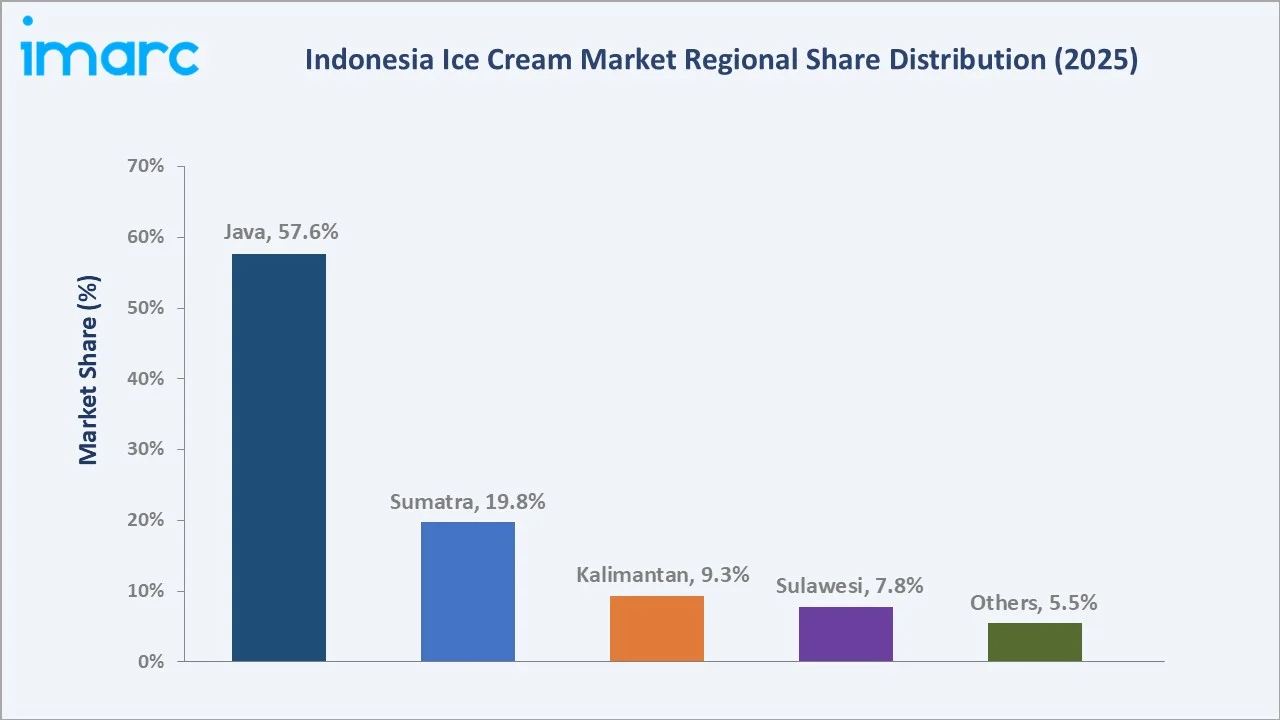
Kalimantan and Sulawesi are early-stage but rapidly developing markets supported by ongoing infrastructure investment.
Competitive Landscape
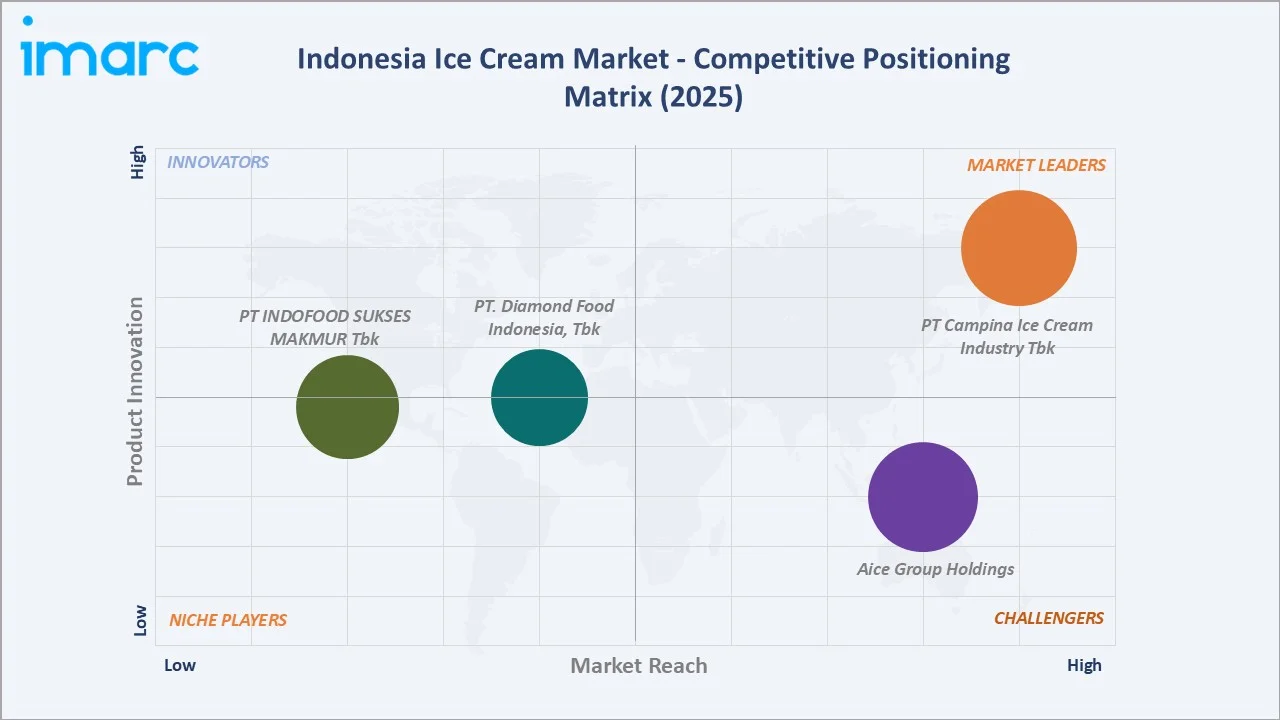
The Indonesia ice cream market is moderately concentrated, with global multinationals, regional Asian players, and domestic Indonesian manufacturers competing across different price, channel, and positioning segments. Three competitive tiers exist: global brand leaders, aggressive value challengers, and domestic specialty players.
|
Company Name |
Key Products |
Market Position |
Core Strength |
|
PT Campina Ice Cream Industry Tbk |
Olympia Chocolate & Vanilla, Spongebob Cup, Happy Cow Cup, Concerto Choco Passion, Tropicana Choco Vanilla, Hula Hula Durian Cup, Petit Chocomix Stick |
Market Leader |
Leading domestic producer with five-decade heritage and strong traditional and modern trade penetration across all Indonesian islands |
|
Aice Group Holdings |
Mooochii, Stick, Cone, Family Pack, 8 Litre, Cup |
Strong Challenger |
Fastest-growing brand through aggressive low-price strategy and high-volume convenience store and street vendor distribution disrupting incumbent pricing |
|
PT. Diamond Food Indonesia, Tbk |
Diamond Ice Cream |
Established Player |
Premium domestic brand leveraging cold-chain distribution expertise and strong Java modern retail channel relationships for premium positioning |
|
PT INDOFOOD SUKSES MAKMUR Tbk |
Jreng-Jreng Ceria Blueberry, Jreng-Jreng Ceria Grape, Kul Kul Volcano, MAX, INDOESKRIM CLASSIC |
Established Player |
Backed by nationwide distribution infrastructure, brand actively distributed across all Indonesian islands |
Key players include PT Campina Ice Cream Industry Tbk, Aice Group Holdings, PT. Diamond Food Indonesia, Tbk, PT INDOFOOD SUKSES MAKMUR Tbk, and others.
Key Company Profiles
PT Campina Ice Cream Industry Tbk
PT Campina Ice Cream Industry Tbk is an Indonesian publicly listed ice cream manufacturer headquartered in Surabaya, East Java. Campina is one of Indonesia's most trusted domestic ice cream brands with a history spanning over five decades, serving consumers through a nationwide distribution network spanning modern and traditional trade channels across all Indonesian islands.
- Key Products: Olympia Chocolate & Vanilla, Spongebob Cup, Happy Cow Cup, Concerto Choco Passion, Tropicana Choco Vanilla, Hula Hula Durian Cup, Petit Chocomix Stick
- Strategic Focus: Campina is focused on maintaining nationwide distribution across both modern and traditional trade channels, expanding its affordable impulse SKU portfolio to defend mass-market share, and investing in local Indonesian flavor innovation to drive product differentiation. The company is strengthening its Gelato premium sub-brand for urban food service growth and exploring digital channel partnerships with food delivery aggregators to expand impulse purchase occasions beyond traditional retail proximity in Indonesian metropolitan areas.
Aice Group Holdings
Aice Group Holdings is a Singapore-headquartered ice cream company with significant manufacturing presence in Indonesia. Aice has disrupted the Indonesian ice cream market through aggressive low-price positioning and rapid convenience store and street vendor distribution expansion, rapidly capturing market share across all Indonesian regions since its market entry.
- Key Products: Mooochii, Stick, Cone, Family Pack, 8 Litre, Cup
- Strategic Focus: Aice is focused on sustained volume-driven low-price strategy, expanding its convenience store and street vendor channel coverage across all Indonesian islands, and developing local Indonesian flavor adaptations to strengthen cultural relevance. The company is investing in production capacity expansion to support continued market share growth and exploring premiumization opportunities in selected urban markets to expand its addressable consumer base beyond the core value segment while maintaining volume leadership.
Market Concentration Analysis
The Indonesia ice cream market is moderately concentrated. Key players collectively account for approximately 45-55% of organized market revenue, while domestic players have captured an estimated 15-20% share through price competition. Market concentration is declining as companies’ growth reshapes competitive dynamics and artisanal entrants capture revenue in the urban premium segment.
Investment & Growth Opportunities
Highest Growth Segments
Premium artisanal formats (~8-10% CAGR), plant-based and dairy-free variants (~12-15% CAGR), digital quick-commerce delivery channel (~15-20% CAGR), Sumatra regional market expansion (~6-7% CAGR), and tub take-home premiumization (~6% CAGR) represent the highest-growth investment vectors through 2034.
Emerging Investment Opportunities
Cold-chain infrastructure investment in Kalimantan and Sulawesi represents a significant market access expansion opportunity as IKN capital relocation drives urbanization and income growth. Players establishing refrigerated logistics networks ahead of competitors can secure first-mover distribution advantages as modern retail penetration expands beyond current coverage areas.
Investment Themes
- Digital quick-commerce infrastructure investment: Building cold-chain delivery capability and digital channel SKU architecture enables brands to capture impulse purchasing through smartphones, creating a new revenue stream with 15-20% CAGR potential beyond traditional retail channels across Indonesian metropolitan areas.
- Halal premium artisanal positioning: Indonesia's Muslim-majority population presents a premium growth opportunity for brands combining halal certification with artisanal formats, capturing the aspiration-quality intersection underserved by mass-market players and international brands with limited local relevance.
Future Market Outlook (2026-2034)
The Indonesia ice cream market is projected to grow from USD 1.07 Billion in 2025 to USD 1.12 Billion in 2026 and is forecast to reach USD 1.68 Billion by 2034 at a 5.12% CAGR. The mid-period anchor of USD 1.37 Billion in 2030 represents the market at its premiumization inflection point, where artisanal formats will have established mainstream consumer awareness and digital channel penetration will be contributing meaningfully to total category volume.
Three structural forces define growth through 2034: Indonesia's demographic dividend sustaining volume demand; cold-chain infrastructure expansion enabling penetration into Sumatra, Kalimantan, and Sulawesi; and rising middle-class aspirations driving premiumization toward artisanal and plant-based formats delivering higher average selling prices and improved margins.
Research Methodology
Primary Research
Primary research comprised structured interviews with 45+ industry stakeholders (2025) including ice cream brand managers, cold-chain logistics specialists, modern trade category managers, food service operators, artisanal ice cream entrepreneurs, and convenience store operators across Java, Sumatra, and Kalimantan.
Secondary Research
Secondary research encompassed company annual reports (Unilever Indonesia, PT Campina); BPS consumption and population data; Ministry of Industry statistics; Indonesian Food and Beverage Association (GAPMMI) reports; Nielsen Indonesia retail audit data; and IMARC proprietary ice cream market database. Over 55 secondary sources were reviewed.
Forecasting Models
Market forecasts used a consumption-based bottom-up model: (i) per-capita ice cream expenditure by urban/rural classification and income tier; (ii) population and income projections by region; (iii) product format and flavor mix by channel; (iv) adjustments for cold-chain penetration trajectory, digital channel contribution, and premiumization assumptions across the 2026-2034 horizon.
Indonesia Ice Cream Market Report Coverage:
| Report Features | Details |
|---|---|
| Base Year of the Analysis | 2025 |
| Historical Period | 2020-2025 |
| Forecast Period | 2026-2034 |
| Units | Billion USD |
| Scope of the Report |
Exploration of Historical and Forecast Trends, Industry Catalysts and Challenges, Segment-Wise Historical and Predictive Market Assessment:
|
| Flavors Covered | Vanilla, Chocolate, Fruit, Others |
| Categories Covered | Impulse Ice Cream, Take-Home Ice Cream, Artisanal Ice Cream |
| Products Covered | Cup, Stick, Cone, Brick, Tub, Others |
| Distribution Channels Covered | Supermarkets and Hypermarkets, Convenience Stores, Ice Cream Parlors, Online Stores, Others |
| Regions Covered | Java, Sumatra, Kalimantan, Sulawesi, Others |
| Companies Covered | PT Campina Ice Cream Industry Tbk, Aice Group Holdings, PT. Diamond Food Indonesia, Tbk, PT INDOFOOD SUKSES MAKMUR Tbk, etc. |
| Customization Scope | 10% Free Customization |
| Post-Sale Analyst Support | 10-12 Weeks |
| Delivery Format | PDF and Excel through Email (We can also provide the editable version of the report in PPT/Word format on special request) |
Key Benefits for Stakeholders:
- IMARC’s industry report offers a comprehensive quantitative analysis of various market segments, historical and current market trends, market forecasts, and dynamics of the Indonesia ice cream market from 2020-2034.
- The research report provides the latest information on the market drivers, challenges, and opportunities in the Indonesia ice cream market.
- Porter's five forces analysis assist stakeholders in assessing the impact of new entrants, competitive rivalry, supplier power, buyer power, and the threat of substitution. It helps stakeholders to analyze the level of competition within the Indonesia ice cream industry and its attractiveness.
- Competitive landscape allows stakeholders to understand their competitive environment and provides an insight into the current positions of key players in the market.
Frequently Asked Questions About the Indonesia Ice Cream Market Report
The Indonesia ice cream market size is estimated at USD 1.12 Billion in 2026, driven by Chocolate leading flavor at 28.6%, Cup leading product at 28.4%, Java commanding 57.6% regional share, Indonesia's tropical climate supporting year-round consumption, and expanding convenience store and digital delivery channel penetration driving sustained impulse purchase volume.
The market grows at 5.12% CAGR during 2026-2034, reaching USD 1.68 Billion by 2034. This growth reflects urbanization-driven consumer base expansion, rising disposable incomes enabling premiumization, cold-chain infrastructure improvement enabling geographic market penetration, and digital channel growth creating new impulse purchase occasions.
Chocolate leads at 28.6%, driven by its broadest demographic appeal across all age groups and versatility across impulse and take-home product formats. The segment benefits from consistent new product launches from leading brands and strong consumer recognition built through decades of mass-market brand investment.
Cup leads at 28.4% through affordability, portability, and suitability for Indonesia's warm tropical climate and high impulse purchase frequency. Mass-market players have expanded cup SKU portfolios specifically targeting convenience store and minimart channels where impulse purchase occasions are highest frequency across Java and Sumatra.
Java leads at 57.6% through its concentration of over 60% of Indonesia's total population, the highest modern retail outlet density in the country, and the most developed cold-chain logistics network enabling consistent product availability across urban and peri-urban consumer markets throughout the island.
Leading companies include PT Campina Ice Cream Industry Tbk, Aice Group Holdings, PT. Diamond Food Indonesia, Tbk, PT INDOFOOD SUKSES MAKMUR Tbk, and others.
Three priority investment opportunities: cold-chain infrastructure development in Kalimantan and Sulawesi enabling geographic expansion, premium artisanal and plant-based segment development targeting Indonesia's growing urban middle class, and digital quick-commerce channel integration creating new impulse purchase occasions beyond traditional retail proximity across Indonesian metropolitan areas.
Need more help?
- Speak to our experienced analysts for insights on the current market scenarios.
- Include additional segments and countries to customize the report as per your requirement.
- Gain an unparalleled competitive advantage in your domain by understanding how to utilize the report and positively impacting your operations and revenue.
- For further assistance, please connect with our analysts.
 Request Customization
 Speak to an Analyst
 Request Brochure
 Inquire Before Buying
Benefits of Customization
- Personalize this research
- Triangulate with your data
- Get data as per your format and definition
- Gain a deeper dive into a specific application, geography, customer, or competitor
- Any level of personalization
Get in Touch With Us
UNITED STATES
Phone: +1-201-971-6302
INDIA
Phone: +91-120-433-0800
UNITED KINGDOM
Phone: +44-753-714-6104
Email: [email protected]
Client Testimonials




.webp)




.webp)













Related Reports

Choose your plan
*Please note that the prices mentioned below are starting prices for each bundle type. Kindly contact our team for further details.*
Single User License
- 1 User License, Access on 2 Devices
- PDF Report + Excel Dataset (Password Protected)
- Lifetime Access
- No Printing Rights
- 10% Free Report Customization
- 10–12 Weeks of Analyst Support
Five User License
- Access for 5 Users, 2 Devices per User
- PDF Report + Excel Dataset (Password Protected)
- Lifetime Access
- Dedicated Account Manager
- 12–14 Weeks of Analyst Support
- No Printing Rights
- 15% Free Report Customization
- 25% Discount on Your Next Purchase
Corporate User License
- Unlimited User Access (Within Your Organization)
- PDF Report + Excel Dataset
- Lifetime Access
- Dedicated Account Manager
- 14–20 Weeks of Analyst Support
- No Printing Rights
- 20% Free Report Customization
- 30% Discount on Your Next Purchase
Essential Insights
What's included:
3 reports
- Lifetime Access
- PDF Reports
- Excel Datasets
- 2 Weeks of Free Analyst Support
- 2 User Licenses
- Access on 2 Devices
- Printing Rights
- Complimentary PowerPoint (PPT) Version
- Complimentary License Upgrade
Professional Access
What's included:
5 reports
- Lifetime Access
- PDF Reports
- Excel Datasets
- 8 Weeks of Free Analyst Support
- 2 User Licenses
- Access on 2 Devices
- Printing Rights
- Complimentary PowerPoint (PPT) Version
- Complimentary License Upgrade
Business Advantage
What's included:
8 reports
- Lifetime Access
- PDF Reports
- Excel Datasets
- 14 Weeks of Free Analyst Support
- 2 User Licenses
- Access on 2 Devices
- Printing Rights
- Complimentary PowerPoint (PPT) Version
- Complimentary License Upgrade
Enterprise Intelligence
What's included:
10 reports
- Lifetime Access
- PDF Reports
- Excel Datasets
- 20 Weeks of Free Analyst Support
- 2 User Licenses
- Access on 2 Devices
- Printing Rights
- Complimentary PowerPoint (PPT) Version
- Complimentary License Upgrade