
Indonesia QR Code Payment Market Size, Share, Trends and Forecast by Solution, Payment Type, Transaction Channel, End User, and Region, 2026-2034
Indonesia QR Code Payment Market Summary:
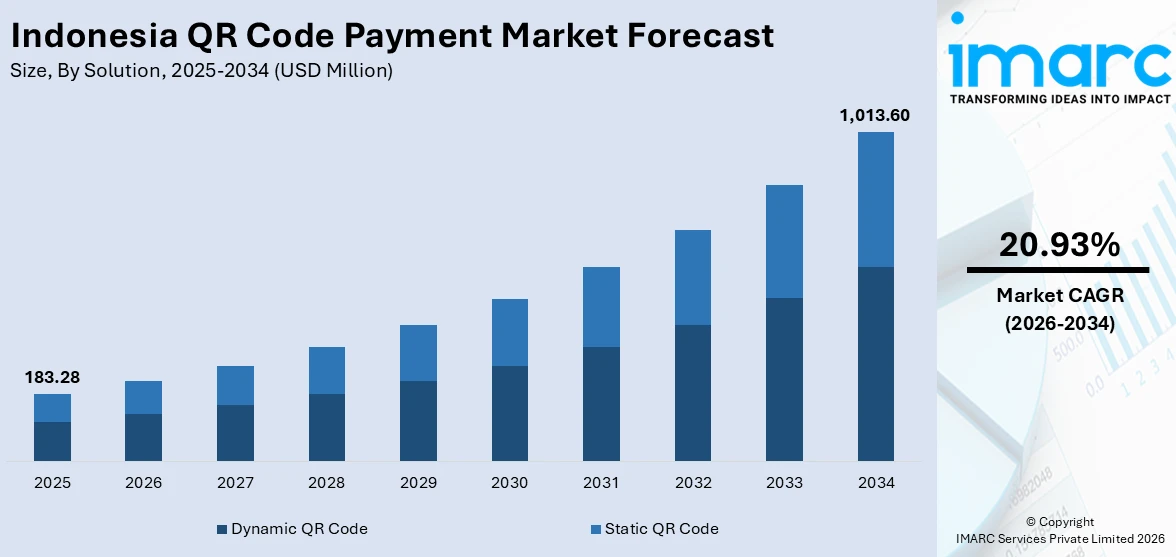
The Indonesia QR code payment market size was valued at USD 183.28 Million in 2025 and is projected to reach USD 1,013.60 Million by 2034, growing at a compound annual growth rate of 20.93% from 2026-2034.
The Indonesia QR code payment market is expanding at a fast rate due to the country’s transition to a cashless economy. The government’s initiative for the standardization of the digital payment infrastructure, the rising use of smartphones, and the implementation of interoperable QR code payment solutions by merchants are adding to the growth of the market. The rising need for contactless payments, financial inclusion initiatives, and the implementation of QR code payments in the retail, transportation, and public sectors are revolutionizing the payment industry. The rising e-commerce market, along with the young and technology-savvy population, is encouraging the adoption of QR code payments, thus fueling the Indonesia QR code payment market share.
Key Takeaways and Insights:
-
By Solution: Dynamic QR code dominate the market with a share of 59.3% in 2025, driven by its ability to generate unique transaction-specific codes that enhance payment security and enable real-time tracking for merchants.
-
By Payment Type: Push payment lead the market with a share of 63.1% in 2025, owing to its consumer-initiated payment model that offers greater control, convenience, and widespread integration with mobile banking and e-wallet applications.
-
By Transaction Channel: Face-to-face dominate the market with a share of 67.8% in 2025, driven by the extensive deployment of QR code infrastructure at physical retail points, traditional markets, and small merchant establishments.
-
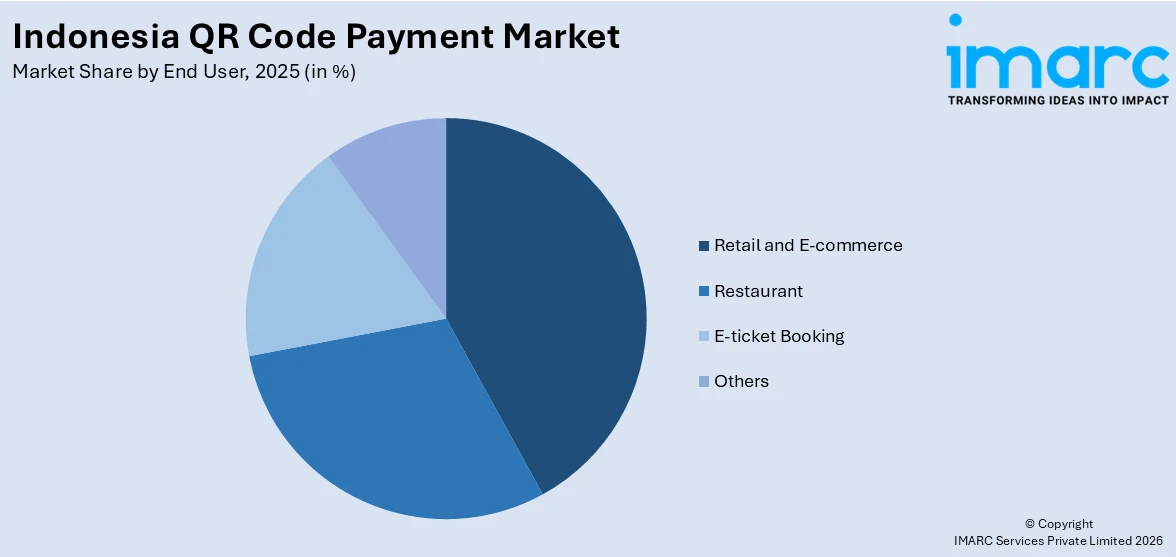
By End User: Retail and e-commerce held the largest share of 41.6% in 2025, driven by the rapid digitalization of shopping experiences and growing consumer demand for seamless digital checkout payment solutions.
-
By Region: Java dominate the market with a share of 62.4% in 2025, driven by the concentration of economic activity, dense urban population centers, advanced digital infrastructure, and the highest merchant acceptance density.
-
Key Players: The Indonesia QR code payment market exhibits a highly competitive landscape, with domestic digital payment platforms, traditional banking institutions, and fintech companies competing to expand merchant networks, enhance user experience, and drive transaction volumes across diverse consumer segments.
To get more information on this market Request Sample
The Indonesia QR code payment market is emerging as the government, banking industry, and technology firms are collaborating to create a digital payment solution that is inclusive and efficient. The standardization of the QR code payment solution in the country has ensured that the fragmented mobile payment services are now interoperable between banks and digital wallets. In August 2025, Bank Indonesia officially launched the QRIS cross-border payment system in Japan, enabling Indonesian users to make payments at Japanese merchants by scanning QR codes using domestic mobile banking and digital wallet applications, marking a major step in expanding interoperability and international acceptance of Indonesia’s QR payment ecosystem. The standardization of the QR code payment solution has also assisted micro, small, and medium-scale businesses to access digital payment solutions without having to invest in expensive point-of-sale devices. The creation of contactless payment solutions is also enhancing the speed of transactions in the retail and service industries. The growing internationalization of the QR payment connectivity solutions is also enhancing the Indonesia QR code payment market.
Indonesia QR code payment Market Trends:
Cross-Border QR Payment Expansion
The Indonesia QR code payment market is experiencing significant growth through international payment connectivity initiatives. The expansion of QR-based payment interoperability with neighboring countries is enabling seamless cross-border transactions for travelers and businesses. In November 2023, Bank Indonesia and Monetary Authority of Singapore officially launched a cross-border QR payment linkage that allows customers to make retail payments in both countries by scanning QRIS or NETS QR codes using their existing mobile banking applications, supporting tourism, cross-border commerce, and regional payment integration. Bilateral payment linkages with multiple regional partners allow consumers to transact using domestic payment applications abroad without currency exchange requirements, fostering greater financial integration and supporting tourism-related commerce across the Asia-Pacific region, contributing to the Indonesia QR code payment market growth.
Integration of NFC Technology with QR Payment Systems
The convergence of near-field communication technology with existing QR code payment infrastructure is emerging as a transformative trend. This hybrid approach enables consumers to choose between scanning QR codes and tapping their smartphones for contactless payments, significantly reducing transaction processing times. In March 2025, Bank Indonesia officially launched QRIS Tap, an NFC-based payment feature that allows users to complete transactions by simply tapping their smartphones at payment terminals, with implementation across public transportation, retail outlets, hospitals, and parking facilities to enhance transaction speed and convenience. The deployment of NFC-enabled payment terminals across public transportation networks, retail outlets, and healthcare facilities is broadening the use cases for QR-linked digital payments and improving the overall user experience.
Accelerating Digital Payment Adoption Among Micro and Small Enterprises
The widespread onboarding of micro, small, and medium enterprises onto standardized QR payment platforms is reshaping the digital commerce landscape. The low-cost entry requirements for merchant participation, eliminating the need for expensive electronic data capture devices, are enabling millions of small vendors, street hawkers, and traditional market operators to accept digital payments. In December 2023, Bank Indonesia reported that 29.63 million merchants had adopted the QRIS platform, with approximately 92% consisting of micro, small, and medium enterprises, highlighting the system’s strong penetration among small-scale businesses and its role in accelerating financial inclusion. This mass merchant digitalization is driving financial inclusion and creating a more formalized transaction environment across the informal economy.
Market Outlook 2026-2034:
The Indonesia QR code payment market is poised for sustained expansion over the forecast period, supported by deepening digital infrastructure, growing consumer trust in cashless payment methods, and continued government commitment to financial inclusion. The ongoing evolution of payment technologies, including the integration of contactless features and expansion into new verticals such as public services and transportation, will broaden the addressable market. Increasing cross-border payment interoperability and rising e-commerce penetration are expected to further accelerate adoption. The market generated a revenue of USD 183.28 Million in 2025 and is projected to reach a revenue of USD 1,013.60 Million by 2034, growing at a compound annual growth rate of 20.93% from 2026-2034.
Indonesia QR Code Payment Market Report Segmentation:
|
Segment Category |
Leading Segment |
Market Share |
|
Solution |
Dynamic QR Code |
59.3% |
|
Payment Type |
Push Payment |
63.1% |
|
Transaction Channel |
Face-to-Face |
67.8% |
|
End User |
Retail and E-commerce |
41.6% |
|
Region |
Java |
62.4% |
Solution Insights:
- Static QR Code
- Dynamic QR Code
The dynamic QR code dominates with a market share of 59.3% of the total Indonesia QR code payment market in 2025.
Dynamic QR codes are at the forefront of the Indonesia QR code payment industry because they provide unique codes for every transaction, ensuring greater security and protection against fraud than static QR code alternatives. Dynamic QR codes’ capacity to include transaction details such as payment amounts and merchant information makes payment processing faster and less prone to human error. The increasing use of dynamic QR code technology by organized retail businesses, e-commerce sites, and transportation services is further solidifying their position in the market because businesses are increasingly looking for payment solutions that are secure, traceable, and automated.
The preference for dynamic QR codes is also supported by their compatibility with sophisticated payment functionalities such as real-time settlement, automated reconciliation, and loyalty program integration. Financial institutions and payment service providers are using dynamic QR code technology to facilitate both offline and online transactions, allowing merchants to create payment-specific QR codes using mobile applications and point-of-sale terminals. This is particularly important for the rapidly growing digital commerce industry in Indonesia, where there is a growing need for flexible, secure, and scalable payment infrastructure.
Payment Type Insights:
- Push Payment
- Pull Payment
The push payment leads with a share of 63.1% of the total Indonesia QR code payment market in 2025.
Push payments are currently leading the Indonesia QR code payment market because consumers like the control and transparency that come with making payments themselves. In a push payment system, consumers use their mobile banking or digital wallet application to scan a merchant's QR code and approve the amount of the payment they want to make. This consumer-friendly method is in line with the digital payment culture in Indonesia, where trust and transparency are of utmost importance. The widespread acceptance of push payments in traditional markets, street vendors, and modern retail settings further cements the segment's leading market position.
The leading market position of push payments is also a result of their ease of integration with merchants, who simply need to display a printed or digital QR code without having to invest in any specialized hardware. This ease of integration has been critical in encouraging mass adoption among merchants, especially micro and small businesses that are the backbone of the Indonesian commercial landscape. The inclusion of push payment functionality in popular digital wallets and mobile banking platforms has ensured that the transaction experience is seamless, further solidifying the position of this payment method as the preferred choice for making payments.
Transaction Channel Insights:
- Face-to-Face
- Remote
The face-to-face dominates with a market share of 67.8% of the total Indonesia QR code payment market in 2025.
The face-to-face payment method is commanding the largest market share in the Indonesia QR code payment market, which is a reflection of the retail environment in the country, where physical point-of-sale interactions are the dominant mode of conducting business. The widespread use of QR codes in physical retail outlets, traditional wet markets, food stalls, and transportation hubs ensures that consumers are exposed to the use of QR code payments in their day-to-day activities. The shift from cash-based face-to-face payments to digital payments using QR codes has been facilitated by the ease of scanning printed QR codes at the point of sale without the need for any additional hardware.
The leadership of the face-to-face payment method is further supported by the increasing adoption of QR code payments in public services such as transportation ticketing systems, parking stations, and government service counters. The installation of contactless payment terminals using QR and NFC technology at mass transit stations is increasing the adoption of QR code payments beyond the retail environment. As urban and semi-urban areas continue to adopt cashless payments for their day-to-day transactions, the face-to-face payment method is also expected to retain its leading market position.
End User Insights:
Access the comprehensive market breakdown Request Sample
- Restaurant
- Retail and E-commerce
- E-ticket Booking
- Others
The retail and e-commerce leads with a share of 41.6% of the total Indonesia QR code payment market in 2025.
The retail and e-commerce industry is currently driving the Indonesia QR code payment market, thanks to the increasing digitalization of the retail sector and the blurring lines between the offline and online retail sectors. The offline retail sector, including modern trade, convenience stores, and traditional retail stores, is increasingly adopting QR code payment solutions to provide consumers with faster and more convenient ways of completing transactions. At the same time, the e-commerce industry is incorporating QR code payment solutions to enable seamless online transactions, thus closing the gap between online browsing and the instant completion of online transactions for the increasing number of online shoppers in Indonesia.
The dominance of the retail and e-commerce segment is further fueled by the growing adoption of omnichannel retailing strategies, where merchants accept QR code payments across both physical storefronts and digital platforms. The increasing penetration of mobile commerce, driven by Indonesia's young and technology-savvy population, is creating sustained demand for QR-enabled payment solutions across diverse retail categories including apparel, electronics, groceries, and personal care. As retailers seek to reduce cash handling costs and improve transaction efficiency, QR code payments are becoming essential.
Regional Insights:
- Java
- Sumatra
- Kalimantan
- Sulawesi
- Others
Java exhibits a clear dominance with a 62.4% share of the total Indonesia QR code payment market in 2025.
Java is the most prominent regional market for QR code payments in Indonesia, thanks to the economic hub that the island represents, with the major metropolitan areas being Jakarta, Surabaya, Bandung, and Semarang. Java has the best digital infrastructure and a high penetration rate of smartphones, along with a large number of merchants, retail, and service outlets, making it an extremely favorable environment for QR code payments to thrive.
The dominance of the region is also due to the early adoption of QR code-enabled public transportation systems, such as mass rapid transit, commuter trains, and bus rapid transit systems in the Greater Jakarta area. The large number of consumers in Java, which represents a substantial portion of the total population of Indonesia, ensures a constant flow of transactions. Java is also home to the headquarters of major financial institutions and digital wallet companies, which place a high priority on Java-based merchant acquisition and consumer engagement initiatives.

Market Dynamics:
Growth Drivers:
Why is the Indonesia QR Code Payment Market Growing?
Government-Led Standardization and Regulatory Support for Digital Payments
The Indonesian government, through its central bank, has been instrumental in promoting the use of QR code payments by implementing a national standard that unifies all QR code payment services in the country. This standard requires all banks, digital wallets, and payment service providers to be interoperable, thus ending the fragmentation that existed in the digital payment industry. According to reports, Bank Indonesia officially launched the Quick Response Code Indonesian Standard (QRIS), with mandatory nationwide implementation effective January 1, 2020, requiring all payment service providers to adopt the unified QR code standard to ensure interoperability and improve payment system efficiency. The government has made it easy for both merchants and consumers to join the digital payment industry by implementing standardized merchant discount rates. The government’s commitment to the digital payment industry goes further than just promoting the use of QR code payments. The government is committed to developing the infrastructure of digital payments in underserved regions, thus promoting financial inclusion for people who previously conducted transactions using cash.
Rapid Smartphone Penetration and Mobile-First Consumer Behavior
The Indonesian government, through its central bank, has been instrumental in promoting the use of QR code payments by implementing a national standard that unifies all QR code payment services in the country. This standard requires all banks, digital wallets, and payment service providers to be interoperable, thus ending the fragmentation that existed in the digital payment industry. In October 2024, Bank Indonesia announced a 0% Merchant Discount Rate (MDR) for QRIS transactions up to Rp500.000 for micro-enterprise merchants starting December 1, 2024, to accelerate digital payment adoption and support financial inclusion among small businesses. The government has made it easy for both merchants and consumers to join the digital payment industry by implementing standardized merchant discount rates. The government’s commitment to the digital payment industry goes further than just promoting the use of QR code payments. The government is committed to developing the infrastructure of digital payments in underserved regions, thus promoting financial inclusion for people who previously conducted transactions using cash.
Expansion of Merchant Acceptance Networks Across Diverse Business Segments
The rapid increase in the number of merchants of all sizes accepting QR code payments is driving a strong network effect that is fueling the growth of the market. The low infrastructure requirements for the acceptance of QR code payments, which only need a printed code or a smartphone screen and do not require costly electronic terminals, have made it possible for millions of micro and small businesses to enter the digital payments market. The growing number of acceptance points is creating a virtuous cycle in which more consumers are encouraged to use QR code payments, which in turn encourages more merchants to accept QR code payments. The expansion of QR code payment acceptance into new areas such as public transportation, healthcare facilities, educational institutions, and government services is increasing the addressable market for QR code payments.
Market Restraints:
What Challenges the Indonesia QR Code Payment Market is Facing?
Digital Infrastructure Gaps in Rural and Remote Regions
Although there has been considerable progress in urban areas, irregular internet connectivity in rural and remote areas remains a challenge for the adoption of QR code payments. In many areas, there is a lack of mobile network coverage, making it difficult for merchants and consumers to make digital payments. The cost of smartphones and data plans is also a challenge for low-income communities, resulting in a digital divide that restricts the adoption of QR payments beyond urban areas.
Security Concerns and Fraud Risks in Digital Payment Ecosystems
Growing concerns about payment fraud, QR code tampering, and cybersecurity vulnerabilities pose significant challenges to the market. Instances of fraudulent QR codes being placed over legitimate merchant codes have raised consumer apprehension about payment safety. The lack of digital literacy among certain population segments increases susceptibility to phishing attacks and social engineering scams targeting QR payment users. These security concerns can undermine consumer confidence and slow the pace of adoption among risk-averse demographics.
Merchant Resistance and Operational Adjustment Challenges
Some merchants, particularly in the informal economy, remain resistant to adopting QR code payments due to concerns about transaction fees, tax transparency, and the perceived complexity of digital systems. Small business operators accustomed to cash-based transactions may view digital payment adoption as an additional operational burden requiring new skills and processes. The fear of revenue disclosure to taxation authorities and uncertainty about settlement procedures further discourage voluntary adoption among cash-dependent merchant segments.
Competitive Landscape:
The Indonesia QR code payment market is marked by a highly competitive environment with the presence of various players such as traditional banking players, mobile wallet operators, fintech companies, and technology giants. The players are differentiating themselves by improving their user interfaces, loyalty reward programs, merchant base, and value-added services beyond payment services. The competitive environment is driven by collaborations between financial companies and technology giants, allowing the development of comprehensive payment services by integrating QR code payments with other financial services such as savings, loans, and insurance. The players are also focusing on developing advanced technologies like artificial intelligence-powered fraud protection, biometric authentication, and real-time analytics to enhance the security of transactions and improve the customer experience. The market is also driven by aggressive customer acquisition tactics, cashback offers, and merchant acquisition programs aimed at increasing transaction volumes and fostering ecosystem loyalty among customers and business users.
Recent Developments:
-
In August 2025, Singapore-based fintech MoolahGo launched QRIS “Scan & Pay” on its moolahPAY digital wallet, becoming the first non-bank wallet in Singapore to support Indonesia’s QRIS system. The feature enables users to make seamless payments at around 40 million QRIS-enabled merchants across Indonesia, including Shopee, Tokopedia, and Lazada.
Indonesia QR Code Payment Market Report Coverage:
|
Report Features |
Details |
|
Base Year of the Analysis |
2025 |
|
Historical Period |
2020-2025 |
|
Forecast Period |
2026-2034 |
|
Units |
Million USD |
|
Scope of the Report |
Exploration of Historical Trends and Market Outlook, Industry Catalysts and Challenges, Segment-Wise Historical and Future Market Assessment:
|
|
Solutions Covered |
Static QR Code, Dynamic QR Code |
|
Payment Types Covered |
Push Payment, Pull Payment |
|
Transaction Channels Covered |
Face-to-Face, Remote |
|
End Users Covered |
Restaurant, Retail and E-commerce, E-ticket Booking, Others |
|
Regions Covered |
Java, Sumatra, Kalimantan, Sulawesi, Others |
|
Customization Scope |
10% Free Customization |
|
Post-Sale Analyst Support |
10-12 Weeks |
|
Delivery Format |
PDF and Excel through Email (We can also provide the editable version of the report in PPT/Word format on special request) |
Frequently Asked Questions About the Indonesia QR Code Payment Market Research Report and Industry Forecast Report
The Indonesia QR code payment market size was valued at USD 183.28 Million in 2025.
The Indonesia QR code payment market is expected to grow at a compound annual growth rate of 20.93% from 2026-2034 to reach USD 1,013.60 Million by 2034.
Dynamic QR code, holding the largest share of 59.3%, is leading the Indonesia QR code payment market owing to its superior transaction security, real-time code generation capabilities, and growing adoption across organized retail and e-commerce platforms.
Key factors driving the Indonesia QR code payment market include government-led payment standardization, rapid smartphone penetration, expanding merchant acceptance networks, rising financial inclusion initiatives, growing e-commerce adoption, and increasing consumer preference for cashless transactions.
Major challenges include digital infrastructure gaps in rural areas, cybersecurity and fraud concerns, merchant resistance to digital payment adoption, inconsistent internet connectivity, limited digital literacy among certain demographics, and operational adjustment difficulties for cash-dependent businesses.
Need more help?
- Speak to our experienced analysts for insights on the current market scenarios.
- Include additional segments and countries to customize the report as per your requirement.
- Gain an unparalleled competitive advantage in your domain by understanding how to utilize the report and positively impacting your operations and revenue.
- For further assistance, please connect with our analysts.
 Request Customization
 Speak to an Analyst
 Request Brochure
 Inquire Before Buying
Benefits of Customization
- Personalize this research
- Triangulate with your data
- Get data as per your format and definition
- Gain a deeper dive into a specific application, geography, customer, or competitor
- Any level of personalization
Get in Touch With Us
UNITED STATES
Phone: +1-201-971-6302
INDIA
Phone: +91-120-433-0800
UNITED KINGDOM
Phone: +44-753-714-6104
Email: [email protected]
Client Testimonials




.webp)




.webp)













Related Reports

Choose your plan
*Please note that the prices mentioned below are starting prices for each bundle type. Kindly contact our team for further details.*
Single User License
- 1 User License, Access on 2 Devices
- PDF Report + Excel Dataset (Password Protected)
- Lifetime Access
- No Printing Rights
- 10% Free Report Customization
- 10–12 Weeks of Analyst Support
Five User License
- Access for 5 Users, 2 Devices per User
- PDF Report + Excel Dataset (Password Protected)
- Lifetime Access
- Dedicated Account Manager
- 12–14 Weeks of Analyst Support
- No Printing Rights
- 15% Free Report Customization
- 25% Discount on Your Next Purchase
Corporate User License
- Unlimited User Access (Within Your Organization)
- PDF Report + Excel Dataset
- Lifetime Access
- Dedicated Account Manager
- 14–20 Weeks of Analyst Support
- No Printing Rights
- 20% Free Report Customization
- 30% Discount on Your Next Purchase
Essential Insights
What's included:
3 reports
- Lifetime Access
- PDF Reports
- Excel Datasets
- 2 Weeks of Free Analyst Support
- 2 User Licenses
- Access on 2 Devices
- Printing Rights
- Complimentary PowerPoint (PPT) Version
- Complimentary License Upgrade
Professional Access
What's included:
5 reports
- Lifetime Access
- PDF Reports
- Excel Datasets
- 8 Weeks of Free Analyst Support
- 2 User Licenses
- Access on 2 Devices
- Printing Rights
- Complimentary PowerPoint (PPT) Version
- Complimentary License Upgrade
Business Advantage
What's included:
8 reports
- Lifetime Access
- PDF Reports
- Excel Datasets
- 14 Weeks of Free Analyst Support
- 2 User Licenses
- Access on 2 Devices
- Printing Rights
- Complimentary PowerPoint (PPT) Version
- Complimentary License Upgrade
Enterprise Intelligence
What's included:
10 reports
- Lifetime Access
- PDF Reports
- Excel Datasets
- 20 Weeks of Free Analyst Support
- 2 User Licenses
- Access on 2 Devices
- Printing Rights
- Complimentary PowerPoint (PPT) Version
- Complimentary License Upgrade