
Italy Health Insurance Market Size, Share, Trends and Forecast by Provider, Type, Plan Type, Demographics, Provider Type, and Region, 2026-2034
Italy Health Insurance Market Size and Share:
The Italy health insurance market size reached USD 90.8 Billion in 2025. Looking forward, IMARC Group expects the market to reach USD 130.8 Billion by 2034, exhibiting a growth rate (CAGR) of 4.02% during 2026-2034. The Italy health insurance market share is driven by the growing aging population seeking more comprehensive and specialized health coverage, along with the increasing adoption of digital health solutions, which is enhancing healthcare delivery and accessibility.
|
Report Attribute
|
Key Statistics
|
|---|---|
|
Base Year
|
2025
|
|
Forecast Years
|
2026-2034
|
|
Historical Years
|
2020-2025
|
| Market Size in 2025 | USD 90.8 Billion |
| Market Forecast in 2034 | USD 130.8 Billion |
| Market Growth Rate (2026-2034) | 4.02% |
Access the full market insights report Request Sample
Italy Health Insurance Market Trends:
Rising Aging Population
According to the Eurostat data published in February 2025, Italy has the highest percentage of residents over the age of 65, totaling 24%. This demographic shift is driving the demand for health insurance as older adults are seeking more comprehensive and specialized healthcare services. Insurers are recognizing the significance of tailored health coverage that addresses the unique challenges faced by the elderly. The rising aging population is catalyzing the demand for products including long-term care, chronic disease management, and preventive services. Companies are responding by developing plans covering a range of services from home healthcare for rehabilitation to meet these needs, which is contributing to the Italy health insurance market growth in the country. In addition, the increasing prevalence of age-related health issues such as cardiovascular diseases and diabetes, is prompting people to purchase insurance offering assistance in these ailments. Health insurers are improving their services by incorporating wellness programs and preventive care initiatives for encouraging healthier habits among older adults. Furthermore, the focus on preserving the quality of life for elderly individuals is resulting in higher investments in mental health services and comprehensive care strategies. This is propelling insurance providers to adapt and innovate their products and meet the changing needs of people, thereby offering a favorable market outlook in Italy.
Increasing Digital Health Solutions
As per the Italy 2025 Digital Decade Country Report by the European Commission, the coverage for advanced digital infrastructures in Italy is steadily expanding, with Fiber to the Premises (FTTP) coverage at 59.6% and Fixed Very High-Capacity Networks (VHCN) at 64%. This ongoing investment is enhancing the digital health landscape, which is positively influencing the Italy health insurance market outlook. As these infrastructures are improving, healthcare providers are adopting digital health solutions such as telemedicine and electronic health records (EHRs), to streamline patient care and communication. In line with this, insurers are understanding the potential of digital tools for improving healthcare delivery and are adapting their offerings. The efficient data management and easier accessibility to medical services is enabling them to create tailored plans addressing the specific needs of people. As a result, insurers are offering customized health packages that can adapt to different life stages and health requirements, catering specifically to the needs of a diverse population. Moreover, digital health solutions are allowing patients to engage with their healthcare providers. This shift is encouraging insurance companies to include features like telehealth services, wellness programs, and personalized care options in their policies, which is increasing the appeal of health insurance. Besides this, the demand for digital services is resulting in prompting innovations in technologies that enhance patient monitoring and management of chronic conditions. The integration of wearable devices and mobile health applications into insurance plans is becoming more common, which is supporting real-time health tracking and proactive interventions. This trend is aiding patients in maintaining their health and reducing long-term costs for insurers and the healthcare system, thereby strengthening the market growth across the country.
Italy Health Insurance Market Segmentation:
IMARC Group provides an analysis of the key trends in each segment of the market, along with forecasts at the regional level for 2026-2034. Our report has categorized the market based on provider, type, plan type, demographics, and provider type.
Provider Insights:
.webp)
To get detailed segment analysis of this market Request Sample
- Private Providers
- Public Providers
The report has provided a detailed breakup and analysis of the market based on the provider. This includes private providers and public providers.
Type Insights:
- Life-Time Coverage
- Term Insurance
A detailed breakup and analysis of the market based on the type have also been provided in the report. This includes life-time coverage and term insurance.
Plan Type Insights:
- Medical Insurance
- Critical Illness Insurance
- Family Floater Health Insurance
- Others
The report has provided a detailed breakup and analysis of the market based on the plan type. This includes medical insurance, critical illness insurance, family floater health insurance, and others.
Demographics Insights:
- Minor
- Adults
- Senior Citizen
A detailed breakup and analysis of the market based on the demographics have also been provided in the report. This includes minor, adults, and senior citizen.
Provider Type Insights:
- Preferred Provider Organizations (PPOs)
- Point of Service (POS)
- Health Maintenance Organizations (HMOs)
- Exclusive Provider Organizations (EPOs)
The report has provided a detailed breakup and analysis of the market based on the provider type. This includes preferred provider organizations (PPOs), point of service (POS), health maintenance organizations (HMOs), and exclusive provider organizations (EPOs).
Regional Insights:
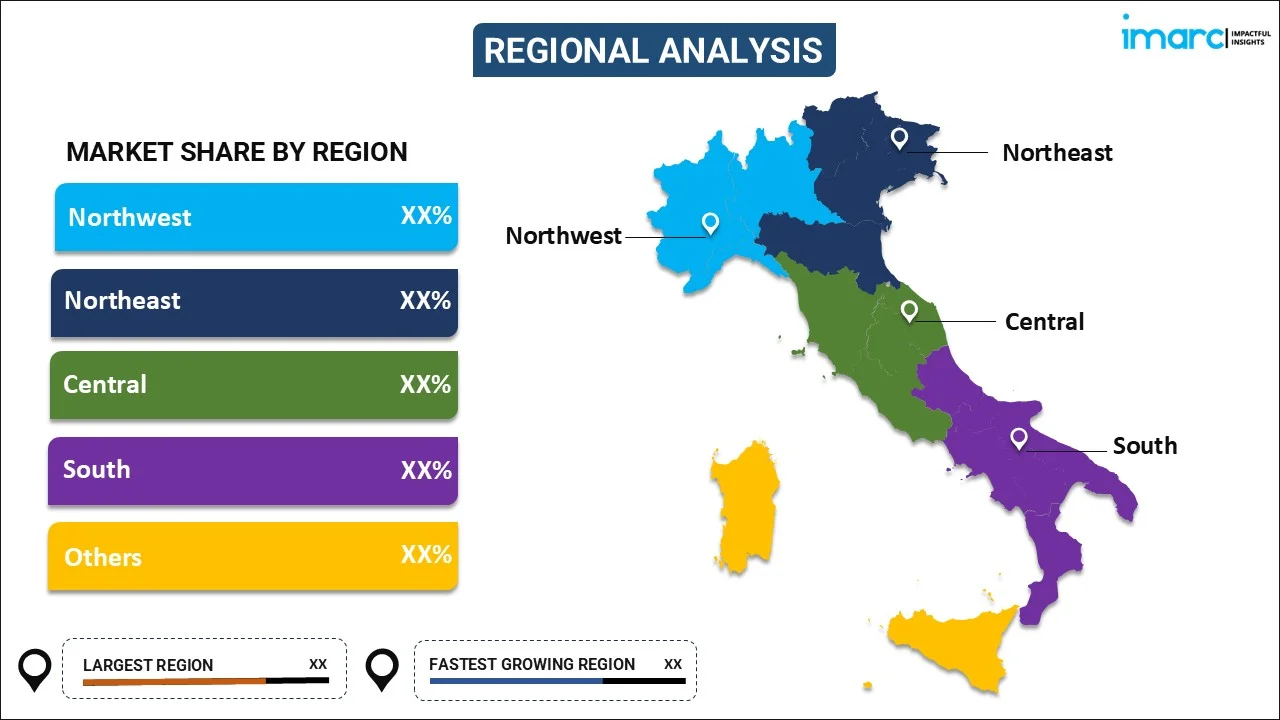
To get detailed regional analysis of this market Request Sample
- Northwest
- Northeast
- Central
- South
- Others
The report has also provided a comprehensive analysis of all the major regional markets, which include Northwest, Northeast, Central, South, and others.
Competitive Landscape:
The market research report has also provided a comprehensive analysis of the competitive landscape. Competitive analysis such as market structure, key player positioning, top winning strategies, competitive dashboard, and company evaluation quadrant has been covered in the report. Also, detailed profiles of all major companies have been provided.
Italy Health Insurance Market News:
- In September 2024, Berkshire Hathaway Specialty Insurance (BHSI) announced the opening of its new office in Milan, Italy, as part of its strategic growth across the region, focusing on delivering sustainable and long-term solutions to the marketplace.
- In March 2023, InSalute Servizi, a company within Intesa Sanpaolo Insurance Division, became operational through the integration of a business unit from Blue Assistance (Reale Group), enabling enhanced customer support for claims and improved healthcare service quality in Italy.
Italy Health Insurance Market Report Coverage:
| Report Features | Details |
|---|---|
| Base Year of the Analysis | 2025 |
| Historical Period | 2020-2025 |
| Forecast Period | 2026-2034 |
| Units | Billion USD |
| Scope of the Report |
Exploration of Historical Trends and Market Outlook, Industry Catalysts and Challenges, Segment-Wise Historical and Future Market Assessment:
|
| Providers Covered | Private Providers, Public Providers |
| Types Covered | Life-Time Coverage, Term Insurance |
| Plan Types Covered | Medical Insurance, Critical Illness Insurance, Family Floater Health Insurance, Others |
| Demographics Covered | Minor, Adults, Senior Citizen |
| Provider Types Covered | Preferred Provider Organizations (PPOs), Point of Service (POS), Health Maintenance Organizations (HMOs), Exclusive Provider Organizations (EPOs) |
| Regions Covered | Northwest, Northeast, Central, South, Others |
| Customization Scope | 10% Free Customization |
| Post-Sale Analyst Support | 10-12 Weeks |
| Delivery Format | PDF and Excel through Email (We can also provide the editable version of the report in PPT/Word format on special request) |
Key Benefits for Stakeholders:
- IMARC’s industry report offers a comprehensive quantitative analysis of various market segments, historical and current market trends, market forecasts, and dynamics of the Italy health insurance market from 2020-2034.
- The research report provides the latest information on the market drivers, challenges, and opportunities in the Italy health insurance market.
- Porter's five forces analysis assist stakeholders in assessing the impact of new entrants, competitive rivalry, supplier power, buyer power, and the threat of substitution. It helps stakeholders to analyze the level of competition within the Italy health insurance industry and its attractiveness.
- Competitive landscape allows stakeholders to understand their competitive environment and provides an insight into the current positions of key players in the market.
Frequently Asked Questions About the Italy Health Insurance Market Report
The Italy health insurance market reached a value of USD 90.8 Billion in 2025.
The market is projected to grow at a CAGR of 4.02% during 2026-2034, reaching USD 130.8 Billion by 2034.
Key growth drivers include aging population, rising healthcare costs, chronic disease prevalence, universal coverage, technological advancements, and increasing private insurance adoption.
The report covers segmentation by provider, type, plan type, demographics, provider type, and region. Each segment includes detailed market size and forecast analysis.
Key trends include digitalization, telemedicine growth, personalized policies, data analytics adoption, rising private insurance demand, and preventive healthcare focus.
Need more help?
- Speak to our experienced analysts for insights on the current market scenarios.
- Include additional segments and countries to customize the report as per your requirement.
- Gain an unparalleled competitive advantage in your domain by understanding how to utilize the report and positively impacting your operations and revenue.
- For further assistance, please connect with our analysts.
 Request Customization
 Speak to an Analyst
 Request Brochure
 Inquire Before Buying
Benefits of Customization
- Personalize this research
- Triangulate with your data
- Get data as per your format and definition
- Gain a deeper dive into a specific application, geography, customer, or competitor
- Any level of personalization
Get in Touch With Us
UNITED STATES
Phone: +1-201-971-6302
INDIA
Phone: +91-120-433-0800
UNITED KINGDOM
Phone: +44-753-714-6104
Email: [email protected]
Client Testimonials




.webp)




.webp)













Related Reports

Choose your plan
*Please note that the prices mentioned below are starting prices for each bundle type. Kindly contact our team for further details.*
Single User License
- 1 User License, Access on 2 Devices
- PDF Report + Excel Dataset (Password Protected)
- Lifetime Access
- No Printing Rights
- 10% Free Report Customization
- 10–12 Weeks of Analyst Support
Five User License
- Access for 5 Users, 2 Devices per User
- PDF Report + Excel Dataset (Password Protected)
- Lifetime Access
- Dedicated Account Manager
- 12–14 Weeks of Analyst Support
- No Printing Rights
- 15% Free Report Customization
- 25% Discount on Your Next Purchase
Corporate User License
- Unlimited User Access (Within Your Organization)
- PDF Report + Excel Dataset
- Lifetime Access
- Dedicated Account Manager
- 14–20 Weeks of Analyst Support
- No Printing Rights
- 20% Free Report Customization
- 30% Discount on Your Next Purchase
Essential Insights
What's included:
3 reports
- Lifetime Access
- PDF Reports
- Excel Datasets
- 2 Weeks of Free Analyst Support
- 2 User Licenses
- Access on 2 Devices
- Printing Rights
- Complimentary PowerPoint (PPT) Version
- Complimentary License Upgrade
Professional Access
What's included:
5 reports
- Lifetime Access
- PDF Reports
- Excel Datasets
- 8 Weeks of Free Analyst Support
- 2 User Licenses
- Access on 2 Devices
- Printing Rights
- Complimentary PowerPoint (PPT) Version
- Complimentary License Upgrade
Business Advantage
What's included:
8 reports
- Lifetime Access
- PDF Reports
- Excel Datasets
- 14 Weeks of Free Analyst Support
- 2 User Licenses
- Access on 2 Devices
- Printing Rights
- Complimentary PowerPoint (PPT) Version
- Complimentary License Upgrade
Enterprise Intelligence
What's included:
10 reports
- Lifetime Access
- PDF Reports
- Excel Datasets
- 20 Weeks of Free Analyst Support
- 2 User Licenses
- Access on 2 Devices
- Printing Rights
- Complimentary PowerPoint (PPT) Version
- Complimentary License Upgrade