
Japan Advertising Market Size, Share, Trends and Forecast by Type, Radio, Outdoor, Internet, and Region, 2026-2034
Japan Advertising Market Size, Share, Trends & Forecast (2026-2034)
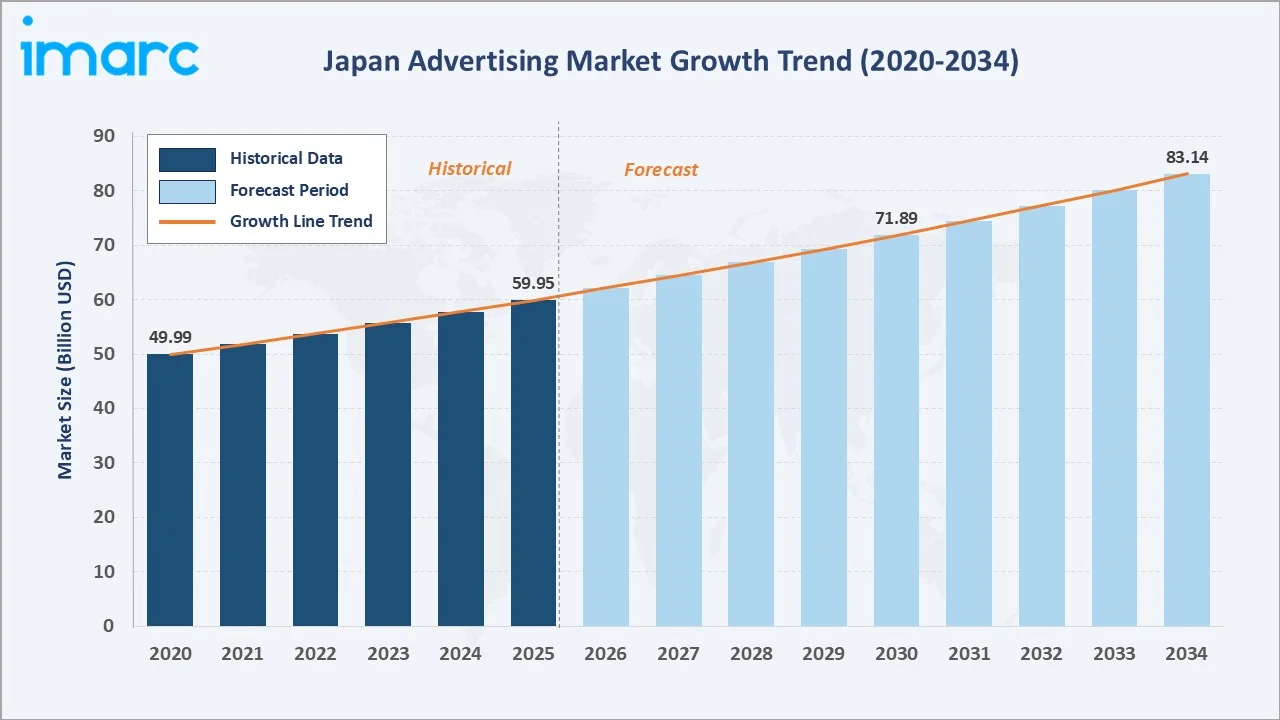
The Japan advertising market grew from USD 59.95 Billion in 2025 to USD 62.17 Billion in 2026 and is projected to reach USD 83.14 Billion by 2034, growing at a CAGR of 3.70% during 2026-2034. The market is driven by rising digital transformation, expanding e-commerce, growing AI-based programmatic targeting, and increasing influencer-led content strategies. Internet from the type segment dominates at 39.6%. The Kanto Region commands 38.9% of the market share.
Market Snapshot
|
Metric |
Value |
|
Base Year Market Size (2025) |
USD 59.95 Billion |
|
Market Size (2026) |
USD 62.17 Billion |
|
Forecast Market Size (2034) |
USD 83.14 Billion |
|
CAGR (2026-2034) |
3.70% |
|
Base Year |
2025 |
|
Historical Period |
2020-2025 |
|
Forecast Period |
2026-2034 |
|
Dominant Type |
Internet (39.6%, 2025) |
|
Leading Region |
Kanto Region (38.9%, 2025) |
The market expanded from USD 49.99 Billion in 2020 to USD 59.95 Billion in 2025 and an estimated USD 62.17 Billion in 2026, anchored at USD 71.89 Billion in 2030 and forecast to reach USD 83.14 Billion by 2034. Post-pandemic ad-spend recovery, expanding internet penetration, and growing smartphone-based media consumption underpin the steady historical and forecast trajectory.
To get more information on this market, Request Sample
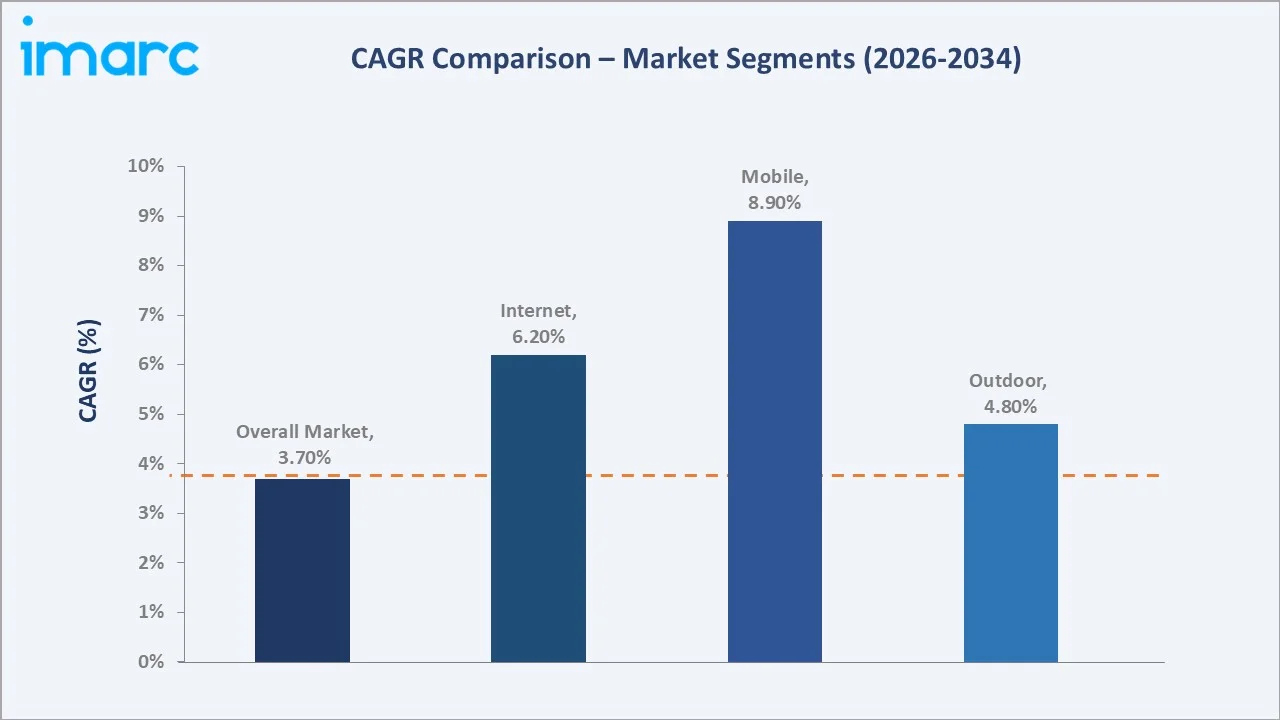
Internet advertising grows fastest at ~6.2% CAGR as programmatic buying, video, and social platforms absorb rising ad budgets. Mobile grows even faster at ~8.9% CAGR as in-app and app-based formats scale, while Print continues to contract as circulation-driven advertising declines structurally.
Executive Summary
The Japan advertising market, which increased from USD 59.95 Billion in 2025 to an estimated USD 62.17 Billion in 2026, representing one of Asia's most mature and technologically advanced media markets driven by a large domestic consumer base, high smartphone penetration, and a well-established agency ecosystem. Advertising in Japan spans television, print, radio, outdoor, internet, mobile, and cinema channels, serving brand-building and performance objectives for organizations across every sector. The market is projected to reach USD 83.14 Billion by 2034.
Internet at 39.6% dominates by capturing rising digital ad budgets through search, display, classified, and video formats. Television at 24.1% leads through its unmatched national reach and premium brand-building capability. The Kanto Region at 38.9% leads nationally through Tokyo's concentration of advertising agencies, brand headquarters, digital publishers, and media buyers.
Key Market Insights
|
Insight |
Data |
|
Dominant Type |
Internet - 39.6% share (2025) |
|
Leading Region |
Kanto Region - 38.9% market share (2025) |
|
Market Opportunity |
AI-driven programmatic targeting; influencer and content-based marketing; AR/VR immersive ad formats; programmatic DOOH integration |
Key Analytical Observations Supporting The Above Data:
- Internet at 39.6%: The Internet segment dominates as search, display, classified, and video advertising capture growing digital ad budgets, supported by rising e-commerce activity and continued adoption of programmatic buying across brand and performance campaigns.
- Television at 24.1%: Television retains a substantial share through its unmatched national reach, premium brand-building capability, and continued relevance for mass-audience campaigns among Japan's large middle-aged and older demographic base.
- Kanto Region at 38.9%: The Kanto Region leads due to Tokyo's concentration of advertising agencies, corporate headquarters, digital publishers, and media buyers, creating a self-reinforcing hub for advertiser budgets and premium inventory.
Japan Advertising Market Overview
The Japan advertising market encompasses the planning, creation, and dissemination of promotional communication across television, print, radio, outdoor, internet, mobile, and cinema channels. It enables organizations to inform, persuade, and build brand equity among target consumer audiences through a strategic mix of traditional and digital media.
The ecosystem integrates advertising and media holding companies, creative and digital agencies, media buyers, ad-tech and programmatic platforms, publishers, and broadcasters, alongside regulatory bodies overseeing advertising standards. Macroeconomic factors include rising smartphone penetration, growing data-privacy awareness, and the incorporation of AI, AR, and VR into campaign formats.
Market Dynamics
To evaluate market opportunities, Request Sample
Market Drivers
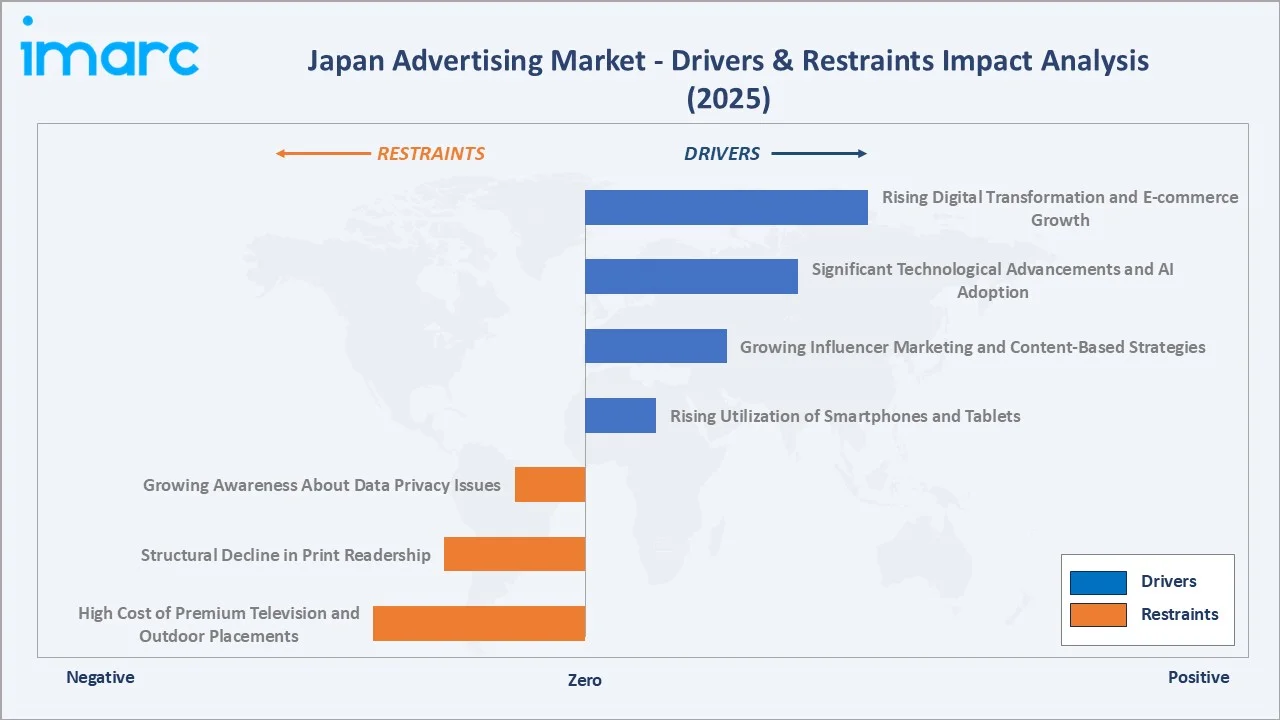
- Rising Digital Transformation and E-commerce Growth: Increased internet penetration and e-commerce expansion are shifting advertising budgets toward digital platforms, with strong demand for online ads, social media marketing, and video content. Advertising expenditure in Japan totalled 7,316.7 Billion Yen in 2023, up 3.0% year-on-year, with video advertising growing 15.9% year-on-year, the highest growth rate among all ad categories, directly boosting demand for internet-based advertising formats. Retailers and consumer brands are progressively reallocating budgets from traditional media toward performance-driven digital channels that offer measurable returns. This shift is further reinforced by the expanding availability of e-commerce data, which allows advertisers to refine targeting and improve campaign return on investment.
- Significant Technological Advancements and AI Adoption: Widespread adoption of artificial intelligence, data analytics, and programmatic advertising is helping brands target audiences more precisely, improving campaign personalization and reach. Platforms such as MASTRUM, a DOOH advertising platform integrating tens of thousands of screens across Japan, illustrate how automation of media transactions is accelerating advertiser adoption of data-driven formats. Agencies are increasingly deploying machine-learning models to optimize bidding strategies and creative selection in real time, reducing wasted ad spend. As measurement standards mature, advertisers are gaining greater confidence in shifting incremental budgets toward AI-enabled channels.
- Growing Influencer Marketing and Content-Based Strategies: Japanese consumers are highly receptive to trusted personalities, making influencer partnerships an increasingly important advertising medium. Brands are expanding collaborations with niche creators across fashion, gaming, travel, and beauty categories, supporting sustained growth in content-based and social advertising expenditure. This trend is reinforced by consumers' preference for authentic, story-driven content over conventional promotional messaging. As a result, agencies are building dedicated influencer-management practices to scale these partnerships efficiently across multiple platforms.
- Rising Utilization of Smartphones and Tablets: The growing penetration of smartphones and tablets is expanding the addressable audience for mobile and in-app advertising formats, encouraging advertisers to reallocate budgets toward mobile-first campaigns and reinforcing the broader structural shift toward digital advertising spend. Higher mobile data speeds and expanding 5G coverage are further improving the delivery of rich media and video ad formats on handheld devices. This is prompting advertisers to design creative assets specifically optimized for mobile consumption rather than repurposing desktop or television creative.
Market Restraints
- Growing Awareness About Data Privacy Issues: Rising consumer and regulatory scrutiny of data privacy is constraining the use of behavioral targeting and third-party cookies, increasing compliance costs for advertisers and agencies and complicating audience measurement across digital channels. Advertisers are being required to invest in consent-management infrastructure and first-party data strategies to remain compliant. These added compliance requirements can slow campaign deployment timelines and increase the operational burden on smaller agencies with limited technical resources.
- Structural Decline in Print Readership: Continued decline in newspaper and magazine circulation is steadily eroding Print's advertising revenue base, requiring publishers and advertisers to reallocate budgets toward digital alternatives, which can disrupt established media planning relationships. Legacy publishers are being forced to restructure commercial models around digital subscriptions and sponsored content, which do not always fully offset lost print advertising revenue. This transition also creates uncertainty for advertisers accustomed to Print's traditionally predictable reach and demographic profile.
- High Cost of Premium Television and Outdoor Placements: Elevated costs associated with premium television slots and high-footfall outdoor placements can limit participation from smaller advertisers, concentrating spend among large brands and reducing overall market accessibility. This pricing dynamic can discourage smaller and regional advertisers from engaging with high-reach formats, pushing them toward lower-cost digital channels instead. Over time, this may reduce revenue diversification for premium television and outdoor media owners.
Market Opportunities
- AI-Driven Programmatic Targeting Expansion: Wider adoption of AI-based bidding and automated media transactions can improve campaign efficiency and audience targeting precision, opening new growth avenues for ad-tech and programmatic platform providers. As advertisers gain confidence in automated systems, budget allocation toward programmatic formats is expected to accelerate across both digital and out-of-home channels. This creates opportunities for platform providers to expand value-added analytics and optimization services alongside core media-buying functionality.
- Immersive AR/VR Advertising Formats: Growing incorporation of augmented and virtual reality into campaigns can help brands create interactive, memorable experiences, creating new opportunities for creative and technology-driven agencies. Retail and entertainment brands are particularly well positioned to capitalize on these formats given their emphasis on experiential engagement. As device compatibility improves and production costs decline, AR/VR is expected to move from a niche premium format toward broader mainstream adoption.
Market Challenges
- Fragmented Audience Measurement Across Channels: Measuring campaign performance consistently across television, print, outdoor, and digital channels remains challenging, complicating budget allocation decisions for advertisers operating multi-channel campaigns. The absence of a fully unified measurement standard makes it difficult to compare returns across formats on a like-for-like basis. This can lead advertisers to under-invest in channels that are harder to measure, even when those channels deliver meaningful brand value.
- Intensifying Competition from Digital-Native Entrants: Growing competition from digital-native agencies and ad-tech platforms is increasing pricing pressure on traditional full-service agencies, requiring continued investment in digital capabilities to retain client budgets. Smaller, specialized digital agencies are able to offer more agile and cost-competitive services, challenging the traditional full-service agency model. This is prompting established players to pursue acquisitions and internal restructuring to remain competitive on both price and capability.
Emerging Market Trends
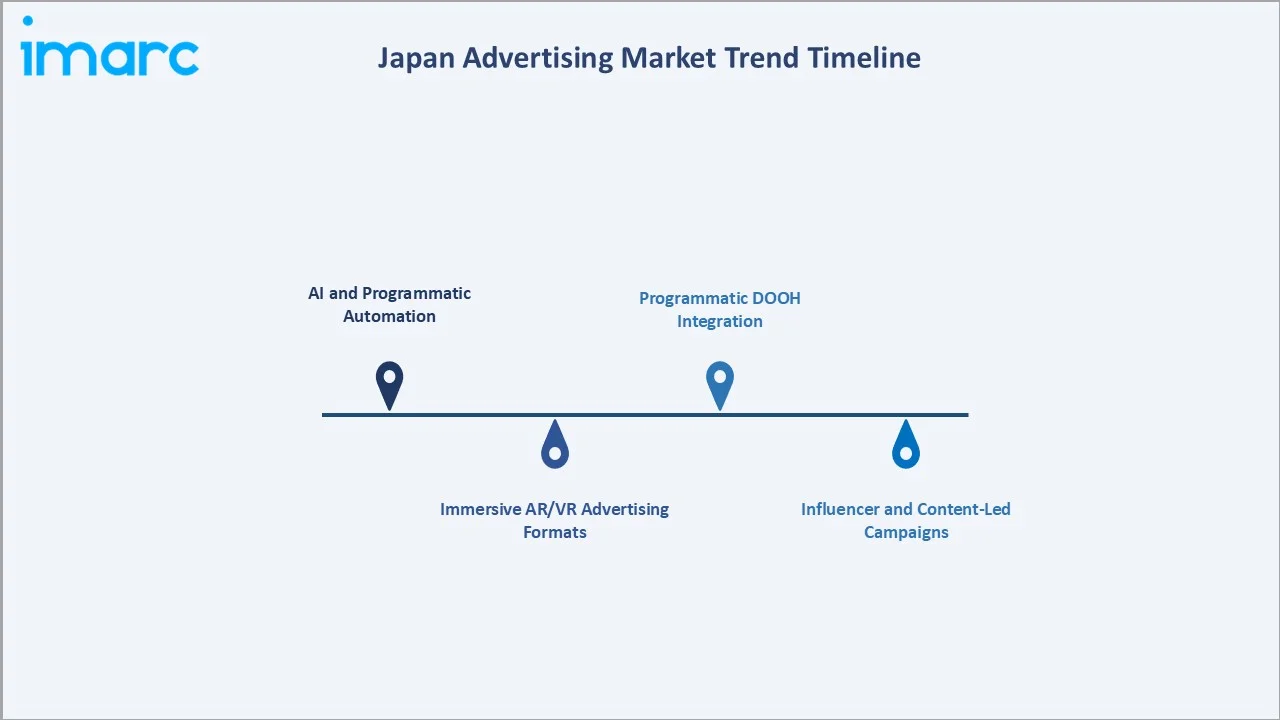
1. AI and Programmatic Automation
Growing adoption of AI-based bidding and automated media transactions is improving campaign efficiency and audience targeting precision across digital and out-of-home formats, reducing manual planning effort for agencies and advertisers alike.
2. Immersive AR/VR Advertising Formats
Brands are increasingly incorporating augmented and virtual reality into campaigns to create interactive, memorable brand experiences that stand out in a crowded media environment, particularly across retail and entertainment categories.
3. Influencer and Content-Led Campaigns
Sustained growth in creator partnerships and branded storytelling reflects Japanese consumers' preference for authentic, subtle, and engaging advertising over overtly promotional messaging, particularly across social platforms.
4. Programmatic DOOH Integration
Integration of programmatic buying with digital out-of-home networks is enabling automated, data-driven purchasing of outdoor inventory, improving measurement and targeting precision for advertisers seeking omni-channel reach.
Industry Value Chain Analysis
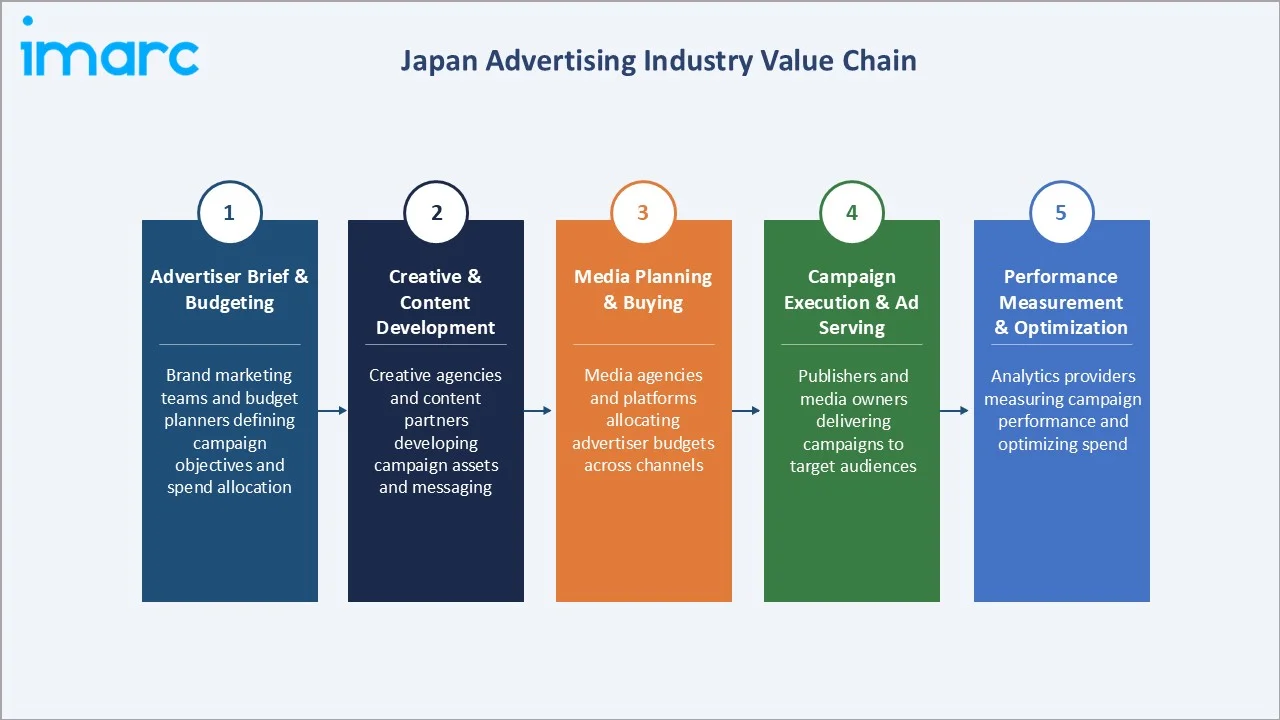
The Japan advertising value chain integrates advertiser brief and budget setting, creative and content development, media planning and buying, campaign execution and ad serving, and performance measurement and optimization. The value chain's commercial architecture is increasingly consolidating toward integrated, data-driven media planning as the primary commercial format.
|
Stage |
Key Participants |
|
Advertiser Brief & Budgeting |
Brand marketing teams and budget planners defining campaign objectives and spend allocation |
|
Creative & Content Development |
Creative agencies and content partners developing campaign assets and messaging |
|
Media Planning & Buying |
Media agencies and platforms allocating advertiser budgets across channels |
|
Campaign Execution & Ad Serving |
Publishers and media owners delivering campaigns to target audiences |
|
Performance Measurement & Optimization |
Analytics providers measuring campaign performance and optimizing spend |
The media planning and buying tier is the value chain's most commercially critical stage, while ad-tech and programmatic platforms are experiencing the industry's most rapid technology-driven transition as automated buying displaces traditional manual media transactions.
Technology Landscape in the Japan Advertising Industry
Programmatic Advertising & AI-Based Targeting
Programmatic advertising and AI-based targeting technology enable automated, data-driven media buying with improved audience precision and campaign efficiency. Their growing adoption across internet and DOOH formats is accelerating measurable, performance-oriented advertising across Japan.
Augmented and Virtual Reality (AR/VR) Ad Formats
AR/VR advertising technology enables immersive, interactive brand experiences that improve engagement and recall. Growing compatibility with smartphones and premium retail environments is accelerating adoption across fashion, automotive, and entertainment advertisers.
Digital Out-of-Home (DOOH) Platform Technology
MASTRUM, an impression-based DOOH advertising platform, completed integration of about 34,000 screens as part of its first phase, powered by a global OOH enterprise software provider. This supports automated, data-driven buying of outdoor advertising inventory, enabling more efficient, measurable DOOH campaigns across Japan's urban centers.
Data Analytics and Audience Measurement Technology
Advanced data analytics and audience measurement technology enable advertisers to evaluate campaign performance consistently across traditional and digital channels. Growing adoption of unified measurement dashboards and first-party data platforms is helping agencies deliver more transparent, accountable reporting, supporting continued advertiser confidence in shifting budgets toward data-driven media strategies.
Market Segmentation Analysis
The report covers the following segments:
|
Segment Category |
Leading Segment |
Market Share |
Year |
|
Type |
Internet |
39.6% |
2025 |
|
Region |
Kanto Region |
38.9% |
2025 |

By Type
Internet leads the Japan advertising market at 39.6% in 2025, encompassing search, display, classified, and video formats that capture the largest share of advertiser budgets amid Japan's ongoing digital transformation.
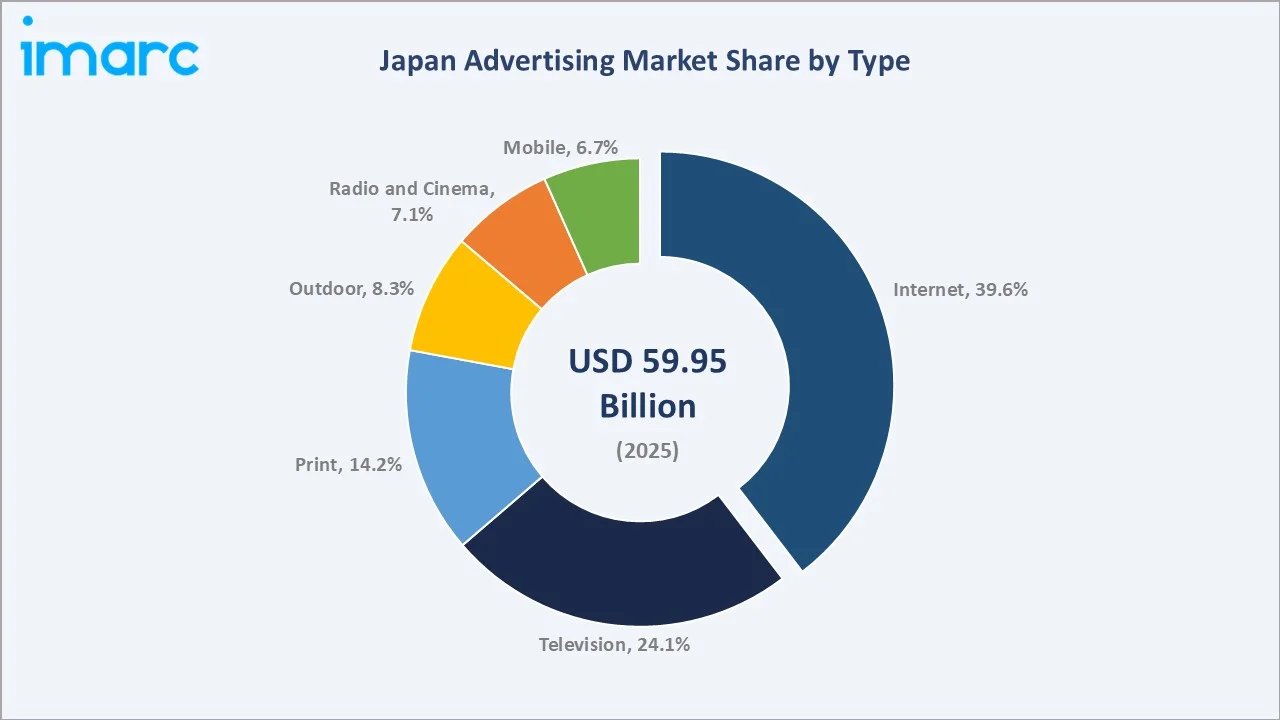
Television follows at 24.1%, supported by its continued reach among mass audiences and premium brand campaigns. Print holds 14.2% amid gradual structural decline in circulation. Outdoor at 8.3% benefits from digital billboard adoption and high-footfall transit locations, while Mobile at 6.7% is expanding rapidly on the back of in-app and app-based formats. Radio and Cinema together account for 7.1%, retaining niche but stable advertiser bases.
Regional Market Insights
|
Region |
Share (2025) |
Key Market Characteristics |
|
Kanto Region |
38.9% |
Driven by high advertiser concentration, strong agency presence, and premium media inventory availability |
|
Kansai/Kinki Region |
18.2% |
Driven by growing regional brand activity, expanding retail advertising, and rising digital adoption |
|
Central/Chubu Region |
15.1% |
Supported by steady industrial and consumer advertising demand across the region |
|
Kyushu-Okinawa Region |
8.6% |
Supported by growing retail, tourism, and regional brand advertising activity |
|
Tohoku Region |
6.7% |
Driven by steady local retail and public-sector advertising demand |
|
Chugoku Region |
5.2% |
Supported by regional industrial and retail advertising activity |
|
Hokkaido Region |
4.0% |
Driven by tourism-linked and seasonal advertising demand |
|
Shikoku Region |
3.3% |
Supported by local retail and community-level advertising activity |
The Kanto Region, at 38.9%, leads through Tokyo's structural advantages as Japan's largest concentration of advertising agencies, brand headquarters, and digital publishers. Kansai/Kinki, at 18.2%, reflects Osaka's growing role as Japan's second-largest advertising hub, while Central/Chubu, at 15.1%, benefits from Nagoya's strong industrial and automotive advertiser base.
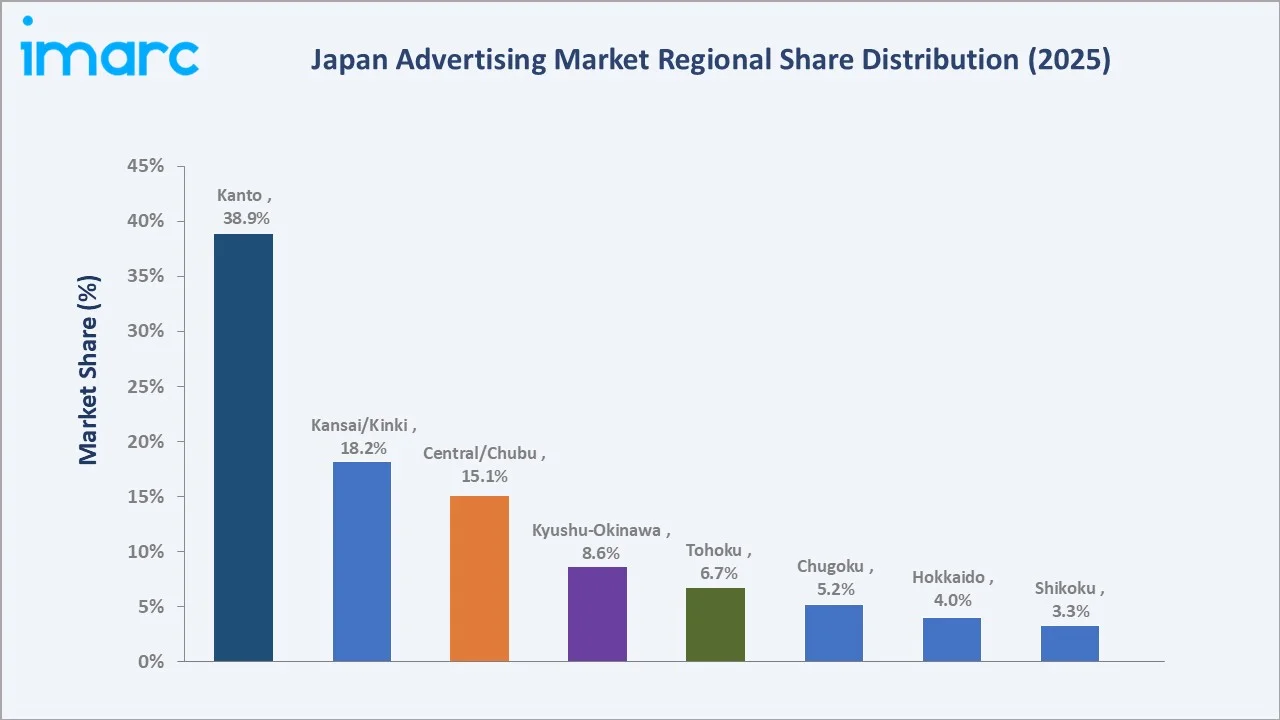
The remaining regions, Kyushu-Okinawa at 8.6%, Tohoku at 6.7%, Chugoku at 5.2%, Hokkaido at 4.0%, and Shikoku at 3.3%, collectively account for 27.8%, representing steady but comparatively smaller advertising pools driven by regional retail, tourism, and public-sector advertising activity.
Competitive Landscape
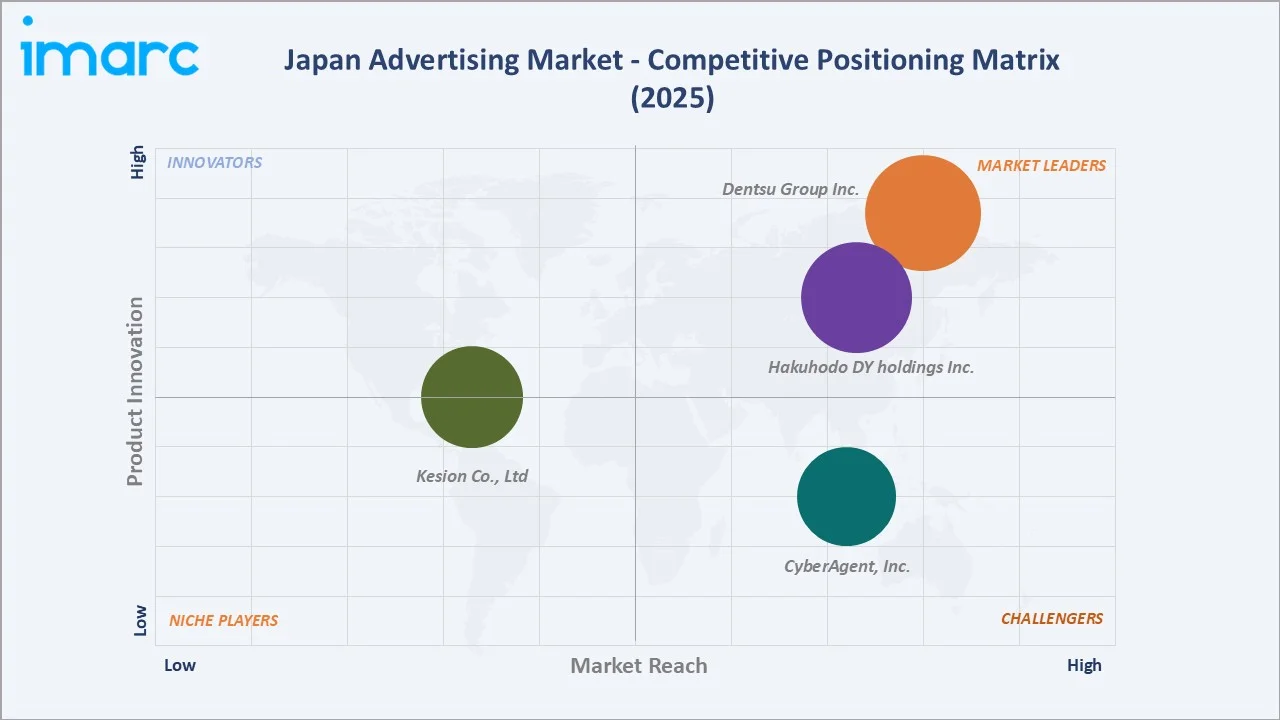
The Japan advertising market competitive landscape is moderately concentrated, led by large integrated advertising and media holding companies alongside digital-native agencies competing for growing internet and mobile ad budgets.
|
Company Name |
Key Products |
Market Position |
Core Strength |
|
Dentsu Group Inc. |
Integrated Advertising & Media Services |
Market Leader |
Japan's largest advertising and communications holding group with a comprehensive full-service agency network |
|
Hakuhodo DY holdings Inc. |
Creative & Media Planning Services |
Market Leader |
Leading full-service agency renowned for creative brand strategy and integrated campaign planning |
|
CyberAgent, Inc. |
Digital & Internet Advertising Services |
Strong Challenger |
Leading digital-native player with strong programmatic and internet advertising capabilities |
|
Kesion Co., Ltd |
Digital Advertising Solutions |
Established Player |
Growing digital advertising specialist serving domestic advertisers |
Key players include Dentsu Group Inc., Hakuhodo DY holdings Inc., CyberAgent, Inc., Kesion Co., Ltd, and others.
Key Company Profiles
Dentsu Group Inc.
Dentsu Group Inc. is Japan's largest advertising and communications holding company, offering integrated media, creative, and digital transformation services to domestic and global clients.
- Key Products: Integrated advertising, media planning, and digital transformation services.
- Strategic Focus: Expanding data-driven and AI-based advertising solutions while strengthening its integrated media and creative service offerings across Japan. The company continues to invest in programmatic infrastructure and audience analytics capabilities to support advertisers pursuing measurable, performance-oriented campaigns. It is also broadening its international network to serve domestic clients expanding their advertising presence into overseas markets.
CyberAgent, Inc.
CyberAgent, Inc. is a leading Japanese internet company with a strong presence in the advertising market through its digital and programmatic advertising business.
- Key Products: Internet advertising, programmatic ad-tech, and digital media services.
- Strategic Focus: Expanding AI-driven programmatic advertising and video ad capabilities to capture rising internet ad budgets. The company continues to invest in its proprietary ad-tech platforms to improve targeting precision and campaign automation for advertisers. It is also broadening its media offerings across gaming, streaming, and social platforms to capture a wider share of Japan's growing digital ad spend.
Market Concentration Analysis
The Japan advertising market is moderately concentrated, with Dentsu and Hakuhodo Inc collectively commanding a substantial share of integrated agency billings, while CyberAgent and other digital-native players continue gaining share within the fast-growing internet advertising segment. Market concentration is gradually declining as digital-first agencies and specialized programmatic platforms capture incremental advertiser budgets.
Investment & Growth Opportunities
Highest Growth Segments
Mobile advertising (~8.9% CAGR), Internet advertising (~6.2% CAGR), and Outdoor advertising (~4.8% CAGR) represent the highest-growth investment vectors through 2034, driven by continued smartphone penetration, programmatic adoption, and digital billboard expansion.
Emerging Investment Opportunities
AI-driven programmatic platforms and DOOH network operators represent the market's highest-value emerging opportunity, as automated, data-driven media buying increasingly displaces traditional manual ad transactions, creating a structurally growing demand pool through 2034.
Investment Themes
- AI and programmatic platform investment as a structural efficiency advantage through 2034: Agencies and ad-tech providers that achieve superior AI-driven targeting capability can create a sustainable cost and performance advantage over competitors dependent on manual media planning.
- Digital-native agency expansion capturing Japan's fastest-growing internet and mobile ad budget pool: Digital-first agencies are well positioned to capture incremental advertiser budgets as Internet and Mobile formats continue outpacing overall market growth.
Future Market Outlook (2026-2034)
The Japan advertising market is projected to grow from USD 59.95 Billion in 2025 to USD 62.17 Billion in 2026 and further to USD 83.14 Billion by 2034, delivering a 3.70% CAGR over the forecast period. Continued digital transformation, AI-driven programmatic adoption, and expanding influencer and content-based marketing are expected to sustain steady growth, even as legacy Print advertising continues its gradual structural decline.
Three structural forces define market growth through 2034. Rising internet and mobile penetration creates a self-reinforcing shift of advertiser budgets toward digital formats. AI-driven programmatic automation improves campaign efficiency, encouraging further reallocation toward measurable digital channels. Immersive AR/VR and DOOH technology adoption creates additive advertising demand above the already steady growth of core digital formats.
Research Methodology
Primary Research
Primary research comprised structured interviews with industry stakeholders, including advertising agency executives, media planners, and digital marketing specialists across Japan.
Secondary Research
Secondary research encompassed company annual reports, Dentsu's Advertising Expenditures in Japan survey, industry association publications, and other publicly available market data sources.
Forecasting Models
Market revenue forecasts were developed using a top-down and bottom-up estimation approach, incorporating historical advertising expenditure trends, type-wise and region-wise share analysis, and macroeconomic indicators relevant to Japan's media and advertising industry.
Japan Advertising Market Report Coverage:
| Report Features | Details |
|---|---|
| Base Year of the Analysis | 2025 |
| Historical Period | 2020-2025 |
| Forecast Period | 2026-2034 |
| Units | Billion USD |
| Scope of the Report |
Exploration of Historical Trends and Market Outlook, Industry Catalysts and Challenges, Segment-Wise Historical and Future Market Assessment:
|
| Types Covered | Television, Print (Newspaper and Magazine), Radio, Outdoor, Internet (Search, Display, Classified, Video), Mobile, Cinema |
| Regions Covered | Kanto Region, Kansai/Kinki Region, Central/ Chubu Region, Kyushu-Okinawa Region, Tohoku Region, Chugoku Region, Hokkaido Region, Shikoku Region |
| Companies Covered | Dentsu Group Inc., Hakuhodo DY holdings Inc., CyberAgent, Inc., Kesion Co., Ltd, etc. |
| Customization Scope | 10% Free Customization |
| Post-Sale Analyst Support | 10-12 Weeks |
| Delivery Format | PDF and Excel through Email (We can also provide the editable version of the report in PPT/Word format on special request |
Key Benefits for Stakeholders:
- IMARC’s industry report offers a comprehensive quantitative analysis of various market segments, historical and current market trends, market forecasts, and dynamics of the Japan advertising market from 2020-2034.
- The research report provides the latest information on the market drivers, challenges, and opportunities in the Japan advertising market.
- Porter's five forces analysis assist stakeholders in assessing the impact of new entrants, competitive rivalry, supplier power, buyer power, and the threat of substitution. It helps stakeholders to analyze the level of competition within the Japan advertising industry and its attractiveness.
- Competitive landscape allows stakeholders to understand their competitive environment and provides an insight into the current positions of key players in the market.
Frequently Asked Questions About the Japan Advertising Market Report
The Japan advertising market size is estimated at USD 62.17 Billion in 2026, driven by Internet's dominant 39.6% type share, Television's 24.1% share, and the Kanto Region's leading 38.9% regional share.
The Japan advertising market grows at 3.70% CAGR during 2026-2034, reaching USD 83.14 Billion by 2034, reflecting sustained digital transformation and AI-driven programmatic adoption.
Internet leads at 39.6%, capturing the largest share of advertiser budgets through search, display, classified, and video formats.
The Kanto Region leads at 38.9%, through Tokyo's concentration of advertising agencies, brand headquarters, and digital publishers.
Leading companies include Dentsu Group Inc., Hakuhodo DY holdings Inc., CyberAgent, Inc., Kesion Co., Ltd, and others.
The Japan advertising market is projected to reach approximately USD 71.89 Billion by 2030, with AI-driven programmatic advertising becoming a standard specification for digital and DOOH campaigns.
Priority investment opportunities include AI and programmatic platform investment, digital-native agency expansion, and DOOH network technology partnerships.
Key trends include AI and programmatic automation, immersive AR/VR ad formats, influencer and content-led campaigns, and programmatic DOOH integration.
Need more help?
- Speak to our experienced analysts for insights on the current market scenarios.
- Include additional segments and countries to customize the report as per your requirement.
- Gain an unparalleled competitive advantage in your domain by understanding how to utilize the report and positively impacting your operations and revenue.
- For further assistance, please connect with our analysts.
 Request Customization
 Speak to an Analyst
 Request Brochure
 Inquire Before Buying
Benefits of Customization
- Personalize this research
- Triangulate with your data
- Get data as per your format and definition
- Gain a deeper dive into a specific application, geography, customer, or competitor
- Any level of personalization
Get in Touch With Us
UNITED STATES
Phone: +1-201-971-6302
INDIA
Phone: +91-120-433-0800
UNITED KINGDOM
Phone: +44-753-714-6104
Email: sales@imarcgroup.com
Client Testimonials




.webp)




.webp)













Related Reports

Choose your plan
*Please note that the prices mentioned below are starting prices for each bundle type. Kindly contact our team for further details.*
Single User License
- 1 User License, Access on 2 Devices
- PDF Report + Excel Dataset (Password Protected)
- Lifetime Access
- No Printing Rights
- 10% Free Report Customization
- 10–12 Weeks of Analyst Support
Five User License
- Access for 5 Users, 2 Devices per User
- PDF Report + Excel Dataset (Password Protected)
- Lifetime Access
- Dedicated Account Manager
- 12–14 Weeks of Analyst Support
- No Printing Rights
- 15% Free Report Customization
- 25% Discount on Your Next Purchase
Corporate User License
- Unlimited User Access (Within Your Organization)
- PDF Report + Excel Dataset
- Lifetime Access
- Dedicated Account Manager
- 14–20 Weeks of Analyst Support
- No Printing Rights
- 20% Free Report Customization
- 30% Discount on Your Next Purchase
Essential Insights
What's included:
3 reports
- Lifetime Access
- PDF Reports
- Excel Datasets
- 2 Weeks of Free Analyst Support
- 2 User Licenses
- Access on 2 Devices
- Printing Rights
- Complimentary PowerPoint (PPT) Version
- Complimentary License Upgrade
Professional Access
What's included:
5 reports
- Lifetime Access
- PDF Reports
- Excel Datasets
- 8 Weeks of Free Analyst Support
- 2 User Licenses
- Access on 2 Devices
- Printing Rights
- Complimentary PowerPoint (PPT) Version
- Complimentary License Upgrade
Business Advantage
What's included:
8 reports
- Lifetime Access
- PDF Reports
- Excel Datasets
- 14 Weeks of Free Analyst Support
- 2 User Licenses
- Access on 2 Devices
- Printing Rights
- Complimentary PowerPoint (PPT) Version
- Complimentary License Upgrade
Enterprise Intelligence
What's included:
10 reports
- Lifetime Access
- PDF Reports
- Excel Datasets
- 20 Weeks of Free Analyst Support
- 2 User Licenses
- Access on 2 Devices
- Printing Rights
- Complimentary PowerPoint (PPT) Version
- Complimentary License Upgrade