
Japan AI in Drug Discovery Market Size, Share, Trends and Forecast by Offering, Application, Therapeutic Area, End User, and Region, 2026-2034
Japan AI in Drug Discovery Market Size, Share, Trends & Forecast (2026-2034)
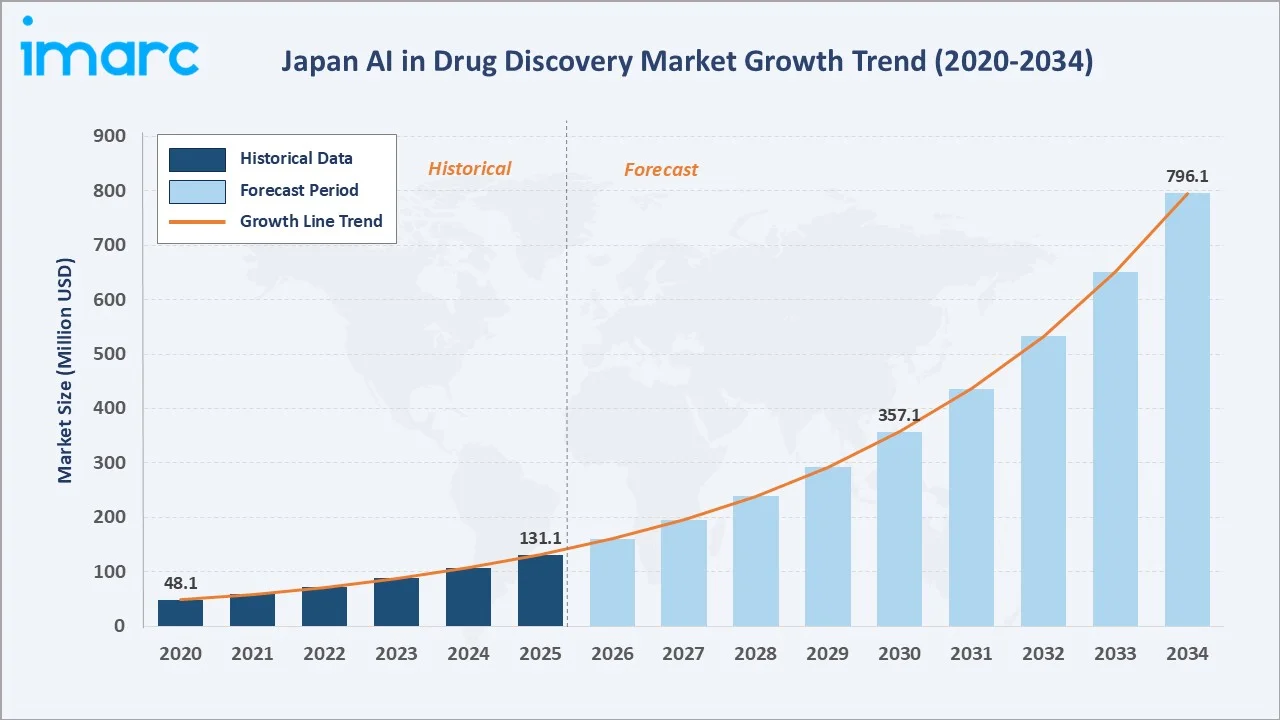
The Japan AI in drug discovery market reached a value of USD 131.1 Million in 2025 and is projected to reach USD 796.1 Million by 2034, exhibiting a CAGR of 22.20% during 2026-2034. Growth is primarily driven by deepening collaboration between domestic AI technology providers and pharmaceutical companies, expanding government-backed digital infrastructure, and rising demand for faster, lower-cost molecule discovery.
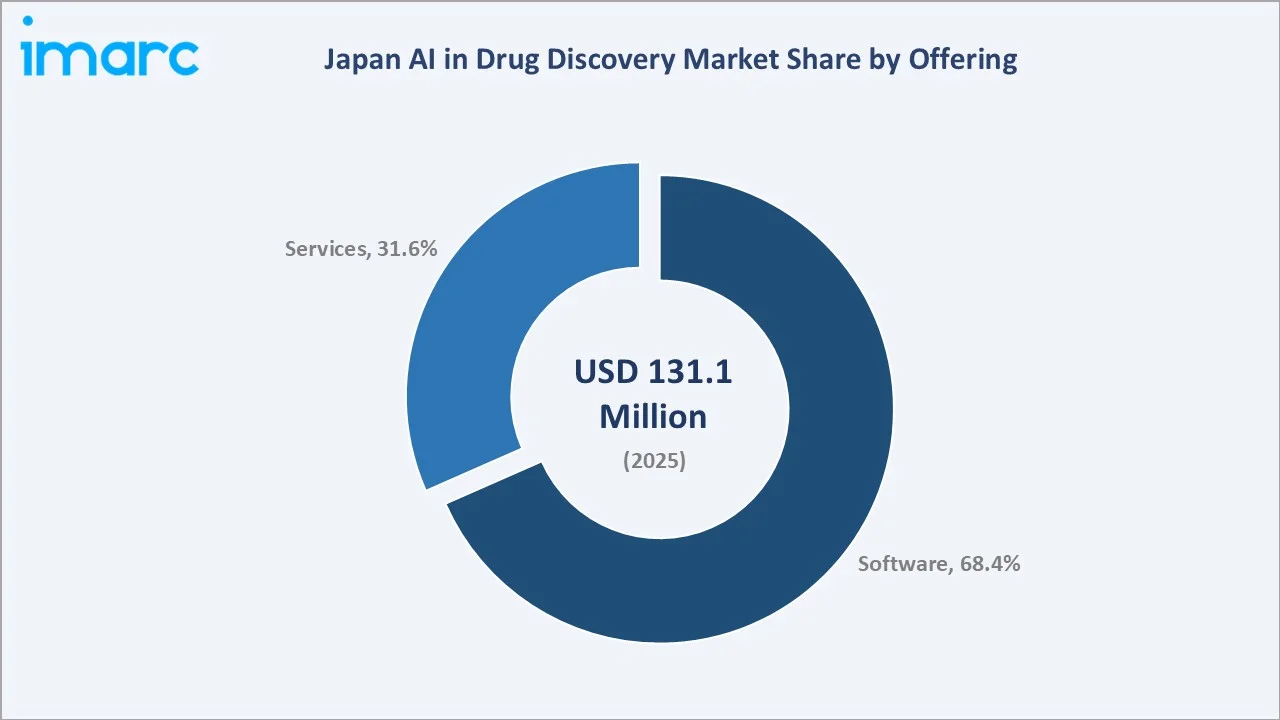
Software leads the offering segment at 68.4%, pharmaceutical and biotechnology companies dominate the end user segment at 57.8%, and Kanto Region commands 43.6% of regional share in 2025.
Market Snapshot
|
Metric |
Value |
|
Market Size (2025) |
USD 131.1 Million |
|
Forecast Market Size (2034) |
USD 796.1 Million |
|
CAGR (2026-2034) |
22.20% |
|
Base Year |
2025 |
|
Historical Period |
2020-2025 |
|
Forecast Period |
2026-2034 |
|
Largest Region |
Kanto Region (43.6%, 2025) |
|
Second Largest Region |
Kansai/Kinki Region (19.8%, 2025) |
|
Leading Offering |
Software (68.4%, 2025) |
|
Leading End User |
Pharmaceutical and Biotechnology Companies (57.8%, 2025) |
The Japan AI in drug discovery market expanded from USD 48.1 Million in 2020 to USD 131.1 Million in 2025, supported by early pilot deployments among leading pharmaceutical companies and growing computational biology capabilities. Anchored at USD 357.1 Million in 2030, the market's climb to USD 796.1 Million by 2034 reflects sustained enterprise adoption, expanding platform capability, and a maturing domestic regulatory environment for digital health tools.
To get more information on this market, Request Sample
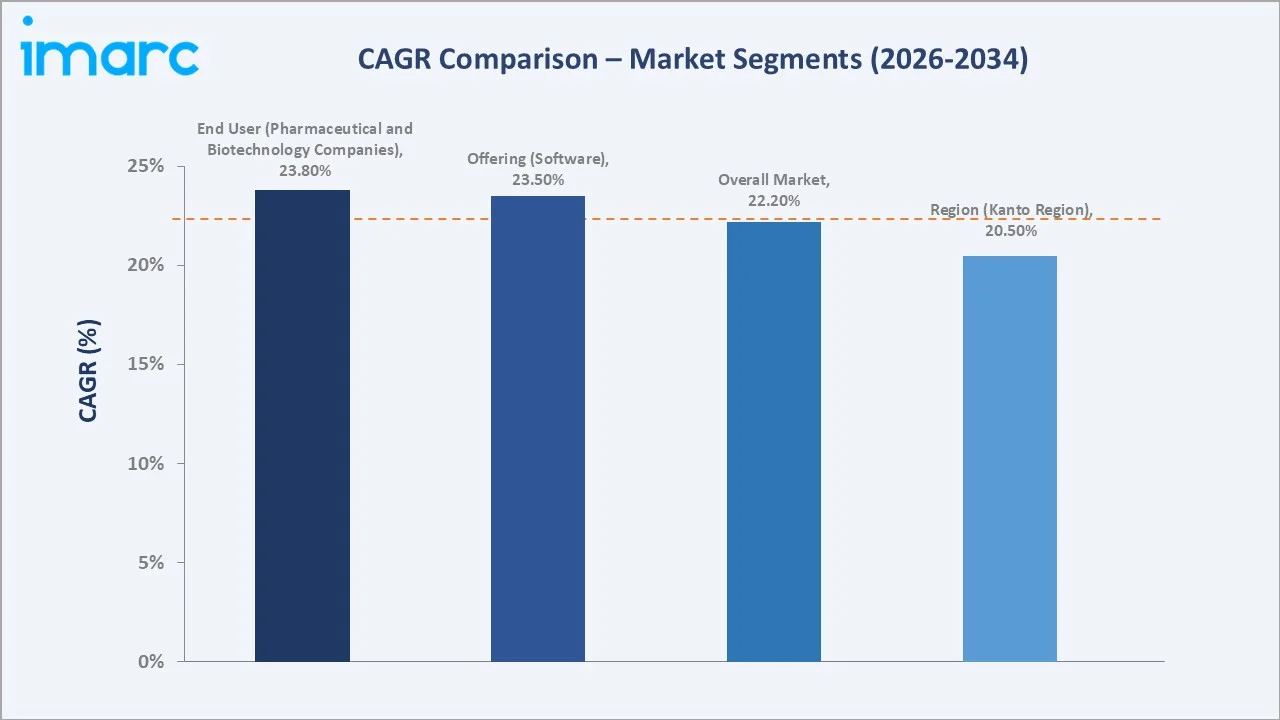
Growth trajectories vary meaningfully across offering, end user and regional segments, with several categories expanding faster than the overall market CAGR of 22.20% through 2034. Segment-level acceleration reflects differences in AI maturity, budget flexibility, and regional research density across Japan.
Executive Summary
The Japan AI in drug discovery market is progressing along a steady growth path, expanding from USD 48.1 Million in 2020 to USD 796.1 Million by 2034. The industry has moved from isolated pilot projects toward platform-led adoption across major pharmaceutical companies, contract research organizations, and academic institutes, supported by improving computing infrastructure and a maturing domestic AI talent base.
Software, at 68.4%, remains the leading offering, propelled by widespread adoption of AI-powered drug discovery platforms and cloud-based analytics. Pharmaceutical and biotechnology companies, at 57.8%, represent the dominant end user category, driven by increasing investment in AI-enabled target identification, lead optimization, and accelerated drug development programs. Kanto Region holds 43.6% market share, fueled by the concentration of global pharmaceutical companies, leading research universities, AI startups, and advanced life sciences innovation hubs centered around Tokyo and Yokohama.
Key Market Insights
|
Insight |
Data |
|
Leading Offering |
Software - 68.4% share (2025) |
|
Second Largest Offering |
Services - 31.6% share (2025) |
|
Leading End User |
Pharmaceutical and Biotechnology Companies - 57.8% share (2025) |
|
Second Largest End User |
Contract Research Organizations (CROs) – 25.4% share (2025) |
|
Leading Region |
Kanto Region - 43.6% share (2025) |
|
Second Largest Region |
Kansai/Kinki Region – 19.8% share (2025) |
|
Top Companies |
FRONTEO, Inc., Mitsui & Co., Ltd., Astellas Pharma Inc., Elix, Inc., Daiichi Sankyo Company, Limited |
Key Analytical Observations Expanding On the Data Above:
- Software dominance at 68.4% is supported by growing enterprise licensing of molecule-generation and virtual screening platforms across Japanese pharmaceutical companies.
- Services at 31.6% share reflect continued reliance on consulting, model customization, and integration support as companies build in-house AI capability.
- Pharmaceutical and biotechnology companies leadership at 57.8% is driven by the sector's central role in funding and deploying AI platforms for early-stage target identification and lead optimization.
- Contract research organizations (CROs) at 25.4% are emerging as the fastest-growing end user category, as pharmaceutical companies increasingly outsource AI-enabled screening and biomarker discovery work.
- Kanto Region at 43.6% share dominates regional demand, anchored by Tokyo's concentration of pharmaceutical headquarters, research institutes, and AI technology vendors.
Japan AI in Drug Discovery Market Overview
AI in drug discovery refers to the application of machine learning (ML), generative modeling, and computational biology techniques to accelerate target identification, molecule design, virtual screening, and preclinical validation. The technology is increasingly transforming traditional pharmaceutical R&D by improving prediction accuracy, reducing discovery timelines, and enhancing the efficiency of candidate selection.
The domestic ecosystem integrates AI technology vendors, cloud and compute providers, pharmaceutical companies, government-backed consortia, and academic research institutions. Together, they support the development and deployment of AI-enabled discovery tools within an evolving national digital health and life sciences policy framework.
Market Dynamics
To evaluate market opportunities, Request Sample
Market Drivers
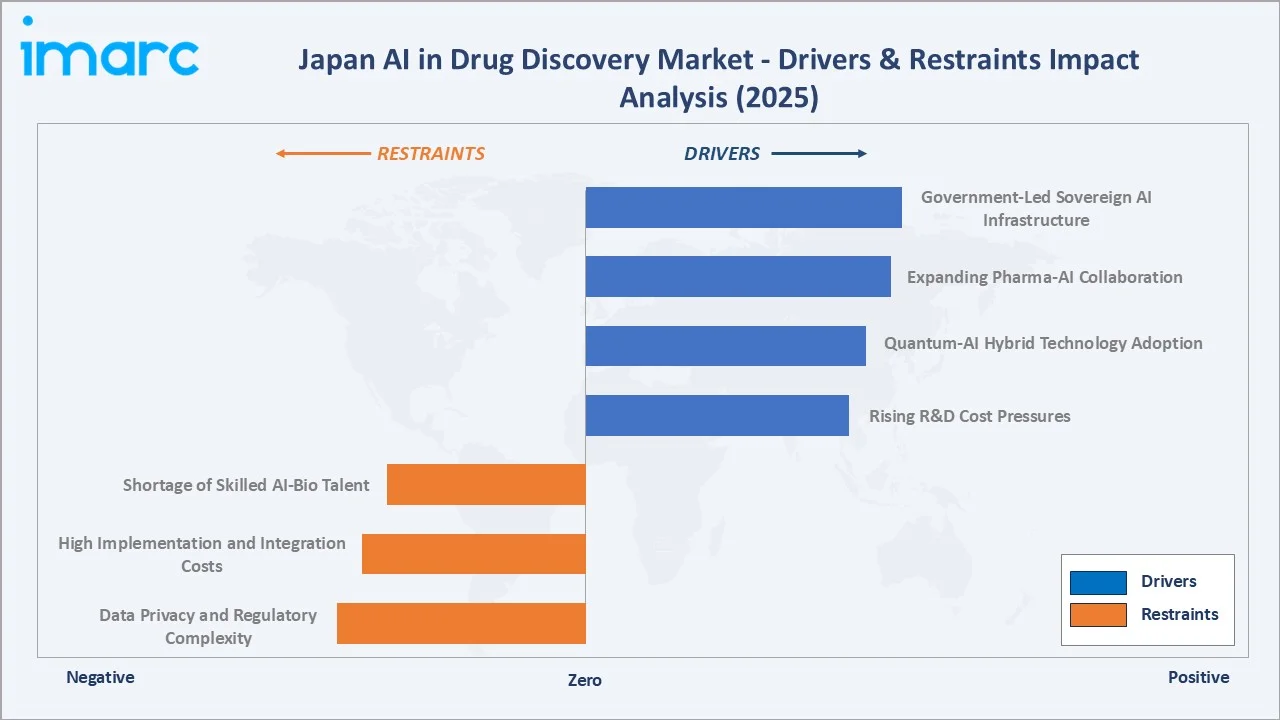
- Government-Led Sovereign AI Infrastructure: Public investment in domestic AI compute capacity is giving pharmaceutical companies secure, large-scale infrastructure for molecule generation and drug-likeness optimization.
- Expanding Pharma-AI Collaboration: Growing partnership activity between AI technology vendors and pharmaceutical companies is accelerating platform validation and adoption across discovery workflows. In December 2025, Fujitsu Limited revealed the creation of a multi-AI agent collaboration technology that could facilitate secure teamwork and rapid adaptation to evolving conditions among AI agents from various companies and suppliers within a supply chain. Utilizing this technology, the firm was set to initiate field trials in January 2026 to enhance Rohto Pharmaceutical Co., Ltd.'s supply chain in partnership with the Institute of Science Tokyo (Science Tokyo).
- Quantum-AI Hybrid Technology Adoption: Integration of quantum-assisted computation with generative AI models is improving molecular generation accuracy and reducing candidate screening cycles.
- Rising R&D Cost Pressures: Escalating costs of traditional drug development are pushing pharmaceutical companies toward AI-enabled approaches that shorten timelines and improve candidate success rates.
Market Restraints
- Data Privacy and Regulatory Complexity: Strict handling requirements for clinical and genomic data add compliance overhead for AI platform providers and their pharmaceutical partners.
- High Implementation and Integration Costs: Deploying AI drug discovery platforms alongside existing legacy research systems requires significant upfront investment, limiting adoption among smaller biotechnology firms.
- Shortage of Skilled AI-Bio Talent: Limited availability of professionals with combined expertise in computational science and pharmaceutical research constrains the pace of platform deployment.
Market Opportunities
- Generative AI for Novel Target Discovery: Expanding use of generative models to identify previously unreported disease-target relationships creates new licensing and co-development opportunities for AI vendors.
- Academic-Industry Research Partnerships: Deepening collaboration between universities and AI drug discovery companies is opening new pathways for translating early-stage research into commercial platforms.
Market Challenges
- Interoperability of Legacy Research Systems: Many pharmaceutical companies continue to rely on fragmented, legacy data systems that complicate integration with modern AI platforms.
- Validation and Trust in AI-Generated Candidates: Building confidence among research scientists in AI-generated molecule recommendations remains an ongoing challenge for platform adoption.
Emerging Market Trends
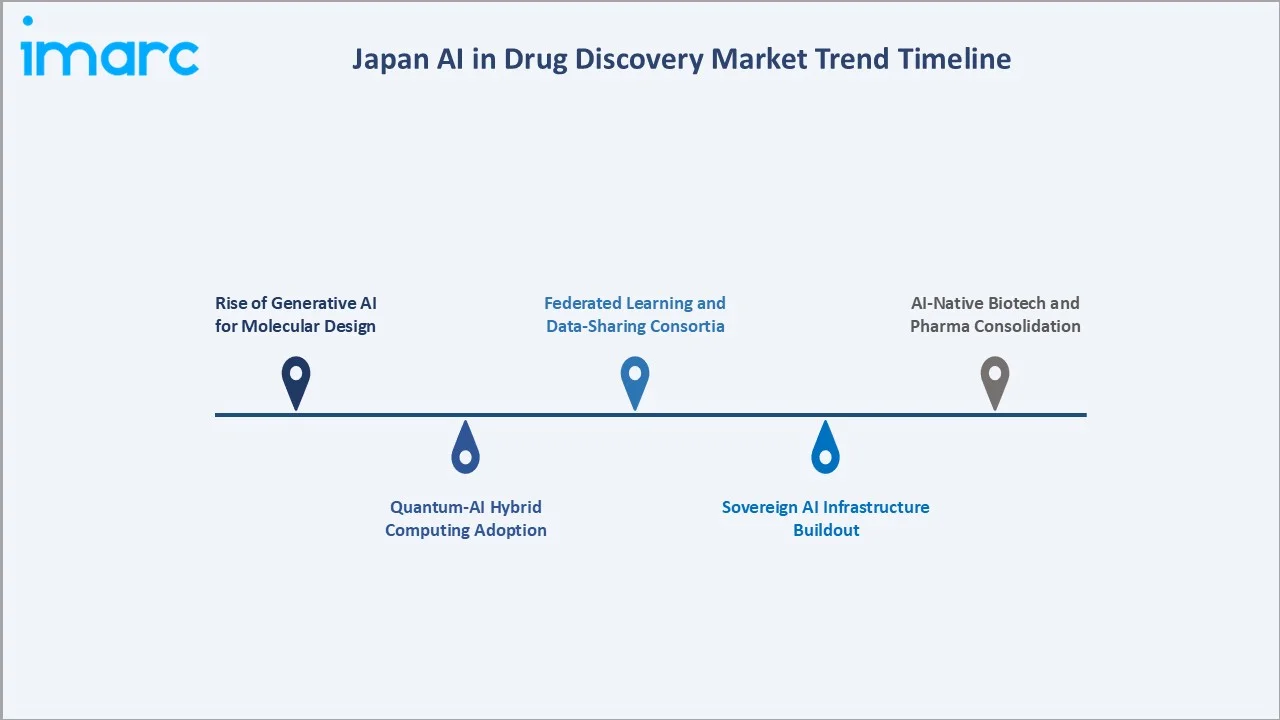
1. Rise of Generative AI for Molecular Design
Japanese AI drug discovery companies are increasingly deploying generative foundation models capable of proposing novel, synthesizable compounds rather than screening existing chemical libraries alone. This shift is broadening the range of chemical space that discovery teams can explore within a given research cycle.
2. Quantum-AI Hybrid Computing Adoption
Pharmaceutical companies and technology vendors are beginning to combine quantum-assisted computation with classical AI models to improve molecular simulation accuracy. Early adoption remains concentrated among larger, well-capitalized organizations able to access specialized computing infrastructure.
3. Sovereign AI Infrastructure Buildout
Development of domestically hosted AI supercomputing platforms is enabling pharmaceutical companies to run large-scale virtual screening programs without relying on external cloud infrastructure. This trend is strengthening data sovereignty and supporting closer industry-government coordination on drug discovery priorities.
4. Federated Learning and Data-Sharing Consortia
AI vendors are increasingly training models on pooled, privacy-preserving datasets contributed by multiple pharmaceutical partners. This approach is expanding the diversity of training data available to platform developers while addressing data confidentiality concerns.
5. AI-Native Biotech and Pharma Consolidation
As AI-enabled discovery platforms mature, established pharmaceutical companies are pursuing closer partnerships and, in some cases, equity investment in AI-native drug discovery startups to secure long-term access to differentiated technology.
Industry Value Chain Analysis
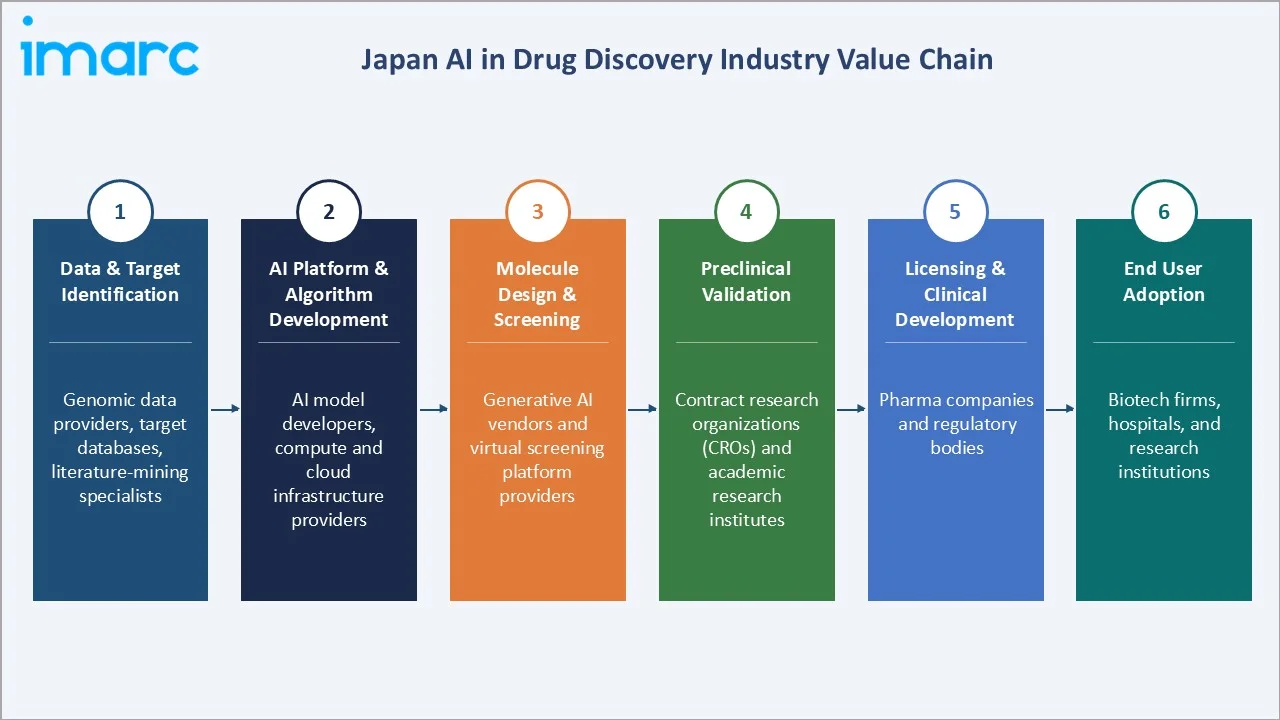
The Japan AI in drug discovery value chain spans six stages, from data and target identification through end user adoption. Platform development and molecule design capture the highest value-add, while compliance and validation capabilities increasingly determine sustainable competitive position within this technology-driven category.
|
Stage |
Key Players / Examples |
|
Data & Target Identification |
Genomic data providers, target databases, literature-mining specialists |
|
AI Platform & Algorithm Development |
AI model developers, compute and cloud infrastructure providers |
|
Molecule Design & Screening |
Generative AI vendors, virtual screening platform providers |
|
Preclinical Validation |
Contract research organizations (CROs), academic research institutes |
|
Licensing & Clinical Development |
Pharmaceutical companies, regulatory bodies |
|
End User Adoption |
Biotechnology firms, hospitals, research institutions |
Vertically integrated organizations, particularly those combining proprietary AI platforms with direct pharmaceutical partnerships, are positioned to capture greater value than vendors reliant solely on third-party licensing arrangements.
Technology Landscape in the Japan AI in Drug Discovery Industry
Generative AI and Molecular Design
Modern AI drug discovery platforms increasingly rely on generative models capable of proposing novel molecular structures optimized for target binding, synthetic feasibility, and drug-likeness, reducing dependence on large historical compound libraries.
Quantum-AI Hybrid Computing
Emerging hybrid computing approaches combine quantum-assisted simulation with classical ML to improve the accuracy of molecular dynamics modeling, particularly for complex protein-ligand interactions.
Data Infrastructure and Federated Learning
Privacy-preserving federated learning techniques are enabling AI vendors to train models across multiple pharmaceutical partners' proprietary datasets without centralizing sensitive compound or patient information.
Cloud and Sovereign Compute Platforms
Domestically hosted AI supercomputing infrastructure is giving pharmaceutical companies scalable access to high-performance computing resources for large-scale virtual screening, without depending entirely on international cloud providers.
Market Segmentation Analysis
The report covers the following segments:
|
Segment Category |
Leading Segment |
Market Share |
Year |
|
Offering |
Software |
68.4% |
2025 |
|
Application |
🔒 |
🔒 |
2025 |
|
Therapeutic Area |
🔒 |
🔒 |
2025 |
|
End User |
Pharmaceutical and Biotechnology Companies |
57.8% |
2025 |
|
Region |
Kanto Region |
43.6% |
2025 |

By Offering
Software leads the offering segment with a 68.4% share in 2025, driven by growing enterprise adoption of molecule-generation, virtual screening, and predictive modeling platforms across pharmaceutical and biotechnology companies. The segment benefits from recurring licensing revenue and expanding platform functionality.
To access detailed market analysis, Request Sample
Services account for 31.6% share in 2025, spanning consulting, model customization, implementation support, and managed AI operations. Demand remains strong among organizations building internal AI capability without dedicated in-house data science teams.
By End User
Pharmaceutical and biotechnology companies dominate the end user segment with 57.8% share in 2025, reflecting their central role in funding and deploying AI-enabled discovery platforms across early-stage research programs.
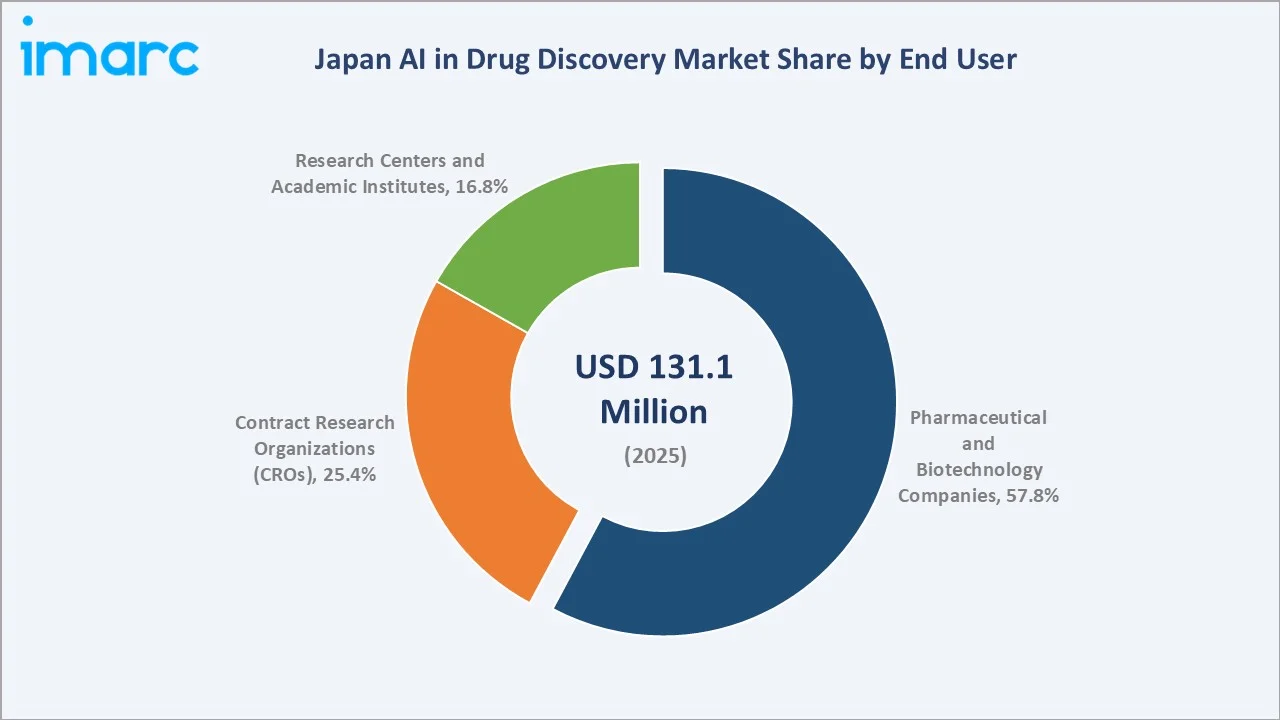
Contract research organizations (CROs) hold 25.4% share and represent the fastest-growing end user category, as pharmaceutical companies increasingly outsource AI-enabled screening work.
Regional Market Insights
|
Region |
Share (2025) |
Key Growth Drivers |
|
Kanto Region |
43.6% |
Concentration of pharmaceutical headquarters, research institutes, and AI technology vendors, supported by strong digital infrastructure |
|
Kansai/Kinki Region |
19.8% |
Established biotechnology and life sciences clusters, growing university-industry research collaboration |
|
Central/Chubu Region |
14.3% |
Expanding manufacturing and research base, rising adoption of digital health technologies |
|
Kyushu-Okinawa Region |
6.7% |
Growing biotechnology cluster investment, expanding academic-industry partnerships, government-backed regional innovation programs |
|
Tohoku Region |
5.4% |
Increasing university research activity, emerging life sciences innovation initiatives |
|
Chugoku Region |
4.3% |
Established chemical and pharmaceutical manufacturing base, gradual digital transformation adoption |
|
Hokkaido Region |
3.4% |
Growing agricultural biotechnology research base, expanding regional research funding |
|
Shikoku Region |
2.5% |
Small but growing pharmaceutical research presence, gradual technology adoption |
Kanto Region leads the regional landscape with 43.6% share in 2025, anchored by Tokyo's dense concentration of pharmaceutical company headquarters and AI technology vendors.
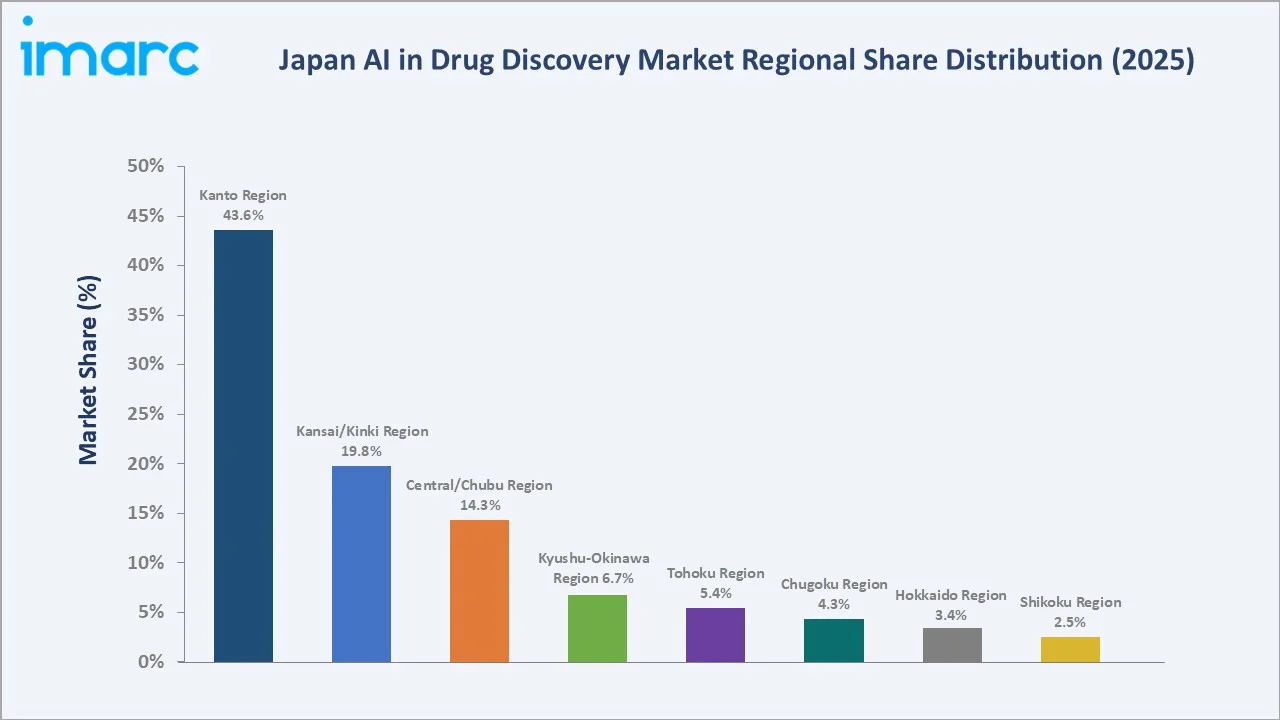
Kyushu-Okinawa Region, at 6.7%, is expanding fastest as government-backed regional innovation programs and academic partnerships strengthen local research capacity.
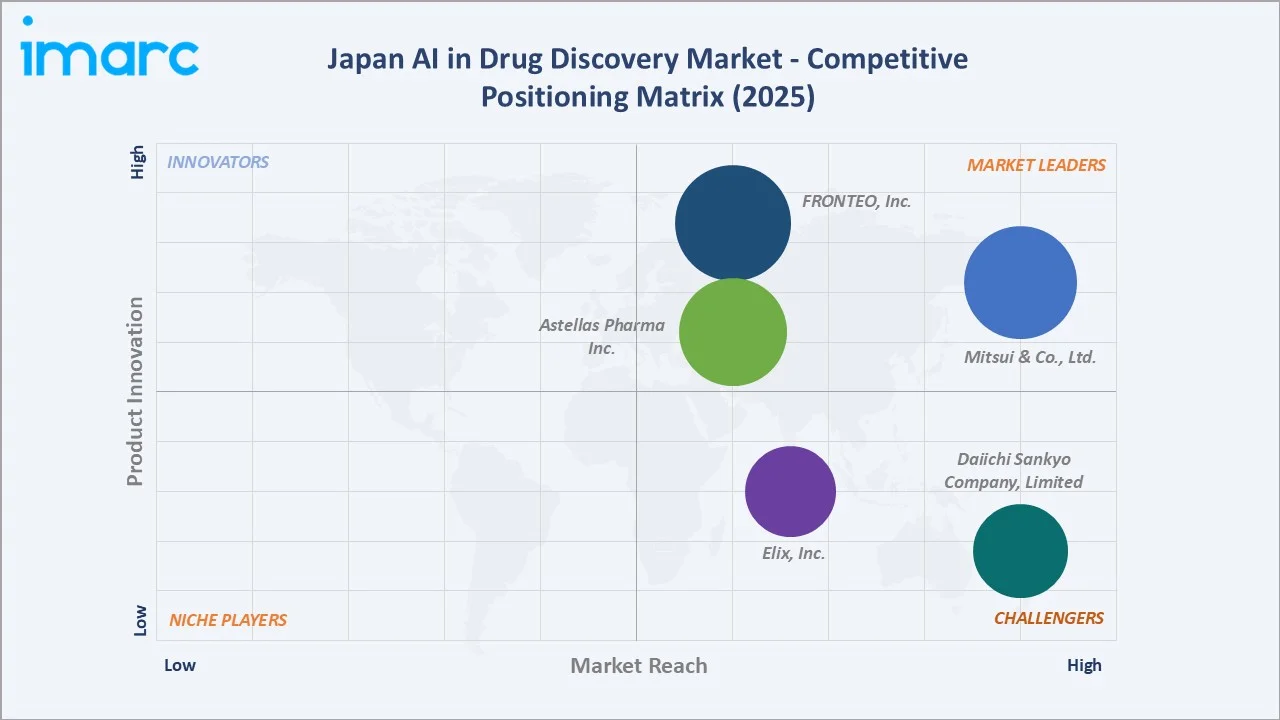
Competitive Landscape
The Japan AI in drug discovery market is moderately fragmented, with established pharmaceutical companies, specialized AI vendors, and government-backed consortia competing across platform capability, partnership breadth, and research depth. Technology differentiation, data access, and regulatory readiness form the key competitive levers shaping market position.
|
Company Name |
Brand / Key Product |
Position |
Strategic Focus |
|
FRONTEO, Inc. |
Drug Discovery AI Factory (DDAIF) |
Leader |
Strengthening AI-enabled target identification capabilities through expanded pharmaceutical partnerships |
|
Mitsui & Co., Ltd. |
Tokyo-1 |
Leader |
Scaling shared AI compute infrastructure across a growing pharmaceutical consortium |
|
Astellas Pharma Inc. |
Human-in-the-Loop |
Leader |
Deepening use of advanced computing platforms across discovery research workflows |
|
Elix, Inc. |
Elix Discovery |
Challenger |
Expanding platform adoption among pharmaceutical partners through customizable AI tools |
|
Daiichi Sankyo Company, Limited |
AI-Driven Ultra-Large-Scale Virtual Screening (ULVS) |
Challenger |
Expanding large-scale computational screening capabilities within internal research programs |
Key players include FRONTEO, Inc., Mitsui & Co., Ltd., Astellas Pharma Inc., Elix, Inc., and Daiichi Sankyo Company, Limited, among others.
Key Company Profiles
FRONTEO, Inc.
FRONTEO, Inc. is a Tokyo-headquartered, Tokyo Stock Exchange-listed company that applies AI and natural language processing to life sciences and drug discovery research.
- Product Portfolio: Drug Discovery AI Factory (DDAIF), an AI-enabled service supporting target identification and hypothesis generation for pharmaceutical research partners.
- Recent Developments: In November 2025, FRONTEO entered a joint research agreement with UBE Corporation to generate and out-license novel drug discovery targets using artificial intelligence.
- Strategic Focus: Enhancing drug target discovery by strengthening AI capabilities and deepening pharmaceutical collaborations.
Mitsui & Co., Ltd.
Mitsui & Co., Ltd. is a diversified Japanese trading and investment company that has expanded into AI-enabled pharmaceutical research as part of its broader healthcare and life sciences initiatives.
- Product Portfolio: Tokyo-1, an AI supercomputing platform supporting drug discovery research for member pharmaceutical companies.
- Recent Developments: The company continues to expand its AI computing infrastructure and consortium membership in collaboration with pharmaceutical research partners.
- Strategic Focus: Broadening shared AI computing resources to enable large-scale pharmaceutical collaboration.
Astellas Pharma Inc.
Astellas Pharma Inc. is a major Tokyo-headquartered pharmaceutical company with a global research and commercial presence across multiple therapeutic areas.
- Product Portfolio: Human-in-the-Loop, an internal AI-enabled discovery platform integrating computational tools with research workflows.
- Recent Developments: The company continues to broaden the use of advanced computing platforms across its internal discovery research operations.
- Strategic Focus: Leveraging advanced computing platforms to improve efficiency across discovery research workflows.
Market Concentration Analysis
The Japan AI in drug discovery market is moderately fragmented, with a mix of specialized AI vendors, established pharmaceutical companies, and government-backed consortia competing for research partnerships and platform adoption across the country.
Barriers to entry include the need for proprietary training data, deep pharmaceutical domain expertise, and access to high-performance computing infrastructure. These factors favor organizations with established pharmaceutical partnerships and differentiated technology platforms.
Consolidation activity is gradually increasing as pharmaceutical companies pursue closer partnerships, and in some cases equity investment, in AI-native drug discovery vendors to secure long-term access to differentiated technology capabilities.
Investment & Growth Opportunities
Fastest-Growing Segments
Contract research organizations (CROs) represent the fastest-growing end user category, expanding as pharmaceutical companies increasingly outsource AI-enabled screening and biomarker discovery work rather than building extensive in-house capability.
Emerging Regions
Kyushu-Okinawa Region represents a significant growth opportunity, supported by expanding biotechnology cluster investment and strengthening academic-industry research partnerships across the region.
Venture & Investment Trends
Investment activity is concentrated in generative AI foundation models, federated learning infrastructure, and platforms supporting cross-institutional data collaboration, reflecting broader industry priorities around data access and molecular design capability.
Future Market Outlook (2026-2034)
The Japan AI in drug discovery market is forecast to expand from USD 131.1 Million in 2025 to USD 796.1 Million by 2034, adding approximately USD 665.0 Million in incremental market value over the forecast period.
Several forces will shape the market through 2034: continued government support for sovereign AI infrastructure, deeper integration of generative and quantum-assisted AI methods, and expanding partnerships between AI vendors and pharmaceutical companies.
By 2034, the Japan AI in drug discovery market is expected to be defined by platform-led adoption across pharmaceutical companies, contract research organizations, and academic institutes, with software solutions continuing to anchor overall market demand.
Research Methodology
Primary Research
Primary research included structured interviews with AI platform vendors, pharmaceutical research executives, academic researchers, and technology infrastructure providers, validating market sizing, segment trends, and regional demand patterns.
Secondary Research
Secondary sources included Japanese government publications, industry association data, company press releases, investor presentations, and publicly available research collaboration announcements.
Forecasting Models
Market forecasts used top-down and bottom-up models incorporating platform adoption rates, pharmaceutical R&D spending patterns, and regional research infrastructure development, with scenario analysis addressing regulatory and technology adoption pace.
Japan AI in Drug Discovery Market Report Coverage:
|
Report Features |
Details |
|
Base Year of the Analysis |
2025 |
|
Historical Period |
2020-2025 |
|
Forecast Period |
2026-2034 |
|
Units |
Million USD |
|
Scope of the Report |
Exploration of Historical Trends and Market Outlook, Industry Catalysts and Challenges, Segment-Wise Historical and Future Market Assessment:
|
|
Offerings Covered |
Software, Services |
|
Applications Covered |
Preclinical Testing, Drug Optimization and Repurposing, Target Identification, Candidate Screening, Others |
|
Therapeutic Areas Covered |
Oncology, Neurodegenerative Diseases, Cardiovascular Diseases, Metabolic Diseases, Others |
|
End Users Covered |
Pharmaceutical and Biotechnology Companies, Contract Research Organizations (CROs), Research Centers and Academic Institutes |
|
Regions Covered |
Kanto Region, Kansai/Kinki Region, Central/Chubu Region, Kyushu-Okinawa Region, Tohoku Region, Chugoku Region, Hokkaido Region, Shikoku Region |
| Comapnies Covered | FRONTEO, Inc., Mitsui & Co., Ltd., Astellas Pharma Inc., Elix, Inc., Daiichi Sankyo Company, Limited, etc. |
|
Customization Scope |
10% Free Customization |
|
Post-Sale Analyst Support |
10-12 Weeks |
|
Delivery Format |
PDF and Excel through Email (We can also provide the editable version of the report in PPT/Word format on special request) |
Key Benefits for Stakeholders:
- IMARC's industry report offers a comprehensive quantitative analysis of various market segments, historical and current market trends, market forecasts, and dynamics of the Japan AI in drug discovery market from 2020-2034.
- The research report provides the latest information on the market drivers, challenges, and opportunities in the Japan AI in drug discovery market.
- Porter's five forces analysis assist stakeholders in assessing the impact of new entrants, competitive rivalry, supplier power, buyer power, and the threat of substitution. It helps stakeholders to analyze the level of competition within the Japan AI in drug discovery industry and its attractiveness.
- Competitive landscape allows stakeholders to understand their competitive environment and provides an insight into the current positions of key players in the market.
Frequently Asked Questions About the Japan AI in Drug Discovery Market Report
The market was valued at USD 131.1 Million in 2025, driven by expanding pharmaceutical adoption of AI-enabled discovery platforms across Japan.
The market is projected to grow at a CAGR of 22.20% between 2026 and 2034, reaching USD 796.1 Million by 2034, driven by expanding adoption of AI-powered drug discovery platforms and rising pharmaceutical R&D investments.
Software leads with a 68.4% share in 2025, driven by growing enterprise adoption of molecule-generation and virtual screening platforms.
Pharmaceutical and biotechnology companies lead with 57.8% share in 2025, reflecting their central role in funding AI-enabled discovery research.
Kanto Region commands 43.6% share in 2025, anchored by Tokyo's concentration of pharmaceutical companies and AI technology vendors.
Leading players include FRONTEO, Inc., Mitsui & Co., Ltd., Astellas Pharma Inc., Elix, Inc., and Daiichi Sankyo Company, Limited, among others.
Generative AI, quantum-AI hybrid computing, and federated learning are the key technologies shaping platform capability and adoption across the market.
Data privacy requirements, high implementation costs, and a shortage of professionals with combined AI and pharmaceutical research expertise remain key restraints.
Need more help?
- Speak to our experienced analysts for insights on the current market scenarios.
- Include additional segments and countries to customize the report as per your requirement.
- Gain an unparalleled competitive advantage in your domain by understanding how to utilize the report and positively impacting your operations and revenue.
- For further assistance, please connect with our analysts.
 Request Customization
 Speak to an Analyst
 Request Brochure
 Inquire Before Buying
Benefits of Customization
- Personalize this research
- Triangulate with your data
- Get data as per your format and definition
- Gain a deeper dive into a specific application, geography, customer, or competitor
- Any level of personalization
Get in Touch With Us
UNITED STATES
Phone: +1-201-971-6302
INDIA
Phone: +91-120-433-0800
UNITED KINGDOM
Phone: +44-753-714-6104
Email: sales@imarcgroup.com
Client Testimonials




.webp)




.webp)













Related Reports

Choose your plan
*Please note that the prices mentioned below are starting prices for each bundle type. Kindly contact our team for further details.*
Single User License
- 1 User License, Access on 2 Devices
- PDF Report + Excel Dataset (Password Protected)
- Lifetime Access
- No Printing Rights
- 10% Free Report Customization
- 10–12 Weeks of Analyst Support
Five User License
- Access for 5 Users, 2 Devices per User
- PDF Report + Excel Dataset (Password Protected)
- Lifetime Access
- Dedicated Account Manager
- 12–14 Weeks of Analyst Support
- No Printing Rights
- 15% Free Report Customization
- 25% Discount on Your Next Purchase
Corporate User License
- Unlimited User Access (Within Your Organization)
- PDF Report + Excel Dataset
- Lifetime Access
- Dedicated Account Manager
- 14–20 Weeks of Analyst Support
- No Printing Rights
- 20% Free Report Customization
- 30% Discount on Your Next Purchase
Essential Insights
What's included:
3 reports
- Lifetime Access
- PDF Reports
- Excel Datasets
- 2 Weeks of Free Analyst Support
- 2 User Licenses
- Access on 2 Devices
- Printing Rights
- Complimentary PowerPoint (PPT) Version
- Complimentary License Upgrade
Professional Access
What's included:
5 reports
- Lifetime Access
- PDF Reports
- Excel Datasets
- 8 Weeks of Free Analyst Support
- 2 User Licenses
- Access on 2 Devices
- Printing Rights
- Complimentary PowerPoint (PPT) Version
- Complimentary License Upgrade
Business Advantage
What's included:
8 reports
- Lifetime Access
- PDF Reports
- Excel Datasets
- 14 Weeks of Free Analyst Support
- 2 User Licenses
- Access on 2 Devices
- Printing Rights
- Complimentary PowerPoint (PPT) Version
- Complimentary License Upgrade
Enterprise Intelligence
What's included:
10 reports
- Lifetime Access
- PDF Reports
- Excel Datasets
- 20 Weeks of Free Analyst Support
- 2 User Licenses
- Access on 2 Devices
- Printing Rights
- Complimentary PowerPoint (PPT) Version
- Complimentary License Upgrade