
Japan Air Purifier Market Size, Share, Trends and Forecast by Technology, Application, and Region, 2026-2034
Japan Air Purifier Market Summary:
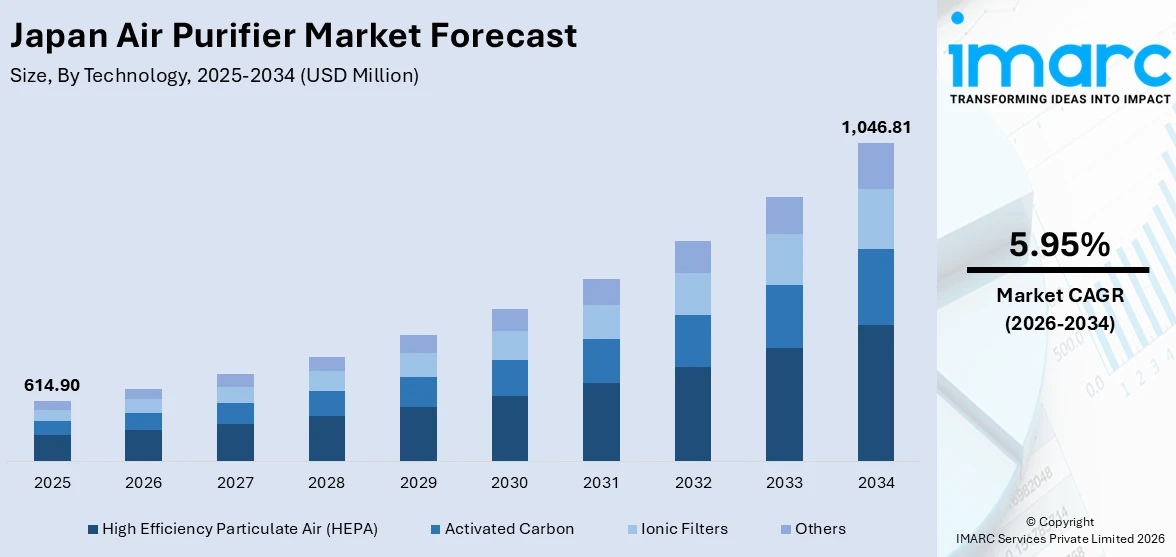
The Japan air purifier market size was valued at USD 614.90 Million in 2025 and is projected to reach USD 1,046.81 Million by 2034, growing at a compound annual growth rate of 5.95% from 2026-2034.
The market is driven by escalating urban air pollution levels, growing health consciousness, and the rising prevalence of seasonal allergens and respiratory ailments across Japanese households. Government regulations promoting energy-efficient appliances, alongside rapid urbanization and the integration of smart home technologies, are boosting adoption across residential and commercial sectors. The increasing demand for compact, multi-functional purification solutions continues to expand the Japan air purifier market share.
Key Takeaways and Insights:
- By Technology: High efficiency particulate air (HEPA) dominates the market with a share of 46.8% in 2025, driven by its proven efficacy in capturing fine particulate matter, allergens, and airborne pollutants across Japanese residential and commercial settings.
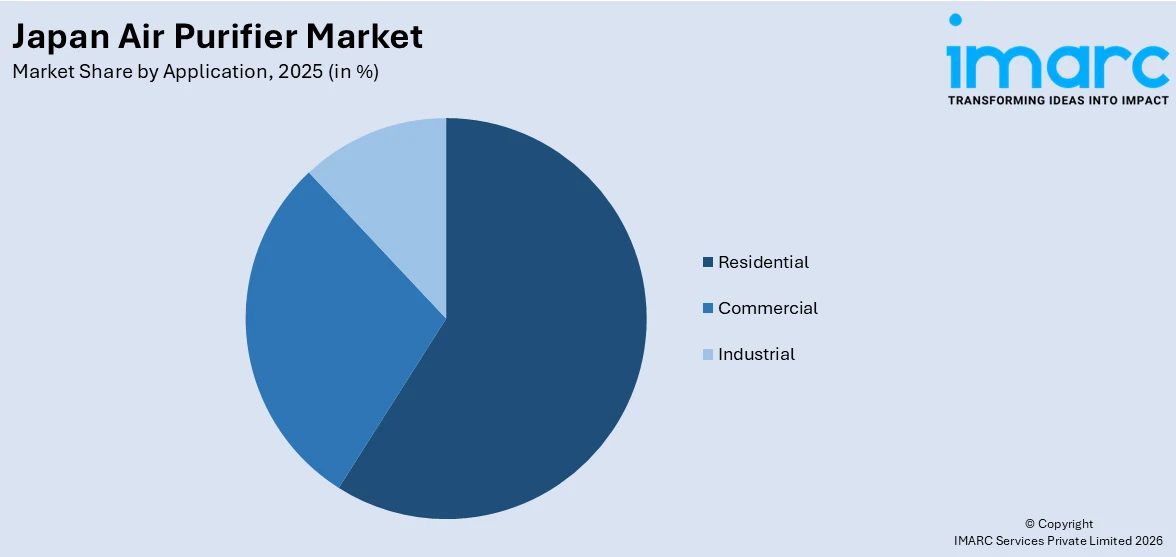
- By Application: Residential leads the market with a share of 58.3% in 2025, owing to rising indoor air quality awareness, growing disposable incomes, and widespread adoption of air purifiers as essential wellness appliances in urban Japan.
- By Region: Kanto Region dominates the market with a share of 36.1% in 2025, driven by Tokyo's exceptionally high population density, elevated urban pollution levels, and strong consumer demand for advanced air purification technologies.
- Key Players: The Japan air purifier market features established domestic manufacturers with strong brand equity alongside international brands competing through premium innovation, defining a landscape of technology leadership and continuous product differentiation. Some of the key players operating in the market include Coway Co., Ltd. (Netmarble Corp.), Daikin Industries Ltd., Dyson Corporation, Hitachi, Ltd., Mitsubishi Electric Corporation, Panasonic Corporation, and Sharp Corporation.
To get more information on this market Request Sample
The Japan air purifier market is experiencing sustained momentum driven by a convergence of environmental, demographic, and lifestyle factors shaping consumer behavior across the country. Escalating urban air pollution, particularly the accumulation of fine particulate matter and industrial emissions in densely populated metropolitan areas, has heightened public awareness of indoor air quality to unprecedented levels. Japan's geriatric population, which is disproportionately susceptible to respiratory and cardiovascular ailments, is increasingly adopting advanced filtration technologies as a proactive health measure. According to reports, in February 2024, the Japan Weather Association announced that cedar pollen had begun dispersing widely across Japan from Kyushu through parts of the Tohoku region, following unseasonably warm conditions that accelerated the start of the pollen season. The widespread prevalence of seasonal allergens, most notably cedar and cypress pollen, generates consistent cyclical demand for high-efficiency purifiers throughout the year.
Japan Air Purifier Market Trends:
Increasing Adoption of IoT-Enabled and Smart Air Purifiers
The convergence of air purification with smart home ecosystems is reshaping consumer expectations across Japan. IoT-enabled purifiers allow homeowners to remotely monitor indoor air quality through smartphone applications and receive real-time filter alerts. AI-powered sensors automatically modulate purification intensity based on detected pollution levels, delivering optimized performance with minimal user effort. In September 2024, Sharp Corporation launched new Plasmacluster‑equipped air purifiers featuring an “AI‑Monitor” that visualizes indoor particle counts and intelligently adjusts purification settings, offering users detailed air quality feedback and automated control.
Growing Popularity of Compact and Multi-Functional Air Purifier Designs
Japan's urban living environment, defined by compact residential spaces and modern aesthetic sensibilities, is fueling strong demand for space-efficient air purifiers. Manufacturers are developing sleek, portable units integrating multiple capabilities including humidification, deodorization, and ionization within a single design. As per sources, Panasonic highlighted its nanoe X‑equipped compact air purifiers in product promotions emphasizing multifunction performance, combining advanced deodorization, allergen suppression, and humidification features with smartphone app connectivity for remote operation. These multi-functional devices deliver comprehensive indoor air management without occupying excessive living space, aligning with minimalist preferences prevalent in Japanese homes.
Sustainability and Energy Efficiency as Key Competitive Differentiators
Environmental consciousness is increasingly shaping purchasing decisions across Japan's air purifier market. Consumers favor products featuring reusable filter components, energy-saving operational modes, and eco-certified materials that minimize environmental impact. This preference aligns strongly with Japan's national sustainability objectives and broader societal shifts toward responsible consumption. In November 2025, Shinshu Ceramics Co., Ltd. won the Eco‑Mark Award 2025’s Excellence Prize for its “Earthplus™” air purifier, which uses 61% recycled plastic from discarded appliances and is recognised for advancing circular economy principles in home air purification products. Manufacturers are advancing eco-friendly purifiers with longer-lasting filters, lower energy use, and recyclable materials, emphasizing sustainability as a key market differentiator in Japan.
Market Outlook 2026-2034:
The air purifier market in Japan is expected to exhibit consistent and promising growth over the forecast period, owing to increasing health awareness, ongoing technological advancements, and changing consumer behavior towards smart and energy-efficient air purifiers. The increasing trend of urbanization, recurring seasonal allergens, and favorable government initiatives for environmental protection are expected to collectively drive the air purifier market in Japan, making it an extremely favorable market for manufacturers to invest in, as the market outlook for air purifiers in Japan is consistently promising over the forecast period. The market generated a revenue of USD 614.90 Million in 2025 and is projected to reach a revenue of USD 1,046.81 Million by 2034, growing at a compound annual growth rate of 5.95% from 2026-2034.
Japan Air Purifier Market Report Segmentation:
| Segment Category | Leading Segment | Market Share |
|---|---|---|
|
Technology |
High Efficiency Particulate Air (HEPA) |
46.8% |
|
Application |
Residential |
58.3% |
|
Region |
Kanto Region |
36.1% |
Technology Insights:
- High Efficiency Particulate Air (HEPA)
- Activated Carbon
- Ionic Filters
- Others
High efficiency particulate air (HEPA) dominates with a market share of 46.8% of the total Japan air purifier market in 2025.
High efficiency particulate air (HEPA) holds the dominant position in the Japan air purifier market owing to its exceptional ability to capture fine particulate matter, allergens, dust, mold spores, and airborne microorganisms from indoor environments. In April 2024, Dyson Japan released the Purifier Hot+Cool™ Gen1 and Purifier Cool™ Gen1 air purifiers featuring H13 HEPA filters that capture 99.95% of PM0.1 particles, reinforcing consumer confidence in high-efficiency filtration. Its proven clinical credibility and widespread endorsement by healthcare professionals make it the most trusted filtration technology among Japanese consumers.
HEPA technology continues to advance in terms of the integration of medical-grade filter varieties that provide higher levels of particle capture efficiency, which can be used to treat serious respiratory issues. Manufacturers are continuing to advance HEPA technology by combining it with other types of filters that provide a higher range of effectiveness. HEPA technology's proven effectiveness continues to provide a high level of consumer loyalty in terms of repurchasing and upgrading products. As consumers become more health-conscious and demand higher levels of indoor air quality, HEPA technology continues to provide the base technology that underpins all application categories in Japan.
Application Insights:
Access the comprehensive market breakdown Request Sample
- Commercial
- Retail Shops
- Offices
- Healthcare Facilities
- Hospitality
- Schools and Educational Institutions
- Laboratories
- Transport
- Others
- Residential
- Industrial
Residential leads with a share of 58.3% of the total Japan air purifier market in 2025.
Residential commands the dominant position in the Japan air purifier market, driven by growing household awareness of indoor air quality, rising disposable incomes, and the widespread recognition of air purifiers as essential wellness appliances. Japanese homeowners are increasingly investing in advanced filtration solutions to combat allergens, odors, and airborne pollutants within compact urban living spaces. The proliferation of health-conscious consumer behavior, alongside targeted awareness campaigns, continues to drive strong residential market penetration across both urban and suburban environments throughout the country.
Residential demand is further reinforced by Japan's geriatric population, which requires consistent access to clean indoor air for managing respiratory sensitivities and maintaining overall wellbeing. The growing availability of aesthetically refined compact models suited to Japanese apartment living has significantly broadened the accessible consumer base. Smart connectivity features enabling remote monitoring and automated operation resonate strongly with technologically engaged homeowners. These converging lifestyle, demographic, and product innovation factors collectively sustain the Residential segment's commanding leadership position across the Japan air purifier market throughout the forecast period.
Regional Insights:
- Kanto Region
- Kansai/Kinki Region
- Central/ Chubu Region
- Kyushu-Okinawa Region
- Tohoku Region
- Chugoku Region
- Hokkaido Region
- Shikoku Region
Kanto Region dominates with a market share of 36.1% of the total Japan air purifier market in 2025.
Kanto Region leads the Japan air purifier market, primarily driven by Tokyo's exceptional population concentration, elevated urban pollution levels generated by dense vehicular traffic and industrial activity, and above-average consumer spending capacity. Residents of this highly urbanized region demonstrate strong preference for advanced filtration and smart-enabled purification solutions. The area's well-developed retail infrastructure, high technology adoption rates, and concentration of corporate offices further support widespread penetration of premium air purifier models across both residential and commercial sectors throughout the region.
The region's dominance is also underpinned by its exceptionally high density of healthcare institutions, educational facilities, and hospitality establishments, all of which actively invest in air purification to meet rising hygiene and wellness expectations. Consumers in this region exhibit strong brand loyalty toward technologically advanced products, driving consistent demand for premium and feature-rich purifier models. The presence of major retail hubs and robust e-commerce adoption further facilitates product accessibility, reinforcing the Kanto Region's position as the primary revenue-generating market within Japan's air purifier landscape.
Market Dynamics:
Growth Drivers:
Why is the Japan Air Purifier Market Growing?
Rising Health Consciousness and Respiratory Wellness Prioritization
Growing public awareness of the long-term health consequences associated with poor indoor air quality is fundamentally reshaping consumer behavior across Japan. Increasing incidence of respiratory ailments, allergies, and airborne illness has elevated air purification from a discretionary purchase to an essential household investment. In January 2026, a Panasonic Homes nationwide survey found only about 11.8% of Japanese homeowners successfully maintained both “comfortable temperature and clean air,” while nearly 70% desired environments that automatically ensure healthy indoor air. Healthcare professionals and wellness advocates are actively promoting clean indoor air as a preventive health measure, encouraging broader adoption across all demographic segments.
Rapid Urbanization and Expansion of Commercial Infrastructure
Japan's ongoing urbanization is generating expanding demand for air purification solutions across newly developed residential communities, commercial complexes, and public infrastructure. As cities grow denser and indoor environments become increasingly enclosed, effective air quality management becomes operationally essential for offices, retail establishments, healthcare institutions, and hospitality venues. In May 2025, the National Institute of Advanced Industrial Science and Technology (AIST) and Daikin jointly demonstrated that proper use of air purifiers with HVAC filters can reduce indoor particle concentrations by up to 88%, validating the importance of air purification in indoor environments. Property developers and facility managers are proactively incorporating air purification systems into building specifications to meet rising occupant wellness expectations.
Increasing Consumer Preference for Premium and Technologically Advanced Products
Major trends in this market include circular economy compliance, biopolymer and bagasse innovation, food delivery packaging demand, international hospitality sustainability standards, and adoption of eco-certification programs Japanese consumers have always shown a strong inclination towards investing in high-quality, technologically advanced home appliances that provide a significant impact on their lifestyles and overall wellness. This is one factor that is benefiting the air purifiers market in Japan, as people are increasingly looking for home appliances that offer advanced air purification capabilities, automation, and stylish integration in their living environments. Thus, companies are launching their innovative product portfolios in this market, thereby fueling the growth of this market in Japan.
Market Restraints:
What Challenges the Japan Air Purifier Market is Facing?
High Initial Cost and Ongoing Maintenance Expenses
Premium air purifiers equipped with advanced multi-stage filtration and smart connectivity command substantial upfront investment, creating affordability barriers for cost-sensitive consumer segments. Recurring filter replacement expenses further elevate total ownership costs, prompting many households to delay purchases or opt for lower-performance alternatives. This pricing constraint is particularly pronounced beyond major metropolitan centers, restricting broader national market penetration.
Limited Consumer Awareness in Rural and Semi-Urban Markets
Despite robust adoption in major urban centers, significant consumer segments in rural and semi-urban Japan remain inadequately informed about the health benefits of air purifiers. Skepticism toward product efficacy, combined with limited retail distribution infrastructure outside metropolitan areas, restricts market expansion into underpenetrated regions, slowing adoption velocity among these otherwise accessible potential buyer segments.
Market Saturation Pressures in Mature Urban Segments
Established metropolitan markets, particularly within the Kanto Region, are approaching elevated household penetration levels as early adopters have already equipped their living spaces with air purification systems. As fresh adoption opportunities diminish, replacement purchasing becomes the primary revenue driver, intensifying pressure on manufacturers to accelerate product innovation and stimulate upgrade-driven demand among existing customers.
Competitive Landscape:
The Japan air purifier market features a competitive landscape shaped by the coexistence of well-established domestic manufacturers and expanding international brands, each bringing distinct competitive strengths. Domestic players leverage deep distribution networks, enduring brand equity, and a strong reputation for precision engineering that resonates profoundly with Japanese consumers. International brands compete through premium design aesthetics, innovative filtration technologies, and aspirational positioning tailored to discerning local preferences. Competitive intensity is further heightened by rapid product innovation cycles, growing e-commerce channel rivalry, and increasing emphasis on smart connectivity, energy efficiency certifications, and sustainable manufacturing practices as key differentiating factors driving market positioning strategies.
Some of the key players include:
- Coway Co., Ltd. (Netmarble Corp.)
- Daikin Industries Ltd.
- Dyson Corporation
- Hitachi, Ltd.
- Mitsubishi Electric Corporation
- Panasonic Corporation
- Sharp Corporation
Recent Developments:
- In December 2024, Blueair Japan launched its first multi-functional air purifiers, including a 2-in-1 Humidifying Air Purifier and the Classic Pro. These models combine high-performance air purification with added humidification and temperature control, marking the brand’s expansion into the “Air Wellness” segment for health-conscious Japanese consumers.
Japan Air Purifier Market Report Scope:
| Report Features | Details |
|---|---|
| Base Year of the Analysis | 2025 |
| Historical Period | 2020-2025 |
| Forecast Period | 2026-2034 |
| Units | Million USD |
| Scope of the Report | Exploration of Historical Trends and Market Outlook, Industry Catalysts and Challenges, Segment-Wise Historical and Future Market Assessment:
|
| Technologies Covered | High Efficiency Particulate Air (HEPA), Activated Carbon, Ionic Filters, Others |
| Applications Covered |
|
| Regions Covered | Kanto Region, Kansai/Kinki Region, Central/ Chubu Region, Kyushu-Okinawa Region, Tohoku Region, Chugoku Region, Hokkaido Region, Shikoku Region |
| Companies Covered | Coway Co. Ltd. (Netmarble Corp.), Daikin Industries Ltd., Dyson Corporation, Hitachi Ltd., Mitsubishi Electric Corporation, Panasonic Corporation, Sharp Corporation |
| Customization Scope | 10% Free Customization |
| Post-Sale Analyst Support | 10-12 Weeks |
| Delivery Format | PDF and Excel through Email (We can also provide the editable version of the report in PPT/Word format on special request) |
Frequently Asked Questions About the Japan Air Purifier Market Report
The Japan air purifier market reached a value of USD 614.90 Million in 2025.
The market is projected to grow at a CAGR of 5.95% during 2026-2034, reaching USD 1,046.81 Million by 2034.
Key growth drivers include heightened consumer awareness of indoor air quality post-COVID-19, rising prevalence of respiratory allergies and asthma, increasing PM2.5 and cross-border air pollution concerns, expanding smart home adoption, and growing demand for HEPA and activated carbon filtration technologies across residential and commercial settings.
The report covers segmentation by technology, application, and region. Each segment includes detailed market size and forecast analysis.
Major players in the Japan air purifier market include Coway Co., Ltd. (Netmarble Corp.), Daikin Industries Ltd., Dyson Corporation, Hitachi, Ltd., Mitsubishi Electric Corporation, Panasonic Corporation, Sharp Corporation, etc.
Key trends include accelerating integration of IoT-enabled air quality sensors and app-based controls, rising demand for multi-functional purifier-humidifier combos, growing adoption of plasmacluster and nanoe™ ionization technologies, increasing preference for energy-efficient DC motor units, and expanding deployment in healthcare facilities and schools.
Need more help?
- Speak to our experienced analysts for insights on the current market scenarios.
- Include additional segments and countries to customize the report as per your requirement.
- Gain an unparalleled competitive advantage in your domain by understanding how to utilize the report and positively impacting your operations and revenue.
- For further assistance, please connect with our analysts.
 Request Customization
 Speak to an Analyst
 Request Brochure
 Inquire Before Buying
Benefits of Customization
- Personalize this research
- Triangulate with your data
- Get data as per your format and definition
- Gain a deeper dive into a specific application, geography, customer, or competitor
- Any level of personalization
Get in Touch With Us
UNITED STATES
Phone: +1-201-971-6302
INDIA
Phone: +91-120-433-0800
UNITED KINGDOM
Phone: +44-753-714-6104
Email: [email protected]
Client Testimonials




.webp)




.webp)













Related Reports

Choose your plan
*Please note that the prices mentioned below are starting prices for each bundle type. Kindly contact our team for further details.*
Single User License
- 1 User License, Access on 2 Devices
- PDF Report + Excel Dataset (Password Protected)
- Lifetime Access
- No Printing Rights
- 10% Free Report Customization
- 10–12 Weeks of Analyst Support
Five User License
- Access for 5 Users, 2 Devices per User
- PDF Report + Excel Dataset (Password Protected)
- Lifetime Access
- Dedicated Account Manager
- 12–14 Weeks of Analyst Support
- No Printing Rights
- 15% Free Report Customization
- 25% Discount on Your Next Purchase
Corporate User License
- Unlimited User Access (Within Your Organization)
- PDF Report + Excel Dataset
- Lifetime Access
- Dedicated Account Manager
- 14–20 Weeks of Analyst Support
- No Printing Rights
- 20% Free Report Customization
- 30% Discount on Your Next Purchase
Essential Insights
What's included:
3 reports
- Lifetime Access
- PDF Reports
- Excel Datasets
- 2 Weeks of Free Analyst Support
- 2 User Licenses
- Access on 2 Devices
- Printing Rights
- Complimentary PowerPoint (PPT) Version
- Complimentary License Upgrade
Professional Access
What's included:
5 reports
- Lifetime Access
- PDF Reports
- Excel Datasets
- 8 Weeks of Free Analyst Support
- 2 User Licenses
- Access on 2 Devices
- Printing Rights
- Complimentary PowerPoint (PPT) Version
- Complimentary License Upgrade
Business Advantage
What's included:
8 reports
- Lifetime Access
- PDF Reports
- Excel Datasets
- 14 Weeks of Free Analyst Support
- 2 User Licenses
- Access on 2 Devices
- Printing Rights
- Complimentary PowerPoint (PPT) Version
- Complimentary License Upgrade
Enterprise Intelligence
What's included:
10 reports
- Lifetime Access
- PDF Reports
- Excel Datasets
- 20 Weeks of Free Analyst Support
- 2 User Licenses
- Access on 2 Devices
- Printing Rights
- Complimentary PowerPoint (PPT) Version
- Complimentary License Upgrade