
Japan Aviation MRO Logistics Market Size, Share, Trends and Forecast by Application, Type, and Region, 2026-2034
Japan Aviation MRO Logistics Market Summary:
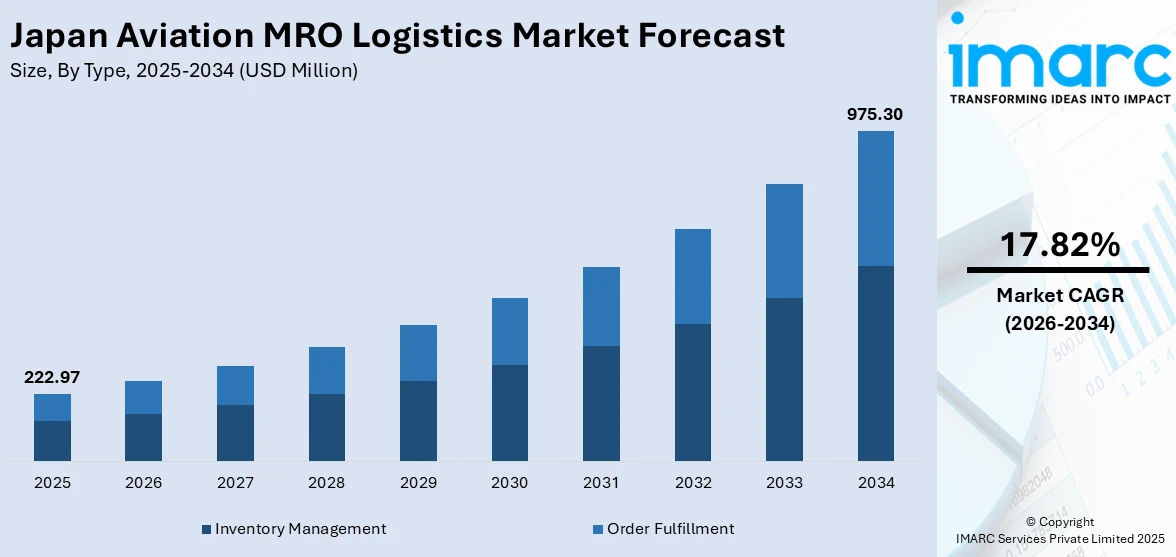
The Japan aviation MRO logistics market size was valued at USD 222.97 Million in 2025 and is projected to reach USD 975.30 Million by 2034, growing at a compound annual growth rate of 17.82% from 2026-2034.
The Japan aviation MRO logistics market is experiencing strong momentum as rising air passenger traffic, fleet modernization efforts, and defense spending expansion drive sustained demand for efficient maintenance supply chains. Increasing adoption of digital technologies such as predictive analytics and IoT-enabled monitoring is transforming inventory management and order fulfillment operations across the sector. Continued airport infrastructure development, growing international tourism, and the integration of advanced logistics solutions are reinforcing the market’s upward trajectory, thereby increasing the Japan aviation MRO logistics market share.
Key Takeaways and Insights:
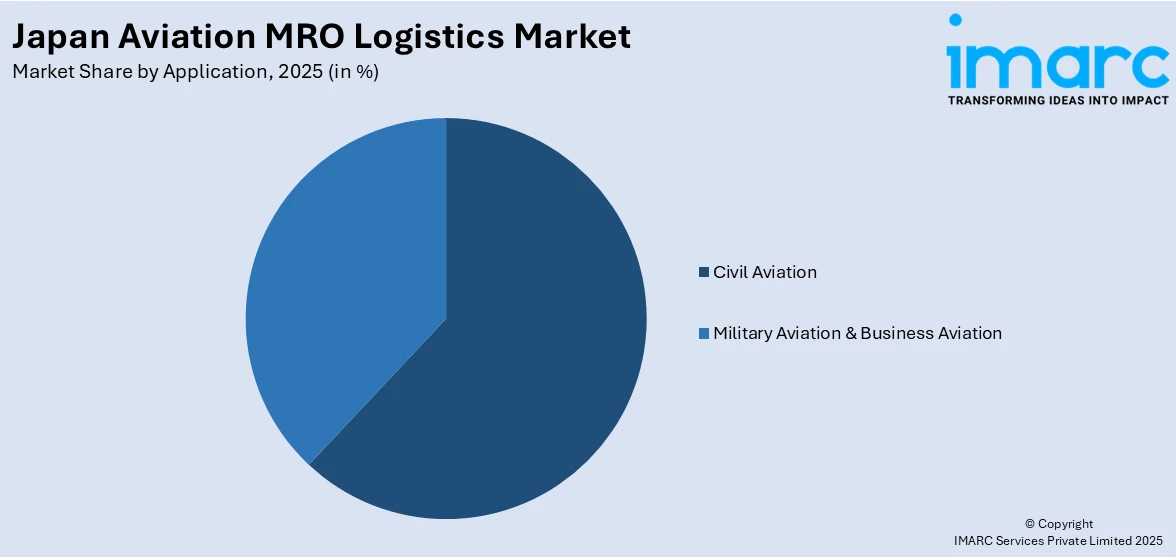
- By Application: Civil aviation dominates the market with a share of 62.4% in 2025, owing to the rapid recovery of commercial air travel, rising passenger volumes at major airports, and ongoing fleet renewal programs by leading Japanese carriers that necessitate comprehensive maintenance logistics support.
- By Type: Inventory management leads the market with a share of 54.1% in 2025, driven by the growing complexity of aircraft fleets requiring sophisticated spare parts tracking, demand forecasting, and warehousing solutions to minimize aircraft downtime and maintain operational efficiency.
- By Region: Kanto region represents the largest region with 35.6% share in 2025, reflecting the concentration of Japan’s busiest airports including Tokyo Haneda and Narita International, alongside the presence of major airline headquarters, MRO service providers, and logistics infrastructure.
- Key Players: Key players in the Japan aviation MRO logistics market drive growth by investing in digital supply chain solutions, expanding warehouse capabilities, strengthening partnerships with airlines and OEMs, and enhancing regional distribution networks to improve parts availability and reduce aircraft turnaround times.
To get more information on this market Request Sample
The Japan aviation MRO logistics market is advancing as airlines, defense organizations, and logistics providers collaborate to build more resilient and technology-driven maintenance supply chains. The expansion of commercial fleets, driven by surging international tourism and recovering domestic travel, is amplifying the need for efficient parts procurement, warehousing, and delivery systems. Military aviation modernization, supported by record defense spending allocations, is further generating demand for specialized logistics infrastructure. Digital transformation is reshaping the sector, with carriers and MRO firms increasingly deploying AI-powered analytics, IoT-based monitoring, and cloud-native platforms to optimize inventory management and streamline order fulfillment. The growing emphasis on supply chain visibility, automation, and real-time tracking capabilities is enabling providers to deliver components faster while reducing costs, contributing to a more efficient and resilient Japan aviation MRO logistics market growth ecosystem that supports the nation’s broader aerospace ambitions.
Japan Aviation MRO Logistics Market Trends:
Accelerated Adoption of AI and Predictive Maintenance Technologies
The aviation maintenance industry in Japan is gradually embracing the use of artificial intelligence and predictive analysis to improve the efficiency of logistics and minimize aircraft downtime. MRO companies and airlines are leveraging the use of IoT sensors and machine learning to track the condition of aircraft components in real time, making it possible to procure parts proactively. The technology also makes it possible for maintenance companies to predict failures before they happen, reducing the need for reactive maintenance cycles and minimizing aircraft-on-ground situations. This is revolutionizing the way spare parts are managed in maintenance networks.
Expansion of Domestic MRO Infrastructure and Capabilities
Japan is strengthening its domestic MRO infrastructure to capture growing regional maintenance demand and reduce reliance on overseas service providers. New facilities and strategic partnerships are expanding the scope of services offered within the country, from airframe overhaul to passenger-to-freighter conversions. For instance, in November 2024, MRO Japan partnered with Germany-based Elbe Flugzeugwerke to perform A320P2F and A321P2F passenger-to-freighter conversions, marking a significant expansion of Japan’s MRO capabilities and supporting the Japan aviation MRO logistics market growth.
Fleet Modernization Driving Complex Logistics Requirements
Japanese carriers are actively renewing their fleets with next-generation aircraft, creating increasingly complex maintenance logistics demands. Advanced composite materials, new engine types, and sophisticated avionics systems require specialized parts inventories and supply chain capabilities. For instance, in March 2024, Japan Airlines announced plans to introduce 42 new aircraft, including Airbus A350-900, A321neo, and Boeing 787-9 models, as part of its comprehensive fleet renewal strategy. This modernization trend is driving demand for upgraded logistics platforms capable of managing diverse component requirements.
Market Outlook 2026-2034:
The Japan aviation MRO logistics market is poised for robust expansion over the forecast period, underpinned by sustained growth in air passenger traffic, accelerating fleet modernization, and rising defense expenditure. The convergence of digital transformation in maintenance operations with expanding airport infrastructure is creating a favorable environment for logistics service providers. Japan welcomed a record 36.9 million international visitors in 2024, representing a 47% increase from the previous year, which is amplifying demand for commercial aviation MRO services and the logistics required to support them. Major infrastructure projects are expected to further stimulate long-term demand. As airlines continue to invest in next-generation aircraft and defense modernization programs accelerate, the need for sophisticated inventory management systems, real-time tracking solutions, and efficient order fulfillment networks will continue to strengthen, driving sustained market expansion across Japan. The market generated a revenue of USD 222.97 Million in 2025 and is projected to reach a revenue of USD 975.30 Million by 2034, growing at a compound annual growth rate of 17.82% from 2026-2034.
Japan Aviation MRO Logistics Market Report Segmentation:
|
Segment Category |
Leading Segment |
Market Share |
|
Application |
Civil Aviation |
62.4% |
|
Type |
Inventory Management |
54.1% |
|
Region |
Kanto Region |
35.6% |
Application Insights:
Access the comprehensive market breakdown Request Sample
- Civil Aviation
- Military Aviation & Business Aviation
Civil aviation dominates with a market share of 62.4% of the total Japan aviation MRO logistics market in 2025.
The civil aviation segment leads the Japan aviation MRO logistics market, reflecting the country’s extensive commercial airline operations and rising passenger volumes. Japan’s two largest carriers, All Nippon Airways and Japan Airlines, operate substantial domestic and international networks that require continuous maintenance logistics support. The recovery of air travel has significantly increased demand for spare parts management, component distribution, and just-in-time delivery services across major airports. In 2025, Tokyo Haneda Airport surpassed 90 million passengers for the first time in history, underscoring the scale of commercial aviation activity driving MRO logistics requirements in Japan.
Commercial aviation MRO logistics demand is further amplified by ongoing fleet renewal programs, as airlines introduce next-generation aircraft with distinct maintenance profiles. The transition to newer models such as the Airbus A350 and Boeing 787 creates parallel logistics requirements for both legacy and modern fleets, necessitating expanded warehousing, diversified parts inventories, and enhanced distribution capabilities. The growing complexity of aircraft systems, including advanced avionics and composite structures, requires specialized component sourcing and precise inventory management, reinforcing the civil aviation segment’s dominant position in the market.
Type Insights:
- Order Fulfillment
- Inventory Management
Inventory management leads with a share of 54.1% of the total Japan aviation MRO logistics market in 2025.
Inventory management represents the largest segment in the Japan aviation MRO logistics market, driven by the critical need to maintain optimal stock levels of aircraft components, engine parts, and consumables across multiple maintenance facilities. Effective inventory management minimizes aircraft-on-ground events and ensures rapid turnaround times, which are essential for maintaining flight schedules and operational efficiency. Japanese airlines and MRO providers are increasingly deploying digital inventory solutions, including AI-driven demand forecasting and automated replenishment systems.
The complexity of managing inventories for diverse fleet types, spanning narrow-body, wide-body, and regional aircraft, requires sophisticated tracking and warehousing systems. MRO logistics providers are investing in cloud-based platforms that offer real-time visibility into parts availability, location, and condition, enabling more efficient allocation of resources across multiple maintenance sites. The integration of blockchain technology for parts traceability and certification verification is emerging as an additional capability that enhances inventory accuracy and regulatory compliance, further strengthening the segment’s market position in Japan.
Regional Insights:
- Kanto Region
- Kansai/Kinki Region
- Central/Chubu Region
- Kyushu-Okinawa Region
- Tohoku Region
- Chugoku Region
- Hokkaido Region
- Shikoku Region
The Kanto Region exhibits a clear dominance with a 35.6% share of the total Japan aviation MRO logistics market in 2025.
The Kanto Region is the leading market for aviation MRO logistics in the Japan aviation market, with the presence of Tokyo Haneda and Narita International Airports, which are the main entry points for domestic and overseas air traffic. The two airports are home to the headquarters of Japan’s major airlines, as well as the country’s major MRO facilities, logistics warehouses, and parts distribution centers that comprise the core of the country’s aviation maintenance logistics chain. The two airports handled a large number of passengers in 2024, thus creating a huge demand for spare parts management and logistics services.
The Kanto Region’s dominance is further reinforced by ongoing infrastructure expansion that is strengthening its aviation logistics capabilities. Narita Airport, which manages 17% of the value of all cargo entering Japan, is undergoing a ¥670 Billion expansion project that broke ground in May 2025, featuring a new 3,500-meter third runway to increase annual aircraft movements from 300,000 to 500,000. The construction of a new automated cargo terminal and passenger terminal consolidation are creating enhanced logistics infrastructure that will directly benefit MRO supply chain operations and further consolidate the Kanto region’s position as the primary hub for aviation maintenance logistics in Japan.
Market Dynamics:
Growth Drivers:
Why is the Japan Aviation MRO Logistics Market Growing?
Surging Air Passenger Traffic and International Tourism Recovery
The Japanese aviation industry is currently undergoing a strong revival in passenger traffic, driven by a strong recovery in international tourism and a steady build-up in domestic tourism. The steady growth in flight operations is driving higher utilization rates for aircraft, which in turn drives the need for more frequent maintenance events and the associated logistics support. Airlines are flying their aircraft at high utilization rates, driving the need for efficient access to spare parts, tools, and consumables to support service schedules. The strong growth in inbound tourism is a key driver for MRO logistics demand, as airlines operate additional flights to support the growth in tourist traffic, which is putting intense pressure on maintenance schedules and driving the need for efficient inventory management and order fulfillment capabilities.
Record Defense Expenditure and Military Aviation Modernization
The increasing pace of the Japanese defense buildup is creating a significant demand for specialized aviation MRO logistics services. The Japanese government’s plans to enhance national security capabilities are being realized through increased purchases of advanced military aircraft, which require specialized maintenance logistics infrastructure. The increasing complexity of military aviation resources, such as next-generation fighter aircraft and surveillance systems, requires more complex logistics infrastructure. The military modernization plan includes the joint development of a next-generation fighter aircraft with the United Kingdom and Italy, which will be deployed by 2035, requiring long-term logistics planning and specialized inventory management expertise for aviation military components.
Major Airport Infrastructure Expansion Programs
Japan is embarking on massive airport infrastructure development projects that are directly contributing to the development of aviation MRO logistics capacity. The development of new runways, passenger terminals, and cargo handling facilities is enhancing aircraft handling capacity and offering opportunities for the expansion of aviation MRO logistics activities. The development of large MRO facilities, improved aviation parts storage, and optimized logistics distribution networks that can support the aviation MRO sector in Japan is being facilitated by airport infrastructure development. The development of integrated passenger terminals and automated cargo handling systems is also optimizing ground handling operations and improving the efficiency of aviation MRO logistics networks in Japan.
Market Restraints:
What Challenges the Japan Aviation MRO Logistics Market is Facing?
Skilled Labor Shortages in Aviation Maintenance and Logistics
Japan’s aviation MRO logistics sector faces persistent challenges related to an aging workforce and difficulty attracting skilled technicians and logistics professionals. The country’s broader demographic decline, characterized by a shrinking working-age population, is acutely affecting the aviation maintenance industry. Specialized training requirements and lengthy certification processes limit the speed at which new workers can enter the field. This labor constraint restricts the ability of MRO logistics providers to scale operations in response to growing demand.
Supply Chain Disruptions and Parts Availability Constraints
Global supply chain vulnerabilities continue to pose significant challenges for aviation MRO logistics in Japan. Geopolitical tensions, raw material shortages, and extended lead times for critical aircraft components create bottlenecks that increase costs and delay maintenance schedules. Engine manufacturers are experiencing wait times that have surged considerably for modern engine repairs, causing cascading effects across the maintenance logistics chain. Dependence on international suppliers for specialized parts heightens exposure to trade disruptions and logistics delays.
High Regulatory Compliance and Operational Costs
Japan’s stringent aviation safety regulations, enforced by the Ministry of Land, Infrastructure, Transport and Tourism, impose substantial compliance requirements on MRO logistics providers. The need to maintain detailed documentation, meet rigorous quality assurance standards, and adhere to strict certification protocols for parts handling and storage adds significant operational costs. These regulatory burdens, while essential for safety, create barriers for smaller logistics providers and increase the overall cost structure of aviation MRO supply chain operations in Japan.
Competitive Landscape:
The Japan aviation MRO logistics market is characterized by a competitive landscape that is determined by the presence of well-established logistics conglomerates, airline-owned MRO facilities, and dedicated aerospace service companies. There is a focus on the development of digital supply chain platforms, automated warehousing systems, and predictive analytics tools to create a competitive edge. Collaborations between airlines, OEMs, and logistics companies are becoming more prevalent, allowing for the provision of integrated maintenance supply chain solutions that can minimize turnaround times and optimize costs. The increasing requirement for passenger-to-freighter conversions and end-of-lease services is also creating new competitive opportunities. Players are concentrating on the extension of their regional reach, improvements in cold chain services for sensitive items, and the development of AI-driven inventory optimization systems to tap into the growing market.
Recent Developments:
- In September 2025, MRO Japan entered into a memorandum of understanding with Airborne Capital, a specialist aircraft lessor and asset manager, to jointly offer advisory services including records review, supply chain coordination, and project planning for end-of-lease transitions, strengthening Japan’s MRO service capabilities for the growing lease transition market.
- In March 2025, MTU Maintenance Zhuhai, a joint venture between MTU Aero Engines and China Southern Airlines, signed a long-term MRO agreement with All Nippon Airways for CFM56-7B engines powering 47 Boeing 737NG aircraft. The contract, covering approximately 100 engines, extends until the end of 2032 and includes dedicated support through a global maintenance network.
Japan Aviation MRO Logistics Market Report Coverage:
|
Report Features |
Details |
|
Base Year of the Analysis |
2025 |
|
Historical Period |
2020-2025 |
|
Forecast Period |
2026-2034 |
|
Units |
Million USD |
|
Scope of the Report |
Exploration of Historical Trends and Market Outlook, Industry Catalysts and Challenges, Segment-Wise Historical and Future Market Assessment:
|
|
Applications Covered |
Civil Aviation, Military Aviation & Business Aviation |
|
Types Covered |
Order Fulfillment, Inventory Management |
|
Regions Covered |
Kanto Region, Kansai/Kinki Region, Central/Chubu Region, Kyushu-Okinawa Region, Tohoku Region, Chugoku Region, Hokkaido Region, Shikoku Region |
|
Customization Scope |
10% Free Customization |
|
Post-Sale Analyst Support |
10-12 Weeks |
|
Delivery Format |
PDF and Excel through Email (We can also provide the editable version of the report in PPT/Word format on special request) |
Frequently Asked Questions About the Japan Aviation MRO Logistics Market Report
The Japan aviation MRO logistics market size was valued at USD 222.97 Million in 2025.
The Japan aviation MRO logistics market is expected to grow at a compound annual growth rate of 17.82% from 2026-2034 to reach USD 975.30 Million by 2034.
Civil aviation dominated the market with a share of 62.4%, driven by rising passenger volumes, extensive commercial airline operations, ongoing fleet renewal programs, and the growing need for efficient spare parts management across Japan’s busiest airports.
Key factors driving the Japan aviation MRO logistics market include surging air passenger traffic, record defense expenditure supporting military fleet modernization, major airport infrastructure expansion projects, growing fleet complexity, and accelerating digital transformation in maintenance supply chains.
Major challenges include skilled labor shortages in aviation maintenance, global supply chain disruptions affecting parts availability, high regulatory compliance costs, extended lead times for critical engine components, and the need for continuous investment in digital logistics infrastructure.
Need more help?
- Speak to our experienced analysts for insights on the current market scenarios.
- Include additional segments and countries to customize the report as per your requirement.
- Gain an unparalleled competitive advantage in your domain by understanding how to utilize the report and positively impacting your operations and revenue.
- For further assistance, please connect with our analysts.
 Request Customization
 Speak to an Analyst
 Request Brochure
 Inquire Before Buying
Benefits of Customization
- Personalize this research
- Triangulate with your data
- Get data as per your format and definition
- Gain a deeper dive into a specific application, geography, customer, or competitor
- Any level of personalization
Get in Touch With Us
UNITED STATES
Phone: +1-201-971-6302
INDIA
Phone: +91-120-433-0800
UNITED KINGDOM
Phone: +44-753-714-6104
Email: [email protected]
Client Testimonials




.webp)




.webp)













Related Reports

Choose your plan
*Please note that the prices mentioned below are starting prices for each bundle type. Kindly contact our team for further details.*
Single User License
- 1 User License, Access on 2 Devices
- PDF Report + Excel Dataset (Password Protected)
- Lifetime Access
- No Printing Rights
- 10% Free Report Customization
- 10–12 Weeks of Analyst Support
Five User License
- Access for 5 Users, 2 Devices per User
- PDF Report + Excel Dataset (Password Protected)
- Lifetime Access
- Dedicated Account Manager
- 12–14 Weeks of Analyst Support
- No Printing Rights
- 15% Free Report Customization
- 25% Discount on Your Next Purchase
Corporate User License
- Unlimited User Access (Within Your Organization)
- PDF Report + Excel Dataset
- Lifetime Access
- Dedicated Account Manager
- 14–20 Weeks of Analyst Support
- No Printing Rights
- 20% Free Report Customization
- 30% Discount on Your Next Purchase
Essential Insights
What's included:
3 reports
- Lifetime Access
- PDF Reports
- Excel Datasets
- 2 Weeks of Free Analyst Support
- 2 User Licenses
- Access on 2 Devices
- Printing Rights
- Complimentary PowerPoint (PPT) Version
- Complimentary License Upgrade
Professional Access
What's included:
5 reports
- Lifetime Access
- PDF Reports
- Excel Datasets
- 8 Weeks of Free Analyst Support
- 2 User Licenses
- Access on 2 Devices
- Printing Rights
- Complimentary PowerPoint (PPT) Version
- Complimentary License Upgrade
Business Advantage
What's included:
8 reports
- Lifetime Access
- PDF Reports
- Excel Datasets
- 14 Weeks of Free Analyst Support
- 2 User Licenses
- Access on 2 Devices
- Printing Rights
- Complimentary PowerPoint (PPT) Version
- Complimentary License Upgrade
Enterprise Intelligence
What's included:
10 reports
- Lifetime Access
- PDF Reports
- Excel Datasets
- 20 Weeks of Free Analyst Support
- 2 User Licenses
- Access on 2 Devices
- Printing Rights
- Complimentary PowerPoint (PPT) Version
- Complimentary License Upgrade