
Japan B2B Payments Market Size, Share, Trends and Forecast by Payment Type, Payment Mode, Enterprise Size, Industry Vertical, and Region, 2026-2034
Japan B2B Payments Market Size, Share, Trends & Forecast (2026-2034)
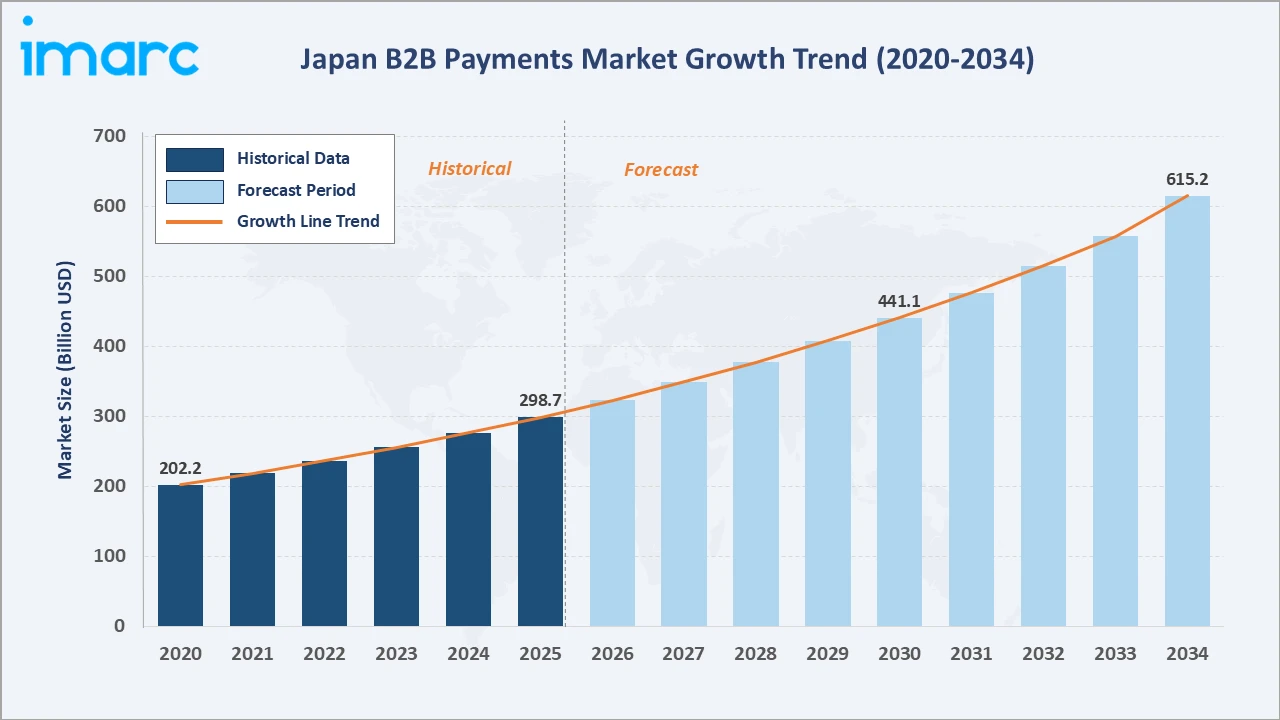
The Japan B2B payments market size increased from USD 298.7 Billion in 2025 to USD 329.7 Billion in 2026 and is projected to reach USD 615.2 Billion by 2034, growing at a CAGR of 8.11% during 2026-2034. Rapid digital transformation, government cashless society initiatives, expanding fintech ecosystems, and rising cross-border trade collectively drive sustained market growth across all B2B payment types and modes.
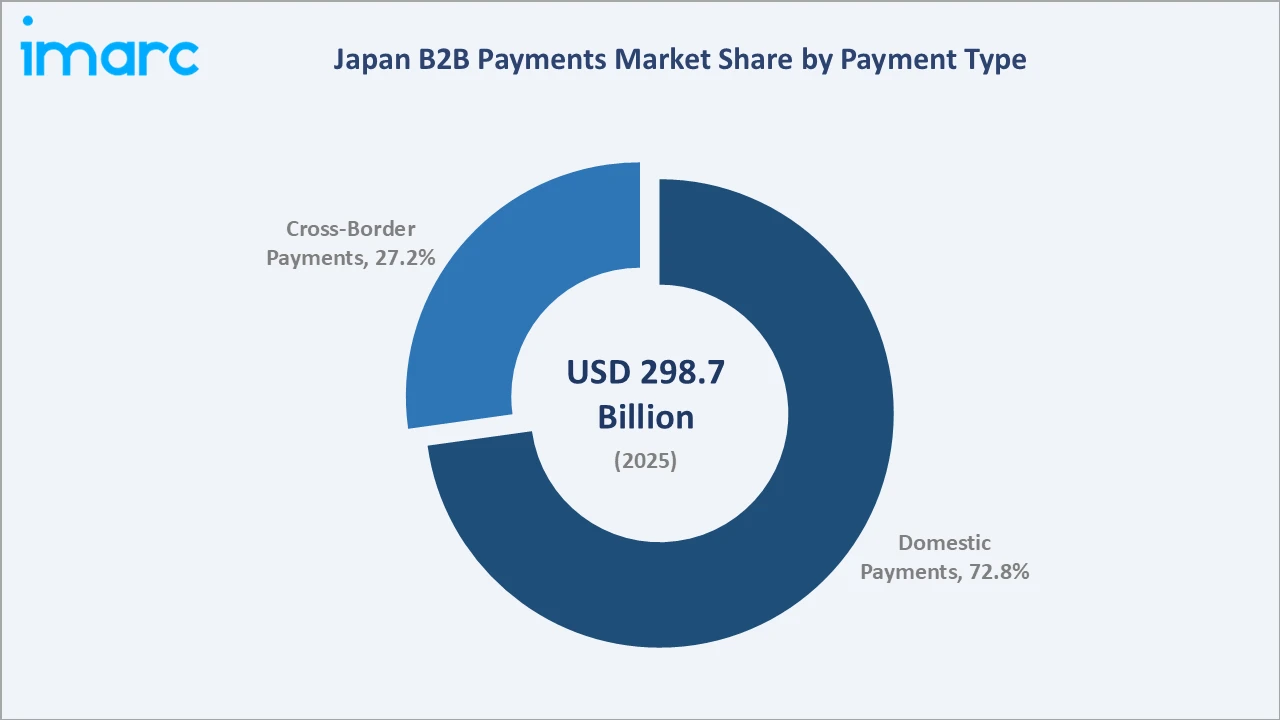
Domestic payments dominate at 72.8%, reflecting Japan's large volume of domestic inter-corporate settlements across supply chains, procurement, and services. Digital payment modes lead at 58.6% as businesses accelerate the adoption of electronic invoicing, automated payment processing, and API-enabled banking.
The Kanto Region commands 31.2% of total market share through Tokyo's unmatched corporate concentration.
Market Snapshot
|
Metric |
Value |
|
Base Year Market Size (2025) |
USD 298.7 Billion |
| Market Size (2026) | USD 329.7 Billion |
|
Forecast Market Size (2034) |
USD 615.2 Billion |
|
CAGR (2026-2034) |
8.11% |
|
Base Year |
2025 |
|
Historical Period |
2020-2025 |
|
Forecast Period |
2026-2034 |
|
Dominant Payment Type |
Domestic Payments (72.8%, 2025) |
|
Leading Payment Mode |
Digital (58.6%, 2025) |
|
Leading Region |
Kanto Region (31.2%, 2025) |
The Japan B2B payments market expanded from USD 202.2 Billion in 2020 to USD 298.7 Billion in 2025 and an estimated USD 329.7 Billion in 2026, anchored at USD 441.1 Billion in 2030 and forecast to reach USD 615.2 Billion by 2034. Growth was driven by accelerated digital payment adoption during the COVID-19 pandemic, government cashless campaigns, and expanding open banking API frameworks supporting enterprise payment automation.
To get more information on this market, Request Sample
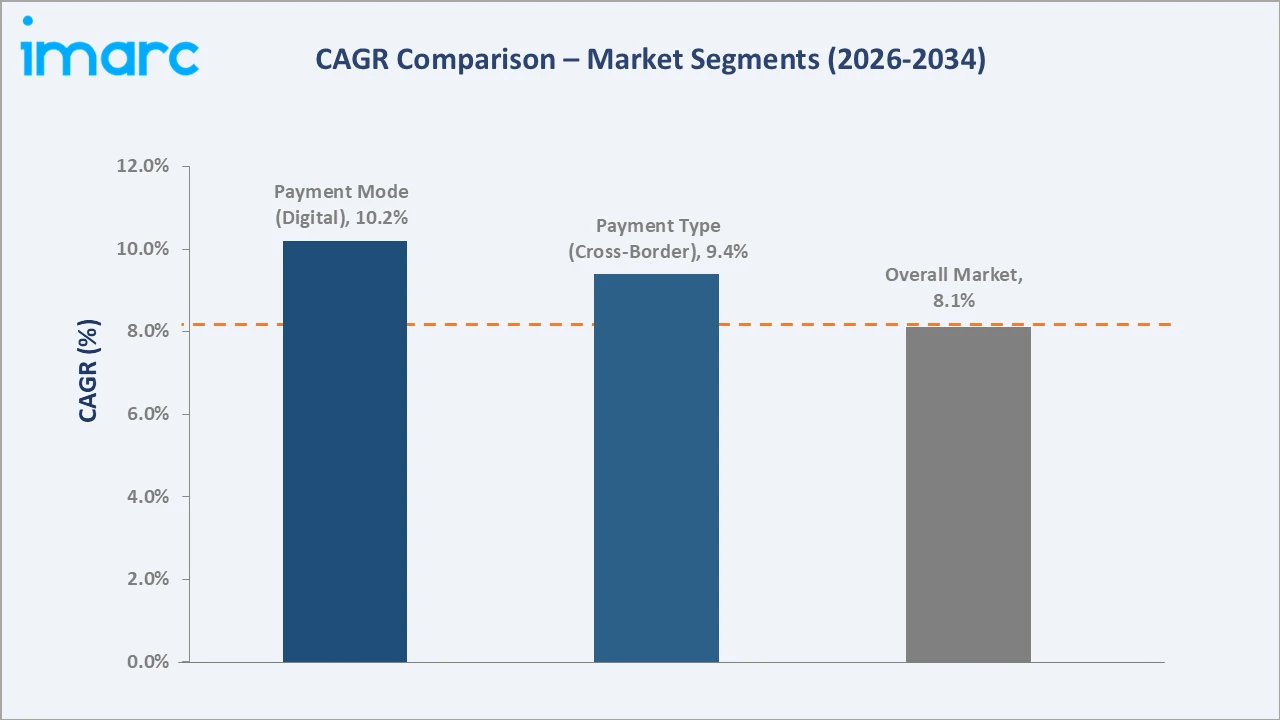
Digital payment modes grow fastest at approximately 10.2% CAGR, driven by e-invoicing mandates, ERP-integrated payment automation, and API banking adoption. Cross-border B2B payments grow at approximately 9.4% CAGR as Japanese enterprises expand international trade and demand faster, lower-cost settlement alternatives to traditional correspondent banking channels.
Executive Summary
The Japan B2B payments market, which increased from USD 298.7 Billion in 2025 to an estimated USD 329.7 Billion in 2026, representing one of Asia's most structurally significant corporate payment markets, shaped by Japan's large enterprise economy, sophisticated banking infrastructure, tightening regulatory frameworks for digital transactions, and active government promotion of cashless business payments. The market is projected to reach USD 615.2 Billion by 2034.
Domestic payments at 72.8% dominate through Japan's extensive domestic supply chain and inter-corporate settlement volumes. Digital payment modes at 58.6% lead as businesses migrate from paper-based processes to automated e-invoicing and API-integrated payment platforms. The Kanto Region at 31.2% leads through Tokyo's concentration of corporate headquarters, financial institutions, and B2B payment infrastructure.
Key Market Insights
|
Insight |
Data |
|
Dominant Payment Type |
Domestic Payments - 72.8% share (2025) |
|
Leading Payment Mode |
Digital - 58.6% market share (2025) |
|
Fastest-Growing Mode |
Digital - driven by e-invoicing mandates and payment automation |
|
Leading Region |
Kanto Region - 31.2% market share (2025) |
|
Market Opportunity |
CBDC B2B settlement; cross-border stablecoin payments; embedded finance; API banking platforms |
Key Analytical Observations Supporting the Above Data:
- Domestic Payments at 72.8%: Domestic B2B payments dominate Japan's corporate payment flows through the country's extensive domestic supply chains, complex keiretsu corporate group structures, and high-volume inter-company settlements across manufacturing, retail, and services sectors requiring efficient, low-cost domestic clearing and settlement infrastructure nationwide.
- Digital at 58.6%: Digital payment modes lead as large enterprises and SMEs accelerate adoption of electronic fund transfers, e-invoicing platforms, and ERP-integrated payment automation driven by Japan's qualified invoice mandate, labour cost pressures, and growing recognition of digital payment efficiency advantages over traditional paper-based processes.
- Kanto Region at 31.2%: Kanto leads through Tokyo's position as Japan's largest corporate and financial hub, hosting megabanks, major trading companies, technology conglomerates, and the highest density of large enterprise B2B payment volumes, creating the most concentrated corporate payment activity in the national market.
Japan B2B Payments Market Overview
The Japan B2B payments market encompasses the processing, clearing, and settlement of inter-corporate financial transactions across domestic and cross-border payment types, spanning electronic fund transfers, corporate card payments, trade finance settlements, and API-enabled digital payment platforms serving enterprises, SMEs, and financial institutions across all industry sectors.
The ecosystem integrates corporate payers and receivers, domestic and international payment processors, megabanks and regional financial institutions, fintech platform providers, ERP and accounting system vendors, regulatory bodies including the Financial Services Agency and Bank of Japan, payment clearing networks, and technology infrastructure providers enabling end-to-end B2B payment automation nationwide.
Market Dynamics
To evaluate market opportunities, Request Sample
Market Drivers
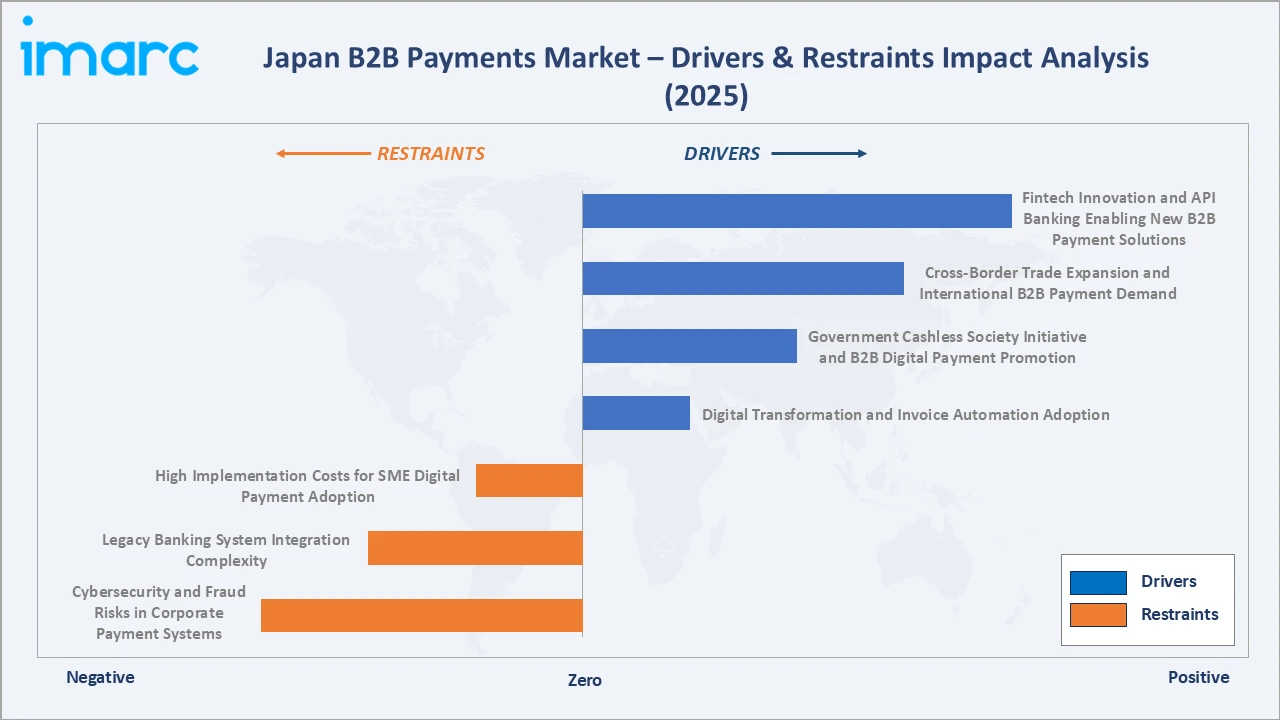
- Digital Transformation and Invoice Automation Adoption: Japan's corporate sector is accelerating the transition from paper-based invoicing and manual bank transfers to automated e-invoicing, ERP-integrated payment processing, and API-enabled banking platforms. Government-mandated e-invoicing frameworks and digital accounting standards are creating structural demand for digital B2B payment solutions across enterprises and SMEs nationwide.
- Government Cashless Society Initiative and B2B Digital Payment Promotion: Japan's government cashless society strategy extends to B2B payment digitization, with open banking regulations mandating API access for corporate payment integration with financial institutions. Policy measures, including consumption tax credit incentives and digital invoice adoption programmes, accelerate corporate payment digitization.
- Cross-Border Trade Expansion and International B2B Payment Demand: Japan's globally integrated economy generates substantial cross-border B2B payment flows from export-driven manufacturers, trading companies, and service exporters. Growing bilateral trade with Southeast Asia, the Americas, and Europe creates structural demand for faster, lower-cost cross-border B2B payment infrastructure beyond traditional correspondent banking channels.
- Fintech Innovation and API Banking Enabling New B2B Payment Solutions: Japan's expanding fintech ecosystem and open banking regulatory framework enable new B2B payment platforms integrating directly with corporate banking APIs. Embedded finance, banking-as-a-service, and real-time payment capabilities are creating new B2B payment value propositions unavailable through traditional bank-direct channels.
Market Restraints
- Cybersecurity and Fraud Risks in Corporate Payment Systems: Rising sophistication of business email compromise, payment fraud, and corporate account takeover attacks creates significant security investment requirements for enterprises deploying digital B2B payment platforms. High-profile corporate payment fraud incidents increase institutional caution and compliance costs, moderating the pace of digital payment adoption.
- Legacy Banking System Integration Complexity: Japan's major banks operate some of the world's most complex legacy core banking systems, creating technical barriers to API integration with corporate ERP and payment management platforms. Integration costs, project complexity, and interoperability challenges slow adoption of seamless automated B2B payment workflows across enterprise segments.
- High Implementation Costs for SME Digital Payment Adoption: Small and medium enterprises face significant barriers to digital payment platform adoption including ERP system investment, staff training costs, and complexity of integrating digital payment workflows with existing accounting systems at commercially viable cost levels across Japan's large and diverse SME population.
Market Opportunities
- CBDC-Enabled B2B Payments and Blockchain Settlement Infrastructure: The Bank of Japan's advancing CBDC pilot programme and Project Pax stablecoin cross-border settlement initiative create infrastructure for programmable B2B payment settlement, enabling atomic trade finance, instant cross-border payment, and automated regulatory reporting that expands the addressable market for B2B payment technology providers.
- Embedded Finance and Supply Chain Finance Expansion: Japan's open banking regulatory framework enables embedded supply chain finance solutions where B2B payment platforms integrate dynamic discounting, invoice financing, and working capital management into corporate procurement workflows, creating new recurring revenue streams for fintech providers.
Market Challenges
- Zengin System Modernisation and Real-Time B2B Payment Infrastructure: Achieving fully interoperable real-time B2B payment settlement across domestic and cross-border transactions remains a structural challenge. Zengin integration with international payment networks and corporate ERP platforms requires ongoing technical investment from financial institutions and payment technology providers.
- Data Privacy Compliance and Cross-Border B2B Payment Regulation: Japan's Act on the Protection of Personal Information and evolving cross-border data transfer regulations create compliance complexity for multinational B2B payment platforms. Maintaining regulatory compliance across multiple jurisdictions increases operational costs and limits the scalability of cross-border B2B payment solutions.
Emerging Market Trends
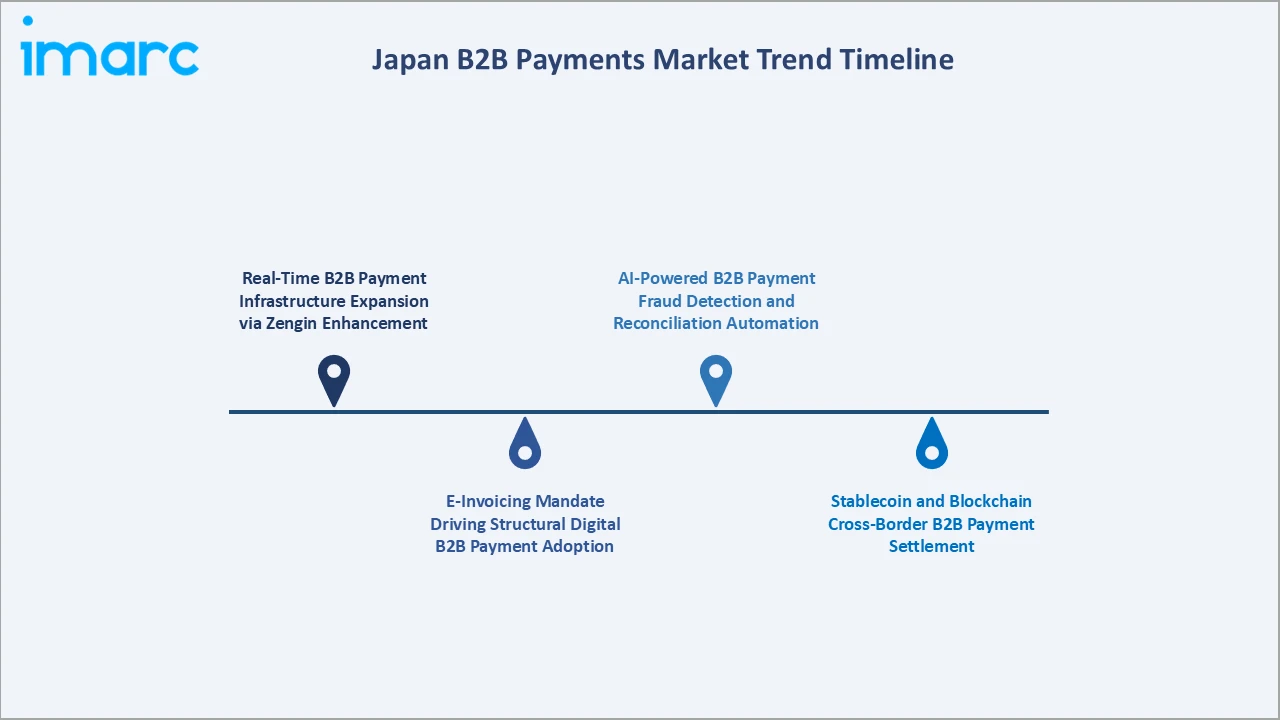
1. Real-Time B2B Payment Infrastructure Expansion via Zengin Enhancement
Japan's Zengin real-time payment network is expanding B2B payment capabilities through API integration frameworks and corporate banking connectivity improvements. Real-time B2B settlement reduces working capital requirements, eliminates payment float, and improves cash flow predictability for enterprises engaged in high-frequency domestic supply chain payments across manufacturing, retail, and distribution sectors.
2. E-Invoicing Mandate Driving Structural Digital B2B Payment Adoption
Japan's qualified invoice preservation system is creating structural demand for integrated e-invoicing and digital B2B payment platforms. Enterprises and SMEs are investing in compliant digital invoicing infrastructure directly integrated with B2B payment processing, accelerating the transition from paper-based to fully digital corporate payment workflows across all industry sectors.
3. Stablecoin and Blockchain Cross-Border B2B Payment Settlement
Japan's megabanks are advancing Project Pax stablecoin-based cross-border B2B payment infrastructure integrated with the SWIFT messaging network, enabling programmable cross-border settlement at significantly lower cost and latency than traditional correspondent banking. This infrastructure creates a new category of cross-border B2B payment capability for internationally engaged Japanese enterprises.
4. AI-Powered B2B Payment Fraud Detection and Reconciliation Automation
Artificial intelligence and machine learning are deployed across Japan's B2B payment ecosystem for real-time fraud detection, automated reconciliation, and intelligent exception handling. AI-powered payment risk management reduces fraud losses and manual reconciliation costs, creating significant operational efficiency improvements for enterprises processing high B2B transaction volumes.
Industry Value Chain Analysis
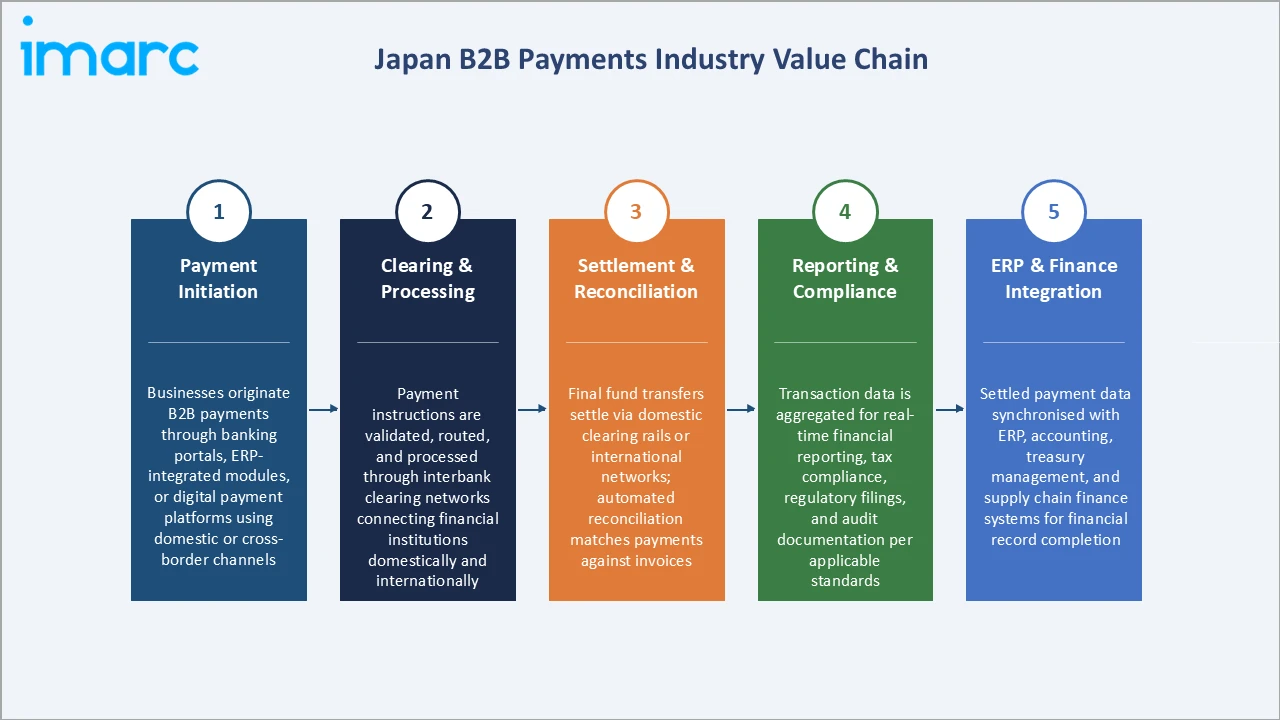
The Japan B2B payments industry value chain integrates payment initiation at the corporate payer level, clearing and processing through financial institution networks, settlement and reconciliation, regulatory reporting and compliance, and ERP-integrated finance management, forming an end-to-end payment processing architecture from transaction origination to financial record completion.
|
Stage |
Description |
|
Payment Initiation |
Businesses originate B2B payments through banking portals, ERP-integrated payment modules, or digital payment platforms using domestic or cross-border channels |
|
Clearing & Processing |
Payment instructions are validated, routed, and processed through interbank clearing networks connecting financial institutions domestically and internationally |
|
Settlement & Reconciliation |
Final fund transfers are settled between financial institutions via domestic clearing rails or international networks; automated reconciliation matches payments against invoices |
|
Reporting & Compliance |
Transaction data is aggregated for real-time financial reporting, tax compliance, regulatory filings, and audit documentation as required by applicable standards |
|
ERP & Finance Integration |
Settled payment data is synchronised with enterprise resource planning, accounting, treasury management, and supply chain finance systems for financial record completion |
The clearing and processing tier represents the highest value-added stage in Japan's B2B payments value chain, with financial institutions and payment processors capturing the largest revenue share through transaction fees, float income, and value-added service fees. The ERP and finance integration tier is the fastest-growing value chain stage as enterprises demand seamless automated payment-to-financial-record workflows.
Technology Landscape in the Japan B2B Payments Industry
API Banking and Open Banking Integration Technology
Open banking API technology enables direct integration between corporate ERP, treasury management, and accounting systems with financial institution banking platforms, eliminating manual payment processing steps. Japan's open banking API framework requires major banks to provide standardised API access for corporate payment initiation, account information retrieval, and payment status reporting.
Blockchain and Distributed Ledger Technology for Settlement
Blockchain and distributed ledger technology is applied in Japan's B2B payment ecosystem for cross-border settlement, trade finance documentation, and CBDC payment infrastructure. Japan's Progmat DLT-based tokenization network underpins Project Pax stablecoin settlement and digital security issuance, creating foundation for programmable B2B payment applications across financial institution and corporate segments.
AI and Automation Technology for Payment Processing
Artificial intelligence, robotic process automation, and machine learning are transforming B2B payment processing through automated invoice matching, payment approval workflow automation, anomaly detection, and intelligent exception handling. AI-powered optical character recognition enables automated conversion of paper invoices into digital payment instructions, supporting Japan's e-invoicing transition across SME segments.
Market Segmentation Analysis
The report covers the following segments:
|
Segment Category |
Leading Segment |
Market Share |
Year |
|
Payment Type |
Domestic Payments |
72.8% |
2025 |
|
Payment Mode |
Digital |
58.6% |
2025 |
|
Enterprise Size |
🔒 |
🔒 |
2025 |
|
Industry Vertical |
🔒 |
🔒 |
2025 |
|
Region |
Kanto Region |
31.2% |
2025 |

By Payment Type
Domestic payments lead at 72.8% in 2025, capturing Japan's dominant share of inter-corporate settlement volumes through the country's extensive domestic supply chains, keiretsu corporate group payment flows, and high-frequency domestic procurement and services payment transactions processed through Japan's Zengin real-time settlement network and bank transfer infrastructure.
To access detailed market analysis, Request Sample
Cross-border payments at 27.2% reflect Japan's substantial international trade and investment payment flows. Growing at approximately 9.4% CAGR, cross-border B2B payments are accelerating as manufacturers, trading companies, and technology exporters seek faster and lower-cost international settlement alternatives to traditional correspondent banking infrastructure connecting Japan with global trade partners.
By Payment Mode
Digital payment modes lead at 58.6% in 2025, capturing the majority of Japan's B2B payment value through electronic fund transfers, API-integrated corporate payment platforms, and e-invoicing-linked automated payment processing. Digital adoption is accelerating under Japan's qualified invoice mandate and enterprise ERP modernisation initiatives across large corporation and SME segments nationwide.
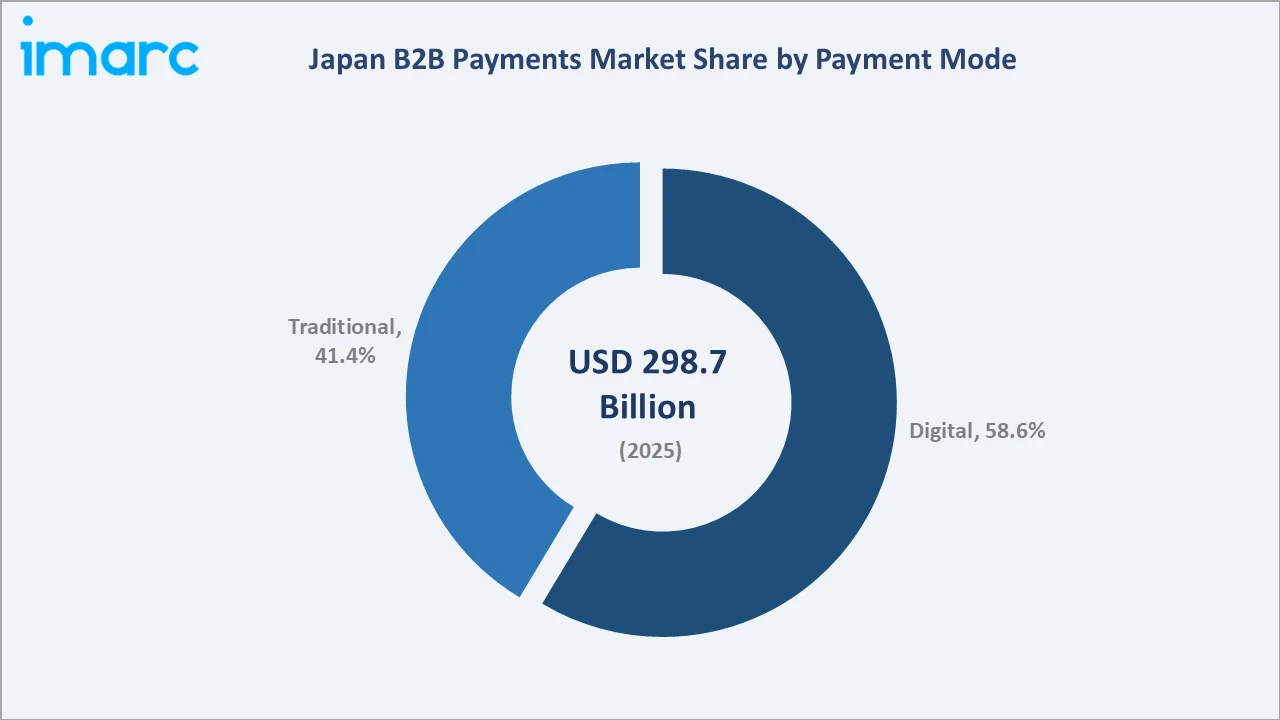
Traditional payment modes at 41.4% persist through paper cheques, manual bank transfers, and paper invoice-linked payment processes that remain prevalent among SMEs and regional enterprises. The traditional-to-digital migration cycle, driven by e-invoice mandates and digital banking infrastructure expansion, will reduce traditional mode share progressively through the 2026-2034 forecast period.
Regional Market Insights
|
Region |
Share (2025) |
Key B2B Payments Market Drivers & Characteristics |
|
Kanto |
31.2% |
Largest B2B payment hub anchored by Tokyo; highest concentration of corporate headquarters, financial institutions, and trading companies generating Japan's largest domestic and cross-border B2B payment volumes |
|
Kansai/Kinki |
19.1% |
Major commercial and manufacturing corridor; substantial B2B payment flows from electronics, chemicals, logistics, and wholesale trade sectors in the Osaka-Kobe-Kyoto economic cluster |
|
Central/Chubu |
15.4% |
Automotive and heavy manufacturing cluster generating high-value B2B payment volumes from complex multi-tier supply chain settlements and procurement transactions across the Nagoya industrial base |
|
Kyushu-Okinawa |
10.3% |
Growing semiconductor and electronics manufacturing base driving cross-border and domestic B2B payment growth; increasing digital payment platform adoption among regional exporters and manufacturers |
|
Tohoku |
8.4% |
Industrial and agricultural activity driving steady B2B payment volumes; post-reconstruction manufacturing investment and food processing supply chain settlements sustaining regional market growth |
|
Chugoku |
6.8% |
Port-based industrial and logistics sector generating moderate B2B payment flows; manufacturing and distribution activity supporting a steady replacement and digital migration cycle in corporate payments |
|
Hokkaido |
4.9% |
Agricultural, tourism, and resource sector B2B payment activity; growing digital corporate payment adoption among regional SMEs and agri-food supply chain participants driving incremental growth |
|
Shikoku |
3.9% |
Smallest regional share; SME-dominated commercial activity and incremental digital B2B payment adoption driving gradual market expansion across the four-prefecture regional economy |
The Kanto Region at 31.2% leads through Tokyo's unmatched concentration of corporate headquarters, megabanks, trading companies, and financial market infrastructure generating Japan's largest B2B payment volumes. The Kansai/Kinki Region at 19.1% reflects Osaka's role as Japan's second commercial hub with substantial manufacturing and wholesale B2B payment activity across its industrial and logistics base.
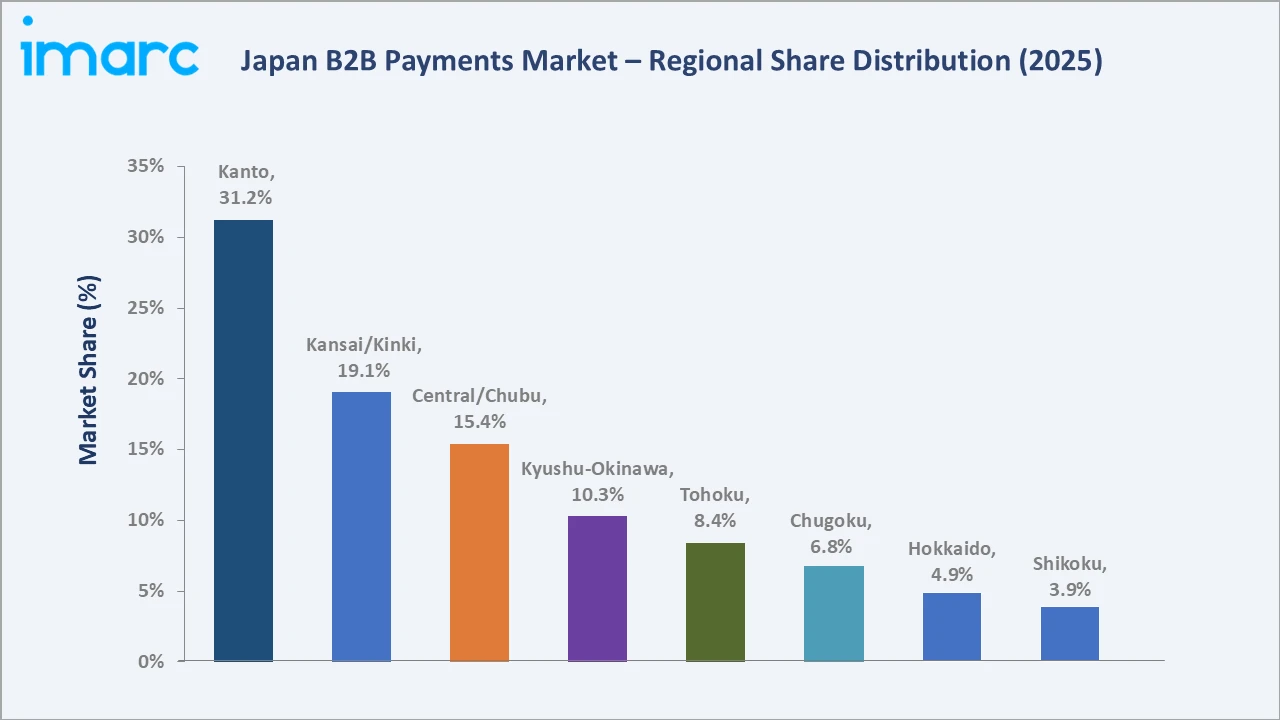
Central/Chubu at 15.4% captures high-value automotive supply chain B2B payment flows from Japan's largest manufacturing cluster. Kyushu-Okinawa at 10.3% benefits from semiconductor manufacturing B2B payment growth. Tohoku, Chugoku, Hokkaido, and Shikoku together represent 24.0% with steady B2B payment market development driven by industrial activity and digital adoption.
Competitive Landscape
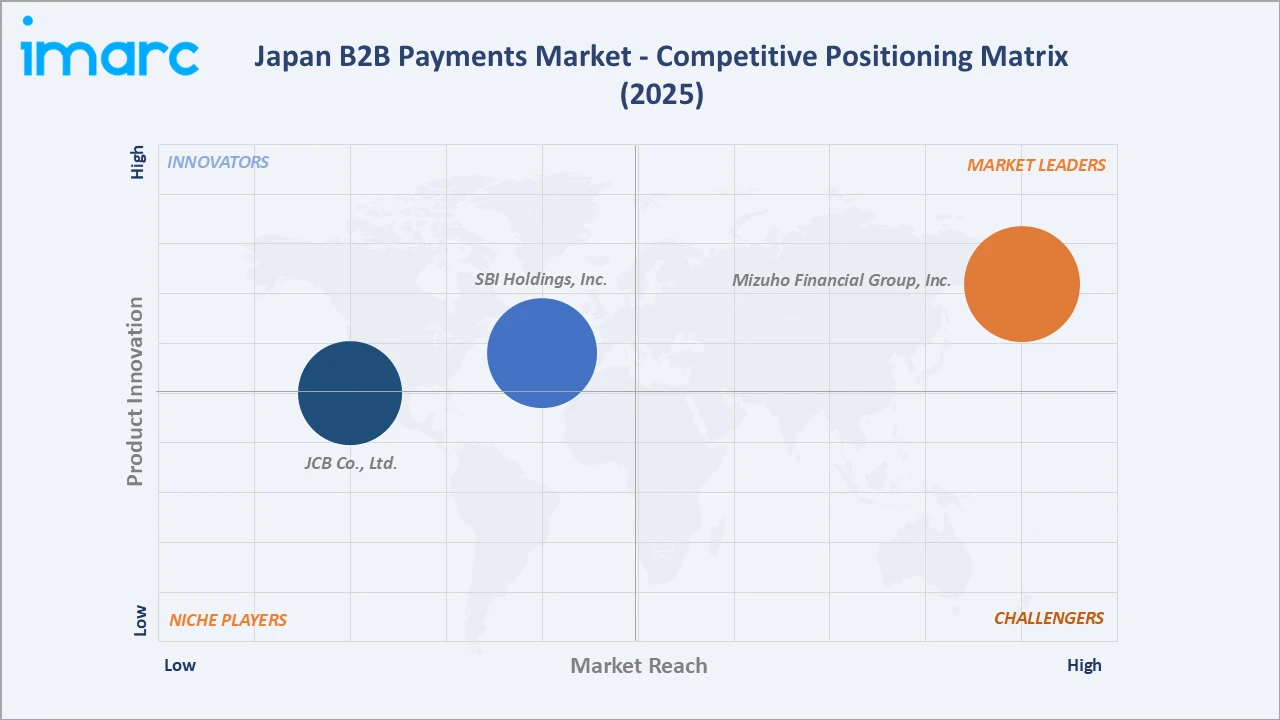
The Japan B2B payments market competitive landscape is moderately concentrated at the large enterprise payment tier, with Japan's three megabanks holding dominant positions through captive corporate customer relationships, established payment network infrastructure, and comprehensive B2B payment service portfolios covering domestic clearing, cross-border settlement, and trade finance operations.
|
Company Name |
Key Products |
Market Position |
Core Strength |
|
Mizuho Financial Group, Inc. |
J-Coin Pay, Mizuho API Banking Platform |
Market Leader |
Major megabank providing comprehensive B2B payment processing, API banking, and Project Pax cross-border stablecoin settlement initiatives |
|
SBI Holdings, Inc. |
SBI Remit, SBI VC Trade, SBI FinTech Solutions |
Emerging Leader |
Diversified financial group expanding B2B capabilities through blockchain-based cross-border settlement and digital asset payment infrastructure |
|
JCB Co., Ltd. |
JCB Corporate Card, JCB B2B Payment Solutions, JCB Global Network |
Emerging Leader |
Japan's leading domestic card network extending into B2B solutions including corporate card programmes and supplier payment platform services |
Key players include Mizuho Financial Group, Inc., SBI Holdings, Inc., JCB Co., Ltd., and others.
Key Company Profiles
Mizuho Financial Group, Inc.
Mizuho Financial Group, Inc. is a Tokyo-based major financial services group operating one of Japan's three megabanks, providing comprehensive B2B payment services including domestic clearing, international settlement, corporate card programmes, and API-integrated business payment platforms to corporate and institutional clients across Japan and globally.
- Key Products: J-Coin Pay, Mizuho API Banking Platform
- Strategic Focus: Advancing cross-border B2B payment digitalisation through stablecoin and DLT infrastructure, expanding API banking services for corporate treasury integration, and developing AI-powered payment analytics and fraud detection capabilities for the institutional B2B payment segment.
JCB Co., Ltd.
JCB Co., Ltd. is a Tokyo-based comprehensive payment services company and Japan's only international payment brand, operating as Japan's largest card issuer, providing corporate card programmes, B2B payment platform services, and global payment network infrastructure to corporate and institutional clients.
- Key Products: JCB Corporate Card, JCB B2B Payment Solutions, JCB Global Network
- Strategic Focus: Growing international corporate card acceptance across Asia and globally and advancing contactless and NFC payment technology to accelerate Japan's commercial cashless transition.
Market Concentration Analysis
The Japan B2B payments market is highly concentrated at the domestic clearing and settlement infrastructure tier, where Japan's three megabanks collectively control primary banking relationships and payment processing volumes of Japan's largest corporate payers. The top three financial groups account for an estimated 55-65% of large enterprise B2B payment processing value nationally.
At the technology and fintech platform tier, market concentration is declining as API banking mandates enable new entrants to compete for SME and mid-market B2B payment processing. Market concentration is expected to decrease further through the forecast period as digital payment platform competition intensifies and embedded finance solutions create new competitive entry points.
Investment & Growth Opportunities
Highest Growth Segments
Digital payment modes at approximately 10.2% CAGR, cross-border B2B payments at approximately 9.4% CAGR, API-enabled corporate payment platforms, stablecoin and CBDC B2B infrastructure, embedded supply chain finance, and AI-powered payment automation represent the highest-growth investment categories in Japan's B2B payments market through 2034.
Emerging Investment Opportunities
Japan's e-invoicing mandate transition is creating a structural multi-year investment cycle in digital B2B payment platforms as enterprises and SMEs invest in compliant e-invoicing and automated payment processing infrastructure. Each enterprise implementing a compliant e-invoicing system requires integrated B2B payment processing, creating a compounding procurement pipeline for payment platform providers through the forecast period.
Investment Themes
- API banking and open banking platform investment capturing Japan's corporate digital payment migration cycle: Japan's open banking mandate creates a structural multi-year API banking infrastructure investment cycle as financial institutions and corporates integrate digital payment initiation and automated reconciliation workflows. API-enabled B2B payment platforms with ERP integration capabilities represent high-value recurring SaaS revenue investment opportunities with long enterprise contract durations.
- Cross-border B2B payment infrastructure investment capturing Japan's international trade digitalisation: Japan's large trade economy creates a substantial addressable market for faster, lower-cost cross-border B2B payment solutions. Stablecoin infrastructure providers, ISO 20022 payment messaging specialists, and blockchain-based trade finance platforms are positioned to capture significant cross-border payment value migration from traditional correspondent banking.
Future Market Outlook (2026-2034)
The Japan B2B payments market is projected to grow from USD 298.7 Billion in 2025 to USD 329.7 Billion in 2026, reaching USD 615.2 Billion by 2034, delivering 8.11% CAGR over the forecast period. The market reaches approximately USD 441.1 Billion by 2030, representing Japan's B2B payments industry at a structural inflection point as stablecoin cross-border settlement enters commercial deployment and digital payment modes surpass 68% of total market value.
The digital payment mode transition is the market's most structurally significant growth driver through 2034. Japan's qualified invoice system mandate, enterprise ERP modernisation programmes, and labour cost pressures driving payment automation investment will increase digital payment mode share from 58.6% in 2025 toward an estimated 75-80% by 2034, creating sustained digital B2B payment platform demand across enterprise and SME segments.
Cross-border B2B payment infrastructure modernisation represents the highest-growth market segment at approximately 9.4% CAGR. Japan's Project Pax stablecoin initiative, CBDC pilot programmes, and ISO 20022 payment messaging modernisation create a technology infrastructure transition opening new B2B payment settlement capabilities for internationally engaged Japanese enterprises through the forecast period.
Research Methodology
Primary Research
Primary research comprised structured interviews with 50 or more industry stakeholders in 2025, including corporate treasury officers, CFOs of major Japanese enterprises, fintech B2B payment platform executives, and banking technology specialists operating across Japan's B2B payments ecosystem at national and regional levels.
Secondary Research
Secondary research encompassed bank annual reports, Bank of Japan payment system statistics, Japan Payments Council data, Ministry of Economy, Trade and Industry e-commerce statistics, IMF Japan financial sector reports, and over 60 secondary industry sources reviewed to develop comprehensive market intelligence for Japan's B2B payments market.
Forecasting Models
Market size forecasts were developed using a bottom-up payment volume and value construction model incorporating payment type segmentation by domestic and cross-border transaction volumes, digital-to-traditional payment mode mix projections, regional corporate activity-weighted payment value allocation, and fee and margin dynamics across payment processing value chain tiers through the 2026-2034 forecast period.
Japan B2B Payments Market Report Coverage:
| Report Features | Details |
|---|---|
| Base Year of the Analysis | 2025 |
| Historical Period | 2020-2025 |
| Forecast Period | 2026-2034 |
| Units | Billion USD |
| Scope of the Report | Exploration of Historical and Forecast Trends, Industry Catalysts and Challenges, Segment-Wise Historical and Predictive Market Assessment:
|
| Payment Types Covered | Domestic Payments, Cross-Border Payments |
| Payment Modes Covered | Traditional, Digital |
| Enterprise Sizes Covered | Large Enterprises, Small and Medium-sized Enterprises |
| Industry Verticals Covered | BFSI, Manufacturing, IT and Telecom, Metals and Mining, Energy and Utilities, Others |
| Regions Covered | Kanto Region, Kansai/Kinki Region, Central/ Chubu Region, Kyushu-Okinawa Region, Tohoku Region, Chugoku Region, Hokkaido Region, Shikoku Region |
| Companies Covered | Mizuho Financial Group, Inc., SBI Holdings, Inc., JCB Co., Ltd., etc. |
| Customization Scope | 10% Free Customization |
| Post-Sale Analyst Support | 10-12 Weeks |
| Delivery Format | PDF and Excel through Email (We can also provide the editable version of the report in PPT/Word format on special request) |
Key Benefits for Stakeholders:
- IMARC’s industry report offers a comprehensive quantitative analysis of various market segments, historical and current market trends, market forecasts, and dynamics of the Japan B2B payments market from 2020-2034.
- The research report provides the latest information on the market drivers, challenges, and opportunities in the Japan B2B payments market.
- Porter's five forces analysis assist stakeholders in assessing the impact of new entrants, competitive rivalry, supplier power, buyer power, and the threat of substitution. It helps stakeholders to analyze the level of competition within the Japan B2B payments industry and its attractiveness.
- Competitive landscape allows stakeholders to understand their competitive environment and provides an insight into the current positions of key players in the market.
Frequently Asked Questions About the Japan B2B Payments Market Report
The Japan B2B payments market size is estimated at USD 329.7 Billion in 2026, led by domestic payments at 72.8%, digital payment modes at 58.6%, and the Kanto Region at 31.2% of total market share, driven by enterprise digital transformation, government cashless society initiatives, and expanding API banking and fintech payment platform adoption.
The Japan B2B payments market grows at 8.11% CAGR during 2026-2034, reaching USD 615.2 Billion by 2034. This growth reflects accelerating digital B2B payment adoption, e-invoicing mandate-driven platform investment, cross-border payment digitalisation, and CBDC and stablecoin B2B settlement infrastructure development across Japan's corporate payment ecosystem.
Domestic payments lead at 72.8%, reflecting Japan's extensive domestic supply chain and inter-corporate settlement volumes across manufacturing, retail, and services sectors. Japan's Zengin real-time payment infrastructure and complex corporate group payment structures generate high domestic B2B payment volumes relative to cross-border transactions.
Digital payment modes dominate at 58.6%, driven by enterprise ERP-integrated payment automation, API banking adoption, and Japan's qualified invoice system mandate requiring digital invoicing infrastructure. Digital mode growth is accelerating as enterprises invest in compliant e-invoicing and automated B2B payment processing to reduce manual processing costs and improve efficiency.
The Kanto Region leads at 31.2%, anchored by Tokyo's position as Japan's largest corporate and financial hub. The region hosts megabanks, major trading companies, technology conglomerates, and the highest concentration of large enterprise B2B payment volumes, generating Japan's most significant domestic and cross-border corporate payment activity.
Leading companies include Mizuho Financial Group, Inc., SBI Holdings, Inc., JCB Co., Ltd., and others.
The Japan B2B payments market is projected to reach approximately USD 441.1 Billion by 2030, with digital payment modes surpassing 68% market share, stablecoin cross-border settlement entering commercial deployment, and embedded supply chain finance becoming a mainstream B2B payment capability for Japan's major enterprise and SME sectors.
Key investment opportunities include API banking and open banking payment platform providers, cross-border B2B stablecoin and CBDC infrastructure operators, e-invoicing and automated payment processing SaaS platforms, supply chain finance and dynamic discounting platforms, AI-powered B2B payment fraud detection systems, and ISO 20022 payment messaging infrastructure modernisation solutions.
Need more help?
- Speak to our experienced analysts for insights on the current market scenarios.
- Include additional segments and countries to customize the report as per your requirement.
- Gain an unparalleled competitive advantage in your domain by understanding how to utilize the report and positively impacting your operations and revenue.
- For further assistance, please connect with our analysts.
 Request Customization
 Speak to an Analyst
 Request Brochure
 Inquire Before Buying
Benefits of Customization
- Personalize this research
- Triangulate with your data
- Get data as per your format and definition
- Gain a deeper dive into a specific application, geography, customer, or competitor
- Any level of personalization
Get in Touch With Us
UNITED STATES
Phone: +1-201-971-6302
INDIA
Phone: +91-120-433-0800
UNITED KINGDOM
Phone: +44-753-714-6104
Email: [email protected]
Client Testimonials




.webp)




.webp)













Related Reports

Choose your plan
*Please note that the prices mentioned below are starting prices for each bundle type. Kindly contact our team for further details.*
Single User License
- 1 User License, Access on 2 Devices
- PDF Report + Excel Dataset (Password Protected)
- Lifetime Access
- No Printing Rights
- 10% Free Report Customization
- 10–12 Weeks of Analyst Support
Five User License
- Access for 5 Users, 2 Devices per User
- PDF Report + Excel Dataset (Password Protected)
- Lifetime Access
- Dedicated Account Manager
- 12–14 Weeks of Analyst Support
- No Printing Rights
- 15% Free Report Customization
- 25% Discount on Your Next Purchase
Corporate User License
- Unlimited User Access (Within Your Organization)
- PDF Report + Excel Dataset
- Lifetime Access
- Dedicated Account Manager
- 14–20 Weeks of Analyst Support
- No Printing Rights
- 20% Free Report Customization
- 30% Discount on Your Next Purchase
Essential Insights
What's included:
3 reports
- Lifetime Access
- PDF Reports
- Excel Datasets
- 2 Weeks of Free Analyst Support
- 2 User Licenses
- Access on 2 Devices
- Printing Rights
- Complimentary PowerPoint (PPT) Version
- Complimentary License Upgrade
Professional Access
What's included:
5 reports
- Lifetime Access
- PDF Reports
- Excel Datasets
- 8 Weeks of Free Analyst Support
- 2 User Licenses
- Access on 2 Devices
- Printing Rights
- Complimentary PowerPoint (PPT) Version
- Complimentary License Upgrade
Business Advantage
What's included:
8 reports
- Lifetime Access
- PDF Reports
- Excel Datasets
- 14 Weeks of Free Analyst Support
- 2 User Licenses
- Access on 2 Devices
- Printing Rights
- Complimentary PowerPoint (PPT) Version
- Complimentary License Upgrade
Enterprise Intelligence
What's included:
10 reports
- Lifetime Access
- PDF Reports
- Excel Datasets
- 20 Weeks of Free Analyst Support
- 2 User Licenses
- Access on 2 Devices
- Printing Rights
- Complimentary PowerPoint (PPT) Version
- Complimentary License Upgrade