
Japan BOPP Films Market Size, Share, Trends and Forecast by Type, Thickness, Production Process, Application, and Region, 2026-2034
Japan BOPP Films Market Size, Share, Trends & Forecast (2026-2034)
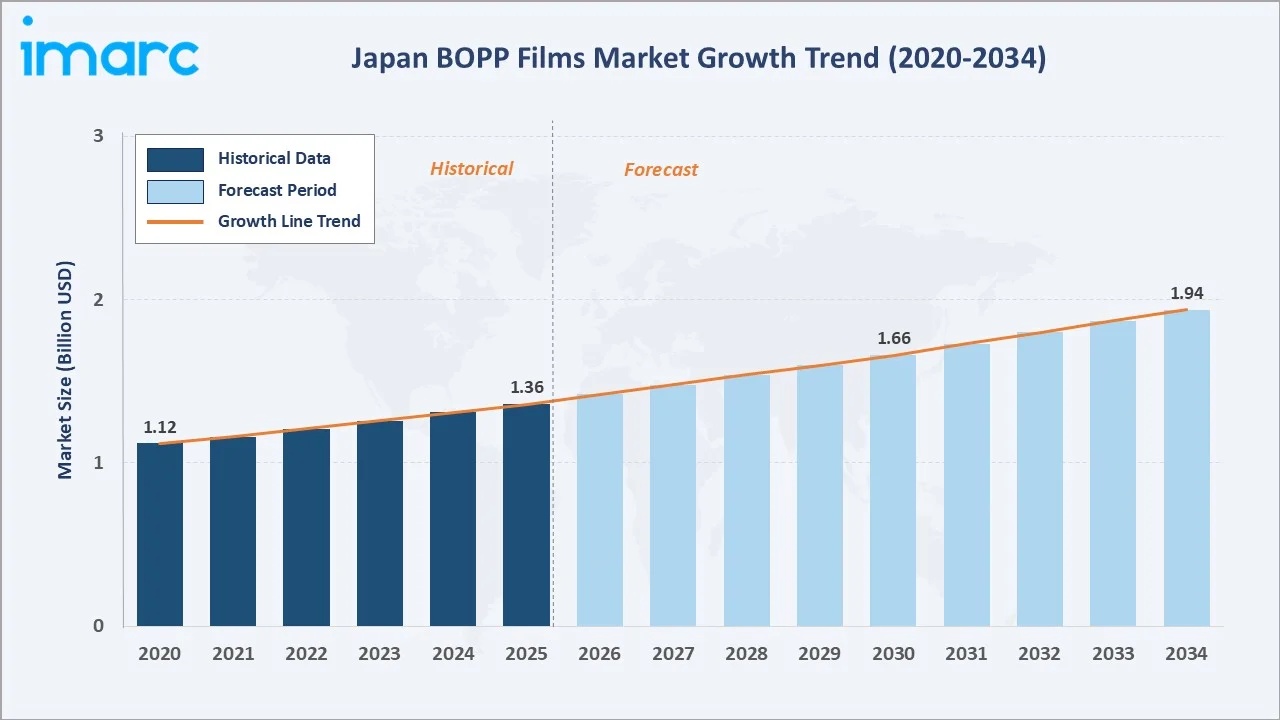
The Japan BOPP films market grew from USD 1.36 Billion in 2025 to USD 1.42 Billion in 2026 and is projected to reach USD 1.94 Billion by 2034, growing at a CAGR of 4.04% during 2026-2034. The market is driven by Japan's stringent government recycling regulations, rapid e-commerce expansion, and sustained demand from the food and beverage packaging sector. The tenter process dominates production at 86.5%. Bags and pouches leads type applications at 31.8%. Kanto commands 37.1% of national market share.
Market Snapshot
|
Metric |
Value |
|
Base Year Market Size (2025) |
USD 1.36 Billion |
|
Market Size (2026) |
USD 1.42 Billion |
|
Forecast Market Size (2034) |
USD 1.94 Billion |
|
CAGR (2026-2034) |
4.04% |
|
Base Year |
2025 |
|
Historical Period |
2020-2025 |
|
Forecast Period |
2026-2034 |
|
Dominant Production Process |
Tenter (86.5%, 2025) |
|
Dominant Type |
Bags and Pouches (31.8%, 2025) |
|
Leading Region |
Kanto (37.1%, 2025) |
The Japan BOPP films market size increased from USD 1.12 Billion in 2020 to USD 1.36 Billion in 2025 and is estimated to reach USD 1.42 Billion in 2026. The market is further expected to grow to USD 1.66 Billion by 2030 and USD 1.94 Billion by 2034. Japan's advanced film manufacturing base, rigorous food safety standards, and export-driven electronics and pharmaceutical sectors underpin sustained market expansion.
To get more information on this market, Request Sample
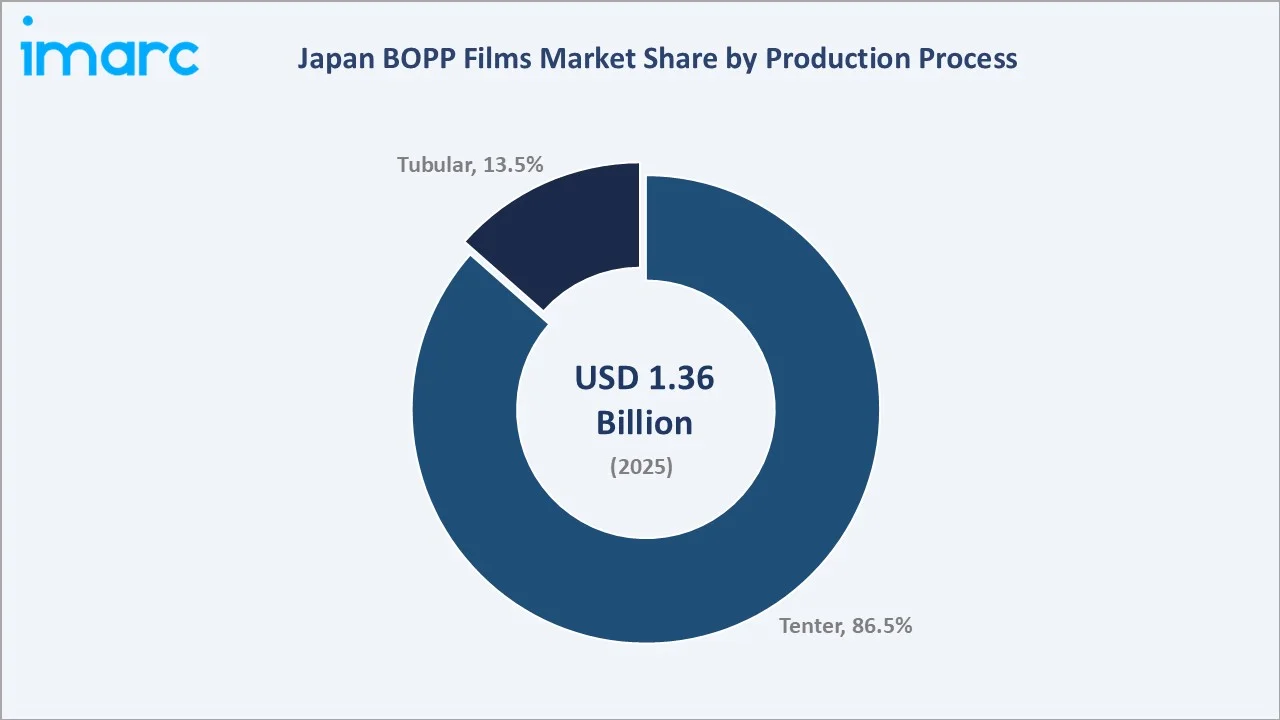
The tenter process commands 86.5% of production share through superior film uniformity and barrier performance. Bags and pouches leads with 31.8%, driven by organized food retail and e-commerce packaging requirements across Japan's consumer market.
Executive Summary
The Japan BOPP films market expanded from USD 1.36 Billion in 2025 to an estimated USD 1.42 Billion in 2026, underpinned by Japan's advanced flexible packaging sector, stringent food safety compliance, and rising consumer preference for lightweight, high-barrier packaging materials.
The market is projected to reach USD 1.94 Billion by 2034 at a CAGR of 4.04%. Government-mandated recyclability standards, e-commerce-driven packaging volumes, and technological advancements in barrier coatings are the primary market growth catalysts. Tenter process at 86.5% leads production. Bags and pouches at 31.8% leads type segments. Kanto at 37.1% leads regionally, reflecting Tokyo-Yokohama's manufacturing and consumer goods concentration.
Key Market Insights
|
Insight |
Data |
|
Dominant Production Process |
Tenter – 86.5% share (2025) |
|
Dominant Type |
Bags and Pouches – 31.8% market share (2025) |
|
Leading Region |
Kanto – 37.1% share (2025) |
|
Market Opportunity |
Recyclable mono-material films; pharmaceutical packaging; metallized films; label film expansion |
Key Analytical Observations Supporting the Above Data:
- Tenter at 86.5%: Dominates through superior width control, uniform mechanical properties, and optical clarity essential for Japan's demanding food, label, and pharmaceutical packaging applications. Its precision processing advantages over tubular methods sustain market leadership.
- Bags and Pouches at 31.8%: Leads due to widespread adoption in food retail, convenience store supply chains, and e-commerce protective packaging across Japan's organized consumer market. Growing demand for resealable and barrier-enhanced pouch formats supports segment expansion.
- Kanto at 37.1%: Leads as Japan's industrial and commercial hub, with concentrated food processing, pharmaceutical manufacturing, and consumer goods companies generating consistent demand. Tokyo-Yokohama's retail density sustains high per-capita packaging film consumption.
Japan BOPP Films Market Overview
Japan's BOPP films market is positioned within the nation's advanced flexible packaging ecosystem. High consumer quality standards, food safety compliance requirements, and retailer-driven packaging innovation create sustained demand for high-performance BOPP films. Japan's mature retail infrastructure and organized food processing sector consistently absorb rising film production volumes across multiple packaging applications.
The ecosystem integrates polypropylene resin production, film manufacturing, conversion, and downstream packaging applications. Macroeconomic factors include Japan's aging population driving convenience food demand, export electronics requiring protective films, and sustainability mandates encouraging recyclable film innovation across the packaging supply chain.
Market Dynamics
To evaluate market opportunities, Request Sample
Market Drivers
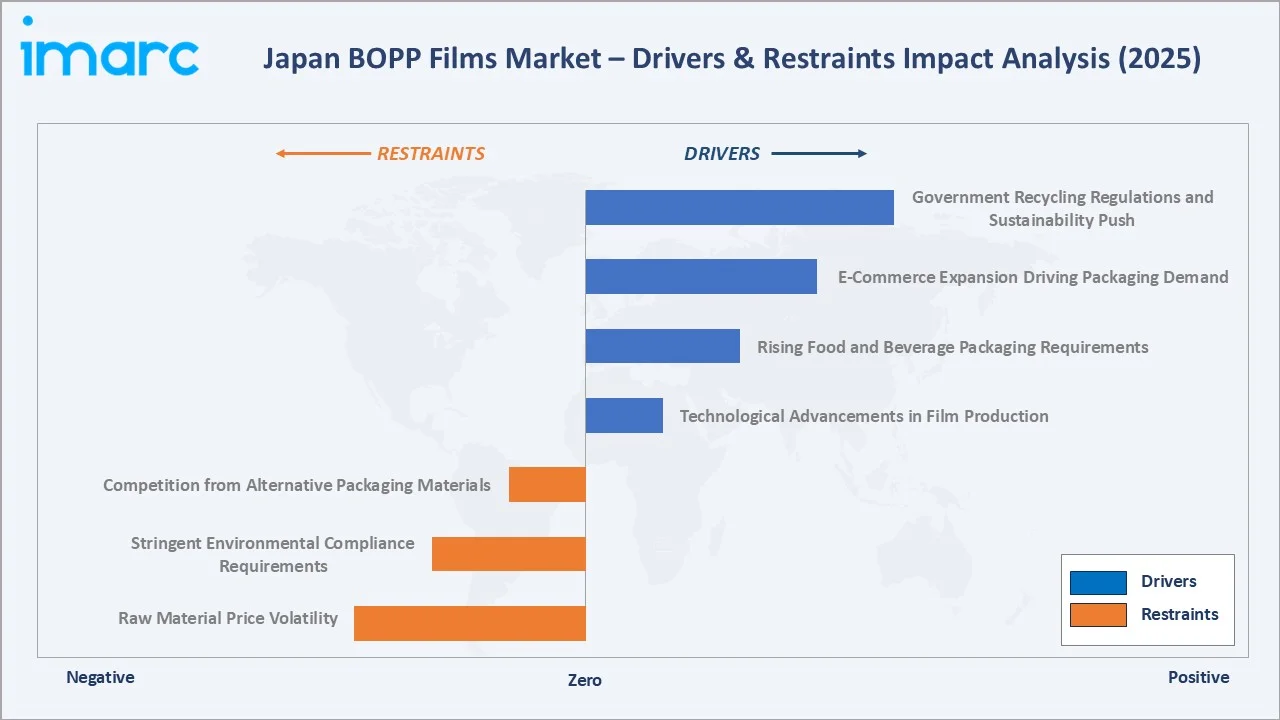
- Government Recycling Regulations and Sustainability Push: Japan's government enforces stringent regulations requiring manufacturers to incorporate recyclable materials in packaging. This framework accelerates adoption of mono-material BOPP films compatible with recycling streams, expanding demand across food and consumer goods packaging segments. Japan's 2030 plastic recycling targets are incentivizing investment in recyclable film technologies and circular economy compliance infrastructure.
- E-Commerce Expansion Driving Packaging Demand: Japan's e-commerce sector is increasing demand for protective, lightweight BOPP films for packaging, void fill, and tamper-evident sealing applications, creating structural demand growth. Rising online grocery and consumer goods delivery volumes are generating consistent incremental demand for high-performance protective and printed BOPP film formats.
- Rising Food and Beverage Packaging Requirements: Japan's robust food and beverage sector requires high-barrier, food-contact compliant BOPP films for extending shelf life and maintaining product quality. Rising demand for processed and ready-to-eat food products across organized retail drives BOPP bags, pouches, and wraps. Japan's convenience store network, exceeding 56,000 outlets nationally, generates consistent high-volume demand for premium food-safe packaging film solutions.
- Technological Advancements in Film Production: Innovations in high-barrier coatings, metallization, and co-extrusion technologies are enhancing BOPP film performance for moisture, oxygen, and UV barriers, expanding adoption across pharmaceutical, personal care, and electronics packaging segments. Next-generation thin-gauge film production enables material reduction without compromising barrier performance, supporting both sustainability goals and cost optimization objectives.
Market Restraints
- Raw Material Price Volatility: Fluctuations in polypropylene resin prices, driven by crude oil price changes and supply chain disruptions, directly impact manufacturing costs and profitability, constraining margin stability and investment capacity for domestic film manufacturers. Feedstock cost volatility limits long-term pricing contract viability, creating commercial uncertainty across Japan's BOPP film manufacturing supply chain.
- Stringent Environmental Compliance Requirements: Japan's evolving plastic packaging regulations require substantial R&D investment in recyclable and biodegradable film solutions. Compliance costs create barriers to product development and competitiveness, restraining expansion in price-sensitive segments. Manufacturers face dual pressure of regulatory compliance investment and market pricing constraints, compressing available margins for product innovation and capacity expansion.
- Competition from Alternative Packaging Materials: BOPP films face intensifying competition from PET films, PLA bioplastics, and paper-based packaging. Growing consumer and regulatory preference for sustainable alternatives is moderating BOPP film adoption in segments where substitutes offer equivalent performance. Paper-based and compostable packaging solutions are gaining market penetration in Japan's premium food and retail sectors, displacing BOPP in sustainability-led applications.
Market Opportunities
- Sustainable and Recyclable Film Innovation: Japan's circular economy policy framework creates commercial opportunities for manufacturers developing mono-material, heat-sealable, and mechanically recyclable BOPP films meeting retailer sustainability commitments and regulatory requirements. Investment in proprietary recyclable film structures enables premium pricing through eco-certification and positions manufacturers for long-term regulatory compliance leadership.
- Medical and Pharmaceutical Packaging Expansion: Japan's pharmaceutical sector presents growth opportunities for high-clarity, sterilization-compatible BOPP films for blister pack lidding, device packaging, and sterile barrier applications across Japan's regulated healthcare supply chain. Japan's growing biosimilar and generic drug export volumes are creating incremental demand for specialty pharmaceutical-grade film grades meeting international standards.
Market Challenges
- Thin Profit Margins from Commodity Competition: BOPP film manufacturing's capital-intensive nature and commodity pricing pressures from large-scale Asian producers create sustained margin compression for Japan's domestic manufacturers competing on value rather than cost-based positioning. Volume-driven imports from lower-cost regional producers are challenging Japan's domestic manufacturers to accelerate specialty film differentiation to sustain margins.
- Technological Transition to Next-Generation Films: Transitioning production lines to manufacture recyclable, barrier, and specialty coated films requires significant capital expenditure, creating adoption barriers for manufacturers operating aging production infrastructure. Long equipment replacement cycles and high capital costs limit the pace at which the industry can transition to next-generation sustainable film production technologies.
Emerging Market Trends
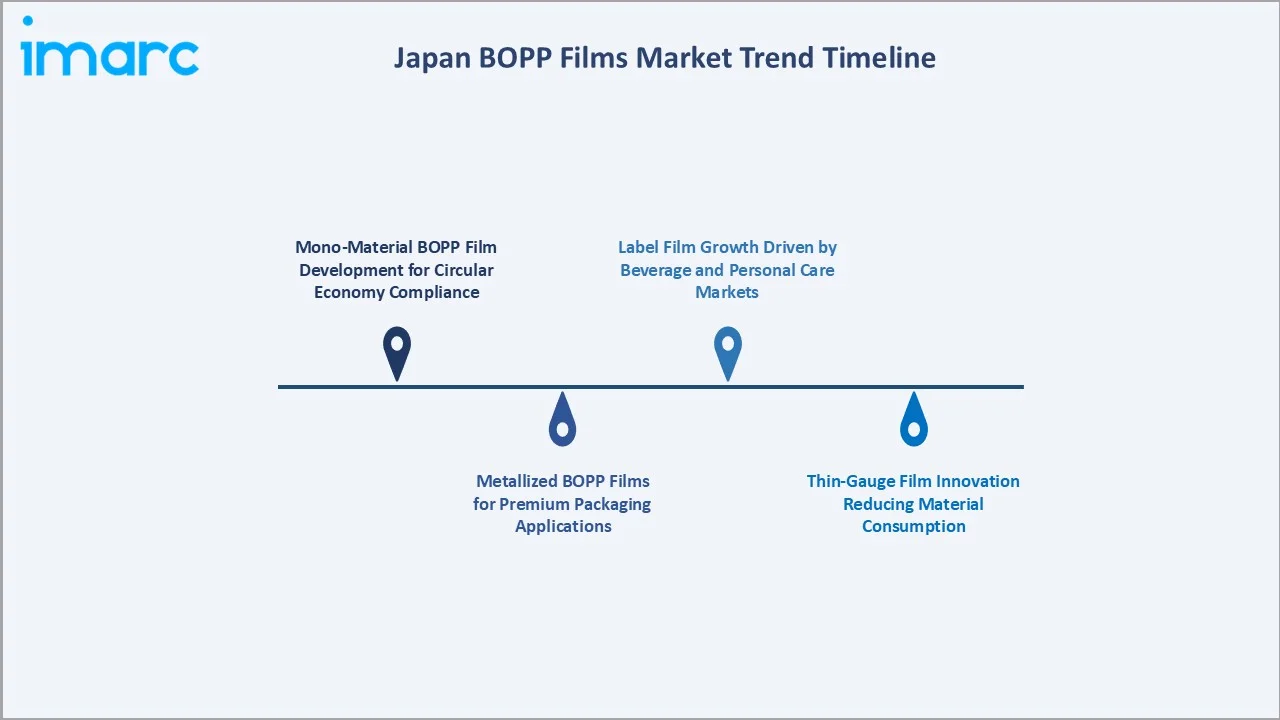
1. Mono-Material BOPP Film Development for Circular Economy Compliance
Mono-material BOPP film development is Japan's most commercially transformative packaging trend. These single-polymer films offer full recyclability while maintaining performance parity with multi-layer laminates. Retailers and brand owners are driving adoption to meet Japan's 2030 plastic recycling targets, creating structured commercial demand for recyclable mono-material film solutions across food, personal care, and household product segments.
2. Metallized BOPP Films for Premium Packaging Applications
Metallized BOPP films are experiencing growing demand in confectionery, cosmetics, and premium food packaging. Japan's brand-conscious consumer culture and retailer emphasis on shelf differentiation are expanding commercial opportunities for metallized film variants with enhanced barrier and aesthetic properties, enabling product premiumization and shelf-presence differentiation across Japan's competitive food and personal care retail environment.
3. Thin-Gauge Film Innovation Reducing Material Consumption
Thin-gauge BOPP film development reduces material consumption per packaging unit while maintaining structural and barrier performance. Japan's sustainability commitments and material cost optimization objectives are accelerating manufacturer adoption of down-gauged film grades across high-volume packaging applications, supporting both environmental compliance goals and per-unit packaging cost reduction across major food and beverage brands.
4. Label Film Growth Driven by Beverage and Personal Care Markets
BOPP label films are experiencing above-average growth driven by Japan's premium beverage market expansion. Enhanced printability and moisture-resistant properties support adoption over paper labels in Japan's high-humidity retail environments across premium brands, with shrink-sleeve BOPP label formats capturing increasing share in the high-growth functional beverage and premium water market segments.
Industry Value Chain Analysis
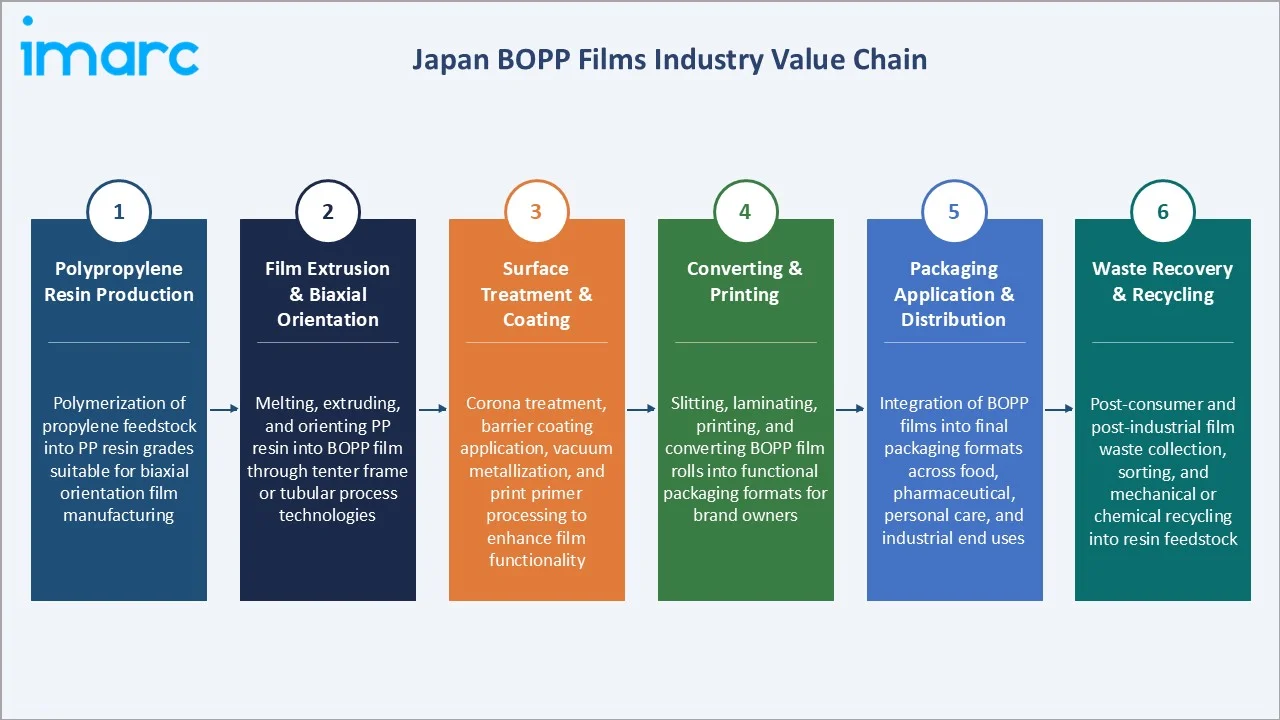
Japan's BOPP films value chain integrates polypropylene resin production, film extrusion, biaxial orientation, surface treatment, converting, and downstream packaging applications across multiple industrial verticals. Each stage adds distinct value and capability.
|
Stage |
Key Activities |
|
Polypropylene Resin Production |
Polymerization of propylene feedstock into PP resin grades suitable for biaxial orientation film manufacturing |
|
Film Extrusion & Biaxial Orientation |
Melting, extruding, and orienting PP resin into BOPP film through tenter frame or tubular process technologies |
|
Surface Treatment & Coating |
Corona treatment, barrier coating application, vacuum metallization, and print primer processing to enhance film functionality |
|
Converting & Printing |
Slitting, laminating, printing, and converting BOPP film rolls into functional packaging formats for brand owners |
|
Packaging Application & Distribution |
Integration of BOPP films into final packaging formats across food, pharmaceutical, personal care, and industrial end uses |
|
Waste Recovery & Recycling |
Post-consumer and post-industrial film waste collection, sorting, and mechanical or chemical recycling into resin feedstock |
Japan's value chain is distinguished by the surface treatment and coating stage, where manufacturers differentiate through proprietary barrier coating formulations, vacuum metallization precision, and printability enhancement technology, enabling premium product positioning and above-commodity margin capture across high-value packaging film applications.
Technology Landscape in the Japan BOPP Films Industry
Biaxial Orientation Technology
Tenter frame biaxial orientation is the dominant production technology, commanding 86.5% of Japan's BOPP film output. The process provides superior control over film dimensions, mechanical properties, and optical clarity, with manufacturers continuously investing in line upgrades for wider and thinner film production capabilities.
Barrier Coating and Metallization Technology
Advanced barrier coating and vacuum metallization technologies enable BOPP film manufacturers to achieve oxygen and moisture transmission rates competitive with aluminum foil laminates. Next-generation transparent barrier coatings using aluminum oxide and silicon oxide deposition support premium food and pharmaceutical packaging applications requiring high clarity barrier performance.
Recyclable Film Technology
Japan's regulatory environment is driving investment in recyclable BOPP film technology, including mono-material heat-sealable structures, solvent-free laminating adhesives, and chemical recycling-compatible film grades, positioning Japanese manufacturers as global leaders in sustainable film innovation aligned with circular economy objectives.
Market Segmentation Analysis
The report covers the following segments:
|
Segment Category |
Leading Segment |
Market Share |
Year |
| Type | Bags and Pouches | 31.8% | 2025 |
| Thickness | 🔒 | 🔒 | 2025 |
| Production Process | Tenter | 86.5% | 2025 |
| Application | 🔒 | 🔒 | 2025 |
| Region | Kanto | 37.1% | 2025 |

By Production Process
The tenter process leads Japan's BOPP film production at 86.5% in 2025. Its dominance reflects capability to produce films with tightly controlled width, uniform mechanical properties, and superior optical clarity essential for demanding food, label, and pharmaceutical packaging applications across Japan's organized retail sector.
To access detailed market analysis, Request Sample
The tubular process accounts for 13.5%, primarily serving niche applications requiring heat-shrink properties, curved surface conformability, and cost-optimized film production for commodity packaging uses. Its lower capital requirements support smaller-scale specialty film producers in Japan's film manufacturing ecosystem.
By Type
Bags and pouches leads with 31.8% in 2025, serving Japan's food retail, convenience store supply, and e-commerce packaging requirements. Wraps account for 27.4% through industrial and food service applications. Labels represent 18.6%, driven by Japan's premium beverage and personal care labeling requirements.
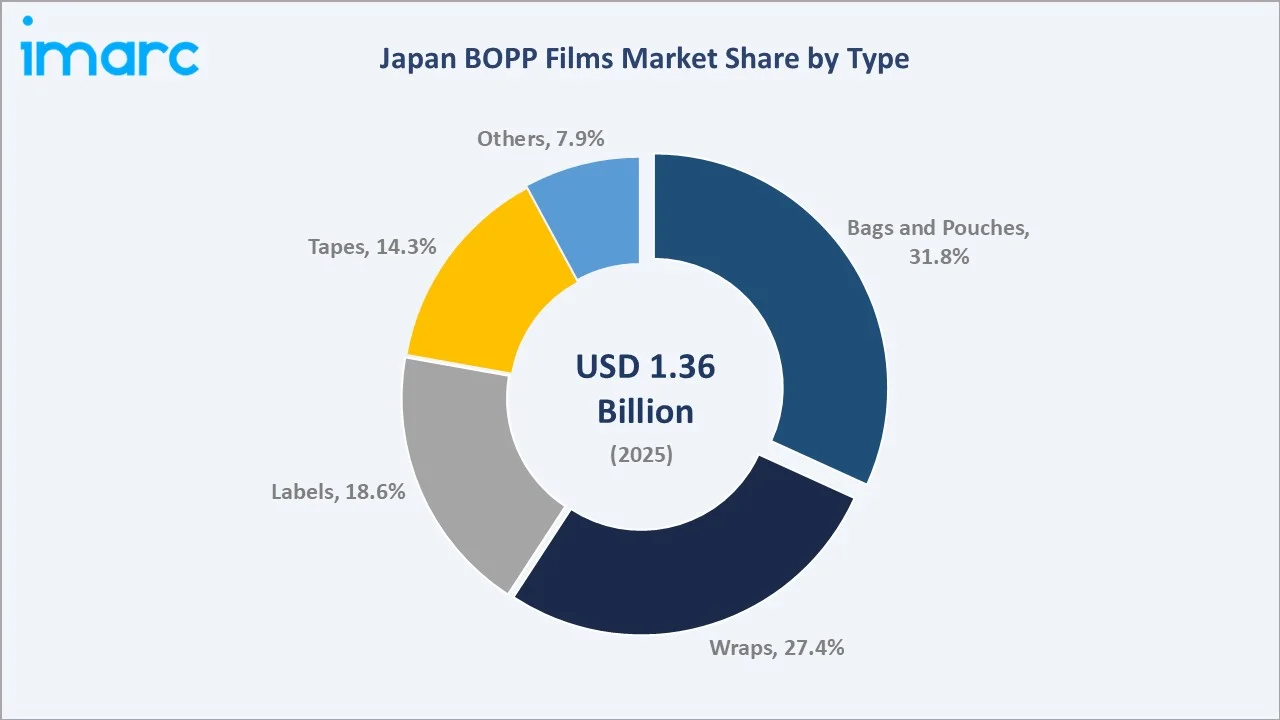
Tapes hold 14.3% through industrial and consumer adhesive tape applications. Others at 7.9% covers specialty applications including agricultural mulch films, release liners, and capacitor films for Japan's electronics manufacturing industry.
Regional Market Insights
|
Region |
Share (2025) |
Key Japan BOPP Films Market Drivers & Characteristics |
|
Kanto |
37.1% |
Driven by high-density food manufacturing, pharmaceutical packaging, and consumer goods sectors generating the highest BOPP film demand nationally. |
|
Kansai/Kinki |
22.6% |
Supporting widespread adoption in food processing, consumer goods, and flexible packaging applications across the region's industrial base. |
|
Central/Chubu |
15.5% |
Reflects automotive and general manufacturing sectors driving demand for protective and industrial BOPP film applications. |
|
Kyushu-Okinawa |
8.8% |
Rising food processing and agricultural packaging investments supporting regional BOPP film adoption across key application sectors. |
|
Tohoku |
6.2% |
Recovery-driven industrial growth and food processing sector expansion increasing BOPP film consumption across the region. |
|
Chugoku |
4.8% |
Industrial manufacturing base supporting steady BOPP film demand for packaging and industrial applications. |
|
Hokkaido |
3.6% |
Agricultural and food processing sector driving demand for fresh produce and dairy packaging film applications. |
|
Shikoku |
1.4% |
Smallest regional share with niche food processing and agricultural film applications driving consumption. |
Kanto's 37.1% leadership reflects Tokyo-Yokohama's high-density food manufacturing concentration, Japan's largest pharmaceutical packaging cluster, and consumer electronics sector demand. Kansai's 22.6% reflects Osaka and Kobe's established food processing industries and organized retail distribution networks generating consistent packaging film volumes.
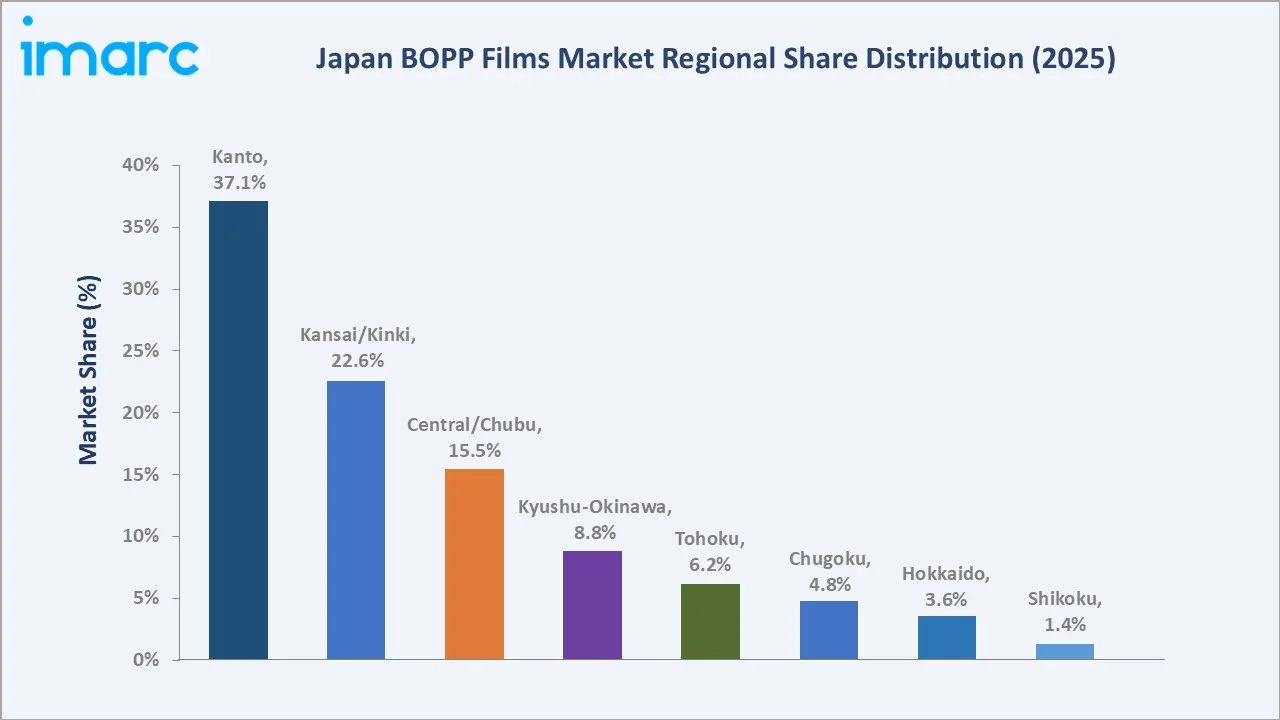
Chubu's 15.5% reflects Nagoya's automotive and industrial manufacturing base. Kyushu-Okinawa's 8.8% reflects growing food processing investments. Tohoku, Chugoku, Hokkaido, and Shikoku collectively represent 16.0%, with agricultural film demand being a key consumption driver across these regions.
Competitive Landscape
Japan's BOPP films market is moderately consolidated with domestic manufacturers holding significant positions. Competition intensifies through technological differentiation in barrier films, sustainable film development, and product quality targeting premium packaging applications across key end-use sectors.
|
Company |
Key Products |
Market Position |
Core Strength |
|
Toray Industries, Inc. |
Torayfan MOTM, Torayfan MH5C, Torayfan PWX4, Torayfan FP72W, Torayfan F7HC, Torayfan MWHX6 |
Market Leader |
Advanced polymer science and proprietary tenter technology enabling thin, high-barrier film production |
|
TOPPAN Inc. |
Packaging films, barrier films, metallized films |
Strong Challenger |
Integrated packaging solutions combining film manufacturing with printing and design capabilities |
|
Toyobo Co., Ltd. |
Biaxially oriented films, specialty films |
Strong Challenger |
Long-established biaxial orientation expertise across PP and other polymer film substrates |
|
Mitsui Chemicals, Inc. |
Functional films, packaging solutions |
Innovator |
Integrated resin-to-film production capability enabling material innovation and cost optimization |
Key players include Toray Industries, Inc., TOPPAN Inc., Toyobo Co., Ltd., Mitsui Chemicals, Inc., and others.
Key Company Profiles
Toray Industries, Inc.
Toray Industries, Inc. is a leading materials science company with a strong position in Japan's biaxially oriented film market, leveraging advanced polymer technology and proprietary manufacturing processes to serve food, pharmaceutical, and industrial sectors.
- Key Products: Torayfan MOTM, Torayfan MH5C, Torayfan PWX4, Torayfan FP72W, Torayfan F7HC, Torayfan MWHX6
- Strategic Focus: Toray Industries, Inc. is expanding its functional film portfolio and strengthening global manufacturing presence through continuous investment in advanced film production technology. The company is prioritizing recyclable BOPP film R&D aligned with Japan's circular economy policy framework and brand owner sustainability mandates across key food packaging segments.
TOPPAN Inc.
TOPPAN Inc. is a diversified printing and packaging company with integrated film manufacturing capabilities, serving Japan's food, pharmaceutical, and consumer goods sectors through high-performance packaging film solutions.
- Key Products: High-barrier packaging films, metallized films, and specialty label films for premium food and personal care applications.
- Strategic Focus: TOPPAN Inc. is integrating sustainable packaging technologies within its broader packaging solutions portfolio to serve increasingly sustainability-focused customers across Japan's food and consumer goods sectors. The company is expanding its metallized and barrier film capabilities to address growing demand for premium packaging differentiation and eco-compliance.
Market Concentration Analysis
Japan's BOPP films market is moderately concentrated, with the key players collectively accounting for an estimated 40–50% of Japan's domestic BOPP film production capacity. The competitive structure is characterized by technology-driven differentiation above cost-based volume positioning.
Market concentration is evolving through two opposing forces: capacity investments by established manufacturers expanding specialty film production, while sustainability-aligned product categories create opportunities for differentiated market entrants offering recyclable and bio-based film solutions to sustainability-committed brand owners.
Investment & Growth Opportunities
Highest Growth Segments
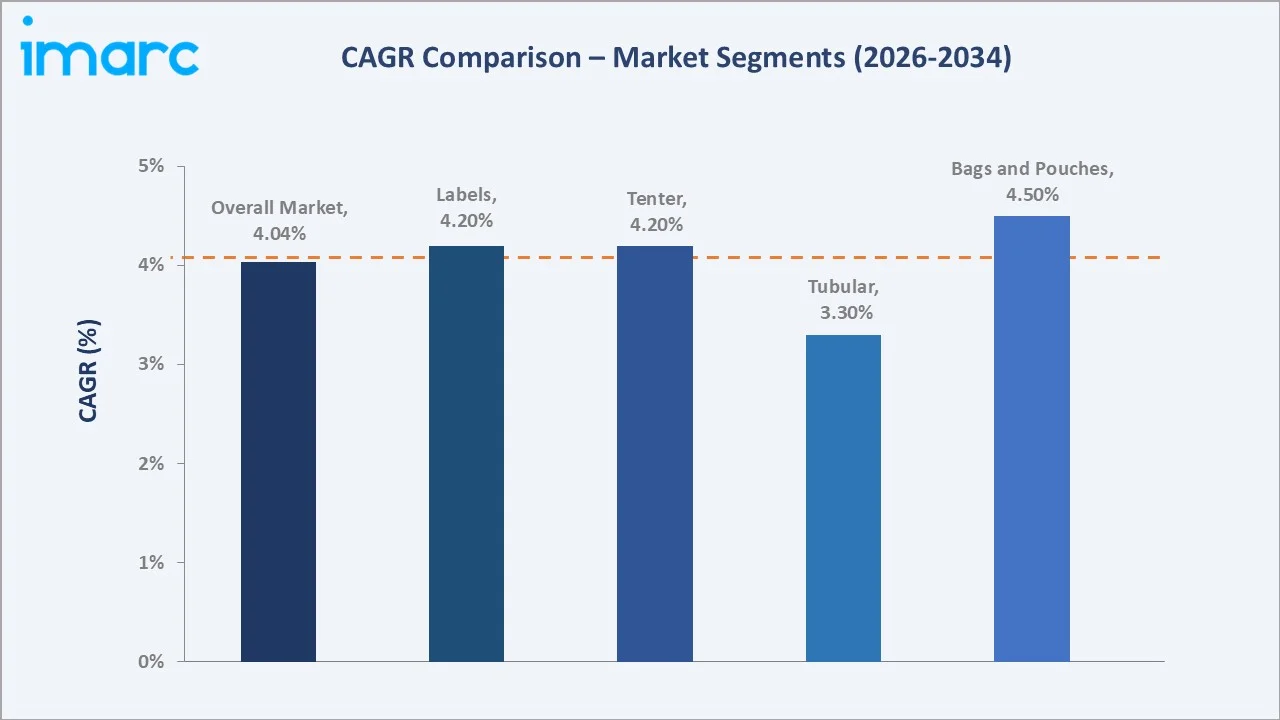
Tapes (~3.6% CAGR), labels (~4.2% CAGR), wraps (~3.8% CAGR), bags and pouches (~4.5% CAGR), and tubular represent Japan's highest-growth BOPP film investment vectors through 2034.
Emerging Investment Opportunities
Japan's recyclable mono-material BOPP film market, driven by regulatory mandates and brand owner sustainability commitments, represents the highest-innovation segment. Investment in proprietary barrier coating technology and recycling-compatible film structures positions manufacturers for premium differentiation and regulatory compliance advantages.
Investment Themes
- Sustainable Film R&D: Investment targeting Japan's 2030 plastic recycling targets, creating above-market margin opportunity through eco-certified film product premiums and regulatory compliance positioning.
- Pharmaceutical Film Applications: Leveraging Japan's world-class pharmaceutical manufacturing base and growing biosimilar and generic drug export volumes to capture demand for specialty high-barrier medical films.
Future Market Outlook (2026-2034)
The Japan BOPP films market is projected to grow from USD 1.36 Billion in 2025 to USD 1.42 Billion in 2026, reaching USD 1.66 Billion by 2030 and USD 1.94 Billion by 2034, registering a CAGR of 4.04%. The trajectory is supported by Japan's organized food retail expansion, e-commerce packaging growth, and manufacturer investment in sustainable film technologies across key application sectors.
Three structural forces define Japan's BOPP film market growth through 2034: Japan's regulatory sustainability framework accelerating recyclable film adoption; Japan's aging demographic sustaining convenience food packaging demand; and export-oriented pharmaceutical and electronics sectors creating premium film demand above commodity market growth rates.
Research Methodology
Primary Research
Primary research comprised structured interviews with Japan BOPP film market stakeholders, including production managers at film manufacturing facilities, packaging procurement executives, regulatory compliance specialists, and distribution channel representatives across Japan's major industrial regions including Kanto, Kansai, and Chubu.
Secondary Research
Secondary research encompassed Japan packaging industry association data, company annual reports, Japan chemical industry statistics, trade publication analysis, patent filings, and government regulatory documentation. Over 40 secondary sources reviewed across domestic and international research databases.
Forecasting Models
Market revenue forecasts were developed using a Japan-specific demand model combining industry output data from Japan's film manufacturing sector, downstream demand from food, pharmaceutical, and consumer goods packaging applications, and sustainability regulation impact modeling for recyclable film transition rates through 2034.
Japan BOPP Films Market Report Coverage:
| Report Features | Details |
|---|---|
| Base Year of the Analysis | 2025 |
| Historical Period | 2020-2025 |
| Forecast Period | 2026-2034 |
| Units | Billion USD |
| Scope of the Report |
Exploration of Historical Trends and Market Outlook, Industry Catalysts and Challenges, Segment-Wise Historical and Future Market Assessment:
|
| Types Covered | Wraps, Bags and Pouches, Tapes, Labels, Others |
| Thicknesses Covered | Below 15 microns,15-30 microns, 30-45 microns, More than 45 microns |
| Production Processes Covered | Tenter, Tubular |
| Applications Covered | Food, Beverage, Tobacco, Personal Care, Pharmaceutical, Electrical and Electronics, Others |
| Regions Covered | Kanto Region, Kansai/Kinki Region, Central/ Chubu Region, Kyushu-Okinawa Region, Tohoku Region, Chugoku Region, Hokkaido Region, Shikoku Region |
| Companies Covered | Toray Industries, Inc., TOPPAN Inc., Toyobo Co., Ltd., Mitsui Chemicals, Inc., etc. |
| Customization Scope | 10% Free Customization |
| Post-Sale Analyst Support | 10-12 Weeks |
| Delivery Format | PDF and Excel through Email (We can also provide the editable version of the report in PPT/Word format on special request) |
Key Benefits for Stakeholders:
- IMARC’s industry report offers a comprehensive quantitative analysis of various market segments, historical and current market trends, market forecasts, and dynamics of the Japan BOPP films market from 2020-2034.
- The research report provides the latest information on the market drivers, challenges, and opportunities in the Japan BOPP films market.
- Porter's five forces analysis assist stakeholders in assessing the impact of new entrants, competitive rivalry, supplier power, buyer power, and the threat of substitution. It helps stakeholders to analyze the level of competition within the Japan BOPP films industry and its attractiveness.
- Competitive landscape allows stakeholders to understand their competitive environment and provides an insight into the current positions of key players in the market.
Frequently Asked Questions About the Japan BOPP Films Market Report
Japan BOPP films market size is estimated at USD 1.42 Billion in 2026, driven by government recycling regulations, e-commerce expansion, and sustained food and beverage packaging demand across Japan's organized retail sector.
The Japan BOPP films market grows at 4.04% CAGR during 2026-2034, reaching USD 1.94 Billion by 2034. Growth is sustained by sustainable packaging regulation adoption, food industry packaging demand, and label film expansion across Japan's premium beverage and personal care sectors.
Tenter process dominates at 86.5% in 2025, driven by superior film uniformity, optical clarity, and mechanical property control advantages for high-performance packaging and label applications across Japan's food, pharmaceutical, and consumer goods packaging sectors.
Bags and pouches leads at 31.8% in 2025, driven by Japan's food retail sector, convenience store packaging requirements, and growing e-commerce protective packaging applications across Japan's organized consumer market and e-commerce distribution channels.
Kanto leads at 37.1% in 2025, through Tokyo-Yokohama's concentrated food processing, pharmaceutical, and consumer electronics manufacturing generating consistent high-volume BOPP film demand across multiple packaging application segments.
Leading companies include Toray Industries, Inc., TOPPAN Inc., Toyobo Co., Ltd., Mitsui Chemicals, Inc., and others.
The Japan BOPP films market is projected to reach approximately USD 1.66 Billion by 2030, with sustainable film adoption, pharmaceutical packaging growth, and label film expansion driving above-average growth in specialty segments across key industrial regions.
Need more help?
- Speak to our experienced analysts for insights on the current market scenarios.
- Include additional segments and countries to customize the report as per your requirement.
- Gain an unparalleled competitive advantage in your domain by understanding how to utilize the report and positively impacting your operations and revenue.
- For further assistance, please connect with our analysts.
 Request Customization
 Speak to an Analyst
 Request Brochure
 Inquire Before Buying
Benefits of Customization
- Personalize this research
- Triangulate with your data
- Get data as per your format and definition
- Gain a deeper dive into a specific application, geography, customer, or competitor
- Any level of personalization
Get in Touch With Us
UNITED STATES
Phone: +1-201-971-6302
INDIA
Phone: +91-120-433-0800
UNITED KINGDOM
Phone: +44-753-714-6104
Email: [email protected]
Client Testimonials

.webp)


.webp)





Related Reports

Choose your plan
*Please note that the prices mentioned below are starting prices for each bundle type. Kindly contact our team for further details.*
Single User License
- 1 User License, Access on 2 Devices
- PDF Report + Excel Dataset (Password Protected)
- Lifetime Access
- No Printing Rights
- 10% Free Report Customization
- 10–12 Weeks of Analyst Support
Five User License
- Access for 5 Users, 2 Devices per User
- PDF Report + Excel Dataset (Password Protected)
- Lifetime Access
- Dedicated Account Manager
- 12–14 Weeks of Analyst Support
- No Printing Rights
- 15% Free Report Customization
- 25% Discount on Your Next Purchase
Corporate User License
- Unlimited User Access (Within Your Organization)
- PDF Report + Excel Dataset
- Lifetime Access
- Dedicated Account Manager
- 14–20 Weeks of Analyst Support
- No Printing Rights
- 20% Free Report Customization
- 30% Discount on Your Next Purchase
Essential Insights
What's included:
3 reports
- Lifetime Access
- PDF Reports
- Excel Datasets
- 2 Weeks of Free Analyst Support
- 2 User Licenses
- Access on 2 Devices
- Printing Rights
- Complimentary PowerPoint (PPT) Version
- Complimentary License Upgrade
Professional Access
What's included:
5 reports
- Lifetime Access
- PDF Reports
- Excel Datasets
- 8 Weeks of Free Analyst Support
- 2 User Licenses
- Access on 2 Devices
- Printing Rights
- Complimentary PowerPoint (PPT) Version
- Complimentary License Upgrade
Business Advantage
What's included:
8 reports
- Lifetime Access
- PDF Reports
- Excel Datasets
- 14 Weeks of Free Analyst Support
- 2 User Licenses
- Access on 2 Devices
- Printing Rights
- Complimentary PowerPoint (PPT) Version
- Complimentary License Upgrade
Enterprise Intelligence
What's included:
10 reports
- Lifetime Access
- PDF Reports
- Excel Datasets
- 20 Weeks of Free Analyst Support
- 2 User Licenses
- Access on 2 Devices
- Printing Rights
- Complimentary PowerPoint (PPT) Version
- Complimentary License Upgrade