
Japan Champagne Market Size, Share, Trends and Forecast by Product, Price, Distribution Channel, and Region, 2026-2034
Japan Champagne Market Size & Forecast 2026-2034
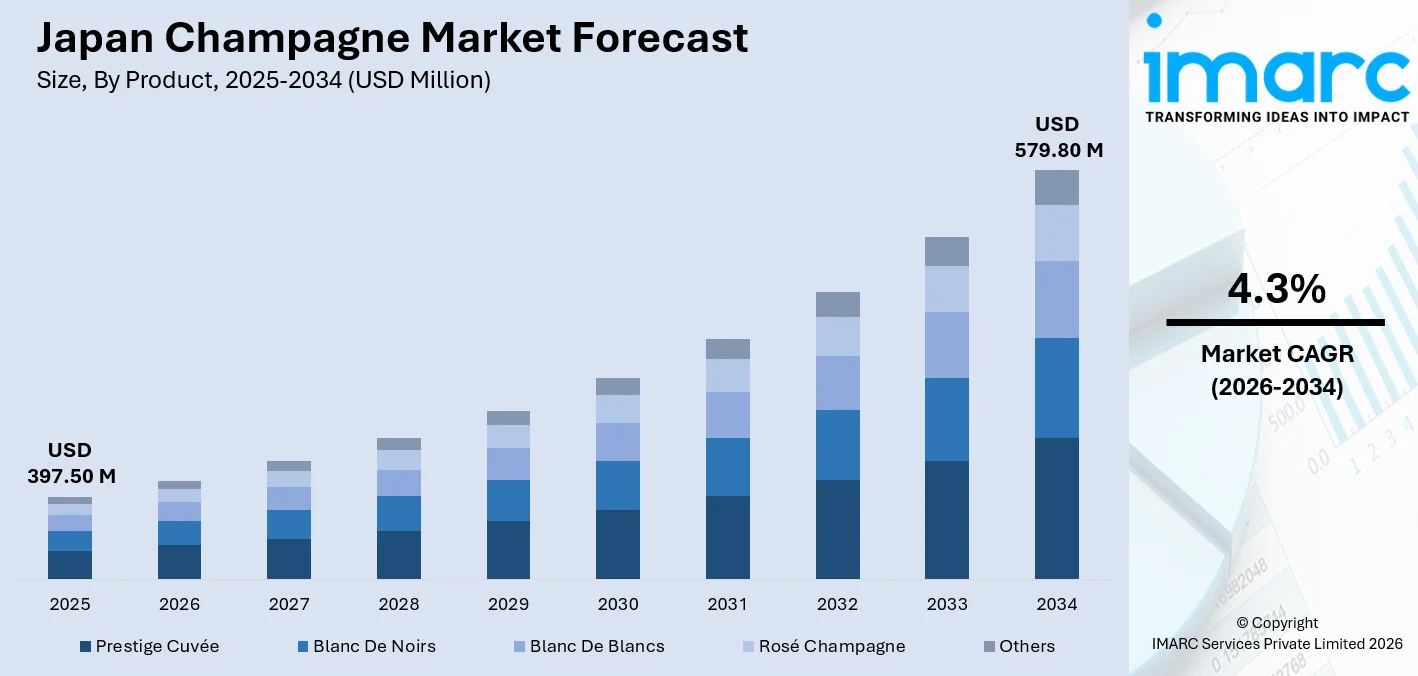
The Japan Champagne market size, valued at USD 397.50 Million in 2025, is projected to reach USD 579.80 Million by 2034, growing at a CAGR of 4.3% from 2026-2034, supported by a deepening culture of premium gifting, luxury hospitality expansion, and rising appreciation for French heritage beverages. In 2025, Japan recorded ¥105.6 billion (approximately USD 704 million) in total sparkling wine imports, with French sparkling wines comprising ¥89.1 billion representing 65.10% of the sparkling wine category, reflecting enduring consumer loyalty to Champagne as a marker of sophistication and elevated market share.
To get more information on this market Request Sample
Japan Champagne Industry Analysis - Key Insights
- Prestige cuvée owns 35.0% of the market by product in 2025 - no other product tier comes close. Japan's gifting culture and event-driven consumption rituals structurally anchor demand at the pinnacle of the product pyramid.
- Luxury commands price at 48.0% in 2025 - a remarkably high concentration. This isn't aspirational positioning, it reflects a consumer base that already equates champagne with celebration and status, making price resistance structurally low.
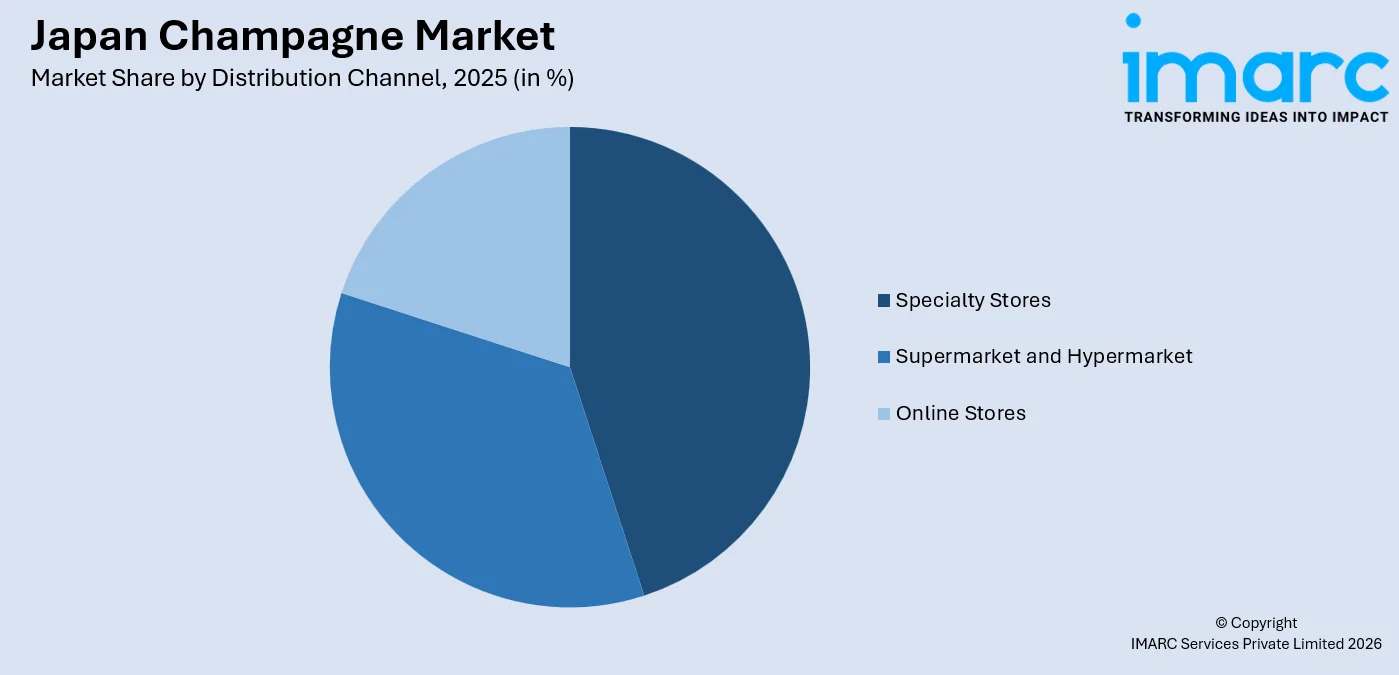
- Specialty stores hold 42.0% of distribution channel in 2025 - the single dominant channel. Curated assortments, sommelier guidance, and in-store tasting events convert casual buyers into loyal connoisseurs, reinforcing repeat premium purchases.
- Kanto Region leads regionally with 52.0% share in 2025 - by far the highest dominance figure across all four segments, driven by Tokyo's dense concentration of luxury hotels, Michelin-starred restaurants, and sophisticated urban consumers.
Japan Champagne Market Trends and Dynamics 2026
Market Trends
Art collaborations and cultural storytelling elevating prestige cuvée desirability
Luxury champagne houses are embedding cultural artistry into their Japan strategy to deepen emotional resonance with discerning consumers. In December 2025, Dom Pérignon launched its Takashi Murakami collaboration in Tokyo, celebrating the artist's first-ever wine label design. Bottles of the 2015 vintage priced at ¥43,340 attracted a celebrity-studded crowd, underscoring how limited-edition prestige releases command cultural cachet alongside commercial traction.
Luxury hospitality expansion creating new premium champagne consumption occasions
Japan's wave of high-end hotel openings is generating high-frequency champagne consumption occasions across the Kanto and Kinki regions. In October 2025, JW Marriott opened its new hotel in Tokyo, located in Takanawa Gateway City, positioning champagne as the premium welcome beverage of choice. This structural addition of luxury venues is directly reinforcing Japan champagne market trends toward on-premise prestige consumption.
Champagne shipments to Japan are recovering momentum, signalling domestic supply confidence
According to industry data, Japan recorded growth in champagne imports over the full year 2025. This demonstrates that Japan's appetite for champagne remained resilient despite broader global market softness.
- Prestige Gifting Culture: Japan's deeply rooted omiyage and luxury gift-giving traditions structurally drive repeat prestige cuvée purchases for seasonal events, corporate celebrations, and milestone occasions.
- Sustainable Viticulture Appeal: Over 60% of champagne vineyards hold sustainability certifications under VDC and 25% of production also has ISO 14001 certification, aligning with growing eco-consciousness among Japan's premium consumer segment.
- Fine Dining & Pairing Experiences: Michelin-starred chefs across Tokyo and Osaka are developing champagne pairing menus that blend French cuvées with Japanese cuisine, broadening the product's cultural integration.
- Rising Specialty Wine Education: Champagne houses and importers are investing in sommelier training and consumer-facing tasting events nationwide, accelerating the conversion of casual wine drinkers into loyal champagne enthusiasts.
Growth Drivers
Affluent urban consumer base with a strong appetite for luxury French products
Japan's growing high-net-worth individual segment is a structural pillar of Japan champagne market growth. Wine consumption in Japan has tripled since the mid-1980s, accounting for nearly 5% of the overall alcoholic beverage market with a consumption volume of 361.000 kL in 2022, a proportion that signals deeply embedded consumer preference rooted in the long-standing cultural association between products and uncompromising quality.
Luxury airline and travel retail integration is accelerating premium brand exposure
Premium travel channels are serving as high-visibility champagne entry points for affluent Japanese consumers. All Nippon Airways (ANA) introduced an upgraded wine program on its international flights in December 2025. Passengers flying in International First Class will enjoy a premium offering that includes KRUG champagne, a brand that has been served to ANA customers since the airline began international operations in 1986, placing prestige cuvée in front of the country's most aspirational and high-spending travellers at the precise moment of peak experience expectation.
Inbound tourism surge multiplying on-premise champagne demand in Kanto
Japan recorded 36.9 million international visitors in 2024, up 47.1% year on year, directly boosting on-premise champagne consumption at Tokyo's luxury hotels, rooftop bars, and fine dining establishments.
- Westernization of Celebration Culture: Weddings, corporate milestones, and New Year celebrations increasingly feature champagne as the ceremonial toast, expanding occasions beyond traditional sake rituals.
- Expanding Specialty Retail Networks: Premium wine specialty chains including Enoteca and Vinos Yamazaki are expanding their footprint and champagne curations, deepening consumer access to premium labels.
- Female Consumer Segment Expansion: Younger Japanese women are emerging as a high-growth champagne consumer cohort, favouring rosé and blanc de blancs styles for lifestyle occasions and social sharing.
- E-Commerce Platform Growth: Online wine retailers are expanding champagne assortments and home delivery services, converting new consumers outside metropolitan areas into regular premium buyers.
Market Restraints
High retail price sensitivity among non-premium consumer segments: Japan's champagne market faces inherent limitations in broadening its consumer base beyond affluent demographics. For middle-income households, champagne remains an infrequent indulgence rather than a routine beverage, constraining the addressable market to a relatively narrow high-income tier and limiting frequency of purchase beyond celebratory occasions.
Intensifying competition from domestic sparkling wines and prosecco: The rise of Japanese domestic sparkling wines and the global popularity of affordable alternatives, including prosecco, create substitution pressure within casual-occasion consumption. As local wineries in Nagano and Yamanashi expand quality sparkling production, some consumers gravitate toward domestic pride-driven choices over imported French champagne.
Supply chain vulnerability from Champagne region climate pressures: Structural challenges in the Champagne region, including regulatory rigidity around AOC grape varieties and increasing exposure to adverse weather, create supply uncertainty. This constrains producers' ability to guarantee consistent vintage availability and volume commitments to Japanese importers and distributors over the medium term.
Japan Champagne Market Segmentation Analysis
| Segment Category | Leading Segment | Market Share | Year |
|---|---|---|---|
| Product | Prestige Cuvée | 35.0% | 2025 |
| Price | Luxury | 48.0% | 2025 |
| Distribution Channel | Specialty Stores | 42.0% | 2025 |
| Region | Kanto Region | 52.0% | 2025 |
Product Insights
Prestige Cuvée - 35.0% Market Share (2025) | Leading Product
Prestige cuvée commands the Japan champagne market through its alignment with the country's deeply entrenched gifting culture and ceremonial consumption rituals. These flagship bottlings from Krug, Dom Pérignon, Veuve Clicquot La Grande Dame, and Moët & Chandon Impérial serve as the default premium gift across weddings, corporate milestones, and Year-End parties. In December 2025, Dom Pérignon launched the Takashi Murakami collaboration in Tokyo with the 2015 vintage priced at ¥43,340 per bottle, demonstrating the power of limited-edition prestige releases to command both cultural relevance and premium pricing.
|
Segment Breakdown Prestige Cuvée (35.0%) · Blanc De Noirs · Blanc De Blancs · Rosé Champagne · Others |
Price Insights
Luxury - 48.0% Market Share (2025) | Leading Price
Luxury-priced champagne owns nearly half the Japan champagne market, a structural concentration that reflects the country's unusually high tolerance for premium pricing across consumables. Japan's average sparkling wine import price reached ¥5,590.14 per litre (approximately USD 37.27) in 2025, the highest average across sparkling wine categories, confirming that volume-to-value dynamics in Japan favour premium and ultra-premium price tiers. The Japan champagne market forecast indicates sustained premiumisation as the core growth engine through 2034.
|
Segment Breakdown Luxury (48.0%) · Economy · Mid-Range |
Distribution Channel Insights
Access the comprehensive market breakdown Request Sample
Specialty Stores - 42.0% Market Share (2025) | Leading Distribution Channel
Specialty wine stores dominate champagne distribution in Japan through their ability to provide curated selections, personalised sommelier service, and immersive brand experiences that supermarkets and online platforms cannot replicate. Chains such as Enoteca, with locations in Roppongi Hills, Ginza-Matsuzakaya, and Hiroo, and Vinos Yamazaki with its 27-location direct-import network, function as premium champagne discovery hubs where connoisseurs and aspirational buyers alike encounter new labels and vintages. Japan champagne market outlook points to continued specialty channel dominance as luxury hospitality and gifting occasions proliferate.
|
Segment Breakdown Specialty Stores (42.0%) · Supermarket and Hypermarket · Online Stores |
Regional Insights
Kanto Region - 52.0% Market Share (2025) | Leading Region
The Kanto Region is the overwhelming engine of Japan's champagne market, driven by Tokyo's unmatched density of luxury hotels, Michelin-starred restaurants, high-end retail districts, and affluent corporate consumers. Tokyo alone hosts the largest concentration of Michelin-starred restaurants globally, each representing a premium on-premise champagne venue. In December 2025, the Park Hyatt Tokyo completed a full-scale renovation and reopened, with champagne featuring prominently in welcome rituals, reinforcing Kanto's structural advantage as the country's premier luxury hospitality destination.
|
Metric
|
Details
|
|---|---|
|
Market Share in 2025
|
52.0%
|
|
Key States
|
Tokyo, Kanagawa, Chiba, Saitama, Ibaraki, Tochigi, and Gunma |
|
Major Growth Drivers
|
Luxury hospitality expansion, corporate event consumption, premium gifting culture, Michelin restaurant ecosystem |
|
Outlook
|
Dominant region, sustained premiumisation momentum |
|
Regional Breakdown Kanto Region (52.0%) · Kinki Region · Central/Chubu Region · Kyushu-Okinawa Region · Tohoku Region · Chugoku Region · Hokkaido Region · Shikoku Region |
Kinki Region:
The Kinki Region, centred on Osaka and Kyoto, is Japan's second-largest champagne market with a strong emphasis on upscale dining and luxury retail. The region hosts KYOTOGRAPHIE, one of Asia's premier international photography festivals, where champagne houses such as Ruinart regularly stage branded cultural activations, demonstrating the region's deep integration of champagne into cultural programming that resonates with affluent domestic and international visitors.
|
Metric
|
Details
|
|---|---|
|
Key States
|
Osaka, Kyoto, Kobe, Nara, and Otsu |
|
Major Growth Drivers
|
Cultural tourism, luxury department stores, fine dining expansion |
|
Outlook
|
Growing arts-and-champagne cultural positioning |
Central/Chubu Region:
The Central/Chubu Region is developing a distinctive champagne identity anchored in luxury alpine tourism. Resorts in Hakuba combine après-ski activities with champagne experiences, and luxury wine tastings in Nagano and Yamanashi prefectures feature imported labels alongside Japanese sparkling wines. The Mitsui Fudosan Group is scheduled to open a five-star hotel in Hakone town in 2026, extending the region's premium hospitality infrastructure and adding incremental champagne on-premise demand in a setting historically associated with the Mitsui family legacy.
|
Metric
|
Details
|
|---|---|
|
Key States
|
Nagoya, Hamamatsu, Shizuoka, Kanazawa, Niigata, and Nagano |
|
Major Growth Drivers
|
Luxury ski resorts, alpine tourism, new hotel openings |
|
Outlook
|
Emerging adventure-luxury champagne pairing destination |
Kyushu-Okinawa Region:
Kyushu-Okinawa is evolving into a champagne consumption hub through beachfront resort experiences and innovative urban pairings. Okinawa's beachfront resorts, including properties featuring Bollinger alongside local seafood menus, and Fukuoka's yatai street food culture, where creative champagne pairings are being introduced, signal an emerging regional identity that bridges champagne's French heritage with Japan's own food culture.
|
Metric
|
Details
|
|---|---|
|
Key States
|
Fukuoka, Kitakyushu, Nagasaki, Kagoshima, and Kumamoto prefectures |
|
Major Growth Drivers
|
Beachfront resort culture, inbound tourism, innovative food pairing |
|
Outlook
|
High growth potential via tourism-driven consumption |
Tohoku Region:
Tohoku's champagne consumption is concentrated in premium hospitality venues in Sendai and ski resort areas such as Zao and Niseko-adjacent properties. While the region commands a smaller share of the national market, growing domestic tourism, particularly luxury ryokan (traditional inn) experiences incorporating western beverage menus, is gradually expanding champagne's footprint beyond Tohoku's major urban centres.
|
Metric
|
Details
|
|---|---|
|
Key States
|
Miyagi, Aomori, Iwaki, Akita, Yamagata, and Fukushima prefectures |
|
Major Growth Drivers
|
Luxury ryokan tourism, ski resort hospitality, Sendai urban dining |
|
Outlook
|
Niche growth through traditional hospitality modernisation |
Market Outlook 2026-2034
What is the future outlook of the Japan champagne market?
The Japan champagne market is expected to sustain steady revenue growth through 2034.
Sustained premiumisation, expanding luxury hospitality infrastructure, and deepening consumer wine education will underpin consistent demand growth across the forecast period. As Japan's pipeline of luxury hotel openings, including Fairmont Tokyo and Mitsui Hakone, translates into new on-premise champagne venues, and as specialty retail chains continue expanding curated champagne portfolios, the market is well-positioned to capture a growing share of Japan's affluent consumer spending on premium celebratory beverages.
Japan Champagne Market - Leading Key Players
The Japan champagne market is shaped by a concentrated group of global champagne houses operating through local joint ventures and dedicated import distribution networks.
| Company | Leading Brands | Highlights |
|---|---|---|
| Moët Hennessy Diageo K.K. (MHD and LVMH) | Dom Pérignon, Krug, Veuve Clicquot, Moët & Chandon, Ruinart, Armand De Brignac | LVMH champagne houses maintained 22% global Champagne-appellation shipment share in 2025; Dom Pérignon's Takashi Murakami collaboration launched in Tokyo, December 2025 |
| Laurent-Perrier | Grand Siècle, Cuvée Rosé | strong rosé portfolio appealing to Japan's female consumer segment |
| Champagne Lanson | Le Black Création, Le Rosé Création, Le Blanc de blancs, Le Black Réserve | consistent exporter to Asian markets, Black Label NV is widely stocked across Japanese specialty stores and premium supermarkets |
Some of the major key players in Japan champagne market are G.H. Mumm (Pernod Ricard), and Champagne Bollinger, etc.
Latest Development & News
- In December 2025, Dom Pérignon launched its first-ever artist collaboration with Japanese contemporary art icon Takashi Murakami at Kaikai Kiki Gallery in Tokyo's Motoazabu neighbourhood. Murakami's signature pop-art floral motifs replaced the traditional grapevine wreath on bottles of the 2015 vintage (¥43,340) and the 2010 Rosé (¥68,640). The event attracted celebrities and Champagne devotees, underscoring the growing role of cultural partnerships in driving prestige cuvée demand across Japan's luxury consumer market.
- In August 2024, All Nippon Airways (ANA) upgraded its in-flight wine offering by featuring Krug champagne for first-class passengers and exclusive champagne options in ANA lounges. The initiative, covering a major portion of ANA's international first-class routes, positioned premium champagne as a core element of Japan's luxury aviation experience, exposing ANA's highest-spending passengers, predominantly affluent domestic and inbound business travellers, to prestige champagne consumption at altitude.
Japan Champagne Market Report Scope:
| Report Features | Details |
|---|---|
| Base Year of the Analysis | 2025 |
| Historical Period | 2020-2025 |
| Forecast Period | 2026-2034 |
| Units | Million USD |
| Scope of the Report | Exploration of Historical and Forecast Trends, Industry Catalysts and Challenges, Segment-Wise Historical and Predictive Market Assessment:
|
| Products Covered | Prestige Cuvée, Blanc De Noirs, Blanc De Blancs, Rosé Champagne, Others |
| Prices Covered | Economy, Mid-Range, Luxury |
| Distribution Channels Covered | Supermarket And Hypermarket, Specialty Stores, Online Stores |
| Regions Covered | Kanto Region, Kinki Region, Central/Chubu Region, Kyushu/Okinawa Region, Tohoku Region, Chugoku Region, Hokkaido Region, Shikoku Region. |
| Customization Scope | 10% Free Customization |
| Post-Sale Analyst Support | 10-12 Weeks |
| Delivery Format | PDF and Excel through Email (We can also provide the editable version of the report in PPT/Word format on special request) |
Key Benefits for Stakeholders:
- IMARC’s report offers a comprehensive quantitative analysis of various market segments, historical and current market trends, market forecasts, and dynamics of the Japan champagne market from 2020-2034.
- The research study provides the latest information on the market drivers, challenges, and opportunities in the Japan champagne market.
- Porter's five forces analysis assist stakeholders in assessing the impact of new entrants, competitive rivalry, supplier power, buyer power, and the threat of substitution. It helps stakeholders to analyze the level of competition within the Japan champagne industry and its attractiveness.
- Competitive landscape allows stakeholders to understand their competitive environment and provides an insight into the current positions of key players in the market.
Frequently Asked Questions About the Japan Champagne Market Report
The Japan champagne market reached a value of USD 397.50 Million in 2025.
The market is projected to grow at a CAGR of 4.3% during 2026-2034, reaching USD 579.80 Million by 2034.
Key growth drivers include rising disposable incomes and a growing affluent consumer class, strong association of champagne with celebrations and luxury, increasing Western and French cultural influence, a shifting drinking culture among younger generations toward premium beverages, and surging international tourism boosting diverse consumption preferences.
The report covers segmentation by product, price, distribution channel, and region. Each segment includes detailed market size and forecast analysis.
Key trends include growing popularity of rosé and prestige cuvée champagne among younger, affluent consumers, expanding online retail and specialty store distribution channels, increasing influence of French lifestyle and fine dining culture, and rising demand for champagne as both a premium gifting and social occasion beverage across Japan.
Need more help?
- Speak to our experienced analysts for insights on the current market scenarios.
- Include additional segments and countries to customize the report as per your requirement.
- Gain an unparalleled competitive advantage in your domain by understanding how to utilize the report and positively impacting your operations and revenue.
- For further assistance, please connect with our analysts.
 Request Customization
 Speak to an Analyst
 Request Brochure
 Inquire Before Buying
Benefits of Customization
- Personalize this research
- Triangulate with your data
- Get data as per your format and definition
- Gain a deeper dive into a specific application, geography, customer, or competitor
- Any level of personalization
Get in Touch With Us
UNITED STATES
Phone: +1-201-971-6302
INDIA
Phone: +91-120-433-0800
UNITED KINGDOM
Phone: +44-753-714-6104
Email: [email protected]
Client Testimonials




.webp)




.webp)













Related Reports

Choose your plan
*Please note that the prices mentioned below are starting prices for each bundle type. Kindly contact our team for further details.*
Single User License
- 1 User License, Access on 2 Devices
- PDF Report + Excel Dataset (Password Protected)
- Lifetime Access
- No Printing Rights
- 10% Free Report Customization
- 10–12 Weeks of Analyst Support
Five User License
- Access for 5 Users, 2 Devices per User
- PDF Report + Excel Dataset (Password Protected)
- Lifetime Access
- Dedicated Account Manager
- 12–14 Weeks of Analyst Support
- No Printing Rights
- 15% Free Report Customization
- 25% Discount on Your Next Purchase
Corporate User License
- Unlimited User Access (Within Your Organization)
- PDF Report + Excel Dataset
- Lifetime Access
- Dedicated Account Manager
- 14–20 Weeks of Analyst Support
- No Printing Rights
- 20% Free Report Customization
- 30% Discount on Your Next Purchase
Essential Insights
What's included:
3 reports
- Lifetime Access
- PDF Reports
- Excel Datasets
- 2 Weeks of Free Analyst Support
- 2 User Licenses
- Access on 2 Devices
- Printing Rights
- Complimentary PowerPoint (PPT) Version
- Complimentary License Upgrade
Professional Access
What's included:
5 reports
- Lifetime Access
- PDF Reports
- Excel Datasets
- 8 Weeks of Free Analyst Support
- 2 User Licenses
- Access on 2 Devices
- Printing Rights
- Complimentary PowerPoint (PPT) Version
- Complimentary License Upgrade
Business Advantage
What's included:
8 reports
- Lifetime Access
- PDF Reports
- Excel Datasets
- 14 Weeks of Free Analyst Support
- 2 User Licenses
- Access on 2 Devices
- Printing Rights
- Complimentary PowerPoint (PPT) Version
- Complimentary License Upgrade
Enterprise Intelligence
What's included:
10 reports
- Lifetime Access
- PDF Reports
- Excel Datasets
- 20 Weeks of Free Analyst Support
- 2 User Licenses
- Access on 2 Devices
- Printing Rights
- Complimentary PowerPoint (PPT) Version
- Complimentary License Upgrade