
Japan Cryptocurrency Market Size, Share, Trends and Forecast by Type, Component, Process, Application, and Region, 2026-2034
Japan Cryptocurrency Market Size, Share, Trends & Forecast (2026-2034)
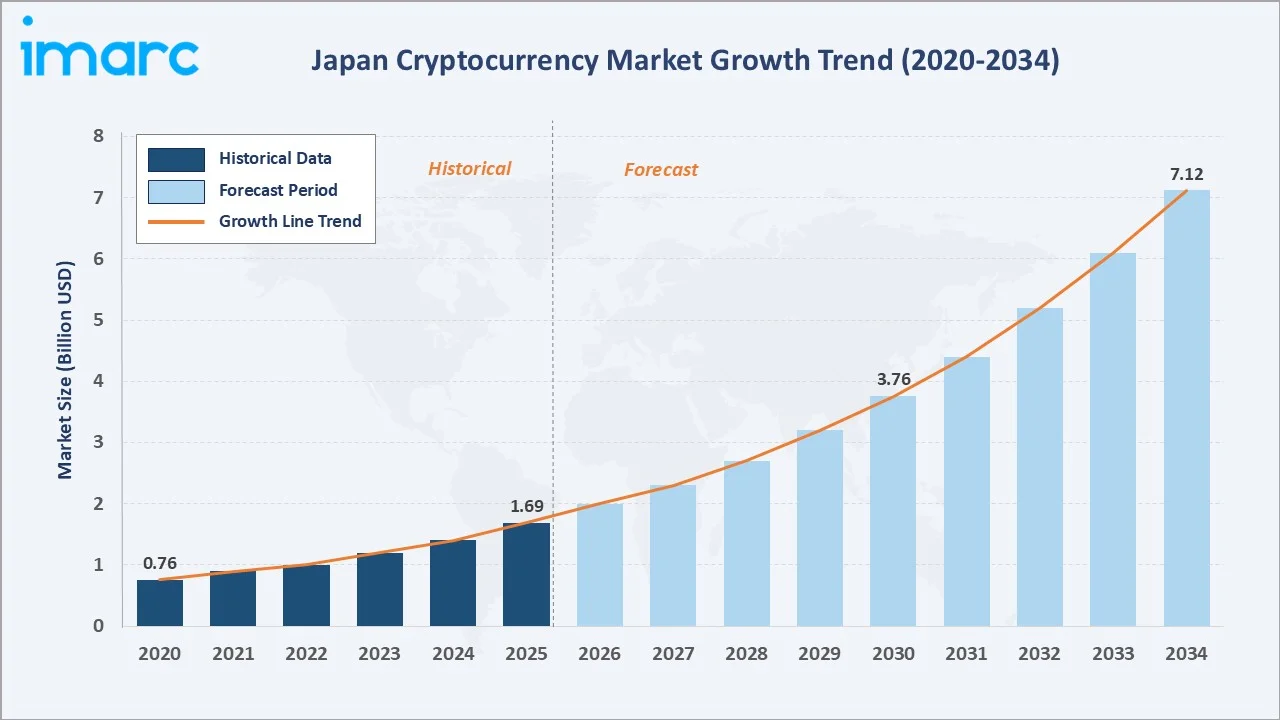
The Japan cryptocurrency market size increased from USD 1.69 Billion in 2025 to USD 1.98 Billion in 2026 and is projected to reach USD 7.12 Billion by 2034, expanding at a CAGR of 17.32% during 2026-2034. Formal regulatory recognition and an FSA-licensed exchange framework, coupled with a large tech-savvy population and early adopter investment base, and growing bank sector integration and blockchain investment are the primary growth catalysts.
Market Snapshot
|
Metric |
Value |
|
Base Year Market Size (2025) |
USD 1.69 Billion |
| Market Size (2026) | USD 1.98 Billion |
|
Forecast Market Size (2034) |
USD 7.12 Billion |
|
CAGR (2026-2034) |
17.32% |
|
Base Year |
2025 |
|
Historical Period |
2020-2025 |
|
Forecast Period |
2026-2034 |
The Kanto region leads the Japan cryptocurrency landscape, holding a 41.5% share in 2025 and an estimated USD 1.98 Billion in 2026, anchored by the region's concentration of exchange headquarters, financial institutions, and tech-savvy urban population. Software commands the largest share of the component segment at 66.8%, reflecting sustained demand for exchange platforms, wallet applications, and blockchain protocol development.
To get more information on this market, Request Sample
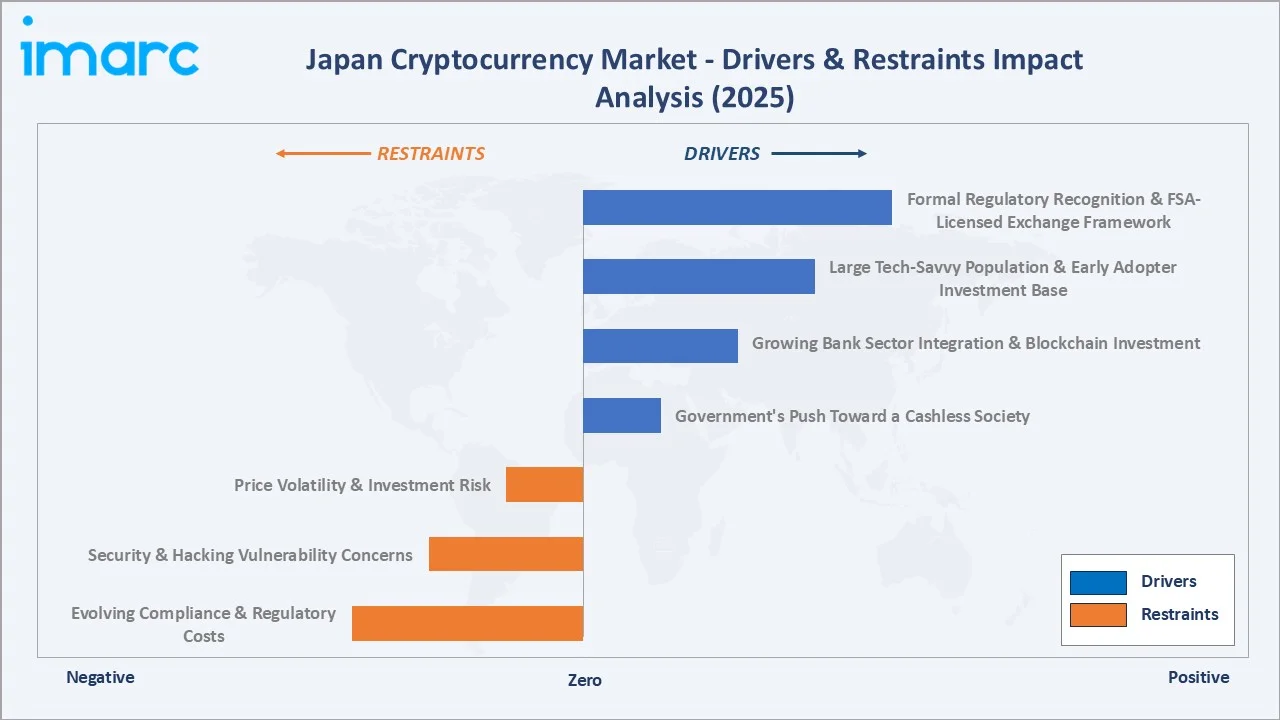
The Japan cryptocurrency market is underpinned by three structural forces: formal regulatory recognition and an FSA-licensed exchange framework, a large tech-savvy population and early adopter investment base, and growing bank sector integration and blockchain investment. Each force independently reinforces category growth, sustaining steady CAGR expansion through 2034 despite price volatility and investment risk.
Executive Summary
The Japan cryptocurrency market is experiencing rapid expansion, driven by formal regulatory recognition, a large tech-savvy investment base, and growing bank sector integration with blockchain technology. The market grew from USD 1.69 Billion in 2025 to an estimated USD 1.98 Billion in 2026 and is forecast to reach USD 7.12 Billion by 2034, growing at a CAGR of 17.32%.
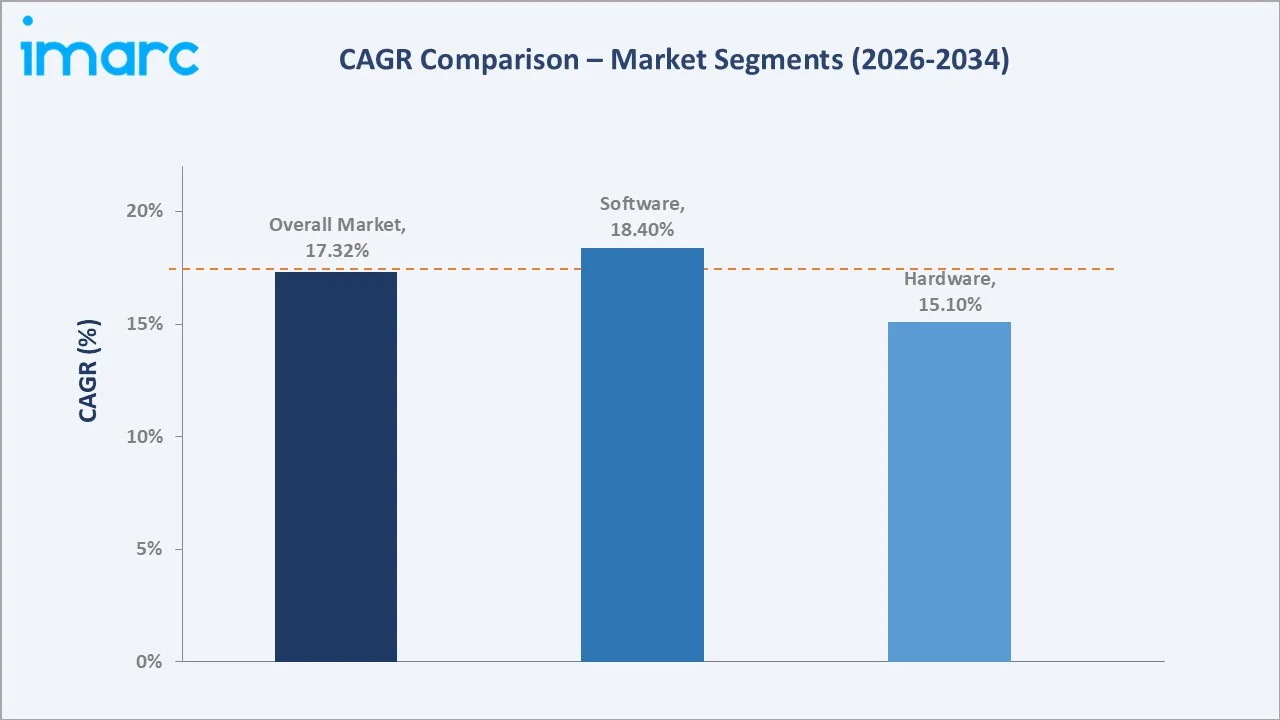
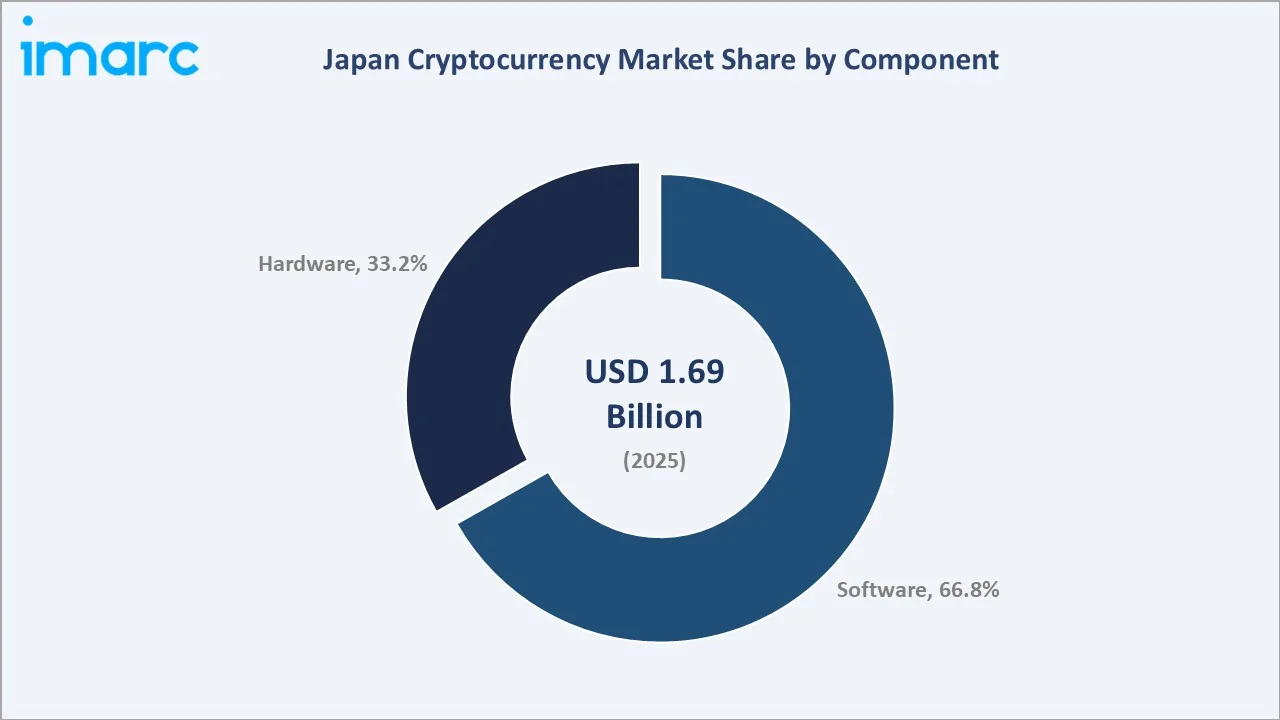
Software dominates the component segment with a 66.8% share in 2025, encompassing exchange platforms, wallet applications, and blockchain protocol solutions, while hardware accounts for 33.2%, reflecting continued demand for mining rigs and secure storage devices.
Transaction leads the process segment at 74.5% share, supported by its central role in trading, remittance, and payment activity, while mining (25.5%) continues to serve network validation and block reward functions. The Kanto Region leads regionally at 41.5%, anchored by the region's concentration of exchange headquarters and financial institutions.
Key Market Insights
|
Insight |
Data |
|
Largest Component Segment |
Software – 66.8% share (2025) |
|
Fastest Growing Component Segment |
Software – ~18.4% CAGR (2026-2034) |
|
Largest Process Segment |
Transaction – 74.5% share (2025) |
|
Leading Region |
Kanto Region – 41.5% share (2025) |
|
Top Companies |
bitFlyer Holdings, Inc., Monex Group, Inc., GMO Internet Group, Inc., SBI Holdings, Inc. |
Key Analytical Observations Supporting The Above Data:
- Software accounts for 66.8% of the Japan cryptocurrency market in 2025. This dominance reflects sustained demand for exchange platforms, wallet applications, and blockchain protocol development.
- Transaction remains the leading process segment at 74.5% share (2025), supported by its central role in trading, remittance, and payment activity.
- Mining is expanding steadily at 25.5% share (2025), as network validation infrastructure continues to support blockchain security and transaction confirmation.
- The Kanto region's 41.5% share (2025) reflects the region's concentration of exchange headquarters, financial institutions, and tech-savvy urban population.
- Rising bank sector integration with blockchain technology is broadening the addressable market across trading, remittance, and institutional investment applications.
Japan Cryptocurrency Market Overview
The Japan cryptocurrency market encompasses software and hardware components supporting transaction and mining processes, offering trading, remittance, payment, and investment solutions for retail and institutional participants. The cryptocurrency ecosystem spans infrastructure and hardware manufacturers, exchange platform and wallet software developers, and an expanding distribution network across web platforms, mobile apps, and institutional trading desks.
Macroeconomic drivers include formal regulatory recognition and an FSA-licensed exchange framework, a large tech-savvy population and early adopter investment base, and growing bank sector integration and blockchain investment. Exchanges are simultaneously investing in compliance infrastructure and institutional trading capabilities to improve platform trust, positioning the Japan cryptocurrency sector for continued innovation-led growth through 2034 despite price volatility and investment risk.
Market Dynamics
To evaluate market opportunities, Request Sample
Market Drivers
- Formal Regulatory Recognition & FSA-Licensed Exchange Framework: Japan's early legal recognition of cryptocurrency has created a formal regulatory foundation that boosts market trust and sustained exchange adoption. In July 2026, Japan’s Parliament approved legislation reclassifying cryptocurrencies from payment instruments to financial assets governed by the Financial Instruments and Exchange Act.
- Large Tech-Savvy Population & Early Adopter Investment Base: A sizable base of technology-forward consumers is driving sustained cryptocurrency adoption as an alternative investment asset class.
- Growing Bank Sector Integration & Blockchain Investment: Major Japanese banks are increasingly offering crypto-related services and investing in blockchain projects, blurring lines between traditional finance and digital assets. In June 2026, MUFG Bank, Mizuho Bank, and Sumitomo Mitsui Banking Corporation formed a joint council to develop and issue yen-backed stablecoins by March 2027. The initiative, supported by Japan’s Financial Services Agency, aims to expand blockchain-based payments and strengthen the yen’s role in digital and cross-border settlement.
- Government’s Push Toward a Cashless Society: In 2025, the cashless payment ratio steadily increased to 58.0% (JPY 162.7 trillion), with electronic money for 3.7% (JPY 6.0 trillion) and code payments for 10.2% (JPY 16.6 trillion). Policy initiatives promoting cashless payments are indirectly supporting cryptocurrency market growth and infrastructure investment.
Market Restraints
- Price Volatility & Investment Risk: Significant price fluctuations in digital assets can deter conservative investors and create unpredictable revenue patterns for exchange operators.
- Security & Hacking Vulnerability Concerns: In 2025, Japan registered an average of 1,231 cyberattacks per week. Persistent cybersecurity risks associated with digital asset custody can undermine consumer confidence and require substantial security investment.
- Evolving Compliance & Regulatory Costs: Ongoing regulatory refinement requires sustained investment in compliance infrastructure, creating cost pressure for smaller exchange operators.
Market Opportunities
- Institutional Trading Desk Expansion: Rising institutional interest in digital assets presents opportunities for exchanges to develop dedicated institutional trading infrastructure.
- Remittance & Payment Use Case Growth: Growing adoption of cryptocurrency for cross-border remittance and payment applications creates opportunities for specialized platform providers.
- Blockchain & Bank Sector Partnership Integration: Rising bank sector interest in blockchain technology offers cryptocurrency providers new institutional partnership opportunities.
Market Challenges
- Balancing Innovation and Compliance: Exchanges must balance platform innovation with the need to maintain rigorous regulatory compliance and security standards.
- Addressing Market Volatility Perception: Managing consumer perception of digital asset volatility requires ongoing investor education and risk management transparency.
Emerging Market Trends
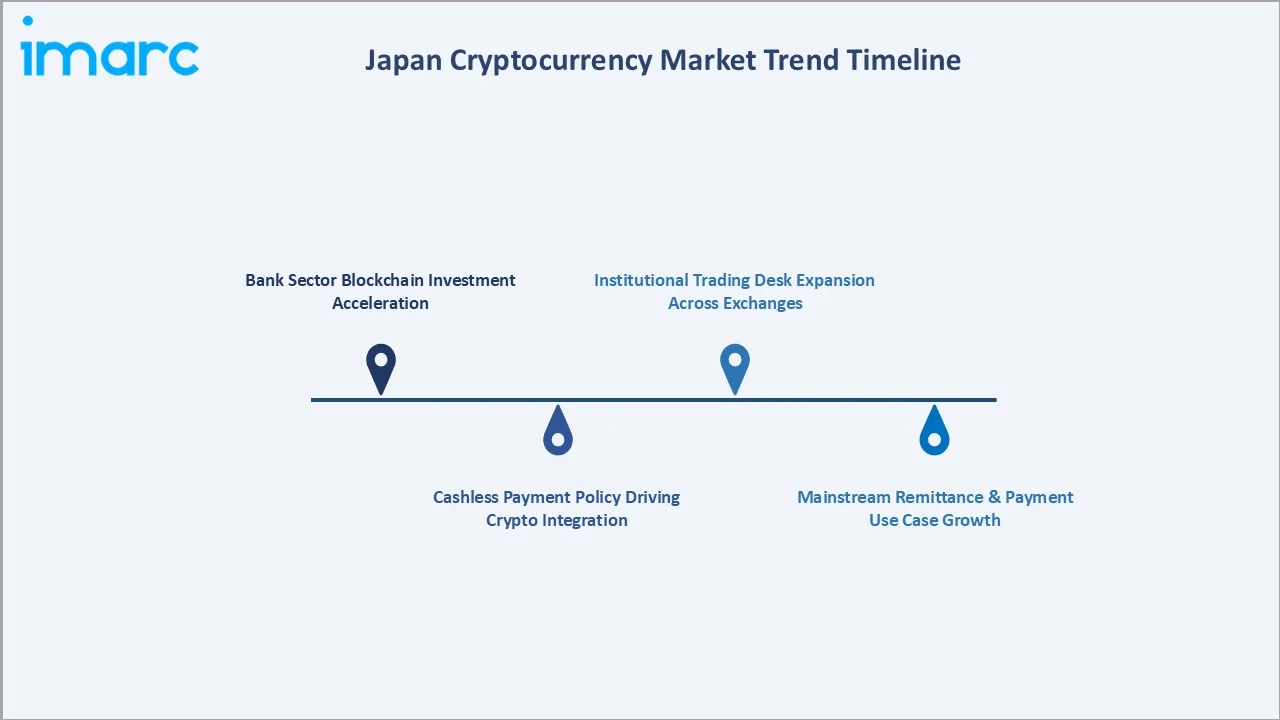
1. Bank Sector Blockchain Investment Acceleration
Major Japanese banks are increasingly investing in blockchain infrastructure and offering crypto-related services, blurring lines between traditional finance and digital assets. Japan-based financial conglomerate SBI Holdings accelerated its crypto expansion through major investments in Gauntlet, EDX Markets, Digital Asset, Morpho, and Circle, alongside acquisitions of Bitbank and Coinhako. The investments support SBI’s group-wide on-chain finance strategy, spanning crypto exchanges, asset tokenization, stablecoins, risk management, and digital market infrastructure.
2. Cashless Payment Policy Driving Crypto Integration
Government-led cashless society initiatives are indirectly accelerating cryptocurrency adoption as part of the broader digital payment ecosystem. In October 2025, PayPay acquired a 40% stake in Binance Japan through a strategic partnership integrating cashless payments with cryptocurrency services. The collaboration will enable PayPay’s roughly 70 million users to buy, sell, store, and withdraw digital assets using PayPay Money.
3. Institutional Trading Desk Expansion Across Exchanges
Growing institutional interest in digital assets is driving exchanges to build dedicated institutional trading infrastructure and liquidity services. Partnerships with banks, asset managers, and fintech firms are further strengthening custody, compliance, and high-volume trading capabilities across Japan.
4. Mainstream Remittance & Payment Use Case Growth
Expanding adoption of cryptocurrency for cross-border remittance and everyday payment applications is broadening market reach beyond speculative trading. Integration with established cashless payment platforms and stablecoin initiatives is improving accessibility and supporting wider consumer and merchant adoption in Japan.
Industry Value Chain Analysis
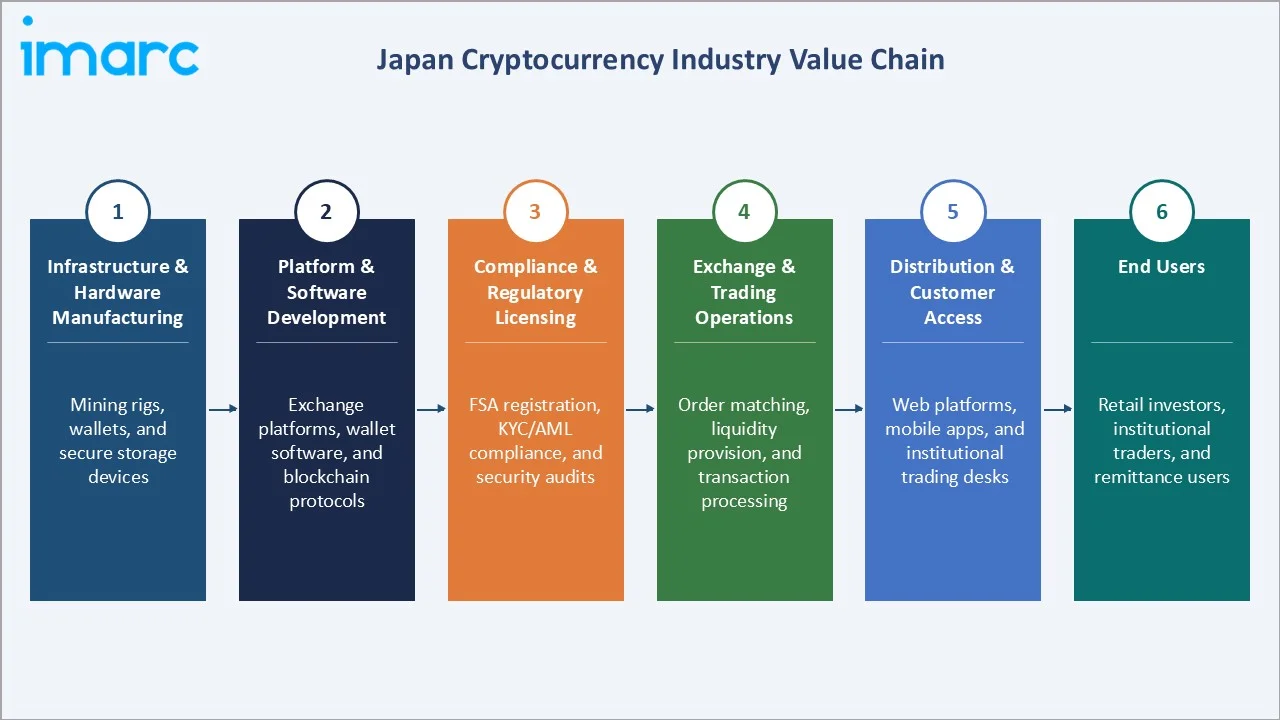
The Japan cryptocurrency value chain spans infrastructure and hardware manufacturing through end-user delivery, with each stage occupied by specialized hardware manufacturers, platform software developers, and compliance partners whose performance directly influences trading security, platform trust, and cost-effectiveness.
|
Stage |
Key Activities |
|
Infrastructure & Hardware Manufacturing |
Mining rigs, wallets, and secure storage devices |
|
Platform & Software Development |
Exchange platforms, wallet software, and blockchain protocols |
|
Compliance & Regulatory Licensing |
FSA registration, KYC/AML compliance, and security audits |
|
Exchange & Trading Operations |
Order matching, liquidity provision, and transaction processing |
|
Distribution & Customer Access |
Web platforms, mobile apps, and institutional trading desks |
|
End Users |
Retail investors, institutional traders, and remittance users |
Technology Landscape in the Japan Cryptocurrency Industry
Advanced Exchange Platform Technology
Exchanges are advancing order matching engines and liquidity infrastructure to improve transaction speed and reliability, supporting broader adoption among retail and institutional trading applications. High-frequency matching engine upgrades, multi-asset spot and derivatives order book integration, and cold wallet-to-hot wallet automated rebalancing systems are being deployed by Japan Financial Services Agency-licensed exchanges to achieve institutional-grade execution performance.
Secure Wallet & Custody Solution Development
Growing investment in secure wallet and cold storage technology is expanding custody safety capabilities, addressing rising demand for reliable, hack-resistant digital asset storage. Hardware security module-based cold storage architectures, multi-signature approval workflows, and geographically distributed key management systems are being adopted by Japanese crypto custodians following FSA mandates requiring exchanges to segregate customer assets and maintain cold wallet ratios of at least 95% of total digital asset holdings.
Compliance & Regulatory Technology Systems
Providers are engineering KYC/AML compliance and regulatory reporting systems to extend adoption across demanding institutional and cross-border remittance applications. Travel Rule-compliant transaction monitoring platforms, real-time suspicious transaction alert systems, and automated regulatory reporting APIs aligned with Japan's Act on Prevention of Transfer of Criminal Proceeds are being integrated into Japanese exchange back-office infrastructure to meet FSA supervisory examination requirements.
Blockchain Infrastructure & Mining Technology Innovation
Expanding research into blockchain infrastructure and mining efficiency technology is strengthening network security and transaction validation performance, supporting premium positioning across institutional-grade use cases. Energy-efficient proof-of-stake validator node infrastructure and Layer 2 scaling solutions compatible with Ethereum and Solana base layers are being developed by Japanese blockchain technology providers, reducing per-transaction energy consumption and settlement latency to support high-throughput institutional DeFi and tokenized securities.
Market Segmentation Analysis
The report covers the following segments:
|
Segment Category |
Leading Segment |
Market Share |
Year |
|
Component |
Software |
66.8% |
2025 |
|
Process |
Transaction |
74.5% |
2025 |
|
Type |
🔒 |
🔒 |
2025 |
|
Application |
🔒 |
🔒 |
2025 |
|
Region |
Kanto Region |
41.5% |
2025 |

By Component
Software dominates with a 66.8% share in 2025. This segment encompasses exchange platforms, wallet applications, and blockchain protocol solutions, supported by sustained demand for their scalability across trading and custody applications.
To access detailed market analysis, Request Sample
Hardware represents 33.2% (2025) of the market, reflecting continued demand for mining rigs and secure storage devices supporting network validation and cold storage custody functions.
By Process
Transaction leads the process segment at 74.5% share (2025), supported by its central role in trading, remittance, and payment activity across retail and institutional participants.
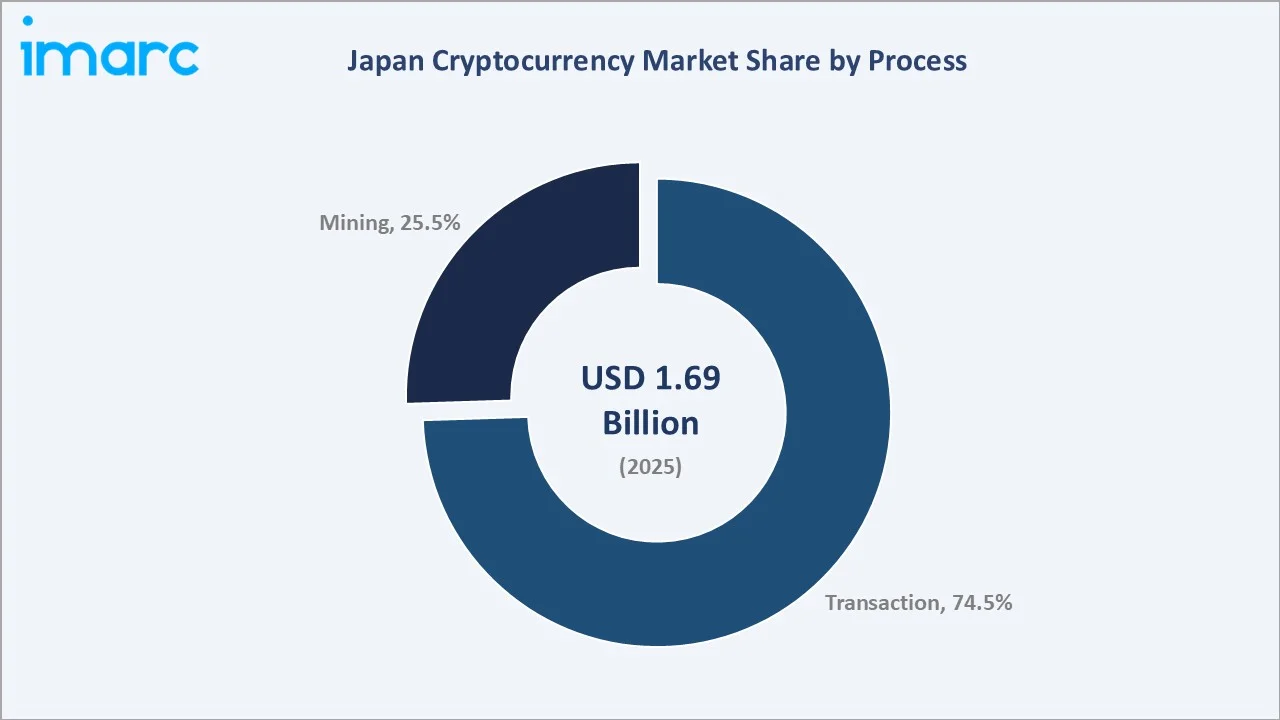
Mining continues to serve 25.5% (2025) of the market, expanding steadily as network validation infrastructure supports blockchain security, block reward generation, and transaction confirmation processes.
Regional Market Insights
The Kanto region's market leadership (41.5%, 2025) reflects the region's concentration of exchange headquarters, financial institutions, and tech-savvy urban population across Tokyo and surrounding prefectures. Growing institutional trading investment and expanding bank sector partnerships combine to sustain its dominant position through 2034.
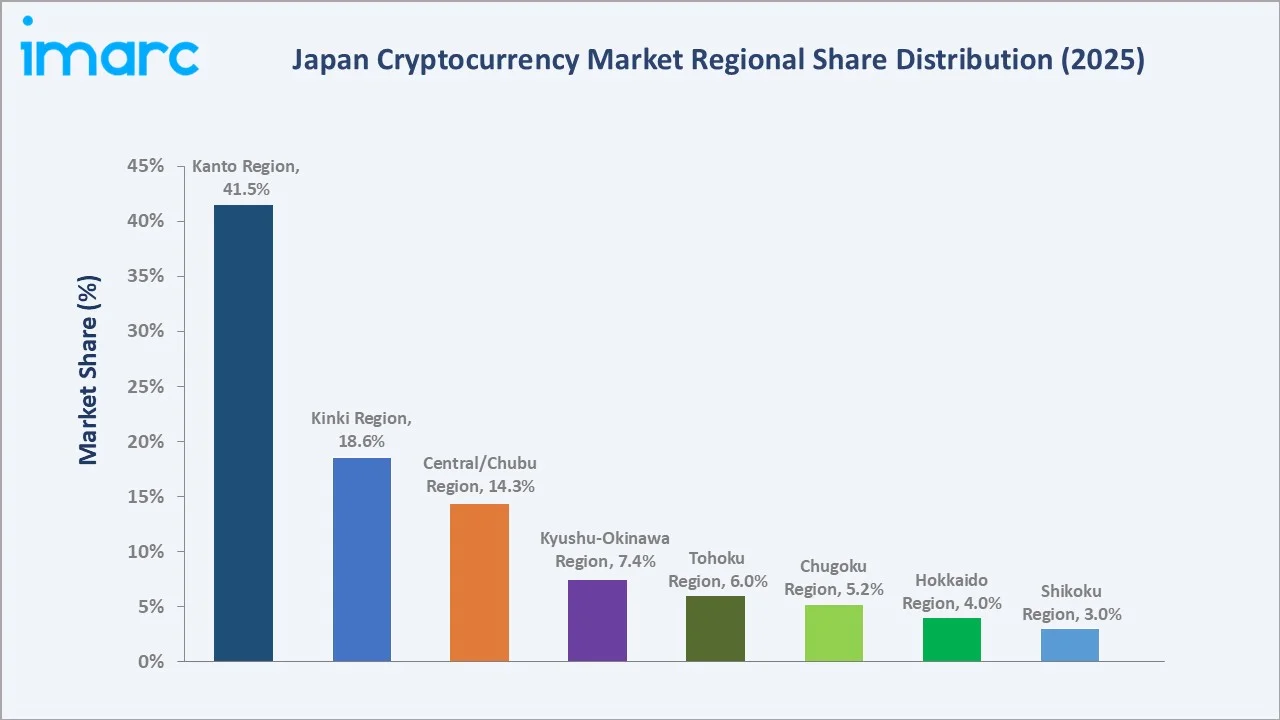
Kinki region at 18.6% (2025) represents the second-largest cryptocurrency market nationally. A strong urban investor base and expanding fintech infrastructure are sustaining steady growth, positioning the region as a key contributor alongside the Kanto Region through the forecast period.
|
Region |
Share (2025) |
Key Growth Drivers |
|
Kanto Region |
41.5% |
Concentration of exchange headquarters, financial institutions, and tech-savvy population |
|
Kinki Region |
18.6% |
Strong urban investor base and expanding fintech infrastructure |
|
Central/Chubu Region |
14.3% |
Growing manufacturing wealth and rising digital asset investment interest |
|
Kyushu-Okinawa Region |
7.4% |
Expanding retail investor adoption and growing remittance use cases |
|
Tohoku Region |
6.0% |
Rising fintech awareness and expanding mobile trading platform access |
|
Chugoku Region |
5.2% |
Growing regional investor participation and expanding exchange access |
|
Hokkaido Region |
4.0% |
Emerging retail investor interest and expanding digital payment adoption |
|
Shikoku Region |
3.0% |
Growing awareness and gradual retail investor base expansion |
Competitive Landscape
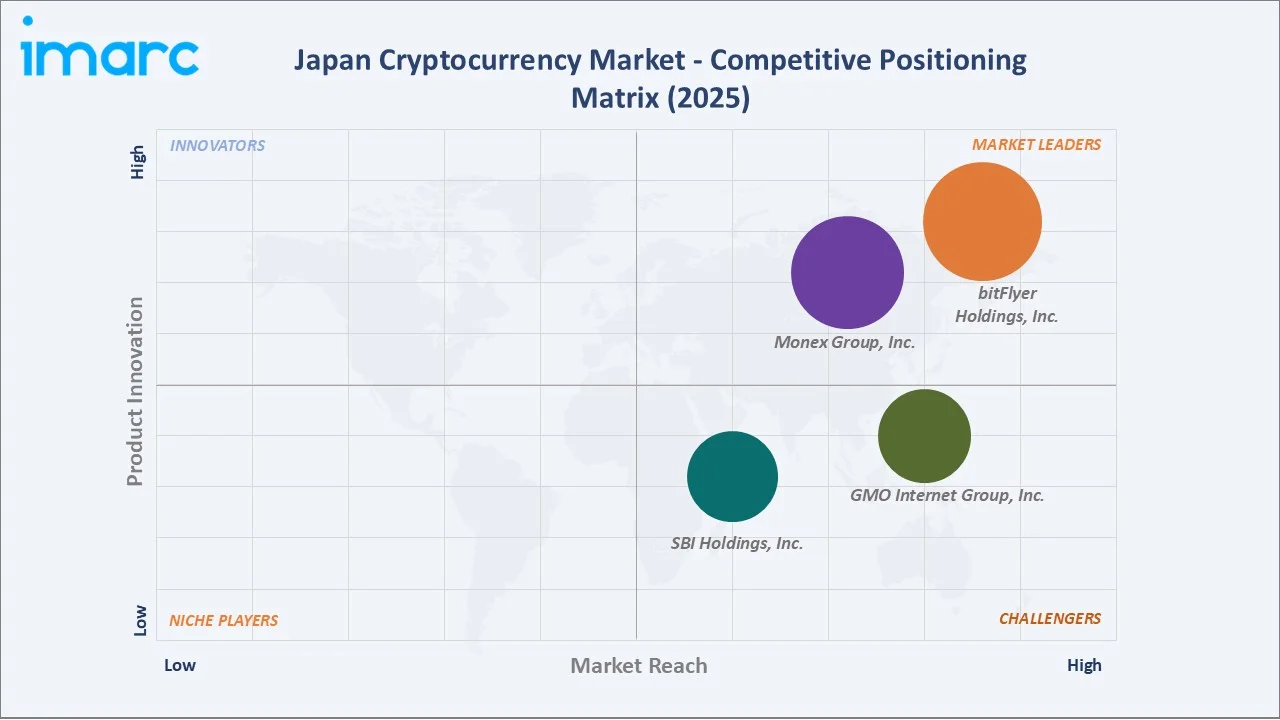
The Japan cryptocurrency market exhibits moderate concentration, with leading exchanges collectively holding a significant share of market revenue in 2025, reflecting sustained investment in platform innovation and distribution reach.
|
Company Name |
Brand Name |
Market Position |
Core Strength |
|
bitFlyer Holdings, Inc. |
bitFlyer |
Market Leader |
Global exchange leadership and extensive institutional trading infrastructure |
|
Monex Group, Inc. |
Coincheck |
Market Leader |
Diversified digital asset platform and integrated retail trading capabilities |
|
GMO Internet Group, Inc. |
GMO Coin |
Strong Challenger |
Advanced trading technology and internet conglomerate backing |
|
SBI Holdings, Inc. |
SBI VC Trade |
Strong Challenger |
Financial group integration and institutional investor expertise |
bitFlyer Holdings, Inc. and Monex Group, Inc. dominate through comprehensive platform portfolios and extensive distribution capacity, supported by continuous compliance investment. GMO Internet Group, Inc. and SBI Holdings, Inc. compete through financial group integration and specialty trading differentiation, respectively.
Key Company Profiles
bitFlyer Holdings, Inc.
bitFlyer Holdings, Inc. is one of the leading Japan-based cryptocurrency exchanges with an extensive institutional trading platform spanning spot trading, futures, and custody services distributed across a vast domestic and global customer base.
- Product Portfolio: Spot trading, cryptocurrency futures, and institutional custody solutions under the bitFlyer brand.
- Recent Developments: In September 2025, bitFlyer Holdings, Inc. announced enhanced crypto-transfer verification requirements effective October 1, 2025, to comply with Japan’s Foreign Exchange and Foreign Trade Act. Customers must provide recipient location details, state the transfer purpose, and confirm that transactions do not require authorization, approval, or reporting under FEFTA.
- Strategic Focus: Strengthening institutional trading innovation; expanding platform capacity across emerging application segments.
Monex Group, Inc.
Monex Group, Inc.’s Coincheck is a leading diversified digital asset platform with a strong integrated retail trading system serving individual investors, remittance users, and payment applications across Japan.
- Product Portfolio: Spot trading, digital asset lending, and integrated retail wallet solutions.
- Recent Developments: In July 2026, Coincheck announced that its app ranked No. 1 in Japan for crypto-trading app downloads during the first half of 2026, extending its seven-year leadership through 2025.
- Strategic Focus: Scaling integrated retail trading capabilities; deepening consumer and remittance distribution partnerships.
Market Concentration Analysis
The Japan cryptocurrency market exhibits moderate concentration, with bitFlyer Holdings, Inc., Monex Group, Inc., and GMO Internet Group, Inc. collectively accounting for a significant share of total category revenue in 2025, reflecting sustained compliance investment, brand loyalty, and extensive distribution infrastructure nationally.
Consolidation pressure remains limited as leading exchanges maintain distinct strategic positioning: bitFlyer Holdings, Inc., and Monex Group, Inc. through comprehensive multi-category platforms, GMO Internet Group, Inc. and SBI Holdings, Inc. through internet conglomerate and financial group positioning rather than pursuing direct M&A consolidation.
Investment & Growth Opportunities
Fastest Growing Segments
Software (~18.4% CAGR) represents the highest-growth investment vector through 2034, driven by expanding exchange platform demand and continuous innovation across trading and compliance technologies. This subcategory addresses a rapidly expanding addressable market within the Japan cryptocurrency ecosystem.
Emerging Market Expansion
The Tohoku, Chugoku, Hokkaido, and Shikoku Regions collectively represent an incremental growth opportunity beyond the Kanto, Kinki, and Central/Chubu Regions by 2034, as rising fintech awareness and expanding mobile trading platform access accelerate category penetration in these regional markets.
Venture and Institutional Investment Trends
- Exchange investment toward institutional trading and compliance technology is creating opportunities for technology vendors serving the cryptocurrency sector.
- Growing bank sector blockchain integration demand is sustaining institutional interest in specialty fintech infrastructure platforms.
- Trading platform and security innovation, led by major exchanges, is opening opportunities for component and technology vendors serving the Japan cryptocurrency industry.
Future Market Outlook (2026-2034)
The Japan cryptocurrency market is positioned for rapid, technology-driven expansion through 2034. From a base of USD 1.69 Billion in 2025 to USD 1.98 Billion in 2026, the market is projected to reach USD 7.12 Billion by 2034, representing substantial incremental value creation at a CAGR of 17.32%. This growth is underpinned by formal regulatory recognition, a large tech-savvy investment base, and growing bank sector integration with blockchain technology.
The component segment will continue evolving through 2034, with software gaining further share as exchange platform demand and compliance technology adoption accelerate. This shift creates opportunities for exchanges investing in institutional trading infrastructure, secure custody technology, and regulatory compliance systems to capture the next phase of the Japan cryptocurrency market growth.
Research Methodology
Primary Research
Primary research comprised structured interviews with industry participants across 2024-2025, including exchange platform executives, institutional trading desk managers, blockchain compliance specialists, and fintech regulatory analysts across major Japanese markets. Expert input validated market sizing, segmentation trends, and regional consumption patterns.
Secondary Research
Secondary research encompassed exchange annual reports, digital asset industry association publications, and fintech trade press covering platform innovation, regulatory trends, and regional market dynamics across major markets.
Forecasting Models
Market size estimations were derived using top-down and bottom-up forecasting, incorporating component and process segment transitions and exchange capacity disclosures. A base-case CAGR of 17.32% reflects consensus estimates validated against announced platform investment timelines and exchange strategic development plans.
Report Coverage:
| Report Features | Details |
|---|---|
| Base Year of the Analysis | 2025 |
| Historical Period | 2020-2025 |
| Forecast Period | 2026-2034 |
| Units | Billion USD |
| Scope of the Report |
Exploration of Historical and Forecast Trends, Industry Catalysts and Challenges, Segment-Wise Historical and Predictive Market Assessment:
|
| Types Covered | Bitcoin, Ethereum, Bitcoin Cash, Ripple, Litecoin, Dashcoin, Others |
| Components Covered | Hardware, Software |
| Processes Covered | Mining, Transaction |
| Applications Covered | Trading, Remittance, Payment, Others |
| Regions Covered | Kanto Region, Kinki Region, Central/ Chubu Region, Kyushu-Okinawa Region, Tohoku Region, Chugoku Region, Hokkaido Region, Shikoku Region |
| Companies Covered | bitFlyer Holdings, Inc., Monex Group, Inc., GMO Internet Group, Inc., SBI Holdings, Inc., etc. |
| Customization Scope | 10% Free Customization |
| Post-Sale Analyst Support | 10-12 Weeks |
| Delivery Format | PDF and Excel through Email (We can also provide the editable version of the report in PPT/Word format on special request) |
Key Benefits for Stakeholders:
- IMARC’s report offers a comprehensive quantitative analysis of various market segments, historical and current market trends, market forecasts, and dynamics of the Japan cryptocurrency market from 2020-2034.
- The research study provides the latest information on the market drivers, challenges, and opportunities in the Japan cryptocurrency market.
- Porter's five forces analysis assist stakeholders in assessing the impact of new entrants, competitive rivalry, supplier power, buyer power, and the threat of substitution. It helps stakeholders to analyze the level of competition within the Japan cryptocurrency industry and its attractiveness.
- Competitive landscape allows stakeholders to understand their competitive environment and provides an insight into the current positions of key players in the market.
Frequently Asked Questions About the Japan Cryptocurrency Market Report
The Japan cryptocurrency market size is estimated at USD 1.98 Billion in 2026.
The market is expected to grow at a CAGR of 17.32% during 2026-2034, driven by formal regulatory recognition and growing bank sector integration.
The Kanto region leads with a 41.5% share in 2025, anchored by the region's concentration of exchange headquarters and financial institutions.
Software dominates with a 66.8% share in 2025, driven by sustained demand for exchange platforms and wallet applications.
Transaction leads with a 74.5% share in 2025, supported by its central role in trading, remittance, and payment activity.
Some of the key players include bitFlyer Holdings, Inc., Monex Group, Inc., GMO Internet Group, Inc., and SBI Holdings, Inc.
Software is growing fastest at an estimated 18.4% CAGR as exchange platform demand and compliance technology adoption accelerate.
Key challenges include price volatility and investment risk, security and hacking vulnerability concerns, and evolving compliance and regulatory costs.
Institutional trading desk expansion, remittance and payment use case growth, and blockchain and bank sector partnership integration represent leading investment opportunities.
Mining, at 25.5% share, is expanding steadily as network validation infrastructure continues to support blockchain security and transaction confirmation.
Need more help?
- Speak to our experienced analysts for insights on the current market scenarios.
- Include additional segments and countries to customize the report as per your requirement.
- Gain an unparalleled competitive advantage in your domain by understanding how to utilize the report and positively impacting your operations and revenue.
- For further assistance, please connect with our analysts.
 Request Customization
 Speak to an Analyst
 Request Brochure
 Inquire Before Buying
Benefits of Customization
- Personalize this research
- Triangulate with your data
- Get data as per your format and definition
- Gain a deeper dive into a specific application, geography, customer, or competitor
- Any level of personalization
Get in Touch With Us
UNITED STATES
Phone: +1-201-971-6302
INDIA
Phone: +91-120-433-0800
UNITED KINGDOM
Phone: +44-753-714-6104
Email: [email protected]
Client Testimonials




.webp)




.webp)













Related Reports

Choose your plan
*Please note that the prices mentioned below are starting prices for each bundle type. Kindly contact our team for further details.*
Single User License
- 1 User License, Access on 2 Devices
- PDF Report + Excel Dataset (Password Protected)
- Lifetime Access
- No Printing Rights
- 10% Free Report Customization
- 10–12 Weeks of Analyst Support
Five User License
- Access for 5 Users, 2 Devices per User
- PDF Report + Excel Dataset (Password Protected)
- Lifetime Access
- Dedicated Account Manager
- 12–14 Weeks of Analyst Support
- No Printing Rights
- 15% Free Report Customization
- 25% Discount on Your Next Purchase
Corporate User License
- Unlimited User Access (Within Your Organization)
- PDF Report + Excel Dataset
- Lifetime Access
- Dedicated Account Manager
- 14–20 Weeks of Analyst Support
- No Printing Rights
- 20% Free Report Customization
- 30% Discount on Your Next Purchase
Essential Insights
What's included:
3 reports
- Lifetime Access
- PDF Reports
- Excel Datasets
- 2 Weeks of Free Analyst Support
- 2 User Licenses
- Access on 2 Devices
- Printing Rights
- Complimentary PowerPoint (PPT) Version
- Complimentary License Upgrade
Professional Access
What's included:
5 reports
- Lifetime Access
- PDF Reports
- Excel Datasets
- 8 Weeks of Free Analyst Support
- 2 User Licenses
- Access on 2 Devices
- Printing Rights
- Complimentary PowerPoint (PPT) Version
- Complimentary License Upgrade
Business Advantage
What's included:
8 reports
- Lifetime Access
- PDF Reports
- Excel Datasets
- 14 Weeks of Free Analyst Support
- 2 User Licenses
- Access on 2 Devices
- Printing Rights
- Complimentary PowerPoint (PPT) Version
- Complimentary License Upgrade
Enterprise Intelligence
What's included:
10 reports
- Lifetime Access
- PDF Reports
- Excel Datasets
- 20 Weeks of Free Analyst Support
- 2 User Licenses
- Access on 2 Devices
- Printing Rights
- Complimentary PowerPoint (PPT) Version
- Complimentary License Upgrade