
Japan eDiscovery Market Size, Share, Trends and Forecast by Component, Deployment Type, End User, Vertical, and Region, 2026-2034
Japan eDiscovery Market Summary:
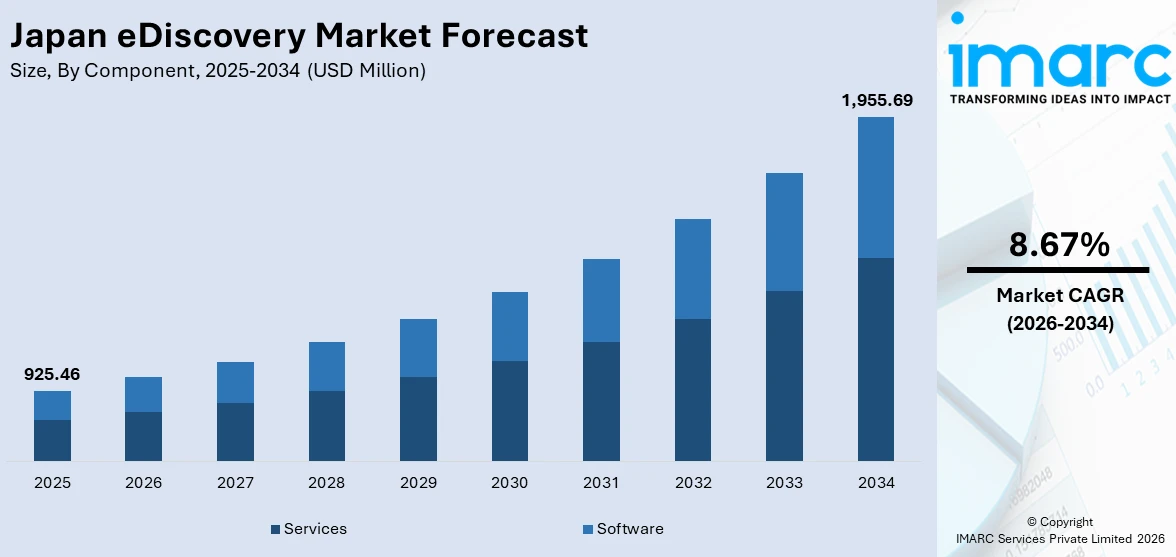
The Japan eDiscovery market size was valued at USD 925.46 Million in 2025 and is projected to reach USD 1955.69 Million by 2034, growing at a compound annual growth rate of 8.67% from 2026-2034.
The Japan eDiscovery market is experiencing strong momentum, driven by escalating cross-border litigation, tightening data protection regulations, and the rapid digitalization of Japanese enterprises. The growing complexity of corporate investigations, heightened cybersecurity threats, and increasing volumes of electronically stored information are compelling organizations to adopt advanced eDiscovery tools. The integration of artificial intelligence (AI) and cloud-based platforms is further transforming legal workflows, enabling faster and more accurate document review, early case assessment, and compliance monitoring.
Key Takeaways and Insights:
- By Component: Services dominate the market with a share of 56.8% in 2025, owing to the increasing complexity of cross-border litigation, growing demand for managed eDiscovery services, and the preference among Japanese enterprises for outsourced expertise in data collection, processing, and document review.
- By Deployment Type: Cloud-based leads the market with a share of 48.9% in 2025. This dominance is driven by superior scalability, cost efficiency, and the ability to support remote legal teams, along with growing data sovereignty compliance needs in Japan’s evolving regulatory environment.
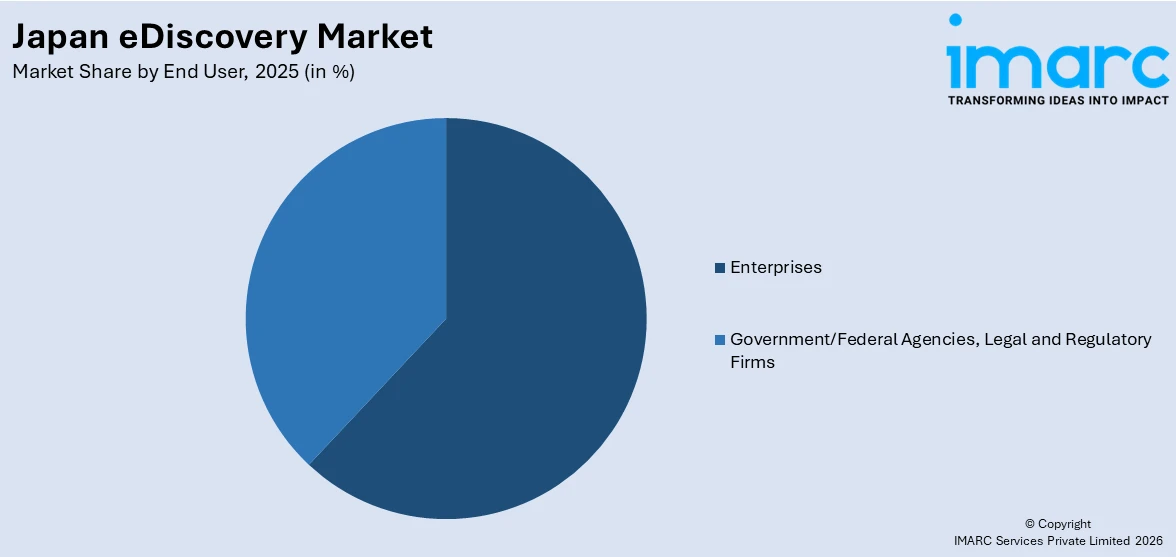
- By End User: Enterprises represent the largest segment with a market share of 62.7% in 2025, reflecting the surging need among large corporations for robust eDiscovery capabilities to manage regulatory investigations, internal compliance audits, and cross-border legal disputes.
- By Vertical: Legal exhibits a clear dominance in the market with 24.6% share in 2025, reflecting the legal sector’s fundamental reliance on electronic discovery tools for litigation support, case preparation, regulatory compliance, and efficient management of growing electronic evidence volumes.
- By Region: Kanto Region comprises the largest region with 36.5% share in 2025, driven by the concentration of Japan’s major law firms, corporate headquarters, financial institutions, and government agencies in the Tokyo metropolitan area, which generates the highest demand for eDiscovery services.
- Key Players: Key players drive the Japan eDiscovery market by expanding AI-powered review platforms, enhancing multilingual processing capabilities, investing in cloud-based infrastructure, and forging strategic partnerships to strengthen compliance readiness, accelerate adoption, and deliver cost-effective legal technology solutions across diverse enterprise segments.
To get more information on this market Request Sample
The Japan eDiscovery market is advancing, as enterprises, legal firms, and regulatory bodies increasingly leverage digital discovery tools to navigate a complex and evolving compliance landscape. Japan’s first AI Promotion Act, enacted on May 28, 2025, further underscores the government’s commitment to fostering AI-driven innovation across legal and business domains. This legislative framework is accelerating the adoption of AI-powered document review, predictive coding, and automated early case assessment tools within eDiscovery workflows. The rising frequency of cyberattacks against Japanese corporations is amplifying the need for robust digital forensics and electronic evidence management. Cloud adoption continues to reshape deployment strategies, offering scalability and data residency compliance for organizations managing large-scale legal matters. Additionally, growing cross-border litigation and data privacy obligations are prompting organizations to invest in eDiscovery platforms that support multilingual data processing, secure data handling, and faster response times for regulatory and legal requests.
Japan eDiscovery Market Trends:
Integration of Generative AI into Legal Review Workflows
Japan’s eDiscovery landscape is being reshaped by the rapid integration of generative AI and machine learning (ML) into document review and privilege identification processes. For instance, in July 2025, Relativity officially launched two generative AI solutions, Relativity aiR for Review and aiR for Privilege, across Japan, Singapore, Hong Kong, India, and South Korea, equipping legal teams in the region with AI-powered tools for faster and more accurate document analysis. These advancements are enabling law firms and corporate legal departments to reduce review timelines, improve accuracy in identifying relevant evidence, and lower overall discovery costs, accelerating the Japan eDiscovery market growth.
Accelerating Migration to Cloud-Based eDiscovery Platforms
The shift from on-premises to cloud-native eDiscovery solutions is gaining significant traction in Japan, driven by scalability needs, remote work requirements, and data sovereignty considerations. Japanese enterprises and law firms are increasingly adopting cloud-based eDiscovery platforms to manage rising data volumes generated from emails, collaboration tools, and digital business applications. Cloud deployment enables faster data ingestion, flexible storage expansion, and real-time collaboration among legal teams across locations. Enhanced security controls, encryption, and audit trails address concerns around data privacy and regulatory compliance.
Rising Cross-Border Regulatory Scrutiny of Japanese Corporations
Japanese corporations are facing heightened cross-border regulatory investigations from authorities in the United States and European Union, particularly around antitrust, anti-bribery, and anti-corruption matters. This increasing scrutiny is driving demand for sophisticated eDiscovery tools capable of handling Japanese, Chinese, and Korean language complexities. These investigations often require rapid preservation, review, and production of large volumes of electronically stored information across multiple jurisdictions. As a result, organizations are prioritizing eDiscovery platforms with advanced multilingual analytics, defensible workflows, and secure cross-border data transfer capabilities to meet stringent regulatory timelines and compliance standards.
.webp)
Market Outlook 2026-2034:
The Japan eDiscovery market is poised for sustained expansion, supported by regulatory modernization, accelerating digital transformation, and rising adoption of AI-driven legal technology solutions. The market generated a revenue of USD 925.46 Million in 2025 and is projected to reach a revenue of USD 1955.69 Million by 2034, growing at a compound annual growth rate of 8.67% from 2026-2034. The strengthening of Japan’s data protection framework, combined with expanding cybersecurity mandates and the government’s AI-friendly legislative approach, will continue to drive investment in advanced eDiscovery platforms. Increasing volumes of electronically stored information, growing cross-border litigation activity, and the transition towards cloud-native deployment models are expected to further accelerate market revenues and foster a more competitive, technology-driven eDiscovery ecosystem across the country.
Japan eDiscovery Market Report Segmentation:
|
Segment Category |
Leading Segment |
Market Share |
|
Component |
Services |
56.8% |
|
Deployment Type |
Cloud-based |
48.9% |
|
End User |
Enterprises |
62.7% |
|
Vertical |
Legal |
24.6% |
|
Region |
Kanto Region |
36.5% |
Component Insights:
- Services
- Software
Services dominate with a market share of 56.8% of the total Japan eDiscovery market in 2025.
The services segment maintains its leadership in the Japan eDiscovery market, owing to the increasing complexity of legal matters requiring specialized managed services, professional consulting, and integration support. Japanese enterprises, particularly those engaged in cross-border litigation with the United States and Europe, rely heavily on service providers that offer end-to-end eDiscovery workflows, from evidence preservation and data collection to document review and production. The demand for outsourced expertise is further amplified by the shortage of in-house legal technology specialists within many Japanese corporations.
In addition, given Japan's changing legal and data protection environment, service providers are essential to maintaining data security, regulatory compliance, and defensible eDiscovery procedures. Without making long-term internal investments, managed service models enable businesses to swiftly scale resources during significant investigations or legal proceedings. Additionally, providers have experience with cross-border data handling, bilingual review, and advanced analytics configuration, which are crucial for complicated international situations. Industry-wide need for knowledgeable eDiscovery service providers is growing, as legal deadlines get closer and data volumes increase.
Deployment Type Insights:
- On-premises
- Cloud-based
- Hybrid
Cloud-based leads with a share of 48.9% of the total Japan eDiscovery market in 2025.
Cloud-based is gaining rapid traction in Japan, driven by the need for scalable, cost-effective platforms that support remote legal teams and comply with stringent data sovereignty requirements. Organizations are increasingly migrating from on-premises systems to cloud-native environments that offer superior processing power, seamless updates, and enterprise-grade security. The locally hosted deployment of platforms within Japan’s data centers enables firms to manage cross-border matters while keeping sensitive data within national boundaries.
Additionally, by providing safe, real-time access to case data from multiple locations, cloud-based deployments are facilitating quicker cooperation between internal legal teams, outside counsel, and service providers. During extensive investigations, advanced features like AI-driven review, automated workflows, and elastic computer resources increase review speed and cost predictability. In Japan, cloud-based eDiscovery solutions are being seen as a long-term strategic option to conventional on-premises systems, as legislative guidance becomes more explicit and trust in cloud security frameworks increases.
End User Insights:
Access the comprehensive market breakdown Request Sample
- Government/Federal Agencies, Legal and Regulatory Firms
- Enterprises
Enterprises comprise the largest segment with a 62.7% share of the total Japan eDiscovery market in 2025.
Enterprises represent the dominant end user category in the Japan eDiscovery market, driven by the growing exposure to regulatory investigations, complex internal compliance requirements, and escalating cybersecurity threats. Japanese multinational corporations, particularly in the automotive, electronics, and financial sectors, face increasing scrutiny from international regulators, necessitating robust digital forensic and evidence management capabilities. The need to maintain comprehensive information governance frameworks across geographically dispersed operations further reinforces enterprise demand.
The urgency for enterprise-level eDiscovery readiness was underscored by a series of major cybersecurity incidents in early 2025. NTT Com, one of Japan’s largest telecom providers, discovered in February 2025 that a data breach had compromised the corporate contract information of 17,891 business clients. Such incidents compel enterprises to invest in advanced eDiscovery platforms that enable rapid incident response, forensic analysis, and regulatory reporting. Enterprise-wide adoption of scalable eDiscovery platforms is increasingly essential to support risk mitigation across complex and distributed data environments.
Vertical Insights:
- BFSI
- Retail and Consumer Goods
- Manufacturing
- Legal
- IT and Telecommunication
- Government
- Energy and Utilities
- Healthcare and Life Science
- Others
Legal prevails the market with a 24.6% share of the total Japan eDiscovery market in 2025.
Legal leads the Japan eDiscovery market, as law firms and legal service providers are the primary consumers of electronic discovery solutions for litigation support, regulatory investigations, and dispute resolution. Japanese law firms handling cross-border matters increasingly require advanced technology-assisted review, predictive coding, and multilingual document processing capabilities to manage complex international cases efficiently. The rising volume of digital evidence and evolving court expectations for electronic submissions are further solidifying legal’s position as the leading vertical.
Law firms are also spending resources on safe, cloud-based eDiscovery tools to help them collaborate with overseas partners, co-counsel, and corporate customers while upholding stringent confidentiality guidelines. Legal teams are reducing review durations, increasing accuracy, and controlling litigation expenses by implementing AI-driven analytics. Law firms are bolstering their internal eDiscovery expertise and collaborations with service providers in order to stay competitive in intricate, data-intensive legal proceedings, as courts and regulators place an increased emphasis on defensible, technology-supported discovery processes.
Regional Insights:
- Kanto Region
- Kansai/Kinki Region
- Central/Chubu Region
- Kyushu-Okinawa Region
- Tohoku Region
- Chugoku Region
- Hokkaido Region
- Shikoku Region
Kanto Region represents the leading region with a 36.5% share of the total Japan eDiscovery market in 2025.
Kanto Region, anchored by Tokyo and its surrounding metropolitan area, dominates the Japan eDiscovery market due to its concentration of major law firms, corporate headquarters, financial institutions, and government agencies. Tokyo serves as the primary hub for cross-border litigation activities and regulatory compliance operations, generating the highest demand for sophisticated eDiscovery services and cloud-based legal technology platforms. The presence of key international and domestic eDiscovery service providers in the region further strengthens its leadership position.
The region’s dominance is reinforced by the dense ecosystem of legal technology infrastructure, including locally hosted cloud data centers that enable compliance with data residency requirements. Major consulting firms maintain dedicated forensic and eDiscovery practices in Tokyo, providing end-to-end services to enterprises and government entities navigating complex investigations. The Kanto Region’s role as Japan’s economic and legal center ensures sustained demand for advanced eDiscovery capabilities. Strong connectivity with national regulators, international courts, and global legal networks further supports rapid information exchange and timely case management within the region.
Market Dynamics:
Growth Drivers:
Why is the Japan eDiscovery Market Growing?
Strengthening Regulatory and Data Protection Framework
Japan's changing data security environment is a major driver of the eDiscovery market's expansion, as regulatory standards for data governance, breach response, and cross-border data handling keep getting stronger. It is becoming more necessary for organizations to manage electronically stored information across business activities with better accountability, transparency, and readiness. A more stringent enforcement environment is indicated by ongoing regulatory discussions, which prompt businesses to review their incident response plans, data retention guidelines, and internal controls. Compliance requirements are also being raised by increased scrutiny of how sensitive data categories, such as biometric, personal, and children's information, are handled. Proactive investment in eDiscovery technologies that facilitate methodical data retention, defensible gathering, sophisticated examination, and prompt production of electronic evidence is being propelled by these advancements.
Escalating Cybersecurity Threats and Digital Forensic Demand
The rising frequency and sophistication of cyberattacks targeting Japanese organizations are significantly amplifying demand for eDiscovery and digital forensic solutions. Ransomware attacks, unauthorized data access, and credential theft incidents are compelling enterprises to deploy advanced eDiscovery tools for rapid incident response, evidence collection, and regulatory compliance. According to Cisco Talos, 68 ransomware incidents affected Japanese organizations in the first half of 2025, a 1.4-fold increase compared to the same period in 2024. These incidents are increasing the need for continuous monitoring, defensible data preservation, and detailed forensic analysis to support internal investigations and potential legal proceedings. Enterprises are prioritizing platforms that can rapidly identify affected data sets, reconstruct attack timelines, and support collaboration between IT security, legal, and compliance teams. As cyber risks escalate, eDiscovery is becoming an integral component of broader cybersecurity and risk management strategies rather than a purely litigation-focused function.
Government Support for AI-Driven Legal Technology Innovation
Japan’s proactive approach to AI governance and digital transformation is creating a favorable environment for the adoption of AI-powered eDiscovery solutions. The AI Guidelines for Business, jointly issued by the Ministry of Economy, Trade and Industry (METI) and the Ministry of Internal Affairs and Communications (MIC) in April 2024, with revised versions released in March 2025, provide practical governance frameworks for organizations deploying AI tools. These initiatives are encouraging legal technology providers to accelerate the development and deployment of generative AI-powered eDiscovery solutions in Japan. These guidelines promote responsible AI use, transparency, and human oversight, reducing adoption barriers for legal and compliance teams. As a result, enterprises are becoming more confident in deploying AI-driven document review, summarization, and relevance ranking tools within eDiscovery workflows.
Market Restraints:
What Challenges the Japan eDiscovery Market is Facing?
Complex Multilingual and Character Encoding Challenges
The processing of Japanese text in eDiscovery workflows presents unique technical challenges, including complex character encoding systems, involving Kanji, Hiragana, and Katakana, which require specialized tools that many Western-developed platforms do not adequately support. Garbled characters and inaccurate keyword searches resulting from encoding mismatches can compromise evidence integrity. These linguistic complexities increase processing costs, extend review timelines, and limit the pool of eDiscovery vendors capable of delivering reliable results in Japanese-language matters.
Legacy Paper-Based Documentation Practices
Despite Japan’s technological advancement, many organizations continue to maintain significant paper-based documentation workflows, creating bottlenecks in the eDiscovery process. Incomplete digitization of records, inconsistent information governance practices, and limited understanding of data architecture within some Japanese enterprises result in slower evidence collection, higher discovery costs, and elevated risks of evidence spoliation during investigations.
High Implementation and Operational Costs
The deployment of comprehensive eDiscovery platforms requires significant upfront investment in technology infrastructure, specialist personnel, and ongoing operational expenditure. Small and mid-sized Japanese enterprises often lack the budget and in-house expertise to implement enterprise-grade eDiscovery solutions, limiting broader market penetration. The cost of multilingual document review, cross-border data handling, and compliance with evolving regulatory standards further adds to the financial burden.
Competitive Landscape:
The Japan eDiscovery market features a dynamic competitive landscape, characterized by a mix of domestic specialists and global technology providers. Competition is intensifying as vendors invest in AI-powered review capabilities, cloud-native infrastructure, and multilingual processing technologies tailored to Japanese, Chinese, and Korean language requirements. Market participants are differentiating through end-to-end service offerings, strategic partnerships with international law firms, and locally hosted data center deployments that address Japan’s stringent data sovereignty mandates. The growing demand for generative AI-driven document review and early case assessment is further reshaping competitive dynamics, with providers racing to deliver faster, more accurate, and cost-effective solutions.
Japan eDiscovery Market Report Coverage:
|
Report Features |
Details |
|
Base Year of the Analysis |
2025 |
|
Historical Period |
2020-2025 |
|
Forecast Period |
2026-2034 |
|
Units |
Million USD |
|
Scope of the Report |
Exploration of Historical Trends and Market Outlook, Industry Catalysts and Challenges, Segment-Wise Historical and Future Market Assessment:
|
|
Components Covered |
Services, Software |
|
Deployment Types Covered |
On-premises, Cloud-based, Hybrid |
|
End Users Covered |
Government/Federal Agencies, Legal and Regulatory Firms, Enterprises |
|
Verticals Covered |
BFSI, Retail and Consumer Goods, Manufacturing, Legal, IT and Telecommunication, Government, Energy and Utilities, Healthcare and Life Science, Others |
|
Regions Covered |
Kanto Region, Kansai/Kinki Region, Central/Chubu Region, Kyushu-Okinawa Region, Tohoku Region, Chugoku Region, Hokkaido Region, Shikoku Region |
|
Customization Scope |
10% Free Customization |
|
Post-Sale Analyst Support |
10-12 Weeks |
|
Delivery Format |
PDF and Excel through Email (We can also provide the editable version of the report in PPT/Word format on special request) |
Frequently Asked Questions About the Japan eDiscovery Market Report
The Japan eDiscovery market size was valued at USD 925.46 Million in 2025.
The Japan eDiscovery market is expected to grow at a compound annual growth rate of 8.67% from 2026-2034 to reach USD 1955.69 Million by 2034.
Services dominated the market with a share of 56.8%, driven by the increasing complexity of cross-border litigation and the preference among Japanese enterprises for outsourced eDiscovery expertise in data collection, processing, and review.
Key factors driving the Japan eDiscovery market include strengthening data protection regulations, escalating cybersecurity threats, government support for AI-driven legal technology, growing cross-border litigation, and accelerating enterprise digital transformation.
Major challenges include complex multilingual character encoding requirements, legacy paper-based documentation practices, high implementation and operational costs, limited in-house legal technology expertise, and data sovereignty constraints affecting cross-border eDiscovery workflows.
Need more help?
- Speak to our experienced analysts for insights on the current market scenarios.
- Include additional segments and countries to customize the report as per your requirement.
- Gain an unparalleled competitive advantage in your domain by understanding how to utilize the report and positively impacting your operations and revenue.
- For further assistance, please connect with our analysts.
 Request Customization
 Speak to an Analyst
 Request Brochure
 Inquire Before Buying
Benefits of Customization
- Personalize this research
- Triangulate with your data
- Get data as per your format and definition
- Gain a deeper dive into a specific application, geography, customer, or competitor
- Any level of personalization
Get in Touch With Us
UNITED STATES
Phone: +1-201-971-6302
INDIA
Phone: +91-120-433-0800
UNITED KINGDOM
Phone: +44-753-714-6104
Email: [email protected]
Client Testimonials




.webp)




.webp)













Related Reports

Choose your plan
*Please note that the prices mentioned below are starting prices for each bundle type. Kindly contact our team for further details.*
Single User License
- 1 User License, Access on 2 Devices
- PDF Report + Excel Dataset (Password Protected)
- Lifetime Access
- No Printing Rights
- 10% Free Report Customization
- 10–12 Weeks of Analyst Support
Five User License
- Access for 5 Users, 2 Devices per User
- PDF Report + Excel Dataset (Password Protected)
- Lifetime Access
- Dedicated Account Manager
- 12–14 Weeks of Analyst Support
- No Printing Rights
- 15% Free Report Customization
- 25% Discount on Your Next Purchase
Corporate User License
- Unlimited User Access (Within Your Organization)
- PDF Report + Excel Dataset
- Lifetime Access
- Dedicated Account Manager
- 14–20 Weeks of Analyst Support
- No Printing Rights
- 20% Free Report Customization
- 30% Discount on Your Next Purchase
Essential Insights
What's included:
3 reports
- Lifetime Access
- PDF Reports
- Excel Datasets
- 2 Weeks of Free Analyst Support
- 2 User Licenses
- Access on 2 Devices
- Printing Rights
- Complimentary PowerPoint (PPT) Version
- Complimentary License Upgrade
Professional Access
What's included:
5 reports
- Lifetime Access
- PDF Reports
- Excel Datasets
- 8 Weeks of Free Analyst Support
- 2 User Licenses
- Access on 2 Devices
- Printing Rights
- Complimentary PowerPoint (PPT) Version
- Complimentary License Upgrade
Business Advantage
What's included:
8 reports
- Lifetime Access
- PDF Reports
- Excel Datasets
- 14 Weeks of Free Analyst Support
- 2 User Licenses
- Access on 2 Devices
- Printing Rights
- Complimentary PowerPoint (PPT) Version
- Complimentary License Upgrade
Enterprise Intelligence
What's included:
10 reports
- Lifetime Access
- PDF Reports
- Excel Datasets
- 20 Weeks of Free Analyst Support
- 2 User Licenses
- Access on 2 Devices
- Printing Rights
- Complimentary PowerPoint (PPT) Version
- Complimentary License Upgrade