
Japan Electric Car Market Size, Share, Trends and Forecast by Type, Vehicle Class, Vehicle Drive Type, and Region, 2026-2034
Japan Electric Car Market Size, Share, Trends & Forecast (2026-2034)
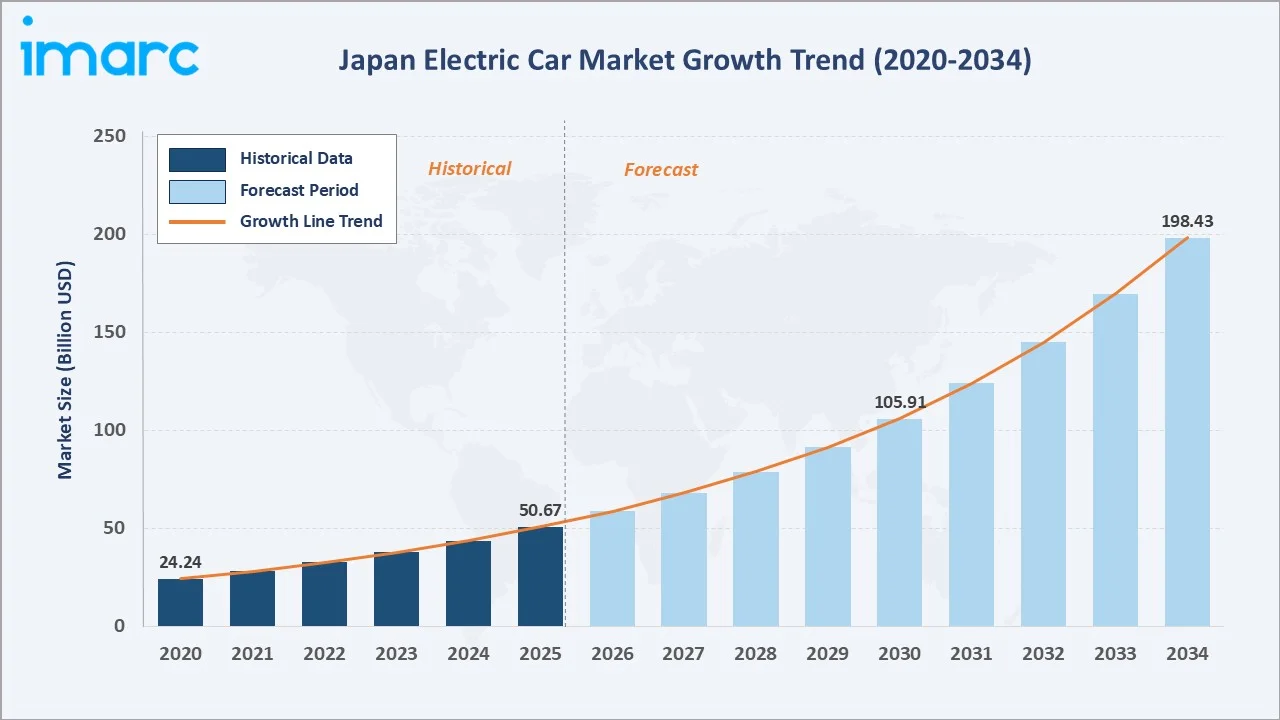
The Japan electric car market reached USD 50.67 Billion in 2025 and is projected to reach USD 198.43 Billion by 2034, growing at a CAGR of 15.89% during 2026-2034. Growth is driven by government subsidies, carbon-neutrality targets, expanding charging infrastructure, and rising battery technology innovation.
Battery Electric Vehicles dominate the type segment at 63.8%, Mid-Priced vehicles lead the vehicle class segment at 72.4%, and the Kanto region commands the largest regional share at 36.2% in 2025.
Market Snapshot
|
Metric |
Value |
|
Market Size (2025) |
USD 50.67 Billion |
|
Forecast Market Size (2034) |
USD 198.43 Billion |
|
CAGR (2026-2034) |
15.89% |
|
Base Year |
2025 |
|
Historical Period |
2020-2025 |
|
Forecast Period |
2026-2034 |
|
Dominant Type |
Battery Electric Vehicle (63.8%, 2025) |
|
Dominant Vehicle Class |
Mid-Priced (72.4%, 2025) |
|
Leading Region |
Kanto Region (36.2%, 2025) |
The market expanded from USD 24.24 Billion in 2020 to USD 50.67 Billion in 2025, driven by early subsidy adoption and initial BEV model rollouts. The market is anchored at USD 105.91 Billion in 2030 and is forecast to reach USD 198.43 Billion by 2034, as battery costs decline further and charging infrastructure matures nationwide.
To get more information on this market, Request Sample
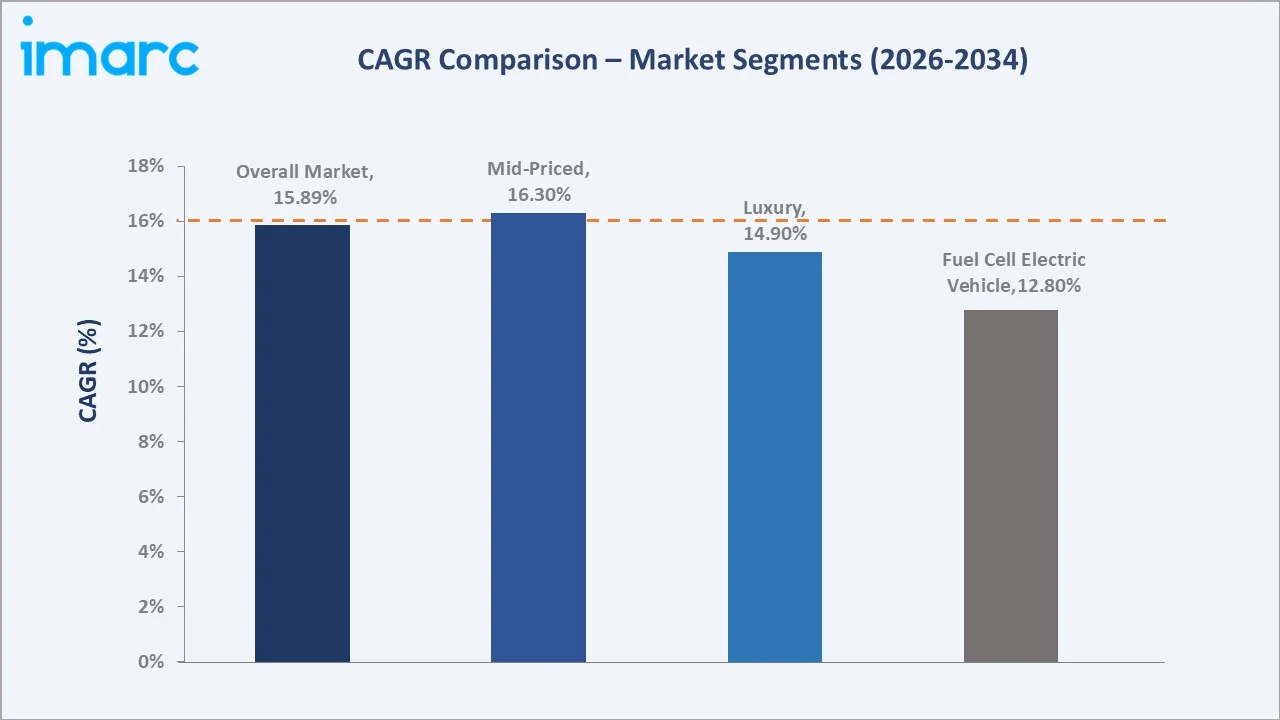
Mid-Priced vehicles grow fastest at ~16.3% CAGR as affordable BEV and PHEV models widen consumer access, while the Battery Electric Vehicle type grows at ~17.1% CAGR on the back of Japan's carbon-neutrality mandate and expanding subsidy coverage across metropolitan and regional markets.
Executive Summary
The Japan electric car market reached USD 50.67 Billion in 2025, reflecting the country's accelerating shift toward zero-emission mobility under its 2050 carbon-neutrality roadmap. It is projected to reach USD 198.43 Billion by 2034.
Battery Electric Vehicles lead the type segment at 63.8% on strong subsidy support and improving battery range. Mid-Priced vehicles lead the vehicle class segment at 72.4% by balancing affordability with performance. The Kanto region leads regionally at 36.2%, backed by dense charging infrastructure and high EV adoption among Tokyo-area consumers.
Key Market Insights
|
Insight |
Data |
|
Dominant Type |
Battery Electric Vehicle - 63.8% share (2025) |
|
Dominant Vehicle Class |
Mid-Priced - 72.4% share (2025) |
|
Leading Region |
Kanto Region - 36.2% share (2025) |
|
Market Opportunity |
Bi-directional (V2G) charging; solid-state batteries; rural charging network expansion; luxury BEV scale-up |
Key Analytical Observations Supporting The Above Data:
- Battery Electric Vehicle at 63.8%: BEVs dominate due to zero tailpipe emissions, improving battery range, and strong government subsidies. Nissan and Toyota continue to expand their BEV line-ups to capture rising domestic demand.
- Mid-Priced at 72.4%: The mid-priced segment dominates as it offers an optimal balance of affordability, range, and features for the mass consumer base, supported by nationwide subsidy programs.
- Kanto Region at 36.2%: Kanto leads owing to favorable local government incentives, a dense charging network, and the concentration of EV-conscious urban consumers in the greater Tokyo metropolitan area.
Japan Electric Car Market Overview
The Japan electric car market encompasses the design, manufacture, and sale of Battery Electric Vehicles, Plug-In Hybrid Electric Vehicles, and Fuel Cell Electric Vehicles across mid-priced and luxury vehicle classes. The ecosystem integrates automakers, battery cell manufacturers, charging infrastructure providers, component suppliers, and regulatory bodies overseeing emission and subsidy frameworks. Key macroeconomic drivers include government carbon-neutrality targets, rising fuel costs, urbanization, and continuous improvements in battery technology and charging networks.
Market Dynamics
To evaluate market opportunities, Request Sample
Market Drivers
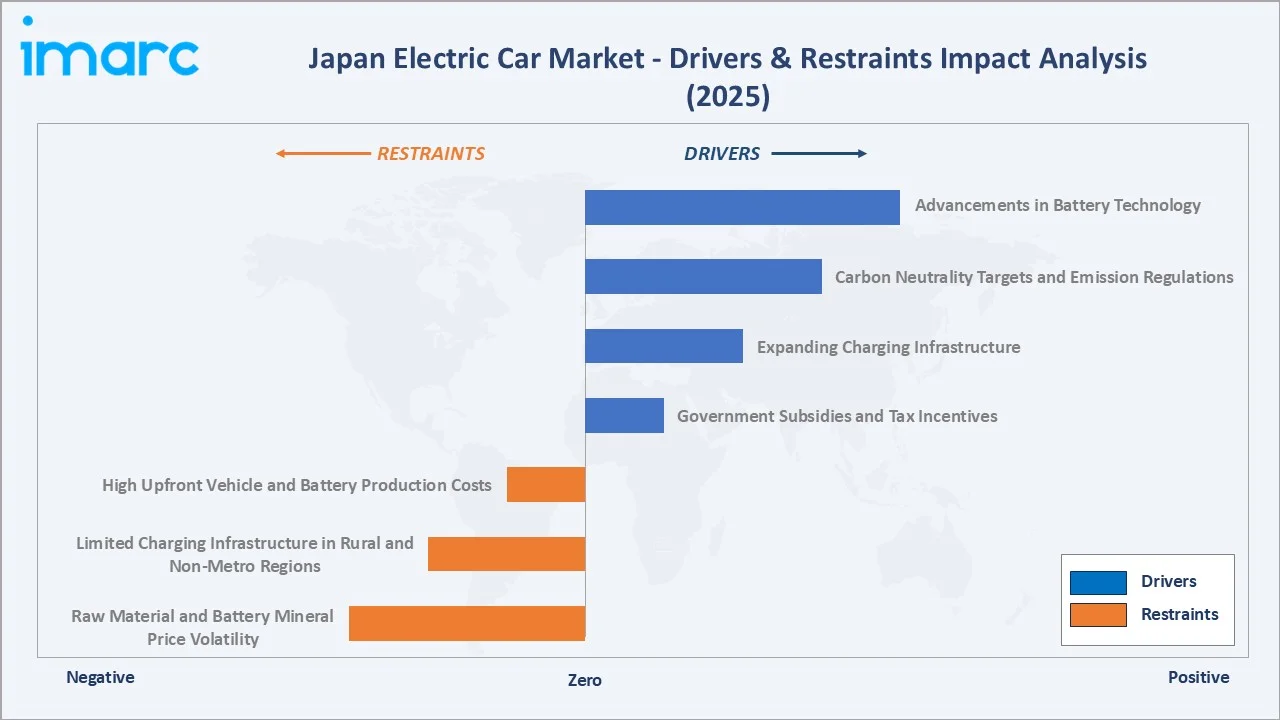
- Government Subsidies and Tax Incentives: Japan's CEV subsidy program and tax exemptions substantially lower EV purchase costs, directly boosting BEV and PHEV adoption across all vehicle classes. As of 2025, subsidy coverage extends to a wide range of qualifying EV models, encouraging first-time buyers. Additional incentives provided by local governments, including purchase grants and tax registration reductions, further improve affordability in several prefectures. These measures also encourage automakers to introduce more competitively priced electric models tailored to the Japanese market.
- Carbon Neutrality Targets and Emission Regulations: Japan's 2050 carbon-neutrality goal and its 2035 target for all-new light-duty vehicles to be electrified are compelling automakers to accelerate BEV and PHEV rollouts, directly increasing electric car production and sales. Stricter fuel-efficiency and emissions regulations are prompting manufacturers to expand their electrified portfolios and increase investment in battery-electric technologies. Government policy certainty is also encouraging long-term investments across the EV value chain.
- Expanding Charging Infrastructure: Continued investment in public and residential charging networks is reducing range anxiety and improving EV usability, particularly in dense urban regions such as Kanto and Kinki, thereby supporting sustained market growth. The deployment of fast-charging stations along expressways, commercial centers, and residential complexes is improving convenience for both private and fleet users. Collaboration between utilities, automakers, and charging network operators is further strengthening nationwide charging accessibility.
- Advancements in Battery Technology: Improvements in battery energy density, charging speed, and cost reduction are enhancing EV affordability and driving range, making electric cars increasingly competitive with conventional vehicles and reinforcing consumer adoption. Automakers are also investing in next-generation battery technologies, including solid-state batteries, to improve safety, extend vehicle range, and reduce charging times. Continuous innovation in battery management systems is further enhancing vehicle performance and lifecycle efficiency.
Market Restraints
- High Upfront Vehicle and Battery Production Costs: Despite subsidies, the higher base cost of EVs relative to conventional vehicles continues to limit adoption among price-sensitive consumer segments, particularly outside the mid-priced category. Battery manufacturing remains capital-intensive, while elevated costs of advanced components continue to pressure vehicle pricing. These factors can delay mass-market adoption despite ongoing technological improvements.
- Limited Charging Infrastructure in Rural and Non-Metro Regions: Regions such as Shikoku and Hokkaido face slower charging network expansion, constraining EV adoption rates outside major metropolitan clusters.
- Raw Material and Battery Mineral Price Volatility: Fluctuating prices for lithium, nickel, and cobalt increase battery production costs, creating pricing pressure for automakers and potentially slowing the pace of EV cost reductions. Supply chain disruptions and geopolitical uncertainties further increase procurement risks for battery manufacturers. These cost fluctuations can affect production planning and reduce manufacturers' flexibility in offering competitively priced electric vehicles.
Market Opportunities
- Solid-State Battery Commercialization: Solid-state battery development promises higher energy density, faster charging, and improved safety, creating a strong differentiation opportunity for Japanese automakers investing early in this technology.
- Bi-Directional (V2G) Charging Expansion: Vehicle-to-grid charging capability enables EV owners to supply power back to the grid, opening new revenue and utility-partnership opportunities as the technology scales nationally.
Market Challenges
- Battery Raw Material Supply Chain Dependence: Japan's reliance on imported lithium, nickel, and cobalt exposes automakers to geopolitical and pricing risks that could affect production costs and delivery timelines.
- Competitive Pressure from Global EV Entrants: Rising competition from Tesla and Chinese manufacturers such as BYD is intensifying pricing and technology pressure on domestic Japanese automakers.
Emerging Market Trends
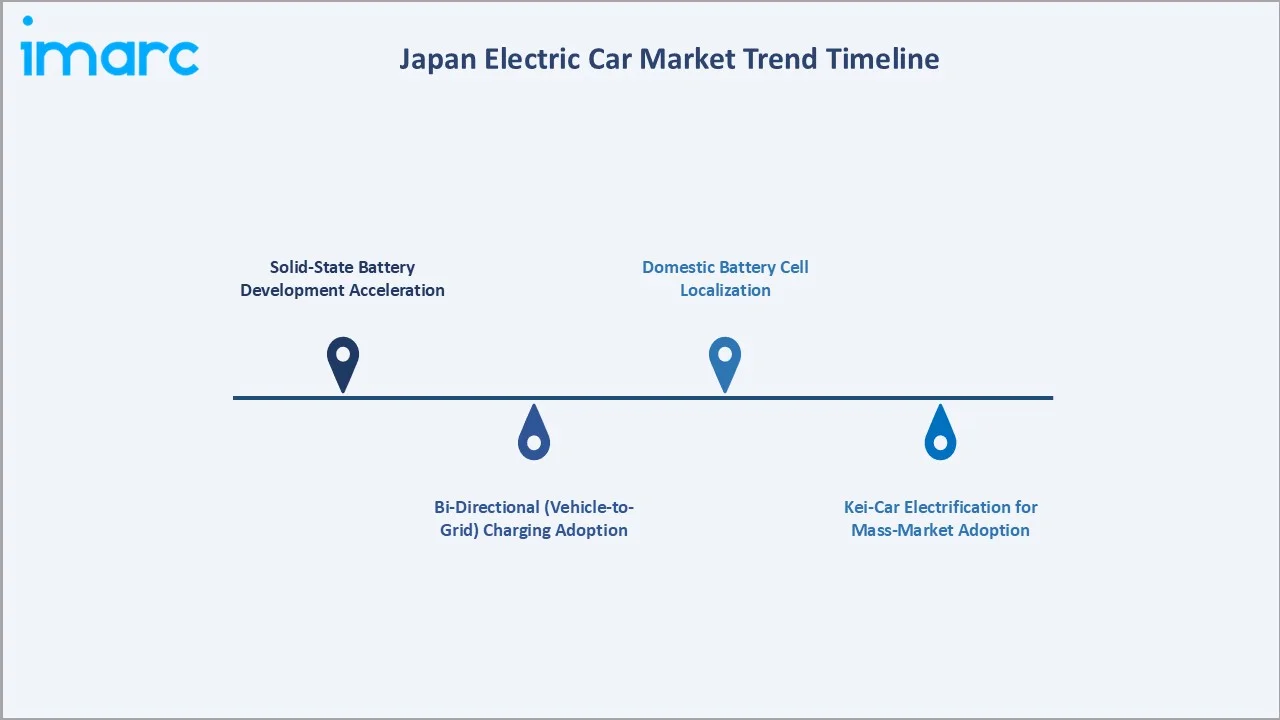
1. Solid-State Battery Development Acceleration
Japanese automakers, are accelerating solid-state battery pilot production, aiming to improve energy density, reduce charging time, and enhance safety for next-generation BEV platforms, strengthening Japan's global EV battery technology leadership.
2. Bi-Directional (Vehicle-to-Grid) Charging Adoption
Vehicle-to-grid charging technology is gaining traction as automakers and utilities collaborate to enable EVs to supply power back to homes and the grid, supporting energy resilience and creating new value propositions for EV ownership.
3. Kei-Car Electrification for Mass-Market Adoption
Electrification of Japan's compact kei-car segment is expanding affordable EV access, particularly benefiting mid-priced vehicle demand and rural and regional market penetration outside major metro areas.
4. Domestic Battery Cell Localization
Automakers and battery manufacturers are investing in domestic battery cell production capacity to reduce import dependence, improve supply chain resilience, and support Japan's long-term EV cost competitiveness.
Industry Value Chain Analysis
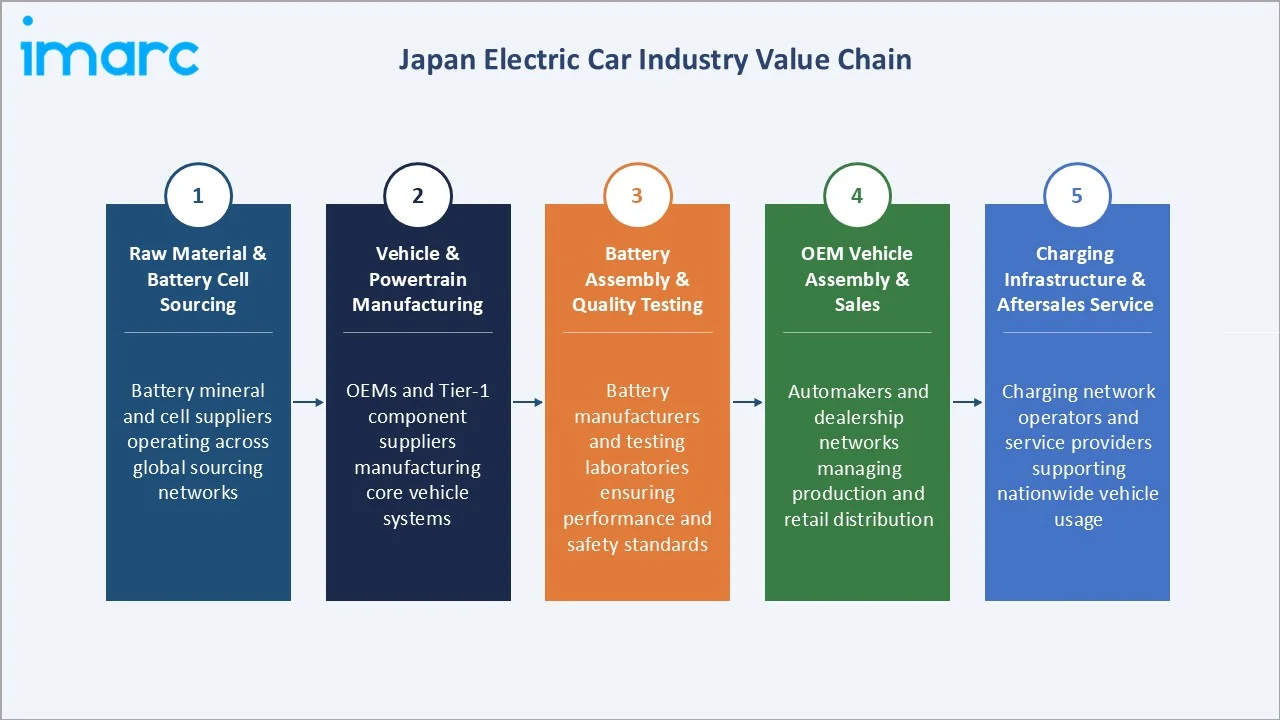
The Japan electric car value chain integrates raw material and battery cell sourcing, vehicle and powertrain manufacturing, battery assembly and testing, OEM vehicle assembly and sales, and charging infrastructure and aftersales services.
|
Stage |
Key Participants |
|
Raw Material & Battery Cell Sourcing |
Battery mineral and cell suppliers operating across global sourcing networks |
|
Vehicle & Powertrain Manufacturing |
OEMs and Tier-1 component suppliers manufacturing core vehicle systems |
|
Battery Assembly & Quality Testing |
Battery manufacturers and testing laboratories ensuring performance and safety standards |
|
OEM Vehicle Assembly & Sales |
Automakers and dealership networks managing production and retail distribution |
|
Charging Infrastructure & Aftersales Service |
Charging network operators and service providers supporting nationwide vehicle usage |
Technology Landscape in the Japan Electric Car Industry
Battery Electric Vehicle (BEV) Technology
Battery Electric Vehicle technology offers zero tailpipe emissions, improving driving range, and declining battery costs. Continuous advances in lithium-ion battery energy density and charging speed are strengthening BEV competitiveness against conventional vehicles, supporting its position as the leading technology type in the market.
Plug-In Hybrid Electric Vehicle (PHEV) Technology
Plug-In Hybrid Electric Vehicle technology combines an internal combustion engine with a rechargeable battery, offering extended range flexibility and easing range anxiety for consumers transitioning from conventional vehicles. This makes PHEVs an attractive bridge technology in Japan's electrification pathway.
Fuel Cell Electric Vehicle (FCEV) Technology
Fuel Cell Electric Vehicle technology uses hydrogen to generate electricity, offering fast refueling and long driving range. Continued investment by Japanese automakers in hydrogen infrastructure and fuel cell development supports the gradual expansion of this technology within the broader electric car market.
Market Segmentation Analysis
The report covers the following segments:
|
Segment Category |
Leading Segment |
Market Share |
Year |
|
Type |
Battery Electric Vehicle |
63.8% |
2025 |
|
Vehicle Class |
Mid-Priced |
72.4% |
2025 |
|
Vehicle Drive Type |
🔒 |
🔒 |
2025 |
|
Region |
Kanto Region |
36.2% |
2025 |

By Type
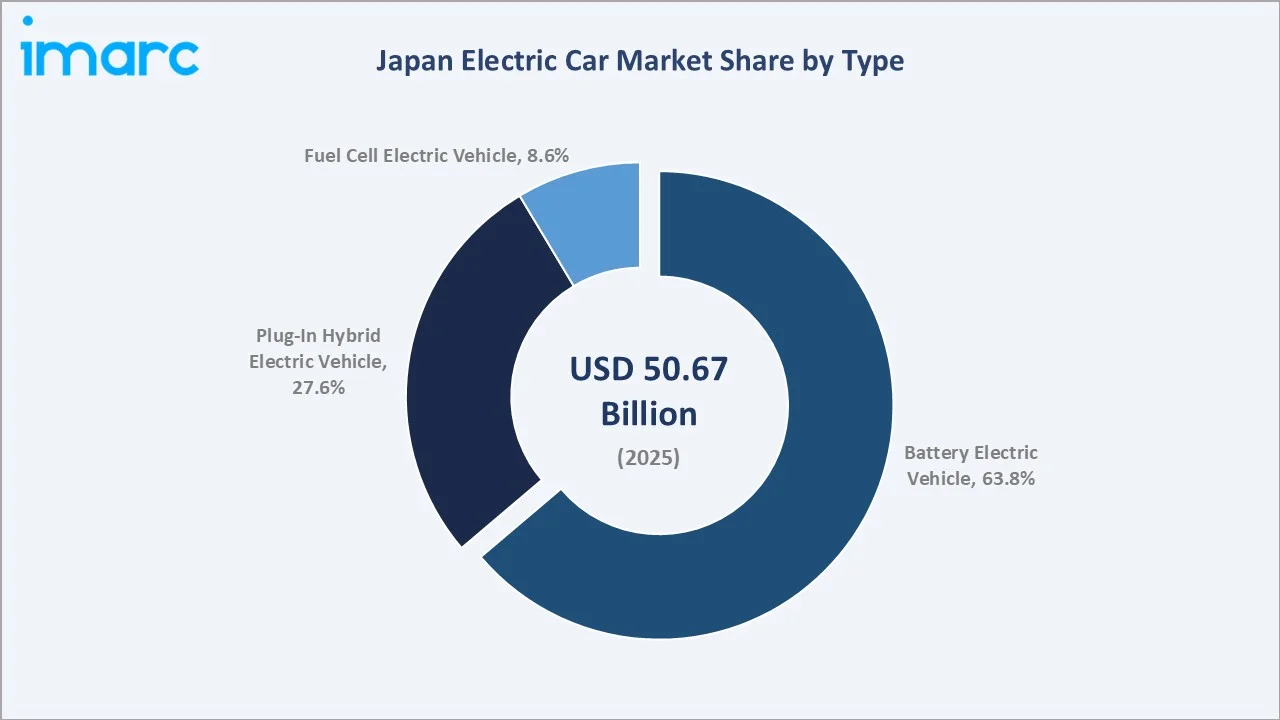
Battery Electric Vehicles lead the type segment at 63.8% in 2025, driven by zero-emission performance, improving battery range, and strong government subsidy alignment with Japan's carbon-neutrality roadmap.
To access detailed market analysis, Request Sample
Plug-In Hybrid Electric Vehicles hold 27.6% share, appealing to consumers seeking a transitional option with extended range flexibility. Fuel Cell Electric Vehicles account for 8.6%, supported by Japan's hydrogen infrastructure investments and Toyota's continued FCEV development programs.
By Vehicle Class
Mid-Priced vehicles dominate the vehicle class segment at 72.4% in 2025, reflecting strong demand from mainstream consumers seeking an affordable, subsidy-eligible entry into electric mobility.
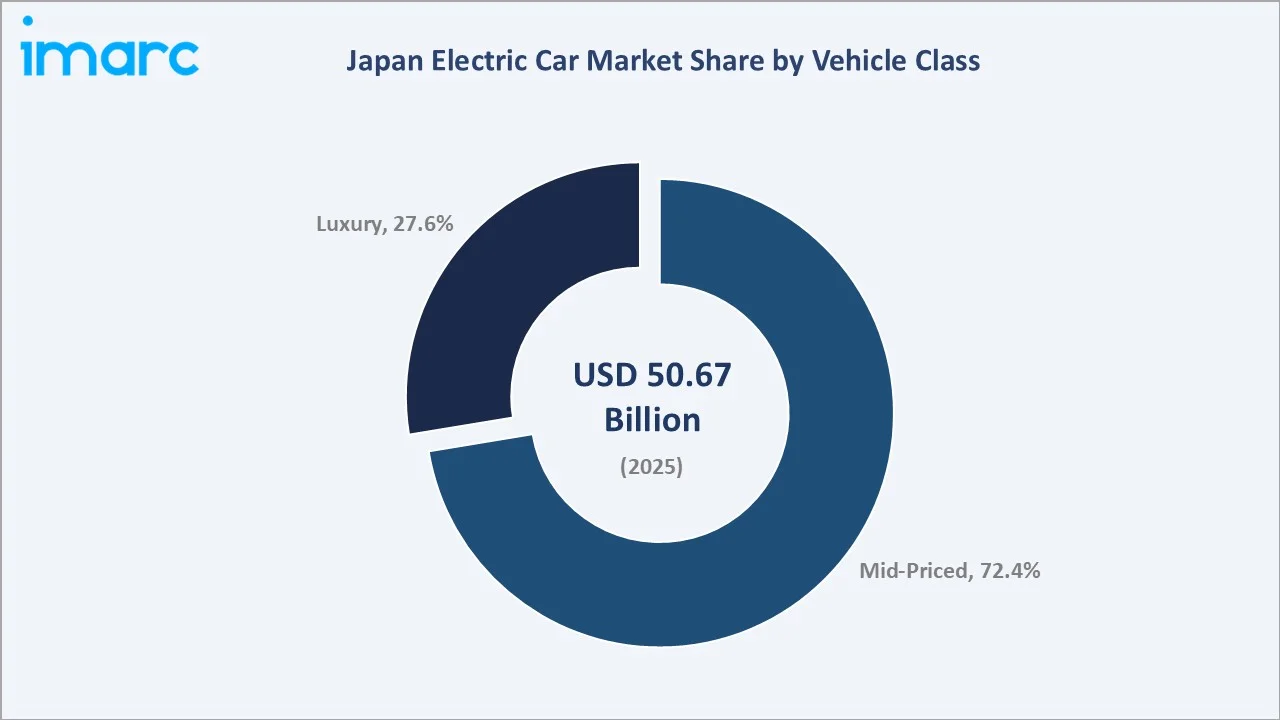
Luxury electric vehicles hold 27.6% share, led by premium BEV models from Japanese and global automakers targeting affluent, technology-conscious consumers in major metropolitan regions.
Regional Market Insights
|
Region |
Share (2025) |
Key Market Drivers & Characteristics |
|
Kanto |
36.2% |
Driven by dense charging infrastructure, high urban EV adoption, and strong local government incentive support |
|
Kinki |
18.7% |
Driven by expanding charging networks and steady urban EV adoption |
|
Central/Chubu |
15.4% |
Supported by a strong automotive manufacturing base and regional EV demand |
|
Kyushu-Okinawa |
8.8% |
Driven by regional decarbonization initiatives and infrastructure investment |
|
Tohoku |
6.9% |
Supported by renewable energy integration and regional subsidy programs |
|
Chugoku |
5.5% |
Driven by automotive supply chain presence and local incentive schemes |
|
Hokkaido |
4.8% |
Emerging adoption supported by developing charging infrastructure |
|
Shikoku |
3.7% |
Gradually increasing adoption supported by national subsidy programs |
Kanto, at 36.2%, leads through its concentration of EV-conscious consumers, dense charging network, and strong municipal incentive alignment with national subsidy schemes. Kinki, at 18.7%, reflects steady urban EV adoption in the Osaka-Kyoto corridor.
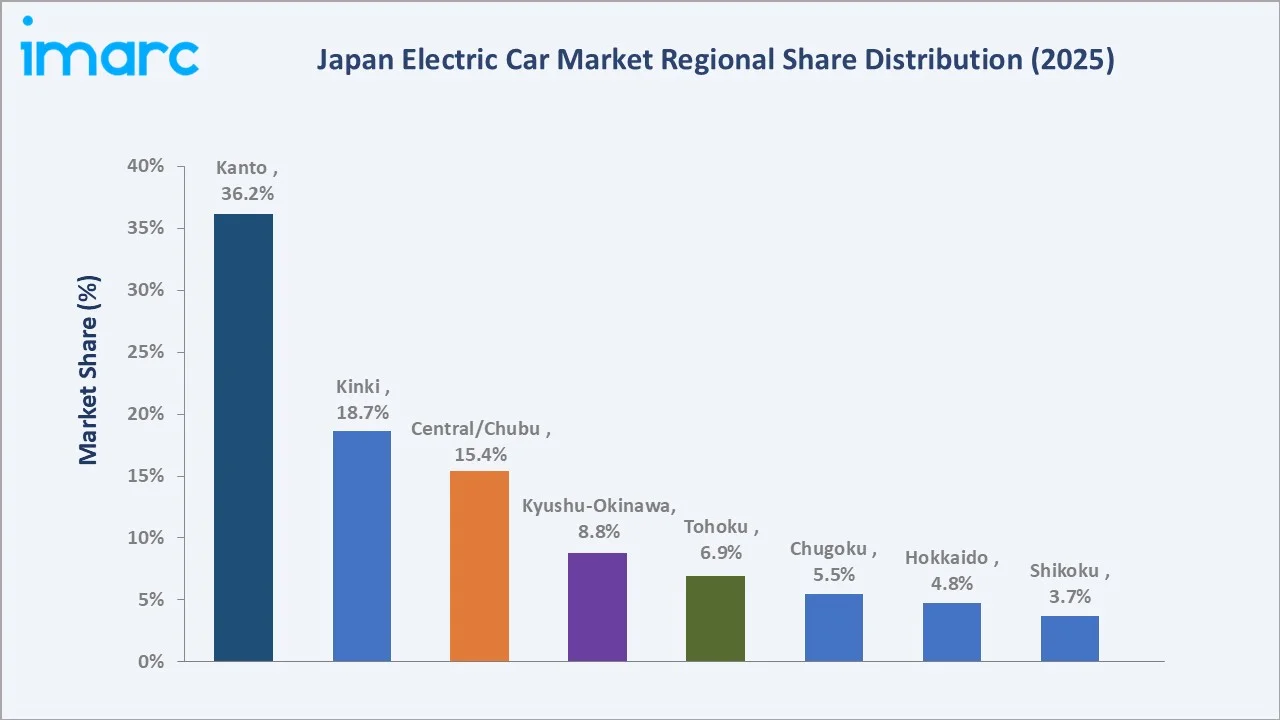
Central/Chubu, at 15.4%, benefits from its automotive manufacturing base, while Kyushu-Okinawa, Tohoku, Chugoku, Hokkaido, and Shikoku collectively represent an emerging but expanding share as national subsidy programs and charging infrastructure investment extend beyond metropolitan cores.
Competitive Landscape
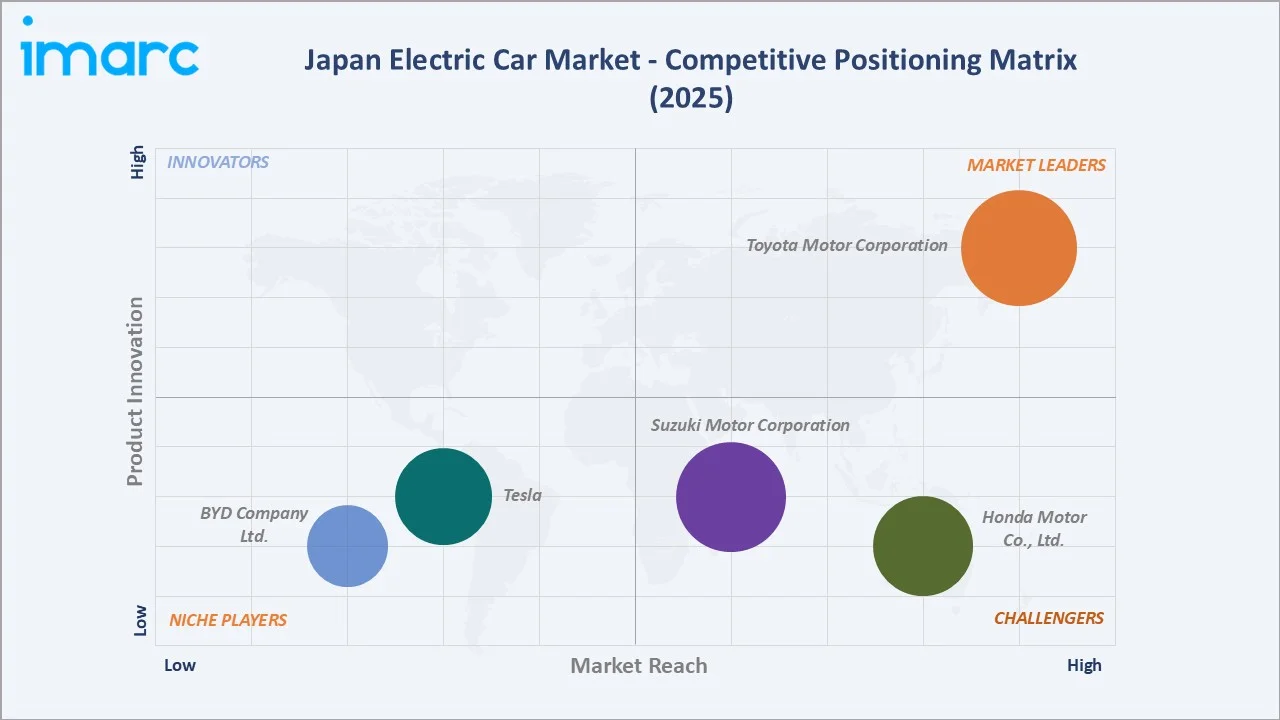
The Japan electric car market is moderately concentrated, led by established domestic automakers Toyota, Nissan, and Honda, alongside Suzuki and Mitsubishi Motors, while global players such as Tesla and BYD compete for share through imported and China-manufactured models.
|
Company Name |
Key Products |
Market Position |
Core Strength |
|
Toyota Motor Corporation |
bZ4X, bZ4X Touring, Mirai (FCEV) |
Market Leader |
Broad electrified portfolio spanning BEV, PHEV, and hydrogen fuel cell technology |
|
Honda Motor Co., Ltd. |
Super-ONE |
Strong Challenger |
Compact BEV platforms backed by advanced solid-state battery development |
|
Suzuki Motor Corporation |
e Vitara, e-Every |
Strong Challenger |
Affordable, compact EVs tailored for Japan's mass-market and kei-car segments |
|
Tesla |
Model 3, Model Y |
Niche Entrant |
Premium BEVs with proprietary software, battery, and charging network technology |
|
BYD Company Ltd. |
Atto 3, Dolphin, Seal (sedan) |
Niche Entrant |
Vertically integrated battery and EV manufacturing with competitive pricing |
Key players include Toyota Motor Corporation, Honda Motor Co., Ltd., Suzuki Motor Corporation, Tesla, BYD Company Ltd., and others.
Key Company Profiles
Toyota Motor Corporation
Toyota Motor Corporation is Japan's largest automaker, with a broad electrified vehicle portfolio spanning BEVs, PHEVs, and hydrogen fuel cell vehicles. It operates as an independent parent company.
- Key Products: bZ4X, bZ4X Touring, Mirai (FCEV)
- Recent Developments: In February 2026, Toyota introduced the bZ4X Touring, a new battery electric vehicle (BEV) designed to combine the driving performance of the original bZ4X with improved practicality for outdoor and everyday use. The model features a larger luggage compartment, making it suitable for recreational activities and family travel.
- Strategic Focus: Expanding its BEV line-up alongside continued hydrogen fuel cell investment to serve diverse consumer segments across mid-priced and luxury classes.
Honda Motor Co., Ltd.
Honda Motor Co., Ltd. is a leading Japanese automaker expanding its electrified vehicle presence through new BEV platforms. It operates as an independent parent company.
- Key Products: Super-ONE
- Recent Developments: In May 2026, Honda launched the Super-ONE compact electric vehicle (EV) in Japan, expanding its domestic EV portfolio with a model focused on delivering an engaging driving experience alongside everyday practicality. Developed on a dedicated platform derived from the N-ONE e:, the Super-ONE features a wider chassis, lightweight construction, a compact e-Axle, and an exclusive BOOST Mode that increases power output for enhanced acceleration.
- Strategic Focus: Scaling solid-state battery development and broadening its BEV model range to compete across mid-priced and premium segments.
Market Concentration Analysis
The Japan electric car market is moderately concentrated, with Toyota and Honda collectively accounting for a substantial majority of domestic EV sales. Suzuki hold meaningful share in the mid-priced segment, while Tesla and BYD represent a smaller but growing niche among global entrants. Market concentration is expected to gradually ease as international players expand their local model offerings through the forecast period.
Investment & Growth Opportunities
Highest Growth Segments
Battery Electric Vehicle type (~17.1% CAGR), Mid-Priced vehicle class (~16.3% CAGR), solid-state battery-equipped BEVs, and bi-directional charging-enabled models represent the highest-growth investment vectors through 2034.
Emerging Investment Opportunities
Domestic battery cell localization represents the market's highest-value emerging opportunity, reducing import dependence while supporting Japan's broader energy security and EV cost competitiveness objectives through 2034.
Investment Themes
- Solid-State Battery Vertical Integration: Automakers and battery manufacturers investing early in solid-state battery production can secure a durable technology and cost advantage as the segment scales toward commercialization.
- Regional Charging Infrastructure Expansion: Investment in charging networks across under-penetrated regions such as Tohoku, Chugoku, Hokkaido, and Shikoku can capture untapped EV demand as national subsidy coverage extends nationwide.
Future Market Outlook (2026-2034)
The Japan electric car market is projected to grow from USD 50.67 Billion in 2025 to USD 198.43 Billion by 2034, at a CAGR of 15.89%, passing through an anchor value of USD 105.91 Billion in 2030. Battery Electric Vehicles are expected to further strengthen their lead as battery costs decline and charging infrastructure matures nationwide. Mid-Priced vehicles will continue to anchor volume growth, while the Kanto region retains its leadership position, supported by continued urban EV adoption and public-private charging investment.
Research Methodology
Primary Research
Primary research comprised structured interviews with industry stakeholders, including OEM EV product leads, battery technology specialists, and charging infrastructure planners across Japan.
Secondary Research
Secondary research included company disclosures, Japan Ministry of Economy, Trade and Industry (METI) EV subsidy data, industry association publications, and national vehicle registration statistics.
Forecasting Models
Market revenue forecasts were developed using a bottom-up model incorporating EV production volumes by type and vehicle class, average selling price trends, and regional subsidy-adjusted demand projections.
Japan Electric Car Market Report Scope:
| Report Features | Details |
|---|---|
| Base Year of the Analysis | 2025 |
| Historical Period | 2020-2025 |
| Forecast Period | 2026-2034 |
| Units | Billion USD |
| Scope of the Report |
Exploration of Historical Trends and Market Outlook, Industry Catalysts and Challenges, Segment-Wise Historical and Future Market Assessment:
|
| Types Covered | Battery Electric Vehicle, Plug-In Hybrid Electric Vehicle, Fuel Cell Electric Vehicle |
| Vehicle Classes Covered | Mid-Priced, Luxury |
| Vehicle Drive Types Covered | Front Wheel Drive, Rear Wheel Drive, All-Wheel Drive |
| Regions Covered | Kanto, Kinki, Central/ Chubu, Kyushu-Okinawa, Tohoku, Chugoku, Hokkaido, Shikoku |
| Companies Covered | Toyota Motor Corporation, Honda Motor Co. Ltd., Suzuki Motor Corporation, Tesla, BYD Company Ltd., etc. |
| Customization Scope | 10% Free Customization |
| Post-Sale Analyst Support | 10-12 Weeks |
| Delivery Format | PDF and Excel through Email (We can also provide the editable version of the report in PPT/Word format on special request) |
Key Benefits for Stakeholders:
- IMARC’s report offers a comprehensive quantitative analysis of various market segments, historical and current market trends, market forecasts, and dynamics of the Japan electric car market from 2020-2034.
- The research study provides the latest information on the market drivers, challenges, and opportunities in the Japan electric car market.
- Porter's Five Forces analysis assists stakeholders in assessing the impact of new entrants, competitive rivalry, supplier power, buyer power, and the threat of substitution. It helps stakeholders to analyze the level of competition within the Japan electric car industry and its attractiveness.
- Competitive landscape allows stakeholders to understand their competitive environment and provides an insight into the current positions of key players in the market.
Frequently Asked Questions About the Japan Electric Car Market Report
The Japan electric car market reached USD 50.67 Billion in 2025, driven by Battery Electric Vehicle dominance at 63.8%, Mid-Priced vehicles leading at 72.4%, and the Kanto region commanding 36.2% share.
The market is projected to grow at a CAGR of 15.89% during 2026-2034, reaching USD 198.43 Billion by 2034, up from USD 105.91 Billion in 2030.
The market was valued at USD 24.24 Billion in 2020, growing at a historical CAGR of 15.89% to reach USD 50.67 Billion by 2025.
Battery Electric Vehicles lead at 63.8% share in 2025, supported by subsidies and improving battery range.
Mid-Priced vehicles lead at 72.4% share, offering an optimal balance of affordability and performance.
The Kanto region leads at 36.2% share, backed by dense charging infrastructure and strong urban EV adoption.
Leading companies include Toyota Motor Corporation, Honda Motor Co., Ltd., Suzuki Motor Corporation, Tesla, BYD Company Ltd., and others.
The market is projected to reach USD 105.91 Billion by 2030, driven by continued BEV adoption and expanding charging infrastructure.
Need more help?
- Speak to our experienced analysts for insights on the current market scenarios.
- Include additional segments and countries to customize the report as per your requirement.
- Gain an unparalleled competitive advantage in your domain by understanding how to utilize the report and positively impacting your operations and revenue.
- For further assistance, please connect with our analysts.
 Request Customization
 Speak to an Analyst
 Request Brochure
 Inquire Before Buying
Benefits of Customization
- Personalize this research
- Triangulate with your data
- Get data as per your format and definition
- Gain a deeper dive into a specific application, geography, customer, or competitor
- Any level of personalization
Get in Touch With Us
UNITED STATES
Phone: +1-201-971-6302
INDIA
Phone: +91-120-433-0800
UNITED KINGDOM
Phone: +44-753-714-6104
Email: [email protected]
Client Testimonials




.webp)




.webp)













Related Reports

Choose your plan
*Please note that the prices mentioned below are starting prices for each bundle type. Kindly contact our team for further details.*
Single User License
- 1 User License, Access on 2 Devices
- PDF Report + Excel Dataset (Password Protected)
- Lifetime Access
- No Printing Rights
- 10% Free Report Customization
- 10–12 Weeks of Analyst Support
Five User License
- Access for 5 Users, 2 Devices per User
- PDF Report + Excel Dataset (Password Protected)
- Lifetime Access
- Dedicated Account Manager
- 12–14 Weeks of Analyst Support
- No Printing Rights
- 15% Free Report Customization
- 25% Discount on Your Next Purchase
Corporate User License
- Unlimited User Access (Within Your Organization)
- PDF Report + Excel Dataset
- Lifetime Access
- Dedicated Account Manager
- 14–20 Weeks of Analyst Support
- No Printing Rights
- 20% Free Report Customization
- 30% Discount on Your Next Purchase
Essential Insights
What's included:
3 reports
- Lifetime Access
- PDF Reports
- Excel Datasets
- 2 Weeks of Free Analyst Support
- 2 User Licenses
- Access on 2 Devices
- Printing Rights
- Complimentary PowerPoint (PPT) Version
- Complimentary License Upgrade
Professional Access
What's included:
5 reports
- Lifetime Access
- PDF Reports
- Excel Datasets
- 8 Weeks of Free Analyst Support
- 2 User Licenses
- Access on 2 Devices
- Printing Rights
- Complimentary PowerPoint (PPT) Version
- Complimentary License Upgrade
Business Advantage
What's included:
8 reports
- Lifetime Access
- PDF Reports
- Excel Datasets
- 14 Weeks of Free Analyst Support
- 2 User Licenses
- Access on 2 Devices
- Printing Rights
- Complimentary PowerPoint (PPT) Version
- Complimentary License Upgrade
Enterprise Intelligence
What's included:
10 reports
- Lifetime Access
- PDF Reports
- Excel Datasets
- 20 Weeks of Free Analyst Support
- 2 User Licenses
- Access on 2 Devices
- Printing Rights
- Complimentary PowerPoint (PPT) Version
- Complimentary License Upgrade