
Japan Freeze-Dried Food Market Size, Share, Trends and Forecast by Type, Distribution Channel, End User, and Region, 2026-2034
Japan Freeze-Dried Food Market Summary:
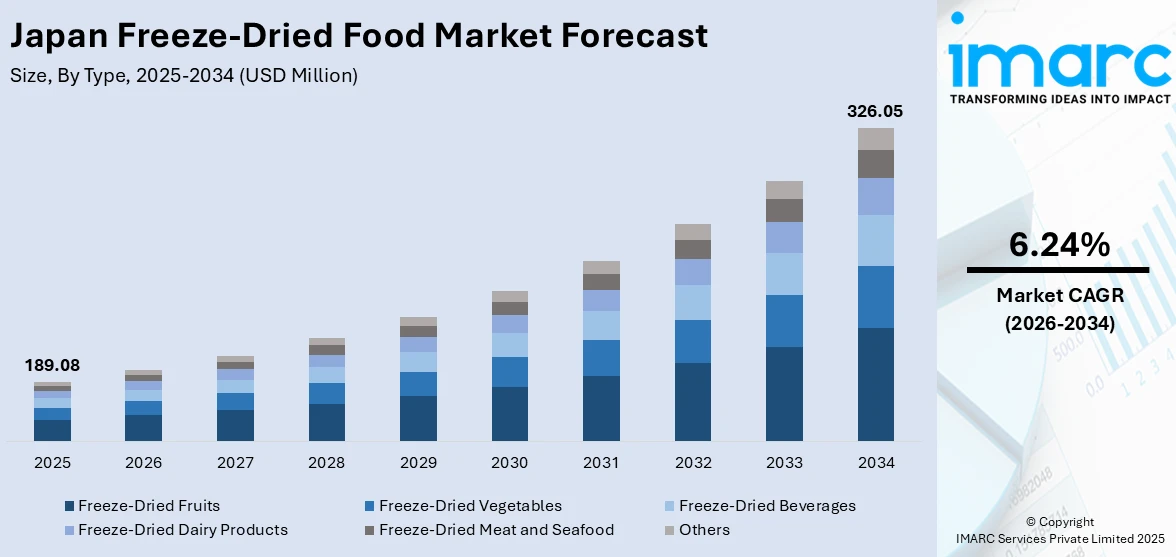
The Japan freeze-dried food market size was valued at USD 189.08 Million in 2025 and is projected to reach USD 326.05 Million by 2034, growing at a compound annual growth rate of 6.24% from 2026-2034.
The Japan freeze-dried food market is experiencing sustained momentum as consumer demand for convenient, shelf-stable, and nutritionally preserved food products continues to intensify. The country’s rapidly aging population, coupled with increasingly hectic urban lifestyles, is strengthening the appeal of ready-to-eat and easy-to-prepare food solutions. Advancements in freeze-drying technology, expanding product diversification beyond traditional miso soups into gourmet meals and health-oriented snacks, and the growing role of e-commerce distribution channels are further reshaping the competitive landscape and broadening the Japan freeze-dried food market share.
Key Takeaways and Insights:
- By Type: Freeze-dried fruits dominate the market with a share of 31.4% in 2025, driven by rising health-conscious snacking preferences and growing demand for natural, nutrient-rich food options among Japanese consumers.
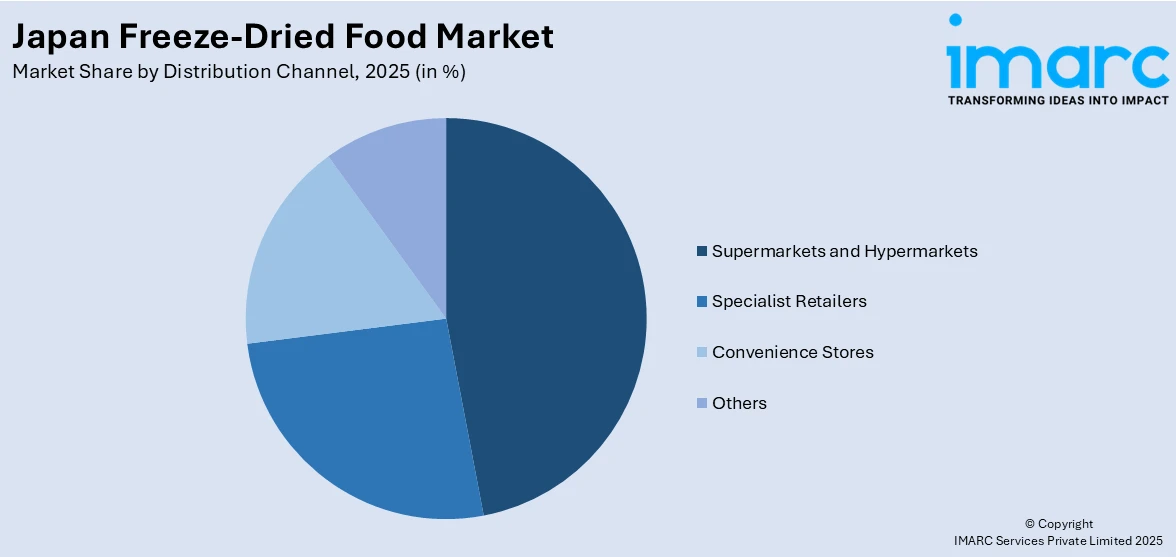
- By Distribution Channel: Supermarkets and hypermarkets lead the market with a share of 46.7% in 2025, supported by extensive product assortment, high consumer footfall, and the trusted in-store shopping experience for food purchases.
- By End User: Household represents the largest segment with a market share of 52.8% in 2025, reflecting strong home consumption patterns fueled by convenience-oriented lifestyles and meal preparation preferences.
- By Region: Kanto region dominates the market with a share of 34.9% in 2025, anchored by Tokyo’s dense population, high urbanization rates, and the concentration of major retail and distribution networks.
- Key Players: The Japan freeze-dried food market is moderately consolidated, with established domestic manufacturers leveraging decades of proprietary freeze-drying expertise, extensive product portfolios, and strong retail partnerships to maintain competitive positioning across both traditional and emerging product categories.
To get more information on this market Request Sample
The Japan freeze-dried food market is evolving beyond its traditional foundations in instant miso soup toward a diversified ecosystem encompassing gourmet meals, health-oriented snacks, and long-shelf-life emergency provisions. The country’s deep cultural affinity for food quality and convenience, combined with a robust retail infrastructure spanning supermarkets, convenience stores, and online platforms, creates a uniquely receptive environment for freeze-dried innovation. Japan’s aging demographic, with the population aged 65 and above reaching a record 36.25 million in September 2024, is generating sustained demand for easy-to-prepare, nutritionally balanced meal solutions tailored to elderly dietary requirements. Simultaneously, younger urban consumers increasingly favor freeze-dried fruit snacks and premium instant meals as part of health-conscious dietary routines. The market’s growth trajectory is further reinforced by disaster preparedness culture, where freeze-dried foods serve as essential components of household emergency stockpiles, particularly in seismically active regions across the Japanese archipelago.
Japan Freeze-Dried Food Market Trends:
Premiumization and Gourmet Product Innovation
The Japan freeze-dried food market is witnessing a significant shift toward premium and gourmet offerings as manufacturers expand beyond basic instant soups into sophisticated meal categories. Companies are investing in advanced processing techniques to replicate the texture, flavor, and visual appeal of restaurant-quality dishes in freeze-dried formats. Amano Foods, a subsidiary of Asahi Group Foods, currently produces over 200 freeze-dried product varieties and commands approximately 65% of the block miso soup market in Japan. The brand’s “freeze-dried master chef” series features complex dishes such as chicken cutlet curry and shrimp tempura, reflecting the industry’s commitment to culinary authenticity and Japan freeze-dried food market growth.
Rising Demand for Health-Conscious Freeze-Dried Snacks
Consumer preferences in Japan are increasingly shifting toward natural, clean-label, and minimally processed foods, supporting rising demand for freeze-dried fruits and vegetable-based snacks. Health awareness remains strong, while convenience continues to play an important role in purchasing decisions, creating a favorable environment for freeze-dried products. These foods align well with modern lifestyles by offering portability, long shelf life, and ease of consumption without compromising nutritional value. Freeze-drying helps preserve essential vitamins, minerals, and antioxidants, making fruit and vegetable snacks an attractive option for consumers seeking both wellness benefits and everyday convenience.
Integration into Disaster Preparedness and Emergency Stockpiling
Japan’s exposure to natural disasters has fostered a strong culture of emergency preparedness, supporting steady demand for long-shelf-life food products. Households are widely encouraged to keep emergency food reserves, with freeze-dried items playing a key role due to their durability and ease of storage. Manufacturers have developed advanced freeze-drying and packaging technologies that remove moisture and protect products from oxidation, allowing food to remain safe and usable for extended periods. These characteristics make freeze-dried foods an essential component of disaster preparedness strategies across Japan.
.webp)
Market Outlook 2026-2034:
The Japan freeze-dried food market is expected to experience steady growth over the forecast period, supported by a combination of demographic, technological, and lifestyle trends. The rising prevalence of single-person households is increasing demand for convenient, portion-controlled, and easy-to-prepare meal options. At the same time, ongoing advancements in freeze-drying technology are improving product quality and variety, encouraging wider consumer adoption. Expanding product offerings and greater availability through online retail channels are further enhancing market reach, accessibility, and long-term growth potential across Japan. The market generated a revenue of USD 189.08 Million in 2025 and is projected to reach a revenue of USD 326.05 Million by 2034, growing at a compound annual growth rate of 6.24% from 2026-2034.
Japan Freeze-Dried Food Market Report Segmentation:
|
Segment Category |
Leading Segment |
Market Share |
|
Type |
Freeze-Dried Fruits |
31.4% |
|
Distribution Channel |
Supermarkets and Hypermarkets |
46.7% |
|
End User |
Household |
52.8% |
|
Region |
Kanto Region |
34.9% |
Type Insights:
- Freeze-Dried Fruits
- Freeze-Dried Vegetables
- Freeze-Dried Beverages
- Freeze-Dried Dairy Products
- Freeze-Dried Meat and Seafood
- Others
Freeze-dried fruits dominate with a market share of 31.4% of the total Japan freeze-dried food market in 2025.
Freeze-dried fruits represent the dominant product segment in Japan’s freeze-dried food market, driven by rising demand for nutritious and convenient snacking options that complement the country’s strong health-focused lifestyle. The freeze-drying process preserves much of the fruit’s natural vitamins, minerals, and antioxidants, making these products a healthier alternative to traditional dried or heavily processed snacks. Consumers commonly use freeze-dried fruits in cereals, yogurts, baked goods, or as ready-to-eat snacks, reflecting their versatility and broad appeal across everyday diets.
The segment’s growth is further propelled by expanding applications in the food and beverage industry, where manufacturers use freeze-dried fruits as natural ingredients in confectionery, bakery, and beverage formulations. Strawberries, mangoes, apples, and blueberries are among the most popular freeze-dried fruit varieties in Japan, favored for their vibrant color retention, concentrated flavor profiles, and versatile culinary applications. The clean-label movement, with consumers actively seeking products free from artificial additives and preservatives, has positioned freeze-dried fruits as an ideal ingredient for health-oriented product development across multiple food categories.
Distribution Channel Insights:
Access the comprehensive market breakdown Request Sample
- Supermarkets and Hypermarkets
- Specialist Retailers
- Convenience Stores
- Others
Supermarkets and hypermarkets lead with a share of 46.7% of the total Japan freeze-dried food market in 2025.
Supermarkets and hypermarkets remain the leading sales channel for freeze-dried foods in Japan, supported by their wide retail reach, diverse product offerings, and strong consumer confidence. Large retail chains allocate dedicated shelf space to freeze-dried soups, fruits, vegetables, and ready-to-eat meals, allowing shoppers to easily compare brands, ingredients, and nutritional details. Ongoing consolidation within Japan’s grocery and drugstore retail landscape is further strengthening distribution efficiency, increasing shelf visibility, and improving nationwide availability of freeze-dried food products across multiple retail formats.
The dominance of supermarkets and hypermarkets is reinforced by their ability to offer competitive pricing through bulk purchasing arrangements and promotional campaigns that drive consumer trial and repeat purchases. These retail formats also benefit from Japan’s strong culture of regular grocery shopping, where consumers prioritize quality assurance and product freshness. While online retail channels are experiencing rapid growth, the tactile shopping experience and immediate product availability provided by physical retail continue to underpin the supermarket segment’s leading market position in Japan’s freeze-dried food landscape.
End User Insights:
- Hotels and Restaurants
- Household
- Food and Beverage Industry
- Others
Household represent the highest revenue with a 52.8% share of the total Japan freeze-dried food market in 2025.
The household end-user segment continues to dominate Japan’s freeze-dried food market, driven by long-standing dietary habits and evolving household structures. Rising numbers of people living alone, dual-income families, and elderly consumers managing independent lifestyles have increased reliance on food options that are easy to store and quick to prepare. Freeze-dried miso soups, rice dishes, and ready-to-eat meals are now common household staples, supporting both daily consumption and emergency preparedness. Japan’s strong preference for convenience-focused living further reinforces consistent household adoption of freeze-dried food products.
Household consumption is further strengthened by disaster preparedness practices deeply rooted in Japanese culture, where families maintain emergency food reserves as standard practice. The Tokyo Metropolitan Government’s Bichiku Navi platform provides household-specific stockpiling recommendations based on family size and composition, frequently featuring freeze-dried rice, miso soups, and complete meal kits as essential emergency provisions. This dual-purpose functionality, serving both daily convenience and emergency preparedness, distinguishes the household segment’s consumption dynamics and ensures consistent demand across seasonal and economic cycles.
Regional Insights:
- Kanto Region
- Kansai/Kinki Region
- Central/Chubu Region
- Kyushu-Okinawa Region
- Tohoku Region
- Chugoku Region
- Hokkaido Region
- Shikoku Region
Kanto region represent the largest share at 34.9% of the total Japan freeze-dried food market in 2025.
The Kanto region’s market leadership is anchored by its status as Japan’s most populous and economically significant metropolitan area, centered around Tokyo and the surrounding prefectures of Kanagawa, Saitama, Chiba, Ibaraki, Tochigi, and Gunma. The region’s massive concentration of urban professionals, university students, and elderly residents creates a diverse consumer base with strong demand for convenient food solutions. Tokyo alone accounts for the highest density of supermarkets, convenience stores, and specialty retailers in the country, providing unmatched distribution infrastructure for freeze-dried product availability. The Kanto region’s advanced e-commerce ecosystem further amplifies market accessibility through online supermarket platforms and direct-to-consumer channels.
The region’s leading position is strengthened by hosting the headquarters of prominent freeze-dried food producers and a dense network of high-visibility retail hubs. Flagship brand outlets in major commercial centers play a key role in showcasing wide product ranges while also educating consumers about freeze-dried offerings. At the same time, the area’s large base of single-person households and independently living older consumers shapes strong demand for foods that emphasize ease of preparation, appropriate portion sizes, and balanced nutrition, creating a stable and supportive market environment for freeze-dried products.
Market Dynamics:
Growth Drivers:
Why is the Japan Freeze-Dried Food Market Growing?
Accelerating Demographic Shift Toward an Aging and Solo-Living Population
The freeze-dried food market is a strong growth driver in the long-term due to Japan, with its continually aging population. There has been a growing need among older consumers to have food choices that are easy to prepare, light on physical exertion, and well-balanced in terms of nutrition, since the older a consumer is, the more cooking becomes hectic. Freeze-dried foods respond to such needs with lightweight, shelf-stable foods that can be reconstituted with the minimum of steps. Deliberately low-food items like miso soups and rice-based foods would be especially popular among the older generation, as they retain familiar tastes without offering health and comfort in a convenient and consistent fashion to enjoy every day.
Continuous Advancement in Freeze-Drying Technology and Product Diversification
There has been a constant increase in freeze-drying technology, which enables Japanese manufacturers to go beyond the stage of instant soups and expand their range to high-end meals, nutrition-oriented snacks, and specialized food products. The improved control of the processing conditions allows manufacturers to work with complex, multi-component recipes without losing the visual appeal, texture, or nutrition. The innovations also contribute to the fact that diverse ingredients can be preserved in the same product at once, and more elaborate and authentic menu items can be introduced. This has led to the fact that the companies can nowadays reproduce full Japanese dishes in freeze dried version and provide consumers with high-quality taste experiences in addition to maintaining expected convenience and shelf life.
Growing Disaster Preparedness Awareness and Emergency Food Stockpiling
Japan’s location in a disaster-prone region has fostered a deeply rooted culture of emergency readiness, supporting steady demand for foods with long shelf lives. Households are widely encouraged to maintain emergency provisions, and freeze-dried meals are commonly chosen due to their durability, compact storage, and ease of preparation. Products such as freeze-dried rice, miso soups, and complete meal kits are well suited for emergency use, requiring only water to consume while preserving familiar flavors. Advances in dehydration and sealing technologies have further enhanced product reliability, allowing manufacturers to offer long-lasting food solutions that align with Japan’s preparedness-focused consumer mindset.
Market Restraints:
What Challenges the Japan Freeze-Dried Food Market is Facing?
Elevated Production Costs and Energy-Intensive Manufacturing
The freeze-drying process requires specialized vacuum chambers, precise temperature control systems, and extended processing cycles that significantly increase production costs compared to alternative food preservation methods. These capital-intensive requirements create cost barriers that limit product affordability and constrain market penetration, particularly in price-sensitive consumer segments where competing preservation formats offer more economical alternatives.
Intense Competition from Alternative Food Preservation Technologies
Freeze-dried products face substantial competitive pressure from retort pouch meals, frozen foods, and canned goods that offer comparable convenience at lower price points. Japan’s frozen food market reached record-high consumption of approximately 2.93 million tons in 2024, demonstrating the strong consumer acceptance and advanced infrastructure supporting alternative preservation categories that compete directly for convenience-oriented food expenditure.
Consumer Perception Barriers Regarding Taste Authenticity
Despite significant technological advancements, a segment of Japanese consumers continues to perceive freeze-dried foods as inferior to freshly prepared meals in terms of taste, texture, and overall dining experience. Overcoming these deeply ingrained quality expectations in a market where food culture emphasizes freshness and authenticity requires sustained investment in product development and consumer education initiatives.
Competitive Landscape:
The Japan freeze-dried food market features a moderately consolidated competitive structure characterized by the presence of established domestic manufacturers with deep expertise in freeze-drying technology and extensive distribution networks. Market participants differentiate through proprietary processing techniques, diverse product portfolios spanning traditional Japanese cuisines and innovative snack formats, and strategic retail partnerships across supermarkets, convenience stores, and e-commerce platforms. Companies are investing in premiumization strategies, expanding into gourmet and health-oriented product categories, and leveraging advanced packaging solutions to enhance shelf appeal and consumer convenience. Strategic brand building, continuous product innovation, and targeted marketing toward aging demographics and health-conscious consumers remain the primary competitive strategies shaping market dynamics.
Recent Developments:
- February 2024: Hikari Miso launched the “Mainichi Miso Soup Mild Sodium Freeze-Dried Miso” in 8 and 20 serving packs at supermarkets across Japan. The product features a 25% reduction in salt content compared to regular varieties while maintaining full miso flavor through bonito flake and kombu dashi broth formulation, and introduced new packaging with 35% less plastic.
Japan Freeze-Dried Food Market Report Coverage:
|
Report Features |
Details |
|
Base Year of the Analysis |
2025 |
|
Historical Period |
2020-2025 |
|
Forecast Period |
2026-2034 |
|
Units |
Million USD |
|
Scope of the Report |
Exploration of Historical Trends and Market Outlook, Industry Catalysts and Challenges, Segment-Wise Historical and Future Market Assessment:
|
|
Types Covered |
Freeze-Dried Fruits, Freeze-Dried Vegetables, Freeze-Dried Beverages, Freeze-Dried Dairy Products, Freeze-Dried Meat and Seafood, Others |
|
Distribution Channels Covered |
Supermarkets and Hypermarkets, Specialist Retailers, Convenience Stores, Others |
|
End Users Covered |
Hotels and Restaurants, Household, Food and Beverage Industry, Others |
|
Regions Covered |
Kanto Region, Kansai/Kinki Region, Central/Chubu Region, Kyushu-Okinawa Region, Tohoku Region, Chugoku Region, Hokkaido Region, Shikoku Region |
|
Customization Scope |
10% Free Customization |
|
Post-Sale Analyst Support |
10-12 Weeks |
|
Delivery Format |
PDF and Excel through Email (We can also provide the editable version of the report in PPT/Word format on special request) |
Frequently Asked Questions About the Japan Freeze-Dried Food Market Report
The Japan freeze-dried food market size was valued at USD 189.08 Million in 2025.
The Japan freeze-dried food market is expected to grow at a compound annual growth rate of 6.24% from 2026-2034 to reach USD 326.05 Million by 2034.
Freeze-dried fruits, representing the largest revenue share of 31.4% in 2025, lead Japan’s freeze-dried food market by retaining essential nutrients and offering convenient, healthy snacking options that align with the country’s growing consumer preference for natural, clean-label food products.
Key factors driving the Japan freeze-dried food market include the rapidly aging population, expanding demand for convenient meal solutions among urban consumers and single-person households, advancing freeze-drying technology, growing disaster preparedness culture, and increasing health consciousness among Japanese consumers.
Major challenges include elevated production costs associated with energy-intensive freeze-drying processes, intense competition from alternative preservation technologies such as frozen and retort pouch foods, consumer perception barriers regarding taste authenticity, and limited consumer awareness of newer freeze-dried product categories beyond traditional miso soups.
Need more help?
- Speak to our experienced analysts for insights on the current market scenarios.
- Include additional segments and countries to customize the report as per your requirement.
- Gain an unparalleled competitive advantage in your domain by understanding how to utilize the report and positively impacting your operations and revenue.
- For further assistance, please connect with our analysts.
 Request Customization
 Speak to an Analyst
 Request Brochure
 Inquire Before Buying
Benefits of Customization
- Personalize this research
- Triangulate with your data
- Get data as per your format and definition
- Gain a deeper dive into a specific application, geography, customer, or competitor
- Any level of personalization
Get in Touch With Us
UNITED STATES
Phone: +1-201-971-6302
INDIA
Phone: +91-120-433-0800
UNITED KINGDOM
Phone: +44-753-714-6104
Email: [email protected]
Client Testimonials




.webp)




.webp)













Related Reports

Choose your plan
*Please note that the prices mentioned below are starting prices for each bundle type. Kindly contact our team for further details.*
Single User License
- 1 User License, Access on 2 Devices
- PDF Report + Excel Dataset (Password Protected)
- Lifetime Access
- No Printing Rights
- 10% Free Report Customization
- 10–12 Weeks of Analyst Support
Five User License
- Access for 5 Users, 2 Devices per User
- PDF Report + Excel Dataset (Password Protected)
- Lifetime Access
- Dedicated Account Manager
- 12–14 Weeks of Analyst Support
- No Printing Rights
- 15% Free Report Customization
- 25% Discount on Your Next Purchase
Corporate User License
- Unlimited User Access (Within Your Organization)
- PDF Report + Excel Dataset
- Lifetime Access
- Dedicated Account Manager
- 14–20 Weeks of Analyst Support
- No Printing Rights
- 20% Free Report Customization
- 30% Discount on Your Next Purchase
Essential Insights
What's included:
3 reports
- Lifetime Access
- PDF Reports
- Excel Datasets
- 2 Weeks of Free Analyst Support
- 2 User Licenses
- Access on 2 Devices
- Printing Rights
- Complimentary PowerPoint (PPT) Version
- Complimentary License Upgrade
Professional Access
What's included:
5 reports
- Lifetime Access
- PDF Reports
- Excel Datasets
- 8 Weeks of Free Analyst Support
- 2 User Licenses
- Access on 2 Devices
- Printing Rights
- Complimentary PowerPoint (PPT) Version
- Complimentary License Upgrade
Business Advantage
What's included:
8 reports
- Lifetime Access
- PDF Reports
- Excel Datasets
- 14 Weeks of Free Analyst Support
- 2 User Licenses
- Access on 2 Devices
- Printing Rights
- Complimentary PowerPoint (PPT) Version
- Complimentary License Upgrade
Enterprise Intelligence
What's included:
10 reports
- Lifetime Access
- PDF Reports
- Excel Datasets
- 20 Weeks of Free Analyst Support
- 2 User Licenses
- Access on 2 Devices
- Printing Rights
- Complimentary PowerPoint (PPT) Version
- Complimentary License Upgrade