
Japan Guacamole Market Size, Share, Trends and Forecast by Form, End Use, and Packaging, and Region, 2026-2034
Japan Guacamole Market Summary:
The Japan guacamole market size was valued at USD 53.81 Million in 2025 and is projected to reach USD 151.78 Million by 2034, growing at a compound annual growth rate of 12.2% from 2026-2034.
The Japan guacamole market is experiencing robust expansion, underpinned by the growing consumer appetite for international flavors, increasing integration of avocado-based condiments into traditional and fusion cuisines, and the rising preference for nutritious, plant-based food options. Evolving dietary patterns, expanding retail availability, and the broadening acceptance of Mexican-inspired dishes across foodservice and household settings are collectively strengthening the Japan guacamole market share.
Key Takeaways and Insights:
- By Form: Frozen dominates the market with a share of 44% in 2025, driven by consumer demand for convenient, shelf-stable food products that preserve freshness and flavor. The expansion of frozen food retail channels and growing household reliance on ready-to-use meal components are reinforcing this leadership.
- By End Use: Households lead the market with a share of 40% in 2025, owing to rising at-home consumption of international dips and spreads, increased experimentation with global recipes, and the growing availability of packaged guacamole products in supermarkets and online retail platforms.
- By Packaging: Plastic containers exhibit a clear dominance in the market with 41% share in 2025, reflecting consumer preference for lightweight, resealable, and transparent packaging that allows product visibility, maintains freshness, and offers convenience for everyday use in household and foodservice settings.
- Key Players: Key players are accelerating Japan guacamole market share by introducing innovative product formulations, expanding distribution through retail and foodservice networks, investing in cold chain logistics, and forming strategic partnerships to strengthen brand presence across metropolitan and suburban consumer segments.
The Japan market for guacamole is moving forward as changing consumer preferences, healthy eating habits, and increasing demand for Mexican-style foods combine to generate considerable natural growth. One major contributor to this growth pattern in Japan’s guacamole consumption trends relates to the increasing involvement in international cuisine that consumers are undertaking. Clearly, younger generations in Japan’s consumer base are leading this trend in moving toward international foods. Guacamole’s appeal in traditional Japanese dishes and fusion foods has helped to overcome previously isolated appeal. Increasing availability in frozen- and ready-to-eat formats may help to improve penetration of guacamole into Japan’s consumer base. This functionality, combined with increasing availability and relentless growth in online shopping options, adds to the upward trend in guacamole consumption.
Japan Guacamole Market Trends:
Rising Integration of Guacamole into Japanese Fusion Cuisine
Japanese chefs and home cooks are increasingly incorporating guacamole into traditional dishes, creating innovative fusion combinations such as wasabi-infused guacamole and avocado-topped sushi rolls. The growing presence of Mexican restaurants across Tokyo, particularly in Shibuya, Harajuku, and Shimokitazawa, is accelerating mainstream acceptance. This culinary experimentation reflects a broader cultural openness among younger consumers who are exposed to global food trends through social media and international travel, contributing to the Japan guacamole market growth.
Expanding Frozen and Convenience Food Culture
Japan’s frozen food sector is experiencing sustained expansion, with sales reaching record highs in recent years, driven by the rise of dual-income households and demand for time-saving meal solutions. Frozen guacamole products are benefiting from this momentum as retailers expand their frozen food sections and dedicated frozen food specialty stores continue to proliferate across the country. The convenience-oriented lifestyle of urban Japanese consumers is positioning frozen guacamole as an accessible and practical addition to everyday meals and snacking occasions.
Growing Consumer Preference for Plant-Based and Nutrient-Dense Foods
Health-conscious eating patterns are gaining momentum across Japan, with consumers increasingly gravitating toward plant-based, whole-food options rich in essential nutrients. Guacamole, composed primarily of avocados and natural ingredients, aligns with these evolving dietary preferences, particularly among flexitarian and wellness-focused demographics. The growing emphasis on functional nutrition and clean-label products is encouraging broader adoption of guacamole as a nutrient-dense condiment that complements both traditional and contemporary Japanese meal preparations.
Market Outlook 2026-2034:
The market for guacamole in Japan is expected to grow further, with enhanced levels of participation in international food cultures, increases in the percentage of households using guacamole dip as a convenient food, and continuous growth in frozen foods store infrastructures. With more diversification in guacamole dip, as well as organic and different flavored guacamole products, further prospects for market growth can be identified. Strategic moves in cold chain infrastructures, green packaging solutions, as well as collaborations between international guacamole dip suppliers and domestic distributors, could further boost market prospects with regards to consumer access in Japan during the forecast period. The market generated a revenue of USD 53.81 Million in 2025 and is projected to reach a revenue of USD 151.78 Million by 2034, growing at a compound annual growth rate of 12.2% from 2026-2034.
Japan Guacamole Market Report Segmentation:
|
Segment Category |
Leading Segment |
Market Share |
|
Form |
Frozen |
44% |
|
End Use |
Households |
40% |
|
Packaging |
Plastic Containers |
41% |
Form Insights:
To get detailed segment analysis of this market, Request Sample
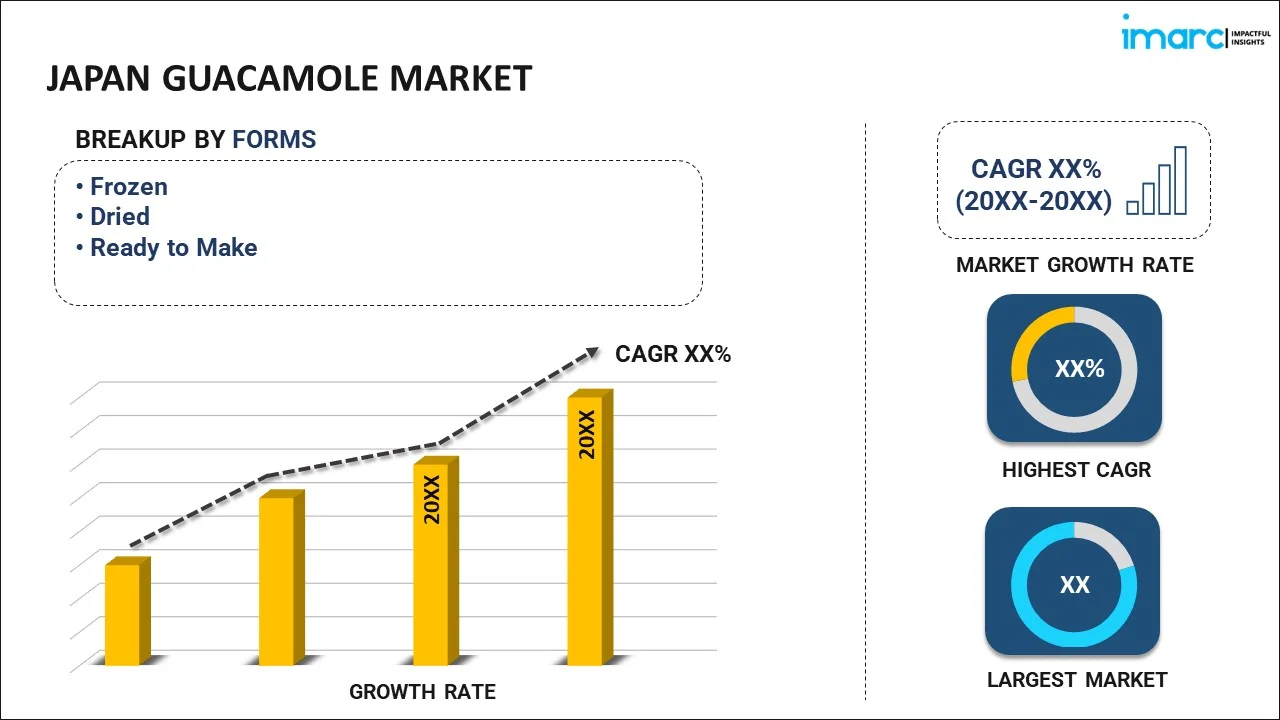
- Frozen
- Dried
- Ready To Make
Frozen dominates with a market share of 44% of the total Japan guacamole market in 2025.
The frozen segment’s leadership is driven by strong consumer demand for convenient, long-shelf-life food products that retain the freshness and flavor of avocado-based dips. Japan’s expanding frozen food infrastructure, including the proliferation of dedicated frozen food specialty stores, has made frozen guacamole increasingly accessible to urban households. According to Japan’s Ministry of Internal Affairs, average household expenditure on frozen foods increased, reflecting a structural shift in Japanese food consumption patterns that strongly benefits frozen guacamole adoption across retail and household channels.
Frozen guacamole products offer significant advantages in terms of inventory management, reduced food waste, and ease of preparation, making them particularly attractive for busy dual-income households and the growing number of single-person households in Japan. Advances in freezing technologies, including flash-freezing and high-pressure processing, have enhanced the texture and nutritional retention of frozen guacamole, addressing earlier quality concerns. The segment is further supported by foodservice operators who rely on frozen formats for consistent portioning, cost efficiency, and streamlined kitchen operations in restaurants, catering services, and quick-service establishments.
End Use Insights:
- Food Processing Industry
- Food Service Industry
- Households
Households lead with a share of 40% of the total Japan guacamole market in 2025.
The household segment’s dominance reflects the increasing integration of guacamole into home cooking and everyday snacking routines across Japan. Rising exposure to international cuisines through social media platforms and cooking programs has encouraged at-home experimentation with Mexican-inspired dishes. Japan’s supermarket retail food sales represent a year-on-year increase, with supermarkets and convenience stores expanding their chilled and frozen dip selections to meet diversifying consumer preferences. This retail channel growth provides a critical distribution pathway for household guacamole consumption.
The demographic transformation of Japanese households, characterized by a growing number of single-person and nuclear family units, is reshaping food purchasing patterns in favor of ready-to-use and pre-packaged meal components. Guacamole’s versatility as a dip, spread, and salad ingredient appeals to health-conscious consumers seeking nutritious alternatives to traditional condiments. The emergence of online grocery platforms and subscription-based food delivery services is further expanding household accessibility to guacamole products, enabling consumers in suburban and semi-urban areas to purchase specialized international food items with greater convenience and regularity.
.webp)
Packaging Insights:
- Glass Bottles
- Plastic Containers
- Stand Up Pouches
The plastic containers exhibit a clear dominance with a 41% share of the total Japan guacamole market in 2025.
Plastic containers maintain their market leadership owing to their lightweight design, resealability, and transparency that allows consumers to visually assess product quality before purchase. These attributes align with Japanese consumer expectations for practical, hygienic, and easy-to-store food packaging. The format is particularly favored in household retail channels, where single-serve and family-sized plastic containers dominate shelf displays in supermarkets, hypermarkets, and convenience stores. Japan’s convenience store network relies extensively on plastic-packaged food items for their compact, stackable, and display-friendly characteristics.
The plastic container segment is also benefiting from ongoing innovations in material science, including the development of recyclable and biodegradable plastic alternatives that address growing environmental concerns among Japanese consumers. Modified atmosphere packaging technologies integrated with plastic containers are extending shelf life while preserving the flavor and nutritional profile of guacamole products. Manufacturers are increasingly introducing portion-controlled and multi-compartment plastic container formats that cater to on-the-go consumption patterns, bento-style meal preparations, and party-sized servings, thereby expanding the addressable market across diverse usage occasions and consumer demographics.
Regional Insights:
To get detailed regional analysis of this market, Request Sample
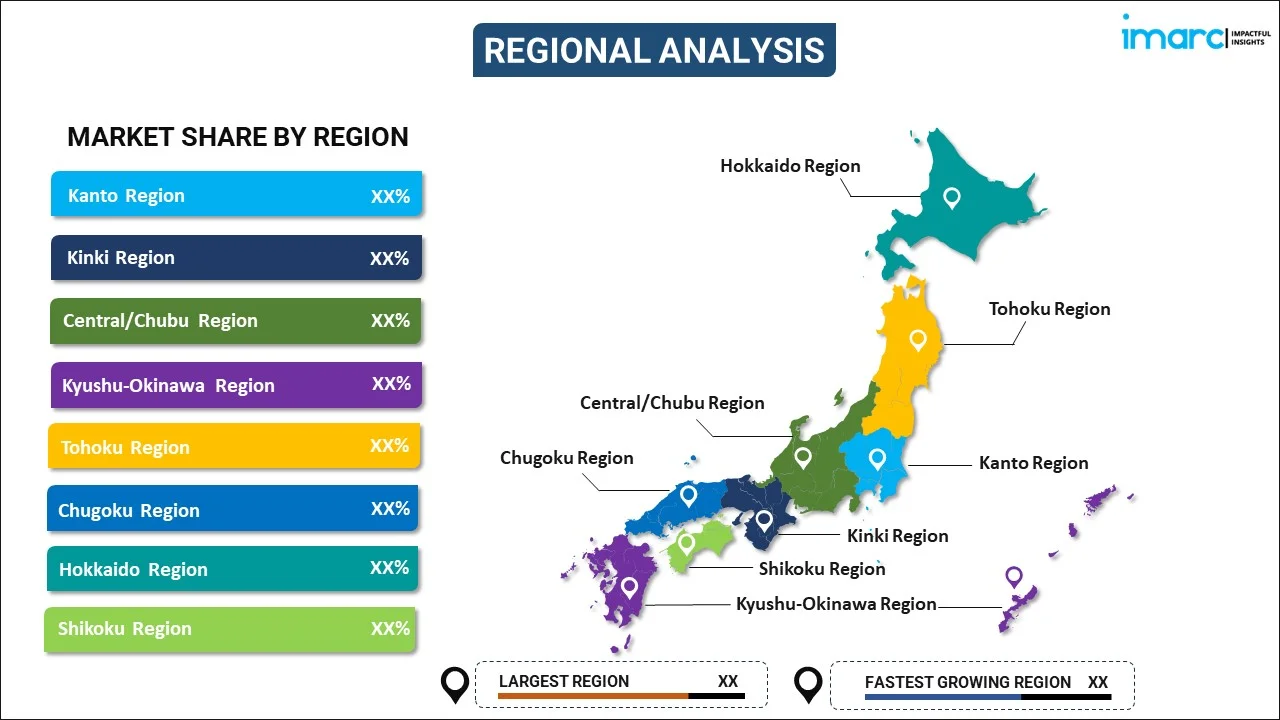
- Kanto Region
- Kinki Region
- Central/ Chubu Region
- Kyushu-Okinawa Region
- Tohoku Region
- Chugoku Region
- Hokkaido Region
- Shikoku Region
The Kanto Region dominates the Japan guacamole market, driven by Tokyo's dense urban population, high purchasing power, thriving international restaurant scene, and extensive modern retail infrastructure that facilitates widespread distribution of imported and frozen guacamole products.
The Kinki Region represents a significant market, supported by Osaka's vibrant culinary culture, strong tourism-driven demand, expanding plant-based food adoption, and well-established supermarket networks across Osaka, Kyoto, and Kobe metropolitan areas.
The Central/Chubu Region contributes steadily to market growth, driven by Nagoya's industrial workforce seeking convenient meal solutions, rising health-food interest among urban consumers, and expanding retail presence of international food products across the region.
The Kyushu-Okinawa Region exhibits promising growth potential, fueled by increasing consumer interest in functional foods, expanding convenience store networks, growing Western cuisine adoption among younger demographics, and Okinawa's culturally diverse food consumption patterns.
The Tohoku Region presents emerging opportunities for guacamole market expansion, supported by increasing urbanization, growing awareness of international cuisines, expanding frozen food distribution channels, and rising consumer preference for convenient and nutritious meal accompaniments.
The Chugoku Region demonstrates gradual market development, driven by Hiroshima's expanding food retail sector, increasing penetration of convenience stores offering international food products, and growing consumer exposure to diverse global culinary trends.
The Hokkaido Region contributes to market growth through its robust food processing industry, expanding retail infrastructure, rising tourism-driven demand for international cuisines, and increasing consumer preference for plant-based and nutrient-dense food options among health-conscious residents.
The Shikoku Region represents a developing market with growth potential, supported by increasing retail modernization, expanding distribution networks for frozen and convenience food products, and gradually rising consumer awareness of international condiments and dips.
Market Dynamics:
Growth Drivers:
Why is the Japan Guacamole Market Growing?
Increasing Health Consciousness and Demand for Nutrient-Dense Foods
Japan’s population is increasingly prioritizing health and wellness in their dietary choices, creating favorable conditions for guacamole adoption. Avocados, the primary ingredient in guacamole, are recognized as rich sources of monounsaturated fats, dietary fiber, potassium, and essential vitamins that contribute to cardiovascular health, improved digestion, and overall well-being. This nutritional profile aligns with the growing demand for functional foods that offer both taste and health benefits, particularly among aging demographics and wellness-focused younger consumers. The shift toward plant-based and whole-food diets is further reinforcing guacamole’s appeal as a clean-label, minimally processed food option. Japanese consumers are progressively moving away from heavily processed condiments in favor of natural alternatives that complement health-oriented meal preparations. The integration of guacamole into everyday meals as a nutritious spread, dip, or topping is expanding its usage occasions beyond occasional snacking to regular meal accompaniment, thereby broadening the consumer base and driving sustained market growth.
Growing Popularity of International Cuisine and Mexican Food Culture
The deepening globalization of food culture in Japan is creating significant opportunities for guacamole market expansion. Younger Japanese consumers, increasingly exposed to international cuisines through travel, social media, and digital content platforms, are driving demand for authentic and fusion Mexican food experiences. The presence of Mexican restaurants in Tokyo alone reflects the growing mainstream acceptance of Mexican flavors and dining experiences across major metropolitan areas. This cultural shift extends beyond foodservice into household consumption, as Japanese home cooks experiment with guacamole in creative applications ranging from sushi toppings to rice bowl accompaniments. The rising influence of food content creators and culinary influencers on platforms popular among Japanese millennials and Generation Z consumers is amplifying awareness and curiosity about guacamole. This organic demand generation, combined with the expanding availability of guacamole products in retail channels, is establishing a virtuous cycle of awareness, trial, and repeat purchase that supports long-term market growth.
Diversification of Avocado Supply Sources Strengthening Raw Material Availability
The ongoing diversification of Japan’s avocado import sources is strengthening the supply chain foundation for guacamole production. While Mexico remains the dominant supplier, the entry of new supply origins is enhancing market resilience and price stability. In November 2024, the Philippines completed its inaugural export of Hass avocados to Japan, marking the first Asian country to achieve this trade milestone. This development reduces dependency on single-source supply, mitigate seasonal availability gaps, and create competitive pricing dynamics that benefit guacamole manufacturers. The broadening supplier base, coupled with improvements in cold chain logistics and import infrastructure, is ensuring a more consistent and cost-effective raw material supply that supports the scalability of guacamole production and distribution across Japan.
Market Restraints:
What Challenges the Japan Guacamole Market is Facing?
Heavy Dependence on Imported Avocados and Price Volatility
Japan’s guacamole market faces significant vulnerability due to its near-complete reliance on imported avocados, with virtually all supply sourced from overseas. Fluctuations in global avocado prices, currency exchange rate movements, rising international shipping costs, and supply disruptions caused by climate variability in producing regions can directly impact raw material costs for guacamole manufacturers. These cost pressures can lead to higher retail prices, potentially constraining consumer adoption, particularly among price-sensitive segments of the market.
Limited Shelf Life and Perishability Challenges
The inherent perishability of avocado-based products presents ongoing challenges for guacamole distribution and retail management. Fresh guacamole is highly susceptible to oxidation, which compromises color, texture, and taste, limiting its ambient shelf life without specialized packaging or preservation technologies. While frozen and processed formats partially address these constraints, maintaining consistent product quality throughout the cold chain requires substantial investment in temperature-controlled logistics infrastructure, increasing operational costs for manufacturers and distributors.
Higher Cost Relative to Traditional Japanese Condiments
Guacamole products command premium pricing compared to established Japanese condiments such as soy sauce, wasabi, and miso, which are deeply embedded in local culinary traditions and benefit from large-scale domestic production. The import-dependent nature of avocados and the specialized processing and cold storage requirements of guacamole contribute to elevated production costs that are ultimately reflected in consumer pricing. This cost differential may limit broader market penetration, especially outside major metropolitan areas where disposable incomes tend to be lower.
Competitive Landscape:
The Japan market for guacamole has a moderately fragmented vendor market with several global as well as local food companies competing to capture market share in this industry. Companies in this market are highly focused on product differentiation in terms of premium product formulations and unique flavors to achieve strong market penetration in Japan, as the Japanese market boasts very high-quality product-seeking consumers. Strategic investments in high-quality frozen food manufacturing, supply chain management, and local channel partners are some of the major strategies employed by companies in the Japan market to maintain a huge market share in the highly competitive market of guacamole. Companies in the Japan guacamole market are also making strategic investments in quality packaging solutions to increase product shelf life and enhance consumer convenience with the expanding channel reach of the market.
Recent Developments:
- In January 2025, Mission Produce announced an agreement to acquire Calavo Growers in a transaction valued at approximately USD 430 Million. The deal combines two of North America’s largest avocado companies, with Calavo’s guacamole and prepared foods business. The acquisition positions the combined entity to strengthen global distribution, including in the Asia-Pacific region.
Japan Guacamole Market Report Scope:
| Report Features | Details |
|---|---|
| Base Year of the Analysis | 2025 |
| Historical Period | 2020-2025 |
| Forecast Period | 2026-2034 |
| Units | Million USD |
| Scope of the Report | Exploration of Historical and Forecast Trends, Industry Catalysts and Challenges, Segment-Wise Historical and Predictive Market Assessment:
|
| Forms Covered | Frozen, Dried, Ready to Make |
| End Uses Covered | Food Processing Industry, Food Service Industry, Household |
| Packagings Covered | Glass Bottles, Plastic Containers, Stand Up Pouches |
| Regions Covered | Kanto Region, Kinki Region, Central/ Chubu Region, Kyushu-Okinawa Region, Tohoku Region, Chugoku Region, Hokkaido Region, Shikoku Region |
| Customization Scope | 10% Free Customization |
| Post-Sale Analyst Support | 10-12 Weeks |
| Delivery Format | PDF and Excel through Email (We can also provide the editable version of the report in PPT/Word format on special request) |
Frequently Asked Questions About the Japan Guacamole Market Research Report Report
The Japan guacamole market size was valued at USD 53.81 Million in 2025.
The Japan guacamole market is expected to grow at a compound annual growth rate of 12.2% from 2026-2034 to reach USD 151.78 Million by 2034.
Frozen dominated the market with a share of 44%, driven by strong consumer preference for convenient, shelf-stable food products that preserve freshness and align with Japan’s expanding frozen food retail infrastructure.
Key factors driving the Japan guacamole market include rising health consciousness, growing popularity of international cuisines, expanding frozen food culture, diversification of avocado supply sources, and increasing household adoption of ready-to-use condiments and dips.
Major challenges include heavy dependence on imported avocados with associated price volatility, limited shelf life and perishability of avocado-based products, higher pricing relative to traditional Japanese condiments, cold chain infrastructure requirements, and seasonal supply fluctuations affecting production consistency.
Need more help?
- Speak to our experienced analysts for insights on the current market scenarios.
- Include additional segments and countries to customize the report as per your requirement.
- Gain an unparalleled competitive advantage in your domain by understanding how to utilize the report and positively impacting your operations and revenue.
- For further assistance, please connect with our analysts.
 Request Customization
 Speak to an Analyst
 Request Brochure
 Inquire Before Buying
Benefits of Customization
- Personalize this research
- Triangulate with your data
- Get data as per your format and definition
- Gain a deeper dive into a specific application, geography, customer, or competitor
- Any level of personalization
Get in Touch With Us
UNITED STATES
Phone: +1-201-971-6302
INDIA
Phone: +91-120-433-0800
UNITED KINGDOM
Phone: +44-753-714-6104
Email: [email protected]
Client Testimonials




.webp)




.webp)













Related Reports

Choose your plan
*Please note that the prices mentioned below are starting prices for each bundle type. Kindly contact our team for further details.*
Single User License
- 1 User License, Access on 2 Devices
- PDF Report + Excel Dataset (Password Protected)
- Lifetime Access
- No Printing Rights
- 10% Free Report Customization
- 10–12 Weeks of Analyst Support
Five User License
- Access for 5 Users, 2 Devices per User
- PDF Report + Excel Dataset (Password Protected)
- Lifetime Access
- Dedicated Account Manager
- 12–14 Weeks of Analyst Support
- No Printing Rights
- 15% Free Report Customization
- 25% Discount on Your Next Purchase
Corporate User License
- Unlimited User Access (Within Your Organization)
- PDF Report + Excel Dataset
- Lifetime Access
- Dedicated Account Manager
- 14–20 Weeks of Analyst Support
- No Printing Rights
- 20% Free Report Customization
- 30% Discount on Your Next Purchase
Essential Insights
What's included:
3 reports
- Lifetime Access
- PDF Reports
- Excel Datasets
- 2 Weeks of Free Analyst Support
- 2 User Licenses
- Access on 2 Devices
- Printing Rights
- Complimentary PowerPoint (PPT) Version
- Complimentary License Upgrade
Professional Access
What's included:
5 reports
- Lifetime Access
- PDF Reports
- Excel Datasets
- 8 Weeks of Free Analyst Support
- 2 User Licenses
- Access on 2 Devices
- Printing Rights
- Complimentary PowerPoint (PPT) Version
- Complimentary License Upgrade
Business Advantage
What's included:
8 reports
- Lifetime Access
- PDF Reports
- Excel Datasets
- 14 Weeks of Free Analyst Support
- 2 User Licenses
- Access on 2 Devices
- Printing Rights
- Complimentary PowerPoint (PPT) Version
- Complimentary License Upgrade
Enterprise Intelligence
What's included:
10 reports
- Lifetime Access
- PDF Reports
- Excel Datasets
- 20 Weeks of Free Analyst Support
- 2 User Licenses
- Access on 2 Devices
- Printing Rights
- Complimentary PowerPoint (PPT) Version
- Complimentary License Upgrade