
Japan Gym Equipment Market Size, Share, Trends and Forecast by Product Type, Distribution Channel, Buyer Type, and Region, 2026-2034
Japan Gym Equipment Market Size, Share, Trends & Forecast (2026-2034)
The Japan gym equipment market grew from USD 1.23 Billion in 2025 to USD 1.33 Billion in 2026 and is projected to reach USD 2.41 Billion by 2034, growing at a CAGR of 7.74% during 2026-2034. The market is driven by rising health and fitness consciousness, rapid expansion of commercial gym networks, and growing demand for smart and technology-enabled workout equipment. Japan has approximately 13,876 fitness facilities nationwide as of 2025, reflecting the country's large and commercially active gym infrastructure driving consistent equipment procurement. This extensive fitness facility network is driving the Japan gym equipment market by generating sustained institutional demand across cardiovascular, strength training, and functional equipment categories.
Expanding home fitness adoption, e-commerce equipment distribution channels, and increasing corporate wellness investment are further supporting market growth. Cardiovascular Machines dominate at 25.0%. Individual buyers lead buyer type segments at 45.0%. Kanto Region commands 35.0% of the national market share.
Market Snapshot
| Metric | Value |
|---|---|
| Base Year Market Size (2025) | USD 1.23 Billion |
| Market Size (2026) | USD 1.33 Billion |
| Forecast Market Size (2034) | USD 2.41 Billion |
| CAGR (2026-2034) | 7.74% |
| Base Year | 2025 |
| Historical Period | 2020-2025 |
| Forecast Period | 2026-2034 |
| Dominant Product Type Segment | Cardiovascular Machines (25.0%, 2025) |
| Dominant Buyer Type | Individual (45.0%, 2025) |
| Leading Region | Kanto Region (35.0%, 2025) |
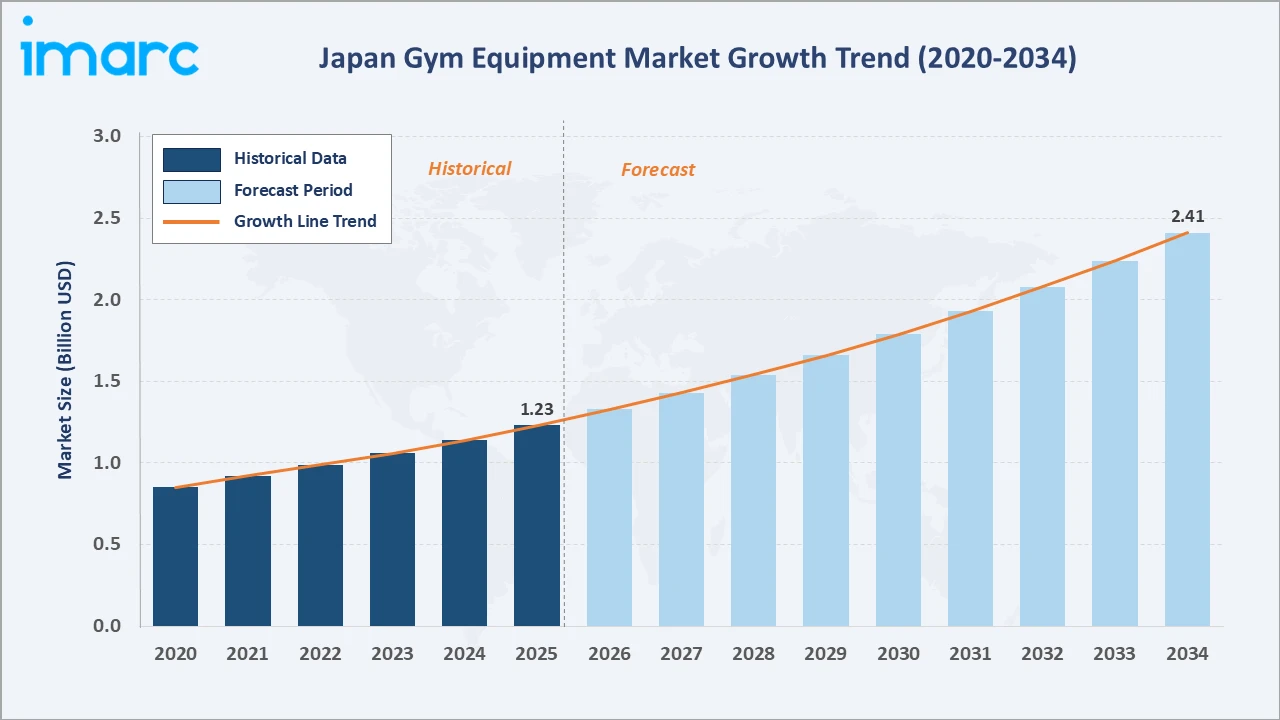
Japan gym equipment market size increased from USD 0.85 Billion in 2020 to USD 1.23 Billion in 2025 and is estimated to reach USD 1.33 Billion in 2026. The market is expected to expand significantly, reaching USD 1.79 Billion by 2030 and USD 2.41 Billion by 2034, registering a CAGR of 7.74% during 2026–2034. Rising health consciousness and preventive wellness spending are expanding equipment demand across individual and institutional buyer categories. Rapid commercial gym network expansion is driving consistent bulk equipment procurement across cardiovascular and strength training segments. Growing corporate wellness programs and government health initiatives are further broadening the addressable market for gym equipment manufacturers and distributors. Cardiovascular machines dominate at 25.0% of total product revenue, while individual buyers represent the largest buyer segment at 45.0% market share in 2025.
To get more information on this market, Request Sample
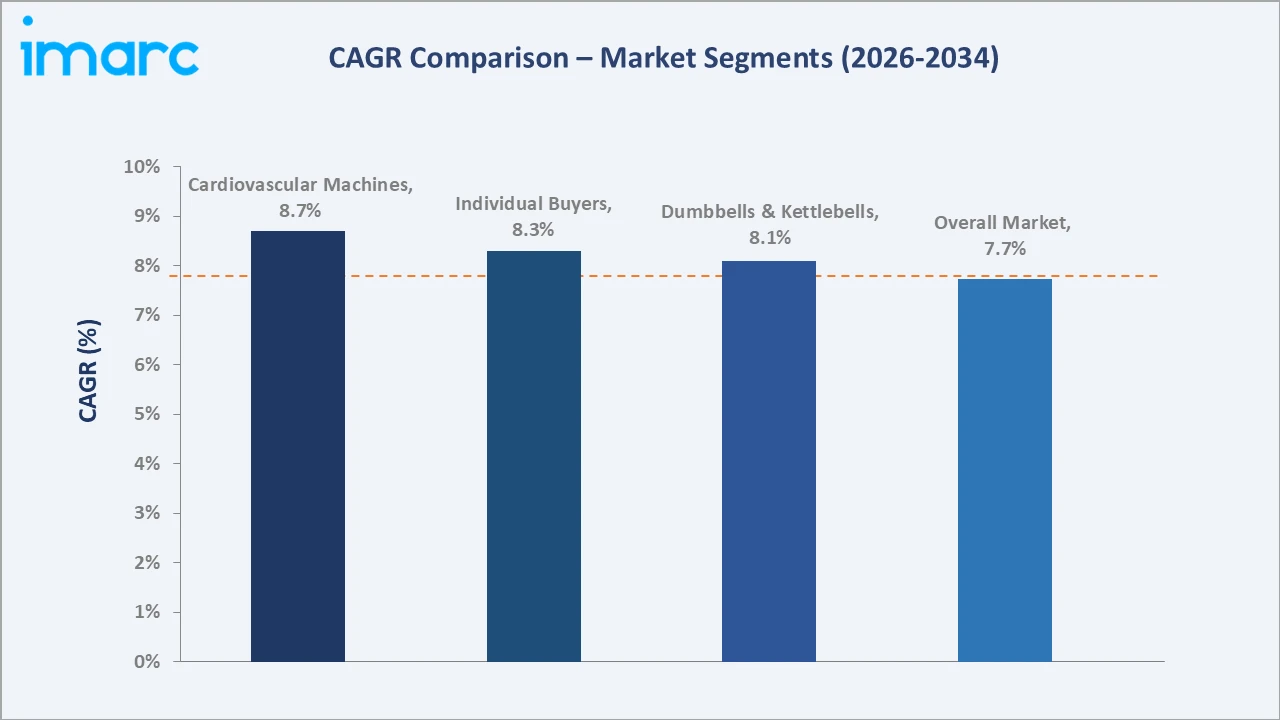
Cardiovascular machines grow fastest at approximately 8.7% CAGR, driven by rising demand in commercial gyms and home fitness setups. Individual buyers grow at ~8.3% CAGR, reflecting Japan's sustained post-pandemic home fitness investment trend.
Executive Summary
The Japan gym equipment market expanded from USD 1.23 Billion in 2025 to an estimated USD 1.33 Billion in 2026, positioning it among Asia-Pacific's most commercially significant fitness equipment markets by value. The market's scale is underpinned by Japan's health-conscious consumer base, the expanding commercial gym infrastructure serving over 13,876 fitness facilities nationwide, and rising institutional demand for technology-enabled workout equipment. These structural demand drivers are supporting the expansion of the cardiovascular machines segment at a rate that outpaces the country's overall fitness equipment market average growth. Japan gym equipment market is commercially distinguished from other major Asian fitness markets by its high per-facility equipment investment density and strong individual buyer demand for premium home fitness solutions. The market is projected to reach USD 2.41 Billion by 2034. Cardiovascular Machines at 25.0% leads through commercial gym utilization dominance and home fitness adoption. Individual buyers at 45.0% reflects Japan's large personal fitness investment base. Kanto Region leads regionally at 35.0%.
Key Market Insights
| Insight | Data |
|---|---|
| Dominant Product Type Segment | Cardiovascular Machines – 25.0% share (2025) |
| Dominant Buyer Type | Individual – 45.0% market share (2025) |
| Leading Region | Kanto Region – 35.0% share (2025) |
| Key Market Opportunity | Smart connected equipment, home fitness, and institutional wellness programs |
Key Analytical Observations Supporting the Above Data:
- Cardiovascular Machines at 25.0%: This segment dominates due to high gym-goer utilization rates for treadmills, ellipticals, and stationary bikes across both institutional and home fitness settings in Japan.
- Individual Buyers at 45.0%: Individual buyers lead as Japan's largest buyer segment, driven by post-pandemic home fitness adoption, rising health consciousness, and expanding e-commerce equipment availability.
- Kanto Region at 35.0%: Kanto Region leads regionally due to Tokyo's high gym density, Japan's highest corporate wellness spending concentration, and strong premium equipment demand from urban consumers.
Japan Gym Equipment Market Overview
Japan gym equipment market is commercially positioned at the intersection of a wellness-focused aging population and a technology-driven fitness culture, with USD 1.23 Billion in 2025 market size and a projected 7.74% CAGR through 2034. The market encompasses commercial gym operators, individual home fitness buyers, institutional procurement channels, and promotional buyer segments.
The Japan gym equipment ecosystem integrates domestic manufacturers, international brand distributors, specialty fitness retailers, e-commerce platforms, and institutional buyers including hospitals, hotels, and corporate wellness centers, serving a commercially diverse buyer base across all eight Japanese regions.
Market Dynamics
To evaluate market opportunities, Request Sample
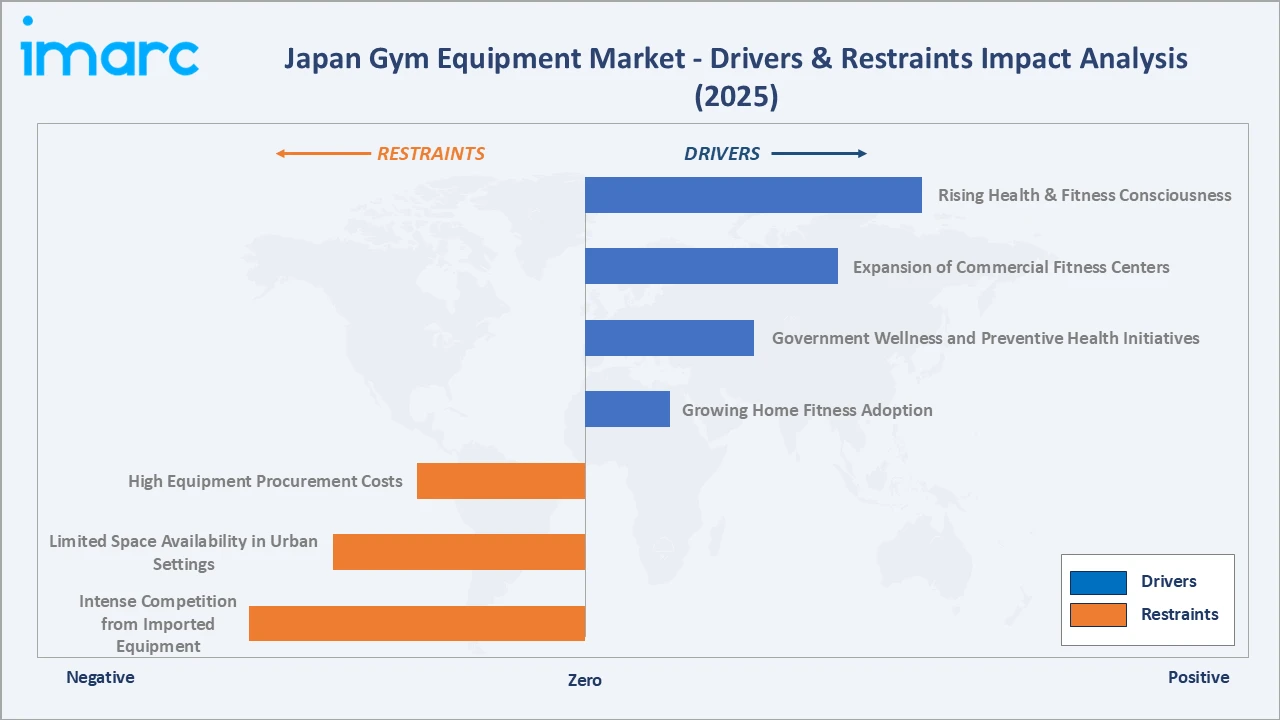
Market Drivers
- Rising Health and Fitness Consciousness: Growing awareness of preventive healthcare and physical wellness is driving sustained demand for gym equipment across individual and institutional buyer segments. Consumers are increasingly investing in fitness infrastructure to support active, health-oriented lifestyles, expanding the overall addressable market for gym equipment manufacturers and distributors.
- Expansion of Commercial Fitness Centers: The rapid proliferation of commercial gyms and fitness clubs is generating consistent institutional equipment procurement demand. New gym openings and facility upgrades are driving bulk purchases of cardiovascular machines, strength training equipment, and specialized fitness apparatus across the institutional buyer segment.
- Government Wellness and Preventive Health Initiatives: Nationally driven health awareness campaigns, workplace wellness mandates, and government-sponsored fitness programs are encouraging gym membership growth and equipment investment across both public-sector institutions and corporate buyer segments, creating structurally sustained procurement demand.
- Growing Home Fitness Adoption: Sustained behavioral shift toward home-based workout routines continues to drive demand for compact, multi-functional gym equipment among residential consumers. The individual buyer segment at 45.0% reflects this structural market transition, with home fitness investment remaining elevated across urban and suburban demographics.
Market Restraints
- High Equipment Procurement Costs: The capital-intensive nature of commercial-grade gym equipment presents procurement barriers, particularly for smaller fitness operators and new market entrants, limiting market penetration among price-sensitive institutional buyer segments.
- Limited Space Availability in Urban Settings: Space constraints and high real-estate costs in urban markets restrict the adoption of full-range gym equipment setups among residential consumers, limiting the total addressable market for larger cardiovascular and strength training systems.
- Intense Competition from Imported Equipment: The availability of lower-cost imported gym equipment intensifies price competition, creating margin pressure across distribution channels and challenging domestic manufacturers seeking to maintain premium product positioning.
Market Opportunities
- Smart and Connected Fitness Equipment: Integration of IoT sensors, AI-driven training personalization, and app-connected equipment platforms presents significant growth opportunities for manufacturers targeting technology-savvy individual and institutional buyer segments.
- Corporate and Institutional Wellness Programs: Rising corporate investment in employee health and rehabilitation center expansion offer institutional procurement growth avenues for specialized gym equipment suppliers across strength training and cardiovascular equipment categories.
- E-Commerce and Direct-to-Consumer Distribution: Growth of online retail channels enables equipment brands to reach individual buyers beyond traditional specialty store networks, expanding total addressable market and supporting individual buyer segment growth at approximately 8.3% CAGR.
Market Challenges
- Technological Obsolescence Cycles: Rapid advancement in fitness technology requires continuous R&D investment, creating challenges for manufacturers to maintain competitive product portfolios and meet evolving consumer expectations for smart and connected equipment features.
- After-Sales Service and Maintenance Complexity: Commercial gym operators require robust after-sales service infrastructure, posing operational challenges for brands seeking to scale across distributed geographic markets with complex maintenance and spare-parts supply requirements.
Emerging Market Trends
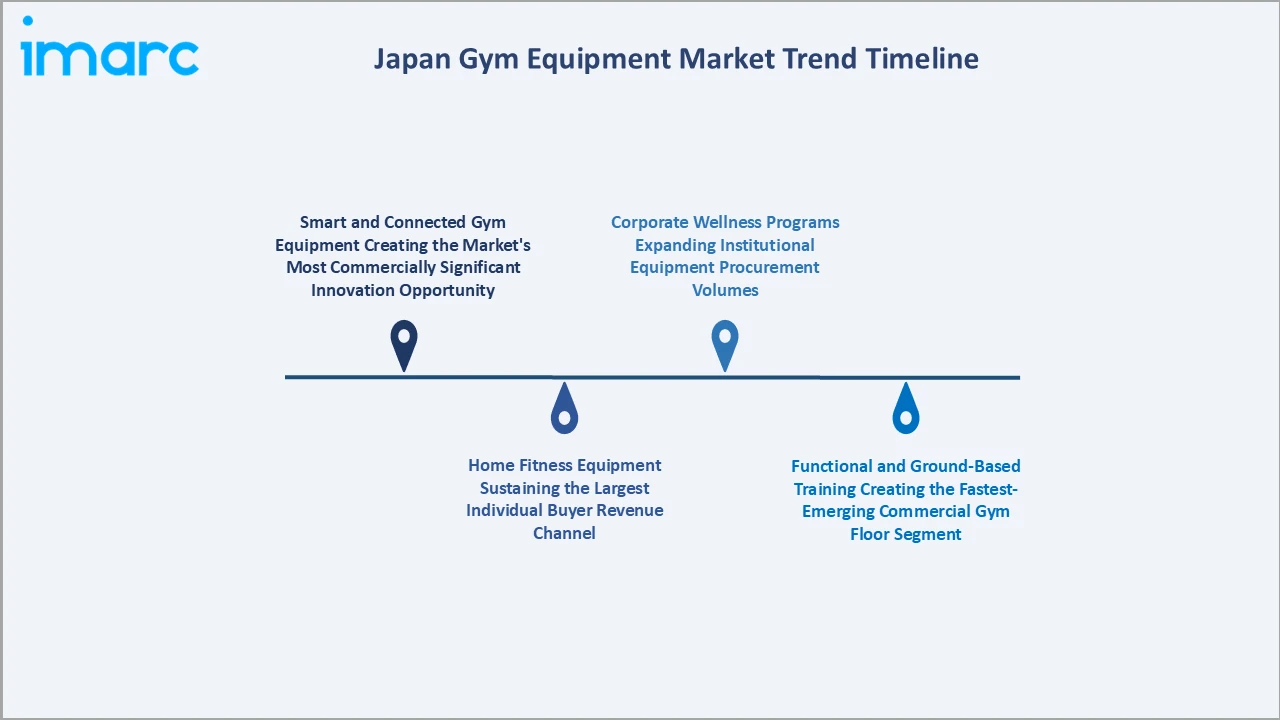
1. Smart and Connected Gym Equipment Creating the Market's Most Commercially Significant Innovation Opportunity
IoT-enabled gym equipment with real-time performance tracking and AI-driven personalized training programs is gaining rapid adoption across commercial gym and home fitness segments. Equipment manufacturers are integrating app connectivity and subscription-based content delivery to differentiate products and create recurring revenue streams.
2. Home Fitness Equipment Sustaining the Largest Individual Buyer Revenue Channel
Post-pandemic behavioral shifts toward home-based fitness have created a structurally larger individual buyer market, representing 45.0% of total buyer-type revenue in 2025. Compact, foldable, and multi-functional equipment formats are gaining traction, designed specifically for space-constrained residential settings across the market.
3. Functional and Ground-Based Training Creating the Fastest-Emerging Commercial Gym Floor Segment
Ground-based equipment supporting functional fitness, high-intensity training, and cross-training methodologies is experiencing growing adoption in commercial gyms. This trend reflects a broader consumer shift from machine-based to free-movement training paradigms, expanding demand for ground base and standalone equipment categories.
4. Corporate Wellness Programs Expanding Institutional Equipment Procurement Volumes
Corporate investment in on-site fitness facilities is fueling institutional demand for commercial-grade cardiovascular and strength training equipment. This trend supports the institutional buyer segment at 40.0% market share, with corporate wellness spending driving consistent bulk procurement cycles.
Industry Value Chain Analysis
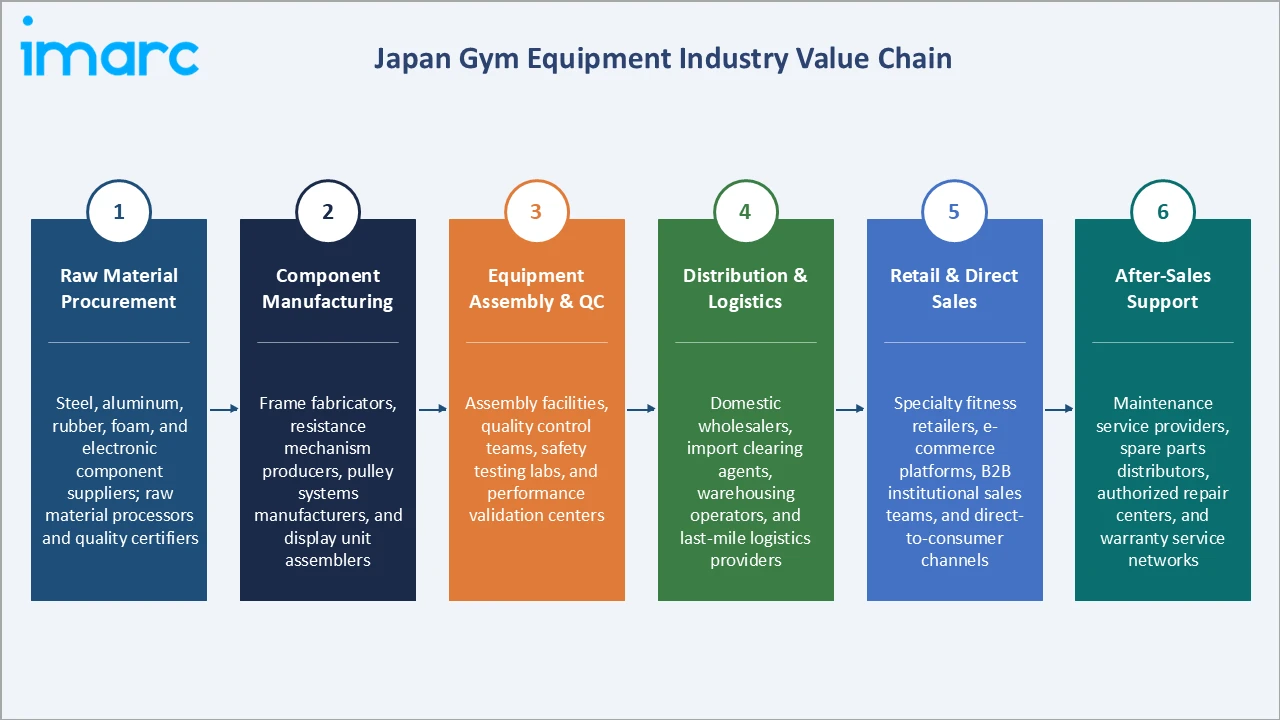
The gym equipment value chain is one of the most structured in the fitness products industry, integrating global raw material sourcing, precision component manufacturing, assembly operations, multi-channel distribution, and comprehensive after-sales service networks serving commercial and residential buyer segments.
| Stage | Key Participants |
|---|---|
| Raw Material Procurement | Steel, aluminum, rubber, foam, and electronic component suppliers; raw material processors and quality certifiers. |
| Component Manufacturing | Frame fabricators, resistance mechanism producers, pulley systems manufacturers, and display unit assemblers. |
| Equipment Assembly & QC | Assembly facilities, quality control teams, safety testing laboratories, and performance validation centers. |
| Distribution & Logistics | Domestic wholesalers, import clearing agents, warehousing operators, and last-mile logistics service providers. |
| Retail & Direct Sales | Specialty fitness retailers, e-commerce platforms, B2B institutional sales teams, and direct-to-consumer channels. |
| After-Sales Support | Maintenance service providers, spare parts distributors, authorized repair centers, and warranty service networks. |
The equipment assembly and quality control stage represents the most commercially value-added phase of the gym equipment value chain, where manufacturing precision directly determines product performance, safety compliance, and brand differentiation. This stage commands the highest margin contribution across the full value chain, serving as the critical quality and commercial differentiator for equipment manufacturers.
Technology Landscape in the Japan Gym Equipment Industry
IoT Connectivity and Smart Equipment Integration
IoT-enabled gym equipment with embedded sensors provides real-time workout metrics, connected app synchronization, and cloud-based performance analytics. This technology integration represents the most commercially significant innovation in the gym equipment industry, enabling personalized training and data-driven fitness programming for both individual and institutional users.
AI-Powered Personalized Training Systems
Artificial intelligence integration into cardiovascular and strength training equipment enables adaptive resistance adjustment, automated form feedback, and personalized training program generation based on user performance history. AI-powered systems are transforming equipment from passive hardware into active coaching platforms, enhancing user engagement and workout efficiency.
Ergonomic and Biomechanical Design Engineering
Advanced biomechanical research drives equipment design that minimizes injury risk while maximizing training efficiency and user comfort. Ergonomic innovation is particularly significant in compact equipment formats designed for space-constrained commercial and residential fitness environments, balancing performance capability with footprint optimization.
Sustainable and Energy-Efficient Equipment Technologies
Energy-harvesting cardiovascular equipment, recycled material construction, and low-power display systems reflect growing commercial alignment with sustainability priorities. Eco-friendly equipment technology is gaining traction among institutional buyers and premium gym operators seeking to align equipment procurement with ESG commitments.
Market Segmentation Analysis
The report covers the following segments:
| Segment Category | Leading Segment | Market Share | Year |
|---|---|---|---|
| Product Type | Cardiovascular Machines | 25.0% | 2025 |
| Distribution Channel | 🔒 | 🔒 | 2025 |
| Buyer Type | Individual | 45.0% | 2025 |
| Region | Kanto Region | 35.0% | 2025 |

By Product Type
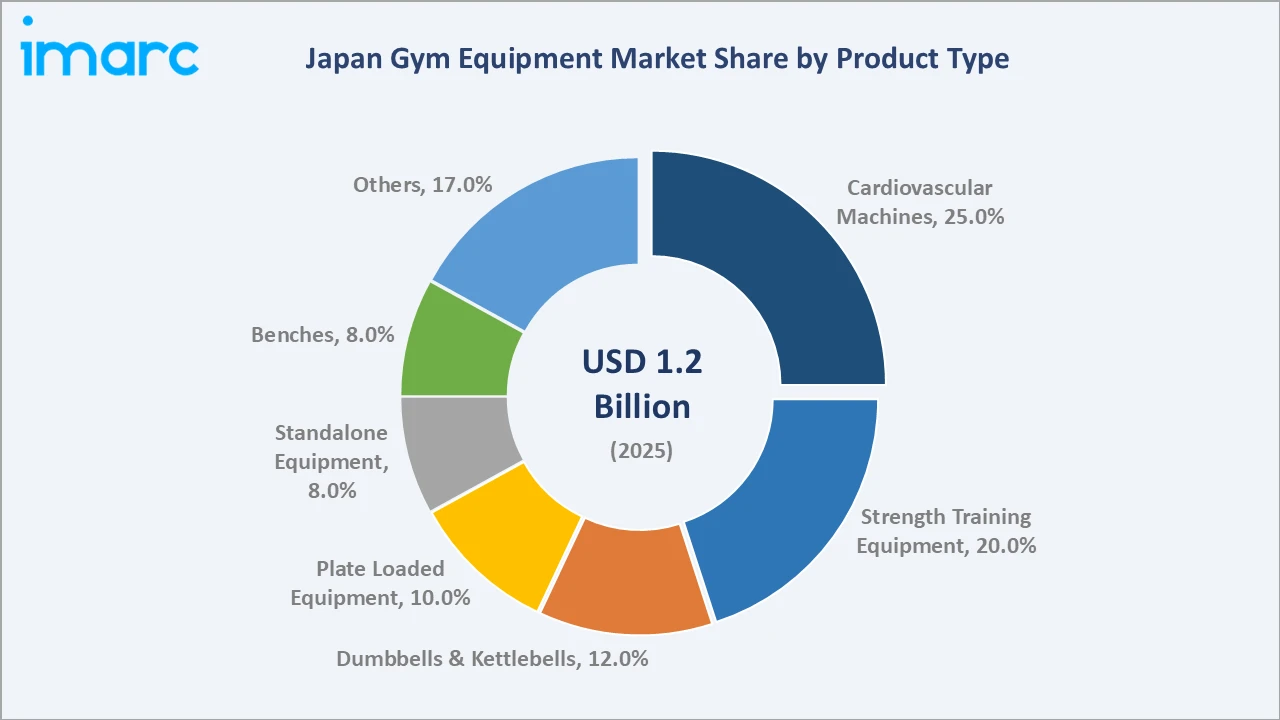
Cardiovascular Machines lead at 25.0% (2025), growing at ~8.7% CAGR during 2026-2034. This segment encompasses treadmills, elliptical trainers, stationary bikes, and rowing machines, commanding Japan's highest gym equipment revenue share through sustained commercial gym and home fitness demand across institutional and individual buyer categories.
To access detailed market analysis, Request Sample
Strength Training Equipment at 20.0% grows at ~7.2% CAGR through corporate wellness and health-club expansion. Dumbbells and Kettlebells at 12.0% grow at ~8.1% CAGR driven by home fitness adoption. Plate Loaded Equipment at 10.0%, Standalone Equipment and Benches each at 8.0%, Ground Base Equipment and Olympic Bars and Collars each at 6.0% (~7.8% CAGR), and Heavy Duty Elite Racks at 5.0% (~7.6% CAGR) complete the segment.
By Buyer Type
Individual buyers lead at 45.0% (2025), growing at ~8.3% CAGR during 2026-2034. This segment represents personal consumers purchasing equipment for home gyms, driven by post-pandemic fitness behavior shifts and Japan's rising per-capita health expenditure across urban and suburban demographics.
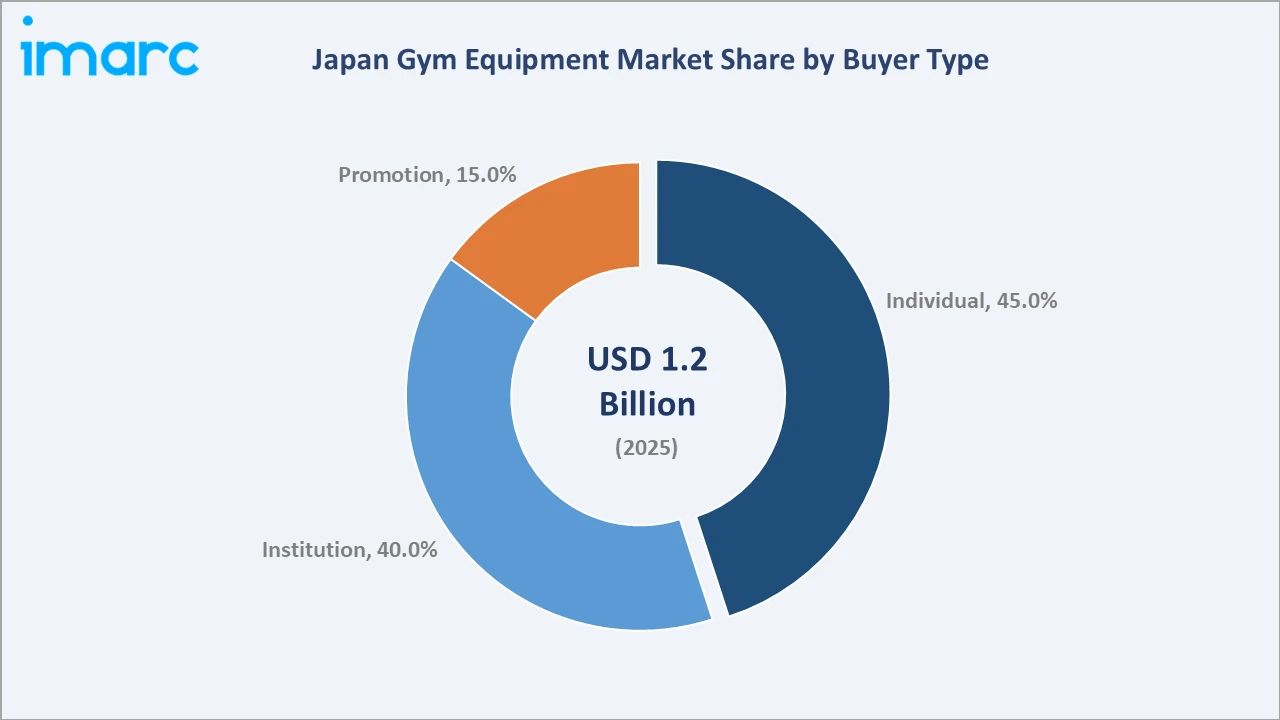
Institution at 40.0% grows at ~7.6% CAGR, encompassing commercial gyms, hotels, hospitals, and corporate wellness centers. Promotion at 15.0% grows at ~6.9% CAGR through government-backed wellness programs and public health procurement initiatives.
Regional Market Insights
| Region | Share (2025) | Key Japan Gym Equipment Market Characteristics |
|---|---|---|
| Kanto Region | 35.0% | Highest gym density, premium equipment demand, and strong corporate wellness investment. |
| Kansai/Kinki Region | 20.0% | Strong commercial gym network; growing fitness culture and institutional procurement. |
| Central/Chubu Region | 15.0% | Manufacturing base proximity supports distribution efficiency and equipment availability. |
| Kyushu-Okinawa Region | 8.0% | Growing fitness infrastructure investment driven by public wellness initiatives. |
| Tohoku Region | 7.0% | Expanding gym network and rising health awareness driving equipment adoption. |
| Chugoku Region | 6.0% | Steady institutional buyer demand from regional fitness and wellness operators. |
| Hokkaido Region | 5.0% | Seasonal indoor fitness demand creating stable equipment procurement cycles. |
| Shikoku Region | 4.0% | Emerging market with growing fitness awareness and new gym development. |
Kanto Region's 35.0% market leadership reflects the area's high-density gym network, strong corporate wellness spending concentration, and robust premium equipment demand from high-income urban consumers. The region accounts for Japan's highest per-capita fitness equipment spending, sustaining consistent institutional and individual buyer procurement.
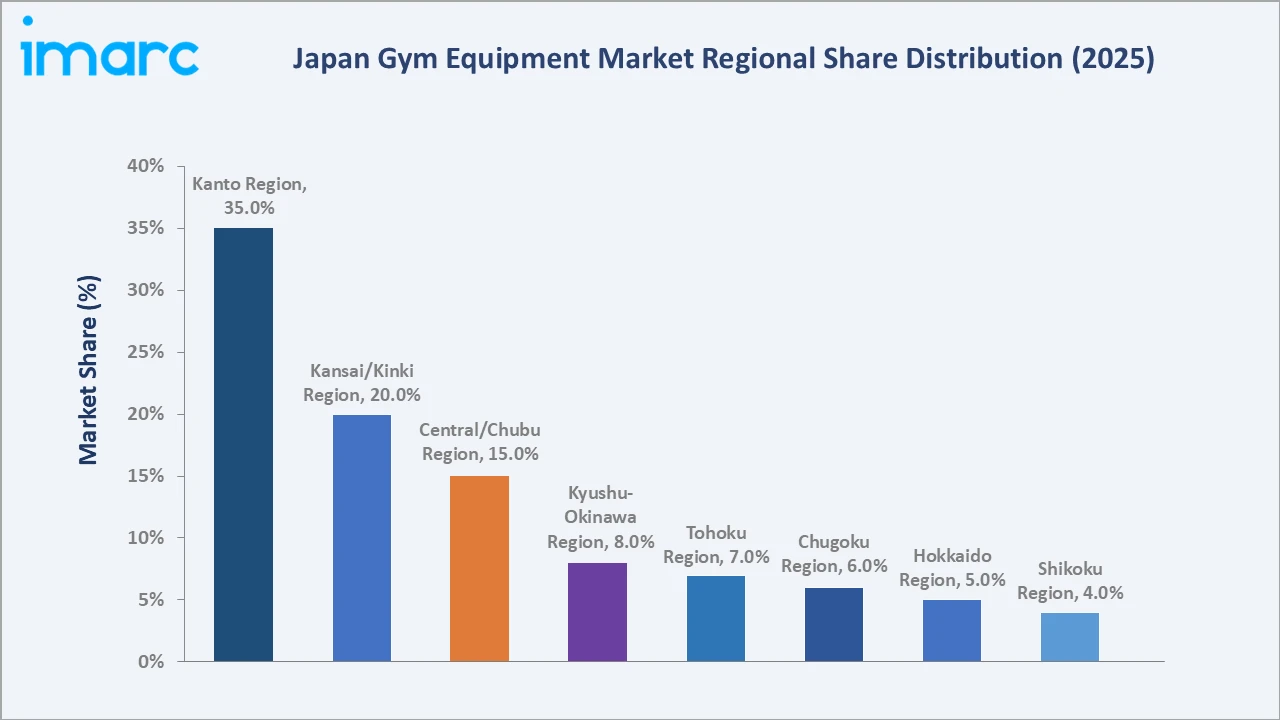
Kansai/Kinki Region at 20.0% reflects a well-established commercial gym cluster, with growing demand from hotel fitness centers, corporate wellness facilities, and expanding regional fitness franchise networks. Central/Chubu Region at 15.0% benefits from its manufacturing base proximity, enabling cost-efficient equipment procurement and rapid delivery cycles for institutional buyers.
Competitive Landscape
Japan gym equipment competitive landscape is commercially stratified between global brand leaders with deep institutional client relationships and domestic specialists serving niche buyer segments. The market combines multinational equipment giants, technology-driven innovators, and Japan-specific operators across all product type and buyer type categories.
The most commercially significant competitive dynamic is the premium differentiation strategy pursued by global leaders against price-competitive pressure from regional alternatives, particularly in the individual buyer and entry-level institutional procurement segments.
| Company | Key Products | Market Position | Core Strength |
|---|---|---|---|
| Life Fitness | Treadmills, ellipticals, stationary bikes, strength systems, connected fitness platforms | Market Leader | Life Fitness delivers commercial-grade cardiovascular and strength equipment recognized for durability, performance, and institutional buyer service networks. |
| Johnson Health Tech Co., Ltd. | Matrix commercial gym equipment, Vision professional fitness systems, Horizon home fitness products | Major Player | Johnson Health Tech provides diversified equipment portfolios spanning commercial gym and home fitness categories across multiple price segments. |
| Technogym S.p.A. | Premium cardiovascular equipment, strength training systems | Premium Leader | Technogym commands the premium institutional segment through wellness ecosystem integration, connected equipment innovation, and luxury gym operator partnerships. |
| Precor Incorporated | Elliptical trainers, treadmills, strength systems | Major Player | Precor specializes in commercial cardiovascular equipment, with a strong presence among gym operators and institutional buyers seeking high-utilization fitness solutions. |
Key Company Profiles
Life Fitness
Life Fitness is a leading global designer, manufacturer, and marketer of commercial-grade cardiovascular and strength training equipment, with an established presence in Japan's institutional gym equipment market through its broad product portfolio and comprehensive after-sales service infrastructure.
- Key Products: Treadmills, elliptical cross-trainers, stationary bikes, strength training systems, and IoT-connected cardiovascular fitness platforms for commercial and home use.
- Key Developments: In 2026, Life Fitness / Hammer Strength announced a strategic partnership with Les Mills to combine fitness equipment engineering with group workout programming. Under the agreement, Les Mills became Life Fitness's official cycle content partner, while Life Fitness became Les Mills' official bike partner for its cycling programs. The collaboration is expected to support new products, live events, and connected fitness experiences, strengthening the integration of gym equipment and digital workout solutions.
- Strategic Focus: Maintaining commercial gym leadership through connected fitness technology integration, premium product positioning, and institutional buyer service excellence.
Johnson Health Tech Co., Ltd.
Johnson Health Tech Co., Ltd. is a major multinational fitness equipment manufacturer and parent company of the Matrix, Vision, and Horizon fitness brands, serving both commercial and residential buyers across multiple price segments through a diversified product portfolio and global distribution network.
- Key Products: Matrix commercial gym equipment, Vision professional fitness systems, and Horizon home fitness products spanning cardiovascular and strength categories.
- Key Developments: In 2026, Johnson Health Tech Co., Ltd., through its Vision Fitness brand, announced plans to introduce more than 60 new products in 2026, expanding its commercial fitness equipment portfolio. The expansion includes the Summit Stairclimber, Access Series selectorized strength equipment, and Keystone Series plate-loaded machines. The company also plans to expand its offerings with workout-tracking applications, digital asset management solutions, accessories, and additional strength-training equipment. This initiative strengthens Johnson Health Tech's presence in the commercial gym equipment market by broadening its product range for fitness clubs, hospitality facilities, educational institutions, and corporate wellness centres.
- Strategic Focus: Expanding market penetration through multi-brand portfolio strategy targeting both institutional gym operators and growing home fitness consumer segments.
Technogym S.p.A.
Technogym S.p.A. is a premium fitness equipment company recognized globally for its wellness ecosystem integrating connected equipment, digital fitness platforms, and lifestyle wellness programming, serving Japan's premium institutional segment through luxury gym operators and hotel fitness centers.
- Key Products: Premium cardiovascular equipment, strength training systems, and the Technogym Wellness Platform providing digital-connected fitness programming and user analytics.
- Key Developments: In 2026, Technogym S.p.A. introduced an AI-powered technical support system designed to help fitness facilities diagnose equipment issues, manage maintenance requests, and reduce equipment downtime. The service combines AI-assisted diagnostics, real-time equipment monitoring, and digital support through its eServices portal, enabling gym operators to troubleshoot problems, track repairs, and access equipment performance reports. This development highlights the growing integration of artificial intelligence and connected services into commercial gym equipment, helping fitness centres improve operational efficiency and equipment reliability.
- Strategic Focus: Targeting the premium institutional market through wellness ecosystem differentiation, connected equipment integration, and strategic placement in luxury and corporate facilities.
Market Concentration Analysis
The gym equipment market demonstrates a moderately concentrated competitive structure, where the leading product categories collectively represent the majority of total market revenue. Market concentration is most pronounced in the institutional buyer segment, where commercial operators standardize procurement around established equipment brands offering comprehensive product lines, service networks, and technology integration.
Market concentration dynamics are evolving through two opposing forces: premium brand differentiation by global equipment leaders sustaining high-share institutional client relationships, and growing competition from value-oriented alternatives expanding access in the individual buyer and entry-level commercial segments. This dual dynamic is gradually broadening the competitive landscape while maintaining the market's moderately concentrated overall structure.
Investment & Growth Opportunities
Highest Growth Segments
Cardiovascular machines (~8.7% CAGR through commercial gym expansion), individual buyers (~8.3% CAGR through home fitness adoption), dumbbells and kettlebells (~8.1% CAGR through functional fitness trends), and heavy duty elite racks (~7.8% CAGR through premium strength training demand) represent the highest-growth gym equipment investment opportunities through 2034.
Emerging Investment Opportunities
The connected gym equipment segment integrating IoT sensors, AI-powered training programs, and subscription fitness content represents the market's highest-CAGR innovation investment opportunity, particularly for institutional gym operators seeking member retention through technology-enabled equipment differentiation and personalized fitness experiences.
Investment Themes
- Smart cardiovascular equipment for commercial gyms: Creating above-market returns through connected fitness platform differentiation; institutional gym operators increasingly prioritize technology-enabled cardiovascular equipment to attract members and sustain high-utilization rates.
- Compact home fitness equipment for individual buyers: Representing the market's largest buyer category at 45.0% with approximately 8.3% CAGR; significant untapped penetration potential exists in suburban residential markets where home gym adoption continues to grow post-pandemic.
- Kanto Region premium distribution investment: Offering the highest absolute revenue concentration at 35.0% market share, with premium gym and corporate wellness center demand sustaining above-national-average equipment procurement volumes through 2034.
Future Market Outlook (2026-2034)
The Japan gym equipment market is projected to grow from USD 1.23 Billion in 2025 to USD 1.33 Billion in 2026, reaching USD 1.79 Billion by 2030 and USD 2.41 Billion by 2034, registering a CAGR of 7.74% during 2026-2034. The market's growth trajectory is supported by structural demand from Japan's commercially active institutional gym operator segment and a rising individual buyer population.
Three structural forces define Japan gym equipment market growth through 2034 commercial gym network expansion creating consistent institutional equipment procurement demand; rising individual buyer investment in home fitness supported by e-commerce growth; and technology-driven equipment innovation enabling premium product differentiation and subscription-based revenue models for manufacturers and gym operators.
Research Methodology
Primary Research
Primary research comprised structured interviews with gym equipment industry stakeholders, including commercial gym procurement directors, fitness equipment distributors, institutional buyer representatives, retail channel managers, and product managers at leading gym equipment manufacturers, providing direct market intelligence on pricing, demand trends, and competitive dynamics.
Secondary Research
Secondary research encompassed fitness center market data, equipment import-export trade records, company annual reports, industry association publications, e-commerce sales data, government health and wellness program reports, and fitness market analyses from domestic and international research organizations.
Forecasting Models
Market revenue forecasts were developed using a demand-side gym expansion model: commercial gym population multiplied by equipment procurement cycles, combined with residential fitness expenditure growth rates stratified by income segment, calibrated against historical 2020–2025 market size data points.
Japan Gym Equipment Market Report Coverage:
| Report Features | Details |
|---|---|
| Base Year of the Analysis | 2025 |
| Historical Period | 2020-2025 |
| Forecast Period | 2026-2034 |
| Units | Billion USD |
| Scope of the Report |
Exploration of Historical Trends and Market Outlook, Industry Catalysts and Challenges, Segment-Wise Historical and Future Market Assessment:
|
| Product Types Covered | Cardiovascular Machines, Strength Training Equipment, Plate Loaded Equipment, Ground Base Equipment, Standalone Equipment, Heavy Duty Elite Racks, Benches, Olympic Bars and Collars, Dumbbells and Kettlebells |
| Distribution Channels Covered | Specialty Stores, Online Retail, Sport Stores, Others |
| Buyer Types Covered | Individual, Institution, Promotion |
| Regions Covered | Kanto Region, Kansai/Kinki Region, Central/Chubu Region, Kyushu-Okinawa Region, Tohoku Region, Chugoku Region, Hokkaido Region, Shikoku Region |
| Companies Covered | Life Fitness, Johnson Health Tech Co., Ltd., Technogym S.p.A., Precor Incorporated, etc. |
| Customization Scope | 10% Free Customization |
| Post-Sale Analyst Support | 10-12 Weeks |
| Delivery Format | PDF and Excel through Email (We can also provide the editable version of the report in PPT/Word format on special request) |
Key Benefits for Stakeholders:
- IMARC’s industry report offers a comprehensive quantitative analysis of various market segments, historical and current market trends, market forecasts, and dynamics of the Japan gym equipment market from 2020-2034.
- The research report provides the latest information on the market drivers, challenges, and opportunities in the Japan gym equipment market.
- Porter's five forces analysis assist stakeholders in assessing the impact of new entrants, competitive rivalry, supplier power, buyer power, and the threat of substitution. It helps stakeholders to analyze the level of competition within the Japan gym equipment industry and its attractiveness.
- Competitive landscape allows stakeholders to understand their competitive environment and provides an insight into the current positions of key players in the market.
Frequently Asked Questions About the Japan Gym Equipment Market Report
Japan gym equipment market is estimated at USD 1.33 Billion in 2026, driven by commercial gym expansion, rising health awareness, and home fitness adoption, registering a CAGR of 7.74% during 2026-2034.
Japan gym equipment market grows at 7.74% CAGR during 2026-2034, reaching USD 2.41 Billion by 2034, sustained by commercial gym expansion, smart equipment adoption, and rising individual buyer demand.
Cardiovascular machines lead at 25.0% through dominant gym-goer demand for treadmills, ellipticals, and stationary bikes across both institutional and home fitness settings in 2025.
Individual buyers lead at 45.0% through Japan's post-pandemic home fitness adoption, rising health consciousness, and expanding e-commerce gym equipment availability across residential segments.
Kanto Region leads at 35.0% through its high gym density, corporate wellness concentration, and Japan's highest per-capita fitness equipment spending in Tokyo and surrounding areas.
Leading companies include Life Fitness, Johnson Health Tech Co., Ltd., Technogym S.p.A., and Precor Incorporated, among others.
Japan gym equipment market is projected to reach approximately USD 1.79 Billion by 2030, with connected fitness and AI-powered training equipment driving premium segment growth.
Three priority investment opportunities: smart cardiovascular equipment for commercial gyms, compact home fitness equipment for individual buyers, and Kanto Region premium distribution.
Key drivers include rising health consciousness, commercial gym network expansion, government wellness programs, and sustained home fitness adoption across urban demographics.
Cardiovascular machines hold 25.0% market share in 2025, growing at approximately 8.7% CAGR through institutional gym procurement and rising home fitness cardiovascular equipment demand.
Individual buyers represent 45.0% market share in 2025, growing at ~8.3% CAGR, reflecting Japan's sustained home fitness investment and rising personal health expenditure.
Japan gym equipment market is projected to reach USD 2.41 Billion by 2034, growing from USD 1.23 Billion in 2025 at a CAGR of 7.74% during the 2026-2034 forecast period.
Need more help?
- Speak to our experienced analysts for insights on the current market scenarios.
- Include additional segments and countries to customize the report as per your requirement.
- Gain an unparalleled competitive advantage in your domain by understanding how to utilize the report and positively impacting your operations and revenue.
- For further assistance, please connect with our analysts.
 Request Customization
 Speak to an Analyst
 Request Brochure
 Inquire Before Buying
Benefits of Customization
- Personalize this research
- Triangulate with your data
- Get data as per your format and definition
- Gain a deeper dive into a specific application, geography, customer, or competitor
- Any level of personalization
Get in Touch With Us
UNITED STATES
Phone: +1-201-971-6302
INDIA
Phone: +91-120-433-0800
UNITED KINGDOM
Phone: +44-753-714-6104
Email: [email protected]
Client Testimonials























Related Reports

Choose your plan
*Please note that the prices mentioned below are starting prices for each bundle type. Kindly contact our team for further details.*
Single User License
- 1 User License, Access on 2 Devices
- PDF Report + Excel Dataset (Password Protected)
- Lifetime Access
- No Printing Rights
- 10% Free Report Customization
- 10–12 Weeks of Analyst Support
Five User License
- Access for 5 Users, 2 Devices per User
- PDF Report + Excel Dataset (Password Protected)
- Lifetime Access
- Dedicated Account Manager
- 12–14 Weeks of Analyst Support
- No Printing Rights
- 15% Free Report Customization
- 25% Discount on Your Next Purchase
Corporate User License
- Unlimited User Access (Within Your Organization)
- PDF Report + Excel Dataset
- Lifetime Access
- Dedicated Account Manager
- 14–20 Weeks of Analyst Support
- No Printing Rights
- 20% Free Report Customization
- 30% Discount on Your Next Purchase
Essential Insights
What's included:
3 reports
- Lifetime Access
- PDF Reports
- Excel Datasets
- 2 Weeks of Free Analyst Support
- 2 User Licenses
- Access on 2 Devices
- Printing Rights
- Complimentary PowerPoint (PPT) Version
- Complimentary License Upgrade
Professional Access
What's included:
5 reports
- Lifetime Access
- PDF Reports
- Excel Datasets
- 8 Weeks of Free Analyst Support
- 2 User Licenses
- Access on 2 Devices
- Printing Rights
- Complimentary PowerPoint (PPT) Version
- Complimentary License Upgrade
Business Advantage
What's included:
8 reports
- Lifetime Access
- PDF Reports
- Excel Datasets
- 14 Weeks of Free Analyst Support
- 2 User Licenses
- Access on 2 Devices
- Printing Rights
- Complimentary PowerPoint (PPT) Version
- Complimentary License Upgrade
Enterprise Intelligence
What's included:
10 reports
- Lifetime Access
- PDF Reports
- Excel Datasets
- 20 Weeks of Free Analyst Support
- 2 User Licenses
- Access on 2 Devices
- Printing Rights
- Complimentary PowerPoint (PPT) Version
- Complimentary License Upgrade