
Japan Honey Market Size, Share, Trends and Forecast by Type, Application, Distribution Channel, and Region, 2026-2034
Japan Honey Market Size, Share, Trends & Forecast (2026-2034)
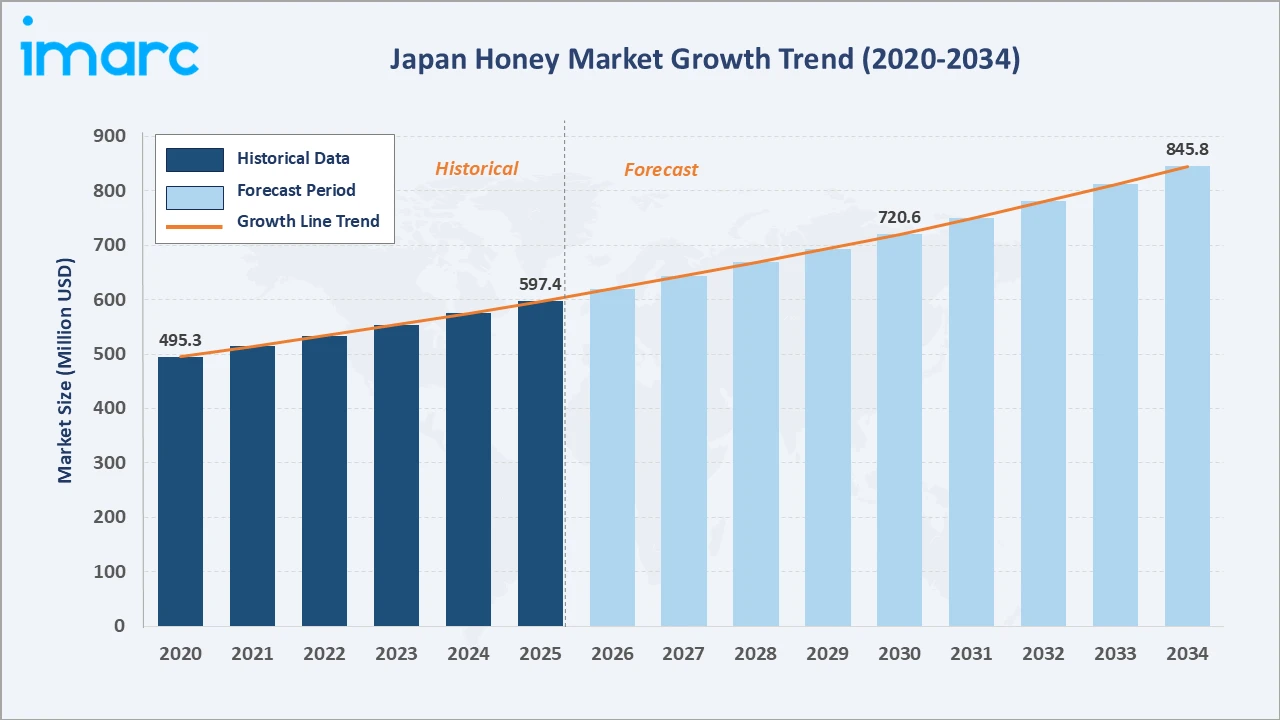
The Japan honey market size increased from USD 597.4 Million in 2025 to USD 626.7 Million in 2026 and is projected to reach USD 845.8 Million by 2034, exhibiting a CAGR of 3.82% during 2026-2034. Rising health consciousness, increasing preference for natural sweeteners, and expanding retail and online distribution are the primary drivers shaping market growth.
Acacia honey leads the type segment at 36.8%, supermarkets and hypermarkets dominate distribution channel at 48.6%, and Kanto Region commands 38.8% regional share.
Market Snapshot
|
Metric |
Value |
|
Base Year Market Size (2025) |
USD 597.4 Million |
| Market Size (2026) | USD 626.7 Million |
|
Forecast Market Size (2034) |
USD 845.8 Million |
|
CAGR (2026-2034) |
3.82% |
|
Base Year |
2025 |
|
Historical Period |
2020-2025 |
|
Forecast Period |
2026-2034 |
|
Largest Region |
Kanto Region (38.8%, 2025) |
|
Second Largest Region |
Kansai/Kinki Region (18.6%, 2025) |
|
Leading Type |
Acacia Honey (36.8%, 2025) |
|
Leading Distribution Channel |
Supermarkets and Hypermarkets (48.6%, 2025) |
The Japan honey market expanded from USD 495.3 Million in 2020 to USD 597.4 Million in 2025 and an estimated USD 626.7 Million in 2026, supported by steady demand for natural sweeteners, a growing wellness-oriented consumer base, and wider retail penetration across urban and suburban markets. Anchored at USD 720.6 Million in 2030, the forecast to USD 845.8 Million by 2034 is underpinned by continued premiumization, an expanding online retail footprint, and rising demand for single-floral and specialty honey types.
To get more information on this market, Request Sample
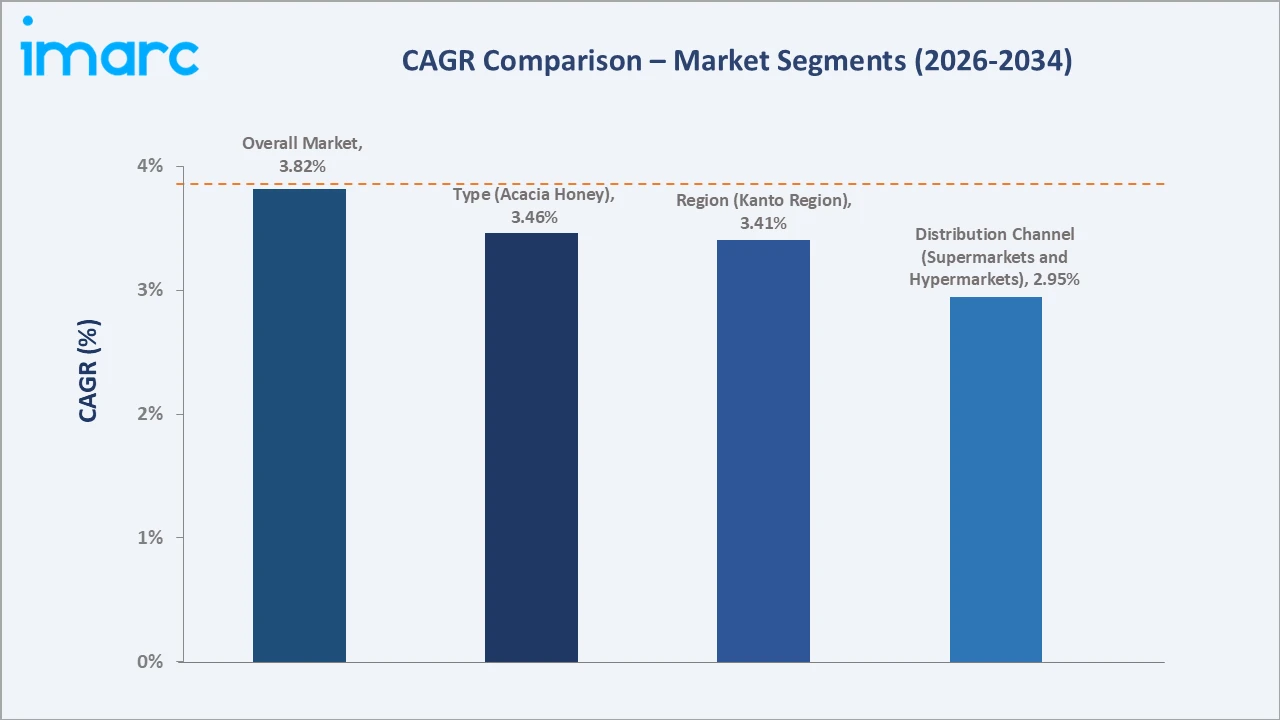
CAGR trajectories across type, distribution channel, and regional sub-segments show online stores and buckwheat honey expanding faster than the overall 3.82% market CAGR, driven by e-commerce convenience, functional-food positioning, and rising demand in emerging regional markets.
Executive Summary
The Japan honey market is on a steady growth trajectory, rising from USD 495.3 Million in 2020 to USD 626.7 Million in 2026, and is projected to reach USD 845.8 Million by 2034. Consumption has shifted from commodity table honey toward single-floral, functional, and premium varieties sold across modern retail and digital channels.
Acacia honey leads the type segment at 36.8% in 2025, supported by its mild flavor profile and broad culinary versatility. Supermarkets and hypermarkets remain the leading distribution channel at 48.6%, reflecting entrenched shopping habits. Kanto Region commands 38.8% of the regional share, led by its dense urban population and concentration of modern retail infrastructure.
Key Market Insights
|
Insight |
Data |
|
Leading Type |
Acacia Honey - 36.8% share (2025) |
|
Second Largest Type |
Clover Honey - 21.4% share (2025) |
|
Leading Distribution Channel |
Supermarkets and Hypermarkets - 48.6% share (2025) |
|
Second Largest Distribution Channel |
Convenience Stores - 24.3% share (2025) |
|
Leading Region |
Kanto Region - 38.8% share (2025) |
|
Second Largest Region |
Kansai/Kinki Region - 18.6% share (2025) |
|
Top Companies |
Yamada Bee Company, Inc., Kato Brothers Honey Co., Ltd., Comvita Limited |
Key Analytical Observations Supporting the Above Data:
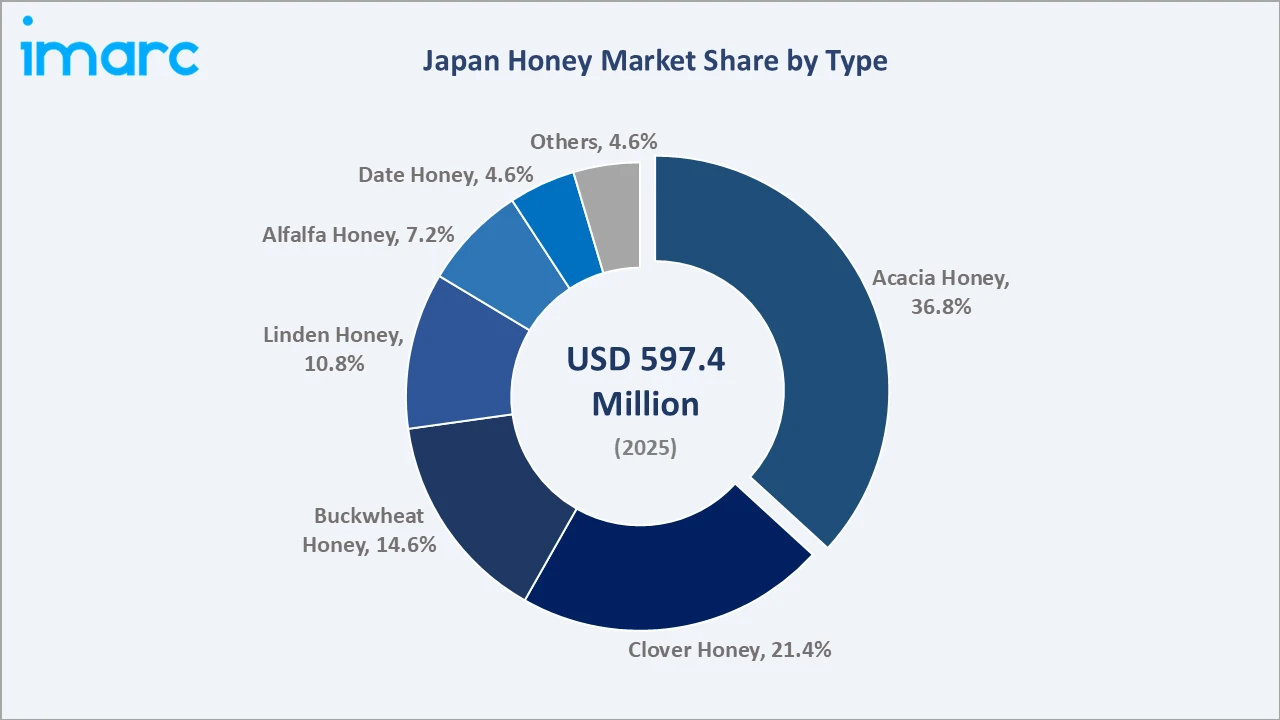
- Acacia honey dominance at 36.8% is supported by its light color, mild aroma, and slow crystallization, making it a preferred everyday choice for households, bakeries, and beverage outlets across Japan.
- Clover honey at 21.4% benefits from consistent import supply and a balanced sweetness profile that appeals to both retail consumers and food manufacturers using honey as an ingredient.
- Supermarkets and hypermarkets leadership at 48.6% reflects Japan's dense network of modern retail outlets and strong consumer preference for evaluating product freshness and labeling before purchase.
- Convenience stores share at 24.3% is driven by Japan's widespread convenience store network, offering easy access to single-serve and premium honey products that cater to on-the-go purchases and everyday household needs.
- Kanto Region at 38.8% dominates regional share, anchored by Tokyo, Kanagawa, and Saitama, supported by high population density and concentrated modern retail and e-commerce infrastructure.
Japan Honey Market Overview
Honey refers to the natural sweetener produced by honeybees from floral nectar, sold across pure, blended, and specialty formats including acacia, clover, buckwheat, linden, alfalfa, and date honey. The Japanese market spans table honey, food-service ingredient honey, and premium single-floral varieties positioned for health-conscious consumers.
The domestic ecosystem integrates beekeepers and apiaries, honey processors and packers, import and trading companies, retail and e-commerce distribution channels, and regulatory bodies overseeing food safety and labeling. Together, these participants enable the delivery of authentic, traceable honey products within an import-dependent supply framework shaped by limited domestic apiary capacity and evolving consumer expectations around origin and purity.
Market Dynamics
To evaluate market opportunities, Request Sample
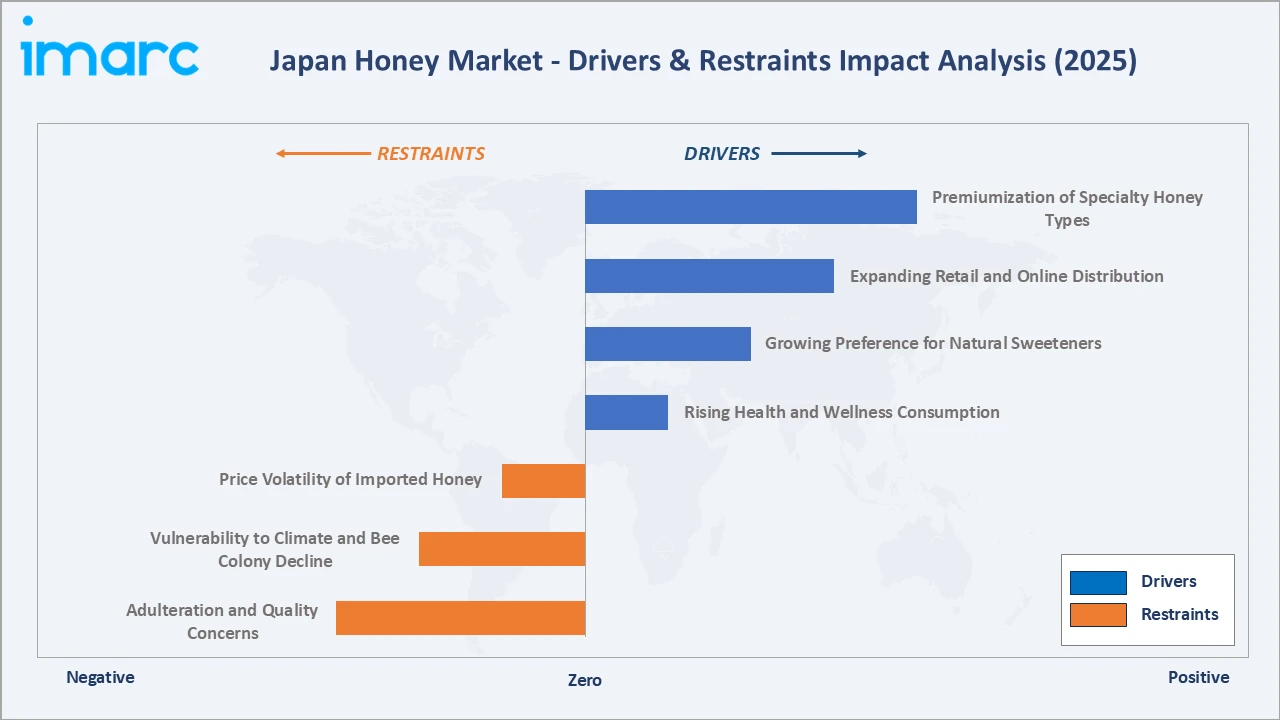
Market Drivers
- Rising Health and Wellness Consumption: As per IMARC Group, the Japan health and wellness market was valued at USD 214.5 Billion in 2025. Growing consumer preference for natural, minimally processed sweeteners over refined sugar is lifting honey consumption across households, bakeries, and beverage formulations.
- Growing Preference for Natural Sweeteners: Increasing awareness of the nutritional profile of honey, including its antioxidant and antimicrobial properties, is broadening its use beyond traditional table consumption into functional food and beverage applications.
- Expanding Retail and Online Distribution: Widening shelf presence across supermarkets, convenience stores, and e-commerce platforms is improving product accessibility.
- Premiumization of Specialty Honey Types: Rising interest in single-floral varieties such as acacia honey and linden honey is encouraging manufacturers to introduce higher-margin, origin-labeled product lines.
Market Restraints
- Adulteration and Quality Concerns: The presence of diluted or mislabeled honey products in the market continues to undermine consumer confidence and complicates purchasing decisions for quality-conscious buyers.
- Vulnerability to Climate and Bee Colony Decline: Shifting weather patterns, pesticide exposure, and habitat loss are straining domestic apiary output and raising sourcing uncertainty for processors reliant on stable floral cycles.
- Price Volatility of Imported Honey: Fluctuations in currency exchange rates and international supply conditions can unsettle input costs for importers and downstream retailers.
Market Opportunities
- Functional and Fortified Honey Products: Growing consumer interest in immune-support and gut-health formulations creates opportunities for honey-based functional food launches aligned with Japan's health-claim labeling framework.
- Traceability and Origin-Verified Sourcing: Blockchain-enabled and QR-based traceability tools present opportunities for brands to differentiate through verified purity and origin storytelling.
Market Challenges
- Import Dependence and Supply Concentration: Heavy reliance on a small number of overseas supplier countries exposes the market to trade policy shifts and logistics disruptions.
- Aging Domestic Beekeeping Workforce: A shrinking pool of active beekeepers and limited apiary succession planning constrain the scalability of domestic honey production.
Emerging Market Trends
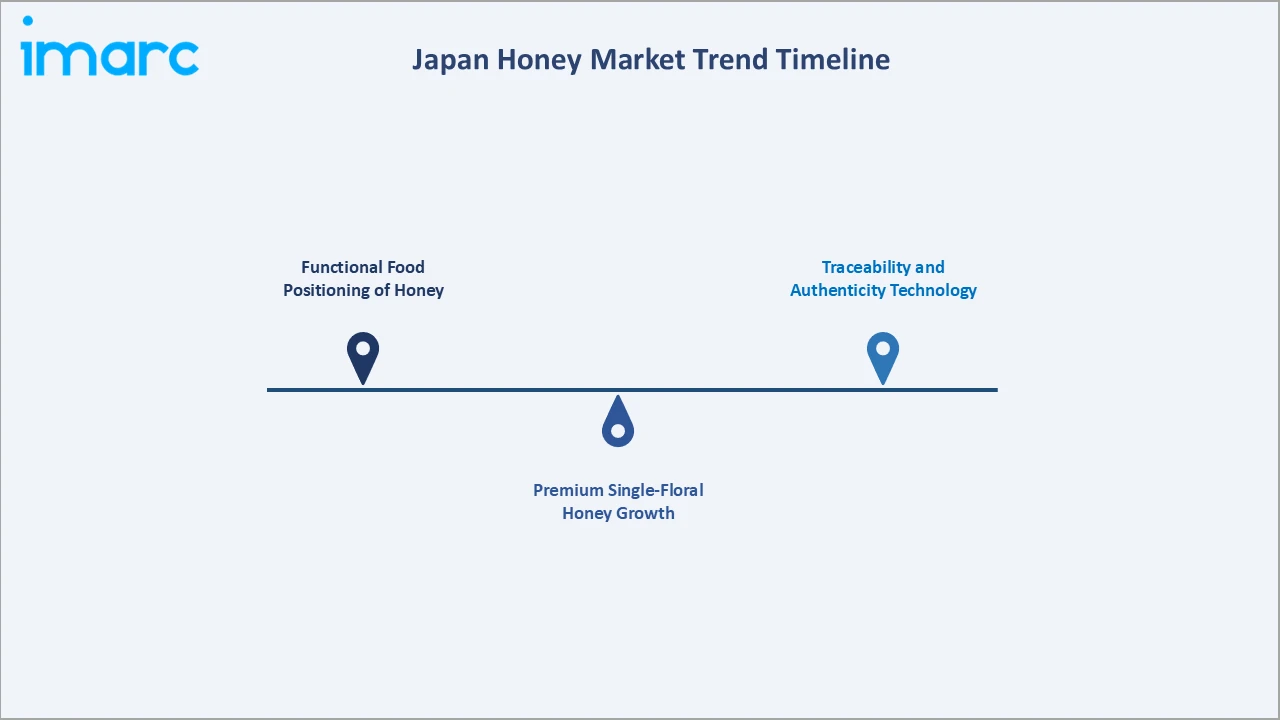
1. Functional Food Positioning of Honey
Manufacturers are increasingly formulating honey-based products under Japan's Foods with Function Claims framework, pairing honey with probiotics and botanical extracts to target immune and gut-health consumers.
2. Premium Single-Floral Honey Growth
Origin-labeled acacia, linden, and buckwheat honey varieties are gaining shelf space as consumers trade up from blended commodity honey toward traceable, single-source products.
3. Traceability and Authenticity Technology
Adoption of QR-code batch tracking and laboratory purity certification is expanding as processors respond to consumer concerns around adulteration and origin verification.
Industry Value Chain Analysis
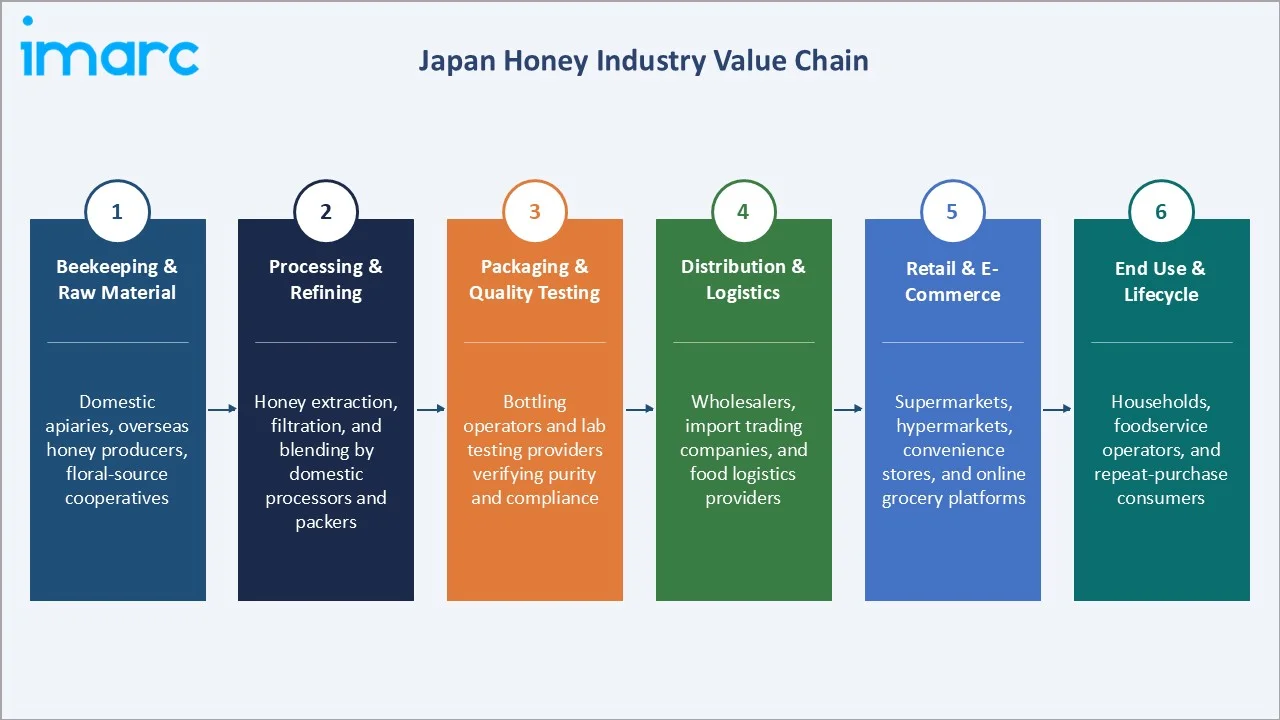
The Japan honey value chain spans six stages, from apiary-level raw material supply through end-user consumption and lifecycle engagement. Processing, packaging, and distribution capture the highest value-add, while quality testing and traceability capabilities increasingly determine sustainable competitive position in this import-dependent category.
|
Stage |
Key Players / Examples |
|
Beekeeping & Raw Material |
Domestic apiaries, overseas honey producers, and floral-source cooperatives supplying raw honey for processing |
|
Processing & Refining |
Honey extraction, filtration, and blending facilities operated by domestic processors and packers |
|
Packaging & Quality Testing |
Bottling operators and laboratory testing providers verifying purity, moisture content, and label compliance |
|
Distribution & Logistics |
Wholesalers, import trading companies, and food logistics providers moving product to retail |
|
Retail & E-Commerce |
Supermarkets, hypermarkets, convenience stores, and online grocery platforms selling to end consumers |
|
End Use & Lifecycle |
Households, foodservice operators, and repeat-purchase consumers supported by customer engagement programs |
Vertically integrated processors with direct sourcing relationships and proprietary quality-testing capabilities are positioned to capture greater value than partners reliant on third-party import intermediaries.
Technology Landscape in the Japan Honey Industry
Quality Testing and Purity Verification
Processors are deploying nuclear magnetic resonance and isotope-ratio testing methods to detect syrup adulteration and verify floral origin, strengthening compliance with Japan's food labeling standards.
Traceability and Digital Authentication
QR-code batch tracking and blockchain-supported supply chain records are being piloted by processors and importers to give consumers verifiable visibility into sourcing and handling from apiary to shelf.
E-Commerce and Direct-to-Consumer Platforms
Subscription-based delivery models and beekeeper-branded online storefronts are enabling smaller producers to reach consumers directly, bypassing traditional multi-tier distribution.
Market Segmentation Analysis
The report covers the following segments:
|
Segment Category |
Leading Segment |
Market Share |
Year |
|
Type |
Acacia Honey |
36.8% |
2025 |
|
Application |
🔒 |
🔒 |
2025 |
|
Distribution Channel |
Supermarkets and Hypermarkets |
48.6% |
2025 |
|
Region |
Kanto Region |
38.8% |
2025 |

By Type
Acacia honey commands a 36.8% majority share in 2025, driven by its light color, mild flavor, and versatility across culinary and beverage applications. The segment benefits from consistent import supply from established acacia-producing regions and strong recognition among Japanese consumers.
To access detailed market analysis, Request Sample
Clover honey follows at 21.4%, valued for its balanced sweetness and use as a food-manufacturing ingredient. Its versatile flavor profile also supports broad adoption across retail and foodservice applications.
By Distribution Channel
Supermarkets and hypermarkets lead distribution channel with 48.6% share in 2025, reflecting Japan's dense modern retail network and consumer preference for in-person label verification before purchase. The channel benefits from broad geographic reach and established supplier relationships.
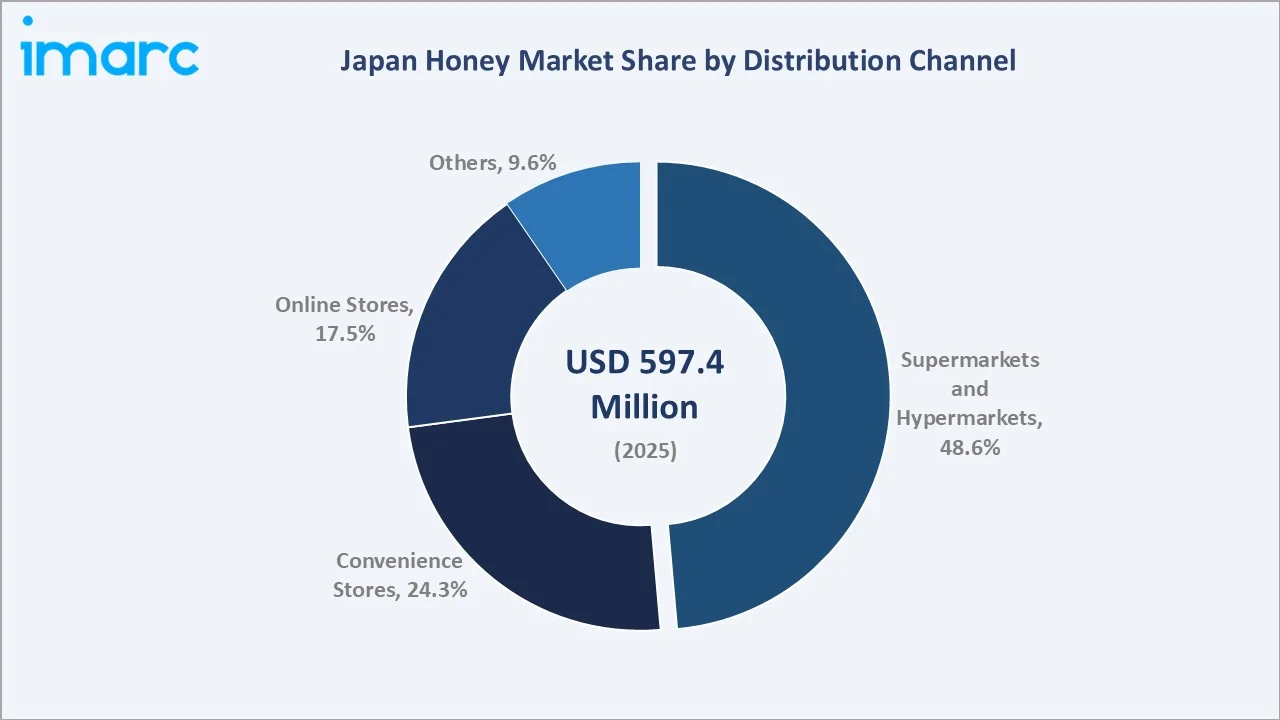
Convenience stores hold 24.3% share, supported by their dense urban footprint and suitability for smaller pack sizes.
Regional Market Insights
|
Region |
Share (2025) |
Key Growth Drivers |
|
Kanto Region |
38.8% |
Large urban population, dense modern retail network, and high concentration of e-commerce and logistics infrastructure |
|
Kansai/Kinki Region |
18.6% |
Established metro consumption base, strong presence of specialty and traditional food retailers |
|
Central/Chubu Region |
15.1% |
Growing suburban household demand and expanding modern trade penetration |
|
Kyushu-Okinawa Region |
8.2% |
Rising health-food awareness, expanding tourism-linked retail, and growing modern grocery formats |
|
Tohoku Region |
6.3% |
Steady demand from traditional retail channels and gradual e-commerce adoption |
|
Chugoku Region |
5.2% |
Moderate urbanization and increasing supermarket chain penetration |
|
Hokkaido Region |
4.6% |
Local specialty food positioning and seasonal tourism-driven retail demand |
|
Shikoku Region |
3.2% |
Smaller population base with steady demand through established regional retailers |
Kanto Region at 38.8% in 2025 leads the regional landscape, anchored by Tokyo, Kanagawa, Chiba, and Saitama. Dense urban population, extensive modern retail coverage, and concentrated e-commerce logistics infrastructure support sustained leadership across both physical and online channels.
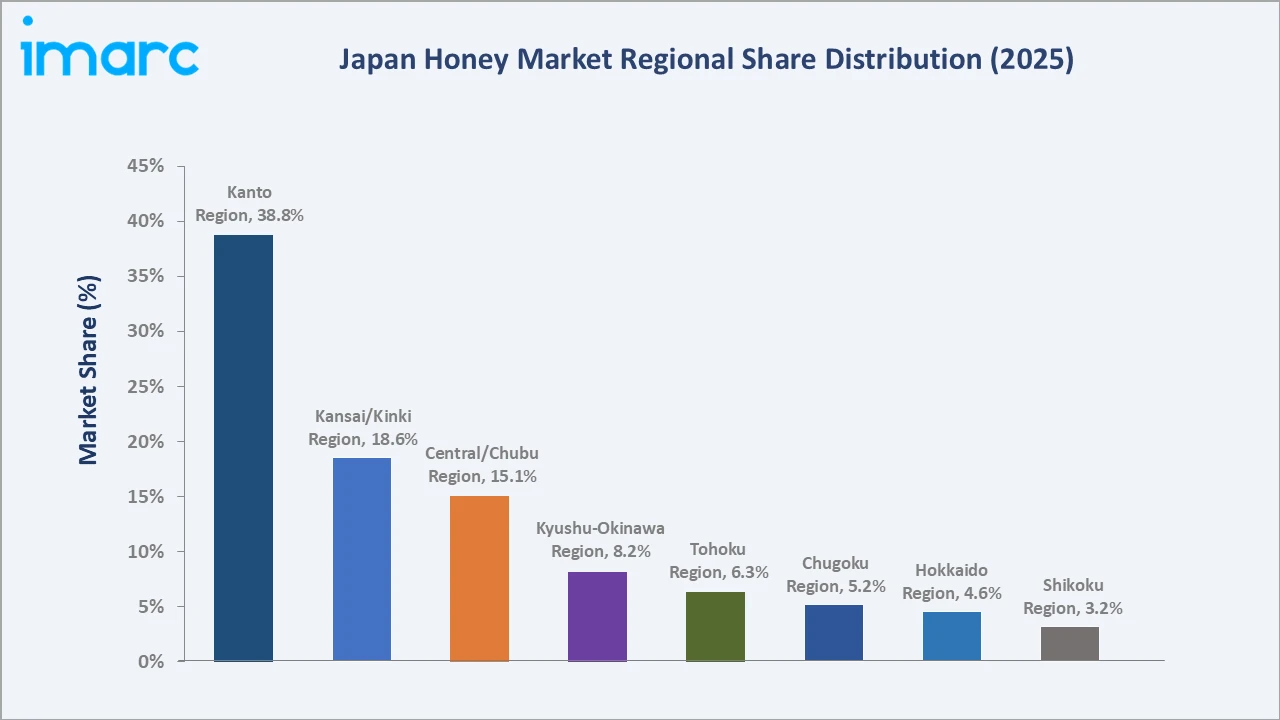
Kyushu-Okinawa Region at 8.2% is the fastest growing region. Expanding modern grocery formats, rising health-food awareness, and steady tourism-linked retail demand are accelerating regional expansion through 2034.
Competitive Landscape
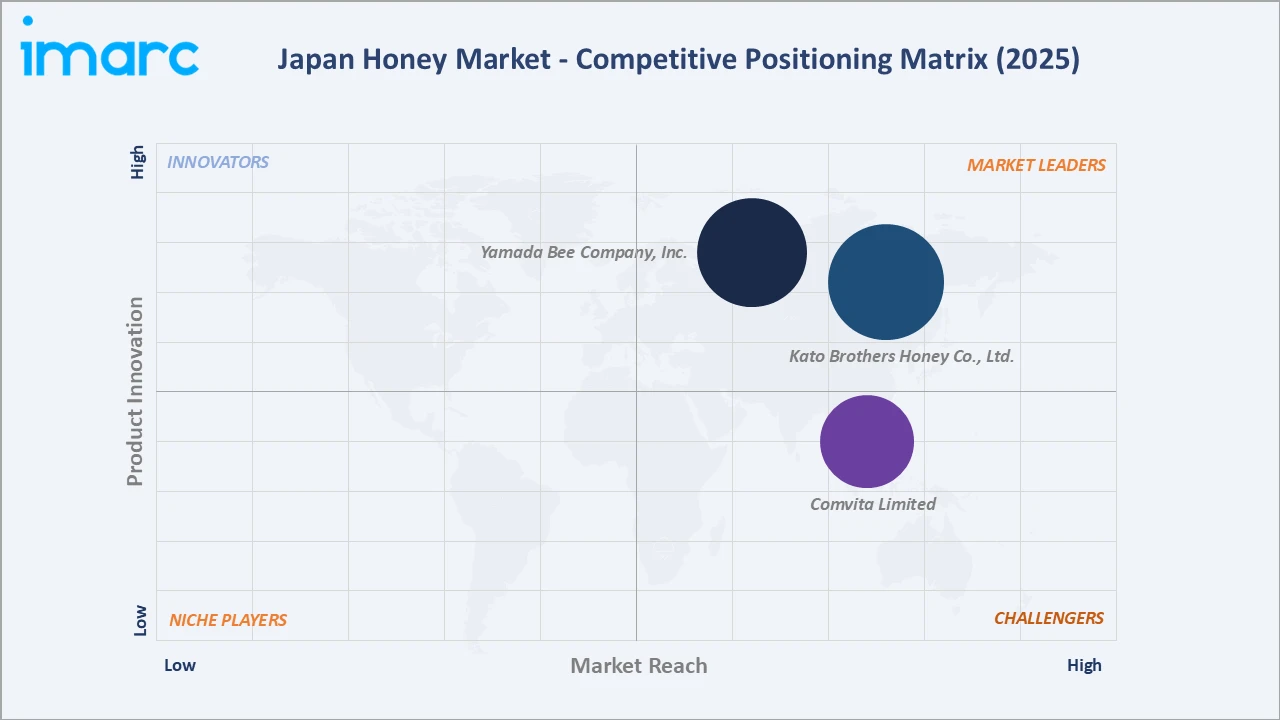
The Japan honey market is moderately fragmented, with established domestic processors leading distribution reach while international honey brands compete on premium positioning and specialty variety depth. Brand trust, sourcing transparency, and retail shelf presence form the key competitive moats in this import-dependent category.
|
Company Name |
Brand / Key Product |
Position |
Strategic Focus |
|
Yamada Bee Company, Inc. |
Yamada Bee Farm Honey |
Leader |
Direct-to-consumer distribution with broad honey and bee-product portfolio |
|
Kato Brothers Honey Co., Ltd. |
Sakura Honey |
Leader |
Retail-focused honey manufacturing with wide supermarket distribution |
|
Comvita Limited |
Comvita Manuka Honey |
Challenger |
Premium positioning through specialty honey and health-oriented branding |
Key players include Yamada Bee Company, Inc., Kato Brothers Honey Co., Ltd., and Comvita Limited, among others.
Key Company Profiles
Yamada Bee Company, Inc.
Yamada Bee Company, Inc. is a Japan-based beekeeping and bee-products company, known for its direct-to-consumer mail-order and retail distribution model across pure honey, royal jelly, and propolis-based products.
- Product Portfolio: A wide range of domestic and imported single-floral honey varieties, alongside royal jelly, propolis, and honey-based confectionery and skincare items.
- Recent Developments: The company continues to expand its premium honey and bee-derived health product offerings while enhancing its e-commerce and direct sales channels to strengthen customer engagement.
- Strategic Focus: Strengthening direct-to-consumer relationships, expanding product diversification across health and beauty categories, and maintaining strict quality-control standards across its honey supply chain.
Kato Brothers Honey Co., Ltd.
Kato Brothers Honey Co., Ltd. is a Tokyo-headquartered food manufacturer known for its Sakura Honey brand, offering a broad range of pure and blended honey products distributed widely across Japanese retail channels.
- Product Portfolio: Sakura Honey pure and blended table honey, alongside honey-based health food product lines sold through supermarkets and specialty retailers.
- Recent Developments: The company has continued to invest in retail distribution reach and quality-assurance processes across its honey product lines to reinforce consumer trust.
- Strategic Focus: Reinforcing retail distribution strength, sustaining brand recognition through the Sakura Honey label, and maintaining consistent quality-assurance practices across its honey portfolio.
Comvita Limited
Comvita Limited is a New Zealand-headquartered health and wellness company specializing in Manuka honey, with an established presence in the Japanese market through health-food retail and specialty distribution channels.
- Product Portfolio: Comvita Manuka Honey products across multiple quality grades, alongside honey-based health supplements and skincare formulations.
- Recent Developments: The company has continued to strengthen its retail and health-food channel partnerships in Japan to support demand for certified, quality-graded Manuka honey.
- Strategic Focus: Deepening engagement with Japan's health-conscious consumer base through certified quality grading, premium positioning, and expanded specialty retail presence.
Market Concentration Analysis
The Japan honey market is moderately fragmented, with the top domestic processors accounting for a meaningful share of retail distribution while a broad base of specialty importers and regional producers serve niche and premium segments.
Barriers to entry include the need for established retail relationships, quality-assurance and food-safety compliance capability, and the ability to secure consistent import supply amid limited domestic apiary capacity. These factors favor well-capitalized incumbents with diversified sourcing networks and established brand recognition.
Consolidation is gradual, as smaller regional producers partner with larger distributors to expand retail reach, while established brands continue to invest in quality certification and traceability capabilities to reinforce competitive positioning across the fragmented supply base.
Investment & Growth Opportunities
Fastest-Growing Segments
Online stores expand fastest among distribution channels, driven by subscription grocery adoption and direct-to-consumer beekeeper platforms. Buckwheat honey is the next-fastest growing type, supported by rising demand for mineral-rich, functionally positioned honey varieties.
Emerging Markets
Kyushu-Okinawa Region is the fastest growing area, anchored by expanding modern grocery formats and rising health-food awareness. The area represents meaningful untapped opportunity for brands able to deliver quality-certified, regionally accessible product lines.
Venture and Investment Trends
Investment is concentrated in quality-testing technology, traceability platforms, and direct-to-consumer e-commerce infrastructure. Capital is also flowing into premium single-floral product development aligned with evolving consumer preferences.
Future Market Outlook (2026-2034)
The Japan honey market is forecast to expand from USD 597.4 Million in 2025 to USD 626.7 Million in 2026, and is projected to reach USD 845.8 Million by 2034 at a CAGR of 3.82%, adding roughly USD 248.4 Million in incremental market value over the forecast period.
Three forces will shape the market through 2034: continued premiumization toward single-floral and specialty honey types; deeper integration of traceability and quality-verification technology; and steady expansion of online and direct-to-consumer distribution channels.
By 2034, the Japan honey market is expected to be defined by quality-certified, traceable sourcing, with online and specialty retail channels accounting for a meaningfully higher share of overall distribution. Rising health-conscious consumption and continued import diversification are expected to further support market evolution.
Research Methodology
Primary Research
Primary research included structured discussions with honey processors, retail category managers, import and trading company representatives, and food-safety specialists, validating market sizing, segment mix, and regional demand patterns.
Secondary Research
Secondary sources included government trade and agriculture publications, food-labeling and safety regulatory documentation, retail industry trade data, and company disclosures from leading honey processors and importers.
Forecasting Models
Market forecasts used top-down and bottom-up models combining historical consumption trends, distribution channel mix evolution, import supply patterns, and macroeconomic variables. Scenario analysis addressed import supply variability and shifting consumer preferences.
Report Coverage:
| Report Features | Details |
|---|---|
| Base Year of the Analysis | 2025 |
| Historical Period | 2020-2025 |
| Forecast Period | 2026-2034 |
| Units | Million USD |
| Scope of the Report | Exploration of Historical and Forecast Trends, Industry Catalysts and Challenges, Segment-Wise Historical and Predictive Market Assessment:
|
| Types Covered | Alfalfa Honey, Date Honey, Buckwheat Honey, Acacia Honey, Clover Honey, Linden Honey, Others |
| Applications Covered | Food and Beverages, Personal Care and Cosmetics, Pharmaceutical, Others |
| Distribution Channels Covered | Supermarkets and Hypermarkets, Convenience Stores, Online Stores, Others |
| Regions Covered | Kanto Region, Kinki Region, Central/ Chubu Region, Kyushu-Okinawa Region, Tohoku Region, Chugoku Region, Hokkaido Region, Shikoku Region |
| Companies Covered | Yamada Bee Company, Inc., Kato Brothers Honey Co., Ltd., Comvita Limited, etc. |
| Customization Scope | 10% Free Customization |
| Post-Sale Analyst Support | 10-12 Weeks |
| Delivery Format | PDF and Excel through Email (We can also provide the editable version of the report in PPT/Word format on special request) |
Key Benefits for Stakeholders:
- IMARC’s report offers a comprehensive quantitative analysis of various market segments, historical and current market trends, market forecasts, and dynamics of the Japan honey market from 2020-2034.
- The research study provides the latest information on the market drivers, challenges, and opportunities in the Japan honey market.
- Porter's five forces analysis assist stakeholders in assessing the impact of new entrants, competitive rivalry, supplier power, buyer power, and the threat of substitution. It helps stakeholders to analyze the level of competition within the Japan honey industry and its attractiveness.
- Competitive landscape allows stakeholders to understand their competitive environment and provides an insight into the current positions of key players in the market.
Frequently Asked Questions About the Japan Honey Market Report
The Japan honey market size is estimated at USD 626.7 Million in 2026, driven by rising health consciousness, natural sweetener demand, and expanding retail distribution.
The market is projected to grow at a CAGR of 3.82% from 2026-2034, reaching USD 845.8 Million, supported by premiumization and expanding online distribution.
Acacia honey leads at 36.8% in 2025, driven by its mild flavor, broad culinary versatility, and slow crystallization compared with other honey types.
Supermarkets and hypermarkets dominate at 48.6% in 2025, fueled by broad retail reach, dense store networks, and strong consumer trust in physical label verification.
Kanto Region commands 38.8% in 2025, led by dense urban population and concentrated modern retail and e-commerce infrastructure.
Kyushu-Okinawa Region is the fastest-growing market, supported by expanding modern grocery formats and rising health-food awareness.
Leading players include Yamada Bee Company, Inc., Kato Brothers Honey Co., Ltd., and Comvita Limited, among others.
Key challenges include adulteration concerns, an aging domestic beekeeping workforce, and exposure to import supply and price volatility.
Need more help?
- Speak to our experienced analysts for insights on the current market scenarios.
- Include additional segments and countries to customize the report as per your requirement.
- Gain an unparalleled competitive advantage in your domain by understanding how to utilize the report and positively impacting your operations and revenue.
- For further assistance, please connect with our analysts.
 Request Customization
 Speak to an Analyst
 Request Brochure
 Inquire Before Buying
Benefits of Customization
- Personalize this research
- Triangulate with your data
- Get data as per your format and definition
- Gain a deeper dive into a specific application, geography, customer, or competitor
- Any level of personalization
Get in Touch With Us
UNITED STATES
Phone: +1-201-971-6302
INDIA
Phone: +91-120-433-0800
UNITED KINGDOM
Phone: +44-753-714-6104
Email: [email protected]
Client Testimonials




.webp)




.webp)













Related Reports

Choose your plan
*Please note that the prices mentioned below are starting prices for each bundle type. Kindly contact our team for further details.*
Single User License
- 1 User License, Access on 2 Devices
- PDF Report + Excel Dataset (Password Protected)
- Lifetime Access
- No Printing Rights
- 10% Free Report Customization
- 10–12 Weeks of Analyst Support
Five User License
- Access for 5 Users, 2 Devices per User
- PDF Report + Excel Dataset (Password Protected)
- Lifetime Access
- Dedicated Account Manager
- 12–14 Weeks of Analyst Support
- No Printing Rights
- 15% Free Report Customization
- 25% Discount on Your Next Purchase
Corporate User License
- Unlimited User Access (Within Your Organization)
- PDF Report + Excel Dataset
- Lifetime Access
- Dedicated Account Manager
- 14–20 Weeks of Analyst Support
- No Printing Rights
- 20% Free Report Customization
- 30% Discount on Your Next Purchase
Essential Insights
What's included:
3 reports
- Lifetime Access
- PDF Reports
- Excel Datasets
- 2 Weeks of Free Analyst Support
- 2 User Licenses
- Access on 2 Devices
- Printing Rights
- Complimentary PowerPoint (PPT) Version
- Complimentary License Upgrade
Professional Access
What's included:
5 reports
- Lifetime Access
- PDF Reports
- Excel Datasets
- 8 Weeks of Free Analyst Support
- 2 User Licenses
- Access on 2 Devices
- Printing Rights
- Complimentary PowerPoint (PPT) Version
- Complimentary License Upgrade
Business Advantage
What's included:
8 reports
- Lifetime Access
- PDF Reports
- Excel Datasets
- 14 Weeks of Free Analyst Support
- 2 User Licenses
- Access on 2 Devices
- Printing Rights
- Complimentary PowerPoint (PPT) Version
- Complimentary License Upgrade
Enterprise Intelligence
What's included:
10 reports
- Lifetime Access
- PDF Reports
- Excel Datasets
- 20 Weeks of Free Analyst Support
- 2 User Licenses
- Access on 2 Devices
- Printing Rights
- Complimentary PowerPoint (PPT) Version
- Complimentary License Upgrade