
Japan Industrial Filtration Market Size, Share, Trends and Forecast by Type, Product, Filter Media, Application, and Region, 2026-2034
Japan Industrial Filtration Market Summary:
The Japan industrial filtration market size was valued at USD 1.72 Billion in 2025 and is projected to reach USD 3.19 Billion by 2034, growing at a compound annual growth rate of 7.15% from 2026-2034.
The market is driven by stringent environmental regulations mandating emission controls and waste treatment standards across manufacturing sectors. Limited freshwater resources intensify demand for water recycling and purification technologies in automotive, electronics, and chemical industries. Advanced filtration innovations enhance operational efficiency while supporting sustainability initiatives. Growing emphasis on workplace safety and indoor air quality further propels adoption of high-performance filtration systems, contributing to the Japan industrial filtration market share.
Key Takeaways and Insights:
- By Type: Liquid dominates the market with a share of 55% in 2025, driven by extensive water treatment applications and industrial process purification needs. Industries prioritize liquid filtration for ensuring product quality and regulatory compliance.
- By Product: Cartridge filter leads the market with a share of 21% in 2025, owing to versatility across chemicals, pharmaceuticals, and electronics industries. Cartridge filters offer superior dirt loading capacity, easy replacement mechanisms, and cost-effective maintenance solutions.
- By Filter Media: Filter paper represents the largest segment with a market share of 30% in 2025, driven by widespread adoption in precision filtration requiring high particle retention efficiency. Filter paper provides optimal balance between performance, cost-effectiveness, and compatibility.
- By Application: Chemicals and petrochemicals dominate the market with a share of 22% in 2025, owing to stringent purity requirements and contamination control needs. Complex filtration demands across solvent recovery, catalyst separation, and product purification drive investment.
- Key Players: The market features multinational filtration technology providers competing alongside specialized regional manufacturers. Competition centers on technological innovation, custom solution development, and comprehensive service offerings across diverse industrial segments and applications.
Japan industrial filtration market experiences sustained growth driven by the convergence of regulatory mandates, environmental consciousness, and technological advancement. The nation's comprehensive framework of industrial emission controls and workplace safety regulations creates consistent demand across manufacturing sectors. Limited freshwater availability intensifies focus on water conservation and treatment technologies, prompting industries to invest in advanced filtration systems for water recycling and purification. In July 2025, Asahi Kasei announced plans for its fourth Planova virus-removal filter plant in Miyazaki to expand domestic production capacity and strengthen Japan’s industrial biopharmaceutical filtration infrastructure. The robust manufacturing ecosystem spanning automotive, electronics, pharmaceuticals, and chemicals rely heavily on filtration for maintaining process integrity, ensuring product quality, and achieving operational efficiency.
Japan Industrial Filtration Market Trends:
Integration of Smart Filtration Technologies
Industrial filtration systems increasingly incorporate intelligent monitoring and predictive maintenance capabilities through sensor integration and data analytics platforms. Smart filtration solutions enable real-time performance tracking, automated efficiency optimization, and proactive filter replacement scheduling based on actual operational conditions. As per sources, in December 2025, Nitto Denko received Japan’s METI Energy Conservation Grand Prize for its RO membrane–based solvent recovery system improving energy efficiency and wastewater reuse in industrial processes. This technological evolution reduces unexpected downtime, minimizes maintenance costs, and extends equipment lifespan while maintaining consistent filtration performance.
Advancement in Nanofiber and Membrane Technologies
Next-generation filtration materials utilizing nanofiber membranes, ceramic composites, and advanced polymer structures demonstrate superior performance characteristics compared to traditional filter media. These innovative materials offer enhanced particle retention efficiency, improved chemical resistance, and extended operational durability in demanding industrial environments. In December 2025, Toray developed nanofiltration membrane technology achieving over 95% lithium recovery from used batteries, supporting high-performance industrial filtration applications in recycling and advanced material processing in Japan. Nanofiber filtration technology provides exceptional surface area-to-volume ratios, enabling capture of submicron particles while maintaining low pressure drop characteristics essential for energy-efficient operations across pharmaceutical manufacturing, semiconductor fabrication, and precision chemical synthesis applications.
Sustainability-Driven Filtration Solutions
Environmental sustainability considerations increasingly influence filtration technology selection and system design across Japanese industries. Companies prioritize filtration solutions that minimize waste generation, enable material recovery, and reduce energy consumption throughout operational lifecycles. Recyclable filter media, regenerable filtration systems, and biodegradable components gain adoption as industries align with circular economy principles. According to reports, Japan’s Ministry of the Environment selected projects using filtration-enabled recycling and traceability technologies to recover lithium from batteries and reduce CO₂ emissions through domestic resource-circulation initiatives. Advanced filtration technologies facilitate water reuse and recycling initiatives, reducing freshwater consumption and wastewater discharge volumes while supporting corporate sustainability commitments and carbon reduction targets.
Market Outlook 2026-2034:
The Japan industrial filtration market demonstrates steady growth trajectory supported by regulatory enforcement, technological innovation, and industrial expansion. Revenue growth stems from replacement demand in established sectors and adoption in emerging applications including hydrogen production, battery manufacturing, and advanced materials processing. Environmental regulations continue tightening emission standards and effluent quality requirements, necessitating filtration system upgrades across existing industrial facilities. The market benefits from strategic focus on high-value manufacturing sectors requiring sophisticated filtration capabilities for maintaining product quality and process control. The market generated a revenue of USD 1.72 Billion in 2025 and is projected to reach a revenue of USD 3.19 Billion by 2034, growing at a compound annual growth rate of 7.15% from 2026-2034.
Japan Industrial Filtration Market Report Segmentation:
|
Segment Category |
Leading Segment |
Market Share |
|
Type |
Liquid |
55% |
|
Product |
Cartridge Filter |
21% |
|
Filter Media |
Filter Paper |
30% |
|
Application |
Chemicals and Petrochemicals |
22% |
Type Insights:
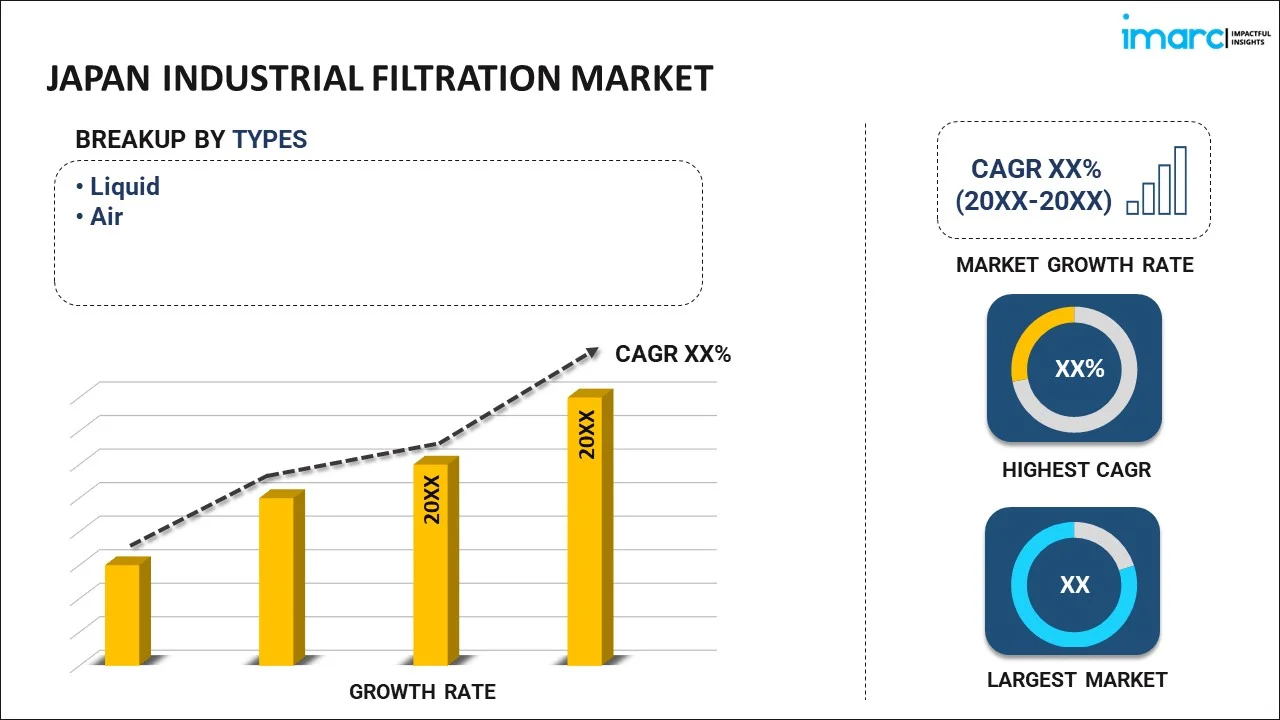
To get detailed regional analysis of this market, Request Sample
- Liquid
- Air
Liquid dominates with a market share of 55% of the total Japan industrial filtration market in 2025.
Liquid maintains dominant position driven by pervasive applications across water treatment, chemical processing, and manufacturing operations requiring fluid purification. Industrial facilities depend on liquid filtration for removing suspended solids, dissolved contaminants, and microbiological organisms from process streams, cooling systems, and wastewater effluents. The segment encompasses diverse technologies including cartridge filtration, membrane separation, depth filtration, and coalescence systems tailored to specific contamination profiles and purity requirements. Water scarcity concerns and environmental regulations mandating wastewater treatment intensify liquid filtration adoption.
Electronics manufacturing demands particulate-free water and chemical solutions for semiconductor fabrication and precision cleaning applications where submicron contamination causes yield losses and quality defects. Food and beverage industries employ liquid filtration throughout production processes ensuring product safety, clarity, and microbiological stability. Metalworking operations utilize liquid filtration for extending coolant and cutting fluid lifecycles, reducing disposal costs and environmental impact. The liquid filtration segment benefits from technological advancement in membrane materials, automated backwashing systems, and integrated monitoring capabilities enhancing operational efficiency and supporting water recycling initiatives.
Product Insights:
- Bag Filter
- Cartridge Filter
- Depth Filter
- Filter Press
- Drum Filter
- Electrostatic Precipitator
- ULPA (Ultra-Low Penetration Air)
- HEPA (High Efficiency Particulate Air)
- Others
Cartridge filter leads with a share of 21% of the total Japan industrial filtration market in 2025.
Cartridge filters represent the leading product segment owing to versatility, ease of maintenance, and cost-effectiveness across diverse industrial applications. These compact filtration elements pack substantial surface area into space-efficient housings, enabling high throughput while minimizing installation footprint requirements. As per sources, Yamashin-Filter reported net sales rose 12.3% and operating profit surged 118.5%, reflecting expanding demand for industrial filtration solutions and performance-driven product adoption across manufacturing sectors. Cartridge filter designs accommodate various media types including pleated membranes, wound depth structures, and melt-blown polymers optimized for different contamination scenarios and filtration precision levels.
Industries value cartridge filters for scalability, allowing capacity expansion through parallel housing configurations without fundamental system redesign. Chemical compatibility across materials including polypropylene, polyester, stainless steel, and specialty polymers enables cartridge filter deployment in aggressive chemical environments and high-temperature applications. Pharmaceutical and electronics sectors particularly favor cartridge filtration for achieving validated sterile filtration and ultra-pure process fluids essential for product quality and regulatory compliance. The cartridge filter market benefits from continuous innovation in media construction, sealing technologies, and end-cap configurations improving reliability and performance consistency.
.webp)
Filter Media Insights:
- Filter Paper
- Metal
- Activated Carbon/Charcoal
- Fiberglass
- Non-Woven Fabric
- Others
Filter paper exhibits a clear dominance with a 30% share of the total Japan industrial filtration market in 2025.
Filter paper dominates the media segment through established performance characteristics, manufacturing scalability, and cost competitiveness across industrial filtration applications. Cellulose-based and synthetic filter papers provide controlled porosity, mechanical strength, and chemical compatibility suitable for capturing particulate contamination from liquids and gases. The medium's fibrous structure enables depth filtration mechanisms where particles lodge throughout media thickness rather than surface accumulation alone, providing superior dirt-holding capacity extending operational intervals between replacements. Filter paper manufacturing processes allow precise control over pore size distribution and mechanical properties.
Industries utilize filter paper in applications ranging from coarse pre-filtration removing bulk contaminants to fine filtration achieving stringent purity specifications. Chemical processing operations employ filter paper media for clarifying process streams, removing catalyst fines, and protecting downstream equipment from particulate damage. Automotive manufacturing relies on filter paper in paint filtration, coolant purification, and hydraulic system protection maintaining equipment reliability. The segment benefits from continuous material science advancement introducing reinforced structures, chemical-resistant treatments, and graduated density configurations optimizing filtration efficiency and lifespan while supporting industrial sustainability initiatives.
Application Insights:
- Automotive
- Food and Beverage
- Chemicals and Petrochemicals
- Pharmaceuticals
- Power Generation
- Oil and Gas
- Metal and Mining
- Others
Chemicals and petrochemicals lead with a market share of 22% of the total Japan industrial filtration market in 2025.
The chemicals and petrochemicals represent the largest application segment driven by complex separation requirements and stringent purity standards throughout processing operations. Chemical manufacturing processes generate diverse contamination challenges including catalyst residues, polymerization byproducts, precipitated solids, and cross-contamination risks requiring sophisticated filtration strategies. Industries employ multi-stage filtration systems combining coarse pre-filtration, intermediate purification, and final polishing achieving product specifications while protecting sensitive process equipment from particulate damage and fouling. Petrochemical refining operations utilize filtration extensively across crude oil processing and product purification.
Catalyst recovery filtration enables valuable material reclamation, reducing operating costs while ensuring process stream purity for downstream units. Solvent filtration systems maintain chemical quality during recycling operations, extending solvent lifecycles and reducing disposal volumes aligning with environmental objectives. Polymer production facilities implement filtration for removing gels, aggregates, and contaminants affecting final product appearance and mechanical properties. The sector's demanding operating conditions including extreme temperatures, corrosive chemicals, and high differential pressures necessitate robust filtration systems utilizing chemically resistant materials and engineered designs supporting safe, efficient chemical processing operations.
Regional Insights:
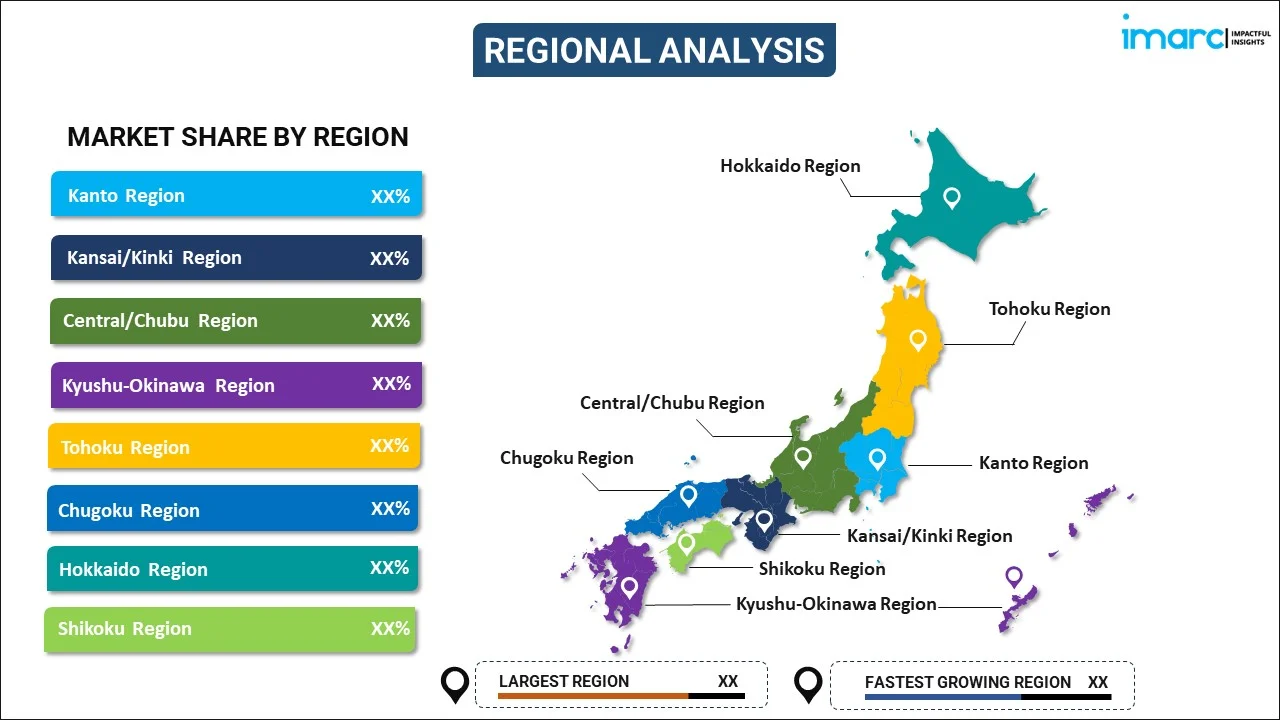
To get detailed regional analysis of this market, Request Sample
- Kanto Region
- Kansai/Kinki Region
- Central/ Chubu Region
- Kyushu-Okinawa Region
- Tohoku Region
- Chugoku Region
- Hokkaido Region
- Shikoku Region
Kanto Region dominates through concentrated manufacturing activities in Tokyo, Yokohama, and surrounding prefectures. Dense industrial infrastructure spanning electronics, chemicals, pharmaceuticals, and automotive sectors drives substantial filtration demand. Advanced technology adoption, stringent environmental regulations, and proximity to research institutions support continuous innovation and market expansion.
Kansai/Kinki Region maintains significant presence with robust chemical, steel, and pharmaceutical manufacturing clusters in Osaka, Kobe, and Kyoto. The region's established industrial base, combined with emphasis on quality-focused production and environmental compliance, creates steady filtration system demand across diverse manufacturing sectors and water treatment facilities.
Central/Chubu Region demonstrates strong market participation through extensive automotive manufacturing, precision machinery, and ceramics industries centered in Nagoya and surrounding areas. The region's export-oriented manufacturing ecosystem prioritizes production quality and operational efficiency, driving adoption of advanced filtration technologies supporting competitive manufacturing capabilities.
Kyushu-Okinawa Region experiences growing filtration adoption driven by semiconductor manufacturing, automotive components, and chemical processing industries. Strategic location advantages, government industrial incentives, and expanding high-tech manufacturing facilities create emerging opportunities for filtration providers serving regional industrial development initiatives.
Tohoku Region maintains moderate market presence through automotive parts manufacturing, electronics assembly, and food processing industries. Post-recovery industrial revitalization efforts emphasize sustainable manufacturing practices and environmental protection, supporting filtration technology adoption aligned with regional economic development and environmental stewardship objectives.
Chugoku Region demonstrates consistent filtration demand through petrochemical complexes, steel production facilities, and machinery manufacturing centered in Hiroshima and surrounding coastal areas. The region's heavy industrial concentration requires robust filtration solutions managing emissions, process fluids, and environmental compliance across energy-intensive manufacturing operations.
Hokkaido Region exhibits specialized filtration applications in food processing, agriculture-related industries, and emerging renewable energy projects. The region's focus on agricultural value-added processing, dairy production, and sustainable energy development creates niche opportunities for filtration technologies supporting regional economic diversification.
Shikoku Region maintains steady filtration utilization through chemical manufacturing, paper production, and maritime-related industries. The region's established industrial sectors combined with environmental consciousness and water resource management priorities drive consistent demand for filtration systems supporting sustainable manufacturing and environmental protection.
Market Dynamics:
Growth Drivers:
Why is the Japan Industrial Filtration Market Growing?
Stringent Environmental Regulations and Compliance Requirements
Japan's comprehensive environmental regulatory framework establishes rigorous standards for industrial emissions, effluent quality, and workplace air quality necessitating advanced filtration system deployment across manufacturing sectors. Government agencies enforce specific air quality standards within industrial facilities, creating mandatory compliance obligations that drive consistent filtration equipment demand. These regulations extend beyond atmospheric emissions to encompass wastewater treatment, hazardous substance containment, and worker exposure limits requiring multi-faceted filtration approaches protecting environmental and human health. Industries face substantial penalties for non-compliance alongside operational restrictions, incentivizing proactive investment in filtration technologies exceeding minimum regulatory requirements.
Water Scarcity and Resource Conservation Initiatives
Japan's limited freshwater resources combined with competing demands from industrial, agricultural, and municipal sectors intensify focus on water conservation and recycling technologies where filtration plays central role. Industries implement closed-loop water systems utilizing advanced filtration for purifying process water, enabling reuse cycles that dramatically reduce freshwater withdrawal and wastewater discharge volumes. In July 2025, Japan held about 430 billion cubic metres of annual water resources, yet ageing infrastructure and uneven utility performance prompted national initiatives to strengthen resilient water systems and sustainable management. Moreover, water treatment costs and discharge permit restrictions create economic incentives for filtration investment delivering measurable returns through reduced utility expenses.
Technological Innovation and Advanced Manufacturing Requirements
Continuous advancement in filtration materials, system designs, and automation capabilities expands application possibilities while improving efficiency and reliability across industrial operations. Next-generation filter media including nanofiber membranes, ceramic structures, and engineered composites deliver superior performance characteristics enabling previously unattainable purity levels and separation efficiency. Smart filtration systems incorporating sensors, controllers, and predictive analytics optimize operational parameters, reduce maintenance costs, and prevent unexpected failures impacting production continuity. Advanced manufacturing sectors including semiconductor fabrication, pharmaceutical production, and precision electronics require ultra-pure processing environments where conventional filtration technologies prove inadequate, driving innovation.
Market Restraints:
What Challenges the Japan Industrial Filtration Market is Facing?
High Capital Investment and Lifecycle Costs
Advanced filtration systems require substantial upfront capital expenditure encompassing equipment procurement, installation infrastructure, and process integration engineering creating financial barriers particularly for small and medium enterprises. Ongoing operational costs including replacement filter elements, energy consumption, maintenance labor, and disposal expenses accumulate throughout system lifecycles impacting total cost of ownership calculations.
Technical Complexity and Operational Expertise Requirements
Effective filtration system specification, installation, and operation demand specialized technical knowledge spanning fluid dynamics, contamination characterization, and process integration often exceeding internal capabilities of end-user organizations. Improper system selection, sizing errors, or installation deficiencies compromise filtration performance leading to inadequate contamination removal, excessive pressure drops, or premature filter element failure.
Competition for Alternative Purification Technologies
Emerging separation and purification technologies including advanced oxidation, membrane bioreactors, and electrochemical treatment systems offer alternative approaches potentially replacing or reducing traditional filtration applications in specific scenarios. Innovation in upstream process controls and contamination prevention strategies reduce filtration loads, potentially enabling smaller systems or extended replacement intervals affecting equipment and consumable demand.
Competitive Landscape:
The Japan industrial filtration market exhibits dynamic competitive environment characterized by established multinational filtration specialists competing alongside regional manufacturers and specialized niche providers. Competition emphasizes technological differentiation through proprietary filter media, innovative system designs, and integrated automation capabilities addressing evolving industrial requirements. Major participants leverage extensive research and development capabilities developing next-generation filtration solutions incorporating advanced materials and smart monitoring technologies. Companies pursue market positioning strategies spanning comprehensive product portfolios serving diverse industrial segments versus specialized focus on specific applications commanding premium positioning. Service capabilities including installation support, maintenance programs, and rapid consumable availability increasingly differentiate providers beyond pure product specifications.
Recent Developments:
- In June 2024, Asahi Kasei announced the launch of a Microza-based membrane system for producing water for injection, offering an alternative to distillation by improving filtration efficiency, reducing energy use, lowering CO2 emissions, and supporting high-purity water production for pharmaceutical manufacturing and industrial processing applications globally across diverse sectors and facilities.
Japan Industrial Filtration Market Report Coverage:
| Report Features | Details |
|---|---|
| Base Year of the Analysis | 2025 |
| Historical Period | 2020-2025 |
| Forecast Period | 2026-2034 |
| Units | Billion USD |
| Scope of the Report | Exploration of Historical and Forecast Trends, Industry Catalysts and Challenges, Segment-Wise Historical and Predictive Market Assessment:
|
| Types Covered | Liquid, Air |
| Products Covered | Bag Filter, Cartridge Filter, Depth Filter, Filter Press, Drum Filter, Electrostatic Precipitator, ULPA (Ultra-Low Penetration Air), HEPA (High Efficiency Particulate Air), Others |
| Filters Media Covered | Filter Paper, Metal, Activated Carbon/Charcoal, Fiberglass, Non-Woven Fabric, Others |
| Applications Covered | Automotive, Food and Beverage, Chemicals and Petrochemicals, Pharmaceuticals, Power Generation, Oil and Gas, Metal and Mining, Others |
| Regions Covered | Kanto Region, Kansai/Kinki Region, Central/ Chubu Region, Kyushu-Okinawa Region, Tohoku Region, Chugoku Region, Hokkaido Region, Shikoku Region |
| Customization Scope | 10% Free Customization |
| Post-Sale Analyst Support | 10-12 Weeks |
| Delivery Format | PDF and Excel through Email (We can also provide the editable version of the report in PPT/Word format on special request) |
Frequently Asked Questions About the Japan Industrial Filtration Market Report
The Japan industrial filtration market size was valued at USD 1.72 Billion in 2025.
The Japan industrial filtration market is expected to grow at a compound annual growth rate of 7.15% from 2026-2034 to reach USD 3.19 Billion by 2034.
Liquid held the largest market share, driven by extensive water treatment applications and industrial process purification requirements across manufacturing sectors. The segment benefits from water scarcity concerns, environmental regulations mandating wastewater treatment, and growing emphasis on water recycling initiatives supporting sustainable industrial operations.
Key factors driving the Japan industrial filtration market include stringent environmental regulations, water scarcity driving conservation initiatives, technological innovations in filtration materials, and growing emphasis on workplace safety and air quality.
Major challenges include high capital investment requirements and ongoing lifecycle costs, technical complexity demanding specialized expertise for system operation, competition from alternative purification technologies, and integration difficulties with existing process infrastructure.
Need more help?
- Speak to our experienced analysts for insights on the current market scenarios.
- Include additional segments and countries to customize the report as per your requirement.
- Gain an unparalleled competitive advantage in your domain by understanding how to utilize the report and positively impacting your operations and revenue.
- For further assistance, please connect with our analysts.
 Request Customization
 Speak to an Analyst
 Request Brochure
 Inquire Before Buying
Benefits of Customization
- Personalize this research
- Triangulate with your data
- Get data as per your format and definition
- Gain a deeper dive into a specific application, geography, customer, or competitor
- Any level of personalization
Get in Touch With Us
UNITED STATES
Phone: +1-201-971-6302
INDIA
Phone: +91-120-433-0800
UNITED KINGDOM
Phone: +44-753-714-6104
Email: [email protected]
Client Testimonials




.webp)




.webp)













Related Reports

Choose your plan
*Please note that the prices mentioned below are starting prices for each bundle type. Kindly contact our team for further details.*
Single User License
- 1 User License, Access on 2 Devices
- PDF Report + Excel Dataset (Password Protected)
- Lifetime Access
- No Printing Rights
- 10% Free Report Customization
- 10–12 Weeks of Analyst Support
Five User License
- Access for 5 Users, 2 Devices per User
- PDF Report + Excel Dataset (Password Protected)
- Lifetime Access
- Dedicated Account Manager
- 12–14 Weeks of Analyst Support
- No Printing Rights
- 15% Free Report Customization
- 25% Discount on Your Next Purchase
Corporate User License
- Unlimited User Access (Within Your Organization)
- PDF Report + Excel Dataset
- Lifetime Access
- Dedicated Account Manager
- 14–20 Weeks of Analyst Support
- No Printing Rights
- 20% Free Report Customization
- 30% Discount on Your Next Purchase
Essential Insights
What's included:
3 reports
- Lifetime Access
- PDF Reports
- Excel Datasets
- 2 Weeks of Free Analyst Support
- 2 User Licenses
- Access on 2 Devices
- Printing Rights
- Complimentary PowerPoint (PPT) Version
- Complimentary License Upgrade
Professional Access
What's included:
5 reports
- Lifetime Access
- PDF Reports
- Excel Datasets
- 8 Weeks of Free Analyst Support
- 2 User Licenses
- Access on 2 Devices
- Printing Rights
- Complimentary PowerPoint (PPT) Version
- Complimentary License Upgrade
Business Advantage
What's included:
8 reports
- Lifetime Access
- PDF Reports
- Excel Datasets
- 14 Weeks of Free Analyst Support
- 2 User Licenses
- Access on 2 Devices
- Printing Rights
- Complimentary PowerPoint (PPT) Version
- Complimentary License Upgrade
Enterprise Intelligence
What's included:
10 reports
- Lifetime Access
- PDF Reports
- Excel Datasets
- 20 Weeks of Free Analyst Support
- 2 User Licenses
- Access on 2 Devices
- Printing Rights
- Complimentary PowerPoint (PPT) Version
- Complimentary License Upgrade