
Japan Industrial IoT Market Size, Share, Trends and Forecast by Component, End User, and Region, 2026-2034
Japan Industrial IoT Market Size & Forecast 2026-2034
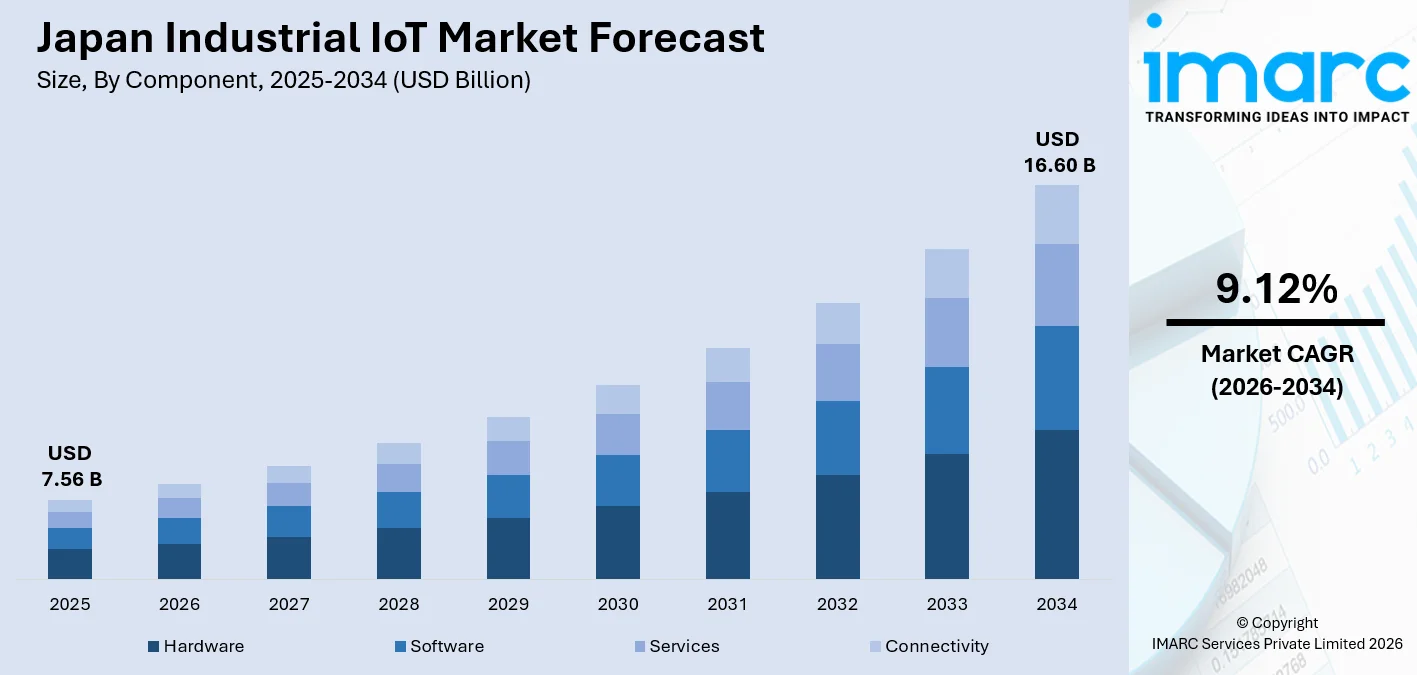
The Japan industrial IoT market size, valued at USD 7.56 Billion in 2025, is projected to reach USD 16.60 Billion by 2034, growing at a CAGR of 9.12% from 2026-2034, driven by rapid technological advancements in automation, strong government support through the Society 5.0 initiative, and escalating demand for operational efficiency across manufacturing, energy, and healthcare sectors. In March 2025, Japan's Ministry of Economy, Trade and Industry (METI) and the Information-technology Promotion Agency (IPA) jointly launched the JC-STAR (Labeling Scheme based on Japan Cyber-Security Technical Assessment Requirements) framework, underscoring the government's commitment to accelerating secure IoT adoption.
To get more information on this market Request Sample
Japan Industrial IoT Analysis - Key Insights
- Hardware commands 39.0% of component share in 2025 - Industrial hardware, including sensors, edge gateways, and controllers, forms the foundational layer of IIoT deployments, enabling real-time data capture and machine connectivity across Japanese manufacturing and energy facilities.
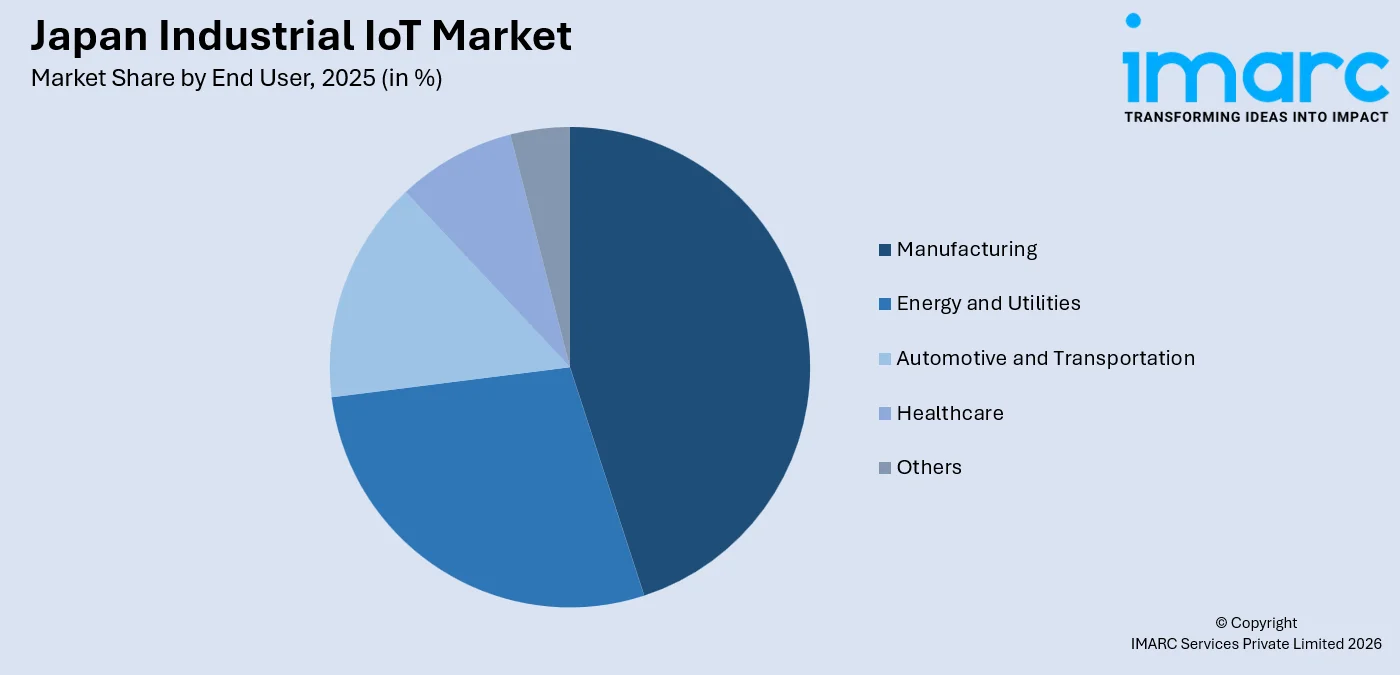
- Manufacturing dominates end user at 42.0% in 2025 - Japan's advanced manufacturing ecosystem, anchored by automotive, electronics, and heavy industry, is the primary adopter of IIoT technology, leveraging connected systems for predictive maintenance, production optimization, and quality assurance across highly automated factory environments.
- Kanto Region leads regionally at 44.0% in 2025 - Home to Tokyo and major industrial hubs, the Kanto region's concentration of technology enterprises, advanced digital infrastructure, and high 5G penetration drives its commanding position in Japan's industrial IoT market, supported by substantial government smart city investment.
Japan Industrial IoT Market Trends and Dynamic 2026
Market Trends
Smart Manufacturing and Industry 4.0 Integration are Reshaping Japan's Industrial Landscape
Industrial sectors in Japan are witnessing rapid advancements in smart manufacturing technologies, with IIoT sensors, collaborative robots, and artificial intelligence analytics being employed to optimize factory operations. Japanese industry is witnessing the adoption of digital twin technologies and real-time monitoring systems to enable predictive decision-making and build supply chain reliability, marking the beginning of the country’s transition to highly connected, data-driven factory operations.
5G Network Expansion and Edge Computing Convergence are Accelerating IIoT Capabilities
The widespread rollout of 5G networks across Japan is enabling ultra-low latency communication between connected industrial devices, unlocking new possibilities for real-time automation and remote monitoring. In May 2025, EdgeCortix Inc. secured USD 21 million in government grants to develop NovaEdge, a next-gen energy-efficient edge AI chiplets, advancing Japan's domestic semiconductor ecosystem for industrial IoT applications.
Industrial Cybersecurity Awareness is Driving Secure IIoT Adoption Across Sectors
Increasing awareness about the security threats posed by cyber-attacks on industrial control systems is accelerating the adoption of security infrastructure across the IIoT landscape in Japan. For instance, the JC-STAR IoT product security labeling scheme is designed to set security conformance requirements to ensure the security of IIoT devices in the Japanese industry, which is part of the larger trend in the Japanese industry IoT market.
- AI and Machine Learning Integration: Advanced AI algorithms are being embedded into IIoT platforms to enable predictive maintenance, anomaly detection, and automated quality control across manufacturing and energy operations.
- Digital Twin Adoption: Manufacturers are deploying virtual replicas of physical assets and production lines, enabling simulation-based optimization and proactive maintenance without disrupting actual operations.
- Remote Monitoring and Asset Tracking: Increasing adoption of IIoT-enabled remote monitoring in energy utilities and transportation networks improves asset visibility, reduces inspection costs, and enhances operational uptime.
- Collaborative Robotics (Cobots): Integration of IoT-connected cobots alongside human workers is increasing manufacturing efficiency while addressing Japan's chronic labor shortage challenges in production environments.
Growth Drivers
Government-Led Society 5.0 and Industry 4.0 Initiatives are Providing Structural Market Support
Japan's landmark Society 5.0 vision continues to provide the strategic and financial framework for IIoT adoption across industrial sectors. In December 2025, the Japanese government allocated YEN 1.00 trillion for smart manufacturing initiatives, encompassing R&D funding, public-private partnerships, and tax incentives for enterprises adopting IIoT technologies. Furthermore, Japan committed approximately USD 65 billion by 2030 to expand its semiconductor and AI sectors, supporting the domestic development of hardware, connectivity, and software components.
Escalating Demand for Predictive Maintenance and Operational Efficiency
Japanese enterprises across manufacturing, energy, and transportation are increasingly deploying IIoT to reduce unplanned downtime and optimize resource utilization. The deployment exemplifies how Japan's top-tier manufacturers are leveraging connected sensor networks and AI analytics to transition from reactive to predictive operational models, creating substantial demand for IIoT hardware, software, and integration services and reinforcing Japan's industrial IoT market trends toward data-driven industrial management.
Aging Population and Labor Shortages are Compelling Widespread Industrial Automation
Japan's declining working-age population is generating structural demand for IIoT-enabled automation as enterprises seek to maintain productivity with a shrinking labor force. IDC Japan forecasts increased IoT adoption in logistics, construction, and medical fields through 2028, directly driven by the worsening labor shortage caused by the declining working population. Japan's industrial automation market reflects that massive scale of investment enterprises are directing toward connected automation solutions that offset workforce constraints.
- Expansion of 5G Infrastructure: Continued 5G rollout by NTT Docomo, KDDI, and SoftBank provides the high-bandwidth, low-latency connectivity backbone essential for large-scale IIoT deployment.
- Smart City Development: Government-supported smart city projects in Tokyo, Yokohama, and Fukuoka are creating demand for IIoT applications in urban infrastructure, transportation, and energy optimization.
- Rising Energy Efficiency Mandates: Growing regulatory and corporate pressure to reduce industrial energy consumption is driving adoption of IIoT-based energy monitoring and management systems.
- Healthcare Digitalization: The expansion of IoT in Japan's healthcare sector is generating demand for connected medical devices, remote patient monitoring, and hospital operations management systems.
.webp)
Market Restraints
High Implementation and Integration Costs: The upfront costs of deploying IIoT systems remain a significant barrier, particularly for small and medium-sized enterprises (SMEs). Large-scale IIoT deployments in Japan often exceed YEN 100 million, making it difficult for budget-constrained businesses to justify adoption. Legacy infrastructure incompatibility further compounds costs as enterprises must invest in system integration alongside new IIoT hardware and software procurement, limiting the pace of broader market penetration.
Interoperability and Cybersecurity Challenges: The fragmented landscape of IIoT protocols, platforms, and standards creates significant interoperability challenges when integrating diverse devices and systems. Simultaneously, escalating cyber threats targeting industrial control systems underscore the persistent cybersecurity risks that require ongoing investment in security infrastructure.
Skilled Workforce Shortage: Despite Japan's strengths in engineering and manufacturing, a significant shortage of specialists with combined expertise in operational technology (OT), information technology (IT), and IIoT implementation is constraining deployment velocity. The digital skill gap is particularly acute in smaller industrial enterprises outside major metropolitan centers, where access to IIoT specialists and system integrators remains limited.
Japan Industrial IoT Market Segmentation Analysis
| Segment Category | Leading Segment | Market Share | Year |
|---|---|---|---|
| Component | Hardware | 39.0% | 2025 |
| End User | Manufacturing | 42.0% | 2025 |
| Region | Kanto Region | 44.0% | 2025 |
Component Insights
Hardware - 39.0% Market Share (2025) | Leading Component
Hardware has the highest market share in the Japanese industrial IoT market, owing to its foundation that facilitates the connectivity of physical devices and systems with digital technologies and platforms. Japan has technical expertise in the manufacture of industrial hardware, producing world-leading sensors and connected devices in the world. The skills and expertise in the manufacture of industrial hardware, coupled with the rising demand from smart factories and infrastructure, ensure that the purchase of hardware is consistently strong across automotive, electronics, and heavy industry sectors.
|
Segment Breakdown Hardware (39.0%) · Software · Services · Connectivity |
End User Insights
Access the comprehensive market breakdown Request Sample
Manufacturing - 42.0% Market Share (2025) | Leading End User
Japan's manufacturing sector represents the dominant end user of industrial IoT technologies, driven by the country's deep-rooted industrial culture, world-class automotive and electronics capabilities, and an accelerating shift toward smart factory operations. The integration of IIoT with collaborative robotics, digital twins, and AI-powered analytics is transforming Japanese factories from labor-intensive environments into highly automated, data-driven production ecosystems.
|
Segment Breakdown Manufacturing (42.0%) · Energy and Utilities · Automotive and Transportation · Healthcare · Others |
Regional Insights
Kanto Region - 44.0% Market Share (2025) | Leading Region
The Kanto region, home to Tokyo and a dense cluster of technology companies, financial institutions, and manufacturing facilities, commands the largest share of Japan's industrial IoT market. The region's world-class digital infrastructure, high 5G penetration, and concentration of R&D centers from leading corporations create an unmatched environment for IIoT innovation and deployment. In April 2025, Princeton Digital Group (PDG) opened its USD 1 billion AI-ready data center in Saitama (Greater Tokyo/Kanto region), with 96 MW IT capacity, directly enhancing the computing infrastructure underpinning large-scale IIoT deployments in the region.
|
Metric
|
Details
|
|---|---|
|
Market Share in 2025
|
44.0%
|
|
Key States
|
Tokyo, Kanagawa, Chiba, Saitama, Ibaraki |
|
Major Growth Drivers
|
5G infrastructure, smart city programs, enterprise concentration, government R&D investment |
|
Outlook
|
Dominant regional market with sustained technology leadership |
|
Regional Breakdown Kanto Region (44.0%) · Kansai/Kinki Region · Central/Chubu Region · Kyushu-Okinawa Region · Tohoku Region · Chugoku Region · Hokkaido Region · Shikoku Region |
Kansai/Kinki Region:
Anchored by Osaka, Kyoto, and Kobe, the Kansai/Kinki Region is a significant IIoT hub driven by its strong manufacturing and pharmaceutical base. The region is adopting edge computing and connected automation to optimize smart factory operations and logistics across its industrial corridor, supported by ongoing public-private IoT development initiatives.
|
Metric
|
Details
|
|---|---|
|
Key States
|
Osaka, Kyoto, Hyogo, Shiga, Nara |
|
Major Growth Drivers
|
Strong manufacturing and pharmaceutical base, smart factory adoption, edge computing deployment, public-private IoT innovation initiatives |
|
Outlook
|
Major industrial IoT hub supporting smart manufacturing and logistics modernization |
Central/Chubu Region:
The Central/Chubu Region, centered on Nagoya and Aichi Prefecture, is Japan's automotive manufacturing heartland. Toyota's extensive IIoT deployments and dense supplier networks have made the region a leading adopter of connected sensors, predictive maintenance systems, and smart production monitoring, driving robust demand for industrial IoT solutions.
|
Metric
|
Details
|
|---|---|
|
Key States
|
Aichi, Shizuoka, Gifu, Nagano, Niigata |
|
Major Growth Drivers
|
Automotive manufacturing ecosystem, Toyota-led IIoT deployments, predictive maintenance adoption, connected production monitoring systems |
|
Outlook
|
Leading IIoT adoption region driven by automotive smart manufacturing |
Kyushu-Okinawa Region:
Kyushu-Okinawa is actively embracing IIoT technology to modernize its semiconductor, automotive, and agriculture industries. The region's focus on improving operational efficiency and disaster resilience is accelerating the adoption of connected monitoring and remote management solutions across industrial and infrastructure sectors.
|
Metric
|
Details
|
|---|---|
|
Key States
|
Fukuoka, Kumamoto, Oita, Kagoshima, Okinawa |
|
Major Growth Drivers
|
Semiconductor manufacturing expansion, industrial automation adoption, agriculture digitization, disaster resilience infrastructure |
|
Outlook
|
Rapidly emerging IIoT market supporting industrial modernization and infrastructure monitoring |
Tohoku Region:
The Tohoku Region is leveraging IIoT solutions to upgrade its manufacturing, energy, and agriculture sectors following post-disaster reconstruction investments. Labor shortages and geographic challenges are driving demand for automated, remotely managed industrial systems, with logistics, construction, and healthcare identified as priority IIoT growth areas.
|
Metric
|
Details
|
|---|---|
|
Key States
|
Miyagi, Fukushima, Iwate, Yamagata, Aomori |
|
Major Growth Drivers
|
Post-disaster reconstruction investment, labor shortages driving automation, smart agriculture adoption, remote industrial monitoring systems |
|
Outlook
|
Growing IIoT deployment region focused on automation and remote operations |
Chugoku Region:
The Chugoku Region, spanning Hiroshima and surrounding prefectures, is advancing IIoT adoption in its steel, shipbuilding, and chemical manufacturing industries. Connected sensor networks and real-time process monitoring are being deployed to improve production efficiency and comply with tightening environmental and safety standards.
|
Metric
|
Details
|
|---|---|
|
Key States
|
Hiroshima, Okayama, Yamaguchi, Shimane, Tottori |
|
Major Growth Drivers
|
Steel and shipbuilding industries, chemical manufacturing digitalization, process monitoring systems, environmental compliance technologies |
|
Outlook
|
Expanding industrial IoT adoption across heavy manufacturing sectors |
Hokkaido Region:
Hokkaido is emerging as a hub for data center and AI infrastructure investment, with SoftBank commencing construction of a USD 455.8 million and 700,000 sqm (7.5 million sq ft) AI-focused data center in Tomakomai in April 2025. This infrastructure development supports broader IIoT capabilities in agriculture, energy, and logistics operations across the region.
|
Metric
|
Details
|
|---|---|
|
Key States
|
Hokkaido |
|
Major Growth Drivers
|
Data center investments, AI infrastructure development, smart agriculture technologies, energy and logistics monitoring solutions |
|
Outlook
|
Emerging IIoT region supported by digital infrastructure and agri-tech innovation |
Shikoku Region:
The Shikoku Region is expanding IIoT adoption in the petrochemical, food processing, and maritime industries. Connected monitoring systems are being deployed to improve facility safety, optimize energy consumption, and manage aging industrial infrastructure, with growing interest in remote asset management applications across dispersed industrial sites.
|
Metric
|
Details
|
|---|---|
|
Key States
|
Ehime, Kagawa, Tokushima, Kochi |
|
Major Growth Drivers
|
Petrochemical and food processing industries, maritime sector digitization, remote asset monitoring, energy efficiency technologies |
|
Outlook
|
Niche IIoT growth region focused on industrial safety and infrastructure management |
Market Outlook 2026-2034
What is the future outlook of Japan industrial IoT market?
Japan industrial IoT market is expected to sustain robust revenue growth through 2034.
Japan's industrial IoT market is positioned for sustained expansion over the forecast period, supported by the continued advancement of Society 5.0 policy frameworks. Structural demand drivers, including escalating automation requirements and ambitious smart city programs, will collectively reinforce IIoT adoption across various sectors. As hardware capabilities advance, broader adoption among SMEs is expected to deepen market penetration, further expanding the Japan industrial IoT market forecast through 2034.
Japan Industrial IoT Market - Leading Key Players
Japan's industrial IoT market features a competitive landscape of domestic technology conglomerates, global IIoT platform providers, and specialized solution vendors. Key players are advancing strategies centered on AI integration, edge computing, 5G-enabled connectivity, and cybersecurity to strengthen their competitive positioning across manufacturing, energy, and healthcare end markets.
| Company | Leading Brands | Highlights |
|---|---|---|
| Hitachi, Ltd. | Hitachi | Operates the Lumada IIoT platform for real-time data ingestion and analytics across factory equipment and industrial systems |
| Mitsubishi Electric Corporation | MELSOFT, e-F@ctory | Develops edge device language models and connected factory solutions for smart manufacturing |
| NEC Corporation | NEC Smart Factory | Provides integrated IIoT solutions for manufacturing, energy, and public infrastructure |
| Siemens AG | MindSphere, SIMATIC | One of the global leaders in industrial automation and digitalization, with extensive Japanese operations |
| Fujitsu Limited | Fujitsu IoT Platform | Offers IoT-enabled enterprise digital transformation services across the Japanese industry |
Some of the existing key players in the market are Yokogawa Electric Corporation, Omron Corporation, Toshiba Corporation, Panasonic Holdings Corporation, Fanuc Corporation, etc.
Latest Development & News
- In January 2026, Monnit established a master partnership agreement with Widetec, authorizing Widetec to sell and support Monnit ALTA Wireless Sensors and IoT solutions throughout Japan. The partnership follows regulatory updates approved in May 2025, permitting Monnit's long-range, low-power sensors to operate at 920 MHz in Japan and addresses challenges, including workforce shortages and aging infrastructure, by combining Monnit's IIoT platform with Widetec's regional expertise.
- In December 2025, SoftBank and Yaskawa Electric collaborated to develop "Physical AI*1" robots. The two companies will collaborate to integrate SoftBank’s AI-RAN platform with Yaskawa Electric’s AI robotics to develop a domestically built AI infrastructure and advance physical AI solutions in Japan. The initiative aims to enhance robotic decision-making capabilities and broaden the range of complex tasks that robots can perform across industrial applications.
- In June 2025, Kigen secured new strategic funding from Japan’s SBI Group, alongside existing investors Arm and SoftBank Vision Fund 2, to accelerate its global expansion in the industrial IoT sector. The investment will support the development of secure eSIM and iSIM connectivity solutions for connected devices across industries such as manufacturing, energy, and logistics.
Japan Industrial IoT Market Report Scope:
| Report Features | Details |
|---|---|
| Base Year of the Analysis | 2025 |
| Historical Period | 2020-2025 |
| Forecast Period | 2026-2034 |
| Units | Billion USD |
| Scope of the Report | Exploration of Historical Trends and Market Outlook, Industry Catalysts and Challenges, Segment-Wise Historical and Future Market Assessment:
|
| Components Covered | Hardware, Software, Services, Connectivity |
| End Users Covered | Manufacturing, Energy and Utilities, Automotive and Transportation, Healthcare, Others |
| Regions Covered | Kanto Region, Kansai/Kinki Region, Central/Chubu Region, Kyushu-Okinawa Region, Tohoku Region, Chugoku Region, Hokkaido Region, Shikoku Region |
| Customization Scope | 10% Free Customization |
| Post-Sale Analyst Support | 10-12 Weeks |
| Delivery Format | PDF and Excel through Email (We can also provide the editable version of the report in PPT/Word format on special request) |
Key Benefits for Stakeholders:
- IMARC’s industry report offers a comprehensive quantitative analysis of various market segments, historical and current market trends, market forecasts, and dynamics of the Japan industrial IoT market from 2020-2034.
- The research report provides the latest information on the market drivers, challenges, and opportunities in the Japan industrial IoT market.
- The study maps the leading, as well as the fastest-growing, regional markets.
- Porter's five forces analysis assists stakeholders in assessing the impact of new entrants, competitive rivalry, supplier power, buyer power, and the threat of substitution. It helps stakeholders to analyze the level of competition within the Japan industrial IoT industry and its attractiveness.
- The competitive landscape allows stakeholders to understand their competitive environment and provides insight into the current positions of key players in the market.
Frequently Asked Questions About the Japan Industrial IoT Market Report
The Japan industrial IoT market reached a value of USD 7.56 Billion in 2025.
The market is projected to grow at a CAGR of 9.12% during 2026-2034, reaching USD 16.60 Billion by 2034.
The Japan industrial IoT market growth is driven by increasing factory automation, adoption of Industry 4.0 technologies, rising demand for predictive maintenance, aging workforce challenges, and strong government support for smart manufacturing.
The report covers segmentation by component, end user, and region. Each segment includes detailed market size and forecast analysis.
The Japan industrial IoT market trends include integration of AI and edge computing, expansion of 5G-enabled smart factories, digital twin adoption, advanced robotics connectivity, and growing focus on cybersecurity and energy-efficient operations.
Need more help?
- Speak to our experienced analysts for insights on the current market scenarios.
- Include additional segments and countries to customize the report as per your requirement.
- Gain an unparalleled competitive advantage in your domain by understanding how to utilize the report and positively impacting your operations and revenue.
- For further assistance, please connect with our analysts.
 Request Customization
 Speak to an Analyst
 Request Brochure
 Inquire Before Buying
Benefits of Customization
- Personalize this research
- Triangulate with your data
- Get data as per your format and definition
- Gain a deeper dive into a specific application, geography, customer, or competitor
- Any level of personalization
Get in Touch With Us
UNITED STATES
Phone: +1-201-971-6302
INDIA
Phone: +91-120-433-0800
UNITED KINGDOM
Phone: +44-753-714-6104
Email: [email protected]
Client Testimonials




.webp)




.webp)













Related Reports

Choose your plan
*Please note that the prices mentioned below are starting prices for each bundle type. Kindly contact our team for further details.*
Single User License
- 1 User License, Access on 2 Devices
- PDF Report + Excel Dataset (Password Protected)
- Lifetime Access
- No Printing Rights
- 10% Free Report Customization
- 10–12 Weeks of Analyst Support
Five User License
- Access for 5 Users, 2 Devices per User
- PDF Report + Excel Dataset (Password Protected)
- Lifetime Access
- Dedicated Account Manager
- 12–14 Weeks of Analyst Support
- No Printing Rights
- 15% Free Report Customization
- 25% Discount on Your Next Purchase
Corporate User License
- Unlimited User Access (Within Your Organization)
- PDF Report + Excel Dataset
- Lifetime Access
- Dedicated Account Manager
- 14–20 Weeks of Analyst Support
- No Printing Rights
- 20% Free Report Customization
- 30% Discount on Your Next Purchase
Essential Insights
What's included:
3 reports
- Lifetime Access
- PDF Reports
- Excel Datasets
- 2 Weeks of Free Analyst Support
- 2 User Licenses
- Access on 2 Devices
- Printing Rights
- Complimentary PowerPoint (PPT) Version
- Complimentary License Upgrade
Professional Access
What's included:
5 reports
- Lifetime Access
- PDF Reports
- Excel Datasets
- 8 Weeks of Free Analyst Support
- 2 User Licenses
- Access on 2 Devices
- Printing Rights
- Complimentary PowerPoint (PPT) Version
- Complimentary License Upgrade
Business Advantage
What's included:
8 reports
- Lifetime Access
- PDF Reports
- Excel Datasets
- 14 Weeks of Free Analyst Support
- 2 User Licenses
- Access on 2 Devices
- Printing Rights
- Complimentary PowerPoint (PPT) Version
- Complimentary License Upgrade
Enterprise Intelligence
What's included:
10 reports
- Lifetime Access
- PDF Reports
- Excel Datasets
- 20 Weeks of Free Analyst Support
- 2 User Licenses
- Access on 2 Devices
- Printing Rights
- Complimentary PowerPoint (PPT) Version
- Complimentary License Upgrade