
Japan Industrial Pumps Market Size, Share, Trends and Forecast by Product, Distribution Channel, Application, and Region, 2026-2034
Japan Industrial Pumps Market Size, Share, Trends & Forecast (2026-2034)
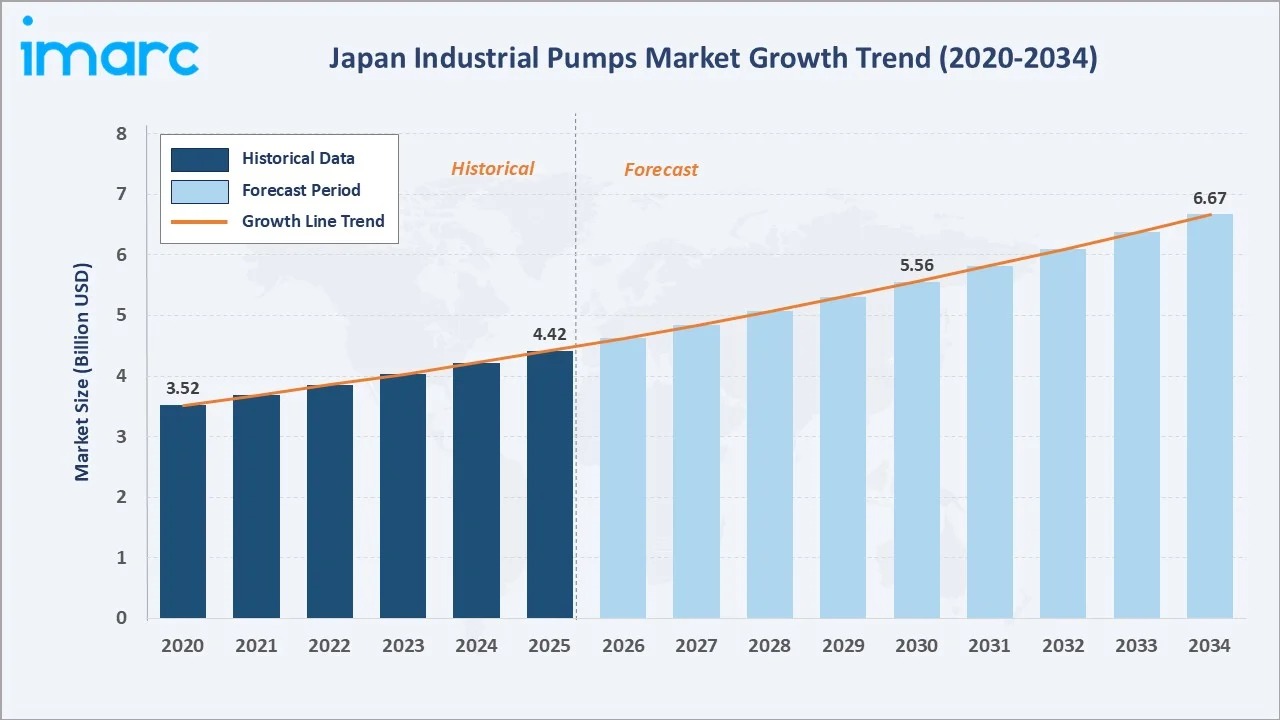
The Japan industrial pumps market was valued at USD 4.42 Billion in 2025 and grew to USD 4.63 Billion in 2026. It is projected to reach USD 6.67 Billion by 2034, expanding at a CAGR of 4.67% during 2026-2034. Market demand is anchored in water and wastewater treatment, chemical processing, oil and gas, food and beverage, and manufacturing sectors. Centrifugal pumps command 61.8% of the 2025 product segment, offline distribution channels account for 68.4% of sales, and the Kanto region holds 34.2% of regional market revenue.
Market Snapshot
|
Metric |
Value |
|
Base Year Market Size (2025) |
USD 4.42 Billion |
|
Market Size (2026) |
USD 4.63 Billion |
|
Forecast Market Size (2034) |
USD 6.67 Billion |
|
CAGR (2026-2034) |
4.67% |
|
Base Year |
2025 |
|
Historical Period |
2020-2025 |
|
Forecast Period |
2026-2034 |
|
Leading Product |
Centrifugal Pump (61.8%, 2025) |
|
Leading Distribution Channel |
Offline (68.4%, 2025) |
|
Leading Region |
Kanto Region (34.2%, 2025) |
The Japan industrial pumps market grew from USD 3.52 Billion in 2020 to USD 4.42 Billion by 2025 and reached USD 4.63 Billion in 2026. The market is projected to reach USD 5.56 Billion by 2030 and USD 6.67 Billion by 2034.
To get more information on this market, Request Sample
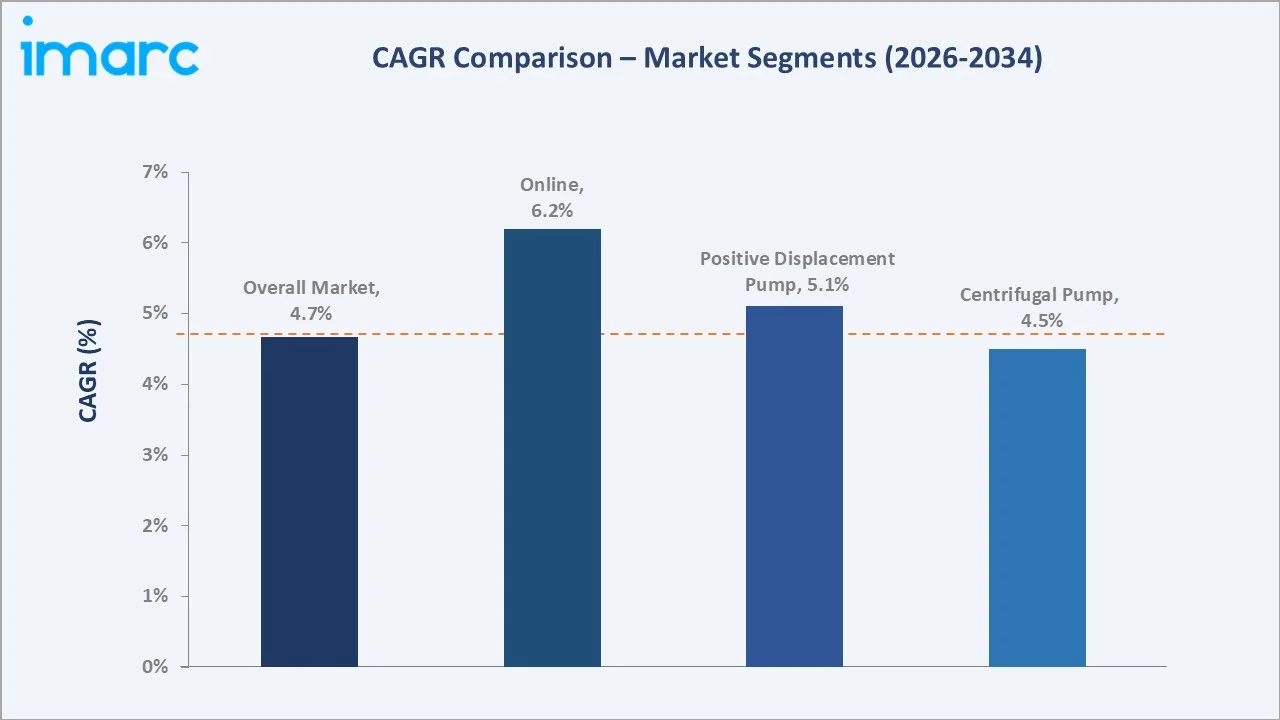
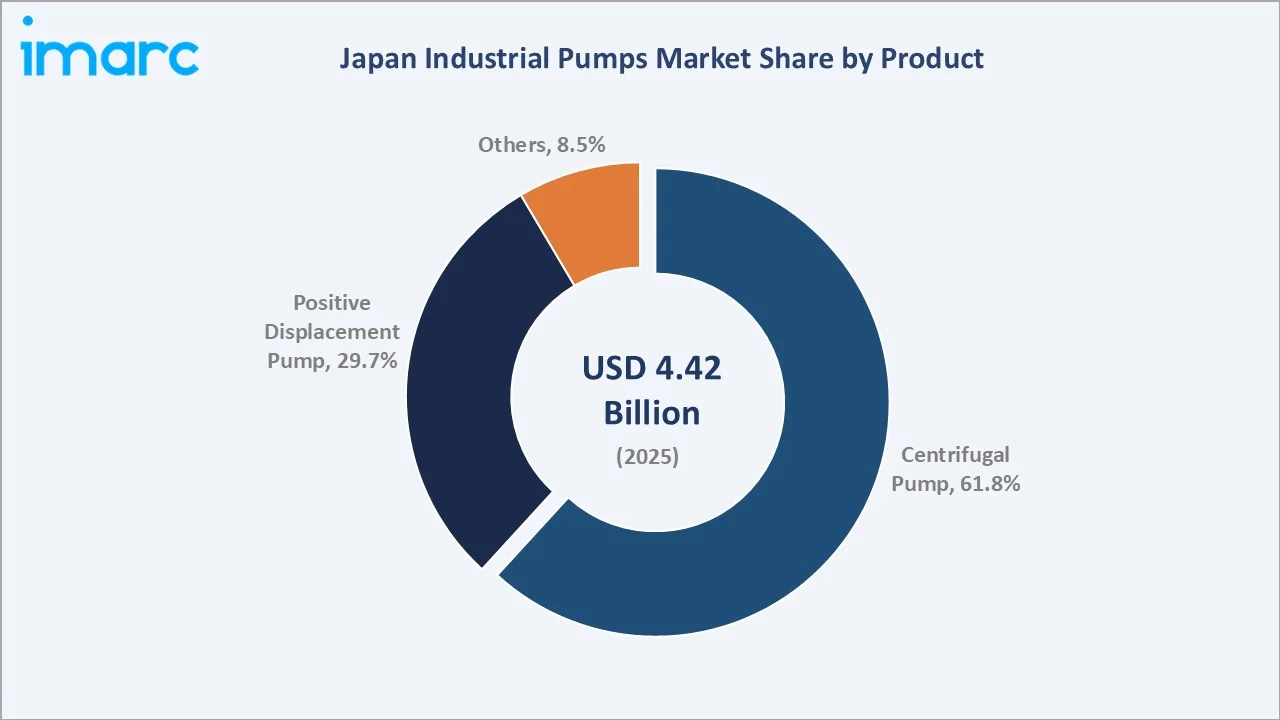
Positive displacement pumps represent the fastest-growing product segment at 5.1% CAGR through 2034, driven by expanding chemical, pharmaceutical, and food processing industries requiring precise volumetric flow control and high-viscosity fluid handling. Centrifugal pumps maintain dominant market leadership at 61.8% of the 2025 product segment, supported by broad applicability across water treatment, HVAC, and general industrial fluid transfer applications.
Executive Summary
The Japan industrial pumps market represents a critical infrastructure segment serving the nation's water and wastewater treatment, chemical processing, petroleum refining, food and beverage, pharmaceutical manufacturing, and general industrial fluid management operations. Japan's advanced industrial base, stringent environmental compliance requirements, and active infrastructure renewal programs collectively sustain robust demand across centrifugal and positive displacement pump categories.
Centrifugal pumps dominate with 61.8% of the 2025 product market, driven by their versatility in water treatment, HVAC systems, and industrial process applications. Offline distribution channels account for 68.4% of 2025 market sales, reflecting the industry's reliance on technical consultants, authorized distributors, and direct manufacturer relationships for complex pump system procurement and specification support. The Kanto region leads with 34.2% of national market share, anchored by Tokyo metropolitan industrial infrastructure and trading company headquarters.
Key Market Insights
|
Insight |
Data |
|
Leading Product |
Centrifugal Pump - 61.8% share (2025) |
|
Leading Distribution Channel |
Offline - 68.4% share (2025) |
|
Leading Region |
Kanto Region - 34.2% (2025) |
|
Key Market Opportunity |
Smart pump integration with IoT and AI-driven predictive maintenance platforms, offering significant operational efficiency gains for water utilities, chemical plants, and manufacturing facilities. |
Key Analytical Observations Supporting the Above Data:
- Centrifugal pumps at 61.8%: Centrifugal pumps' broad applicability across water treatment, HVAC, general industrial fluid transfer, and chemical processing makes them the dominant product category, with established domestic manufacturing infrastructure supporting competitive pricing and service availability.
- Offline distribution at 68.4%: Complex pump system specification, technical application engineering, and long-term service contract requirements favor offline channels through authorized distributors and manufacturer direct sales teams, maintaining dominant market share over digital procurement platforms.
- Kanto Region at 34.2%: Tokyo metropolitan industrial infrastructure, including water utilities, chemical plants, semiconductor fabs, and pharmaceutical manufacturers, concentrates the largest regional industrial pump demand, reinforced by proximity to trading and distribution headquarters.
Japan Industrial Pumps Market Overview
The Japan industrial pumps market encompasses the design, manufacturing, distribution, installation, and maintenance of mechanical devices for moving fluids in industrial process applications. Industrial pumps serve critical functions across water and wastewater treatment infrastructure, chemical and petrochemical processing, food and beverage production, pharmaceutical manufacturing, oil and gas operations, and general industrial fluid management. The market ecosystem spans raw material and component suppliers, pump OEM manufacturers, quality testing and certification bodies, authorized distributors and EPC contractors, end-use industrial operators, and MRO service providers across Japan's eight regional industrial markets.
Market Dynamics
To evaluate market opportunities, Request Sample
Market Drivers
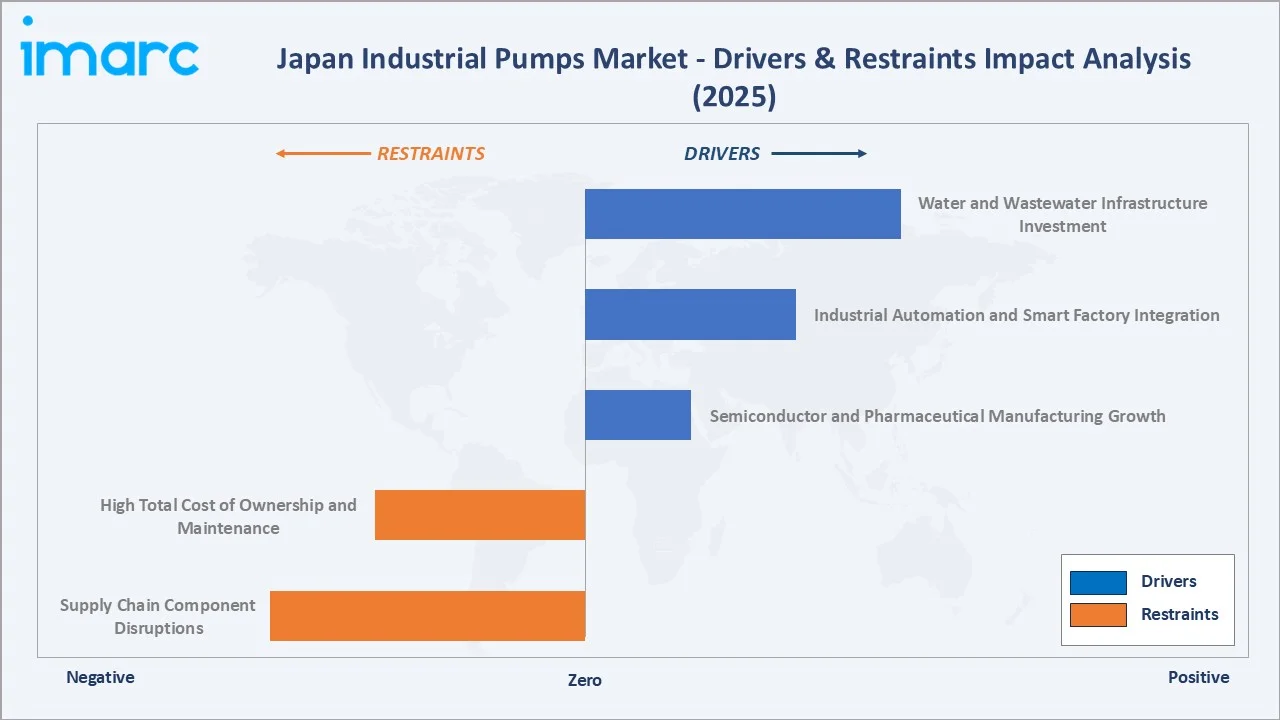
- Water and Wastewater Infrastructure Investment: According to Japan’s Ministry of Land, Infrastructure, Transport and Tourism (MLIT), the country had approximately 490,000 kilometers of sewer networks in 2023, with around 16% expected to be at least 50 years old by 2030, increasing to 34% by 2040. The aging infrastructure is driving demand for industrial pumps as municipalities invest in sewer rehabilitation, wastewater management, and replacement of outdated pumping systems to improve operational efficiency and reliability.
- Industrial Automation and Smart Factory Integration: Japan's Society 5.0 industrial digitalization framework is accelerating IoT-enabled pump monitoring, predictive maintenance, and automated flow control system adoption. Manufacturers are integrating smart pumps with industrial IoT platforms to optimize energy consumption, reduce unplanned downtime, and improve process reliability.
- Semiconductor and Pharmaceutical Manufacturing Growth: Japan's expanding semiconductor fabrication and pharmaceutical manufacturing sectors require high-purity, precision fluid handling pumps for ultrapure water delivery, chemical dosing, and cleanroom process applications, creating sustained demand for specialized pump technology at premium performance specifications.
Market Restraints
- High Total Cost of Ownership and Maintenance: Industrial pump total cost of ownership, including energy consumption, scheduled maintenance, seal and bearing replacement, and unplanned repair costs, represents a significant operational burden for end users, creating price sensitivity in procurement decisions and evaluation of alternative fluid management technologies.
- Supply Chain Component Disruptions: Global semiconductor shortages affecting pump motor drive electronics, casting and machining lead time volatility, and logistics cost increases have created supply chain management challenges, extending pump delivery lead times and creating inventory management pressures.
Market Opportunities
- Energy-Efficient Variable Frequency Drive Pump Integration: Japan's strict industrial energy efficiency regulations and carbon neutrality commitments are driving replacement of fixed-speed pumps with variable frequency drive-equipped systems, offering energy savings in variable-load applications and creating significant upgrade market opportunities across water utilities and industrial facilities.
- Digital Pump Monitoring and Predictive Maintenance Services: IoT sensor integration, AI-driven vibration analysis, and remote pump condition monitoring service platforms represent high-value aftermarket opportunities for pump manufacturers to build recurring revenue streams and deepen customer relationships beyond hardware sales.
Market Challenges
- Skilled Technician Shortage for Pump Maintenance: Japan's aging workforce and declining enrollment in mechanical engineering programs are creating shortages of qualified pump maintenance technicians, challenging industrial operators to maintain complex pump systems and driving adoption of remote monitoring and automated diagnostic technologies to compensate for reduced manual inspection capacity.
- Stringent Regulatory Compliance Requirements: Chemical resistance certification, pressure vessel compliance, explosion-proof classification, and hygienic design standards for food and pharmaceutical applications require extensive product testing and documentation, increasing development costs and market entry barriers for new pump designs and international suppliers entering the Japan market.
Emerging Market Trends
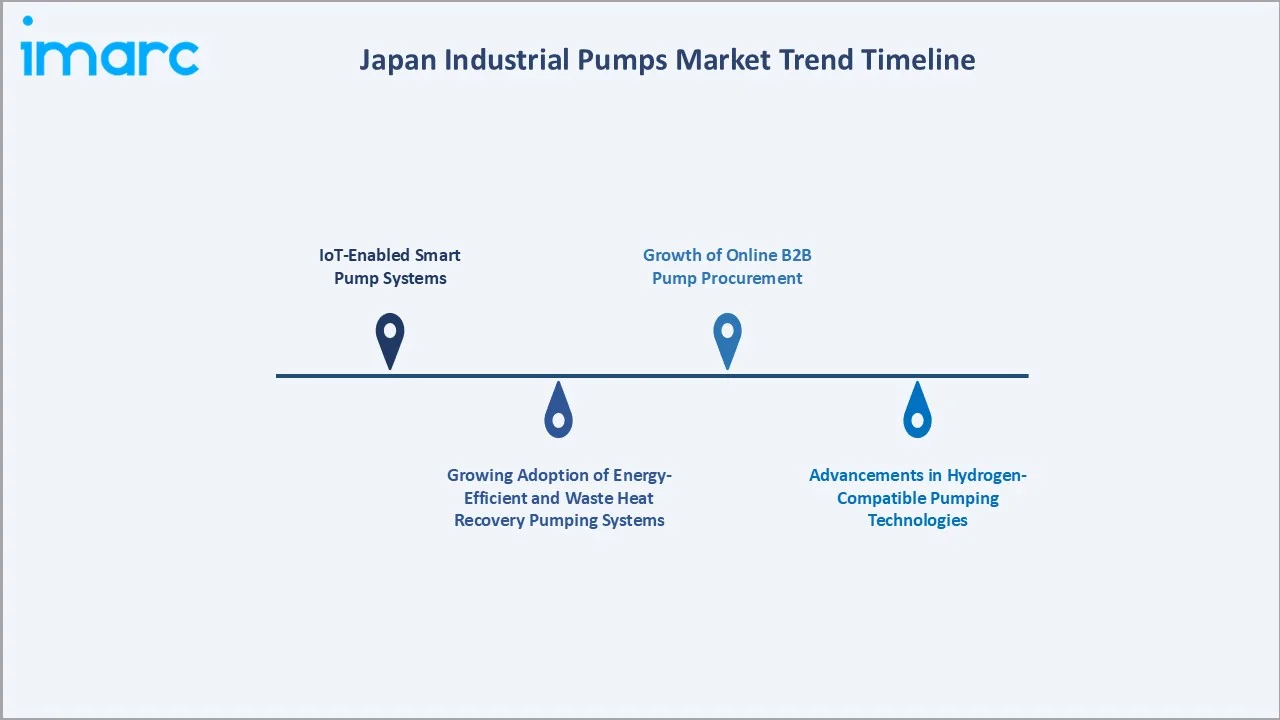
1. IoT-Enabled Smart Pump Systems
Leading Japanese pump manufacturers are integrating vibration sensors, flow meters, temperature probes, and IoT communication modules directly into pump housings, enabling real-time performance monitoring and predictive failure detection. Smart pump adoption is accelerating across water utilities and chemical plants seeking to reduce unplanned downtime and optimize energy consumption through data-driven operations.
2. Growing Adoption of Energy-Efficient and Waste Heat Recovery Pumping Systems
Investments in advanced pumping technologies, heat recovery systems, and automated process controls are supporting industrial efficiency and sustainability across manufacturing and wastewater treatment applications. In October 2025, Mitsubishi Heavy Industries Thermal Systems introduced the ETI-W centrifugal heat pump in Japan, which recovers factory waste heat to produce hot water at temperatures of up to 90°C and capacities of 640 kW, offering an energy-efficient alternative to conventional boilers for high-temperature industrial applications.
3. Growth of Online B2B Pump Procurement
E-procurement platforms and digital pump configurators are gaining traction for standardized pump models, replacement parts, and small-capacity general-purpose applications. Major distributors and OEMs are deploying comprehensive online catalogs with technical specification tools, driving online channel growth, the fastest distribution channel expansion in the Japan industrial pumps market through 2034.
4. Advancements in Hydrogen-Compatible Pumping Technologies
In January 2026, Torishima Pump Mfg. Co., Ltd. received an order from Kawasaki Heavy Industries for high-flow liquid hydrogen pumps featuring superconducting motor technology. The pumps will support the Kawasaki LH₂ Terminal, a major component of Japan’s government-backed liquid hydrogen supply chain demonstration project. The development of high-flow liquid hydrogen pumps equipped with superconducting motor technology is supporting the expansion of hydrogen storage, transportation, and supply chain facilities while encouraging the adoption of advanced industrial equipment.
Industry Value Chain Analysis
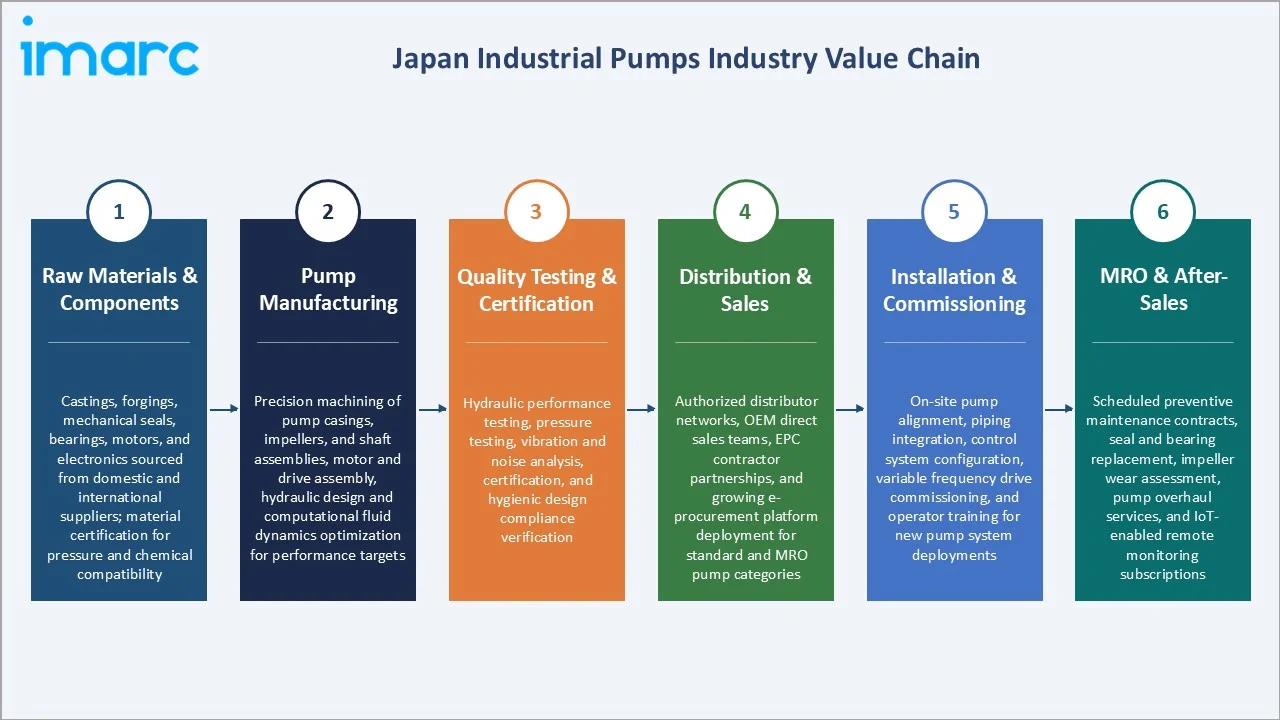
The Japan industrial pumps market value chain spans six integrated stages from raw material and component supply through end-of-life MRO services, each representing distinct value-addition activities and competitive positioning opportunities for market participants.
|
Stage |
Key Activities |
|
Raw Materials & Components |
Castings, forgings, mechanical seals, bearings, motors, and electronics sourced from domestic and international suppliers; material certification for pressure and chemical compatibility. |
|
Pump Manufacturing |
Precision machining of pump casings, impellers, and shaft assemblies, motor and drive assembly, hydraulic design and computational fluid dynamics optimization for performance targets. |
|
Quality Testing & Certification |
Hydraulic performance testing, pressure testing, vibration and noise analysis, certification, and hygienic design compliance verification. |
|
Distribution & Sales |
Authorized distributor networks, OEM direct sales teams, EPC contractor partnerships, and growing e-procurement platform deployment for standard and MRO pump categories. |
|
Installation & Commissioning |
On-site pump alignment, piping integration, control system configuration, variable frequency drive commissioning, and operator training for new pump system deployments. |
|
MRO & After-Sales |
Scheduled preventive maintenance contracts, seal and bearing replacement, impeller wear assessment, pump overhaul services, and IoT-enabled remote monitoring subscriptions. |
Pump manufacturing and MRO & after-sales services represent the highest value-added stages for Japanese pump companies. Quality testing and certification are a critical differentiator, particularly for chemical, pharmaceutical, and semiconductor application pumps requiring rigorous compliance documentation. Growing IoT integration is expanding MRO service revenue streams through subscription-based remote monitoring and predictive maintenance offerings.
Technology Landscape in the Japan Industrial Pumps Industry
Advanced Hydraulic Design and Computational Fluid Dynamics
Japanese pump manufacturers are leveraging computational fluid dynamics (CFD) modeling and advanced hydraulic design software to optimize impeller geometry, volute profiles, and internal flow paths for efficiency improvements and cavitation resistance. High-efficiency pump designs achieving IE4 and IE5 motor efficiency classifications are becoming standard offerings as energy performance requirements tighten under national efficiency regulations.
IoT Integration and Predictive Maintenance Platforms
Embedded vibration analysis, acoustic emission monitoring, and thermal imaging sensor integration are enabling condition-based maintenance strategies, replacing fixed-interval pump overhaul programs. AI-powered pump diagnostic platforms from companies provide real-time anomaly detection, remaining useful life prediction, and automated maintenance scheduling for industrial pump fleets.
Advanced Materials and Coating Technologies
Ceramic coating, thermal spray, and high-performance polymer lining technologies are extending pump wear life in abrasive slurry, corrosive chemical, and high-temperature process applications. Silicon carbide mechanical seals, PEEK polymer components, and superalloy casing materials enable pump deployment in increasingly demanding chemical, semiconductor, and pharmaceutical processing environments.
Market Segmentation Analysis
The report covers the following segments:
|
Segment Category |
Leading Segment |
Market Share |
Year |
|
Product |
Centrifugal Pump |
61.8% |
2025 |
|
Distribution Channel |
Offline |
68.4% |
2025 |
|
Application |
🔒 |
🔒 |
2025 |
|
Region |
Kanto Region |
34.2% |
2025 |

By Product
Centrifugal pumps lead with a 61.8% share in 2025, driven by their broad applicability across water supply, wastewater treatment, HVAC cooling circuits, chemical process circulation, and general industrial fluid transfer.
To access detailed market analysis, Request Sample
Positive displacement pumps account for 29.7% of 2025 market share, serving applications requiring precise volumetric flow control, high-pressure delivery, or high-viscosity fluid handling. Others, including submersible, axial flow, and jet pumps, comprise 8.5% of the 2025 market.
By Distribution Channel
Offline dominates with a 68.4% share in 2025, encompassing authorized distributor networks, manufacturer direct sales teams, EPC contractor procurement, and trade show-sourced purchasing relationships.
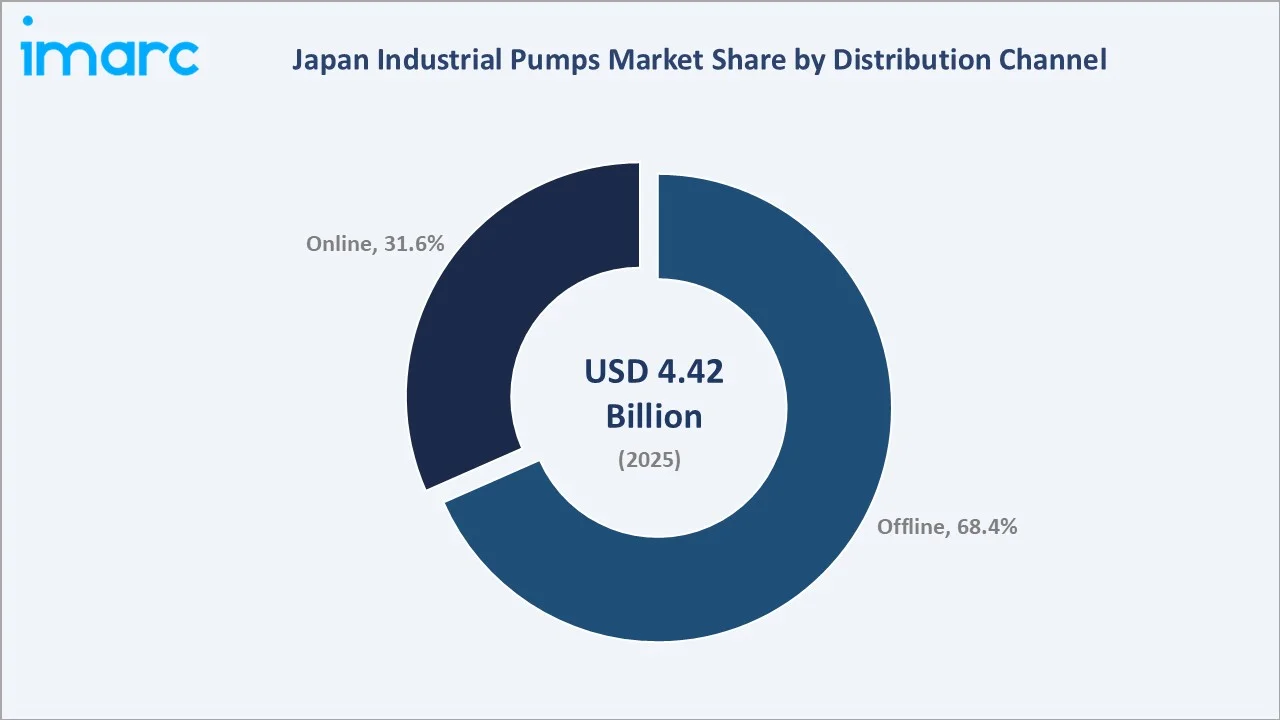
Online represents 31.6% of 2025 market share, serving standardized pump model procurement, MRO replacement parts sourcing, and small-capacity general-purpose pump purchases through manufacturer e-commerce platforms and industrial B2B marketplaces.
Regional Market Insights
|
Region |
Share (2025) |
Key Characteristics |
|
Kanto Region |
34.2% |
Largest market anchored by Tokyo metropolitan industrial infrastructure, water utility systems, semiconductor fabrication, pharmaceutical manufacturing, and major chemical plant operations. |
|
Kansai/Kinki Region |
21.8% |
Major industrial hub with chemical processing, steel manufacturing, water treatment facilities, and precision engineering operations concentrated in industrial zones. |
|
Central/Chubu Region |
14.9% |
Automotive manufacturing heartland requiring pump systems for cooling circuits, painting processes, and general plant utilities, with growing food processing and pharmaceutical sectors adding demand. |
|
Kyushu-Okinawa Region |
9.8% |
Active chemical and semiconductor manufacturing base with growing water treatment infrastructure investment, expanding food processing and electronics manufacturing driving pump procurement. |
|
Tohoku Region |
7.2% |
Post-reconstruction infrastructure renewal programs and expanding manufacturing activity supporting water supply and industrial pump demand, food processing and chemical sectors growing steadily. |
|
Chugoku Region |
5.7% |
Steel, chemical, and shipbuilding industrial operations generating pump demand for process fluid management, cooling, and hydraulic applications. |
|
Hokkaido Region |
3.8% |
Agricultural processing, dairy, food production, and water infrastructure operations driving steady pump demand; growing semiconductor and energy sector investments expanding market. |
|
Shikoku Region |
2.6% |
Smallest regional market with chemical manufacturing, paper industry, and water infrastructure operations, consistent pump procurement from industrial facilities and municipal utilities. |
The Kanto region leads with 34.2% of the 2025 market, driven by Tokyo-area water treatment capacity, semiconductor and pharmaceutical manufacturing concentration, and major industrial facility density. Kansai/Kinki region accounts for 21.8%, reflecting the concentration of manufacturing operations, chemical processing, water utilities, and industrial infrastructure. The Central/Chubu region's 14.9% share is anchored by automotive manufacturing pump requirements.
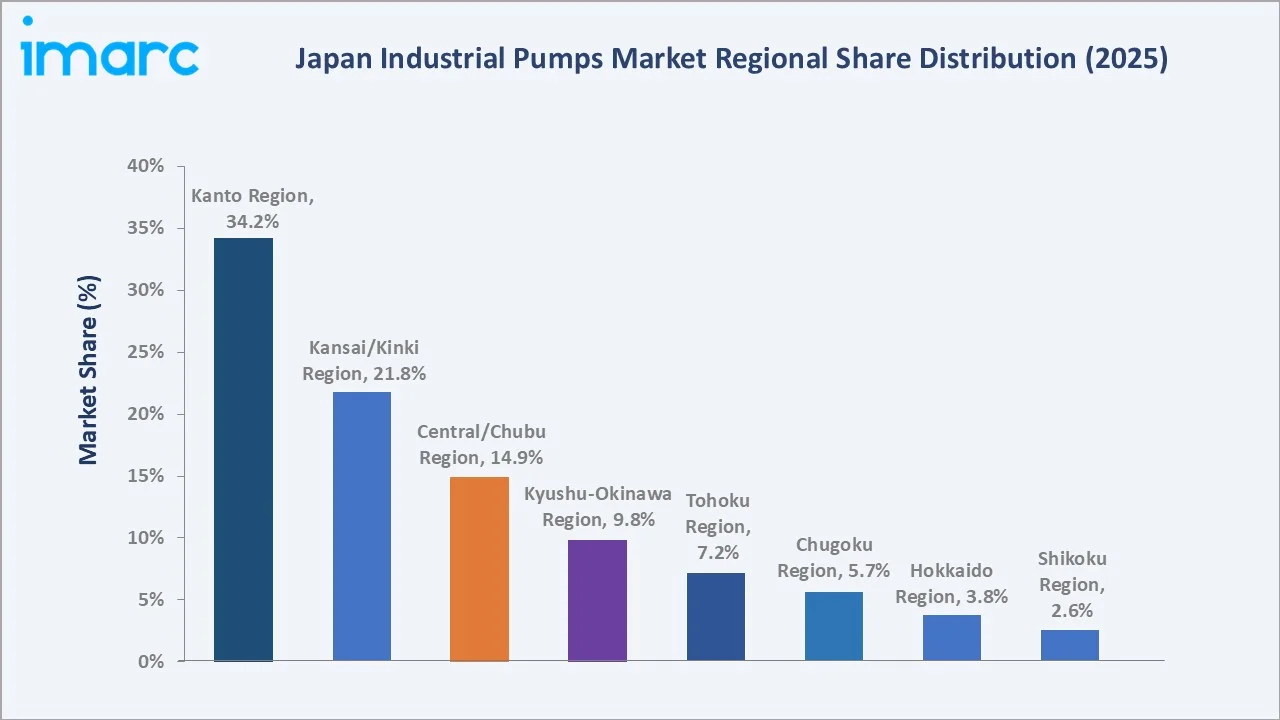
Kyushu-Okinawa accounted for 9.8%, benefiting from semiconductor production, chemical industries, and investments in water treatment infrastructure. Tohoku captured 7.2%, with demand supported by infrastructure renewal and manufacturing activities. Chugoku represented 5.7%, driven by steel, chemical, and shipbuilding operations requiring process fluid handling and cooling systems. Hokkaido held a 3.8% share, supported by agricultural processing, dairy production, and water infrastructure requirements. Shikoku accounted for the remaining 2.6%, with demand arising from chemical manufacturing, paper production, and municipal water utilities.
Competitive Landscape
The Japan industrial pumps market is led by strong domestic manufacturers with deep application engineering expertise, complemented by established global pump brands with Japan operations. Competition centers on hydraulic performance efficiency, total cost of ownership, application engineering capabilities, spare parts availability, and growing IoT and smart pump technology differentiation.
| Company | Key Products | Market Position | Core Strengths |
|---|---|---|---|
| EBARA CORPORATION | model GS, model FS, model S, model IBL, model GSO, model FSS, model SAL, model GSD | Market Leader | EBARA CORPORATION is a foundational pioneer and major global manufacturer of industrial pumps and fluid machinery in Japan. |
| Nikkiso Co., Ltd. | Canned Motor Pumps (Non-Seal Pumps), Reciprocating Pumps (Metering Pumps) | Market Leader | Nikkiso Co., Ltd. plays a foundational role in Japan’s industrial pump and fluid-handling sector as a pioneer and major manufacturer. |
| IWAKI CO., LTD. | Magnetic drive pumps, Motor driven metering pumps, Electromagnetic metering pumps, Pneumatic drive bellows pumps, Rotary displacement pumps | Established Player | IWAKI CO., LTD. is one of the pioneers and leading global manufacturers of chemical pumps and fluid control equipment. |
| TSURUMI MANUFACTURING CO., LTD. | Submersible Pumps, Liquid Ring Pumps | Established Player | TSURUMI MANUFACTURING CO., LTD. is a pioneer and leading manufacturer of industrial and submersible pumps in Japan |
| Xylem | End Suction Pumps, In-Line Pumps, Double Suction Pumps, Multi-Stage Pumps, Length Turbine Pumps, Circulator Pumps | Challenger | Xylem plays a critical role as a leading global provider of highly efficient centrifugal and smart fluid management solutions in the competitive Japan industrial pumps market. |
Global brands compete effectively in specialized technology segments leveraging international R&D investment and global product platform advantages.
Key Company Profiles
EBARA CORPORATION
EBARA CORPORATION is a Japanese industrial machinery manufacturer established in 1912 and headquartered in Tokyo. The company specializes in pumps and fluid-handling equipment, serving industrial, energy, infrastructure, and environmental applications. Its product portfolio includes standard pumps, custom-engineered pumps, blowers, and related fluid systems for manufacturing facilities and water infrastructure. In the Japan industrial pumps market, EBARA supports applications such as water supply, wastewater management, industrial fluid transportation, and process operations.
- Key Products: model GS, model FS, model S, model IBL, model GSO, model FSS, model SAL, model GSD.
- Strategic Focus: Expanding its industrial pump portfolio through technological innovation, energy-efficient designs, and advanced fluid-handling solutions. The company prioritizes improving operational reliability, strengthening its presence across industrial and infrastructure applications, and developing sustainable pumping technologies to meet evolving market requirements.
Nikkiso Co., Ltd.
Nikkiso Co., Ltd. operates across industrial, aerospace, and medical businesses, with its industrial division specializing in pumps and fluid-handling systems. Its product portfolio includes canned motor pumps, reciprocating metering pumps, cryogenic pumps, and specialized pumping systems for demanding industrial applications. In the Japan industrial pumps market, Nikkiso serves sectors requiring reliable fluid transfer, including energy, chemical processing, and liquefied gas infrastructure.
- Key Offerings: Canned Motor Pumps (Non-Seal Pumps), Reciprocating Pumps (Metering Pumps).
- Strategic Focus: Focuses on developing specialized pumping solutions for demanding industrial applications, including cryogenic fluid handling, energy, and chemical processing. Its strategic priorities include advancing pump technology, enhancing operational reliability, and supporting emerging infrastructure requirements through high-performance and energy-efficient equipment.
Market Concentration Analysis
The Japan industrial pumps market is moderately concentrated. Domestic manufacturers command the water utility, chemical process, and submersible pump segments through long-standing customer relationships, established service networks, and application engineering expertise. International brands capture significant share in specialized technology segments, energy-efficient circulators, precision process pumps, and high-performance sealing applications, where global R&D investment delivers differentiated product capabilities. The market shows consolidation potential in the smart pump and digital services segment as technology leadership becomes an increasingly important competitive differentiator alongside hardware performance.
Investment & Growth Opportunities
Highest Growth Segments
The online distribution channel grows at 6.2% CAGR and positive displacement pumps grow at 5.1% CAGR, while digital pump services and hydrogen economy pump technology represent emerging high-value growth vectors.
Investment Themes
- IoT Smart Pump Platform and Digital Services Development: Investing in embedded sensor integration, cloud-connected pump monitoring platforms, and AI-driven predictive maintenance service subscriptions creates recurring revenue streams beyond hardware sales, building customer retention and data-driven competitive differentiation in Japan's water utility, chemical, and manufacturing pump markets.
- Energy-Efficient VFD Pump Replacement Programs: Japan's aging fixed-speed pump infrastructure and tightening energy efficiency regulations create substantial replacement market opportunity. Targeted retrofit programs offering VFD-equipped pump systems with documented energy savings calculations and ROI payback analysis address both utility compliance requirements and industrial cost reduction priorities.
- Hydrogen Economy and Advanced Manufacturing Pump Technology: Developing hydrogen-compatible cryogenic, high-pressure, and specialty material pump designs for Japan's emerging hydrogen energy infrastructure positions manufacturers for a high-growth technology segment, while expanding pharmaceutical, semiconductor, and food processing applications support premium-priced positive displacement pump market development.
Future Market Outlook (2026-2034)
The Japan industrial pumps market was valued at USD 4.42 Billion in 2025 and reached USD 4.63 Billion in 2026. The market is projected to reach USD 5.56 Billion by 2030 and USD 6.67 Billion by 2034, exhibiting a CAGR of 4.67% during 2026-2034. Growth will be anchored by water infrastructure renewal investment, industrial automation integration, aging pump fleet replacement demand, and expanding advanced manufacturing sectors requiring precision fluid management systems.
Three structural forces will define the Japan industrial pumps market through 2034. First, Japan's national water infrastructure renewal will sustain substantial centrifugal pump procurement across municipal water utilities and wastewater treatment facilities, with increasing emphasis on energy-efficient variable frequency drive-equipped pump systems meeting current performance and sustainability standards.
Second, the industrial automation transition toward smart factories and Industry 4.0 operations will drive systematic replacement of conventional pumps with IoT-enabled smart pump systems providing real-time performance data, predictive maintenance capabilities, and automated process optimization, rewarding pump manufacturers with strong digital platform development capabilities. Third, Japan's hydrogen economy roadmap and semiconductor manufacturing expansion will create sustained demand for specialty pump technologies in cryogenic hydrogen handling, high-purity chemical delivery, and ultrapure water management applications, supporting premium positive displacement and specialty centrifugal pump market development through the forecast period.
Research Methodology
Primary Research
Primary research included structured interviews with pump manufacturers, authorized distributors, water utility procurement managers, chemical plant maintenance engineers, EPC project managers, and Japan Fluid Power Association representatives. Technical consultations with pump application engineers and industrial automation specialists informed technology trend analysis and market forecast assumptions.
Secondary Research
Secondary research incorporated Japan pump shipment statistics, water infrastructure investment data, pump manufacturer annual reports and investor presentations, and international industrial pump market analyses covering competing regional markets.
Forecasting Models
Market forecasting integrates Japan water infrastructure investment program timelines, industrial production output projections, energy efficiency regulation implementation schedules, aging pump fleet replacement cycle modeling, digital adoption penetration scenarios for smart pump technology, and end-use sector growth trajectories across water, chemical, pharmaceutical, semiconductor, and food processing industries.
Japan Industrial Pumps Market Report Coverage:
| Report Features | Details |
|---|---|
| Base Year of the Analysis | 2025 |
| Historical Period | 2020-2025 |
| Forecast Period | 2026-2034 |
| Units | Billion USD |
| Scope of the Report |
Exploration of Historical Trends and Market Outlook, Industry Catalysts and Challenges, Segment-Wise Historical and Future Market Assessment:
|
| Products Covered |
|
| Distribution Channels Covered | Online, Offline |
| Applications Covered | Oil and Gas, Chemicals, Construction, Power Generation, Water and Wastewater, Others |
| Regions Covered | Kanto Region, Kansai/Kinki Region, Central/ Chubu Region, Kyushu-Okinawa Region, Tohoku Region, Chugoku Region, Hokkaido Region, Shikoku Region |
| Companies Covered | EBARA CORPORATION, Nikkiso Co., Ltd., IWAKI CO., LTD., TSURUMI MANUFACTURING CO., LTD., Xylem, etc. |
| Customization Scope | 10% Free Customization |
| Post-Sale Analyst Support | 10-12 Weeks |
| Delivery Format | PDF and Excel through Email (We can also provide the editable version of the report in PPT/Word format on special request) |
Key Benefits for Stakeholders:
- IMARC’s industry report offers a comprehensive quantitative analysis of various market segments, historical and current market trends, market forecasts, and dynamics of the Japan industrial pumps market from 2020-2034.
- The research report provides the latest information on the market drivers, challenges, and opportunities in the Japan industrial pumps market.
- Porter's five forces analysis assist stakeholders in assessing the impact of new entrants, competitive rivalry, supplier power, buyer power, and the threat of substitution. It helps stakeholders to analyze the level of competition within the Japan industrial pumps industry and its attractiveness.
- Competitive landscape allows stakeholders to understand their competitive environment and provides an insight into the current positions of key players in the market.
Frequently Asked Questions About the Japan Industrial Pumps Market Report
The Japan industrial pumps market reached USD 4.63 Billion in 2026, driven by water infrastructure investment, industrial automation adoption, and growing demand from semiconductor and pharmaceutical manufacturing sectors.
The market is projected to grow at a CAGR of 4.67% during 2026-2034, supported by water utility renewal programs, aging pump fleet replacement, energy efficiency mandates, and smart pump technology adoption.
The Japan industrial pumps market is projected to reach USD 5.56 Billion by 2030, driven by municipal water infrastructure investment, industrial automation integration, and expanding pharmaceutical and semiconductor pump demand.
The market is projected to reach USD 6.67 Billion by 2034, supported by water infrastructure renewal completion, smart factory pump system deployments, hydrogen economy applications, and positive displacement pump growth.
Centrifugal pumps lead with 61.8% of the 2025 market, driven by broad applicability in water treatment, HVAC, chemical processing, and industrial fluid transfer applications across all regional markets.
Offline channels dominate with 68.4% of 2025 sales, reflecting technical specification complexity, application engineering support requirements, and long-term service contract relationships favoring authorized distributor and direct sales models.
The Kanto region leads with 34.2% of the 2025 market, driven by Tokyo metropolitan water utilities, semiconductor fabrication, pharmaceutical manufacturing, and major chemical plant operations concentrated in the region.
Key players include EBARA CORPORATION, Nikkiso Co., Ltd., IWAKI CO., LTD., TSURUMI MANUFACTURING CO., LTD., and Xylem, among others.
Need more help?
- Speak to our experienced analysts for insights on the current market scenarios.
- Include additional segments and countries to customize the report as per your requirement.
- Gain an unparalleled competitive advantage in your domain by understanding how to utilize the report and positively impacting your operations and revenue.
- For further assistance, please connect with our analysts.
 Request Customization
 Speak to an Analyst
 Request Brochure
 Inquire Before Buying
Benefits of Customization
- Personalize this research
- Triangulate with your data
- Get data as per your format and definition
- Gain a deeper dive into a specific application, geography, customer, or competitor
- Any level of personalization
Get in Touch With Us
UNITED STATES
Phone: +1-201-971-6302
INDIA
Phone: +91-120-433-0800
UNITED KINGDOM
Phone: +44-753-714-6104
Email: [email protected]
Client Testimonials




.webp)



.webp)










Related Reports

Choose your plan
*Please note that the prices mentioned below are starting prices for each bundle type. Kindly contact our team for further details.*
Single User License
- 1 User License, Access on 2 Devices
- PDF Report + Excel Dataset (Password Protected)
- Lifetime Access
- No Printing Rights
- 10% Free Report Customization
- 10–12 Weeks of Analyst Support
Five User License
- Access for 5 Users, 2 Devices per User
- PDF Report + Excel Dataset (Password Protected)
- Lifetime Access
- Dedicated Account Manager
- 12–14 Weeks of Analyst Support
- No Printing Rights
- 15% Free Report Customization
- 25% Discount on Your Next Purchase
Corporate User License
- Unlimited User Access (Within Your Organization)
- PDF Report + Excel Dataset
- Lifetime Access
- Dedicated Account Manager
- 14–20 Weeks of Analyst Support
- No Printing Rights
- 20% Free Report Customization
- 30% Discount on Your Next Purchase
Essential Insights
What's included:
3 reports
- Lifetime Access
- PDF Reports
- Excel Datasets
- 2 Weeks of Free Analyst Support
- 2 User Licenses
- Access on 2 Devices
- Printing Rights
- Complimentary PowerPoint (PPT) Version
- Complimentary License Upgrade
Professional Access
What's included:
5 reports
- Lifetime Access
- PDF Reports
- Excel Datasets
- 8 Weeks of Free Analyst Support
- 2 User Licenses
- Access on 2 Devices
- Printing Rights
- Complimentary PowerPoint (PPT) Version
- Complimentary License Upgrade
Business Advantage
What's included:
8 reports
- Lifetime Access
- PDF Reports
- Excel Datasets
- 14 Weeks of Free Analyst Support
- 2 User Licenses
- Access on 2 Devices
- Printing Rights
- Complimentary PowerPoint (PPT) Version
- Complimentary License Upgrade
Enterprise Intelligence
What's included:
10 reports
- Lifetime Access
- PDF Reports
- Excel Datasets
- 20 Weeks of Free Analyst Support
- 2 User Licenses
- Access on 2 Devices
- Printing Rights
- Complimentary PowerPoint (PPT) Version
- Complimentary License Upgrade