
Japan Industrial Valves Market Size, Share, Trends and Forecast by Product Type, Functionality, Material, Size, End Use Industry, and Region, 2026-2034
Japan Industrial Valves Market Summary:
The Japan industrial valves market size was valued at USD 3.59 Billion in 2025 and is projected to reach USD 5.27 Billion by 2034, growing at a compound annual growth rate of 4.36% from 2026-2034.
The Japan industrial valves market is gaining sustained momentum as the nation accelerates infrastructure modernization, energy transition, and advanced manufacturing development. Increasing investments in refinery upgrades, petrochemical expansions, and hydrogen-based energy systems are driving demand for high-performance flow control solutions. Growing emphasis on water treatment infrastructure renewal and smart factory integration is reinforcing the need for precision-engineered industrial valves, supporting Japan industrial valves market share.
Key Takeaways and Insights:
- By Product Type: Gate valve dominates the market with a share of 26% in 2025, owing to its widespread use in isolation applications across oil and gas, water treatment, and power generation facilities requiring full-bore flow and minimal pressure drop.
- By Functionality: On-off/isolation valves lead the market with a share of 65% in 2025, driven by essential flow shutoff requirements in pipeline operations, refinery processes, and industrial safety systems throughout the country.
- By Material: Steel exhibits a clear dominance in the market with 44% share in 2025, reflecting the preference for high-strength, corrosion-resistant materials suited for demanding environments in petrochemical, energy, and heavy industrial applications.
- By Size: 1"–6" holds the largest segment with a market share of 30% in 2025, owing to versatile applicability in process piping, utility distribution, and general industrial operations across manufacturing and infrastructure sectors.
- By End Use Industry: Oil and gas represent the largest segment with a market share of 33% in 2025, reflecting Japan's substantial refining capacity and liquefied natural gas processing infrastructure that requires extensive valve deployment.
- Key Players: Key players drive the Japan industrial valves market by expanding product portfolios, advancing smart valve technologies, and strengthening distribution networks. Their investments in research, automation compatibility, and partnerships with engineering firms boost reliability, accelerate adoption, and ensure consistent availability across diverse industrial sectors.
The Japan industrial valves market is advancing as industries prioritize operational efficiency, safety compliance, and digital integration across critical infrastructure systems. A major factor shaping this progress is the nation's commitment to upgrading aging pipeline networks and industrial facilities to meet contemporary performance standards. For instance, Japan's Ministry of Land, Infrastructure, Transport and Tourism reported in 2024 that approximately 20% of the country's water supply pipelines have exceeded their statutory useful life of 40 years, necessitating large-scale replacement programs that substantially increase demand for gate valves, butterfly valves, and check valves across municipal and industrial applications. Policy support for energy diversification, expanding hydrogen and ammonia supply chains, and the ongoing restart of nuclear power facilities are contributing to a favorable environment for advanced valve procurement. Smart manufacturing initiatives under the Society 5.0 framework continue to encourage adoption of digitally integrated flow control systems across industrial operations. Rising investments in seismic-resilient infrastructure and stricter environmental compliance standards are additionally reinforcing sustained procurement activity throughout the Japanese industrial valve sector.
Japan Industrial Valves Market Trends:
Growing adoption of smart and digitally integrated valve systems
Japan's industrial sector is increasingly embracing Internet of Things-enabled valve technologies that allow real-time monitoring, predictive maintenance, and automated flow control. Manufacturers are embedding advanced sensors, actuators, and communication modules into valve assemblies to improve operational visibility and reduce unplanned downtime across facilities. This digital transformation aligns with the broader Society 5.0 vision, where connected infrastructure supports higher productivity and safer operations across chemical plants, refineries, and power generation facilities, supporting Japan industrial valves market growth.
Expansion of hydrogen and ammonia energy infrastructure
The national push toward a hydrogen-based economy is creating significant demand for specialized industrial valves capable of handling high-pressure, cryogenic, and corrosive hydrogen and ammonia streams. Under Japan's revised Basic Hydrogen Strategy released by METI in June 2023, the government targets 15 Trillion yen in public and private sector investment over 15 years and aims to increase hydrogen supply to 12 Million tonnes annually by 2040. New supply chain infrastructure for hydrogen transportation, storage, and utilization at power plants and industrial complexes requires advanced valve solutions specifically designed to prevent leakage and ensure long-term operational integrity. This emerging energy transition pathway is fundamentally reshaping product development priorities and material innovation within the Japanese flow control equipment industry.
Accelerating renewal of aging water and wastewater infrastructure
Municipal and industrial water systems across Japan are undergoing extensive rehabilitation as decades-old pipelines, treatment facilities, and distribution networks approach end-of-life conditions. According to the Ministry of Land, Infrastructure, Transport and Tourism, Japan had approximately 490,000 kilometres of sewer systems in 2023, with 16% expected to be at least 50 years old by 2030, rising to 34% by 2040. Valve replacement programs are expanding rapidly as local governments invest in seismically resilient, corrosion-resistant piping systems to ensure service continuity. The emphasis on disaster preparedness, particularly developing earthquake-proof water supply networks in densely populated urban areas, is accelerating the adoption of modern butterfly, gate, and check valves designed for enhanced durability, reliability, and long-term performance.
Market Outlook 2026-2034:
The Japan industrial valves market is positioned for steady growth over the forecast period, underpinned by sustained industrial modernization, energy transition investments, and infrastructure rehabilitation initiatives. Expanding petrochemical operations, ongoing nuclear plant recommissioning, and increasing adoption of hydrogen energy systems are expected to maintain robust demand for high-performance flow control equipment. Advancements in smart valve technologies, including sensor-equipped actuators and cloud-based monitoring platforms, are enabling more efficient and predictive maintenance-driven operations across process industries. Growing investments in seismic-resilient water supply networks, coupled with stricter environmental compliance standards for industrial emissions and wastewater management, are expected to sustain procurement activity. Strategic government initiatives promoting domestic manufacturing competitiveness and green transformation are further reinforcing long-term market expansion across multiple end use sectors. The market generated a revenue of USD 3.59 Billion in 2025 and is projected to reach a revenue of USD 5.27 Billion by 2034, growing at a compound annual growth rate of 4.36% from 2026-2034.
Japan Industrial Valves Market Report Segmentation:
|
Segment Category |
Leading Segment |
Market Share |
|
Product Type |
Gate Valve |
26% |
|
Functionality |
On-Off/Isolation Valves |
65% |
|
Material |
Steel |
44% |
|
Size |
1"–6" |
30% |
|
End Use Industry |
Oil and Gas |
33% |
Product Type Insights:
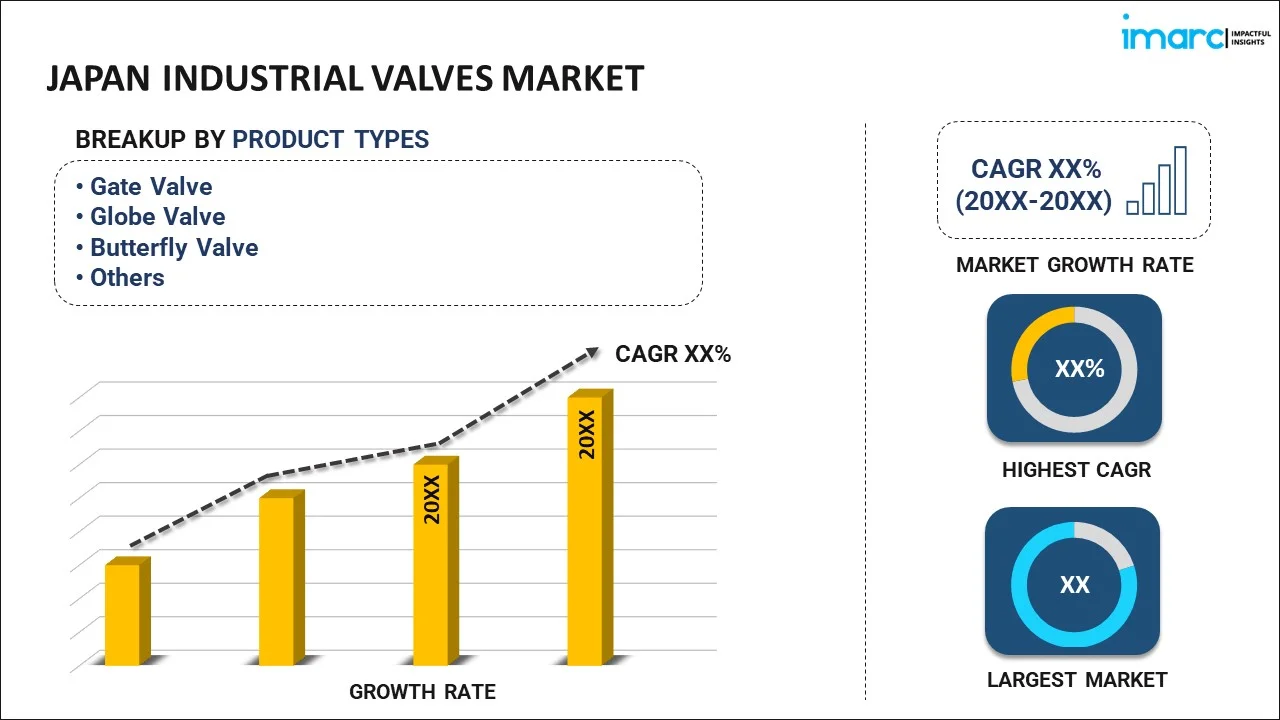
To get detailed segment analysis of this market Request Sample
- Gate Valve
- Globe Valve
- Butterfly Valve
- Ball Valve
- Check Valve
- Plug Valve
- Others
Gate valve dominates with a 26% share of the total Japan industrial valves market in 2025.
Gate valves remain the most widely deployed product type across Japan's industrial landscape, valued for their ability to provide unobstructed full-bore flow and reliable isolation in high-pressure pipeline systems. These valves are essential in oil refining complexes, liquefied natural gas terminals, and municipal water distribution networks where complete shutoff capability is critical. Their robust construction, minimal flow resistance, and compatibility with diverse pipeline configurations make them indispensable across upstream, midstream, and downstream operations, reinforcing consistent procurement demand throughout the country.
The prevalence of gate valves is further reinforced by their suitability for high-temperature steam service in thermal power plants and chemical processing facilities. Their robust construction, minimal flow resistance, and compatibility with various pipeline materials make them indispensable in large-diameter applications across heavy industrial environments. Japan's ongoing investment in replacing aging pipeline infrastructure across both industrial and municipal sectors continues to generate substantial replacement demand, with seismic-resilient gate valve designs gaining increasing preference in earthquake-prone coastal and urban regions to ensure operational continuity during natural disaster events.
Functionality Insights:
- On-Off/Isolation Valves
- Control Valves
On-off/isolation valves lead with a 65% share of the total Japan industrial valves market in 2025.
On-off and isolation valves command the largest functionality segment in Japan, reflecting the fundamental requirement for flow shutoff and process isolation across virtually every industrial application. These valves are critical for maintenance operations, emergency shutdowns, and sectional isolation in refineries, chemical plants, and power generation facilities throughout the country. Their versatile deployment across both legacy and newly commissioned infrastructure ensures sustained demand, as industries prioritize operational safety, regulatory compliance, and uninterrupted process control across diverse manufacturing and energy production environments.
The dominance of on-off and isolation valves is sustained by their deployment in both legacy and newly commissioned infrastructure across Japan. Water treatment plants, district heating networks, and pharmaceutical manufacturing facilities rely heavily on these valves for routine maintenance and safety-critical isolation functions in daily operations. The growing emphasis on process automation across Japanese industries is also boosting demand for actuated isolation valves that can be seamlessly integrated into distributed control systems, enabling remote operation, faster emergency response capabilities, and enhanced operational safety in critical process environments nationwide.
Material Insights:
- Steel
- Cast Iron
- Alloy Based
- Others
Steel exhibits a clear dominance with a 44% share of the total Japan industrial valves market in 2025.
Steel-bodied valves constitute the largest material segment in Japan's industrial valves market, driven by their superior strength, corrosion resistance, and thermal stability across demanding operational environments. Carbon steel and stainless-steel variants are extensively utilized in oil and gas processing, petrochemical manufacturing, and power generation applications where valves must reliably withstand elevated pressures and temperatures. Their compliance with stringent Japanese Industrial Standards and compatibility with cryogenic, high-purity, and high-temperature service conditions further reinforce widespread adoption across critical industrial sectors.
The preference for steel valves is further strengthened by their compliance with stringent Japanese Industrial Standards and international specifications required for critical process applications. Stainless steel grades are particularly favored in food processing, pharmaceutical production, and semiconductor manufacturing, where hygiene standards and contamination prevention are paramount operational considerations. The ongoing expansion of liquefied natural gas receiving terminals and hydrogen storage facilities is additionally driving demand for specialized steel alloy valves designed for cryogenic and high-purity service conditions, reinforcing the material's dominant position across Japan's industrial valve landscape.
.webp)
Size Insights:
- Upto 1"
- 1"-6"
- 7"-25"
- 26"-50"
- 51" and Above
1"–6" represents the leading segment with a 30% share of the total Japan industrial valves market in 2025.
Valves in the 1-inch to 6-inch range represent the most widely consumed size category, owing to their versatile applicability across process piping, utility distribution, and general-purpose industrial operations. This size range addresses the majority of flow control requirements in secondary and tertiary piping networks within refineries, chemical plants, water treatment facilities, and manufacturing operations. Their compact form factor, broad availability of standardized designs, and compatibility with automated actuation systems make them indispensable across pharmaceutical, food processing, and building services applications.
The popularity of the 1-inch to 6-inch size range is also attributable to the broad availability of standardized designs, rapid delivery timelines, and compatibility with automated actuation systems used in modern facilities. These mid-range valves serve as workhorses in heating, ventilation, and air conditioning systems, laboratory environments, and food and beverage processing lines across the country. Their compact form factor and ease of installation make them ideal for space-constrained industrial settings, while advancements in material coatings and sealing technologies continue to extend their operational lifespan and enhance overall reliability.
End Use Industry Insights:
- Oil and Gas
- Power
- Pharmaceutical
- Water and Wastewater Treatment
- Chemical
- Food and Beverage
- Others
Oil and gas hold the largest share of 33% of the total Japan industrial valves market in 2025.
The oil and gas sector represents the largest end use industry for industrial valves in Japan, driven by the country's extensive refining infrastructure, strategically important liquefied natural gas import terminals, and well-established integrated petrochemical complexes. Japan ranks among the top global importers of liquefied natural gas, requiring vast networks of specialized valves for receiving, regasification, storage, and distribution operations across multiple major coastal terminals. Ongoing maintenance cycles and evolving environmental compliance standards further sustain consistent valve procurement throughout the sector.
The sector's valve demand is further amplified by ongoing maintenance and upgrade cycles at aging refinery complexes, where process safety regulations mandate regular valve inspection, replacement, and modernization to maintain operational compliance. Expanding investments in offshore gas exploration, pipeline interconnections, and strategic petroleum reserve facilities sustain consistent procurement volumes across the industry. The transition toward cleaner refining processes, including desulfurization and hydrogen treatment units, is also generating new demand for corrosion-resistant and high-pressure valve solutions specifically designed to meet evolving environmental compliance standards and stricter emission reduction targets.
Regional Insights:
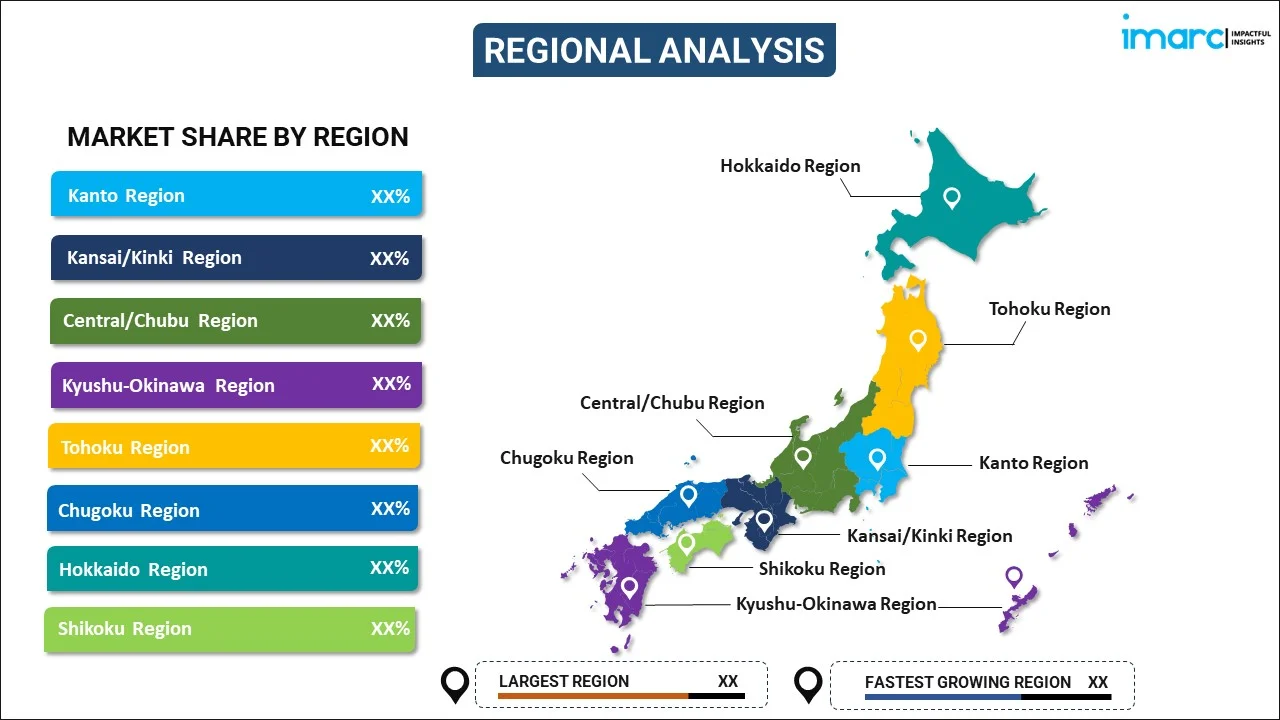
To get detailed regional analysis of this market Request Sample
- Kanto Region
- Kansai/Kinki Region
- Central/ Chubu Region
- Kyushu-Okinawa Region
- Tohoku Region
- Chugoku Region
- Hokkaido Region
- Shikoku Region
The Kanto Region, anchored by Tokyo and Yokohama, serves as the primary hub for industrial valve consumption owing to the concentration of petroleum refining, petrochemical processing, and advanced manufacturing facilities. Extensive port infrastructure supporting liquefied natural gas imports and growing investments in urban water supply modernization sustain strong valve procurement activity across this economically dominant region. The presence of major research institutions and technology centers further drives adoption of innovative smart valve solutions throughout industrial operations.
The Kansai/Kinki Region, centered around Osaka and Kobe, drives significant industrial valve demand through its established chemical manufacturing base, steel production complexes, and pharmaceutical operations. Ongoing facility modernization efforts and expanding environmental compliance requirements across heavy industries continue to support consistent valve replacement and upgrade cycles. The region's robust port infrastructure and industrial corridors connecting major production facilities further sustain procurement activity for both standard and specialized valve products across multiple sectors.
The Central/Chubu Region, anchored by Nagoya and its surrounding industrial corridor, generates substantial valve consumption through its automotive manufacturing ecosystem, power generation infrastructure, and heavy machinery production facilities. Major thermal and nuclear power plants in the region require continuous valve maintenance and periodic upgrades, while expanding industrial automation initiatives are driving adoption of digitally integrated flow control equipment. The region's concentration of precision engineering capabilities supports demand for high-specification valve solutions across diverse industrial applications.
Kyushu-Okinawa Region represents a growing industrial valve market driven by its expanding semiconductor fabrication facilities, petrochemical operations, and energy generation infrastructure. The region's strategic location for liquefied natural gas receiving terminals and increasing investment in renewable energy systems, including geothermal power plants, are creating additional demand for specialized industrial valve solutions. Growing development of advanced manufacturing zones and ongoing expansion of chemical processing capacity further contribute to sustained valve procurement activity across Kyushu.
The Tohoku Region contributes to valve demand through its food processing industry, chemical manufacturing operations, and post-reconstruction infrastructure development programs. Ongoing seismic resilience upgrades to water distribution systems and industrial facilities following major earthquake events continue to drive procurement of modern, earthquake-resistant valve designs. The region's growing investments in offshore wind energy projects and the expansion of agricultural processing capabilities are additionally supporting steady demand for reliable industrial flow control equipment across multiple sectors.
The Chugoku Region contributes to industrial valve demand through its established petroleum refining operations, shipbuilding industry, and chemical manufacturing base centered around Hiroshima and Okayama. Ongoing modernization of coastal industrial facilities and expanding investments in renewable energy infrastructure are supporting steady procurement of corrosion-resistant and high-performance valve solutions.
Hokkaido Region drives industrial valve demand through its substantial agricultural processing industry, natural gas extraction operations, and district heating systems required for its cold climate conditions. Growing investments in offshore wind energy developments and expanding dairy and food processing facilities are supporting steady valve procurement activity in the region. The development of hydrogen supply infrastructure and the modernization of municipal water and wastewater networks are further contributing to increasing demand for durable and climate-adapted valve solutions.
The Shikoku Region contributes to industrial valve demand through its established pulp and paper manufacturing, chemical processing, and copper smelting industries. Growing investments in renewable energy infrastructure, particularly offshore wind and biomass power generation, alongside ongoing modernization of aging water distribution networks, are supporting steady procurement of durable and corrosion-resistant valve solutions.
Market Dynamics:
Growth Drivers:
Why is the Japan Industrial Valves Market Growing?
Accelerating energy transition and diversification initiatives
Japan's strategic commitment to achieving carbon neutrality is fundamentally reshaping energy infrastructure development, creating substantial demand for industrial valves across emerging energy pathways. The national Green Transformation strategy is driving investments in hydrogen production facilities, ammonia co-firing systems at thermal power plants, and carbon capture and storage infrastructure, each requiring specialized valve solutions designed for novel operating conditions. The ongoing restart and modernization of nuclear power generation facilities, combined with the decommissioning of older units, generates parallel demand for safety-critical valve systems meeting stringent regulatory requirements. Expanded deployment of liquefied natural gas as a transition fuel continues to necessitate new receiving terminals, storage systems, and distribution networks equipped with cryogenic and high-pressure valves. Renewable energy integration, including offshore wind and geothermal development, further broadens the application scope for industrial valves in energy production and distribution systems across the country. The diversification of energy sources requires complex piping networks that connect generation, storage, and consumption points, driving procurement of both conventional and specialty valve products. As Japan accelerates its transition toward cleaner energy systems, the demand for advanced flow control solutions designed for emerging applications continues to strengthen across the entire energy value chain.
Comprehensive infrastructure modernization and seismic resilience programs
Japan is undertaking large-scale rehabilitation of its aging industrial and municipal infrastructure, generating sustained procurement demand for modern industrial valves. Water supply networks, sewage treatment systems, and industrial piping installations constructed during the rapid economic growth period are reaching end-of-life conditions, necessitating systematic replacement programs across the country. Government-mandated seismic resilience standards require upgraded pipeline components, including earthquake-resistant valve designs with flexible joints and automatic shutoff mechanisms, to protect critical water and gas supply systems against natural disaster impacts. Municipal authorities across the nation are investing in comprehensive pipeline renewal projects that incorporate advanced valve materials and smart monitoring capabilities to enhance system reliability. Industrial facilities are simultaneously modernizing process equipment to comply with updated safety regulations and environmental standards, driving replacement of legacy valve installations with technologically advanced alternatives that improve operational safety and efficiency. The scale of infrastructure renewal extends across transportation networks, district energy systems, and wastewater management facilities, each requiring substantial quantities of high-performance valves. Government fiscal support through national resilience budgets and public infrastructure investment programs continues to ensure stable funding for these modernization initiatives, providing a reliable demand foundation for the industrial valves market over the medium to long term.
Rising adoption of industrial automation and smart manufacturing
The proliferation of advanced manufacturing technologies under Japan's Society 5.0 framework is accelerating demand for digitally integrated industrial valve solutions across process industries. Factories and processing plants are increasingly implementing distributed control systems, supervisory control architectures, and industrial Internet of Things platforms that require valves equipped with smart actuators, position sensors, and communication interfaces. This transformation enables real-time process optimization, predictive maintenance scheduling, and remote operational monitoring, reducing unplanned downtime and improving overall equipment effectiveness. The chemical, pharmaceutical, and food processing sectors are leading adoption of automated valve systems to meet stringent quality control requirements and production consistency standards. Growing labor shortages in Japan's industrial workforce are further motivating the shift toward automated process control, positioning smart valve technologies as essential components of next-generation manufacturing infrastructure throughout the country. The integration of artificial intelligence and machine learning algorithms with valve diagnostic systems is enabling more sophisticated condition monitoring and failure prediction capabilities. As industries seek to maximize operational efficiency while managing workforce constraints, investments in automated valve systems and digital process control platforms are expected to continue expanding, reinforcing sustained growth in demand for technologically advanced industrial valve solutions across the Japanese manufacturing sector.
Market Restraints:
What Challenges the Japan Industrial Valves Market is Facing?
High costs associated with advanced valve technologies
The integration of smart sensors, advanced actuators, and corrosion-resistant alloy materials significantly increases the unit cost of industrial valves, creating procurement barriers for small and medium-sized enterprises. Advanced valve systems designed for hydrogen, cryogenic, and high-purity applications require specialized manufacturing processes and premium materials that elevate prices beyond conventional alternatives. These cost pressures may slow adoption rates, particularly among budget-constrained municipal infrastructure projects and smaller industrial operators.
Prolonged supply chain disruptions and raw material volatility
Japan's industrial valve manufacturers face persistent challenges from global supply chain uncertainties affecting the availability and pricing of critical raw materials including specialty steel alloys, nickel, and chromium. Fluctuations in international commodity markets and logistical bottlenecks can delay production timelines and increase manufacturing costs, impacting project schedules and procurement budgets. Dependency on imported raw materials exposes the domestic valve industry to geopolitical risks and trade policy uncertainties that complicate long-term planning.
Skilled labor shortages in valve manufacturing and maintenance
Japan's aging workforce and declining working-age population present significant challenges for the industrial valve sector, both in manufacturing and field maintenance operations. Specialized valve fabrication, installation, and servicing require experienced technicians with deep technical expertise that cannot be easily automated or rapidly trained. This labor constraint limits production capacity expansion and can delay critical maintenance activities at industrial facilities, potentially impacting operational safety and equipment reliability.
Competitive Landscape:
The Japan industrial valves market is characterized by intense competition among established domestic manufacturers and international players vying for market share across diverse industrial applications. Companies are focusing on expanding product portfolios with smart valve technologies, advanced materials, and application-specific designs to differentiate their offerings in an increasingly sophisticated market. Strategic investments in research and development are driving innovation in areas such as hydrogen-compatible valves, seismic-resistant designs, and digitally integrated flow control systems. Manufacturers are strengthening partnerships with engineering procurement and construction firms, end users, and automation integrators to secure long-term supply agreements and project-based contracts. Domestic producers leverage deep expertise in Japanese Industrial Standards compliance and localized technical support services, while international competitors offer global technology platforms and diversified product ranges. Mergers, acquisitions, and technical collaborations are actively shaping the competitive landscape as companies seek to broaden capabilities, enhance manufacturing efficiency, and expand geographic reach within the market. After-sales service networks and maintenance support capabilities are emerging as key competitive differentiators.
Japan Industrial Valves Market Report Coverage:
| Report Features | Details |
|---|---|
| Base Year of the Analysis | 2025 |
| Historical Period | 2020-2025 |
| Forecast Period | 2026-2034 |
| Units | Billion USD |
| Scope of the Report | Exploration of Historical Trends and Market Outlook, Industry Catalysts and Challenges, Segment-Wise Historical and Future Market Assessment:
|
| Product Types Covered | Gate Valve, Globe Valve, Butterfly Valve, Ball Valve, Check Valve, Plug Valve, Others |
| Functionalities Covered | On-Off/Isolation Valves, Control Valves |
| Materials Covered | Steel, Cast Iron, Alloy Based, Others |
| Sizes Covered | Upto 1”, 1”-6”, 7”-25”, 26”-50”, 51” and Above |
| End Use Industries Covered | Oil and Gas, Power, Pharmaceutical, Water and Wastewater Treatment, Chemical, Food and Beverage, Others |
| Regions Covered | Kanto Region, Kansai/Kinki Region, Central/ Chubu Region, Kyushu-Okinawa Region, Tohoku Region, Chugoku Region, Hokkaido Region, Shikoku Region |
| Customization Scope | 10% Free Customization |
| Post-Sale Analyst Support | 10-12 Weeks |
| Delivery Format | PDF and Excel through Email (We can also provide the editable version of the report in PPT/Word format on special request) |
Frequently Asked Questions About the Japan Industrial Valves Market Research Report Report
The Japan industrial valves market size was valued at USD 3.59 Billion in 2025.
The Japan industrial valves market is expected to grow at a compound annual growth rate of 4.36% from 2026-2034 to reach USD 5.27 Billion by 2034.
Gate valve dominated the market with a share of 26%, driven by its widespread application in oil and gas, water treatment, and power generation sectors requiring reliable full-bore isolation and minimal pressure loss across high-pressure pipeline systems.
Key factors driving the Japan industrial valves market include accelerating energy transition investments, comprehensive infrastructure modernization programs, rising adoption of industrial automation, expanding hydrogen energy systems, and growing seismic resilience requirements.
Major challenges include high costs of advanced valve technologies, supply chain disruptions affecting raw material availability, skilled labor shortages in manufacturing and maintenance, fluctuating commodity prices, and complex regulatory compliance requirements across diverse industrial applications.
Need more help?
- Speak to our experienced analysts for insights on the current market scenarios.
- Include additional segments and countries to customize the report as per your requirement.
- Gain an unparalleled competitive advantage in your domain by understanding how to utilize the report and positively impacting your operations and revenue.
- For further assistance, please connect with our analysts.
 Request Customization
 Speak to an Analyst
 Request Brochure
 Inquire Before Buying
Benefits of Customization
- Personalize this research
- Triangulate with your data
- Get data as per your format and definition
- Gain a deeper dive into a specific application, geography, customer, or competitor
- Any level of personalization
Get in Touch With Us
UNITED STATES
Phone: +1-201-971-6302
INDIA
Phone: +91-120-433-0800
UNITED KINGDOM
Phone: +44-753-714-6104
Email: [email protected]
Client Testimonials




.webp)




.webp)













Related Reports

Choose your plan
*Please note that the prices mentioned below are starting prices for each bundle type. Kindly contact our team for further details.*
Single User License
- 1 User License, Access on 2 Devices
- PDF Report + Excel Dataset (Password Protected)
- Lifetime Access
- No Printing Rights
- 10% Free Report Customization
- 10–12 Weeks of Analyst Support
Five User License
- Access for 5 Users, 2 Devices per User
- PDF Report + Excel Dataset (Password Protected)
- Lifetime Access
- Dedicated Account Manager
- 12–14 Weeks of Analyst Support
- No Printing Rights
- 15% Free Report Customization
- 25% Discount on Your Next Purchase
Corporate User License
- Unlimited User Access (Within Your Organization)
- PDF Report + Excel Dataset
- Lifetime Access
- Dedicated Account Manager
- 14–20 Weeks of Analyst Support
- No Printing Rights
- 20% Free Report Customization
- 30% Discount on Your Next Purchase
Essential Insights
What's included:
3 reports
- Lifetime Access
- PDF Reports
- Excel Datasets
- 2 Weeks of Free Analyst Support
- 2 User Licenses
- Access on 2 Devices
- Printing Rights
- Complimentary PowerPoint (PPT) Version
- Complimentary License Upgrade
Professional Access
What's included:
5 reports
- Lifetime Access
- PDF Reports
- Excel Datasets
- 8 Weeks of Free Analyst Support
- 2 User Licenses
- Access on 2 Devices
- Printing Rights
- Complimentary PowerPoint (PPT) Version
- Complimentary License Upgrade
Business Advantage
What's included:
8 reports
- Lifetime Access
- PDF Reports
- Excel Datasets
- 14 Weeks of Free Analyst Support
- 2 User Licenses
- Access on 2 Devices
- Printing Rights
- Complimentary PowerPoint (PPT) Version
- Complimentary License Upgrade
Enterprise Intelligence
What's included:
10 reports
- Lifetime Access
- PDF Reports
- Excel Datasets
- 20 Weeks of Free Analyst Support
- 2 User Licenses
- Access on 2 Devices
- Printing Rights
- Complimentary PowerPoint (PPT) Version
- Complimentary License Upgrade