
Japan Mobile Phone Insurance Market Size, Share, Trends and Forecast by Phone Type, Coverage, Distribution Channel, End User, and Region, 2026-2034
Japan Mobile Phone Insurance Market Size, Share, Trends & Forecast (2026-2034)
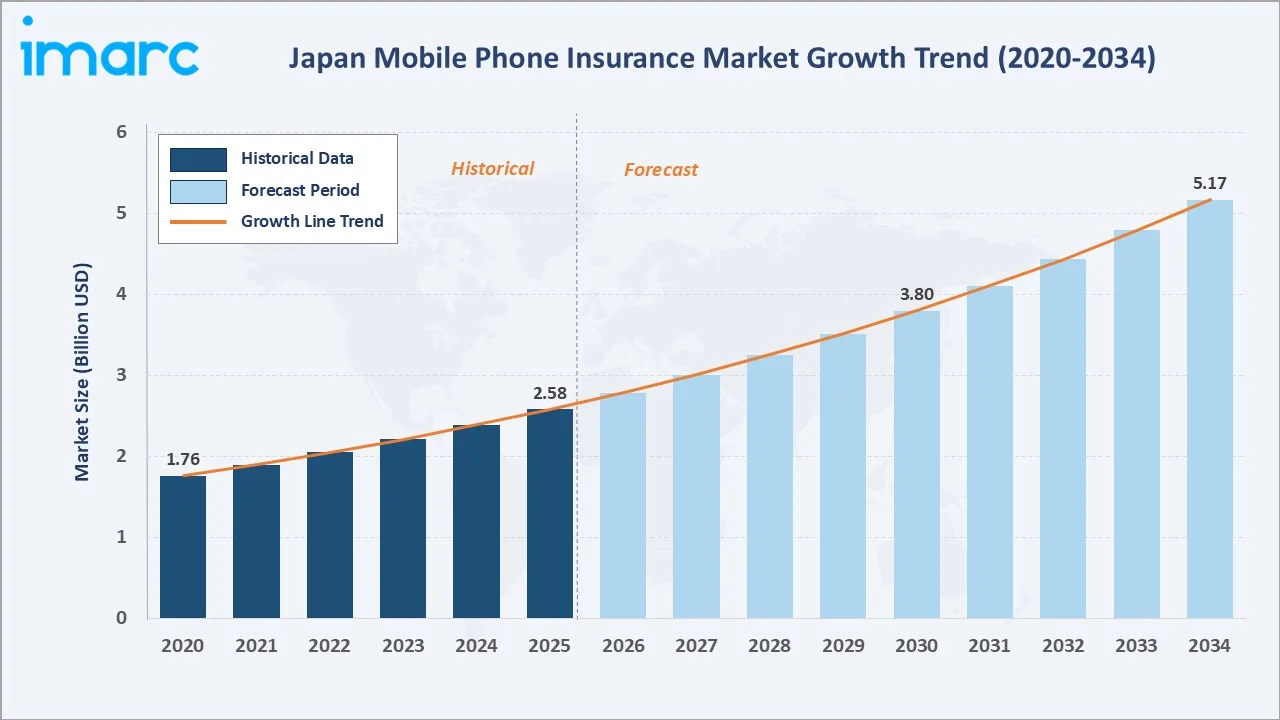
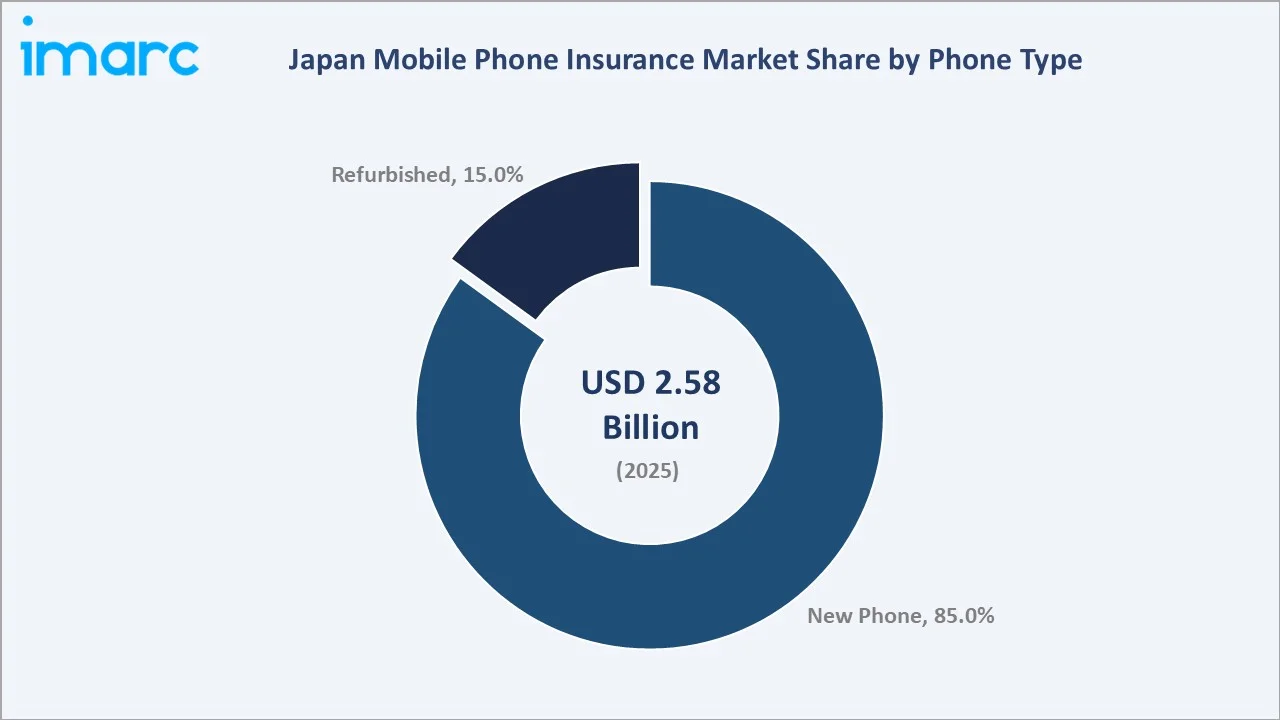
The Japan mobile phone insurance market grew from USD 2.58 Billion in 2025 to USD 2.79 Billion in 2026 and is projected to reach USD 5.17 Billion by 2034, growing at a CAGR of 8.02% during 2026-2034. The market is driven by high smartphone penetration, increasing adoption of expensive flagship devices, and rising consumer awareness of device protection. Japan had approximately 194 million active cellular mobile connections in early 2025, representing around 157% of the country’s total population, creating a strong financial incentive for consumers to protect high-value handsets through insurance. New phones lead at 85.0% by phone type, personal users dominate at 78.0% by end-user, and the Kanto region commands the largest regional share at 34.0% in 2025.
Market Snapshot
|
Metric |
Value |
|
Base Year Market Size (2025) |
USD 2.58 Billion |
|
Market Size (2026) |
USD 2.79 Billion |
|
Forecast Market Size (2034) |
USD 5.17 Billion |
|
CAGR (2026-2034) |
8.02% |
|
Base Year |
2025 |
|
Historical Period |
2020-2025 |
|
Forecast Period |
2026-2034 |
|
Dominant Phone Type |
New Phone (85.0%, 2025) |
|
Dominant End-User |
Personal (78.0%, 2025) |
|
Leading Region |
Kanto Region (34.0%, 2025) |
The Japan mobile phone insurance market grew from USD 1.76 Billion in 2020 to USD 2.58 Billion in 2025, and further to USD 2.79 Billion in 2026, supported by growing carrier-bundled insurance adoption, increasing smartphone values, and the emergence of digital insurtech platforms offering flexible app-based coverage. The market is projected to reach USD 3.80 Billion by 2030 before reaching USD 5.17 Billion by 2034.
To get more information on this market, Request Sample
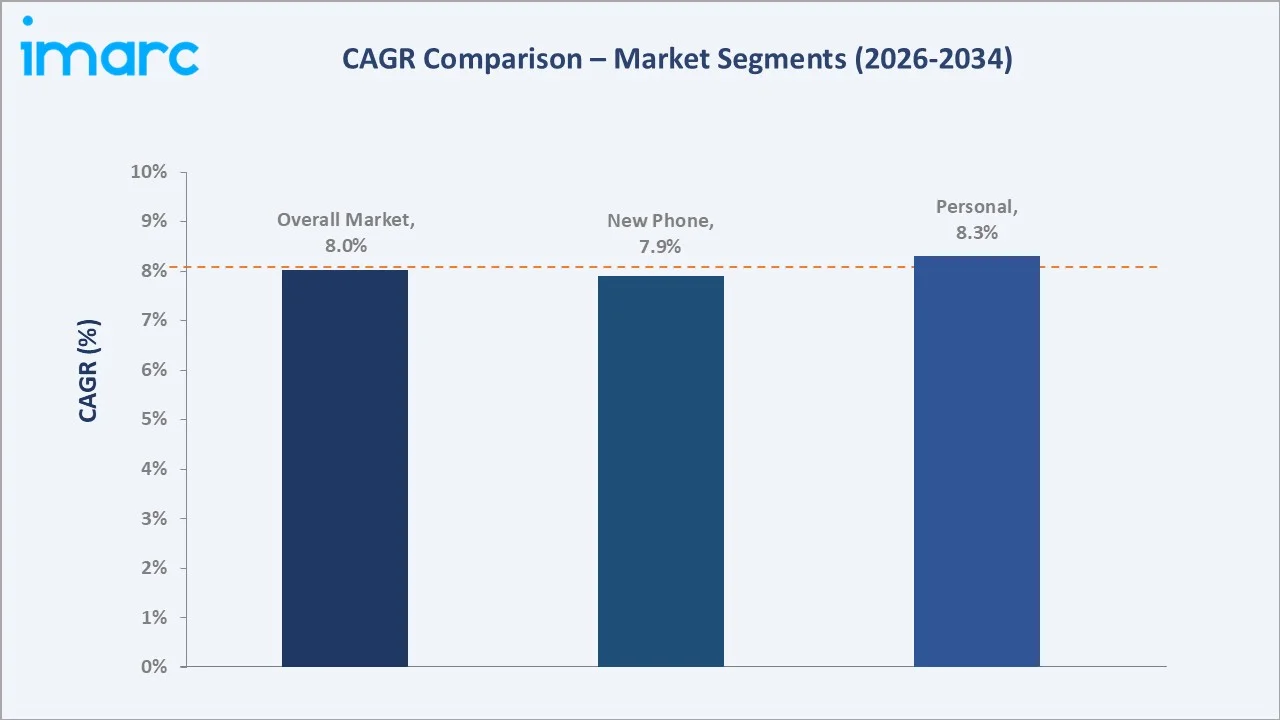
Personal end-users are projected to grow at 8.3% CAGR as consumer awareness of device protection deepens. New phone insurance at approximately 7.9% CAGR reflects sustained flagship device purchases requiring premium coverage. The overall market CAGR of 8.02% reflects Japan position as one of the fastest-growing mobile insurance markets in the Asia-Pacific region.
Executive Summary
The Japan mobile phone insurance market is on a high-growth trajectory, driven by the convergence of near-universal smartphone penetration, escalating device replacement costs, and an increasingly digital insurance distribution ecosystem. The market has expanded consistently, supported by growing carrier-bundled insurance adoption across various subscriber bases, the rise of direct-to-consumer insurtech platforms, and a generational shift in consumer willingness to pay for device protection as smartphones become central to all aspects of daily and professional life in Japan.
New phones at 85.0% dominate total insurance demand, reflecting the market concentration of coverage on high-value flagship and premium devices that represent the greatest financial risk to consumers in the event of damage, loss, or theft. Personal users account for 78.0% of demand, driven by individual consumers protecting their primary daily-use device. The Kanto region leads at 34.0%, reflecting the concentration of Japan population, economic activity, and smartphone sales density in the greater Tokyo metropolitan area.
Key Market Insights
|
Insight |
Data |
|
Dominant Phone Type |
New Phone - 85.0% share (2025) |
|
Dominant End-User |
Personal - 78.0% share (2025) |
|
Leading Region |
Kanto Region - 34.0% (2025) |
|
Key Market Opportunity |
Digital insurtech platforms and AI-enabled personalized pricing are expanding coverage beyond carrier-bundled policies to SIM-free and MVNO device owners. |
Key Analytical Observations Supporting the Above Data:
- New Phone at 85.0%: New phone insurance dominates because consumers purchasing flagship devices priced more have the strongest financial motivation to protect their investment. Carrier distribution channels bundle insurance at point-of-sale for new device activations, making new phone coverage the default entry point into the Japan mobile insurance market.
- Personal at 78.0%: Personal users lead because Japan has one of the highest per-capita smartphone ownership rates globally, and individual consumers account for the vast majority of device purchases and insurance enrollments across all carrier channels. The aging population is also a growth driver, as elderly users increasingly rely on smartphones for healthcare management, social connectivity, and government services.
- Kanto Region at 34.0%: Kanto dominance reflects both population concentration and the highest density of flagship device purchases, premium carrier plan subscriptions, and digitally engaged consumers who are most likely to purchase and maintain smartphone insurance policies through online and app-based channels.
Japan Mobile Phone Insurance Market Overview
The Japan mobile phone insurance market encompasses all insurance products providing financial protection against smartphone and feature phone damage, malfunction, theft, and loss. Product types range from carrier-bundled protection plans offered directly at device activation to standalone third-party insurance policies available from general insurers, specialty device protection providers, and digital insurtech platforms. Coverage categories include physical damage and screen breakage, internal component failure, water damage, theft and loss protection, and extended warranty services.
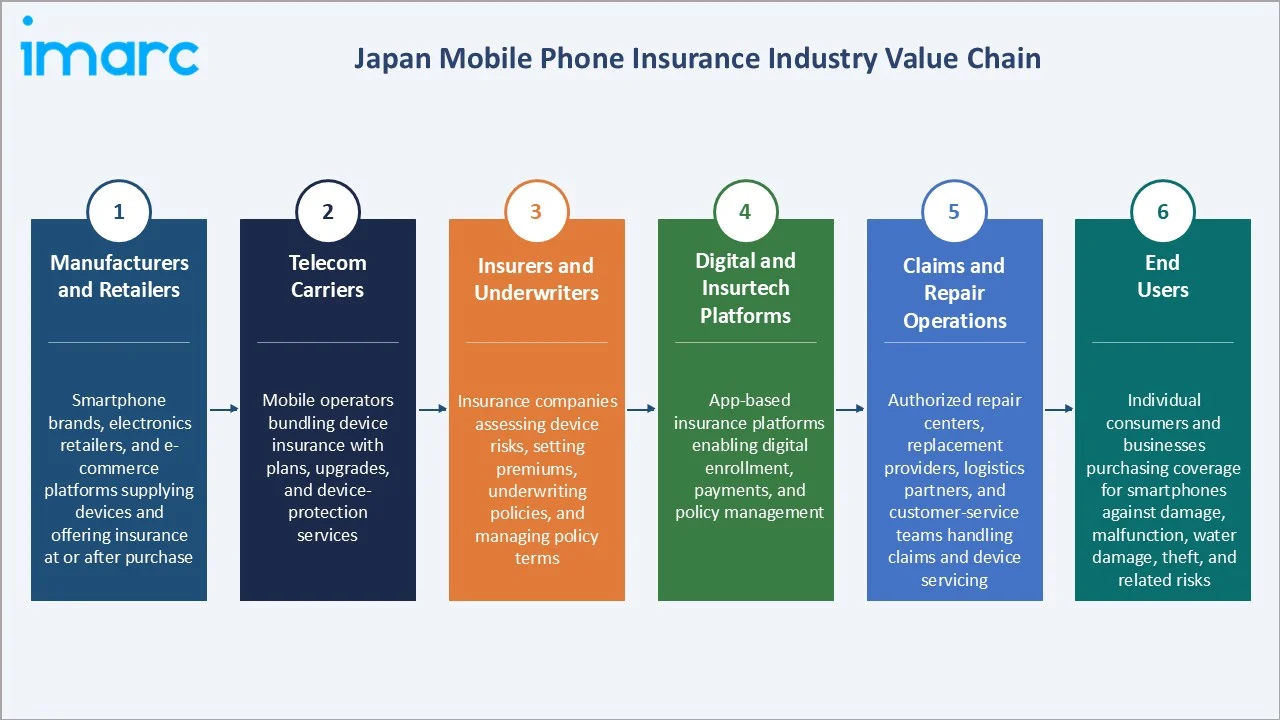
The market ecosystem spans device manufacturers and retailers who sell insured devices, telecom carriers who distribute carrier-bundled protection plans as the primary enrollment channel, licensed insurers and underwriters who assume the insurance risk, digital platforms and insurtech companies who enable direct consumer enrollment through apps and websites, and claims management and repair operations that deliver the service fulfilment.
Market Dynamics
To evaluate market opportunities, Request Sample
Market Drivers
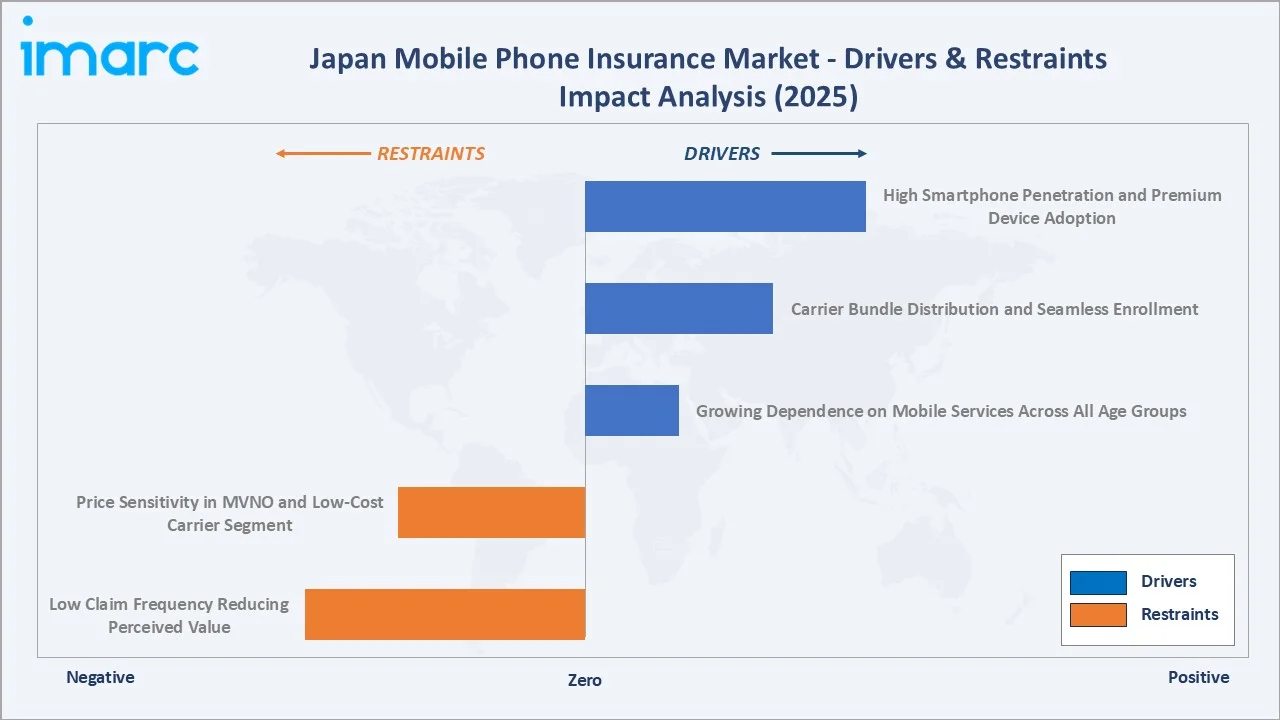
- High Smartphone Penetration and Premium Device Adoption: In early 2025, Japan recorded approximately 194 million active cellular mobile connections, equivalent to 157% of the total population, with the market heavily weighted toward premium-tier devices priced well above the global average. As average device values rise, the financial risk of loss, damage, or malfunction increases proportionately, creating strong and growing consumer motivation to purchase mobile insurance as a prudent financial protection measure.
- Carrier Bundle Distribution and Seamless Enrollment: The three major carriers embed mobile insurance as a standard add-on product in their retail stores and online enrollment flows, providing near-frictionless access to coverage at the point of device activation. This distribution model drives extremely high attachment rates for new device purchases through major carriers and ensures consistent premium volume growth aligned with device sales cycles.
- Growing Dependence on Mobile Services Across All Age Groups: Japan unique demographic profile, including one of the oldest populations, is contributing to mobile insurance demand as elderly users who increasingly rely on smartphones for healthcare management, social connectivity, and government digital services become highly motivated to maintain protection against device loss or failure that would significantly disrupt their daily routines.
Market Restraints
- Low Claim Frequency Reducing Perceived Value: Japan relatively low rates of device theft and the durability culture around electronic device care mean that many insured consumers rarely file claims, reducing their perception of value and leading to policy cancellation, particularly among price-conscious younger consumers managing subscription costs across multiple services.
- Price Sensitivity in MVNO and Low-Cost Carrier Segment: The growing MVNO subscriber base is generally more price-sensitive than major carrier subscribers and less exposed to carrier-bundled insurance distribution. Reaching this segment requires standalone low-premium insurance products that are not yet widely available at commercially viable price points.
Market Opportunities
- SIM-Free and MVNO Device Owner Market Expansion: The growing population of consumers using SIM-free flagship devices from Apple, Samsung, and Sony purchased outside carrier channels represents a large and currently underinsured segment that digital insurtech platforms are beginning to reach through app-based standalone policies.
- Smartphone Protection & Insurance Bundles: In June 2026, NTT Docomo launched Japan’s first carrier-provided smartphone screen protector bundled with crack-repair insurance, covering repair costs up to ¥10,000. Available to eligible subscribers, the one-year coverage supports one claim and initially includes four Sony Xperia 1 VIII products. The service targets Japan’s estimated 3.5 million annual screen-repair demand. With millions of screen repairs annually, similar screen protector-plus-insurance bundles could expand across other smartphone brands and carriers, creating new revenue streams for device retailers, insurers, and repair providers.
Market Challenges
- Commoditization of Basic Coverage Products: Standard physical damage and malfunction coverage products are becoming commoditized as both carrier and third-party providers offer broadly similar core benefits, creating pricing pressure that limits premium growth for undifferentiated products and requiring insurers to invest in value-added services such as faster replacement, AI-powered claims, and premium tech support to justify higher premiums.
- Consumer Awareness Gaps in Non-Metro Markets: Outside major metropolitan areas, consumer awareness of standalone mobile insurance products beyond carrier-bundled policies remains limited, constraining market penetration in regional markets that represent most of Japan’s geographic market outside the Kanto Region.
Emerging Market Trends
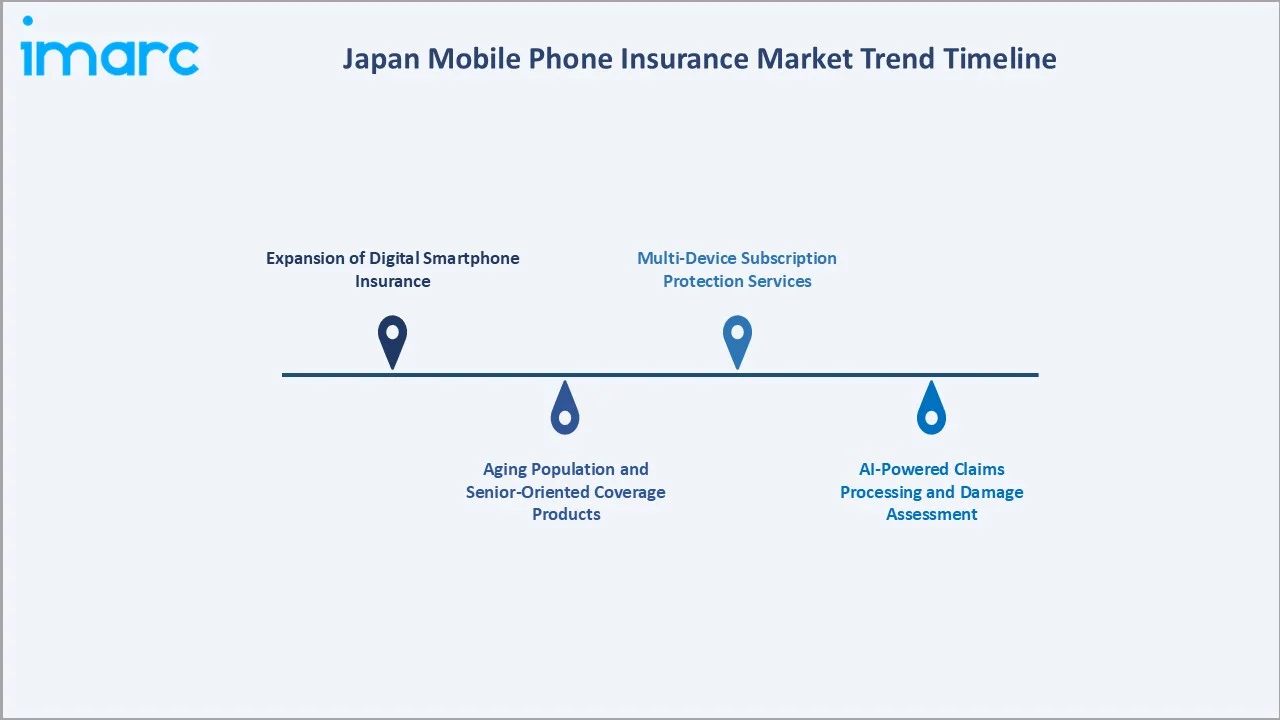
1. Expansion of Digital Smartphone Insurance
In December 2025, PayPay Insurance Service and PayPay launched Smartphone Insurance, available through the PayPay app. It covers damage, water-related issues, malfunctions, and theft, and applies to both new and used smartphones regardless of carrier or purchase channel. This launch highlights a growing trend toward digital, app-based smartphone insurance, making device protection more accessible and convenient. Flexible coverage for new and used smartphones, regardless of carrier or purchase channel, could encourage wider adoption of embedded insurance services.
2. Aging Population and Senior-Oriented Coverage Products
Japan uniquely aged demographic profile is creating a growing segment of senior smartphone users who require accessible insurance products with simplified enrollment, multilingual customer support, and reliable next-day replacement services that reduce the device downtime that would disproportionately impact elderly users dependent on smartphones for healthcare management, emergency contacts, and daily navigation. Carriers are adapting coverage and customer service models to serve this growing and underserved insurance consumer segment.
3. Multi-Device Subscription Protection Services
In August 2025, Asurion Japan K.K. launched a new subscription-based device protection service priced at JPY 1,980 per month covering eight categories of digital devices, including two smartphones, tablets, PCs, game consoles, and wireless earbuds, with no limit on non-smartphone devices and next-day replacement available. This launch marks a structural shift from single-device policy models toward ecosystem-wide connected device protection, reflecting the evolution of consumer digital dependency beyond primary smartphone ownership.
4. AI-Powered Claims Processing and Damage Assessment
Leading insurers and device protection providers are deploying AI-powered image recognition systems for remote device damage assessment, enabling consumers to photograph damage via a smartphone app and receive instant coverage confirmation and repair authorization without visiting a store. This technology reduces claim processing time from days to hours and significantly lowers the administrative cost of claims handling, supporting improvements in carrier combined ratios and enabling insurers to price products more competitively.
Industry Value Chain Analysis
The Japan mobile phone insurance value chain spans six integrated stages from device manufacturing through end-user coverage activation. The insurer and underwriter stage captures the highest value addition in the chain, as licensed risk carriers combine actuarial expertise, regulatory capital deployment, and claims management capability to assume device protection risk that generates the core insurance premium revenue stream underpinning the entire market.
|
Stage |
Key Participants |
|
Manufacturers and Retailers |
Smartphone brands, electronics retailers, and e-commerce platforms supplying devices and offering insurance at or after purchase. |
|
Telecom Carriers |
Mobile operators bundling device insurance with plans, upgrades, and device-protection services. |
|
Insurers and Underwriters |
Insurance companies assessing device risks, setting premiums, underwriting policies, and managing policy terms. |
|
Digital and Insurtech Platforms |
App-based insurance platforms enabling digital enrollment, payments, and policy management. |
|
Claims and Repair Operations |
Authorized repair centers, replacement providers, logistics partners, and customer-service teams handling claims and device servicing. |
|
End Users |
Individual consumers and businesses purchasing coverage for smartphones against damage, malfunction, water damage, theft, and related risks. |
The insurer and underwriter stage is the highest value-added stage in the value chain. Licensed risk carriers deploy regulatory capital, apply actuarial pricing models, and manage the claims lifecycle that generates the fundamental economics of the market, advantages that digital distributors and carrier channels depend on and cannot replicate without insurance licensing and risk capital.
Technology Landscape in the Japan Mobile Phone Insurance Industry
AI-Powered Claims Assessment and Fraud Detection
Artificial intelligence and machine learning are being deployed across Japan mobile insurance claims processing workflows to automate device damage assessment from customer-submitted photographs, verify damage authenticity, flag potential fraudulent claims, and generate instant repair cost estimates.
App-Based Policy Management and Personalized Pricing
Mobile-native insurance platforms are establishing new consumer expectations for policy management through dedicated apps, enabling instant policy activation, real-time coverage status checking, digital claims submission, and dynamic premium adjustment. PayPay Insurance's launch in December 2025 demonstrates how payment infrastructure can become a powerful insurance distribution channel with minimal incremental customer acquisition cost.
Blockchain and Smart Contract Policy Administration
Leading insurers and insurtech providers are exploring blockchain-based policy administration systems that enable transparent, tamper-proof policy records, automated claims triggers based on verifiable device events, and smart contract premium settlement that reduces administrative overhead. While still in early adoption, these technologies represent the next frontier of Japan mobile insurance operational efficiency improvement, with potential to further reduce claims processing costs and improve consumer trust through transparent policy terms.
Market Segmentation Analysis
The report covers the following segments:
|
Segment Category |
Leading Segment |
Market Share |
Year |
|
Phone Type |
New Phone |
85.0% |
2025 |
|
Coverage |
🔒 |
🔒 |
2025 |
|
Distribution Channel |
🔒 |
🔒 |
2025 |
|
End User |
Personal |
78.0% |
2025 |
|
Region |
Kanto Region |
34.0% |
2025 |

By Phone Type
New phones dominate at 85.0% in 2025, reflecting the concentration of insurance adoption among consumers purchasing premium-tier devices through major carrier channels where insurance enrollment is embedded in the activation process. The high average selling price of flagship devices in Japan creates a large insurable value pool that motivates both consumers to purchase coverage and carriers to promote insurance attachment at point of sale.
To access detailed market analysis, Request Sample
Refurbished phones at 15.0% represent a growing segment as consumer interest in certified refurbished devices increases, driven by sustainability awareness, cost sensitivity among younger consumers, and expanding availability of high-quality refurbished flagships through carrier and e-commerce channels.
By End-User
Personal users lead at 78.0% in 2025, reflecting the consumer-driven nature of Japan smartphone market where individual device ownership is near-universal and flagship device purchase frequency drives consistent insurance enrollment across all major carrier channels. Personal insurance demand is further reinforced by Japan aging demographic, as elderly users who depend on smartphones for healthcare and social connectivity have particularly strong motivation to maintain continuous device protection coverage.
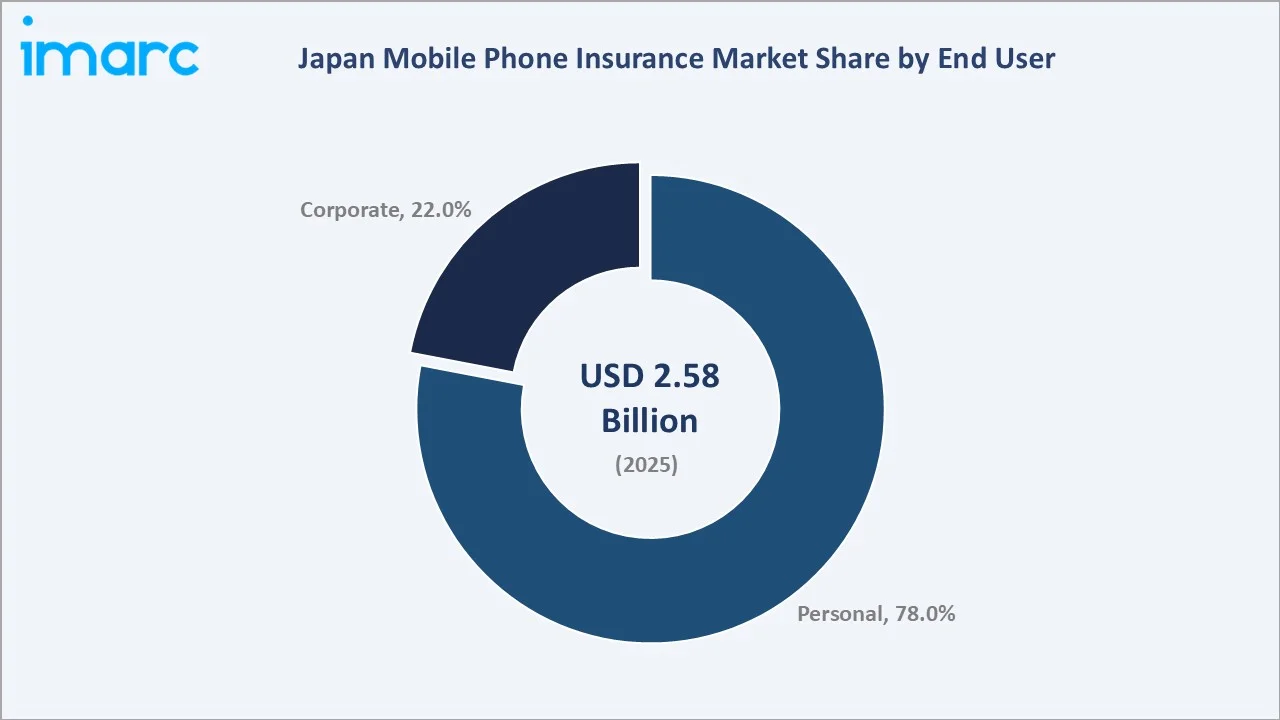
Corporate users at 22.0% serve enterprise mobile fleet management needs across Japan technology, financial services, retail, and logistics sectors. The corporate segment is growing as enterprise IT managers increasingly incorporate mobile device insurance into comprehensive device lifecycle management programs that include MDM software, device refresh cycles, and risk management for the large installed base of employee-issued smartphones.
Regional Market Insights
|
Region |
Share (2025) |
Key Japan Mobile Phone Insurance Market Drivers & Characteristics |
|
Kanto Region |
34.0% |
Reflecting the Tokyo metropolitan area concentration, Japan highest smartphone sales density, greatest flagship device purchase frequency, and the most digitally engaged consumer base. |
|
Kansai/Kinki Region |
20.0% |
Reflecting a consumer base with strong smartphone adoption, an active retail electronics market, and growing digital insurance channel usage across the metropolitan area. |
|
Central/Chubu Region |
17.0% |
Reflecting the metropolitan area and surrounding manufacturing corridor, with strong corporate mobile fleet demand from automotive and industrial sector employees and growing consumer smartphone penetration. |
|
Kyushu-Okinawa Region |
10.0% |
Reflecting a geographically distributed consumer base, with growing smartphone adoption and carrier-bundled insurance penetration across the region. |
|
Tohoku Region |
7.0% |
Reflecting post-disaster infrastructure investment driving smartphone adoption and government digital service usage, with carrier insurance penetration growing across the region's major cities. |
|
Chugoku Region |
6.0% |
Reflecting steady carrier subscriber growth and moderate corporate insurance demand from regional manufacturing and logistics employers. |
|
Shikoku Region |
4.0% |
Reflecting a smaller consumer base across four prefectures with growing smartphone penetration among younger demographics and increasing awareness of device protection needs. |
|
Hokkaido Region |
2.0% |
Reflecting a geographically dispersed population with growing urban smartphone penetration and progressive carrier insurance attachment rate improvement. |
The Kanto region commanding 34.0% of total market share reflects the extraordinary concentration of Japan economic activity, consumer spending power, and digital adoption in the greater Tokyo metropolitan area.
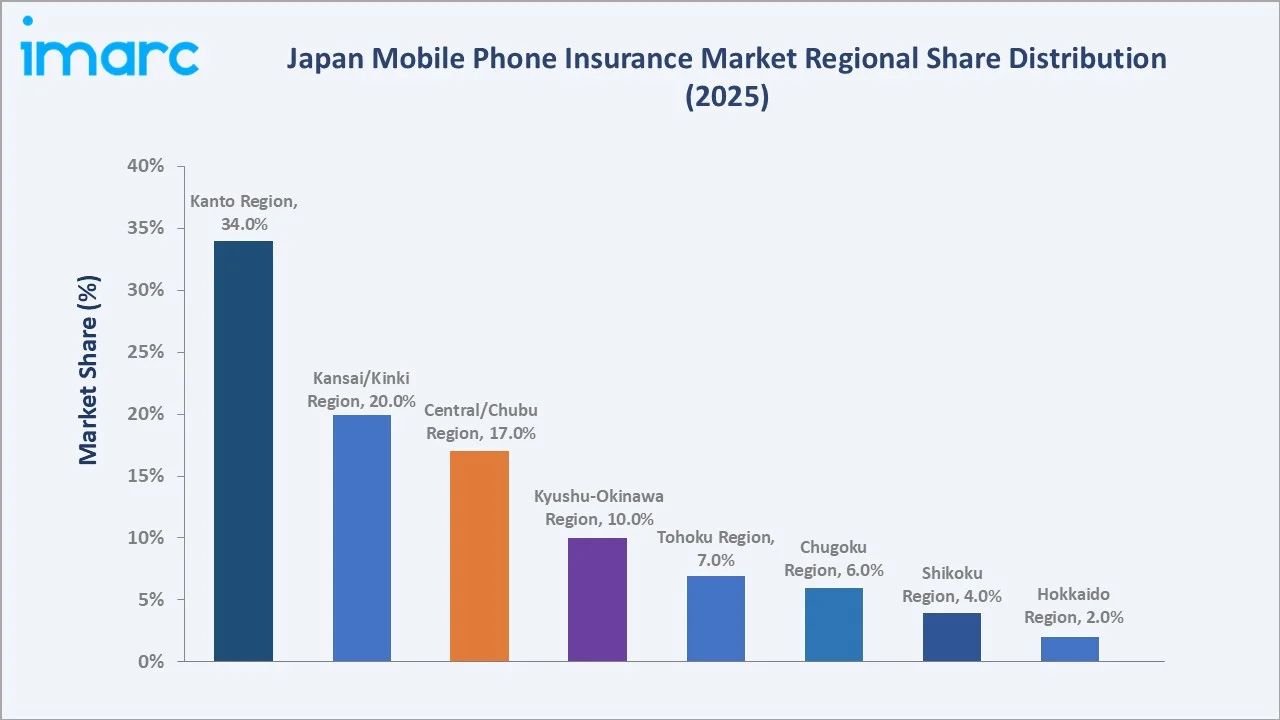
The Kansai at 20.0% and Chubu region at 17.0% represent Japan second and third largest economic zones, respectively, providing a substantial combined consumer base for mobile insurance. The five remaining regions, Kyushu-Okinawa at 10.0%, Tohoku at 7.0%, Chugoku at 6.0%, Shikoku at 4.0%, and Hokkaido at 2.0%, are experiencing progressive growth as smartphone penetration deepens, carrier insurance programs expand geographic reach, and digital insurtech platforms provide coverage accessibility independent of physical carrier store proximity.
Competitive Landscape
The Japan mobile phone insurance market is dominated by carrier-affiliated insurance programs backed by major general insurers, with an emerging competitive layer of digital insurtech entrants disrupting traditional distribution models. The market is becoming more competitive as insurtech platforms offer direct-to-consumer alternatives that reach SIM-free and MVNO device owners outside carrier networks.
|
Company |
Key Offerings |
Market Position |
Core Strength |
|
NTT, Inc. |
Smart Anshin Hoshou |
Market Leader |
Through its subsidiary NTT DOCOMO, it provides device compensation, partners with major insurers, and operates its own dedicated reinsurance business for mobile phones. |
|
KDDI CORPORATION |
au smartphone protection plans |
Established Player |
KDDI Corporation acts as a major mobile network operator, device distributor, and service promoter within Japan's mobile phone insurance ecosystem002E |
|
PayPay Corporation |
PayPay Smartphone Insurance |
Market Leader |
PayPay Corporation acts as the digital platform provider that hosts and integrates the PayPay Insurance mini app within its cashless payment application, allowing users to seamlessly browse, select, and enroll in mobile phone insurance. |
|
Rakuten Group |
SAIKYO Protection |
Niche Player |
Rakuten Mobile offers SAIKYO Protection digital safety service for 990 yen per month, integrating Norton Mobile Security with defenses against malware, data privacy risks, and cyber threats. |
The competitive landscape is at an inflection point as digital insurtech entrants demonstrate that carrier-independent mobile insurance distribution is commercially viable at scale in Japan. This trend is pressuring traditional carrier-affiliated programs to innovate on product flexibility, pricing transparency, and digital customer experience, while creating new partnership opportunities between insurers, fintech platforms, and device ecosystem operators.
Key Company Profiles
NTT, Inc.
NTT, Inc., one of Japan’s major telecommunications and ICT groups. Its business portfolio spans integrated ICT, mobile communications, global solutions, regional communications, real estate, and energy. NTT’s mobile business is primarily operated through NTT DOCOMO, which provides mobile telecommunications and related digital services in Japan. The company continues to leverage its extensive communications infrastructure, technology capabilities, and customer base across its businesses.
- Key Offerings: Smart Anshin Hoshou.
- Strategic Focus: Expanding digital and ICT services, strengthening its telecommunications ecosystem, and using advanced technologies to improve customer experiences. In Japan’s mobile phone insurance market, its ecosystem supports device protection and value-added services through its mobile communications business.
PayPay Corporation
PayPay Corporation is a Japan-based fintech company that operates the PayPay cashless payment platform. Its business focuses on mobile payments and expanding digital financial services through its large user and merchant ecosystem. Through the PayPay app, users can also access services such as insurance via the PayPay Insurance mini app. In the mobile phone insurance market, this digital ecosystem supports convenient, app-based insurance enrollment and claims management.
- Key Offerings: PayPay Smartphone Insurance.
- Strategic Focus: Expanding its digital financial services ecosystem by integrating payments, insurance, and other services within its mobile application. In the mobile phone insurance market, its strategy emphasizes digital enrollment, flexible coverage, and convenient app-based customer access.
Market Concentration Analysis
The Japan mobile phone insurance market is moderately concentrated, with the three major companies, NTT, Inc., KDDI CORPORATION, and PayPay Corporation collectively accounting for the majority of insured device policies through carrier-bundled enrollment programs. However, the underlying insurance underwriting is distributed among several major P&C insurers, preventing extreme concentration at the risk-carrying level.
The emergence of insurtech platforms is beginning to fragment the distribution concentration by providing direct-to-consumer enrollment channels that operate independently of carrier relationships. These platforms are growing fastest among SIM-free, MVNO, and refurbished device owners, segments that the carrier-bundled insurance model does not effectively reach.
Market concentration is expected to evolve toward greater distribution diversity through 2034, as digital platforms scale their consumer bases and fintech super-apps deploy insurance products to large existing user populations. This will not significantly reduce carrier dominance in the near term but will progressively expand the addressable insurance market beyond the currently carrier-centric enrollment model.
Investment & Growth Opportunities
Highest Growth Segments
Personal end-user insurance represents the largest volume growth opportunity, with rising average device values and growing elderly user dependency on smartphones creating consistently expanding premium pools. Digital insurtech distribution targeting SIM-free and MVNO device owners represents the highest incremental growth opportunity, as this large and currently underinsured segment becomes accessible through app-based enrollment.
Investment Themes
- Digital Distribution Platform Partnerships: Fintech and payment super-apps with large existing user bases represent the most efficient insurance distribution channels in Japan digital economy. Investment in insurance product development for super-app distribution provides access to millions of consumers at near-zero incremental acquisition cost compared to traditional agency and carrier store distribution.
- AI Claims Automation and Operational Efficiency: Investment in AI-powered damage assessment, fraud detection, and automated claims processing directly reduces the combined ratio for mobile insurance products, enabling more competitive premium pricing while sustaining profitability. Leading providers are building proprietary AI claims capabilities as a competitive differentiator that supports both consumer experience improvement and underwriting margin protection.
Future Market Outlook (2026-2034)
The Japan mobile phone insurance market stood at USD 2.58 Billion in 2025 and is projected to grow from USD 2.79 Billion in 2026 to USD 5.17 Billion by 2034, exhibiting a CAGR of 8.02% during the forecast period. The market is expected to reach an intermediate milestone of approximately USD 3.80 Billion by 2030, as digital insurtech platforms scale their consumer bases, multi-device protection subscriptions gain mainstream adoption, and the corporate mobile insurance segment expands with enterprise mobility growth.
Three structural forces will define Japan mobile phone insurance market through 2034. First, the sustained escalation of smartphone average selling prices will progressively increase the financial risk that motivates consumer insurance enrollment. Second, the transformation of insurance distribution from carrier-bundled point-of-sale enrollment to digital platform and super-app channels will broaden market access to the MVNO, SIM-free, and refurbished device segments that are currently significantly underinsured, adding incremental premium volume that is structurally uncorrelated with carrier subscriber growth. Third, the evolution of coverage from single-device mobile insurance toward multi-device connected ecosystem protection will expand the average premium per insured consumer relationship, with innovations like subscription model demonstrating the commercial viability of broader device protection as a service that deepens consumer engagement and improves renewal rates across the insured base through 2034.
Research Methodology
Primary Research
Primary research comprised structured consultations with mobile phone insurance product managers at telecom carriers, underwriting executives at Japan major P&C insurers, insurtech startup founders and digital platform operators, device retailer category managers, corporate IT and mobility procurement managers, and consumer research participants across Japan major regional markets. These discussions validated market sizing, assessed distribution channel dynamics, identified emerging product innovation, and provided forward-looking competitive intelligence.
Secondary Research
Secondary research drew on IMARC Group market data, Japan insurance market statistics, telecommunications subscriber data, company investor presentations and annual reports, industry publications covering Japan insurance and telecommunications sectors, and press releases and product announcements from key market participants. Historical market data spanning 2020 through 2025 was cross-validated across multiple data sources.
Forecasting Models
Market forecasts incorporated historical premium growth trends, smartphone penetration and average selling price trajectory modeling, carrier subscriber growth and insurance attachment rate projections, digital platform consumer adoption forecasting, corporate mobile fleet expansion estimates, product innovation impact assessment, and macroeconomic indicators including Japan consumer expenditure and digital services adoption data through 2034.
Japan Mobile Phone Insurance Market Report Coverage:
| Report Features | Details |
|---|---|
| Base Year of the Analysis | 2025 |
| Historical Period | 2020-2025 |
| Forecast Period | 2026-2034 |
| Units | Billion USD |
| Scope of the Report | Exploration of Historical Trends and Market Outlook, Industry Catalysts and Challenges, Segment-Wise Historical and Future Market Assessment:
|
| Phone Types Covered | New Phone, Refurbished |
| Coverages Covered | Physical Damage, Electronic Damage, Virus Protection, Data Protection, Theft Protection |
| Distribution Channels Covered | Mobile Operators, Device OEMs, Retailers, Online, Others |
| End Users Covered | Corporate, Personal |
| Regions Covered | Kanto Region, Kansai/Kinki Region, Central/Chubu Region, Kyushu-Okinawa Region, Tohoku Region, Chugoku Region, Hokkaido Region, Shikoku Region |
| Companies Covered | NTT, Inc., KDDI CORPORATION, PayPay Corporation, Rakuten Group, etc. |
| Customization Scope | 10% Free Customization |
| Post-Sale Analyst Support | 10-12 Weeks |
| Delivery Format | PDF and Excel through Email (We can also provide the editable version of the report in PPT/Word format on special request) |
Key Benefits for Stakeholders:
- IMARC’s industry report offers a comprehensive quantitative analysis of various market segments, historical and current market trends, market forecasts, and dynamics of the Japan mobile phone insurance market from 2020-2034.
- The research report provides the latest information on the market drivers, challenges, and opportunities in the Japan mobile phone insurance market.
- Porter's five forces analysis assist stakeholders in assessing the impact of new entrants, competitive rivalry, supplier power, buyer power, and the threat of substitution. It helps stakeholders to analyze the level of competition within the Japan mobile phone insurance industry and its attractiveness.
- Competitive landscape allows stakeholders to understand their competitive environment and provides an insight into the current positions of key players in the market.
Frequently Asked Questions About the Japan Mobile Phone Insurance Market Report
The Japan mobile phone insurance market reached USD 2.79 Billion in 2026, driven by high smartphone penetration, rising flagship device values, and growing adoption of digital insurtech platforms alongside traditional carrier-bundled insurance programs.
The market is projected to grow at a CAGR of 8.02% during 2026-2034, supported by escalating smartphone values, digital distribution platform growth, multi-device coverage expansion, and corporate mobile fleet insurance development.
The market is projected to reach approximately USD 3.80 Billion by 2030, driven by digital insurtech platform scaling, multi-device subscription protection adoption, and expansion into MVNO and SIM-free device owner segments.
New phones lead with an 85.0% share in 2025, reflecting the concentration of insurance enrollment among consumers purchasing flagship devices through major carrier channels where insurance is embedded in the activation process.
Personal users lead with a 78.0% share in 2025, driven by Japan near-universal smartphone ownership and the strong financial motivation of individual consumers to protect high-value flagship devices, reinforced by Japan aging population reliance on smartphones.
The Kanto region leads with a 34.0% share in 2025, reflecting the greater Tokyo metropolitan area concentration of over 43 million residents, Japan highest smartphone sales density, and the greatest digital insurance platform adoption rates.
Key players include NTT, Inc., KDDI CORPORATION, PayPay Corporation, and Rakuten Group, among others.
The market is projected to reach USD 5.17 Billion by 2034, driven by sustained smartphone value escalation, digital platform insurance distribution maturation, multi-device ecosystem protection adoption, and corporate mobile insurance segment growth.
Need more help?
- Speak to our experienced analysts for insights on the current market scenarios.
- Include additional segments and countries to customize the report as per your requirement.
- Gain an unparalleled competitive advantage in your domain by understanding how to utilize the report and positively impacting your operations and revenue.
- For further assistance, please connect with our analysts.
 Request Customization
 Speak to an Analyst
 Request Brochure
 Inquire Before Buying
Benefits of Customization
- Personalize this research
- Triangulate with your data
- Get data as per your format and definition
- Gain a deeper dive into a specific application, geography, customer, or competitor
- Any level of personalization
Get in Touch With Us
UNITED STATES
Phone: +1-201-971-6302
INDIA
Phone: +91-120-433-0800
UNITED KINGDOM
Phone: +44-753-714-6104
Email: [email protected]
Client Testimonials






















Related Reports

Choose your plan
*Please note that the prices mentioned below are starting prices for each bundle type. Kindly contact our team for further details.*
Single User License
- 1 User License, Access on 2 Devices
- PDF Report + Excel Dataset (Password Protected)
- Lifetime Access
- No Printing Rights
- 10% Free Report Customization
- 10–12 Weeks of Analyst Support
Five User License
- Access for 5 Users, 2 Devices per User
- PDF Report + Excel Dataset (Password Protected)
- Lifetime Access
- Dedicated Account Manager
- 12–14 Weeks of Analyst Support
- No Printing Rights
- 15% Free Report Customization
- 25% Discount on Your Next Purchase
Corporate User License
- Unlimited User Access (Within Your Organization)
- PDF Report + Excel Dataset
- Lifetime Access
- Dedicated Account Manager
- 14–20 Weeks of Analyst Support
- No Printing Rights
- 20% Free Report Customization
- 30% Discount on Your Next Purchase
Essential Insights
What's included:
3 reports
- Lifetime Access
- PDF Reports
- Excel Datasets
- 2 Weeks of Free Analyst Support
- 2 User Licenses
- Access on 2 Devices
- Printing Rights
- Complimentary PowerPoint (PPT) Version
- Complimentary License Upgrade
Professional Access
What's included:
5 reports
- Lifetime Access
- PDF Reports
- Excel Datasets
- 8 Weeks of Free Analyst Support
- 2 User Licenses
- Access on 2 Devices
- Printing Rights
- Complimentary PowerPoint (PPT) Version
- Complimentary License Upgrade
Business Advantage
What's included:
8 reports
- Lifetime Access
- PDF Reports
- Excel Datasets
- 14 Weeks of Free Analyst Support
- 2 User Licenses
- Access on 2 Devices
- Printing Rights
- Complimentary PowerPoint (PPT) Version
- Complimentary License Upgrade
Enterprise Intelligence
What's included:
10 reports
- Lifetime Access
- PDF Reports
- Excel Datasets
- 20 Weeks of Free Analyst Support
- 2 User Licenses
- Access on 2 Devices
- Printing Rights
- Complimentary PowerPoint (PPT) Version
- Complimentary License Upgrade