
Japan Nutritional Supplements Market Size, Share, Trends and Forecast by Product Type, Form, Distribution Channel, Consumer Group, and Region, 2026-2034
Japan Nutritional Supplements Market Size, Share, Trends & Forecast (2026-2034)
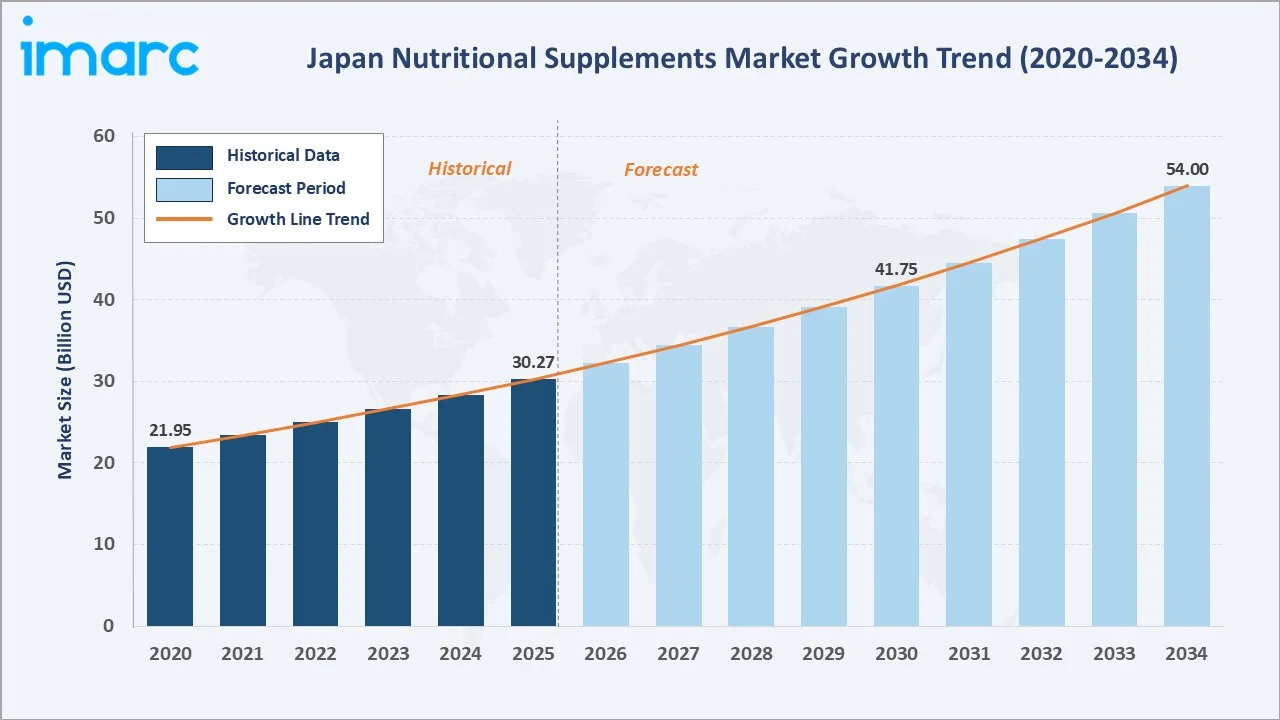
The Japan nutritional supplements market reached USD 30.27 Billion in 2025 and is projected to reach USD 54.00 Billion by 2034, growing at a CAGR of 6.64% during 2026-2034. Japan’s rapidly ageing population driving preventive nutrition demand, the explosive growth of sports nutrition and fitness supplement culture, the distinctive beauty supplement trend rooted in Japan’s anti-ageing beauty culture, and the government-supported Food with Function Claims (FFC) system enabling science-backed health claims are the primary growth catalysts.
Market Snapshot
|
Metric |
Value |
|
Market Size (2025) |
USD 30.27 Billion |
|
Forecast Market Size (2034) |
USD 54.00 Billion |
|
CAGR (2026-2034) |
6.64% |
|
Base Year |
2025 |
|
Historical Period |
2020-2025 |
|
Forecast Period |
2026-2034 |
The Kanto Region leads nationally with a 35.6% market share in 2025, anchored by Greater Tokyo's dense concentration of supplement retailers, e-commerce distribution infrastructure, and health-conscious urban consumer population. Dietary supplements command the largest product type share at 36.8%, while tablets dominate the form segment at 29.6%, reflecting Japanese consumers' preference for precise dosing, compact storage, and the established trust in pharmaceutical-adjacent tablet formats that Japan's supplement market inherited from its prescription drug culture.
To get more information on this market, Request Sample
The Japan nutritional supplements market is underpinned by three structural forces: demographic pressure from Japan's super-ageing society that creates a structurally large and growing addressable market for age-targeted supplements; the Government’s Food with Function Claims (FFC) system introduced in 2015 that has enabled thousands of products to make science-substantiated health claims, dramatically expanding the category's credibility with Japanese consumers; and the global Japanese soft power phenomenon through which Japanese beauty culture and health philosophy has elevated international demand for Japanese-brand nutritional supplements.
Executive Summary
The Japan nutritional supplements market is one of Asia’s most dynamic consumer health segments, combining a large and growing domestic consumer base with a sophisticated regulatory framework, world-class domestic manufacturers, and growing international brand recognition. The market was valued at USD 30.27 Billion in 2025 and is forecast to reach USD 54.00 Billion by 2034 at a CAGR of 6.64%, well above Japan’s overall consumer market growth rate.
Dietary supplements lead the product type segment at 36.8% in 2025, encompassing vitamins, minerals, amino acids, botanical extracts, probiotics, collagen, and specialty nutraceuticals sold through pharmacy, health food store, and e-commerce channels under Japan’s Food with Function Claims (FFC) or Food for Specified Health Uses (FOSHU) regulatory frameworks. Tablets dominate the form segment at 29.6%, reflecting Japanese consumers’ pharmaceutical-derived trust in compressed tablet dosing precision.
Key Market Insights
|
Insight |
Data |
| Largest Product Type |
Dietary Supplement – 36.8% share (2025) |
| Fastest Growing Product Type |
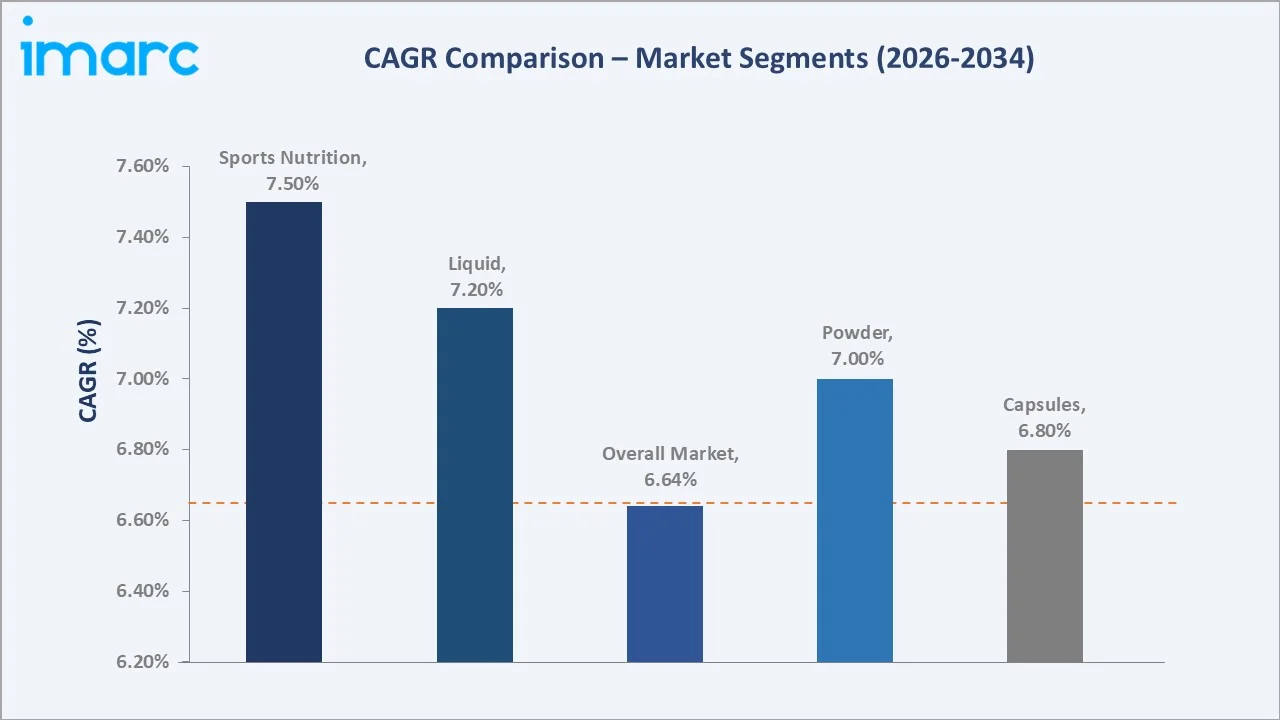
Sports Nutrition – ~7.5% CAGR (2026-2034) |
| Dominant Form |
Tablets – 29.6% share (2025) |
|
Fastest Growing Form |
Liquid – ~7.2% CAGR (2026-2034) |
| Leading Region | Kanto Region – 35.6% share (2025) |
| Top Companies | Otsuka Holdings Co., Ltd., DHC Corporation, Kirin Holdings Company, Limited, Suntory Holdings Limited, Yakult Honsha Co., Ltd |
Key Analytical Observations Supporting The Above Data:
- Dietary supplements' 36.8% (2025) product type leadership reflects Japan's established supplement culture anchored in the Food with Function Claims (FFC) registration system, which has thousands of registered products covering probiotics, lutein, EPA/DHA, collagen peptides, and GABA.
- Tablets' 29.6% (2025) form dominance reflects the pharmaceutical heritage of Japan's supplement market, as Japanese consumers are among the world's highest-trusting in medical products. This commands consumer confidence across age groups, from vitamin complex tablets used by elderly consumers managing multiple health conditions to sports performance tablet formulations used by gym-active adults.
- The Kanto Region's 35.6% (2025) market dominance reflects Greater Tokyo's consumer spending concentration: Tokyo’s 37 million residents represent Japan’s single largest supplement consumer market, with Tokyo’s health food store density, gym and fitness club concentration, and highest-per-capita e-commerce supplement purchasing rate generating disproportionate market value relative to its population share.
- The 6.64% CAGR reflects the demographic tailwind from Japan's ageing population creating structural demand for age-specific supplements; the government’s preventive healthcare strategy that actively positions nutritional supplements as cost-reducing health maintenance tools; and the growth of sports nutrition and beauty supplement categories among Japan's 20–40-year-old millennial and Gen Z consumers.
Japan Nutritional Supplements Market Overview
Japan’s nutritional supplements market encompasses dietary supplements, functional foods approved under the FOSHU or FFC systems, sports nutrition products, and specialty nutritional products across weight management, beauty, and therapeutic nutrition categories. Japan is one of the world’s most sophisticated and discerning nutritional supplements markets, with consumers among the most informed regarding ingredient science, clinical evidence, and product quality standards of any consumer supplement market globally.
Japan's nutritional supplement regulatory framework is unique globally: the Food with Function Claims (FFC) system (introduced 2015) allows manufacturers to register products making specific health claims backed by systematic reviews or randomized controlled trials, without requiring the lengthy FOSHU pre-market approval process. This system has enabled a proliferation of science-based supplement innovation that has significantly expanded the category's consumer reach beyond early-adopter health enthusiasts to mainstream consumers responding to credible health claim communications at point of sale.
Market Dynamics
To evaluate market opportunities, Request Sample
Market Drivers
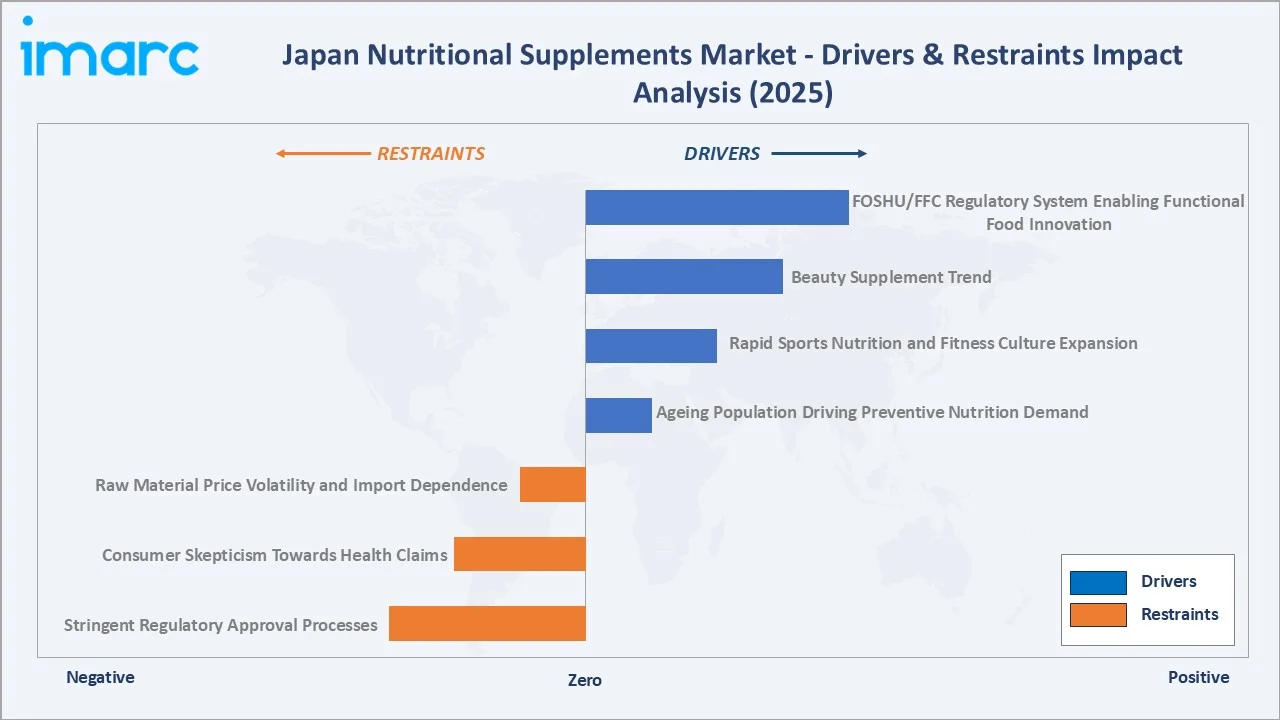
- Ageing Population Driving Preventive Nutrition Demand: Japan is the world’s most rapidly ageing society, with 36.19 million people over 65 years of age in 2025. Japan’s elderly population is among the world’s most active supplement consumers, with the majority of Japanese adults over 60 regularly consuming dietary supplements. The Ministry of Health, Labor and Welfare’s preventive healthcare strategy explicitly encourages supplement use as a cost-effective tool for maintaining health and reducing medical care expenditure within Japan’s universal healthcare system.
- Rapid Sports Nutrition and Fitness Culture Expansion: Japan’s sports nutrition market is growing at approximately 7.5% CAGR, driven by a structural shift in Japan’s fitness culture. Social media fitness culture has normalized protein supplement use among 20–35-year-old active adults who represent the fastest-growing sports nutrition consumer demographic.
- Beauty Supplement Trend: Japan’s distinctive ‘beauty from within’ supplement culture has created a substantial beauty supplement market segment where collagen peptides, hyaluronic acid, ceramide, Q10, placenta extract, and astaxanthin supplements are consumed for skin elasticity, moisture retention, and anti-ageing beauty benefits.
- FOSHU/FFC Regulatory System Enabling Functional Food Innovation: Japan’s Food for Specified Health Uses (FOSHU) and Food with Function Claims (FFC) regulatory systems provide the legal framework for science-backed health claim communications that are essential to mainstream consumer adoption of functional food and supplement products beyond wellness enthusiasts.
Market Restraints
- Stringent Regulatory Approval Processes: While the FFC self-notification system has streamlined lower-risk health claim registration, the FOSHU pre-approval pathway remains time-consuming and costly. Obtaining FOSHU status requires clinical trial substantiation at specific intake levels, 2–3-year review processes, and ongoing post-market surveillance obligations that cost JPY 10–50 Million per product in total regulatory investment.
- Consumer Skepticism Towards Health Claims: Japan’s supplement market has been affected by high-profile product quality incidents and misleading health claim controversies, most significantly the 2024 Kobayashi Pharmaceutical beni-koji (red yeast rice) supplement recall linked to renal health concerns that resulted in multiple consumer deaths, generating widespread media coverage and temporary consumer confidence shocks across the supplement category.
- Raw Material Price Volatility and Import Dependence: Japan imports the majority of supplement raw materials from overseas suppliers, primarily China, India, the US, and Norway. Global commodity price volatility for key ingredients, combined with yen exchange rate fluctuations that significantly affect JPY-denominated input costs, creates margin pressure for supplement manufacturers.
Market Opportunities
- Personalized Nutrition and AI-Driven Supplement Recommendation: Japan’s technology-forward consumer base and high smartphone penetration (~85% in 2025) are creating commercial viability for AI-powered personalized supplement recommendation platforms that analyze individual health data to generate personalized supplement protocols. Startups and established manufacturers are developing digital health platforms that integrate supplement recommendation with IoT health monitoring, creating data-driven subscription supplement models that command premium pricing and generate superior customer lifetime value versus generic supplement retail.
- Probiotic and Gut Microbiome Supplement Growth: Japan’s world-leading probiotic food culture provides an ideal platform for the expansion of the probiotic supplement category beyond beverages into capsule, powder, and gummy formats. The FFC system’s registration of probiotic strain-specific health claims for gut health, immune function, and bowel regularity enables science-differentiated probiotic supplement marketing that commands premium pricing and drives rapid category expansion among Japan’s health-conscious senior and wellness consumer segments.
Market Challenges
- 2024 Red Yeast Rice Supplement Incident Regulatory Impact: Kobayashi Pharmaceutical’s beni-koji (red yeast rice) supplement incident in early 2024 triggered the Ministry of Health, Labor and Welfare’s most significant supplement regulatory overhaul. While the long-term regulatory environment improvements are market-positive, the transition period has increased compliance costs, extended product registration timelines, and created temporary consumer confidence disruption.
- Counterfeit and Unregistered Supplement Products: Japan’s e-commerce supplement market faces growing infiltration by unregistered dietary supplement products from overseas sellers on platforms such as Amazon Japan, which lack FOSHU or FFC registration, Japanese language safety disclosures, and ingredient traceability documentation required under the Food Sanitation Act.
Emerging Market Trends
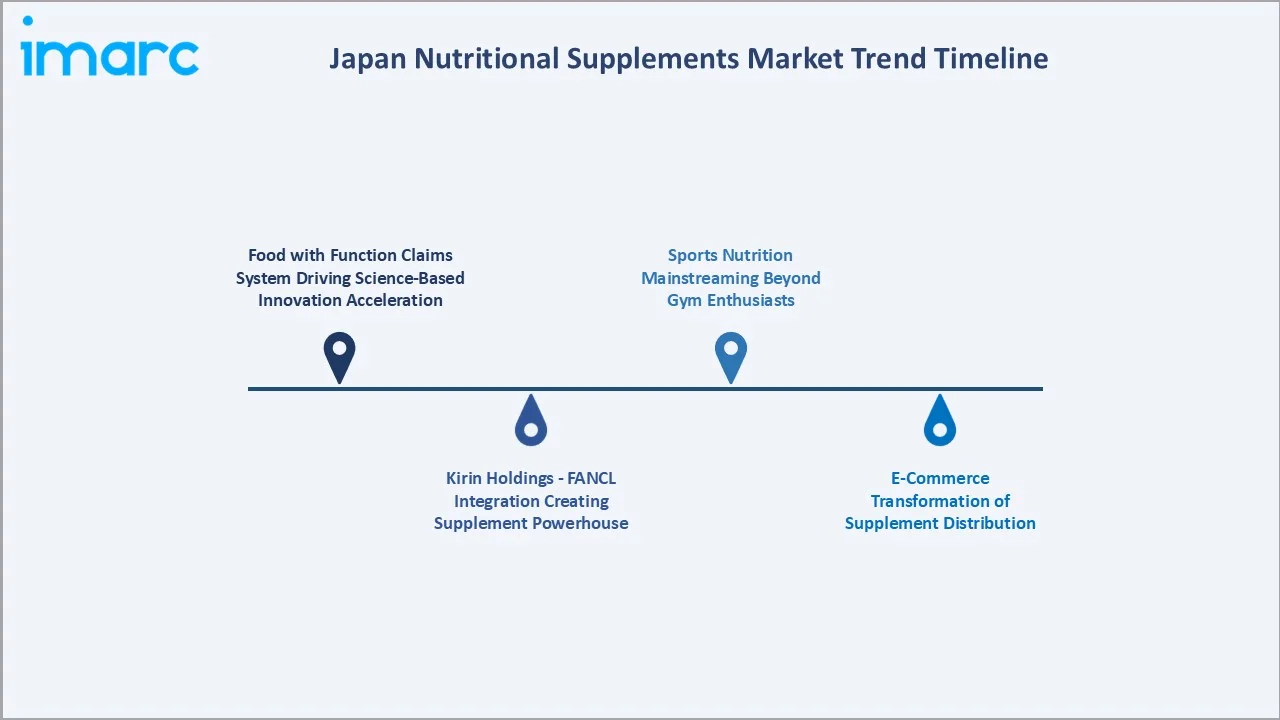
1. Food with Function Claims System Driving Science-Based Innovation Acceleration
Japan’s FFC system has become one of the world’s most productive frameworks for functional food and supplement science-based health claim innovation. The FFC’s systematic review acceptance pathway enables ingredient innovation cycles of 60–90 days that make Japan’s functional supplement market one of the world’s most responsive to emerging nutrition science, accelerating product launches in areas including gut microbiome, cognitive health, sleep quality, and stress management supplements.
2. Kirin Holdings – FANCL Integration Creating Supplement Powerhouse
Kirin Holdings’ acquisition of FANCL Corporation in June 2024 created Japan’s most integrated science-to-consumer supplement enterprise. The combined entity’s ability to develop proprietary functional ingredients through Kirin’s biotechnology R&D and bring them to market through FANCL’s subscription customer base represents a new competitive model that other Japanese supplement companies must strategically respond to, driving broader industry investment in ingredient R&D, direct-to-consumer channel development, and fermentation-derived supplement innovation.
3. E-Commerce Transformation of Supplement Distribution
Japan’s supplement distribution landscape is being fundamentally reshaped by e-commerce platform growth, driven by Amazon Japan’s supplement category expansion, Rakuten Ichiba supplement retail growth, and manufacturer direct-to-consumer subscription platforms that deliver monthly supplement packages to enrolled customers. DHC Corporation has successfully transitioned its subscription customer base from catalogue/mail-order to digital subscription management,
4. Sports Nutrition Mainstreaming Beyond Gym Enthusiasts
Japan’s sports nutrition category is transitioning from a niche product segment targeting serious athletes and dedicated gym-goers to a mainstream consumer health category used by casual exercisers, active seniors maintaining muscle mass, office workers using protein supplements for workplace performance and satiety, and women using sports nutrition products for toning and body composition management rather than muscle building.
Industry Value Chain Analysis
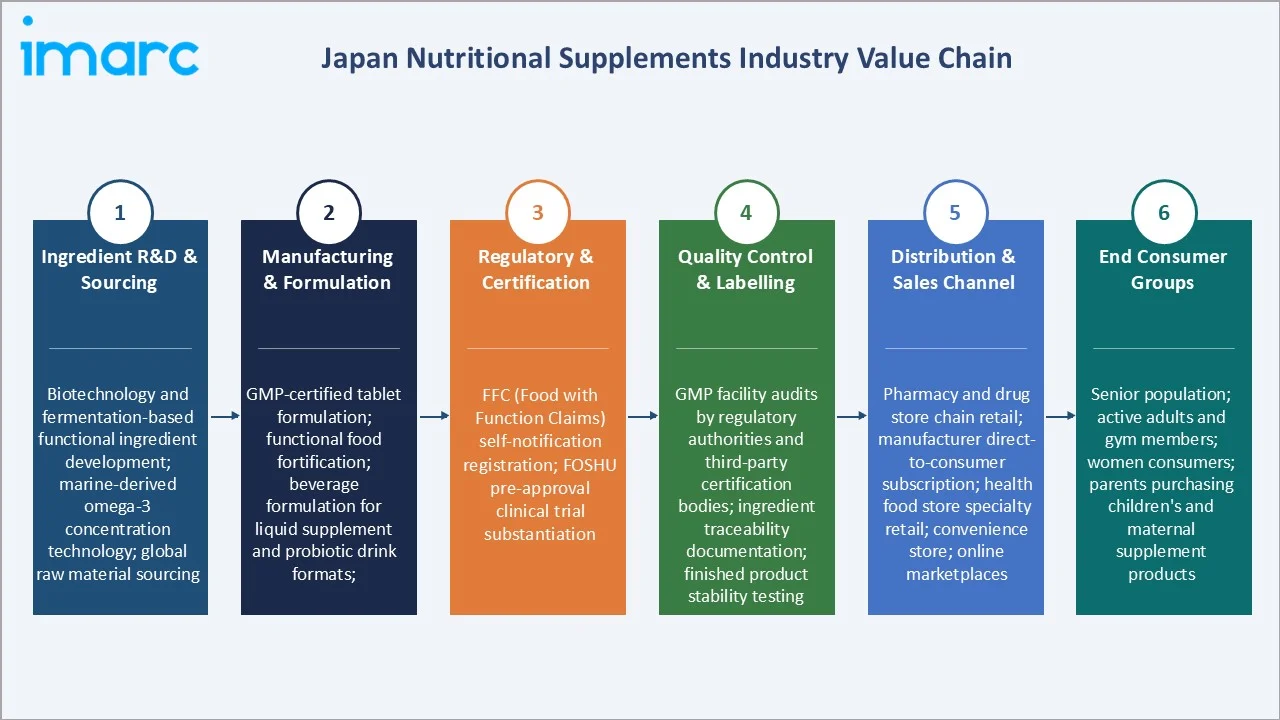
The Japan nutritional supplements market value chain spans functional ingredient research and sourcing through consumer health outcomes, with the FFC/FOSHU regulatory gateway serving as the critical credibility and market access control point that differentiates science-substantiated premium supplement products from unregistered commodity imports.
|
Stage |
Key Players / Examples |
| Ingredient R&D & Sourcing | Biotechnology and fermentation-based functional ingredient development; marine-derived omega-3 concentration technology; global raw material sourcing |
| Manufacturing & Formulation | GMP-certified tablet formulation; functional food fortification; beverage formulation for liquid supplement and probiotic drink formats |
| Regulatory & Certification | FFC (Food with Function Claims) self-notification registration; FOSHU (Food for Specified Health Uses) pre-approval clinical trial substantiation |
| Quality Control & Labelling | GMP facility audits by regulatory authorities and third-party certification bodies; ingredient traceability documentation; finished product stability testing |
| Distribution & Sales Channel | Pharmacy and drug store chain retail; manufacturer direct-to-consumer subscription; health food store specialty retail; convenience store; online marketplaces |
| End Consumer Groups | Senior population; active adults and gym members; women consumers; parents purchasing children’s and maternal supplement products |
Technology Landscape in the Japan Nutritional Supplements Industry
Fermentation Technology and Probiotic Strain Development
Japan’s biotechnology and fermentation expertise provides a distinctive competitive advantage in probiotic strain development, fermentation-derived bioactive ingredient production, and precision fermentation applications for supplement ingredient innovation. Kirin Holdings’ Lactococcus lactis JCM 5805 strain exemplifies Japan’s unique ability to develop proprietary probiotic strains with specific mechanistic clinical evidence that enables differentiated FFC health claim registration and premium product positioning.
Nano-Encapsulation and Bioavailability Enhancement Technology
Japanese supplement manufacturers are increasingly investing in advanced delivery system technologies that improve the bioavailability and efficacy of active ingredients: nano-encapsulation of astaxanthin, CoQ10, and curcumin for improved absorption; liposomal vitamin C formulations; enteric-coated probiotic capsules providing acid-resistant delivery to the intestinal microbiome; and micro-encapsulated powder formats enabling functional ingredients to be incorporated into food products without flavor or color alteration.
AI-Powered Personalized Supplement Recommendation Platforms
Japanese technology companies and supplement manufacturers are developing AI-powered health data analysis platforms that transform individual health biomarker data into personalized supplement protocols. Companies including Suntory Wellness, Meiji Holdings, and health-tech startups are building the data infrastructure and AI recommendation engines that enable truly personalized supplement prescriptions at scale.
Market Segmentation Analysis
The report covers the following segments:
|
Segment Category |
Leading Segment |
Market Share |
Year |
| Product Type | Dietary Supplement |
36.8% |
2025 |
| Form | Tablets |
29.6% |
2025 |
| Distribution Channel |
🔒 |
🔒 |
2025 |
| Consumer Group | 🔒 | 🔒 | 2025 |
|
Region |
Kanto Region |
35.6% |
2025 |

By Product Type
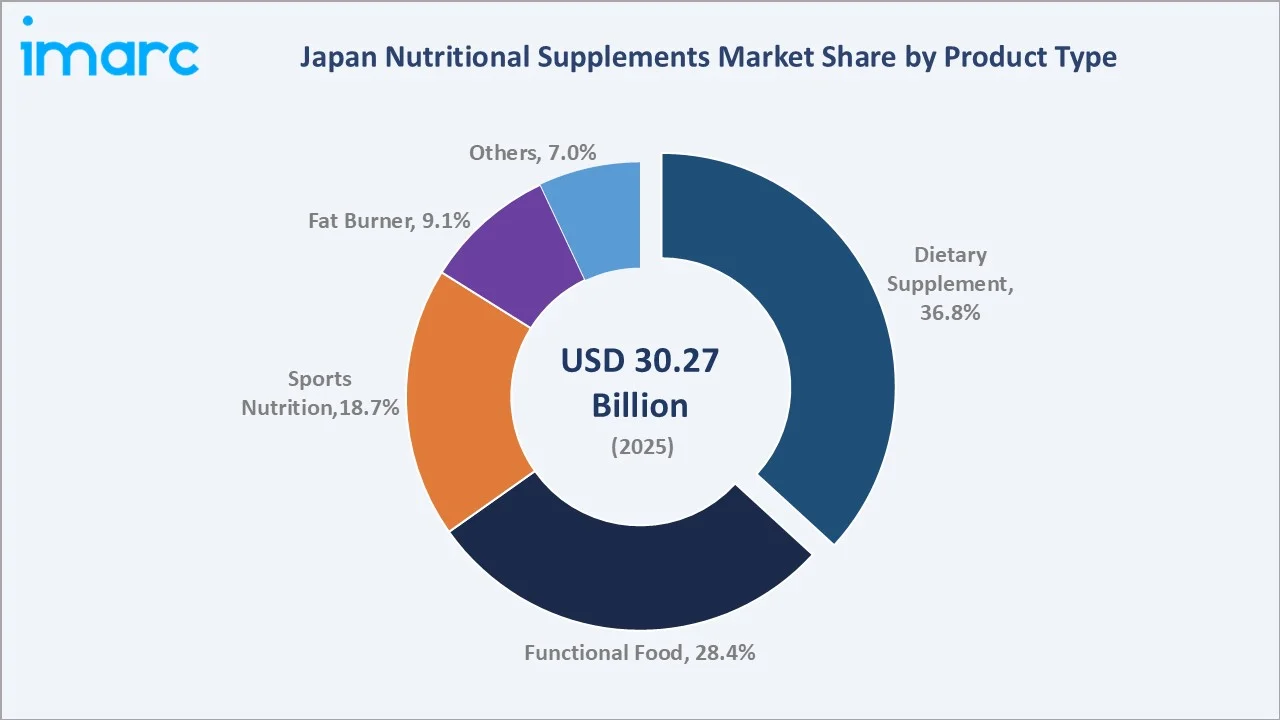
The product type segment is analyzed across dietary supplement (36.8%), functional food (28.4%), sports nutrition (18.7%), fat burner (9.1%), and others (7.0%). Dietary Supplements lead, anchored by Japan’s extensive FFC-registered supplement portfolio and the country’s deeply embedded supplement consumption culture among health-conscious adult and senior consumer segments.
To access detailed market analysis, Request Sample
Functional food encompasses the FOSHU-approved and FFC-registered food product segment that sits at the intersection of Japan’s food and health supplement markets. Sports nutrition is expected to grow fastest within the category at approximately 7.5% CAGR, driven by gym membership expansion, social media fitness culture, and the mainstreaming of protein supplementation beyond serious athletes.
By Form
The form segment is led by tablets (29.6%), capsules (24.8%), powder (18.9%), soft gels (12.7%), liquid (8.5%), and others (5.5%). Tablets’ leadership reflects the format’s universal consumer trust, convenient daily dosing portability, and established retail positioning across pharmacy and drug store supplement planograms.
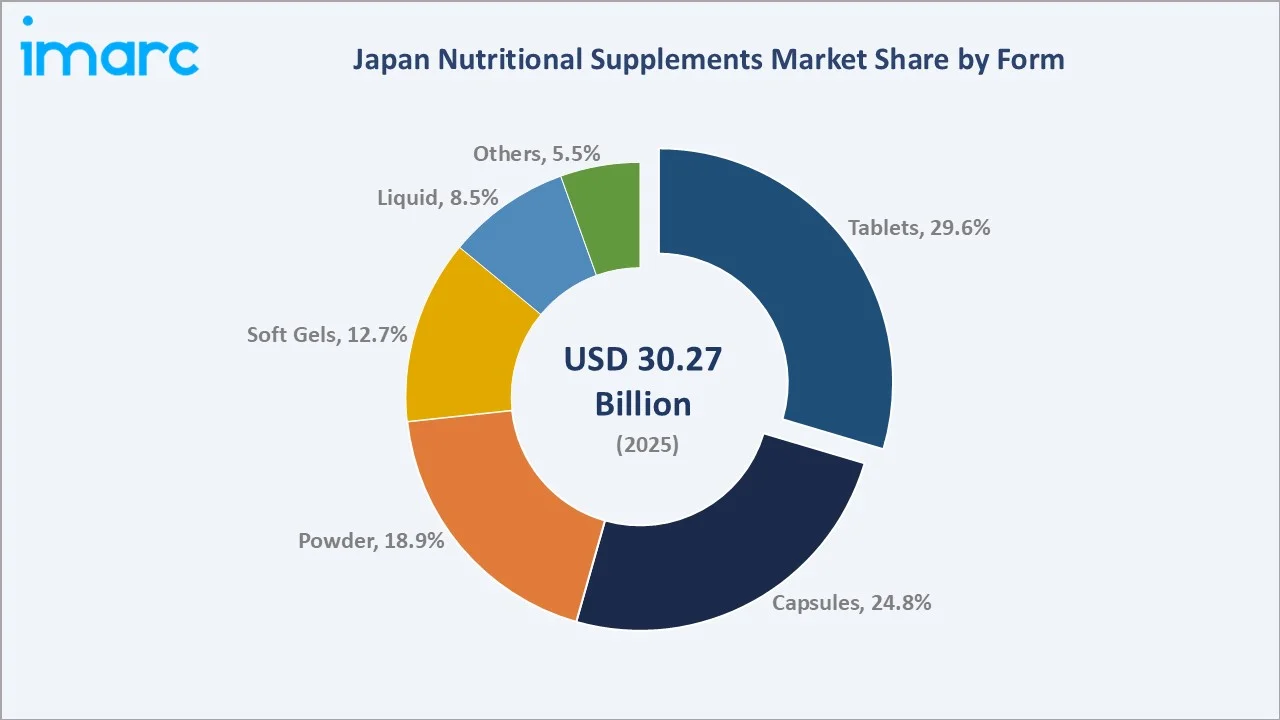
Capsules serve the premium supplement tier where ingredient protection, oil-based formulations, and additive-minimized formulations justify the higher manufacturing cost relative to compressed tablets. Powder is driven by the sports nutrition segment’s protein shake, BCAA, and creatine product categories where bulk powder delivery enables economical high-dose ingredient consumption.
Regional Market Insights
The Kanto Region’s 35.6% national leadership reflects Greater Tokyo’s position as Japan’s single largest consumer health market, hosting the country’s highest concentration of supplement retail chains, e-commerce distribution infrastructure, and health-conscious urban professional and senior consumer populations.
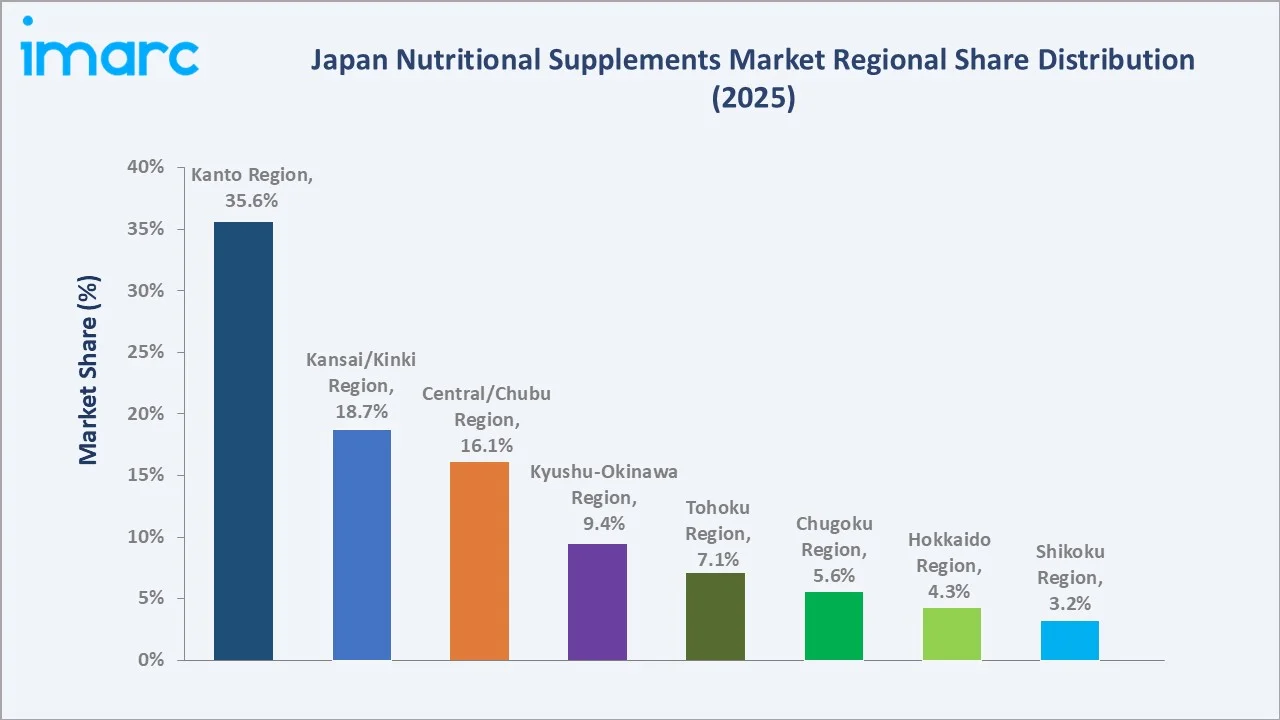
The Kansai/Kinki Region at 18.7% encompasses Osaka, Kyoto, and Kobe, Japan’s second-largest metropolitan area, where strong domestic supplement brand presence, traditional health food culture, and the region’s pharmaceutical industry concentration contribute to above-national-average per-capita supplement spending.
|
Region |
Share (2025) |
Key Market Drivers & Characteristics |
| Kanto Region | 35.6% | Greater Tokyo metropolitan area’s largest national consumer health market; highest supplement retail chain and drug store density; e-commerce distribution hub driving online supplement purchasing growth; large senior and working-age health-conscious population |
| Kansai/Kinki Region |
18.7% | Osaka-Kobe pharmaceutical industry concentration creating supplement manufacturing and innovation ecosystem; traditional health food consumer culture in Kyoto; strong domestic functional food brand heritage |
| Chubu (Central) Region |
16.1% | Nagoya metropolitan area large corporate and industrial workforce driving workplace wellness and sports nutrition demand; automotive industry employee wellness programs supporting supplement adoption |
| Kyushu-Okinawa Region |
9.4% | Okinawa longevity culture creating unique supplement consumer awareness; warm climate supporting active outdoor lifestyle and sports nutrition; growing health tourism and wellness resort sector |
| Tohoku Region |
7.1% |
Growing health awareness in post-seismic recovery communities; cold climate supporting immune support and vitamin D supplement demand; aging rural population driving preventive nutrition supplement adoption |
| Chugoku Region |
5.6% |
Hiroshima and Okayama metropolitan areas driving regional supplement retail; industrial and commercial workforce supplement demand; growing health consciousness among mid-size city consumer populations |
| Hokkaido Region |
4.3% |
Cold climate and outdoor activity culture supporting vitamin D, joint health, and sports supplement demand; premium local natural ingredient sourcing supporting Hokkaido-branded supplement product development; growing health and wellness tourism sector |
| Shikoku Region |
3.2% |
Regional supplement consumer demand growth through e-commerce channel expansion; growing senior population driving preventive nutrition supplement adoption; health consciousness increase supported by government wellness campaigns |
Competitive Landscape
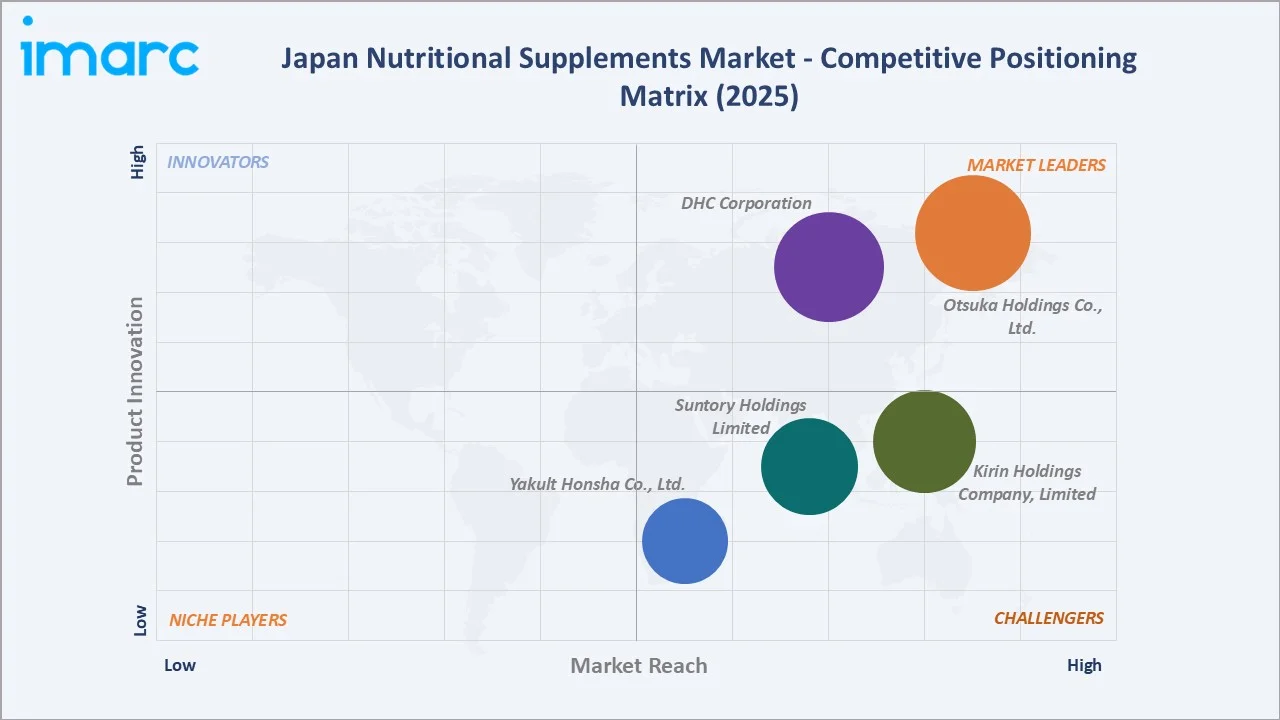
The Japan nutritional supplements market competitive landscape is characterized by the dominance of domestic Japanese pharmaceutical and food companies that combine pharmaceutical-grade manufacturing quality, extensive FFC/FOSHU registered product portfolios, direct-to-consumer subscription business models, and deep consumer trust built over decades of branded supplement marketing.
|
Company Name |
Key Products / Brands |
Market Position |
Core Strength |
| Otsuka Holdings Co., Ltd. | Nature Made vitamins, Pocari Sweat, Amino-Value, EQUELLE, Nature Made Zero Sugar Gummies, among others | Market Leader | One of Japan’s largest supplement and functional beverage companies; Nature Made vitamin range (Japanese market leader in multivitamins); broad distribution across pharmacy, convenience store, and e-commerce channels |
| DHC Corporation | Soy Isoflavone Equol, DHA 30-day Supply, Lutein for Light Protection, Fragrant Bulgarian Rose Capsules, Caloriepon, among others |
Market Leader |
One of Japan’s largest direct-to-consumer supplement brands; additive-free formulation philosophy; catalogue and e-commerce subscription model with superior customer retention |
| Kirin Holdings Company, Limited | FANCL Calorie Limit, Wellage Premium, Enkin, Inner fat support, Age-specific supplements, Basic Nutrition, Beauty supplements, Personal One, Lactococcus lactis JCM 5805 immune strain, among others | Strong Challenger | Combining fermentation biotech with additive-free supplement expertise; proprietary Lactococcus lactis JCM 5805 immune strain; science-to-consumer integration model |
| Suntory Holdings Limited | Sesamin EX, Vistra | Strong Challenger | Premium wellness supplement brand with sesamin lignan proprietary ingredient platform; Suntory Wellness dedicated supplement business unit; clinical research investment in lifestyle disease supplement efficacy |
| Yakult Honsha Co., Ltd. | Yakult Probiotic Drink, Joie Supplement Series, Cosmetics-Nutrition Range |
Challenger |
Global distribution network; probiotic category awareness creation; home delivery subscription model; strong senior consumer trust in probiotic science |
International supplement brands represent a smaller market share in Japan than in most other major markets, reflecting the strength of Japanese domestic supplement brand equity and the regulatory investment required for FOSHU/FFC registration.
Key Company Profiles
Otsuka Holdings Co., Ltd.
Otsuka Holdings Co., Ltd.’s subsidiary Otsuka Pharmaceutical Co. Ltd. is one of Japan’s largest nutritional supplement and functional beverage companies. The company operates across pharmaceutical drugs, nutraceuticals, and consumer products, making it one of the world’s most diversified health company platforms.
- Product Portfolio: Nature Made vitamin range; Amino Value amino acid sport recovery supplement; Pocari Sweat electrolyte sports drink; EQUELLE women’s health supplement for menopausal symptom management; Nature Made Zero Sugar Gummies.
- Recent Developments: For FY2025, Otsuka Holdings Co., Ltd. recorded that the Nutraceuticals segment accounted for external revenue of JPY 577.6 billion, up from JPY 557.0 billion in FY2024. Within the segment, the “For Healthier Life” category, covering Nature Made, MegaFood and Calorie Mate, rose to JPY 234.7 billion in FY2025 from JPY 219.3 billion in FY2024.
- Strategic Focus: Nature Made digital subscription channel development; EQUELLE women’s health segment expansion targeting Japan’s large menopausal consumer demographic; sports and active nutrition portfolio growth.
DHC Corporation
DHC Corporation is Japan’s pioneer and market leader in direct-to-consumer (DTC) nutritional supplements, having built Japan’s largest supplement subscription customer base.
- Product Portfolio: Soy Isoflavone Equol, DHA 30-day Supply, Lutein for Light Protection, Fragrant Bulgarian Rose Capsules, and Caloriepon, among others.
- Strategic Focus: Digital subscription platform transition and customer data integration for personalized supplement recommendation; overseas market expansion in the USA and Southeast Asia; new collagen and beauty supplement product category innovation to defend market leadership in Japan’s most competitive supplement sub-category; FFC registration expansion across the product portfolio.
Market Concentration Analysis
The Japan nutritional supplements market exhibits moderate concentration at the category level, with the top domestic companies collectively accounting for an estimated 35–45% of total market value. However, market concentration varies significantly by segment: the dietary supplement sub-segment is more concentrated around established direct-to-consumer brands, while the functional food segment is more fragmented, with hundreds of food manufacturers registering FFC products across diverse food categories.
Japan’s supplement market’s concentration is progressively increasing through M&A consolidation: Kirin’s FANCL acquisition in 2024 and Meiji Holdings’ sustained investment in protein nutrition and functional dairy reflect the strategic imperative of building scale and R&D investment capacity that the FFC clinical evidence requirement and direct-to-consumer digital channel development make increasingly competitive without significant resources.
Investment & Growth Opportunities
Fastest Growing Segments
Sports Nutrition (~7.5% CAGR, fastest product type); Liquid form supplements including probiotic drinks and collagen shots (~7.2% CAGR, fastest form segment); senior-targeted precision supplement products for sarcopenia, cognitive decline, and osteoporosis management; AI-powered personalized supplement subscription services; and probiotic and gut microbiome supplement categories represent the highest-growth investment vectors within Japan’s nutritional supplements market through 2034.
Emerging Market Expansion
Japan’s supplement brands are increasingly targeting Southeast Asian export markets where Japanese brand quality positioning commands 20–50% price premiums over domestically produced Asian supplement brands. Suntory Wellness’ VISTRA brand (launched in Thailand), DHC’s US market expansion, and FANCL’s Hong Kong retail network exemplify the internationalization strategy through which Japan’s domestic supplement market leaders are leveraging Japanese brand equity to capture premium market positions in overseas markets.
Venture and Institutional Investment Trends
- Healthtech startups developing AI-powered personalized supplement recommendation and digital health integration platforms are attracting seed and Series A venture investment in Japan, with the convergence of Japan’s ageing population, high smartphone penetration, and consumer willingness to invest in health monitoring creating a compelling commercial environment for digital health-supplement integration business models.
- International ingredient suppliers and nutraceutical companies are investing in FFC registration of their functional ingredients in Japan’s regulatory system to access the world’s most sophisticated functional supplement market, with ingredient registrations enabling partnerships with established Japanese supplement manufacturers for co-developed FFC-registered products that leverage both the ingredient’s proprietary clinical evidence and the manufacturer’s domestic brand and distribution infrastructure.
Future Market Outlook (2026-2034)
The Japan nutritional supplements market is positioned for above-average growth through 2034. From a base of USD 30.27 Billion in 2025, the market is projected to reach USD 54.00 Billion by 2034 at a CAGR of 6.64%, representing total incremental value creation of USD 23.73 Billion.
This robust growth will be driven by the compounding effect of Japan’s structural demographic tailwind, the FFC system’s continued enablement of functional innovation, the mainstreaming of sports nutrition and beauty supplements across broader consumer demographics, and the digitalization of supplement distribution through direct-to-consumer subscription and AI-powered personalized nutrition platforms.
By 2034, Sports Nutrition will have grown from 18.7% to an estimated 23–25% of product type market share as gym culture mainstreaming, active ageing senior fitness participation, and protein supplement normalization across convenience food formats continue to expand the addressable market. Liquid forms will have grown from 8.5% to approximately 14–16% of form share as probiotic drinks, collagen shots, and beauty supplement liquid formats achieve mainstream retail distribution penetration beyond pharmacy into convenience store and supermarket channels.
Research Methodology
Primary Research
Primary research comprised structured interviews with over 65 industry participants in 2024–2025, including supplement manufacturer product managers, retail pharmacy supplement category directors, e-commerce supplement platform buyers, clinical dietitians and sports nutritionists, and supplement subscription service management personnel across Kanto, Kansai, Chubu, and Kyushu regions.
Secondary Research
Secondary research encompassed Ministry of Health, Labor and Welfare FFC registration database statistics, Consumer Affairs Agency FOSHU product approval database, Japan Health and Nutrition Food Association JHFA certification data, Ministry of Economy, Trade and Industry food manufacturing industry statistics, Japan Customs dietary supplement import and export trade data, Intage survey data on Japanese consumer supplement purchase frequency and category preferences, and annual reports.
Forecasting Models
Market size estimations were derived using top-down and bottom-up forecasting, incorporating MHLW dietary supplement market statistics, FFC registration growth trajectory modelling, demographic age-cohort supplement expenditure modelling using Statistics Bureau of Japan household expenditure survey data, sports and fitness sector growth projections from Japan Health Club Industry Association membership data, e-commerce channel growth projections from Japan E-commerce Association market size data, and export market value contribution modelling.
Japan Nutritional Supplements Market Report Coverage:
| Report Features | Details |
|---|---|
| Base Year of the Analysis | 2025 |
| Historical Period | 2020-2025 |
| Forecast Period | 2026-2034 |
| Units | Billion USD |
| Scope of the Report |
Exploration of Historical Trends and Market Outlook, Industry Catalysts and Challenges, Segment-Wise Historical and Future Market Assessment:
|
| Product Types Covered | Sports Nutrition, Dietary Supplement, Fat Burner, Functional Food, Others |
| Forms Covered | Powder, Tablets, Capsules, Liquid, Soft Gels, Others |
| Distribution Channels Covered | Brick And Mortar, E-Commerce |
| Consumer Groups Covered | Infants, Children, Adults, Pregnant, Geriatric |
| Regions Covered | Kanto Region, Kansai/Kinki Region, Central/ Chubu Region, Kyushu-Okinawa Region, Tohoku Region, Chugoku Region, Hokkaido Region, Shikoku Region |
| Companies Covered | Otsuka Holdings Co., Ltd., DHC Corporation, Kirin Holdings Company, Limited, Suntory Holdings Limited, Yakult Honsha Co., Ltd., etc. |
| Customization Scope | 10% Free Customization |
| Post-Sale Analyst Support | 10-12 Weeks |
| Delivery Format | PDF and Excel through Email (We can also provide the editable version of the report in PPT/Word format on special request) |
Key Benefits for Stakeholders:
- IMARC’s industry report offers a comprehensive quantitative analysis of various market segments, historical and current market trends, market forecasts, and dynamics of the Japan nutritional supplements market from 2020-2034.
- The research report provides the latest information on the market drivers, challenges, and opportunities in the Japan nutritional supplements market.
- Porter's five forces analysis assist stakeholders in assessing the impact of new entrants, competitive rivalry, supplier power, buyer power, and the threat of substitution. It helps stakeholders to analyze the level of competition within the Japan nutritional supplements industry and its attractiveness.
- Competitive landscape allows stakeholders to understand their competitive environment and provides an insight into the current positions of key players in the market.
Frequently Asked Questions About the Japan Nutritional Supplements Market Report
The Japan nutritional supplements market reached USD 30.27 Billion in 2025 and is projected to reach USD 54.00 Billion by 2034.
The market is expected to grow at a CAGR of 6.64% during 2026-2034, driven by Japan’s rapidly ageing population driving preventive nutrition demand, sports nutrition and fitness culture expansion, the beauty supplement trend, and the digitalization of supplement distribution through direct-to-consumer and AI-personalized platforms.
The Kanto Region leads with a 35.6% market share in 2025, anchored by Greater Tokyo’s position as Japan’s single largest consumer health spending market, with the highest supplement retail chain density, e-commerce fulfilment infrastructure, gym membership concentration, and health-conscious urban professional and senior consumer population.
Dietary supplements dominate with a 36.8% share in 2025, reflecting Japan’s established supplement consumption culture, the FFC system’s enablement of science-backed health claim products, and the deep consumer trust in supplement quality among Japanese adult and senior consumer segments.
Tablets hold the largest form share at 29.6%, reflecting Japanese consumers’ pharmaceutical-derived preference for precision dosing, compact storage, and the product safety and quality associations that compressed tablet formats carry from Japan’s prescription drug consumer culture.
Some of the key players include Otsuka Holdings Co., Ltd., DHC Corporation, Kirin Holdings Company, Limited, Suntory Holdings Limited, and Yakult Honsha Co., Ltd.
Key challenges include the regulatory impact of the 2024 Kobayashi Pharmaceutical red yeast rice supplement incident, stringent FOSHU pre-approval processes limiting rapid innovation in the highest-claim tier, consumer skepticism recovery, and counterfeit and unregistered supplement product infiltration through e-commerce platforms.
Need more help?
- Speak to our experienced analysts for insights on the current market scenarios.
- Include additional segments and countries to customize the report as per your requirement.
- Gain an unparalleled competitive advantage in your domain by understanding how to utilize the report and positively impacting your operations and revenue.
- For further assistance, please connect with our analysts.
 Request Customization
 Speak to an Analyst
 Request Brochure
 Inquire Before Buying
Benefits of Customization
- Personalize this research
- Triangulate with your data
- Get data as per your format and definition
- Gain a deeper dive into a specific application, geography, customer, or competitor
- Any level of personalization
Get in Touch With Us
UNITED STATES
Phone: +1-201-971-6302
INDIA
Phone: +91-120-433-0800
UNITED KINGDOM
Phone: +44-753-714-6104
Email: [email protected]
Client Testimonials




.webp)




.webp)













Related Reports

Choose your plan
*Please note that the prices mentioned below are starting prices for each bundle type. Kindly contact our team for further details.*
Single User License
- 1 User License, Access on 2 Devices
- PDF Report + Excel Dataset (Password Protected)
- Lifetime Access
- No Printing Rights
- 10% Free Report Customization
- 10–12 Weeks of Analyst Support
Five User License
- Access for 5 Users, 2 Devices per User
- PDF Report + Excel Dataset (Password Protected)
- Lifetime Access
- Dedicated Account Manager
- 12–14 Weeks of Analyst Support
- No Printing Rights
- 15% Free Report Customization
- 25% Discount on Your Next Purchase
Corporate User License
- Unlimited User Access (Within Your Organization)
- PDF Report + Excel Dataset
- Lifetime Access
- Dedicated Account Manager
- 14–20 Weeks of Analyst Support
- No Printing Rights
- 20% Free Report Customization
- 30% Discount on Your Next Purchase
Essential Insights
What's included:
3 reports
- Lifetime Access
- PDF Reports
- Excel Datasets
- 2 Weeks of Free Analyst Support
- 2 User Licenses
- Access on 2 Devices
- Printing Rights
- Complimentary PowerPoint (PPT) Version
- Complimentary License Upgrade
Professional Access
What's included:
5 reports
- Lifetime Access
- PDF Reports
- Excel Datasets
- 8 Weeks of Free Analyst Support
- 2 User Licenses
- Access on 2 Devices
- Printing Rights
- Complimentary PowerPoint (PPT) Version
- Complimentary License Upgrade
Business Advantage
What's included:
8 reports
- Lifetime Access
- PDF Reports
- Excel Datasets
- 14 Weeks of Free Analyst Support
- 2 User Licenses
- Access on 2 Devices
- Printing Rights
- Complimentary PowerPoint (PPT) Version
- Complimentary License Upgrade
Enterprise Intelligence
What's included:
10 reports
- Lifetime Access
- PDF Reports
- Excel Datasets
- 20 Weeks of Free Analyst Support
- 2 User Licenses
- Access on 2 Devices
- Printing Rights
- Complimentary PowerPoint (PPT) Version
- Complimentary License Upgrade