
Japan Outdoor Advertising Market Size, Share, Trends and Forecast by Type, Segment, and Region, 2026-2034
Japan Outdoor Advertising Market Size, Share, Trends & Forecast (2026-2034)
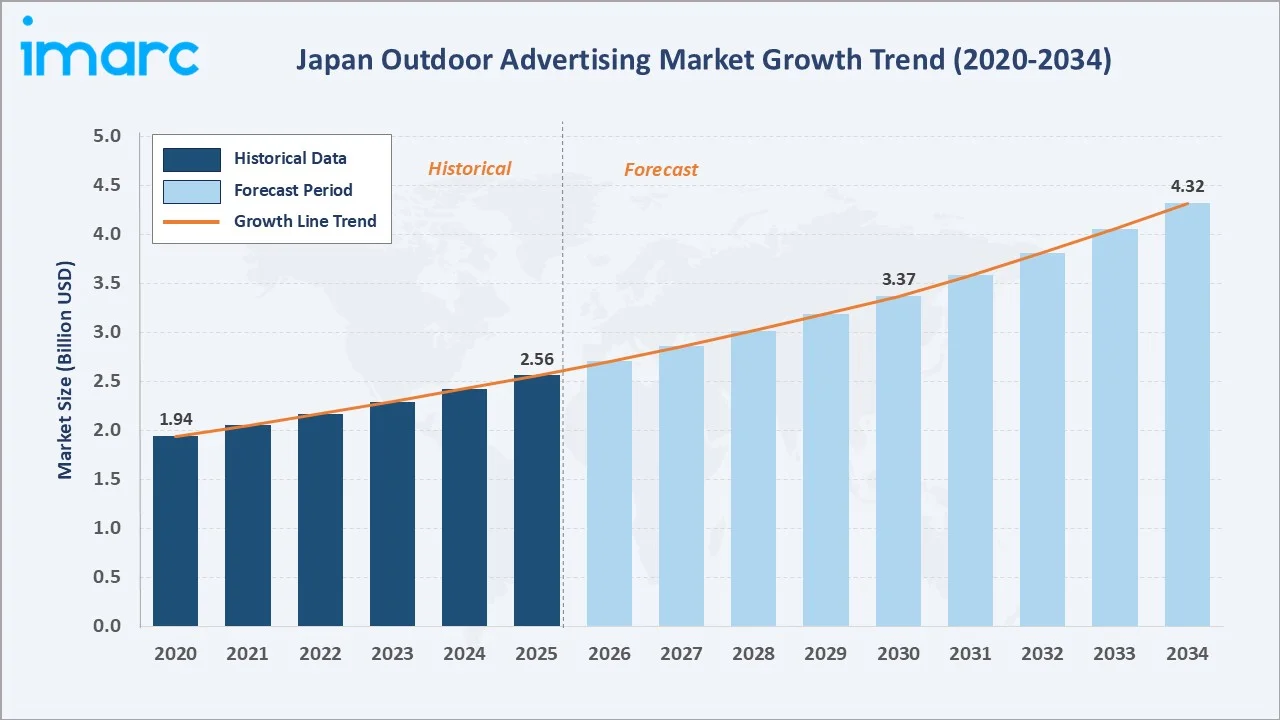
The Japan outdoor advertising market reached USD 2.56 Billion in 2025 and is projected to reach USD 4.32 Billion by 2034, growing at a CAGR of 5.68% during 2026-2034. Growth is anchored in Japan's exceptional urban density, world-leading rail commuter volumes, and the accelerating conversion of static inventory to digital screens.
Tokyo's Shibuya, Shinjuku, and Ikebukuro districts alone concentrate some of the highest daily pedestrian footfall globally, sustaining premium pricing for large-format displays. Traditional outdoor advertising leads by type at 56.4%, transport advertising dominates by segment at 38.7%, and the Kanto region commands 44.3% of national billings.
Market Snapshot
|
Metric |
Value |
|
Market Size (2025) |
USD 2.56 Billion |
|
Forecast Market Size (2034) |
USD 4.32 Billion |
|
CAGR (2026-2034) |
5.68% |
|
Base Year |
2025 |
|
Historical Period |
2020-2025 |
|
Forecast Period |
2026-2034 |
|
Dominant Type |
Traditional Outdoor Advertising (56.4%, 2025) |
|
Dominant Segment |
Transport Advertising (38.7%, 2025) |
|
Leading Region |
Kanto Region (44.3%, 2025) |
The market expanded from USD 1.94 Billion in 2020 to USD 2.56 Billion in 2025, recovering strongly after pandemic-era mobility restrictions suppressed commuter footfall and transit advertising demand. The trajectory is anchored at approximately USD 3.37 Billion in 2030 before reaching USD 4.32 Billion by 2034.
To get more information on this market, Request Sample
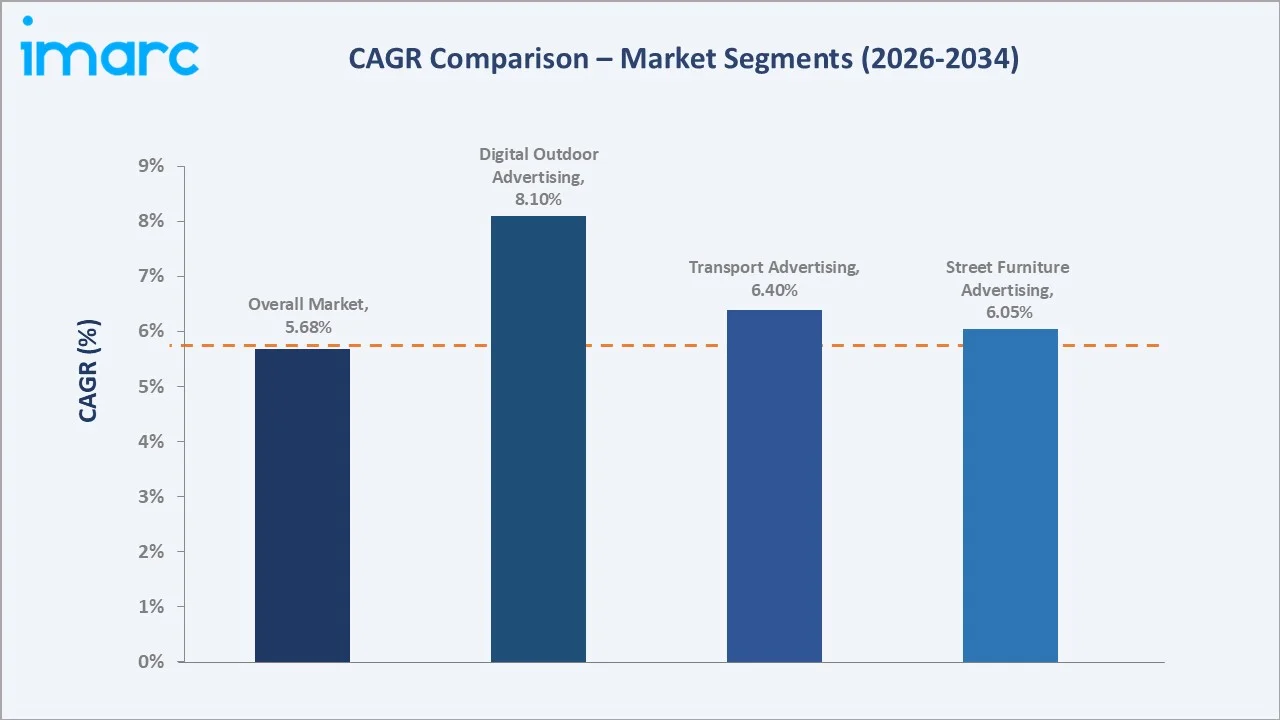
Digital outdoor advertising grows fastest at roughly 8.10% CAGR as media owners retrofit static faces with LED screens and adopt programmatic trading. Transport advertising expands at approximately 6.40% CAGR, supported by station-domination packages and in-carriage digital signage across Japan Railways and private rail networks.
Executive Summary
The Japan outdoor advertising market reached USD 2.56 Billion in 2025, representing one of Asia's most mature and highest-yield out-of-home advertising economies. Japan's combination of extreme urban concentration, exceptional public transport dependence, and disciplined municipal signage governance produces a market defined by premium inventory quality rather than inventory volume.
Traditional outdoor advertising at 56.4% retains leadership through the installed base of large-format billboards, station posters, and printed transit media. Transport advertising at 38.7% leads by segment, reflecting rail's centrality to Japanese daily mobility. The Kanto region at 44.3% concentrates national advertising spend through the Greater Tokyo metropolitan economy.
Key Market Insights
|
Insight |
Data |
|
Dominant Type |
Traditional Outdoor Advertising - 56.4% share (2025) |
|
Dominant Segment |
Transport Advertising - 38.7% market share (2025) |
|
Leading Region |
Kanto Region - 44.3% market share (2025) |
|
Market Opportunity |
Programmatic DOOH trading; station digital retrofit; retail media OOH networks; regional city screen build-out; AI-driven contextual creative |
Key Analytical Observations Supporting The Above Data:
- Traditional Outdoor Advertising at 56.4%: Traditional formats retain dominance through the extensive installed base of billboards, station posters, wrapped vehicles, and printed in-carriage media that remain cost-efficient for long-duration brand campaigns and reach audiences beyond metropolitan digital screen clusters.
- Transport Advertising at 38.7%: Transport advertising leads because rail carries most of the urban commuting in Japan, delivering repeated daily exposure across station concourses, platforms, carriages, and ticket gates with dwell times unmatched by roadside formats.
- Kanto Region at 44.3%: Kanto dominates through the Greater Tokyo economy, hosting national corporate headquarters, the densest rail network, and the highest-footfall commercial districts, which together concentrate premium advertiser budgets in a single metropolitan cluster.
Japan Outdoor Advertising Market Overview
The Japan outdoor advertising market encompasses the sale, operation, and measurement of all advertising inventory located in public spaces, spanning roadside and rooftop billboards, rail and airport transit media, street furniture such as bus shelters and kiosks, and emerging digital out-of-home screen networks.
The ecosystem integrates advertisers, media agencies, media owners, rail and transit concession holders, screen hardware suppliers, programmatic technology platforms, and municipal authorities governing signage permissions. Macroeconomic factors include urban population concentration, inbound tourism recovery, retail consumption trends, and corporate advertising budget cycles.
Market Dynamics
To evaluate market opportunities, Request Sample
Market Drivers
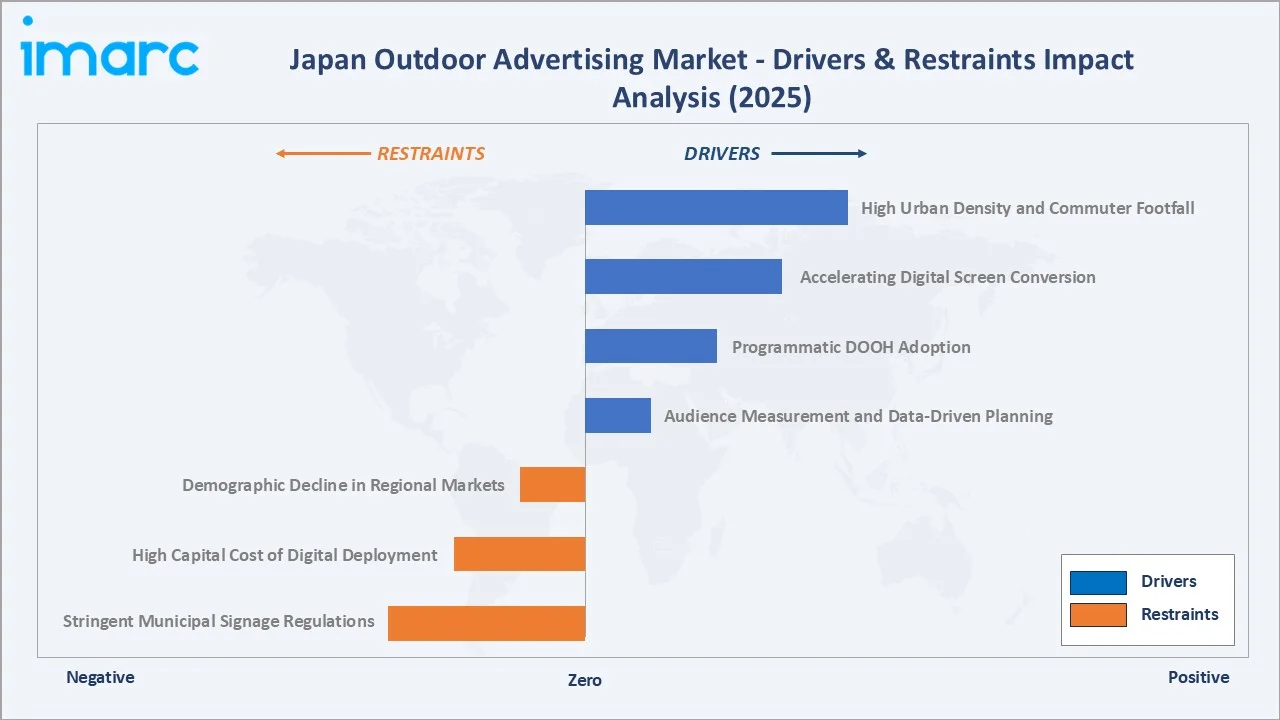
- High Urban Density and Commuter Footfall: Japan's population is overwhelmingly concentrated in metropolitan corridors, with Greater Tokyo alone housing over a quarter of national residents. This density produces exceptional daily impression volumes across stations, crossings, and commercial districts, allowing outdoor advertising to deliver mass reach at competitive cost-per-thousand rates relative to television and print.
- Accelerating Digital Screen Conversion: Media owners are converting static faces into LED and LCD displays across stations, shopping districts, and roadside sites. Digital inventory supports dayparting, multiple advertiser rotation, and rapid creative changes, materially increasing revenue yield per site and attracting advertisers seeking flexible, campaign-responsive outdoor placements.
- Programmatic DOOH Adoption: The adoption of programmatic digital out-of-home (DOOH) advertising is expanding across Japan, enabling advertisers to automate media buying and access premium digital outdoor inventory through demand-side platforms. This shift is improving campaign flexibility, audience targeting, and real-time optimization while increasing the efficiency of outdoor advertising investments.
- Audience Measurement and Data-Driven Planning: Growing demand for measurable advertising performance is driving the adoption of advanced audience measurement and analytics solutions. Advertisers are increasingly leveraging population movement, location intelligence, and exposure data to evaluate campaign effectiveness, optimize media planning, and improve return on advertising investment across digital billboards and street furniture networks.
Market Restraints
- Stringent Municipal Signage Regulations: Japanese municipalities enforce detailed outdoor advertising ordinances governing display size, illumination, placement, and heritage-district restrictions. Kyoto and several designated scenic zones impose particularly stringent limits. These rules constrain new inventory creation, lengthen approval timelines, and restrict the expansion of high-yield large-format digital installations.
- High Capital Cost of Digital Deployment: Converting static faces to digital requires substantial investment in screens, structural reinforcement, power supply, connectivity, and content management systems. Payback periods are extended for lower-footfall sites, discouraging smaller regional media owners from digitising and slowing the pace of nationwide inventory modernisation outside major metropolitan areas.
- Demographic Decline in Regional Markets: Japan's shrinking and ageing population reduces commuter volumes and retail footfall in regional prefectures. Declining audience delivery in Tohoku, Chugoku, Shikoku, and parts of Hokkaido limits advertiser willingness to fund outdoor campaigns outside the principal metropolitan corridors, constraining national market growth.
Market Opportunities
- Retail Media Integration: Retail media networks are extending from e-commerce into physical retail environments, creating opportunities for screen networks in shopping centres, convenience stores, and station retail concourses that combine outdoor reach with transactional targeting data.
- Inbound Tourism Advertising: Sustained inbound tourism growth is creating demand for multilingual and destination-targeted outdoor campaigns across airports, major stations, and tourist districts, opening a distinct advertiser category for media owners with premium gateway inventory.
Market Challenges
- Competition from Digital Media Channels: Outdoor advertising competes for budget with highly developed digital and connected television channels that offer granular attribution. Demonstrating comparable measurement rigour remains essential for outdoor media owners to defend and expand their share of total advertising spend.
- Inventory Access Concentration: Concentration of premium inventory among a limited number of rail operators and established media owners creates access constraints and pricing pressure for advertisers, while limiting the ability of newer operators to build competitive national inventory portfolios.
Emerging Market Trends
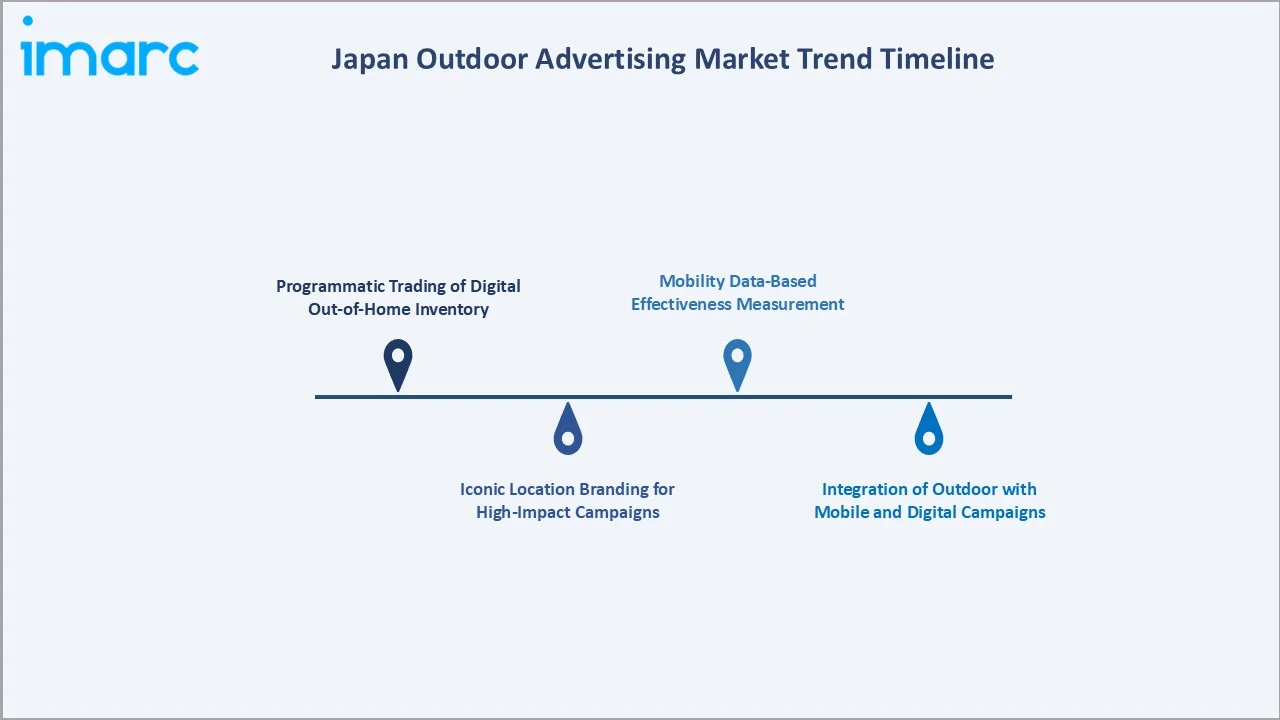
1. Programmatic Trading of Digital Out-of-Home Inventory
The adoption of programmatic trading is transforming Japan's digital out-of-home (DOOH) advertising market by enabling automated, data-driven media buying across premium digital displays. Advertisers are increasingly leveraging demand-side platforms to optimize campaign execution, improve audience targeting, and access high-traffic outdoor inventory with greater flexibility and efficiency.
2. Iconic Location Branding for High-Impact Campaigns
Brands are increasingly prioritizing premium, high-footfall outdoor locations to maximize campaign visibility and strengthen brand recognition. High-profile advertising placements in major commercial districts, transportation hubs, and urban landmarks enable advertisers to engage large audiences, enhance campaign impact, and reinforce integrated marketing strategies across domestic and international markets.
3. Mobility Data-Based Effectiveness Measurement
Media owners and agencies are adopting population-flow and exposure analytics to quantify outdoor delivery. Linking audience movement with location-specific impressions enables continuous optimisation of media selection and placement, moving outdoor planning from estimated reach toward verified, comparable performance metrics.
4. Integration of Outdoor with Mobile and Digital Campaigns
Outdoor placements are increasingly planned as reach extensions within integrated campaigns, with mobile retargeting applied to audiences exposed to specific screens. This convergence improves attribution clarity and positions outdoor as a measurable component of omnichannel media plans rather than a standalone brand channel.
Industry Value Chain Analysis
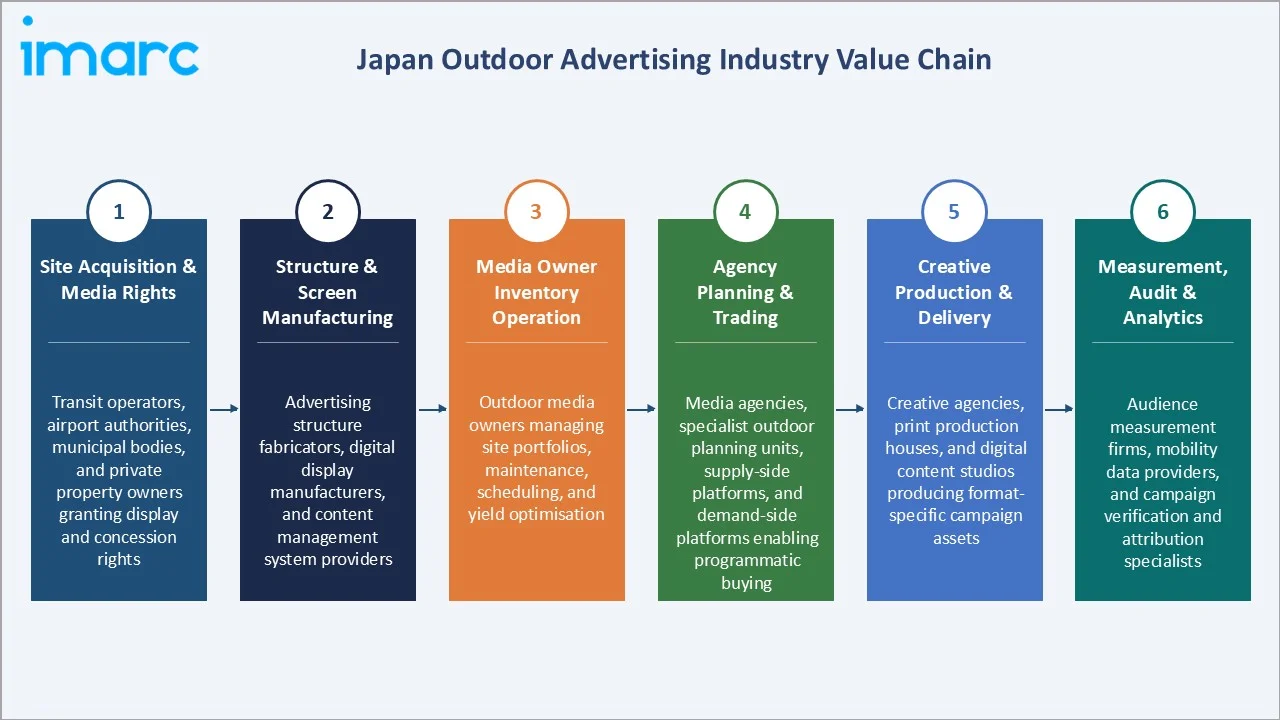
The outdoor advertising value chain integrates site acquisition and media rights negotiation, structure and screen manufacturing, media owner inventory operation, agency planning and programmatic trading, creative production and campaign delivery, and independent measurement and audit. Commercial value is concentrating toward media owners controlling premium transit and metropolitan inventory.
|
Stage |
Key Participants |
|
Site Acquisition & Media Rights |
Transit operators, airport authorities, municipal bodies, and private property owners granting display and concession rights |
|
Structure & Screen Manufacturing |
Advertising structure fabricators, digital display manufacturers, and content management system providers |
|
Media Owner Inventory Operation |
Outdoor media owners managing site portfolios, maintenance, scheduling, and yield optimisation |
|
Agency Planning & Trading |
Media agencies, specialist outdoor planning units, supply-side platforms, and demand-side platforms enabling programmatic buying |
|
Creative Production & Delivery |
Creative agencies, print production houses, and digital content studios producing format-specific campaign assets |
|
Measurement, Audit & Analytics |
Audience measurement firms, mobility data providers, and campaign verification and attribution specialists |
The media owner inventory operation tier is the value chain's most commercially critical stage, as control of premium transit and metropolitan sites determines pricing power. The agency planning and trading tier is undergoing the fastest structural change as programmatic platforms displace manual, relationship-based inventory negotiation.
Technology Landscape in the Japan Outdoor Advertising Industry
Digital LED Display Technology
High-brightness LED display technology enables full-motion creative in daylight conditions across large-format roadside and building-mounted sites. Improved energy efficiency, finer pixel pitch, and remote content management have lowered operating costs while expanding creative flexibility, making digital conversion economically viable across a widening set of Japanese urban locations.
Programmatic DOOH Platforms
Supply-side and demand-side platforms now connect Japanese outdoor inventory to automated buying workflows. These systems enable impression-based trading, audience-triggered creative, and real-time campaign adjustment, aligning outdoor purchasing with the operational standards advertisers already apply across online and connected television media.
Mobility and Exposure Analytics
Anonymised mobility datasets and computer-vision audience sensors are enabling verified impression counting for outdoor sites. These technologies underpin the transition toward standardised outdoor currency metrics, allowing advertisers to compare outdoor delivery directly against other measured media channels within unified planning frameworks.
Market Segmentation Analysis
The report covers the following segments:
|
Segment Category |
Leading Segment |
Market Share |
Year |
|
Type |
Traditional Outdoor Advertising |
56.4% |
2025 |
|
Segment |
Transport Advertising |
38.7% |
2025 |
|
Region |
Kanto Region |
44.3% |
2025 |

By Type
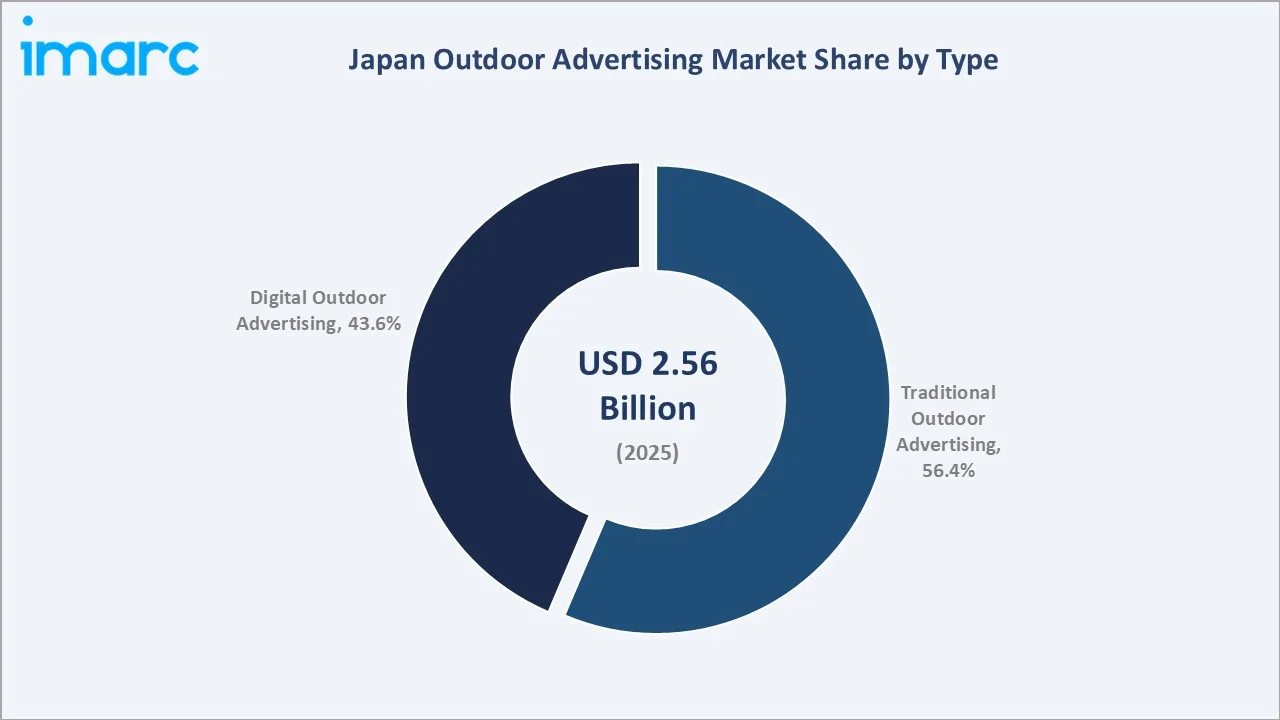
Traditional outdoor advertising leads at 56.4% in 2025, comprising static billboards, printed station and in-carriage posters, wrapped transit vehicles, and non-digital street furniture displays across metropolitan and regional Japan.
To access detailed market analysis, Request Sample
Digital outdoor advertising at 43.6% is the faster-growing type at approximately 8.10% CAGR, driven by station screen networks, large-format LED installations in Shibuya and Shinjuku, and programmatic trading adoption. Traditional formats retain scale through lower unit costs and broader regional site coverage.
By Segment
Transport advertising leads at 38.7%, reflecting the centrality of rail to Japanese daily mobility and the resulting concentration of high-dwell-time inventory across station concourses, platforms, and carriages. The segment grows at approximately 6.40% CAGR through station digital retrofit programmes.
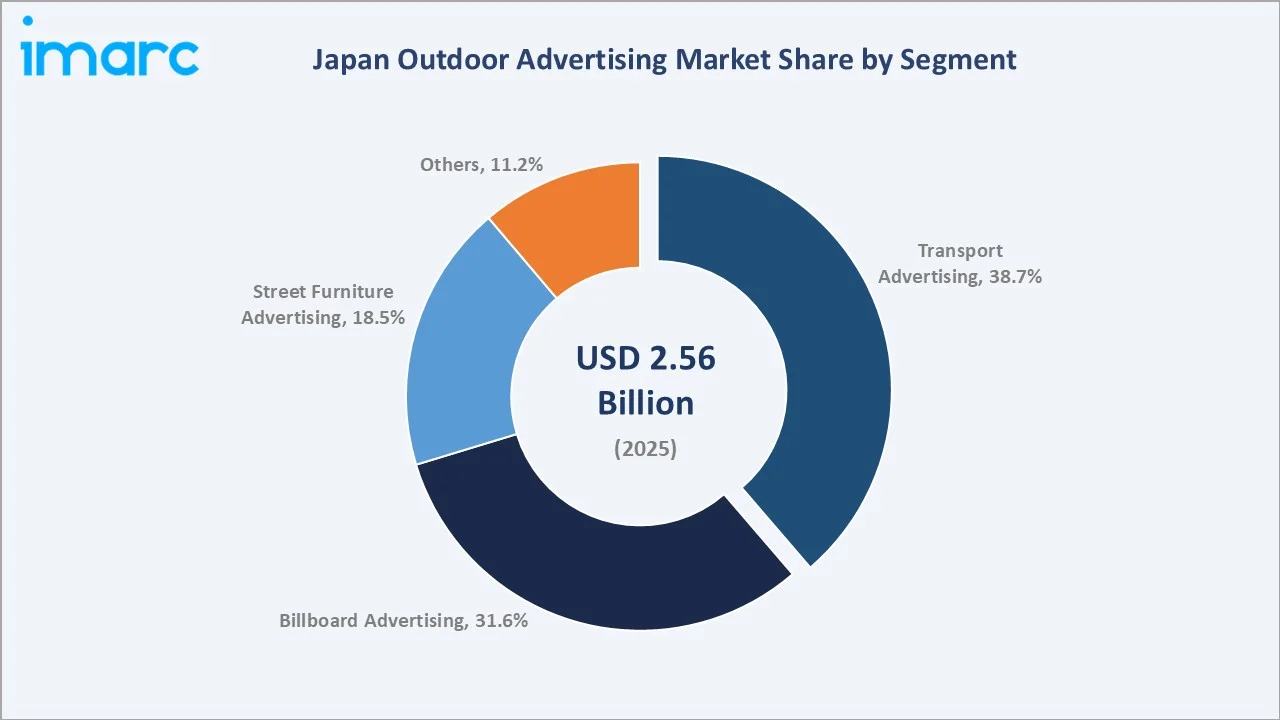
Billboard advertising at 31.6% covers roadside and building-mounted large formats concentrated in metropolitan commercial districts. Street furniture advertising at 18.5% spans bus shelters, kiosks, and municipal structures, and is the primary focus of programmatic street furniture trading. Others at 11.2% includes airport, stadium, and place-based formats.
Regional Market Insights
|
Region |
Share (2025) |
Key Market Drivers & Characteristics |
|
Kanto Region |
44.3% |
Largest regional market, driven by the highest concentration of corporate advertisers, the densest commuter rail network, and premium metropolitan display inventory |
|
Kansai/Kinki Region |
18.2% |
Second-largest market, supported by high commercial density, established retail corridors, and substantial domestic and inbound visitor traffic |
|
Central/Chubu Region |
13.8% |
Driven by a strong industrial and manufacturing base, high private vehicle usage supporting roadside formats, and expanding station media inventory |
|
Kyushu-Okinawa Region |
7.5% |
Supported by regional hub status, gateway tourism traffic, and progressive deployment of digital display inventory |
|
Tohoku Region |
5.9% |
Moderate demand concentrated around principal regional centres, with transit media dominant and comparatively limited digital conversion |
|
Chugoku Region |
4.7% |
Driven by regional commercial activity and tourism footfall, with roadside and traditional formats accounting for most inventory |
|
Hokkaido Region |
3.3% |
Characterised by seasonal tourism cycles and event-driven advertising demand concentrated in principal urban centres |
|
Shikoku Region |
2.3% |
Smallest regional market, characterised by traditional formats and predominantly localised advertiser bases |
Kanto at 44.3% leads through Greater Tokyo's unmatched combination of corporate advertiser concentration, commuter volume, and premium landmark inventory. Kansai/Kinki at 18.2% forms the clear secondary market, anchored by Osaka's dense commercial districts and substantial domestic and inbound visitor traffic.
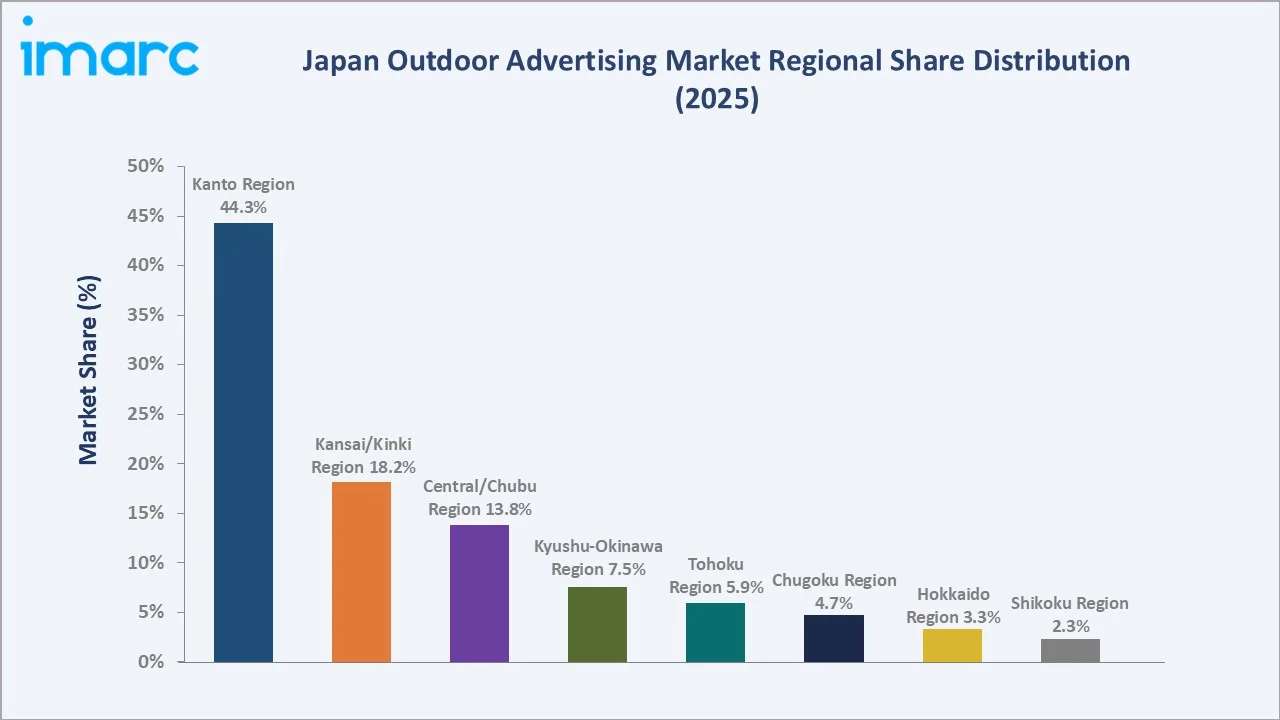
Central/Chubu at 13.8% reflects Nagoya's industrial economy and high private vehicle usage supporting roadside formats. Kyushu-Okinawa at 7.5% is expanding through Fukuoka's growth and tourism gateway traffic, while Tohoku, Chugoku, Hokkaido, and Shikoku together represent 16.2% of national billings.
Competitive Landscape
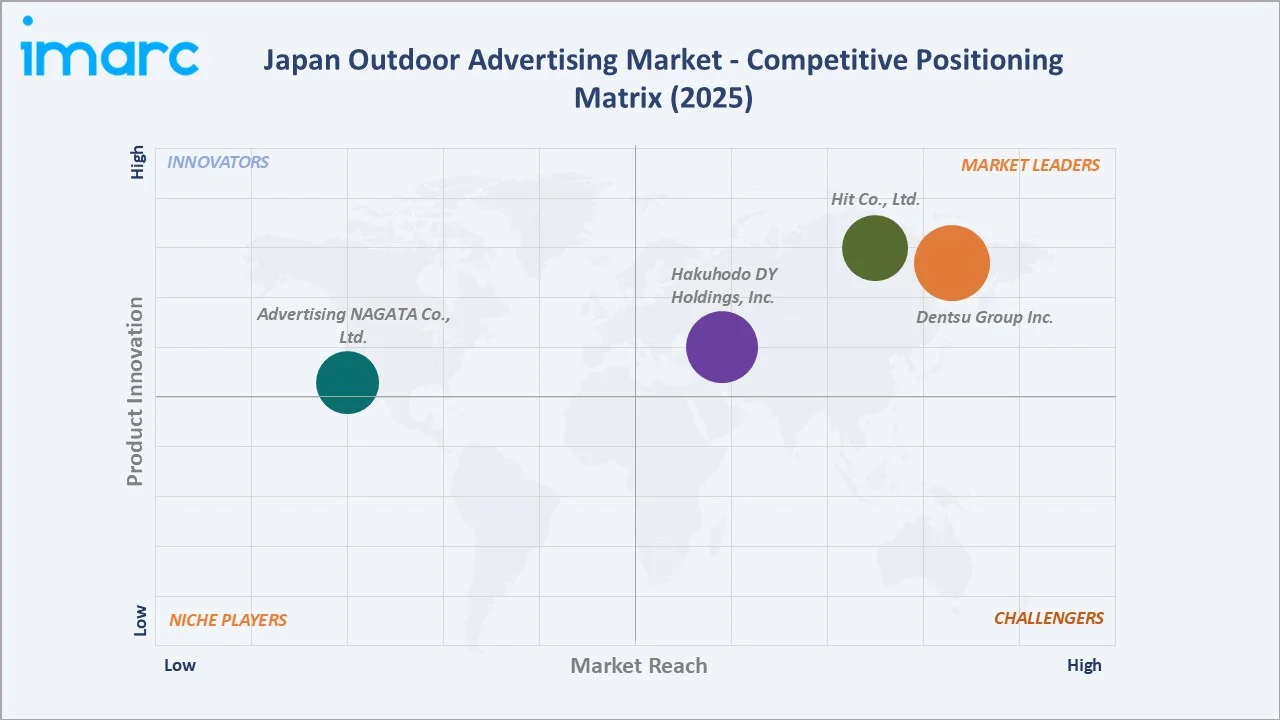
The Japan outdoor advertising market is moderately concentrated across three competitive tiers: integrated advertising holding groups with dedicated outdoor divisions, specialist media owners controlling transit and street furniture concessions, and regional operators serving prefecture-level advertiser bases.
|
Company Name |
Key Offerings |
Market Position |
Core Strength |
|
Dentsu Group Inc. |
Integrated OOH planning and buying, landmark billboard and transit media |
Market Leader |
Japan's largest advertising group with unmatched advertiser relationships and integrated media planning capability across all outdoor formats. |
|
Hakuhodo DY Holdings Inc. |
Outdoor media planning, billboard and street furniture inventory |
Market Leader |
Operates dedicated outdoor units and is advancing mobility-data-based measurement of outdoor advertising effectiveness. |
|
Hit Co., Ltd. |
Large-format digital outdoor displays, billboard |
Market Leader |
Operates premium large-format digital sites at high-traffic stations and major metropolitan roadways. |
|
Advertising NAGATA Co., Ltd. |
Billboard, transit, and street furniture media sales and operation |
Established Operator |
Long-established outdoor media operator participating in industry effectiveness measurement initiatives. |
Key players include Dentsu Group Inc., Hakuhodo DY Holdings Inc., Hit Co., Ltd., Advertising NAGATA Co., Ltd., and others.
Key Company Profiles
Dentsu Group Inc.
Dentsu Group Inc. is a Japan-based advertising and marketing communications group with a leading presence in the outdoor advertising market through integrated media planning, landmark billboard buying, and transit media services.
- Key Offerings: Integrated OOH planning and buying, landmark billboard placements, transit and station media, and digital out-of-home campaign delivery.
- Strategic Focus: Strengthening integrated omnichannel offerings that position outdoor advertising as a measurable reach component within broader campaign architectures.
Hakuhodo DY Holdings, Inc.
Hakuhodo DY Holdings, Inc. is a major Japanese advertising group operating dedicated outdoor media units with billboard, transit, and street furniture inventory alongside advancing measurement capability.
- Key Offerings: Outdoor media planning and sales, billboard and street furniture inventory, and audience exposure analytics services.
- Strategic Focus: Establishing verified, data-based effectiveness measurement as a competitive differentiator for Japanese outdoor media planning.
Market Concentration Analysis
The Japan outdoor advertising market is moderately concentrated, with integrated advertising groups and principal transit media owners collectively accounting for an estimated 55-65% of national billings. Rail operator affiliated media companies control the majority of premium station and in-carriage inventory, creating structural access advantages within the transport advertising segment.
Street furniture inventory is concentrated among municipal concession holders, while large-format digital sites are distributed across a smaller set of specialist operators. Concentration is expected to moderate modestly through the forecast period as programmatic platforms broaden advertiser access to independent and regional inventory.
Investment & Growth Opportunities
Highest Growth Segments
Digital outdoor advertising (approximately 8.10% CAGR), transport advertising (approximately 6.40% CAGR), and street furniture advertising (approximately 6.05% CAGR) represent the highest-growth vectors through 2034, supported by station digital retrofit programmes, programmatic trading expansion, and municipal concession renewals incorporating digital display rights.
Emerging Investment Opportunities
Station and retail concourse digital screen networks represent the market's highest-yield emerging opportunity, combining guaranteed commuter footfall with proximity to point-of-purchase decisions. Regional city digital conversion offers a secondary opportunity where static inventory retains meaningful audience delivery at substantially lower acquisition cost than metropolitan sites.
Investment Themes
- Digital Conversion of Premium Static Inventory: Converting high-footfall static faces to digital materially increases revenue yield per site through multi-advertiser rotation and dayparting. Sites with verified high impression volumes offer the strongest returns, making footfall-verified inventory the primary screening criterion for digital conversion capital allocation.
- Measurement and Data Infrastructure: Investment in mobility analytics and verified impression measurement supports premium pricing and defends outdoor budgets against digital channel competition. Operators establishing measurement credibility early are positioned to capture incremental spend from performance-oriented advertisers entering the outdoor channel.
Future Market Outlook (2026-2034)
The Japan outdoor advertising market is projected to grow from USD 2.56 Billion in 2025 to USD 4.32 Billion by 2034, delivering a 5.68% CAGR. The anchor value of approximately USD 3.37 Billion in 2030 represents the point at which digital inventory is expected to approach parity with traditional formats in revenue contribution.
Three structural forces define growth through 2034. Digital conversion raises revenue yield per site without requiring proportional inventory expansion, circumventing regulatory constraints on new signage. Programmatic trading broadens the advertiser base by lowering minimum spend thresholds and simplifying access for international brands. Verified measurement legitimises outdoor within performance-oriented media plans.
Risks centre on demographic contraction in regional prefectures and continued municipal regulatory tightening in heritage and scenic zones. These constraints are expected to reinforce the concentration of growth within metropolitan corridors, particularly Kanto and Kansai, rather than materially altering the national growth trajectory.
Research Methodology
Primary Research
Primary research comprised structured interviews with 40+ industry stakeholders (2025), including outdoor media owner executives, agency outdoor planning directors, rail operator media concession managers, programmatic DOOH platform leads, and municipal signage regulatory officials.
Secondary Research
Secondary research encompassed company annual reports and disclosures of Japanese advertising groups; national advertising expenditure statistics; rail operator passenger volume data; municipal outdoor advertising ordinances; inbound tourism statistics; and industry association publications covering outdoor media measurement. Over 50 secondary sources reviewed.
Forecasting Models
Market revenue forecasts were developed using a bottom-up model: (i) inventory counts by format, region, and digital status; (ii) average occupancy and yield per site; (iii) digital conversion rate assumptions by region; and (iv) advertiser demand adjustment reflecting macroeconomic conditions, commuter volume trends, and inbound tourism recovery.
Japan Outdoor Advertising Market Report Coverage:
| Report Features | Details |
|---|---|
| Base Year of the Analysis | 2025 |
| Historical Period | 2020-2025 |
| Forecast Period | 2026-2034 |
| Units | Billion USD |
| Scope of the Report |
Exploration of Historical Trends and Market Outlook, Industry Catalysts and Challenges, Segment-Wise Historical and Future Market Assessment:
|
| Types Covered | Traditional Outdoor Advertising, Digital Outdoor Advertising |
| Segments Covered | Billboard Advertising, Transport Advertising, Street Furniture Advertising, Others |
| Regions Covered | Kanto Region, Kansai/Kinki Region, Central/Chubu Region, Kyushu-Okinawa Region, Tohoku Region, Chugoku Region, Hokkaido Region, Shikoku Region |
| Companies Covered | Dentsu Group Inc., Hakuhodo DY Holdings Inc., Hit Co., Ltd., Advertising NAGATA Co., Ltd., etc. |
| Customization Scope | 10% Free Customization |
| Post-Sale Analyst Support | 10-12 Weeks |
| Delivery Format | PDF and Excel through Email (We can also provide the editable version of the report in PPT/Word format on special request) |
Key Benefits for Stakeholders:
- IMARC’s industry report offers a comprehensive quantitative analysis of various market segments, historical and current market trends, market forecasts, and dynamics of the Japan outdoor advertising market from 2020-2034.
- The research report provides the latest information on the market drivers, challenges, and opportunities in the Japan outdoor advertising market.
- Porter's five forces analysis assist stakeholders in assessing the impact of new entrants, competitive rivalry, supplier power, buyer power, and the threat of substitution. It helps stakeholders to analyze the level of competition within the Japan outdoor advertising industry and its attractiveness.
- Competitive landscape allows stakeholders to understand their competitive environment and provides an insight into the current positions of key players in the market.
Frequently Asked Questions About the Japan Outdoor Advertising Market Report
The Japan outdoor advertising market reached USD 2.56 Billion in 2025, led by traditional outdoor advertising at 56.4% by type, transport advertising at 38.7% by segment, and the Kanto region at 44.3% of national billings, reflecting Greater Tokyo's concentration of commuter volume and premium display inventory.
The market grows at a 5.68% CAGR during 2026-2034, reaching USD 4.32 Billion by 2034. Growth reflects digital screen conversion raising yield per site, programmatic trading broadening the advertiser base, and verified measurement supporting premium pricing across metropolitan inventory.
Traditional outdoor advertising leads at 56.4%, supported by the extensive installed base of billboards, printed station media, and wrapped transit vehicles. Digital outdoor advertising at 43.6% grows faster at approximately 8.10% CAGR through ongoing screen deployment.
Transport advertising leads at 38.7% through rail's centrality to Japanese daily mobility, delivering repeated high-dwell-time exposure across station concourses, platforms, and carriages. The segment grows at approximately 6.40% CAGR supported by station digital retrofit programmes.
The Kanto region leads at 44.3% through Greater Tokyo's corporate advertiser concentration, densest rail network, and premium landmark inventory in Shibuya, Shinjuku, and Ikebukuro.
Leading companies include Dentsu Group Inc., Hakuhodo DY Holdings Inc., Hit Co., Ltd., Advertising NAGATA Co., Ltd., and others.
The market is projected to reach approximately USD 3.37 Billion by 2030, by which point digital inventory is expected to approach revenue parity with traditional formats, programmatic trading is anticipated to be standard for digital inventory, and verified measurement is expected to be widely adopted.
Three priority opportunities: digital conversion of footfall-verified premium static inventory, station and retail concourse screen network development, and investment in mobility analytics and verified impression measurement infrastructure supporting premium pricing.
Need more help?
- Speak to our experienced analysts for insights on the current market scenarios.
- Include additional segments and countries to customize the report as per your requirement.
- Gain an unparalleled competitive advantage in your domain by understanding how to utilize the report and positively impacting your operations and revenue.
- For further assistance, please connect with our analysts.
 Request Customization
 Speak to an Analyst
 Request Brochure
 Inquire Before Buying
Benefits of Customization
- Personalize this research
- Triangulate with your data
- Get data as per your format and definition
- Gain a deeper dive into a specific application, geography, customer, or competitor
- Any level of personalization
Get in Touch With Us
UNITED STATES
Phone: +1-201-971-6302
INDIA
Phone: +91-120-433-0800
UNITED KINGDOM
Phone: +44-753-714-6104
Email: [email protected]
Client Testimonials




.webp)




.webp)













Related Reports

Choose your plan
*Please note that the prices mentioned below are starting prices for each bundle type. Kindly contact our team for further details.*
Single User License
- 1 User License, Access on 2 Devices
- PDF Report + Excel Dataset (Password Protected)
- Lifetime Access
- No Printing Rights
- 10% Free Report Customization
- 10–12 Weeks of Analyst Support
Five User License
- Access for 5 Users, 2 Devices per User
- PDF Report + Excel Dataset (Password Protected)
- Lifetime Access
- Dedicated Account Manager
- 12–14 Weeks of Analyst Support
- No Printing Rights
- 15% Free Report Customization
- 25% Discount on Your Next Purchase
Corporate User License
- Unlimited User Access (Within Your Organization)
- PDF Report + Excel Dataset
- Lifetime Access
- Dedicated Account Manager
- 14–20 Weeks of Analyst Support
- No Printing Rights
- 20% Free Report Customization
- 30% Discount on Your Next Purchase
Essential Insights
What's included:
3 reports
- Lifetime Access
- PDF Reports
- Excel Datasets
- 2 Weeks of Free Analyst Support
- 2 User Licenses
- Access on 2 Devices
- Printing Rights
- Complimentary PowerPoint (PPT) Version
- Complimentary License Upgrade
Professional Access
What's included:
5 reports
- Lifetime Access
- PDF Reports
- Excel Datasets
- 8 Weeks of Free Analyst Support
- 2 User Licenses
- Access on 2 Devices
- Printing Rights
- Complimentary PowerPoint (PPT) Version
- Complimentary License Upgrade
Business Advantage
What's included:
8 reports
- Lifetime Access
- PDF Reports
- Excel Datasets
- 14 Weeks of Free Analyst Support
- 2 User Licenses
- Access on 2 Devices
- Printing Rights
- Complimentary PowerPoint (PPT) Version
- Complimentary License Upgrade
Enterprise Intelligence
What's included:
10 reports
- Lifetime Access
- PDF Reports
- Excel Datasets
- 20 Weeks of Free Analyst Support
- 2 User Licenses
- Access on 2 Devices
- Printing Rights
- Complimentary PowerPoint (PPT) Version
- Complimentary License Upgrade