
Japan Pallet Market Size, Share, Trends and Forecast by Type, Application, Structural Design, and Region, 2026-2034
Japan Pallet Market Summary:
The Japan pallet market size was valued at USD 3.96 Billion in 2025 and is projected to reach USD 4.67 Billion by 2034, growing at a compound annual growth rate of 1.82% from 2026-2034.
The Japan pallet market is gaining steady momentum as industrial expansion, e-commerce growth, and evolving logistics infrastructure strengthen demand for efficient material handling solutions. Increasing emphasis on sustainability, adoption of smart tracking technologies, and government initiatives promoting standardized palletizing systems are reshaping the competitive landscape. Advancements in warehouse automation, rising cold chain logistics requirements, and growing international trade volumes are further accelerating adoption, positioning pallets as critical components in Japan’s modernizing supply chain ecosystem and supporting the Japan pallet market share.
Key Takeaways and Insights:
- By Type: Wood dominates the market with the largest share of 55% in 2025, driven by cost-effectiveness, wide availability, ease of repair, and compatibility with international phytosanitary standards for export shipments.
- By Application: Food and beverages lead the market with a share of 32% in 2025, supported by stringent HACCP compliance requirements, expanding cold chain logistics, and growing demand for hygienic material handling solutions.
- By Structural Design: Block represents the largest segment with a market share of 44% in 2025, owing to four-way forklift accessibility, superior load-bearing capacity, and strong compatibility with automated warehouse systems.
- Key Players: The Japan pallet market features a moderately competitive landscape, with established domestic pallet rental providers and manufacturers competing alongside international pooling operators across material segments, driving innovation in sustainability, automation compatibility, and smart tracking solutions.
The Japan pallet market is undergoing a significant transformation as the country’s logistics sector adapts to acute labor shortages, stricter environmental mandates, and accelerating e-commerce expansion. The government’s implementation of overtime regulations for truck drivers in April 2024, capping annual overtime at 960 hours, has intensified demand for automation-compatible pallet solutions that reduce manual handling requirements. For instance, in February 2025, Fujitsu and Sustainable Shared Transport Inc. launched an open logistics platform across Japan prioritizing trunk transport using standardized pallet units, funded by a JPY 50 million investment, with plans to expand operations to 80 routes by March 2026. Concurrently, manufacturers are investing in IoT-enabled pallets with RFID tagging for real-time tracking, while the shift toward circular economy models is expanding pallet pooling and rental services. Japan’s commitment to carbon neutrality by 2050 and its Green Transformation program are further accelerating demand for eco-friendly pallet materials, positioning the market for sustained growth across industrial and commercial applications.
Japan Pallet Market Trends:
Integration of IoT and RFID Technologies in Pallet Management
The adoption of smart pallet technologies is transforming logistics operations across Japan, as companies increasingly integrate RFID tags and IoT sensors to track shipments in real time, including location, temperature, and humidity. This digital shift improves inventory accuracy, reduces asset losses, and enhances supply chain visibility. Operators use scanning systems at depots to verify pallet functionality and capture operational data such as origin, customer, and usage duration. These insights enable more precise demand forecasting, optimize truck scheduling, and contribute to the overall growth and efficiency of the Japan pallet market. For instance, in April 2023, Kao Corporation developed a state-of-the-art, fully automated warehouse at its Toyohashi Plant, which manufactures a diverse range of skin care and hair care products. The facility became operational on March 31, 2023, and is designed to streamline logistics, enabling flexible and efficient distribution of products from the production site to distribution centers and retail outlets.
Expansion of Pallet Pooling and Circular Economy Models
The transition from single-use disposable pallets to shared-use pooling and rental systems is gaining momentum in Japan, driven by corporate sustainability initiatives and government circular economy policies. Pallet pooling helps reduce material consumption, lower logistics costs, and enhance environmental performance across supply chains. Operators are adopting durable, long-life plastic pallets designed for repeated use, while incorporating recyclable materials to minimize environmental impact. These practices promote sustainable logistics, optimize resource utilization, and support the broader growth of the pallet rental and shared-use market in Japan.
Rising Adoption of Automated Pallet Handling Systems
Warehouse automation investments are rapidly growing in Japan, driven by the need to overcome labor shortages and enhance efficiency in logistics operations. Automated guided vehicles, palletizing robots, and smart warehouse systems are becoming key components of modern distribution centers. Leading companies are expanding production and assembly capabilities for automated equipment, including vehicles designed to handle items by pallet, case, or piece. Integration of renewable energy solutions, such as solar-powered systems, is also being implemented to support sustainable and energy-efficient warehouse operations.
Market Outlook 2026-2034:
The Japan pallet market is poised for sustained expansion over the forecast period, supported by continued investments in logistics automation, expanding e-commerce fulfillment infrastructure, and strengthening regulatory frameworks around food safety and environmental sustainability. The growing adoption of smart tracking technologies and pallet pooling services is expected to improve asset utilization and reduce supply chain inefficiencies. Rising demand from cold chain logistics, pharmaceutical distribution, and construction sectors will further broaden the application base for advanced pallet solutions. The market generated a revenue of USD 3.96 Billion in 2025 and is projected to reach a revenue of USD 4.67 Billion by 2034, growing at a compound annual growth rate of 1.82% from 2026-2034.
Japan Pallet Market Report Segmentation:
|
Segment Category |
Leading Segment |
Market Share |
|
Type |
Wood |
55% |
|
Application |
Food and Beverages |
32% |
|
Structural Design |
Block |
44% |
Type Insights:
To get detailed segment analysis of this market Request Sample
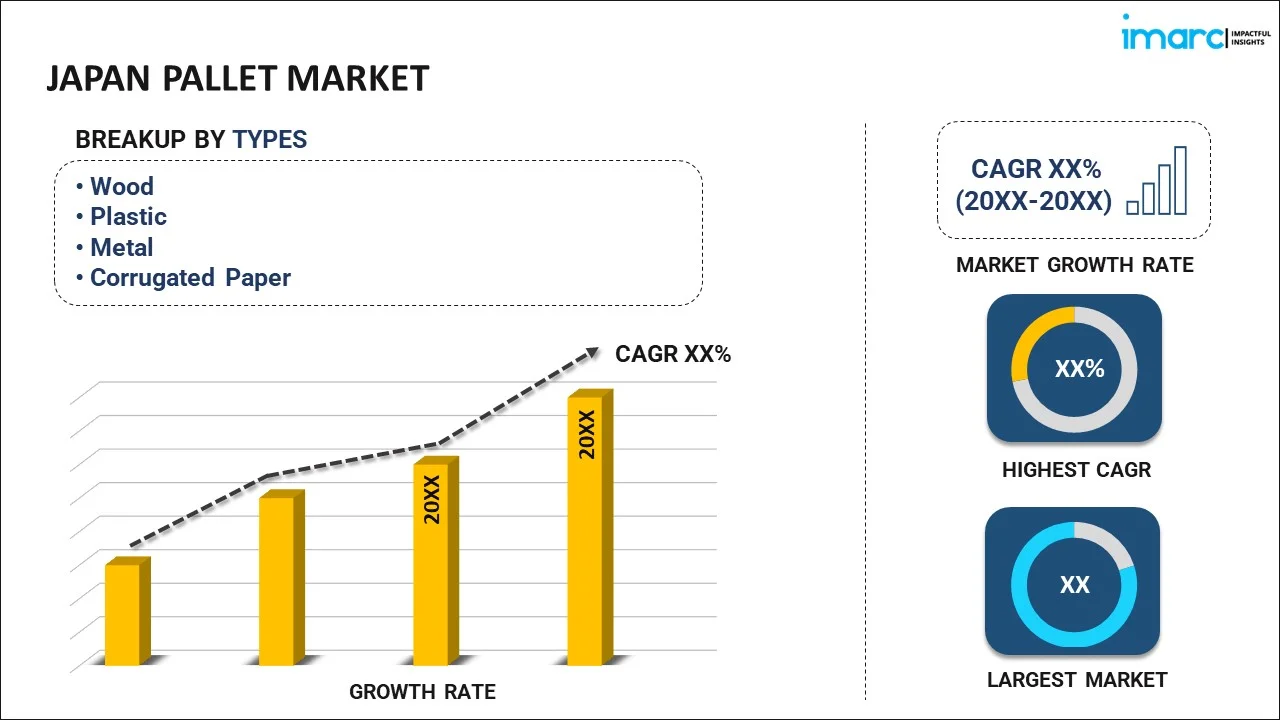
- Wood
- Plastic
- Metal
- Corrugated Paper
Wood dominates with a market share of 55% of the total Japan pallet market in 2025.
Wood pallets continue to dominate the Japan pallet market due to their cost-effectiveness, easy availability, and simple repairability compared to other materials. Their versatility makes them suitable for a wide range of industrial applications, from manufacturing operations to export logistics. Japan enforces strict phytosanitary standards for wooden packaging in international trade, ensuring that heat-treated wood pallets comply with global regulations for the safe and secure cross-border shipment of goods. This reliability reinforces wood’s position as a staple in supply chains.
Despite growing interest in alternative materials, wood remains the preferred choice across Japan’s manufacturing and export sectors because of its strong load-bearing capacity and suitability for handling heavy industrial goods. Its durability and adaptability make it ideal for repeated use in diverse logistics environments. The continued reliance on imported and domestically produced wooden pallets reflects the material’s competitiveness, affordability, and central role in maintaining efficient supply chain operations across the country.
Application Insights:
- Food and Beverages
- Chemicals and Pharmaceuticals
- Machinery and Metal
- Construction
- Others
Food and beverages lead with a share of 32% of the total Japan pallet market in 2025.
The food and beverages sector represents the largest application segment in the Japan pallet market, driven by stringent food safety regulations and the critical importance of maintaining product integrity throughout the cold chain. Japan’s Ministry of Health, Labour and Welfare mandates HACCP compliance for all food-related businesses, including logistics operators, creating sustained demand for hygienic pallet solutions that meet strict sanitation standards for perishable goods distribution.
The growth of cold chain logistics in Japan is driving increased demand for pallets in the food and beverage sector. The Japan cold chain logistics market size was valued at USD 21.7 Billion in 2025. Looking forward, IMARC Group estimates the market to reach USD 32.1 Billion by 2034, exhibiting a CAGR of 4.47% from 2026-2034. Expanding temperature-controlled storage and transportation networks require reliable pallet solutions to ensure safe and efficient handling of perishable goods. Leading Japanese food companies have collaborated to develop integrated logistics systems that streamline loading processes and reduce manual cargo handling across frozen food distribution networks. These initiatives support more efficient operations, enhance supply chain reliability, and further reinforce the central role of pallets in temperature-sensitive logistics.
.webp)
Structural Design Insights:
- Block
- Stringer
- Others
Block represents the largest share at 44% of the total Japan pallet market in 2025.
The pallet market in Japan has seen a very clear dominance of block pallets due to their 4-way entry point structure that enables forklifts and pallet jacks to work around the pallet in all directions, giving the operations of handling pallets in the warehouse and logistics setting a very good boost. This architectural strength causes block pallets to be especially suitable for the environment of Japan, which has been moving towards more automated warehouse operations, with the strict consistency of orientation and multi-directional accessibility being the only way to ensure smooth operations.
The compatibility of block pallets with automated storage and retrieval systems, conveyor belts, and robotic palletizing equipment further strengthens their market position. The Japan warehouse automation market reached USD 1,465.53 million in 2025, and the growing deployment of automated guided vehicles and palletizing robots in logistics hubs across Tokyo and Osaka metropolitan areas is driving preference for block pallet designs that deliver reliable performance in high-speed, precision-based automated material handling systems.
Regional Insights:
To get detailed regional analysis of this market Request Sample
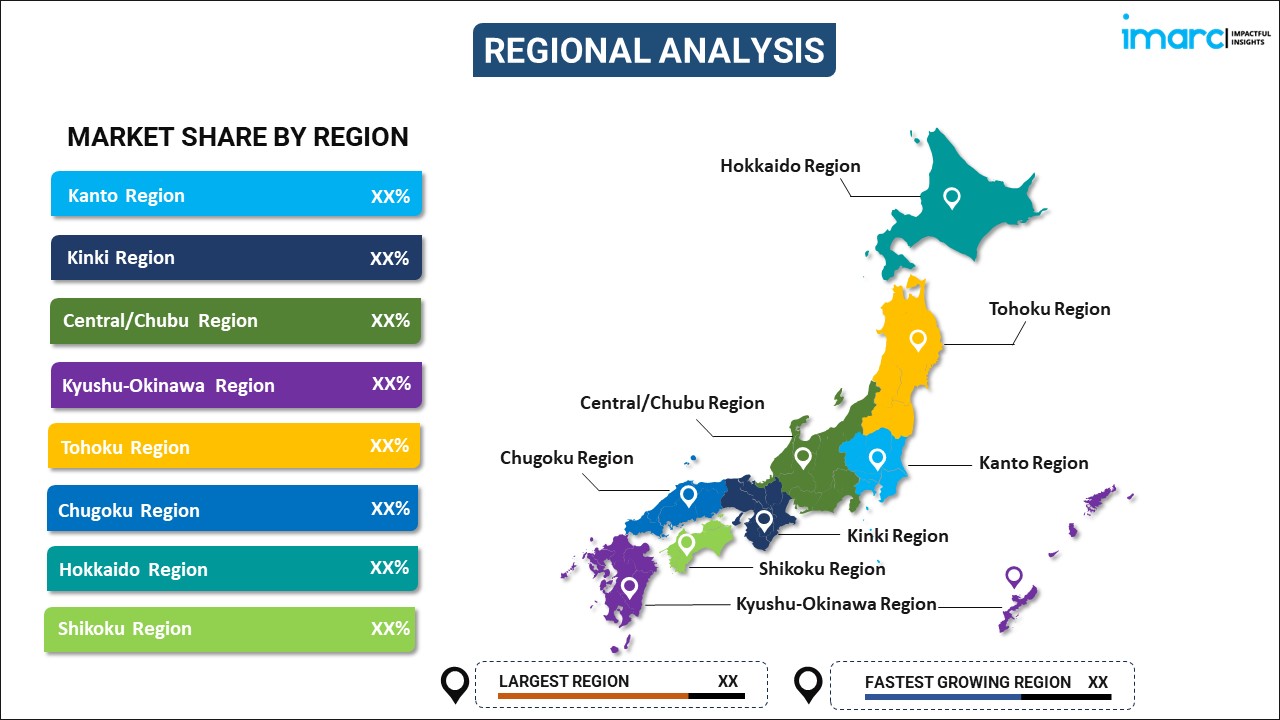
- Kanto Region
- Kinki Region
- Central/Chubu Region
- Kyushu-Okinawa Region
- Tohoku Region
- Chugoku Region
- Hokkaido Region
- Shikoku Region
The Kanto Region, with Tokyo as its hub, sees high pallet demand due to dense industrial activity, extensive warehousing, and large-scale logistics operations. E-commerce growth, increasing consumer demand, and modern distribution centers drive the need for standardized pallets and automated handling solutions for efficient cargo movement.
Kinki, including Osaka and Kobe, has strong manufacturing and export-oriented industries. Rising domestic and international shipments, coupled with advanced logistics hubs and port operations, fuel demand for durable pallets, pallet racks, and automated storage systems to support smooth cargo handling and supply chain efficiency.
Chubu’s industrial base, including automotive and electronics manufacturing, drives pallet usage for transporting raw materials and finished goods. Expansion of distribution networks, adoption of automated storage and retrieval systems, and the need for standardized palletization to optimize warehouse space further support market growth.
Kyushu and Okinawa Regions rely on efficient pallet-based logistics to manage regional trade and tourism-driven cargo. Growing port activities, inter-island transport, and modernization of warehouses increase the adoption of robust pallets and pallet handling systems across supply chains.
Tohoku’s agriculture and manufacturing sectors demand reliable pallets for transporting perishable goods and industrial materials. Seasonal harvests, expansion of cold chain logistics, and regional infrastructure upgrades drive the need for durable and standardized pallet solutions.
Chugoku’s industrial and port activities, particularly in Hiroshima and Okayama, boost pallet demand. Efficient cargo handling, warehouse automation, and integration with shipping and distribution networks are key drivers for pallet market growth in the region.
Hokkaido’s cold climate and agricultural output necessitate sturdy pallets for the safe transport of perishable and bulk goods. Growing cold chain logistics, port-based exports, and investment in warehouse automation support steady pallet market expansion.
Shikoku’s smaller regional industries and agricultural output rely on pallets for domestic transport and storage. Modernization of logistics operations, inter-island shipping requirements, and the adoption of standardized pallet solutions contribute to market growth across the region.
Market Dynamics:
Growth Drivers:
Why is the Japan Pallet Market Growing?
Expanding E-Commerce and Logistics Infrastructure Demands
The rapid expansion of Japan’s e-commerce sector is creating substantial demand for pallets across distribution centers, fulfillment hubs, and last-mile delivery networks. Online retail growth has intensified the need for efficient material handling solutions that can support high-volume, fast-turnaround warehouse operations. The increasing complexity of omnichannel fulfillment strategies requires standardized, durable pallets that facilitate seamless movement between storage, picking, packing, and shipping stages. In July 2025, Amazon deployed its one millionth warehouse robot to a fulfillment facility in Japan, alongside the launch of its DeepFleet generative AI model that coordinates robot movements within warehouses, reducing travel time by 10%. This level of automation demands consistent, high-quality pallet solutions that integrate smoothly with advanced robotic systems and conveyor infrastructure across the logistics supply chain.
Government Regulatory Initiatives Driving Operational Modernization
The introduction of stricter regulations on truck driver working hours in Japan has significantly impacted logistics operations, encouraging greater adoption of palletized cargo systems. Standardized pallet solutions help improve loading efficiency, reduce manual handling, and optimize truck capacity under tighter labor constraints. Concurrently, government-backed pallet pooling initiatives allow companies to share and reuse pallets, lowering costs while promoting sustainable logistics practices. Broader national programs supporting green innovation and circular economy models are also driving the use of recyclable and reusable pallet materials, creating new opportunities for pallet manufacturers focused on environmentally friendly and efficient supply chain solutions.
Growth in Food Safety and Cold Chain Logistics Requirements
Japan’s strict food safety regulations are driving strong demand for specialized pallet solutions that meet hygiene, traceability, and temperature control requirements across the food supply chain. Mandatory compliance with food safety standards compels logistics operators to use pallets that prevent contamination and support proper sanitation during storage and transport. Updated industry guidelines and regulations further enhance safety protocols for food and chemical handling. In addition, rules governing approved food contact materials require pallets and related logistics equipment to meet stringent compliance standards, reinforcing the need for safe, hygienic, and fully certified pallet solutions throughout Japan’s food distribution network.
Market Restraints:
What Challenges the Japan Pallet Market is Facing?
High Initial Investment Costs for Smart Pallet Solutions
The deployment of IoT-enabled pallets equipped with RFID tags, temperature sensors, and GPS tracking capabilities requires significant upfront capital investment compared to conventional pallet options. Small and medium-sized enterprises, which constitute a substantial portion of Japan’s logistics ecosystem, often face financial barriers when adopting these advanced solutions, limiting broader market penetration of smart pallet technologies.
Labor Shortages Impacting Logistics Operations
Japan’s aging population and declining workforce participation are creating persistent labor shortages across the logistics sector, with nearly 40% of cold chain logistics firms reporting insufficient drivers and warehouse staff. While automation offers long-term solutions, the transition period continues to constrain operational efficiency, increase delivery times, and elevate costs for pallet-dependent supply chain operations.
Raw Material Supply Constraints and Price Volatility
Declining domestic wood supply and reliance on imported timber for wooden pallet manufacturing expose the market to international price fluctuations and supply chain disruptions. The requirement for ISPM-15 compliant heat-treated wood adds processing costs, while increasing competition from alternative materials creates pricing pressures that challenge traditional wood pallet manufacturers.
Competitive Landscape:
The Japan pallet market exhibits a moderately fragmented competitive landscape characterized by the presence of established domestic pallet rental operators, specialized manufacturers, and international pooling service providers. Competition is intensifying as companies invest in sustainability-focused innovations, RFID-based tracking solutions, and automation-compatible pallet designs to differentiate their offerings. Strategic emphasis on circular economy models, pallet pooling services, and material diversification is shaping competitive dynamics. Companies are expanding their portfolios to include recycled plastic pallets alongside traditional wood options, while investing in digital platforms to optimize fleet management and improve service delivery across Japan’s evolving logistics infrastructure.
Recent Developments:
- In August 2025, Daifuku completed the construction of a new factory building for automated guided vehicle assembly at its Shiga Works production base in Shiga, Japan. The facility features the SOTR series product line that handles items by pallet, case, or piece, with a 1.5 MW solar power system installed as part of the company’s broader investment of approximately JPY 33 billion through 2028 to expand production capacity by 1.4 times.
- In January 2024, Sagawa Express, one of Japan’s leading logistics providers, partnered with Sumitomo Corporation and Dexterity Inc. to deploy AI-powered robotic systems for truck loading operations, demonstrating the logistics industry’s commitment to automated pallet handling solutions that address critical labor shortages.
Japan Pallet Market Report Coverage:
| Report Features | Details |
|---|---|
| Base Year of the Analysis | 2025 |
| Historical Period | 2020-2025 |
| Forecast Period | 2026-2034 |
| Units | Billion USD |
| Scope of the Report | Exploration of Historical and Forecast Trends, Industry Catalysts and Challenges, Segment-Wise Historical and Predictive Market Assessment:
|
| Types Covered | Wood, Plastic, Metal, Corrugated Paper |
| Applications Covered | Food and Beverages, Chemicals and Pharmaceuticals, Machinery and Metal, Construction, Others |
| Structural Designs Covered | Block, Stringer, Others |
| Regions Covered | Kanto Region, Kinki Region, Central/ Chubu Region, Kyushu-Okinawa Region, Tohoku Region, Chugoku Region, Hokkaido Region, Shikoku Region |
| Customization Scope | 10% Free Customization |
| Post-Sale Analyst Support | 10-12 Weeks |
| Delivery Format | PDF and Excel through Email (We can also provide the editable version of the report in PPT/Word format on special request) |
Frequently Asked Questions About the Japan Pallet Market Report
The Japan pallet market size was valued at USD 3.96 Billion in 2025.
The Japan pallet market is expected to grow at a compound annual growth rate of 1.82% from 2026-2034 to reach USD 4.67 Billion by 2034.
Wood pallets, representing the largest market share of 55% in 2025, remain the dominant type in the Japan pallet market, driven by cost-effectiveness, ease of repair, wide availability, and compliance with international phytosanitary standards required for export-oriented logistics operations.
Key factors driving the Japan pallet market include expanding e-commerce logistics infrastructure, government regulations promoting palletization and sustainability, growing food safety and cold chain requirements, rising warehouse automation adoption, and increasing demand for circular economy pallet solutions.
Major challenges include high initial costs for smart pallet technologies, persistent labor shortages in the logistics sector, raw material supply constraints for wood pallets, price volatility in imported timber, and slow adoption of advanced solutions among small and medium-sized enterprises.
Need more help?
- Speak to our experienced analysts for insights on the current market scenarios.
- Include additional segments and countries to customize the report as per your requirement.
- Gain an unparalleled competitive advantage in your domain by understanding how to utilize the report and positively impacting your operations and revenue.
- For further assistance, please connect with our analysts.
 Request Customization
 Speak to an Analyst
 Request Brochure
 Inquire Before Buying
Benefits of Customization
- Personalize this research
- Triangulate with your data
- Get data as per your format and definition
- Gain a deeper dive into a specific application, geography, customer, or competitor
- Any level of personalization
Get in Touch With Us
UNITED STATES
Phone: +1-201-971-6302
INDIA
Phone: +91-120-433-0800
UNITED KINGDOM
Phone: +44-753-714-6104
Email: [email protected]
Client Testimonials




.webp)




.webp)













Related Reports

Choose your plan
*Please note that the prices mentioned below are starting prices for each bundle type. Kindly contact our team for further details.*
Single User License
- 1 User License, Access on 2 Devices
- PDF Report + Excel Dataset (Password Protected)
- Lifetime Access
- No Printing Rights
- 10% Free Report Customization
- 10–12 Weeks of Analyst Support
Five User License
- Access for 5 Users, 2 Devices per User
- PDF Report + Excel Dataset (Password Protected)
- Lifetime Access
- Dedicated Account Manager
- 12–14 Weeks of Analyst Support
- No Printing Rights
- 15% Free Report Customization
- 25% Discount on Your Next Purchase
Corporate User License
- Unlimited User Access (Within Your Organization)
- PDF Report + Excel Dataset
- Lifetime Access
- Dedicated Account Manager
- 14–20 Weeks of Analyst Support
- No Printing Rights
- 20% Free Report Customization
- 30% Discount on Your Next Purchase
Essential Insights
What's included:
3 reports
- Lifetime Access
- PDF Reports
- Excel Datasets
- 2 Weeks of Free Analyst Support
- 2 User Licenses
- Access on 2 Devices
- Printing Rights
- Complimentary PowerPoint (PPT) Version
- Complimentary License Upgrade
Professional Access
What's included:
5 reports
- Lifetime Access
- PDF Reports
- Excel Datasets
- 8 Weeks of Free Analyst Support
- 2 User Licenses
- Access on 2 Devices
- Printing Rights
- Complimentary PowerPoint (PPT) Version
- Complimentary License Upgrade
Business Advantage
What's included:
8 reports
- Lifetime Access
- PDF Reports
- Excel Datasets
- 14 Weeks of Free Analyst Support
- 2 User Licenses
- Access on 2 Devices
- Printing Rights
- Complimentary PowerPoint (PPT) Version
- Complimentary License Upgrade
Enterprise Intelligence
What's included:
10 reports
- Lifetime Access
- PDF Reports
- Excel Datasets
- 20 Weeks of Free Analyst Support
- 2 User Licenses
- Access on 2 Devices
- Printing Rights
- Complimentary PowerPoint (PPT) Version
- Complimentary License Upgrade