
Japan Pet Supplement Market Size, Share, Trends and Forecast by Pet Type, Distribution Channel, Source, And Application, and Region, 2026-2034
Japan Pet Supplement Market Summary:
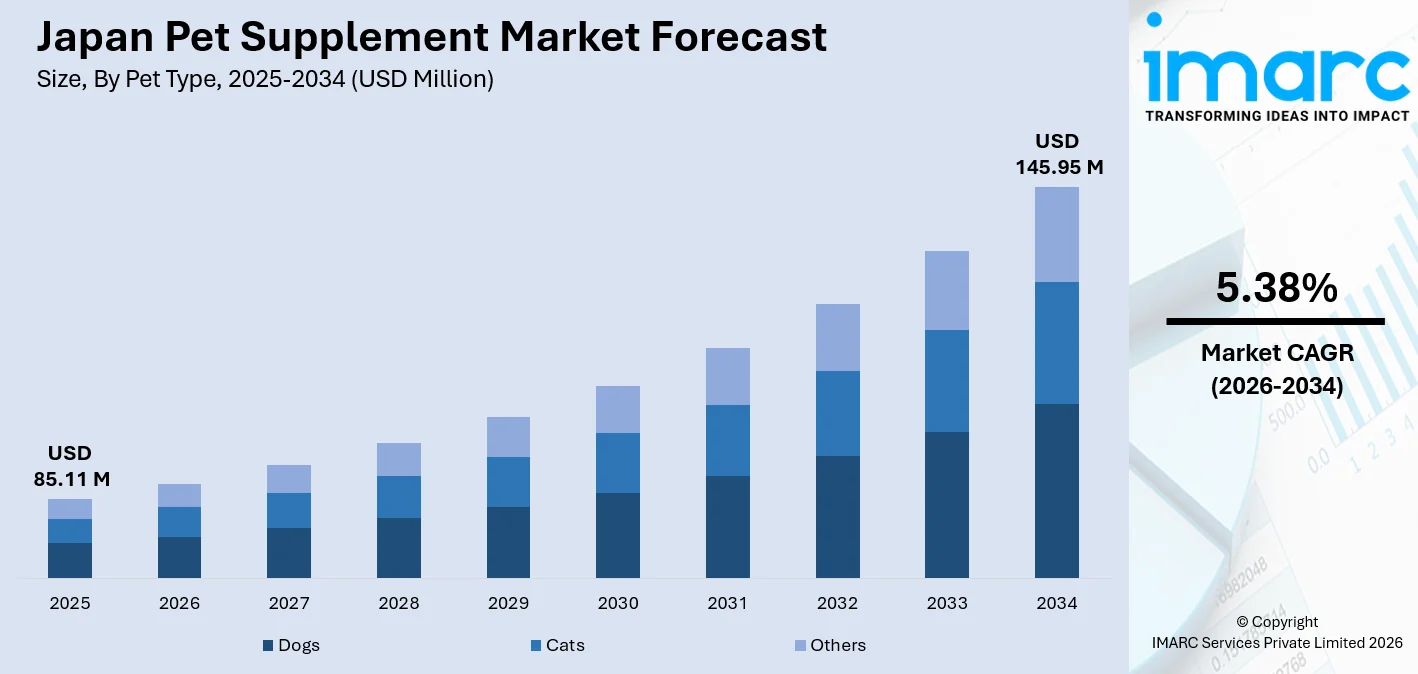
The Japan pet supplement market grew from USD 85.11 Million in 2025 to USD 96.00 Million in 2026 and is projected to reach USD 145.95 Million by 2034, growing at a compound annual growth rate of 5.38% from 2026-2034.
The Japan pet supplement market is experiencing steady expansion, fueled by the deepening humanization of pets and growing awareness of preventive animal health. Rising disposable incomes are encouraging pet owners to invest in premium wellness products for their companion animals. Increasing veterinary endorsements, evolving consumer preferences for targeted nutritional support, and robust offline retail availability are collectively strengthening Japan pet supplement market share.
Key Takeaways and Insights:
- By Pet Type: Dogs dominates the market with a share of 59.4% in 2025, reflecting Japan’s strong canine ownership base and growing owner focus on targeted nutritional wellness.
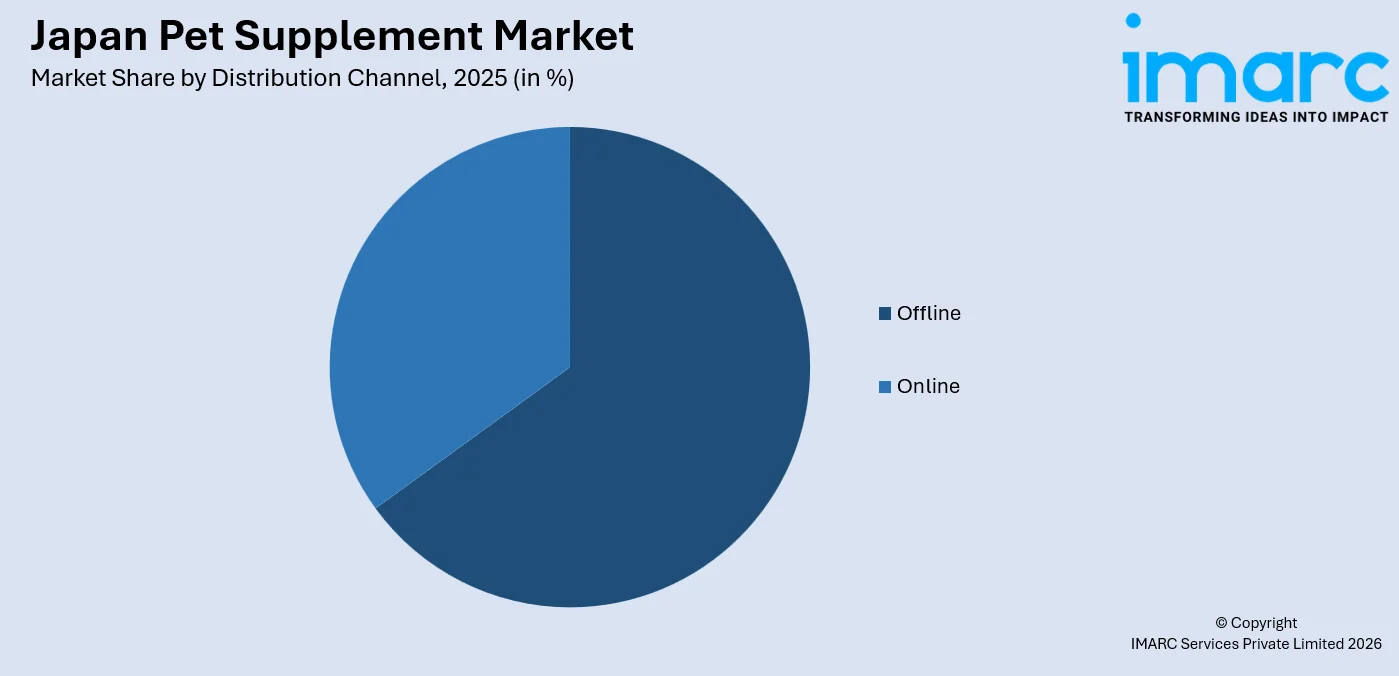
- By Distribution Channel: Offline leads the market with a share of 63.7% in 2025, reflecting strong consumer preference for purchasing through physical specialty stores and veterinary clinics.
- By Source: Conventional represents the largest segment with a market share of 71.2% in 2025, benefiting from wider product availability, competitive pricing, and broad consumer acceptance across all distribution channels.
- By Application: Multivitamins dominates the market with a share of 33.8% in 2025, catering to growing demand for comprehensive daily nutritional support across all pet types and life stages.
- By Region: Kanto Region leads the market with a share of 35.6% in 2025, anchored by the high pet ownership concentration in Tokyo and surrounding metropolitan prefectures.
- Key Players: The Japan pet supplement market is moderately competitive, with domestic manufacturers and international brands actively competing through product differentiation, veterinary channel partnerships, and innovation in functional and life-stage-specific supplement formulations.
To get more information on this market Request Sample
The Japan pet supplement market is witnessing meaningful expansion driven by shifting attitudes toward pet ownership and growing animal health awareness. In 2025, multiple Japanese companies introduced new functional pet supplements, including NMN-based and veterinarian-supervised formulations tailored for age-related health and palatability, reflecting innovation for Japan’s aging companion animals. As Japan's population ages and individuals adopt pets for companionship, demand for specialized products addressing age-related conditions, digestive health, and immune support continues to rise. Urban households in high-density regions such as the Kanto area show willingness to invest in supplement regimens aligned with preventive health goals. Veterinary guidance plays a key role, as Japanese pet owners place high trust in clinically backed formulations. The growing integration of premium nutrition into everyday pet care, combined with expanding product variety, continues to reinforce demand across the Japan pet supplement market.
Japan Pet Supplement Market Trends:
Rising Culture of Pet Humanization
Japan’s evolving relationship between owners and companion animals is reshaping pet wellness purchasing behavior. Industry reporting highlights that Japan’s pet market reached approximately ¥2 trillion in 2025, as pet owners increasingly treat pets like family members, with major events such as Japan Wanko Festa 2025 showcasing 180+ pet‑related businesses offering high‑end meals and supplements, underscoring premium and wellness‑oriented purchasing trends. As pets are increasingly regarded as family members, demand for specialized health-supporting products has grown. This humanization trend is directly accelerating uptake of functional supplements that mirror human nutritional philosophies, supporting continued Japan pet supplement market growth.
Expanding Focus on Senior and Preventive Pet Health
Japan’s aging pet population mirrors broader demographic shifts across the country. As companion animals live longer, demand for supplements addressing joint mobility, cognitive function, and immune resilience continues to strengthen. According to reports, the average lifespan for dogs in Japan is 14.1 years and for cats is 14.5 years, indicating continued longevity gains among companion animals, a trend that increases demand for products addressing age‑related conditions such as joint mobility and immune support. This preventive wellness orientation encourages pet owners to incorporate nutritional supplements proactively into their animals’ daily health management routines alongside regular veterinary care.
Growing Preference for Premium and Functional Supplement Formulations
Japanese consumers demonstrate increasing preference for premium supplement formulations with targeted functional benefits. In 2025, Japanese pet product testing service provider EAS launched a “pet clinical trial” service to help manufacturers scientifically validate safety and efficacy — enabling products to carry dual claims of veterinarian supervision and evidence‑based results, which boosts consumer trust and differentiation in the market. Clean-label products, scientifically validated ingredients, and veterinarian-endorsed formulations are gaining consumer trust and loyalty. This premiumization trajectory broadens the appeal of high-quality pet supplements, elevating product standards and reinforcing demand for advanced supplement categories throughout Japan’s competitive pet wellness sector.
Market Outlook 2026-2034:
The Japan pet supplement market is set to sustain meaningful expansion through the forecast period, supported by entrenched trends of pet humanization, preventive care adoption, and premiumization across product categories. Continued demographic shifts, including Japan's aging population and growing single-person household numbers, will reinforce demand for specialized supplement solutions targeting joint health, immune resilience, and overall vitality. The offline retail channel is expected to retain its dominant role, while evolving consumer preferences will further diversify application categories. The market generated a revenue of USD 85.11 Million in 2025, which is expected to reach USD 96.00 Million in 2026 and further grow to USD 145.95 Million by 2034, at a compound annual growth rate of 5.38% from 2026-2034.
Japan Pet Supplement Market Report Segmentation:
| Segment Category | Leading Segment | Market Share |
|---|---|---|
|
Pet Type |
Dogs |
59.4% |
|
Distribution Channel |
Offline |
63.7% |
|
Source |
Conventional |
71.2% |
|
Application |
Multivitamins |
33.8% |
|
Region |
Kanto Region |
35.6% |
Pet Type Insights:
- Dogs
- Cats
- Others
The dogs dominates with a market share of 59.4% of the total Japan pet supplement market in 2025.
Dogs represent the most prominent pet type in Japan's supplement market, supported by a deeply ingrained culture of canine companionship and high owner engagement. Japanese dog owners are increasingly health-conscious regarding their pets, seeking targeted nutritional support for joint mobility, coat health, and digestive wellness. The strong emotional bond between owners and their dogs translates into consistent willingness to invest in supplementation, particularly as dogs age and require more nuanced dietary support tailored to specific life stages and health conditions.
The diverse range of supplement formulations available for dogs, spanning vitamins, probiotics, hip and joint support, and calming products, reflects the breadth of health needs that Japanese owners seek to address. Veterinary consultations and specialist retail advice significantly influence purchasing decisions, reinforcing demand for professionally endorsed products. This combination of emotional investment, veterinary guidance, and growing preventive care culture collectively positions the dog segment as the central driver of supplementation trends across Japan's premium pet health landscape.
Distribution Channel Insights:
Access the comprehensive market breakdown Request Sample
- Online
- Offline
The offline leads with a share of 63.7% of the total Japan pet supplement market in 2025.
The offline distribution channel plays a pivotal role in Japan's pet supplement purchasing landscape, offering consumers direct access to specialist advice through dedicated pet stores, veterinary clinics, and neighborhood retail outlets. Japanese pet owners demonstrate a pronounced tendency to seek in-person consultation when selecting health-supporting products for their animals. Physical retail environments build consumer confidence through product visibility, sample availability, and the presence of trained staff capable of providing targeted guidance on formulation suitability and administration practices.
Veterinary clinics represent a particularly influential offline touchpoint, with many Japanese pet owners relying on clinical recommendations when introducing supplementation into their pets' routines. The integration of supplements into veterinary health plans has elevated trust in offline channels and positioned physical retail as the dominant gateway for premium pet wellness spending. This embedded relationship between offline purchasing and professional health guidance continues to reinforce the channel's dominance across Japan's expanding pet supplement distribution ecosystem.
Source Insights:
- Organic
- Conventional
The conventional dominates with a market share of 71.2% of the total Japan pet supplement market in 2025.
Conventional pet supplements maintain strong market presence in Japan, benefiting from established consumer familiarity, extensive availability across both offline and online channels, and competitive pricing that makes them accessible to a broad range of pet owners. These products typically offer consistent quality backed by established manufacturing standards, addressing common nutritional needs across various pet types and life stages. The versatility and reliability of conventional supplement formulations support their continued dominance among Japanese consumers who prioritize assured efficacy at accessible price points.
Conventional formulations span a wide range of product types, including multivitamins, digestive support supplements, and joint health aids, enabling retailers to cater to diverse consumer needs within a single product category. Japan's regulatory environment for pet supplements places emphasis on ingredient safety and quality assurance, standards that conventional manufacturers have consistently aligned with over extended periods. This regulatory alignment, combined with sustained retail penetration, reinforces consumer confidence and positions the conventional segment as the foundational pillar of Japan's pet supplement market.
Application Insights:
- Multivitamins
- Skin and Coat
- Hip and Joint
- Prebiotics and Probiotics
- Calming
- Others
The multivitamins leads with a share of 33.8% of the total Japan pet supplement market in 2025.
Multivitamins serve as the cornerstone of Japan's pet supplement application landscape, offering comprehensive nutritional support that addresses multiple health dimensions simultaneously. Their broad appeal across all life stages and pet types makes them particularly well-suited for the preventive care orientation that defines Japanese pet owner behavior. Pet owners seeking a foundational supplement regimen consistently gravitate toward multivitamin products as an accessible entry point into structured nutritional support, reinforcing their sustained dominance within Japan's expanding wellness-oriented supplement market.
The wide formulation diversity within the multivitamin category, from chewable tablets and powder forms to liquid preparations, ensures compatibility with varied pet preferences and owner convenience requirements. In Japan, where product quality standards are stringently observed, multivitamin supplements undergo rigorous quality assessments that resonate deeply with health-conscious consumers. The growing emphasis on holistic pet wellness, encompassing immune support, energy optimization, and metabolic health, ensures that multivitamin supplements maintain their prominent position across the full spectrum of Japan's pet supplement application segments.
Regional Insights:
- Kanto Region
- Kansai/Kinki Region
- Central/ Chubu Region
- Kyushu-Okinawa Region
- Tohoku Region
- Chugoku Region
- Hokkaido Region
- Shikoku Region
Kanto Region exhibits a clear dominance with a 35.6% share of the total Japan pet supplement market in 2025.
The Kanto Region commands the largest market share in Japan's pet supplement landscape, driven by the extraordinary concentration of urban households in Tokyo, Kanagawa, Chiba, and Saitama prefectures. As Japan's most densely populated and economically productive region, Kanto hosts a large and affluent pet owner base demonstrating high engagement with premium wellness categories. The presence of a robust specialty retail network, numerous veterinary facilities, and digitally connected consumers amplifies demand for advanced supplement formulations across all pet types.
Tokyo, as Japan's commercial and cultural hub, plays a particularly influential role in establishing premium supplement adoption trends that subsequently filter through to other regions. The Kanto Region's developed logistics infrastructure enables efficient distribution of new and specialty products, supporting product variety and consumer accessibility. High disposable incomes, coupled with pet humanization trends deeply embedded in urban lifestyle culture, position the Kanto Region as the primary engine of market expansion and innovation across Japan's pet supplement sector.
Market Dynamics:
Growth Drivers:
Why is the Japan Pet Supplement Market Growing?
Deep-Rooted Pet Humanization Culture in Japan
Japan's strong pet humanization trend is one of the most powerful structural forces driving supplement demand. As social dynamics evolve, marked by declining birth rates, aging demographics, and rising single-person households, companion animals have assumed heightened emotional significance in daily life. Reflecting this shift toward treating pets as family members, Japanese pharmaceutical company Sato Yakuhin launched a new pet supplement “NMN+CoQ10” for dogs and cats in April 2025, developed jointly with a veterinarian and even suitable for human consumption, underscoring how companies are innovating products that appeal to deeply bonded pet owners. This shift from traditional pet ownership to full pet parenthood has altered consumer behavior, encouraging owners to apply the same wellness principles they embrace personally to their animal companions, placing pet supplements firmly within mainstream health management routines.
Aging Pet Population and Preventive Health Orientation
Japan's companion animal population is aging alongside its human population, generating sustained demand for preventive and therapeutic supplement solutions. As dogs and cats live longer due to advances in veterinary care, age-related conditions including joint deterioration, cognitive decline, and digestive fragility are becoming more prevalent. Reflecting this trend, in October 2025, Hill’s Pet Nutrition Japan hosted the “Senior Pet Care Innovations: Hill’s Global Symposium 2025: Science for Longevity!”, highlighting new approaches to supporting senior pet health and longevity and demonstrating how companies are actively addressing the needs of aging pets. Japanese pet owners demonstrate a strong preventive health orientation, preferring to address vulnerabilities before they manifest clinically, deepening the integration of life-stage-specific supplements into routine care practices and encouraging sustained repeat purchasing patterns.
Strong Veterinary Influence and Rising Health Awareness
Japan's sophisticated veterinary care ecosystem plays an instrumental role in expanding pet supplement adoption. Veterinarians hold significant influence over consumer purchasing decisions, and their professional endorsements have accelerated market penetration across clinical and specialty retail channels. Rising health literacy among Japanese pet owners, driven by widespread access to information and retail education initiatives, is reinforcing demand for formulations with transparent ingredient profiles and documented clinical backing, elevating product quality and evidence-based efficacy as the primary determinants of purchasing decisions.
Market Restraints:
What Challenges the Japan Pet Supplement Market is Facing?
High Product Cost and Consumer Price Sensitivity
Premium pet supplement formulations in Japan often carry substantial price points that limit accessibility among price-sensitive consumer segments. While pet humanization encourages health-focused spending, economic pressures and budget constraints deter regular supplementation, particularly for multi-pet households. This tension between perceived value and affordability requires manufacturers and retailers to navigate strategic product tiering, transparent benefit communication, and accessible pricing structures to sustain and expand market participation beyond affluent consumer demographics.
Regulatory Complexity and Compliance Requirements
Japan’s stringent regulatory framework for pet supplement and pet food safety imposes significant compliance obligations on manufacturers seeking to expand within this market. Adherence to ingredient safety standards, labeling accuracy requirements, and quality assurance protocols demands substantial investment in testing, documentation, and ongoing compliance monitoring. These regulatory barriers can slow new product introduction timelines, elevate operational costs, and present particular challenges for smaller market entrants attempting to meet Japan’s exacting compliance standards.
Limited Consumer Awareness in Non-Urban Regions
Outside Japan’s major metropolitan centers, awareness of specialized pet supplement products remains uneven. Rural and semi-urban owners often have limited access to specialty retail outlets, veterinary consultation services, and educational resources that typically drive supplement adoption. The unequal geographic distribution of awareness-building channels restricts market penetration in smaller cities and rural areas, constraining organic growth beyond Japan’s densely populated urban zones.
Competitive Landscape:
The Japan pet supplement market features a competitive landscape shaped by the coexistence of domestically established brands and internationally recognized nutrition companies. Market participants compete primarily through product differentiation, with formulation innovation, veterinary endorsement, and premium positioning serving as critical levers for brand differentiation. The growing emphasis on scientifically validated ingredients and transparent labeling has elevated quality standards across the sector, compelling manufacturers to invest continuously in research and development. Specialty retail channels and veterinary distribution networks serve as important competitive battlegrounds, where visibility, professional recommendation, and consumer trust are central to capturing market share. The online channel is increasingly supplementing traditional distribution, enabling brands to engage directly with digitally connected consumers through subscription services and personalized health solutions.
Recent Developments:
- In January 2026, Zpeer Inc. announced A‑DHA‑PT™, a high‑concentration DHA supplement to support canine neurological health. The company also announced a research collaboration with the University of Tokyo to study clinical benefits for idiopathic epilepsy in dogs.
Japan Pet Supplement Market Report Coverage:
| Report Features | Details |
|---|---|
| Base Year of the Analysis | 2025 |
| Historical Period | 2020-2025 |
| Forecast Period | 2026-2034 |
| Units | Million USD |
| Scope of the Report | Exploration of Historical and Forecast Trends, Industry Catalysts and Challenges, Segment-Wise Historical and Predictive Market Assessment:
|
| Pet Types Covered | Dogs, Cats, Others |
| Distribution Channels Covered | Online, Offline |
| Sources Covered | Organic, Conventional |
| Applications Covered | Multivitamins, Skin and Coat, Hip and Joint, Prebiotics and Probiotics, Calming, Others |
| Regions Covered | Kanto Region, Kansai/Kinki Region, Central/ Chubu Region, Kyushu-Okinawa Region, Tohoku Region, Chugoku Region, Hokkaido Region, Shikoku Region |
| Customization Scope | 10% Free Customization |
| Post-Sale Analyst Support | 10-12 Weeks |
| Delivery Format | PDF and Excel through Email (We can also provide the editable version of the report in PPT/Word format on special request) |
Frequently Asked Questions About the Japan Pet Supplement Market Report
The Japan pet supplement market size increased from USD 85.11 Million in 2025 to USD 96.00 Million in 2026.
The Japan pet supplement market is expected to grow at a compound annual growth rate of 5.38% from 2026-2034 to reach USD 145.95 Million by 2034.
Dogs represent the dominant pet type in Japan’s supplement market, holding a 59.4% share in 2025, driven by Japan’s strong canine ownership culture and growing owner focus on targeted nutritional wellness across all life stages.
Key factors driving the Japan pet supplement market include rising pet humanization, aging companion animal populations requiring preventive nutritional support, strong veterinary influence on purchasing decisions, increasing health literacy among pet owners, and expanding product diversity across functional supplement categories.
Major challenges include high product costs limiting broader consumer access, stringent regulatory compliance requirements for manufacturers, and uneven product awareness and retail accessibility in non-urban and rural regions of Japan.
Need more help?
- Speak to our experienced analysts for insights on the current market scenarios.
- Include additional segments and countries to customize the report as per your requirement.
- Gain an unparalleled competitive advantage in your domain by understanding how to utilize the report and positively impacting your operations and revenue.
- For further assistance, please connect with our analysts.
 Request Customization
 Speak to an Analyst
 Request Brochure
 Inquire Before Buying
Benefits of Customization
- Personalize this research
- Triangulate with your data
- Get data as per your format and definition
- Gain a deeper dive into a specific application, geography, customer, or competitor
- Any level of personalization
Get in Touch With Us
UNITED STATES
Phone: +1-201-971-6302
INDIA
Phone: +91-120-433-0800
UNITED KINGDOM
Phone: +44-753-714-6104
Email: [email protected]
Client Testimonials




.webp)




.webp)













Related Reports

Choose your plan
*Please note that the prices mentioned below are starting prices for each bundle type. Kindly contact our team for further details.*
Single User License
- 1 User License, Access on 2 Devices
- PDF Report + Excel Dataset (Password Protected)
- Lifetime Access
- No Printing Rights
- 10% Free Report Customization
- 10–12 Weeks of Analyst Support
Five User License
- Access for 5 Users, 2 Devices per User
- PDF Report + Excel Dataset (Password Protected)
- Lifetime Access
- Dedicated Account Manager
- 12–14 Weeks of Analyst Support
- No Printing Rights
- 15% Free Report Customization
- 25% Discount on Your Next Purchase
Corporate User License
- Unlimited User Access (Within Your Organization)
- PDF Report + Excel Dataset
- Lifetime Access
- Dedicated Account Manager
- 14–20 Weeks of Analyst Support
- No Printing Rights
- 20% Free Report Customization
- 30% Discount on Your Next Purchase
Essential Insights
What's included:
3 reports
- Lifetime Access
- PDF Reports
- Excel Datasets
- 2 Weeks of Free Analyst Support
- 2 User Licenses
- Access on 2 Devices
- Printing Rights
- Complimentary PowerPoint (PPT) Version
- Complimentary License Upgrade
Professional Access
What's included:
5 reports
- Lifetime Access
- PDF Reports
- Excel Datasets
- 8 Weeks of Free Analyst Support
- 2 User Licenses
- Access on 2 Devices
- Printing Rights
- Complimentary PowerPoint (PPT) Version
- Complimentary License Upgrade
Business Advantage
What's included:
8 reports
- Lifetime Access
- PDF Reports
- Excel Datasets
- 14 Weeks of Free Analyst Support
- 2 User Licenses
- Access on 2 Devices
- Printing Rights
- Complimentary PowerPoint (PPT) Version
- Complimentary License Upgrade
Enterprise Intelligence
What's included:
10 reports
- Lifetime Access
- PDF Reports
- Excel Datasets
- 20 Weeks of Free Analyst Support
- 2 User Licenses
- Access on 2 Devices
- Printing Rights
- Complimentary PowerPoint (PPT) Version
- Complimentary License Upgrade