
Japan Plywood Market Size, Share, Trends and Forecast by Sector, Application, and Region, 2026-2034
Japan Plywood Market Summary:
The Japan plywood market grew from USD 2.58 Billion in 2025 to USD 2.67 Billion in 2026 and is projected to reach USD 3.54 Billion by 2034, growing at a compound annual growth rate of 3.57% from 2026-2034.
The Japan plywood market is advancing steadily as the construction sector prioritizes durable, versatile, and sustainable building materials. Growing emphasis on seismic-resilient housing, green building standards, and energy-efficient construction practices is reinforcing plywood demand across residential and commercial projects. Expanding renovation activity, rising interest in engineered wood solutions, and supportive government policies promoting domestic timber utilization are strengthening the overall market environment and positioning plywood as a preferred material for modern construction applications across the country.
Key Takeaways and Insights:
- By Sector: New Construction dominates the market with a share of 70% in 2025, driven by steady residential and commercial building activity, urban redevelopment initiatives, and government-supported infrastructure projects that sustain strong demand for structural plywood across Japan.
- By Application: Residential leads the market with a share of 65% in 2025, reflecting the sustained need for housing construction, renovation of aging structures, and adoption of wood-based building solutions that align with energy-efficiency standards and seismic safety requirements.
- Key Players: Key players drive the Japan plywood market by advancing production technologies, expanding product portfolios with fire-resistant and moisture-resistant variants, and strengthening domestic timber procurement. Their investments in sustainable forestry practices, quality certifications, and distribution networks enhance supply reliability and support consistent growth across construction and interior design applications.
The Japan plywood market is experiencing steady growth driven by a confluence of factors supporting the construction and building materials sector. The country's emphasis on earthquake-resilient construction continues to sustain demand for structural plywood, which offers superior dimensional stability and load-bearing capacity compared to alternative panel products. Government initiatives promoting the utilization of domestically sourced timber are encouraging greater use of plywood manufactured from Japanese cedar and cypress, supporting both the forestry industry and national carbon neutrality objectives. The ongoing push toward energy-efficient buildings, reinforced by mandatory energy-saving standards introduced for all new constructions, is creating opportunities for high-performance plywood in wall sheathing, flooring, and roofing applications. Additionally, the expanding renovation and home improvement market is contributing to sustained demand as homeowners upgrade aging properties to meet modern safety and insulation requirements. Rising interest in mass timber construction for mid-rise and high-rise buildings is further broadening the scope of plywood applications, positioning the material as a critical component in Japan's evolving plywood market share.
Japan Plywood Market Trends:
Rising Adoption of Sustainable and Certified Wood Products
Japan is witnessing an increasing shift toward sustainably sourced and certified plywood as environmental consciousness shapes purchasing decisions across the construction industry. The implementation of the Revised Clean Wood Act has strengthened due diligence requirements for timber legality, encouraging builders and suppliers to prioritize certified wood products. This regulatory push aligns with broader consumer and corporate preferences for materials sourced from responsibly managed forests, supporting Japan plywood market growth and reinforcing the transition toward environmentally responsible construction practices.
Growth of Mass Timber and Engineered Wood Construction
Japan is experiencing a notable expansion in mass timber and engineered wood construction as the country pursues its carbon neutrality goals. The Expo 2025 Osaka showcased this momentum through the Grand Ring, a timber structure measuring over 61,035 square metres recognized by Guinness World Records as the largest wooden architectural structure, utilizing approximately 70% Japanese cedar and cypress. This trend is driving demand for structural plywood and veneer products as architects and developers integrate wood into increasingly ambitious building projects nationwide.
Advancements in Plywood Manufacturing Technologies
Japanese plywood manufacturers are investing in advanced production technologies to enhance product performance and broaden application scope. Leading producers are developing ultra-thick plywood panels for structural applications, enabling plywood to compete with laminated lumber and cross-laminated timber in load-bearing roles. Innovations in fire-resistant coatings, moisture-resistant adhesives, and precision rotary lathe processing are improving product quality, durability, and safety. These technological advancements are expanding plywood's suitability for high-rise construction and specialized industrial applications.
Market Outlook 2026-2034:
The Japan plywood market is positioned for sustained growth, supported by consistent construction activity, government timber promotion policies, and evolving building standards that favor wood-based materials. Increasing domestic timber utilization, coupled with advancements in engineered wood technologies and the expansion of renovation markets, is expected to drive higher revenue streams. The integration of plywood into mass timber projects, alongside the strengthening of sustainable procurement standards, will foster a more competitive, innovative, and environmentally responsible plywood landscape across Japan's construction sector. The market generated revenue of USD 2.58 Billion in 2025, which is expected to reach USD 2.67 Billion in 2026 and further grow to USD 3.54 Billion by 2034, at a compound annual growth rate (CAGR) of 3.57% during 2026-2034.
Japan Plywood Market Report Segmentation:
|
Segment Category |
Leading Segment |
Market Share |
|
Sector |
New Construction |
70% |
|
Application |
Residential |
65% |
Sector Insights:
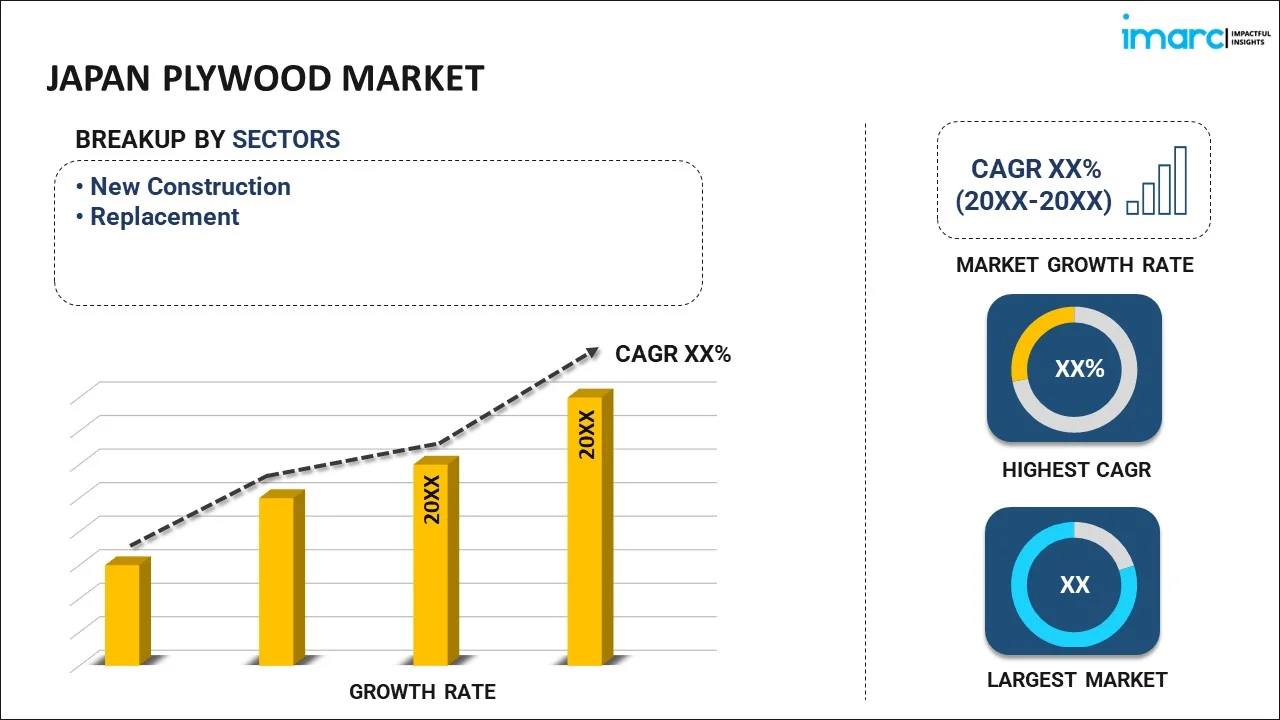
To detailed segment analysis of this market, Request Sample
- New Construction
- Replacement
New Construction dominates with a market share of 70% of the total Japan plywood market in 2025.
The new construction sector accounts for the predominant share of Japan's plywood market, driven by ongoing residential housing development, commercial building projects, and public infrastructure initiatives. Plywood serves as a critical structural material in wall sheathing, subflooring, roofing, and concrete formwork applications across new building sites. The material's exceptional strength-to-weight ratio, dimensional stability, and seismic performance characteristics make it indispensable for construction in Japan's earthquake-prone geography. Urban redevelopment programs in major metropolitan areas continue to sustain strong demand for construction-grade plywood panels.
Government policies actively support new construction activity that utilizes domestic wood products. Japan's Ministry of Land, Infrastructure, Transport and Tourism introduced mandatory energy-saving standards for all new buildings, creating additional demand for insulation-compatible plywood solutions. The Osaka Expo 2025, which featured multiple timber-utilizing pavilions and the Grand Ring structure containing substantial volumes of wood, demonstrated the growing role of plywood and engineered wood in large-scale new construction projects. These factors collectively reinforce the new construction sector's dominant position within the market.
Application Insights:
- Residential
- Commercial
Residential leads with a share of 65% of the total Japan plywood market in 2025.
The residential application segment holds the largest share of the Japan plywood market, reflecting the sustained importance of housing construction and renovation in driving material demand. Plywood is extensively utilized in residential buildings for structural sheathing, floor underlayment, interior paneling, and cabinetry. Japan's housing stock includes millions of aging structures requiring seismic retrofitting and energy-efficiency upgrades, creating consistent renovation-driven demand. The preference for wooden residential construction, deeply embedded in Japanese building tradition, continues to support plywood consumption across detached houses and apartment complexes.
Recent industry developments underscore the residential sector's significance. In February 2025, Sumitomo Forestry and Daito Trust Construction concluded a business alliance agreement focused on establishing stable supply and procurement structures for Japanese structural timber, including plywood products, to serve the rental housing and custom-built wooden housing markets. The alliance specifically targets expanded utilization of domestically sourced dimensional lumber for residential applications. This partnership highlights the strategic importance manufacturers and builders place on securing reliable plywood supply chains to meet the ongoing residential construction and renovation demand across Japan.
Regional Insights:
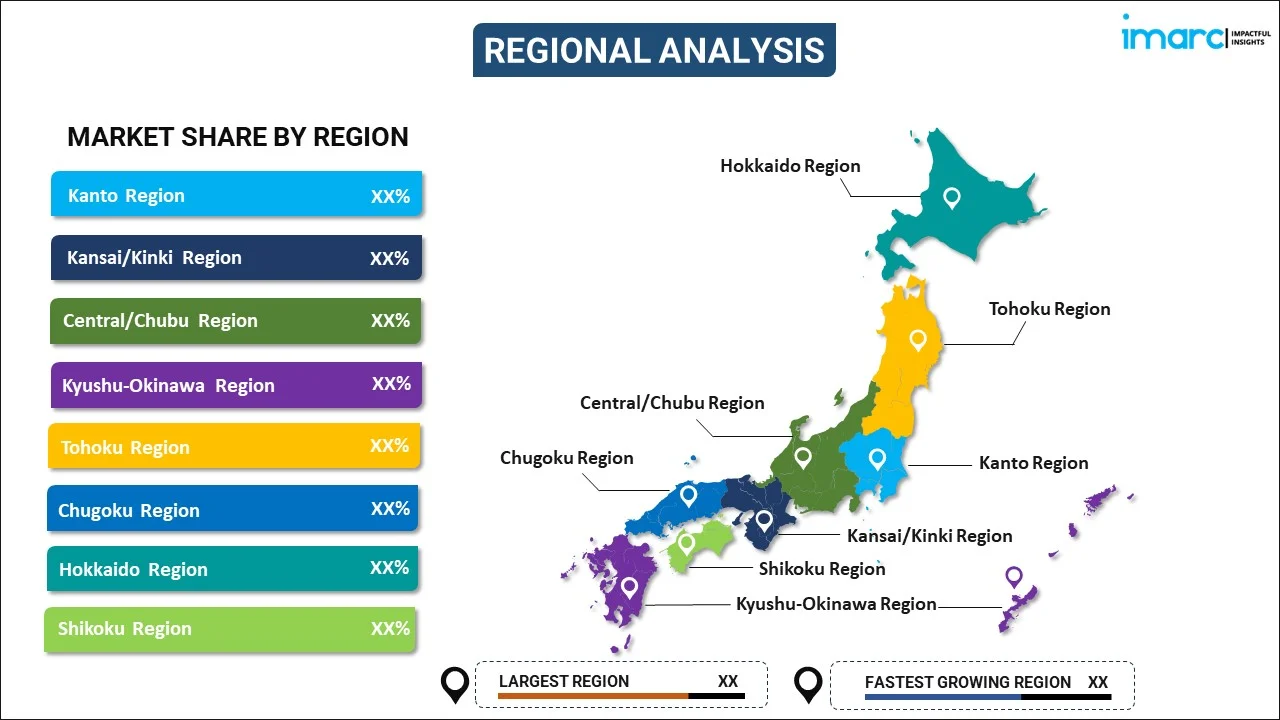
To detailed regional analysis of this market, Request Sample
- Kanto Region
- Kansai/Kinki Region
- Central/ Chubu Region
- Kyushu-Okinawa Region
- Tohoku Region
- Chugoku Region
- Hokkaido Region
- Shikoku Region
The Kanto Region, with cities such as Tokyo and Yokohama, covers the largest plywood consumption area in the Japanese market. The high density of urbanization in the region, high-rise residential buildings, and on-going commercial constructions result in a good demand for plywood panels. This region is advantageous because it is close to the seaports, thus able to receive imported timber products as needed. Renovation activities and developments in the area render the Kanto region the biggest plywood consumption region in the Japanese market.
The Kansai/Kinki Region is witnessing high demand for plywood due to various infrastructure development activities connected with the Osaka Expo 2025. The structure for the Grand Ring, a part of the Expo, comprised high volumes of local timber, including plywood and veneer. Residential development in the Osaka area, driven by improvements in water-side development and development along transit corridors, is another factor. The region already possesses a strong manufacturing industry, which further adds to the situation in Japan.
The Central/Chubu Region makes a significant contribution to the plywood market in Japan through the construction activities in the country and the construction of residential houses. The presence of the automobile and manufacturing industries in the region drives demand for plywood in the construction of industrial premises. The residential houses built in cities like Nagoya help drive the demand for plywood. The availability of local timber resources in the country from other forested areas helps support plywood production.
The plywood consumption in the region is also partly met by the Kyushu-Okinawa Region through residential, agriculture, and facility development activities. The region offers a high level of forestry resources, allowing for Japanese cedar wood utilization. The interest in the use of sustainable building practices, along with government initiatives in the use of wood in facility development, ensures that the region uses a high amount of plywood. The development activities in Fukuoka and other cities in the region add to the plywood consumption.
The Tohoku Region remains a major base for Japan's plywood manufacturing industry, supported by large manufacturing plants located along the region's coasts. The reconstruction programs initiated as a result of the disaster continue to ensure a sustained market for plywood materials for rebuilding residential and public infrastructures. The Fukushima Laminated-Timber Advanced Manufacturing Center, a facility operated by Woodcore located in Namie, remains a major industry development in the production of engineered timber. The region's timber resource base has remained a major support to the plywood manufacturing industry.
The Chugoku Region contributes to Japan's plywood market through a combination of residential construction, renovation activity, and industrial applications. The region's moderate population centers, including Hiroshima and Okayama, generate consistent demand for building materials. Access to domestic timber from surrounding prefectures supports local manufacturing operations. Growing emphasis on energy-efficient housing and seismic safety upgrades in older buildings is creating additional opportunities for plywood in both new construction and renovation segments.
Hokkaido's plywood market is supported by residential construction adapted to the region's cold climate requirements, where plywood serves critical insulation and structural functions. The region's extensive larch and spruce forests provide domestic raw materials for plywood manufacturing. Agricultural facility construction and food processing infrastructure development contribute additional demand. Government programs promoting wood utilization in public buildings and the growing tourism accommodation sector are expanding plywood applications beyond traditional residential construction uses.
Shikoku's plywood market reflects the region's smaller population base while maintaining steady demand through residential construction and renovation of aging structures. The region's rich forestry heritage, particularly in Japanese cedar, supports local timber processing and plywood manufacturing. Government initiatives encouraging wood utilization in public facilities and the growing need for seismic retrofitting in older buildings are sustaining plywood consumption. Local craftsmanship traditions continue to support demand for high-quality decorative plywood applications.
Market Dynamics:
Growth Drivers:
Why is the Japan Plywood Market Growing?
Government Policies Promoting Domestic Timber Utilization
Japan's government has implemented comprehensive policies to increase the utilization of domestically sourced timber, directly benefiting the plywood manufacturing sector. With majority of national land covered by forests and many post-war plantations reaching harvest maturity, authorities are actively encouraging the conversion of Japanese cedar and cypress into high-value wood products including plywood, veneer, and paneling. The Act for Promotion of Use of Wood in Buildings has expanded its scope to include private buildings, while revised building standards now facilitate the use of domestic timber in structures up to three storeys. The Revised Clean Wood Act strengthens due diligence requirements for timber legality verification, further incentivizing the procurement of domestically produced plywood. Government subsidies for high-level logging machinery and support programs for forestry workforce development are enhancing raw material availability. These coordinated policy measures create a favorable regulatory environment that supports increased plywood production from domestic sources, reduces import dependence, and stimulates investment in modern manufacturing facilities across Japan's wood processing industry.
Expanding Construction and Renovation Activity
Japan's construction sector continues to generate consistent demand for plywood through a combination of new building projects and extensive renovation activity. The residential construction market encompasses both new housing starts and growing renovation expenditure driven by energy-efficiency mandates and seismic-retrofit subsidies. Apartments and condominiums account for a significant share of construction activity, reflecting strong urban demand for compact living spaces that require structural plywood for walls, floors, and formwork. The renovation segment is experiencing meaningful expansion as Japan addresses its substantial stock of aging residential properties. Mandatory energy-saving standards introduced in April 2025 for all new buildings are simultaneously encouraging retrofitting of existing structures to meet updated insulation and energy performance criteria.
Rising Emphasis on Carbon Neutrality and Sustainable Building Materials
Japan's commitment to achieving carbon neutrality by 2050 is fundamentally reshaping building material preferences and elevating the role of wood products including plywood in the construction value chain. Wooden buildings generate significantly lower embodied carbon compared to steel and concrete alternatives, making plywood an increasingly attractive choice for environmentally conscious developers and government procurement. The broader green building movement is reinforcing demand for certified and sustainably sourced plywood products. Forest certification programs under the Sustainable Green Ecosystem Council and international frameworks are gaining traction among Japanese builders. The government's target to raise energy efficiency levels for new buildings to net zero energy house standards by 2030 creates sustained demand for high-performance building envelope materials, including structural plywood. These decarbonization imperatives are transforming plywood from a commodity construction material into a strategically important component of Japan's sustainable construction framework.
Market Restraints:
What Challenges the Japan Plywood Market is Facing?
Declining Housing Starts and Demographic Pressures
Japan's demographic trajectory presents a fundamental challenge to plywood demand as the shrinking and aging population reduces long-term housing requirements. Housing starts have experienced fluctuations, with several months recording year-on-year declines throughout recent periods. The growing surplus of vacant housing stock across the country further moderates the need for new residential construction. These demographic pressures create uncertainty about sustained demand growth and challenge manufacturers to find alternative applications to offset potential residential market contraction.
Competition from Alternative Building Materials
Plywood faces increasing competition from alternative engineered wood products and non-wood building materials that offer comparable or superior performance characteristics. Cross-laminated timber, laminated veneer lumber, and oriented strand board are expanding their presence in structural applications traditionally served by plywood. Additionally, advanced composite materials and steel-framed construction systems continue to compete for market share in commercial and industrial building segments. This competitive pressure requires plywood manufacturers to continuously innovate and differentiate their product offerings.
Raw Material Supply Constraints and Import Dependencies
Despite abundant domestic forest resources, Japan's plywood industry faces challenges related to raw material procurement, including dependence on imported tropical hardwood logs from Southeast Asian countries. Tightening environmental regulations in supplier nations, fluctuating international timber prices, and shipping cost volatility create supply chain vulnerabilities. While the domestic timber self-sufficiency rate has improved, the industry still relies on imported species for specific plywood grades and applications, exposing manufacturers to external supply disruptions.
Competitive Landscape:
Japan’s plywood market displays a highly concentrated competition scenario, where domestic companies dominate the market by virtue of large production capacity. The companies are focusing their strategies on increasing the domestic utilization of timber products, adopting advanced technological solutions to enhance manufacturing efficiency, investing in the production of premium quality timber products, and abiding by the stringent requirements set by the Japan Agricultural Standard – Certification requirements. Enterprises are also focusing their attention toward the production of special types of timber products that possess fire resistance and moisture resistance properties. Companies are forging partnership alliances to enhance the stability of timber supply agreements, which are beneficial for their cost structures. Companies are therefore forging stronger ties with companies involved in the forestry sector, residential constructions, and timber supply, which provide scope for the implementation of vertical business strategies. Companies are undertaking initiatives to effectively market their use of environmentally friendly certifications, introducing technological advancements in the manufacture of ultra-thick structural materials, and focusing their attention toward the production of specialized types of timber-based solutions suitable for use in mass timber construction projects.
Japan Plywood Market Report Coverage:
| Report Features | Details |
|---|---|
| Base Year of the Analysis | 2025 |
| Historical Period | 2020-2025 |
| Forecast Period | 2026-2034 |
| Units | Billion USD |
| Scope of the Report | Exploration of Historical Trends and Market Outlook, Industry Catalysts and Challenges, Segment-Wise Historical and Future Market Assessment:
|
| Sectors Covered | New Construction, Replacement |
| Applications Covered | Residential, Commercial |
| Regions Covered | Kanto Region, Kansai/Kinki Region, Central/ Chubu Region, Kyushu-Okinawa Region, Tohoku Region, Chugoku Region, Hokkaido Region, Shikoku Region |
| Customization Scope | 10% Free Customization |
| Post-Sale Analyst Support | 10-12 Weeks |
| Delivery Format | PDF and Excel through Email (We can also provide the editable version of the report in PPT/Word format on special request) |
Frequently Asked Questions About the Japan Plywood Market Report
The Japan plywood market size increased from USD 2.58 Billion in 2025 to USD 2.67 Billion in 2026.
The Japan plywood market is expected to grow at a compound annual growth rate of 3.57% from 2026-2034 to reach USD 3.54 Billion by 2034.
New Construction dominated the market with a share of 70%, driven by sustained residential and commercial building activity, urban redevelopment projects, and government policies promoting wood utilization in construction.
Key factors driving the Japan plywood market include government policies promoting domestic timber utilization, expanding construction and renovation activity, rising emphasis on carbon neutrality, mandatory energy-saving building standards, and growing adoption of mass timber construction.
Major challenges include declining housing starts due to demographic pressures, competition from alternative engineered wood and non-wood building materials, raw material supply constraints, import dependencies on tropical hardwood logs, and fluctuating international timber prices.
Need more help?
- Speak to our experienced analysts for insights on the current market scenarios.
- Include additional segments and countries to customize the report as per your requirement.
- Gain an unparalleled competitive advantage in your domain by understanding how to utilize the report and positively impacting your operations and revenue.
- For further assistance, please connect with our analysts.
 Request Customization
 Speak to an Analyst
 Request Brochure
 Inquire Before Buying
Benefits of Customization
- Personalize this research
- Triangulate with your data
- Get data as per your format and definition
- Gain a deeper dive into a specific application, geography, customer, or competitor
- Any level of personalization
Get in Touch With Us
UNITED STATES
Phone: +1-201-971-6302
INDIA
Phone: +91-120-433-0800
UNITED KINGDOM
Phone: +44-753-714-6104
Email: [email protected]
Client Testimonials




.webp)




.webp)













Related Reports

Choose your plan
*Please note that the prices mentioned below are starting prices for each bundle type. Kindly contact our team for further details.*
Single User License
- 1 User License, Access on 2 Devices
- PDF Report + Excel Dataset (Password Protected)
- Lifetime Access
- No Printing Rights
- 10% Free Report Customization
- 10–12 Weeks of Analyst Support
Five User License
- Access for 5 Users, 2 Devices per User
- PDF Report + Excel Dataset (Password Protected)
- Lifetime Access
- Dedicated Account Manager
- 12–14 Weeks of Analyst Support
- No Printing Rights
- 15% Free Report Customization
- 25% Discount on Your Next Purchase
Corporate User License
- Unlimited User Access (Within Your Organization)
- PDF Report + Excel Dataset
- Lifetime Access
- Dedicated Account Manager
- 14–20 Weeks of Analyst Support
- No Printing Rights
- 20% Free Report Customization
- 30% Discount on Your Next Purchase
Essential Insights
What's included:
3 reports
- Lifetime Access
- PDF Reports
- Excel Datasets
- 2 Weeks of Free Analyst Support
- 2 User Licenses
- Access on 2 Devices
- Printing Rights
- Complimentary PowerPoint (PPT) Version
- Complimentary License Upgrade
Professional Access
What's included:
5 reports
- Lifetime Access
- PDF Reports
- Excel Datasets
- 8 Weeks of Free Analyst Support
- 2 User Licenses
- Access on 2 Devices
- Printing Rights
- Complimentary PowerPoint (PPT) Version
- Complimentary License Upgrade
Business Advantage
What's included:
8 reports
- Lifetime Access
- PDF Reports
- Excel Datasets
- 14 Weeks of Free Analyst Support
- 2 User Licenses
- Access on 2 Devices
- Printing Rights
- Complimentary PowerPoint (PPT) Version
- Complimentary License Upgrade
Enterprise Intelligence
What's included:
10 reports
- Lifetime Access
- PDF Reports
- Excel Datasets
- 20 Weeks of Free Analyst Support
- 2 User Licenses
- Access on 2 Devices
- Printing Rights
- Complimentary PowerPoint (PPT) Version
- Complimentary License Upgrade