
Japan Private Equity Market Size, Share, Trends and Forecast by Fund Type and Region, 2026-2034
Japan Private Equity Market Size, Share, Trends & Forecast (2026-2034)
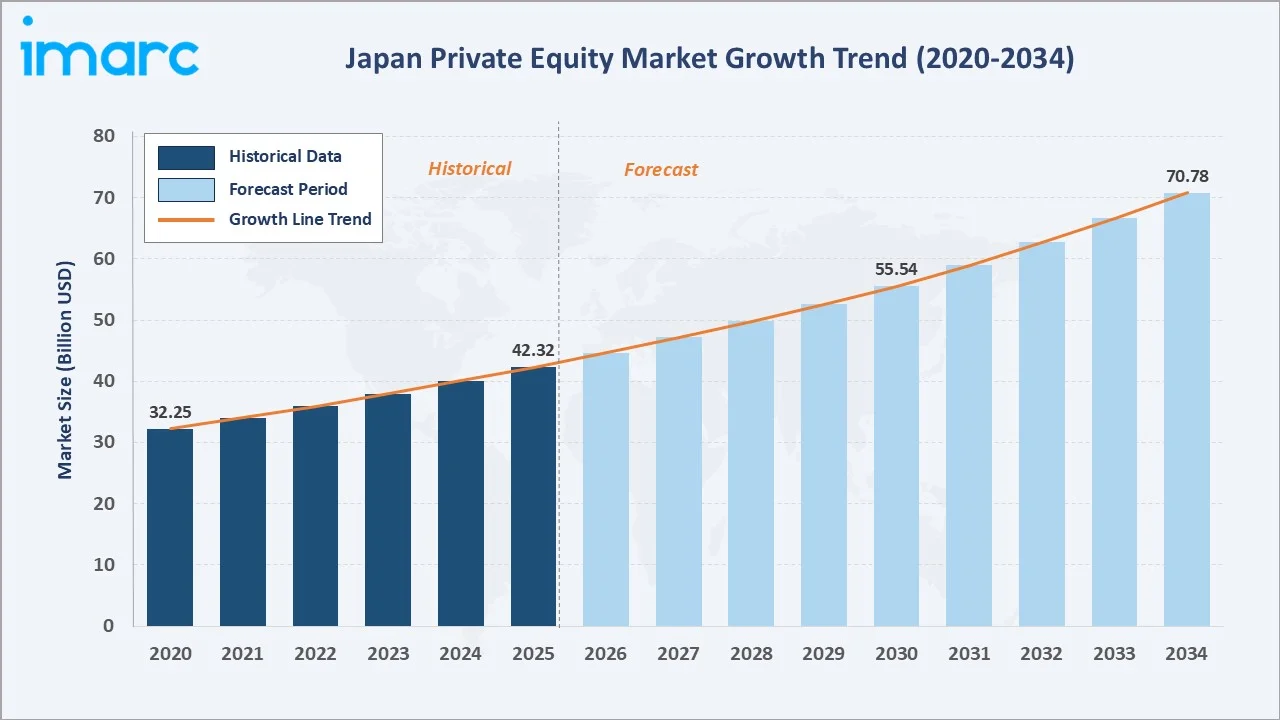
The Japan private equity market size increased from USD 42.32 Billion in 2025 to USD 45.82 Billion in 2026 and is projected to reach USD 70.78 Billion by 2034, growing at a CAGR of 5.59% during 2026-2034. Growth is underpinned by corporate governance reforms, Tokyo Stock Exchange restructuring pressure, and rising succession-driven divestitures among family-owned businesses.
Buyout funds command the largest share at 42.8%, followed by venture capital at 29.4%. The Kanto Region leads geographically at 47.6%, anchored by Tokyo's concentration of asset managers, listed companies, and institutional capital. Expanding foreign LP participation and a deepening secondaries market are reinforcing the market's structural momentum.
Market Snapshot
|
Metric |
Value |
|
Base Year Market Size (2025) |
USD 42.32 Billion |
| Market Size (2026) | USD 45.82 Billion |
|
Forecast Market Size (2034) |
USD 70.78 Billion |
|
CAGR (2026-2034) |
5.59% |
|
Base Year |
2025 |
|
Historical Period |
2020-2025 |
|
Forecast Period |
2026-2034 |
|
Dominant Fund Type |
Buyout (42.8%, 2025) |
|
Dominant Region |
Kanto Region (47.6%, 2025) |
The market expanded from USD 32.25 Billion in 2020 to USD 42.32 Billion in 2025 and an estimated USD 45.82 Billion in 2026, supported by a rebound in deal activity following pandemic-era disruptions. Anchored at USD 55.54 Billion by 2030, the market is forecast to reach USD 70.78 Billion by 2034. Post-pandemic recovery in exit markets, coupled with sustained fundraising momentum from domestic and cross-border limited partners, underpins this consistent upward trajectory.
To get more information on this market, Request Sample
Venture capital funds are projected to expand fastest at approximately 7.5% CAGR as Japan's startup financing ecosystem matures and government-backed entrepreneurship initiatives gain traction. Infrastructure funds follow at approximately 6.5% CAGR, reflecting rising capital allocation toward energy transition and digital infrastructure assets, while buyout and real estate funds grow steadily in line with the broader market average.
-1.11.webp)
Executive Summary
The Japan private equity market, which increased from USD 42.32 Billion in 2025 to an estimated USD 45.82 Billion in 2026, reflecting one of Asia's most established and increasingly institutionalized alternative investment markets, driven by a structural wave of corporate restructuring, succession transitions, and governance-led capital reallocation. Private equity has evolved from a niche strategy into a mainstream tool for unlocking value from Japan's vast base of family-owned enterprises and conglomerate carve-outs. The market is projected to reach USD 70.78 Billion by 2034.
Buyout funds at 42.8% dominate through large-scale carve-outs and public-to-private transactions, while venture capital at 29.4% benefits from Japan's expanding startup pipeline. The Kanto Region at 47.6% leads through Tokyo's dominant concentration of general partners, limited partners, and target companies, supported by the Kinki Region's Osaka-centered industrial and consumer deal flow.
Key Market Insights
|
Insight |
Data |
|
Dominant Fund Type |
Buyout - 42.8% share (2025) |
|
Dominant Region |
Kanto Region - 47.6% share (2025) |
|
Leading Growth Fund Type |
Venture Capital (VCs) - ~7.5% CAGR (2026-2034) |
|
Market Opportunity |
Continuation funds; GP-led secondaries; public-to-private deals; cross-border LP co-investment |
Key Analytical Observations Supporting The Above Data:
- Buyout at 42.8%: The buyout segment leads as it captures large-scale carve-outs from Japanese conglomerates and succession-driven acquisitions of mid-cap family businesses. Its dominance is reinforced by Tokyo Stock Exchange reforms pressuring listed companies to divest non-core units, creating a steady pipeline of control transactions for domestic and international buyout sponsors.
- Venture Capital at 29.4%: Venture capital ranks second as Japan's startup ecosystem matures, supported by government initiatives promoting entrepreneurship and technology commercialization. Growing corporate venture capital participation and increasing follow-on funding rounds are reinforcing venture capital's expanding share of overall private equity commitments.
- Kanto Region at 47.6%: The Kanto Region dominates due to Tokyo's concentration of general partners, institutional limited partners, investment banks, and listed target companies. The region's deep talent pool and proximity to regulators and exchanges make it the primary hub for deal origination, execution, and portfolio management.
Japan Private Equity Market Overview
-1.1.webp)
The Japan private equity market encompasses buyout, venture capital, real estate, infrastructure, and other fund strategies deployed across the country's corporate and startup landscape. Private equity sponsors raise capital from pension funds, insurers, sovereign wealth funds, and family offices to acquire ownership stakes in privately held or newly private companies, actively managing operations to enhance value before eventual exit. Japan's aging business-owner demographic, expanding corporate governance reforms, and growing institutional appetite for alternative assets have positioned private equity as an increasingly central mechanism for corporate transformation and capital allocation nationwide.
Market Dynamics
To evaluate market opportunities, Request Sample
Market Drivers
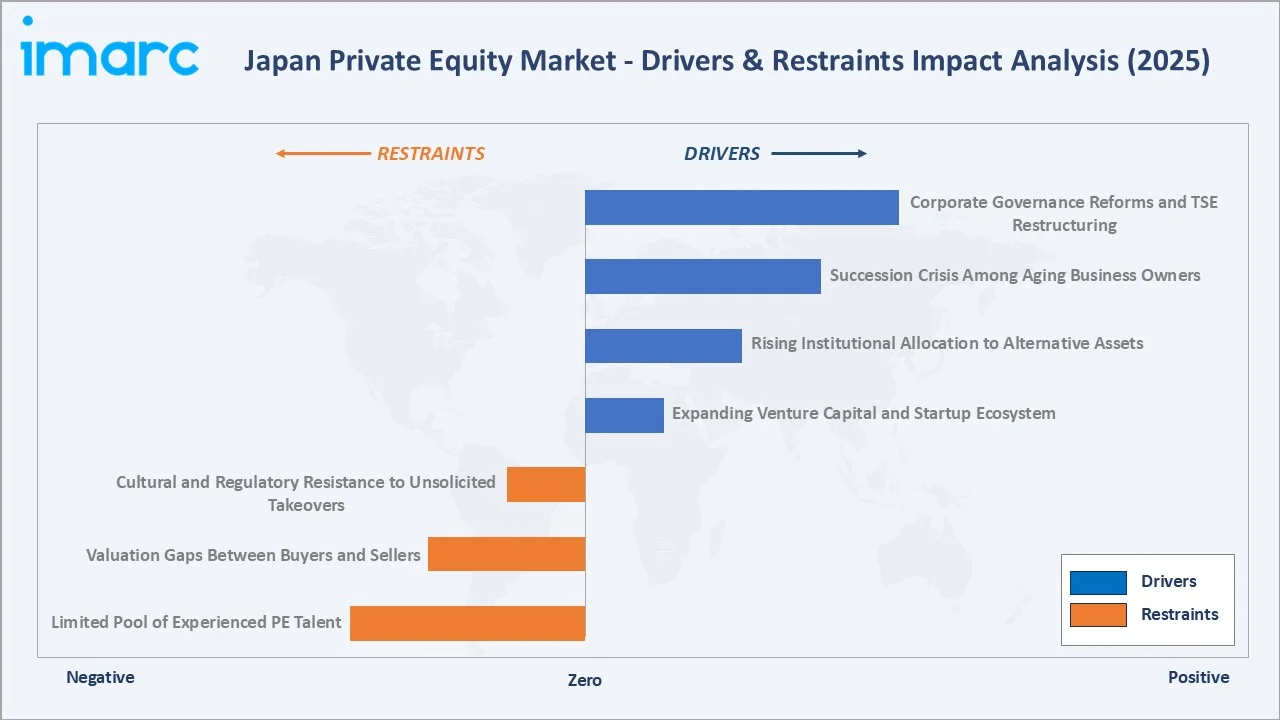
- Corporate Governance Reforms and TSE Restructuring: Tokyo Stock Exchange reforms compelling listed companies to improve capital efficiency are accelerating divestitures of non-core and underperforming units. This governance-driven unbundling is generating a steady pipeline of buyout opportunities as corporations streamline portfolios to meet market expectations. Boards facing sustained price-to-book discounts are increasingly engaging private equity sponsors as credible partners for restructuring, rather than relying solely on internal turnaround efforts. This trend is expected to sustain a durable, policy-reinforced deal-sourcing channel for buyout funds well beyond the current forecast horizon.
- Succession Crisis Among Aging Business Owners: Japan's aging population of small and mid-sized business owners lacking succession plans is driving a wave of ownership transitions. Private equity firms are stepping in to acquire these businesses, providing capital, professional management, and continuity solutions. With a significant proportion of small and mid-cap company owners now beyond typical retirement age, the absence of qualified family or internal successors is pushing many toward third-party sale, cementing private equity as a mainstream succession pathway across regional Japan.
- Rising Institutional Allocation to Alternative Assets: Persistently low domestic bond yields are pushing pension funds, insurers, and regional banks to increase allocations toward private equity in search of superior risk-adjusted returns, expanding the domestic limited partner base. Public pension reform discussions encouraging diversification into alternative assets are reinforcing this shift, while regional financial institutions are building dedicated allocation programs to gain exposure to buyout and venture strategies previously accessed mainly by larger institutions.
- Expanding Venture Capital and Startup Ecosystem: Government-backed entrepreneurship initiatives and growing corporate venture capital participation are fueling Japan's startup financing ecosystem, broadening the venture capital opportunity set for specialist fund managers. Universities and regional governments are increasingly co-sponsoring incubation and seed-funding programs, expanding the pipeline of investable early-stage companies and encouraging larger follow-on rounds as startups scale toward growth-stage financing.
Market Restraints
- Limited Pool of Experienced PE Talent: Japan's private equity industry faces a persistent shortage of experienced deal professionals with cross-border transaction expertise, which can slow deal execution and limit capital deployment pace. Competition for qualified associates and operating partners is pushing compensation higher across leading sponsors, while smaller and regional firms struggle to attract talent capable of managing complex carve-out and turnaround mandates at scale.
- Valuation Gaps Between Buyers and Sellers: Elevated seller expectations rooted in long-standing family ownership can create pricing gaps that delay or derail transactions, requiring creative deal structuring and extending negotiation timelines. Sentimental attachment to legacy businesses often complicates objective valuation discussions, and sponsors frequently must rely on earn-outs, rollover equity, and phased buyout structures to bridge persistent price expectation gaps.
- Cultural and Regulatory Resistance to Unsolicited Takeovers: Cultural preference for negotiated friendly transactions and residual regulatory caution around hostile approaches limit the scope of contested buyout activity relative to more permissive markets. Board-level resistance to outside ownership, combined with cross-shareholding legacies among select corporate groups, continues to slow the pace at which certain public-to-private opportunities can be pursued by external sponsors.
Market Opportunities
- Continuation Funds and GP-Led Secondaries: Continuation vehicles allow general partners to retain high-performing assets beyond traditional fund life while offering investors liquidity, opening new avenues for value extension in Japan's maturing buyout market. As more sponsors complete a second or third fund cycle, growing familiarity with continuation structures among domestic limited partners is expected to widen adoption beyond the largest, most established fund managers.
- Cross-Border Limited Partner Co-Investment: Rising international investor interest in Japan-focused strategies is creating opportunities for domestic sponsors to expand fund sizes through cross-border co-investment structures. Global pension funds and sovereign wealth funds seeking direct exposure alongside established local sponsors are opening a growing co-investment pipeline that supports larger, more competitive bids for large-cap buyout targets.
Market Challenges
- Currency Volatility Affecting Cross-Border Returns: Yen volatility against major currencies can affect realized returns for foreign limited partners, requiring more sophisticated hedging strategies from internationally focused sponsors. Extended holding periods typical of buyout strategies further amplify the currency risk carried across a fund's life, making forward-looking hedging policy an increasingly important part of fund-level risk management.
- Intensifying Competition for Quality Assets: Growing capital inflows are intensifying competition among sponsors for high-quality buyout targets, pressuring managers to differentiate through sector specialization and operational value creation. As more domestic and global sponsors pursue the same pool of proven succession-ready targets, disciplined underwriting and proprietary sourcing relationships are becoming decisive competitive differentiators.
Emerging Market Trends
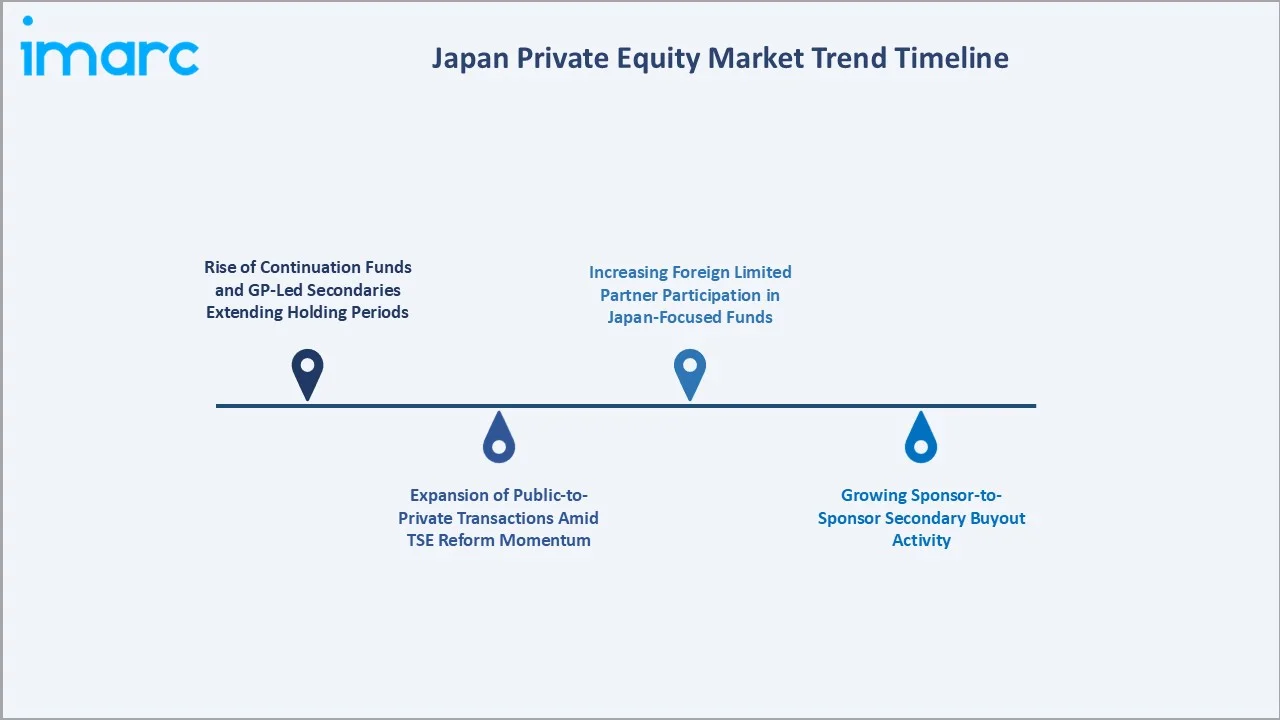
1. Rise of Continuation Funds and GP-Led Secondaries Extending Holding Periods
Continuation funds are gaining traction among Japanese buyout sponsors seeking to retain high-conviction assets beyond standard fund horizons while providing liquidity to existing limited partners. This structure allows managers to continue driving operational improvements without being constrained by fixed fund maturities.
2. Expansion of Public-to-Private Transactions Amid TSE Reform Momentum
Tokyo Stock Exchange initiatives pressuring listed companies to improve capital efficiency are accelerating public-to-private transactions, as boards facing persistent valuation discounts increasingly view private ownership as a faster route to strategic restructuring.
3. Growing Sponsor-to-Sponsor Secondary Buyout Activity
Secondary buyouts, where one sponsor sells a portfolio company to another, are becoming more common as Japan's buyout market matures and specialist sponsors seek assets suited to their sector expertise and value-creation playbooks.
4. Increasing Foreign Limited Partner Participation in Japan-Focused Funds
International institutional investors are allocating growing capital toward Japan-dedicated private equity funds, attracted by governance reform momentum and a deep pipeline of succession-driven deal flow, broadening the limited partner base.
Industry Value Chain Analysis
The Japan private equity value chain integrates capital raising and fund formation, deal sourcing and origination, due diligence and valuation, deal structuring and execution, portfolio value creation, and exit and realization. The value chain has progressively shifted toward proactive, thesis-driven origination as competition for quality assets intensifies, with portfolio value creation capabilities increasingly differentiating sponsors.
|
Stage |
Key Participants |
|
Capital Raising & Fund Formation |
Fund formation counsel, placement agents, pension funds, insurers, sovereign wealth funds, family offices |
|
Deal Sourcing & Origination |
GP deal teams, investment banks, restructuring advisors, corporate development networks |
|
Due Diligence & Valuation |
Financial, legal, commercial and ESG due diligence advisors, valuation specialists |
|
Deal Structuring & Execution |
Legal counsel, debt financing providers, tax advisors, regulatory approval bodies |
|
Portfolio Value Creation |
Operating partners, management teams, digital transformation and ESG advisors |
|
Exit & Realization |
Investment banks, IPO underwriters, strategic acquirers, secondary buyout sponsors |
Technology Landscape in the Japan Private Equity Industry
Buyout and Control Investment Strategies
Buyout and control investment strategies remain the dominant approach in Japan, targeting majority or full ownership stakes in mature, cash-generative businesses through carve-outs, succession-driven acquisitions, and public-to-private transactions, enabling sponsors to implement operational and governance improvements.
Growth Capital and Venture Capital Strategies
Growth capital and venture capital strategies target high-potential technology, healthcare and consumer companies at expansion stages, providing capital alongside strategic guidance to scale operations and prepare for eventual public listing or acquisition.
Digital Deal Sourcing and AI-Enabled Due Diligence
The increasing adoption of digital deal sourcing platforms and AI-enabled due diligence tools is transforming private equity investment processes in Japan. Advanced analytics, automation, and artificial intelligence help sponsors identify attractive investment opportunities, accelerate due diligence, enhance risk assessment, and improve decision-making efficiency. These technologies enable firms to evaluate larger deal pipelines, reduce transaction timelines, and compete more effectively for high-quality assets in an increasingly sophisticated private equity market.
Market Segmentation Analysis
The report covers the following segments:
|
Segment Category |
Leading Segment |
Market Share |
Year |
|
Fund Type |
Buyout |
42.8% |
2025 |
|
Region |
Kanto Region |
47.6% |
2025 |

By Fund Type
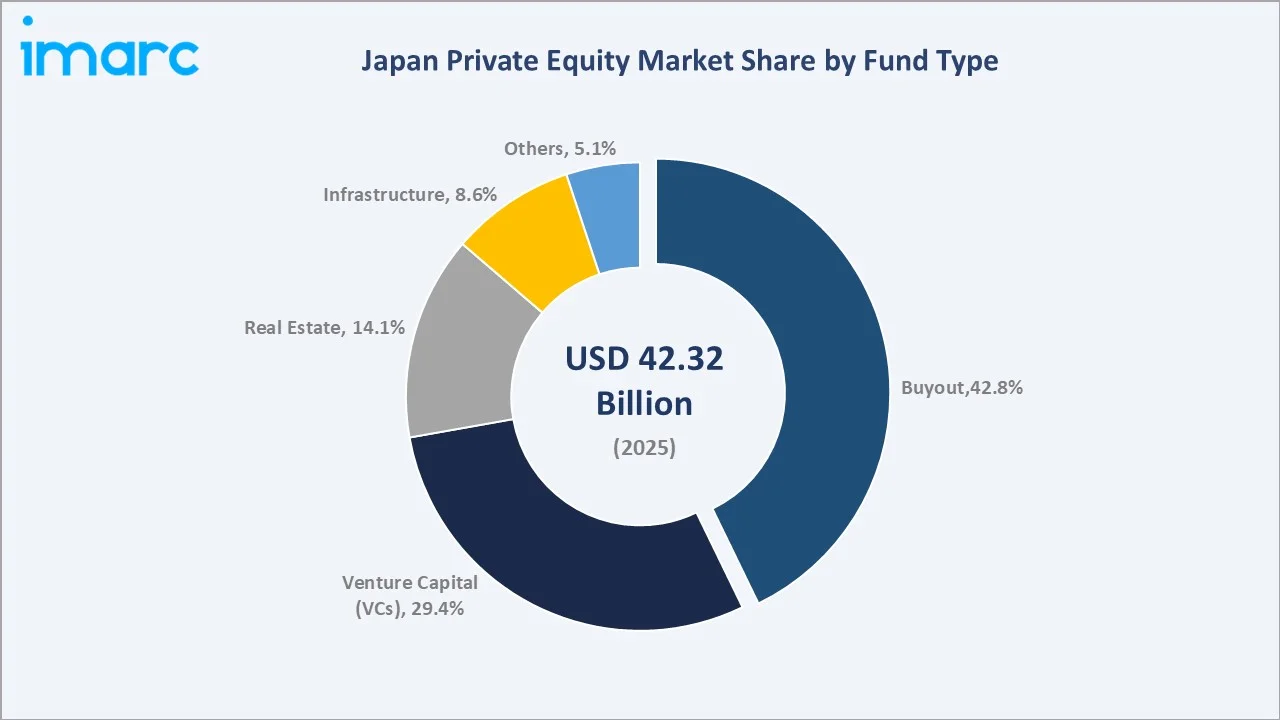
Buyout leads at 42.8% in 2025, encompassing large-scale carve-outs, public-to-private transactions and succession-driven acquisitions, the most capital-intensive and highest-revenue category within Japan's private equity market.
To access detailed market analysis, Request Sample
Venture capital at 29.4% captures Japan's expanding startup financing ecosystem. Real estate at 14.1% reflects continued institutional appetite for logistics, residential and hospitality assets, while infrastructure at 8.6% benefits from rising energy transition investment. Others at 5.1% includes mezzanine, distressed and special situations strategies.
Regional Market Insights
|
Region |
Share (2025) |
Key Market Drivers & Characteristics |
|
Kanto Region |
47.6% |
Tokyo's concentration of GPs, LPs, investment banks and listed target companies |
|
Kinki Region |
18.3% |
Osaka-centered industrial and consumer deal flow, strong family business succession pipeline |
|
Central/Chubu Region |
13.8% |
Nagoya's manufacturing and automotive supply chain carve-out opportunities |
|
Kyushu-Okinawa Region |
7.4% |
Growing semiconductor and logistics investment activity, regional revitalization support |
|
Tohoku Region |
5.2% |
Renewable energy and infrastructure-linked private equity interest |
|
Chugoku Region |
3.8% |
Manufacturing and chemicals sector mid-cap buyout opportunities |
|
Hokkaido Region |
2.4% |
Agriculture, tourism and renewable energy-linked investment activity |
|
Shikoku Region |
1.5% |
Niche manufacturing and regional consumer business succession deals |
Kanto Region, at 47.6%, leads through Tokyo's unmatched concentration of general partners, institutional capital and listed target companies. Kinki Region, at 18.3%, reflects Osaka's industrial and consumer deal-making strength.
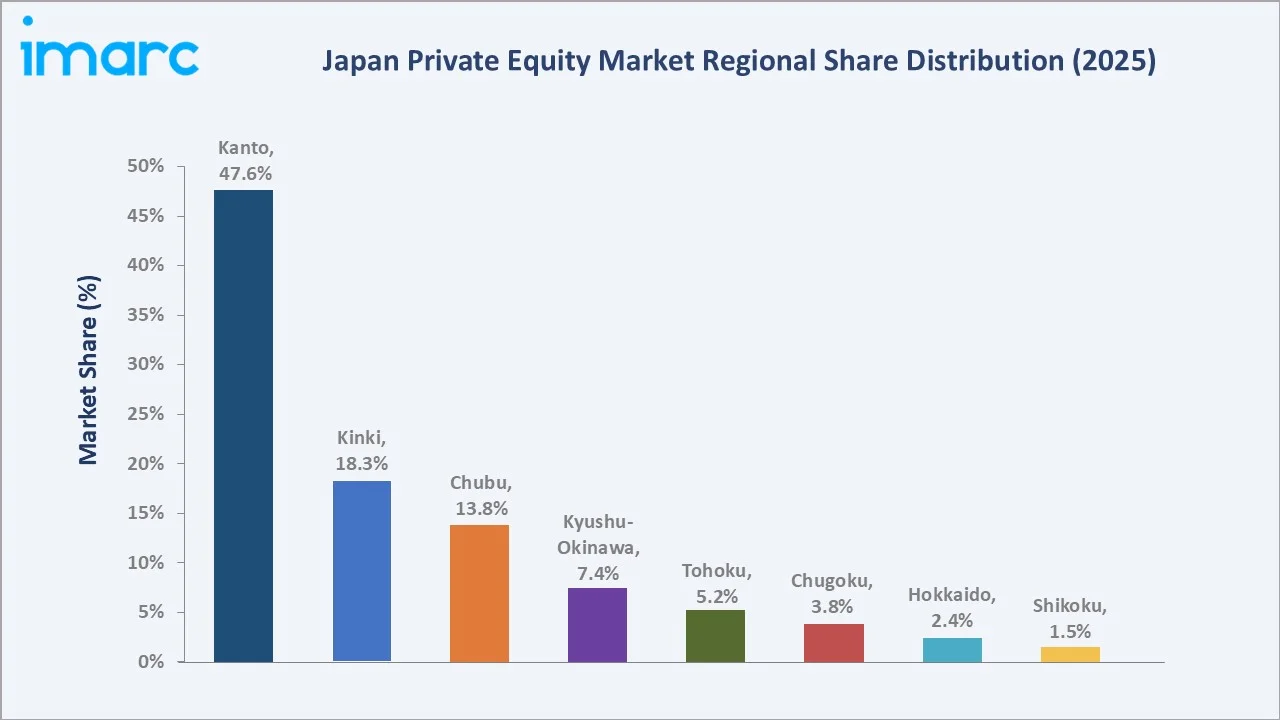
Central/Chubu Region, at 13.8%, benefits from Nagoya's automotive and manufacturing carve-out pipeline. The remaining regions collectively account for approximately 20.3% of the market, representing an emerging opportunity set for sponsors seeking less competitive mid-cap transactions outside Japan's primary metropolitan centers.
Competitive Landscape
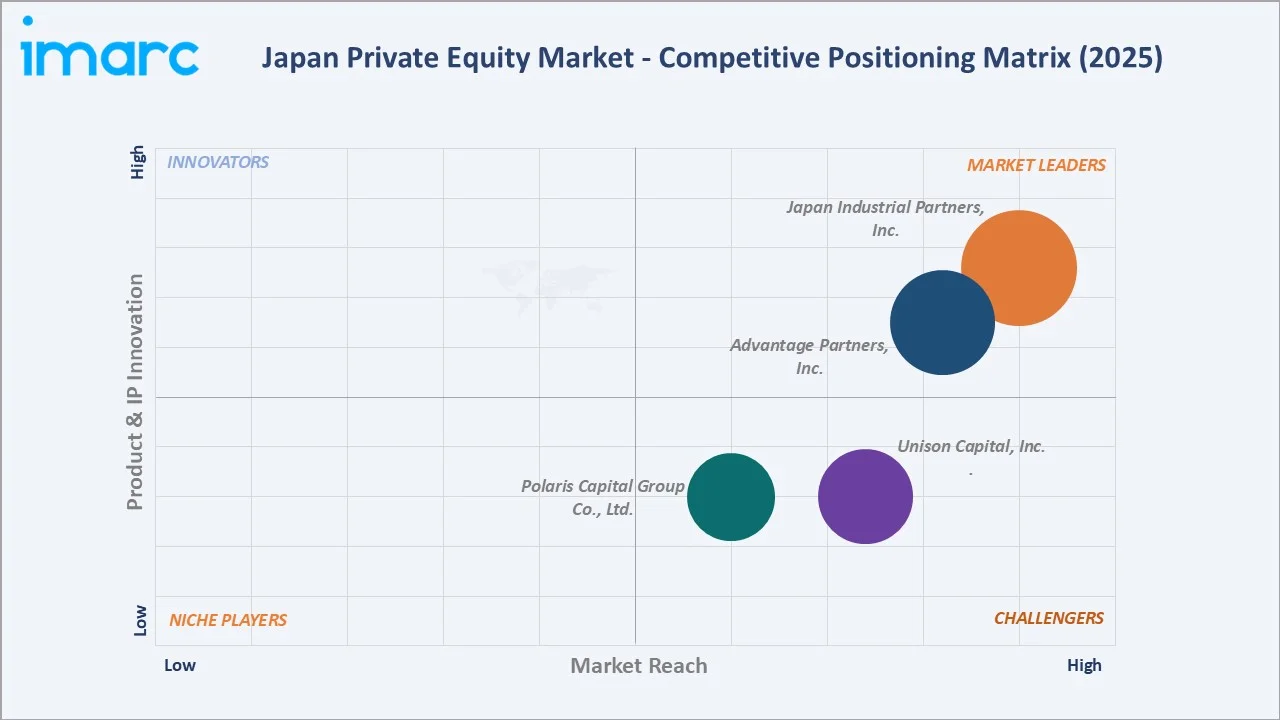
The Japan private equity market competitive landscape is moderately concentrated, comprising established domestic buyout specialists, global sponsors with dedicated Japan platforms, and a growing set of mid-market and sector-focused firms competing for succession-driven and carve-out deal flow across the country's institutionalizing alternative investment ecosystem.
|
Company Name |
Key Fund Strategy |
Market Position |
Core Strength |
|
Japan Industrial Partners, Inc. |
Corporate Carve-Out & Turnaround Buyout Funds |
Market Leader |
Specializes in large-scale corporate carve-outs and turnaround buyouts, including its landmark acquisition of Toshiba Corporation. |
|
Advantage Partners, Inc. |
Japan Mid-Market Buyout & Private Solutions Funds |
Market Leader |
Japan's first independent private equity fund; closed its largest-ever in 2026. |
|
Unison Capital, Inc. |
Mid-Cap Buyout & Consumer/Healthcare Funds |
Strong Challenger |
Pioneer of Japanese private equity, specializing in control buyouts across healthcare, consumer and B2B service sectors. |
|
Polaris Capital Group Co., Ltd. |
Mid-Market Buyout & Growth Capital Funds |
Strong Challenger |
Focuses on mid-market buyouts and growth capital investments supporting operational transformation. |
Key players include Japan Industrial Partners, Inc., Advantage Partners, Inc., Unison Capital, Inc., Polaris Capital Group Co., Ltd., and others.
Key Company Profiles
Japan Industrial Partners, Inc.
Japan Industrial Partners (JIP) is a Tokyo-based private equity firm specializing in corporate carve-outs, buyouts and turnaround investments across Japan's industrial and technology sectors.
- Key Fund Strategy: Corporate carve-out and turnaround buyout funds.
- Strategic Focus: Expanding large-scale corporate carve-out and turnaround investments across electronics, industrial and technology sectors.
Advantage Partners, Inc.
Advantage Partners is Japan's first independent private equity firm, with a diversified platform spanning buyout, private solutions and Asia ex-Japan strategies.
- Key Fund Strategy: Japan mid-market buyout and listed private solutions funds.
- Strategic Focus: Expanding founder-succession, corporate carve-out and public-to-private buyout investments across Japan's mid-market corporate landscape.
Market Concentration Analysis
The Japan private equity market is moderately concentrated, with the top four key players collectively accounting for a meaningful share of large and mid-market buyout activity. Global sponsors with dedicated Japan platforms are increasing their competitive presence; while emerging mid-market specialists are gaining share through sponsor-to-sponsor and carve-out transactions, gradually diversifying the market's competitive structure. Market concentration is expected to ease further over the forecast period as record fundraising broadens the base of active sponsors and as regional mid-cap specialists expand beyond the Kanto Region to compete for succession-driven deal flow.
Investment & Growth Opportunities
Highest Growth Segments
Venture capital (~7.5% CAGR), infrastructure funds (~6.5% CAGR), continuation vehicles and GP-led secondaries, public-to-private transactions, and cross-border limited partner co-investment structures represent the highest-growth investment vectors through 2034.
Emerging Investment Opportunities
Regional mid-cap buyout opportunities outside the Kanto Region represent the market's highest-value emerging opportunity, as succession-driven family businesses in the Kinki, Chubu and Kyushu-Okinawa regions offer comparatively attractive entry valuations relative to Tokyo-centered transactions.
Investment Themes
- Corporate carve-out specialization as a structural sourcing advantage through 2034: Sponsors developing dedicated carve-out execution capabilities are positioned to capture a growing pipeline of non-core divestitures driven by TSE capital efficiency reforms, creating a differentiated deal-sourcing advantage. Building in-house carve-out integration teams and standardized transition-services playbooks allows sponsors to bid competitively on complex conglomerate divestitures that generalist buyout firms are less equipped to execute efficiently.
- Cross-border LP co-investment platforms capturing Japan's fundraising momentum: Sponsors building dedicated cross-border co-investment platforms are well positioned to capture growing international institutional demand for Japan-focused exposure, enabling larger fund sizes. Establishing dedicated investor-relations coverage for global pension funds and sovereign wealth funds strengthens long-term fundraising relationships and supports participation in larger, more competitively bid public-to-private transactions.
Future Market Outlook (2026-2034)
The Japan private equity market is projected to grow from USD 42.32 Billion in 2025 to USD 45.82 Billion in 2026, reaching USD 70.78 Billion by 2034, delivering a 5.59% CAGR over the forecast period. The market's anchor value of approximately USD 55.54 Billion by 2030 represents a private equity industry at an advanced stage of institutionalization, with continuation funds achieving mainstream adoption, public-to-private transactions becoming a routine governance-driven exit path, and foreign limited partner participation reaching new highs.
Two structural forces underpin this trajectory with strong confidence: sustained succession-driven deal flow from Japan's aging business-owner base and deepening institutional capital allocation toward alternative assets amid persistently low domestic bond yields.
Research Methodology
Primary Research
Primary research comprised structured interviews with private equity fund managers, limited partners, investment bankers, legal advisors and portfolio company executives across Japan's buyout, venture capital, real estate and infrastructure fund segments.
Secondary Research
Secondary research encompassed fund manager disclosures, Japan Private Equity Association publications, Financial Services Agency and METI policy documents, Tokyo Stock Exchange governance reform materials, and industry deal databases covering fundraising, deal activity and exit trends.
Forecasting Models
Market revenue forecasts were developed using a bottom-up model incorporating: (i) historical fund closing and deployment data by fund type; (ii) institutional allocation trend analysis across pension, insurance and sovereign capital pools; (iii) deal volume and average transaction size projections by region; and (iv) succession-driven deal flow estimates based on demographic and corporate ownership data.
Japan Private Equity Market Report Coverage:
| Report Features | Details |
|---|---|
| Base Year of the Analysis | 2025 |
| Historical Period | 2020-2025 |
| Forecast Period | 2026-2034 |
| Units | Billion USD |
| Scope of the Report | Exploration of Historical Trends and Market Outlook, Industry Catalysts and Challenges, Segment-Wise Historical and Future Market Assessment:
|
| Fund Types Covered | Buyout, Venture Capital (VCS), Real Estate, Infrastructure, Others |
| Regions Covered | Kanto Region, Kinki Region, Central/ Chubu Region, Kyushu-Okinawa Region, Tohoku Region, Chugoku Region, Hokkaido Region, Shikoku Region |
| Companies Covered | Japan Industrial Partners, Inc., Advantage Partners, Inc., Unison Capital, Inc., Polaris Capital Group Co., Ltd., etc. |
| Customization Scope | 10% Free Customization |
| Post-Sale Analyst Support | 10-12 Weeks |
| Delivery Format | PDF and Excel through Email (We can also provide the editable version of the report in PPT/Word format on special request) |
Key Benefits for Stakeholders:
- IMARC’s report offers a comprehensive quantitative analysis of various market segments, historical and current market trends, market forecasts, and dynamics of the Japan private equity market from 2020-2034.
- The research study provides the latest information on the market drivers, challenges, and opportunities in the Japan private equity market.
- Porter's five forces analysis assist stakeholders in assessing the impact of new entrants, competitive rivalry, supplier power, buyer power, and the threat of substitution. It helps stakeholders to analyze the level of competition within the Japan private equity industry and its attractiveness.
- Competitive landscape allows stakeholders to understand their competitive environment and provides an insight into the current positions of key players in the market.
Frequently Asked Questions About the Japan Private Equity Market Report
The Japan private equity market size is estimated at USD 45.82 Billion in 2026, driven by buyout funds dominant at 42.8%, venture capital at 29.4%, and the Kanto Region commanding 47.6% market share through Tokyo's concentration of general partners and institutional capital.
The market grows at a 5.59% CAGR during 2026-2034, reaching USD 70.78 Billion by 2034, driven by governance-led corporate restructuring, succession-driven deal flow, and rising institutional allocation to alternative assets.
Buyout leads at 42.8%, capturing large-scale carve-outs and succession-driven acquisitions. This segment benefits from Tokyo Stock Exchange reforms pressuring listed companies to divest non-core units.
Venture capital grows fastest at approximately 7.5% CAGR, supported by Japan's maturing startup financing ecosystem and expanding corporate venture capital participation.
The Kanto Region leads at 47.6% through Tokyo's concentration of general partners, institutional limited partners and listed target companies.
Leading companies include Japan Industrial Partners, Inc., Advantage Partners, Inc., Unison Capital, Inc., Polaris Capital Group Co., Ltd., and others.
The market is projected to reach approximately USD 55.54 Billion by 2030, with continuation funds and public-to-private transactions becoming increasingly mainstream deal structures.
Three priority opportunities include corporate carve-out specialization amid TSE governance reforms, cross-border limited partner co-investment platform development, and regional mid-cap buyout expansion beyond the Kanto Region.
Need more help?
- Speak to our experienced analysts for insights on the current market scenarios.
- Include additional segments and countries to customize the report as per your requirement.
- Gain an unparalleled competitive advantage in your domain by understanding how to utilize the report and positively impacting your operations and revenue.
- For further assistance, please connect with our analysts.
 Request Customization
 Speak to an Analyst
 Request Brochure
 Inquire Before Buying
Benefits of Customization
- Personalize this research
- Triangulate with your data
- Get data as per your format and definition
- Gain a deeper dive into a specific application, geography, customer, or competitor
- Any level of personalization
Get in Touch With Us
UNITED STATES
Phone: +1-201-971-6302
INDIA
Phone: +91-120-433-0800
UNITED KINGDOM
Phone: +44-753-714-6104
Email: [email protected]
Client Testimonials




.webp)




.webp)













Related Reports

Choose your plan
*Please note that the prices mentioned below are starting prices for each bundle type. Kindly contact our team for further details.*
Single User License
- 1 User License, Access on 2 Devices
- PDF Report + Excel Dataset (Password Protected)
- Lifetime Access
- No Printing Rights
- 10% Free Report Customization
- 10–12 Weeks of Analyst Support
Five User License
- Access for 5 Users, 2 Devices per User
- PDF Report + Excel Dataset (Password Protected)
- Lifetime Access
- Dedicated Account Manager
- 12–14 Weeks of Analyst Support
- No Printing Rights
- 15% Free Report Customization
- 25% Discount on Your Next Purchase
Corporate User License
- Unlimited User Access (Within Your Organization)
- PDF Report + Excel Dataset
- Lifetime Access
- Dedicated Account Manager
- 14–20 Weeks of Analyst Support
- No Printing Rights
- 20% Free Report Customization
- 30% Discount on Your Next Purchase
Essential Insights
What's included:
3 reports
- Lifetime Access
- PDF Reports
- Excel Datasets
- 2 Weeks of Free Analyst Support
- 2 User Licenses
- Access on 2 Devices
- Printing Rights
- Complimentary PowerPoint (PPT) Version
- Complimentary License Upgrade
Professional Access
What's included:
5 reports
- Lifetime Access
- PDF Reports
- Excel Datasets
- 8 Weeks of Free Analyst Support
- 2 User Licenses
- Access on 2 Devices
- Printing Rights
- Complimentary PowerPoint (PPT) Version
- Complimentary License Upgrade
Business Advantage
What's included:
8 reports
- Lifetime Access
- PDF Reports
- Excel Datasets
- 14 Weeks of Free Analyst Support
- 2 User Licenses
- Access on 2 Devices
- Printing Rights
- Complimentary PowerPoint (PPT) Version
- Complimentary License Upgrade
Enterprise Intelligence
What's included:
10 reports
- Lifetime Access
- PDF Reports
- Excel Datasets
- 20 Weeks of Free Analyst Support
- 2 User Licenses
- Access on 2 Devices
- Printing Rights
- Complimentary PowerPoint (PPT) Version
- Complimentary License Upgrade