
Japan Stacker Market Size, Share, Trends and Forecast by Type, End User, and Region, 2026-2034
Japan Stacker Market Summary:
The Japan stacker market size was valued at USD 144.40 Million in 2025 and is projected to reach USD 227.57 Million by 2034, growing at a compound annual growth rate of 5.2% from 2026-2034.
The Japan stacker market is witnessing sustained expansion driven by the country’s accelerating warehouse automation initiatives and growing e-commerce logistics infrastructure. Rising demand for efficient material handling solutions across retail distribution centers, manufacturing facilities, and third-party logistics warehouses is strengthening adoption. Persistent labor shortages in the logistics sector, coupled with government-backed digital transformation programs, are compelling businesses to invest in advanced stacking equipment. The ongoing electrification of material handling fleets and integration of lithium-ion battery technologies are further enhancing operational efficiency, positioning Japan as a key market for next-generation stacker solutions and supporting the Japan stacker market share.
Key Takeaways and Insights:
- By Type: Electric dominates the market with a share of 45% in 2025, owing to its superior energy efficiency, lower maintenance requirements, and alignment with Japan’s carbon neutrality objectives driving widespread adoption across automated warehouses and distribution centers.
- By End User: Retail and wholesale lead the market with a share of 30% in 2025, driven by the rapid expansion of e-commerce fulfillment infrastructure, increasing demand for efficient inventory management systems, and growing need for high-throughput material handling in distribution centers.
- Key Players: Key players drive the Japan stacker market by advancing electric and autonomous stacking technologies, expanding lithium-ion battery integration, strengthening distribution networks, and investing in smart warehouse solutions. Their focus on safety innovations, energy efficiency, and automated logistics accelerates adoption across diverse industrial and commercial applications nationwide.
The Japan stacker market is experiencing a transformative phase as the convergence of automation technologies, sustainability mandates, and evolving logistics requirements reshapes material handling operations across the country. The growing prominence of electric stackers reflects a broader industry shift toward zero-emission warehouse equipment, supported by Japan’s Green Transformation strategy aimed at achieving net-zero emissions by 2050. Advanced lithium-ion battery systems are replacing traditional lead-acid alternatives, offering faster charging cycles, extended operational hours, and reduced total cost of ownership. The retail and wholesale sector continues to anchor demand as e-commerce platforms expand their fulfillment capabilities to meet consumer expectations for rapid delivery. Concurrently, the integration of sensor technologies, telematics platforms, and warehouse management systems is enabling real-time fleet monitoring and predictive maintenance, further optimizing stacker utilization and supporting the Japan stacker market growth.
Japan Stacker Market Trends:
Accelerating Electrification of Material Handling Fleets
The transition from internal combustion engine-powered stackers to fully electric models is gaining considerable momentum across Japan’s warehousing and manufacturing sectors. Electric stackers powered by advanced lithium-ion batteries offer significant advantages including zero emissions during operation, reduced noise levels suitable for indoor environments, and substantially lower lifecycle maintenance costs. This shift is reinforced by Japan’s national decarbonization agenda and corporate sustainability commitments, encouraging facility operators to modernize their fleets. In August 2025, Toyota Material Handling introduced an advanced lineup of electric heavy-duty stackers designed to maximize productivity across diverse warehouse environments.
Integration of Autonomous and AI-Driven Technologies
Japanese logistics facilities are increasingly incorporating autonomous capabilities into stacker operations, leveraging technologies such as LiDAR navigation, three-dimensional vision systems, and artificial intelligence-driven route optimization. These innovations enable stackers to perform tasks including pallet transport, putaway, and replenishment with minimal human intervention, addressing the chronic labor shortage in the warehouse sector. In September 2024, Mitsubishi Heavy Industries and Mitsubishi Logisnext showcased advanced autonomous forklift solutions at Logis-Tech Tokyo, featuring the ΣSynX automation platform with SynfoX-based unmanned forklifts and lithium-ion battery models equipped with AI-enabled safety features.
Rising Demand for Compact and Space-Optimized Stacking Solutions
As warehouse rental costs escalate in Japan’s major urban centers, operators are prioritizing compact stacking equipment capable of navigating narrow aisles and maximizing vertical storage capacity. Walk-behind and ride-on electric stackers with reduced turning radii are gaining traction in high-density fulfillment centers where floor space utilization is critical. This trend aligns with the expansion of micro-fulfillment centers positioned close to population hubs to support rapid last-mile delivery. The Japan logistics market size reached USD 355.9 Billion in 2025. Looking forward, IMARC Group expects the market to reach USD 567.4 Billion by 2034, exhibiting a growth rate (CAGR) of 5.32% during 2026-2034, with warehousing and distribution services registering the fastest growth, further fueling demand for space-efficient stacking solutions.
Market Outlook 2026-2034:
The Japan stacker market is poised for sustained growth over the forecast period, underpinned by structural shifts in logistics infrastructure, deepening warehouse automation, and the ongoing transition toward electric and intelligent material handling equipment. Japan’s 2024 logistics problem, arising from stricter overtime regulations for commercial drivers, continues to amplify the urgency for automated and semi-automated material handling solutions in warehouse environments. The expansion of e-commerce fulfillment networks and third-party logistics facilities is expected to sustain strong demand for electric and semi-electric stackers. Additionally, advancements in battery technology, telematics-enabled fleet management, and AI-powered safety monitoring systems are anticipated to enhance equipment efficiency and drive replacement cycles, creating consistent growth opportunities across the forecast period. The market generated a revenue of USD 144.40 Million in 2025 and is projected to reach a revenue of USD 227.57 Million by 2034, growing at a compound annual growth rate of 5.2% from 2026-2034.
Japan Stacker Market Report Segmentation:
|
Segment Category |
Leading Segment |
Market Share |
|
Type |
Electric |
45% |
|
End User |
Retail and Wholesale |
30% |
Type Insights:
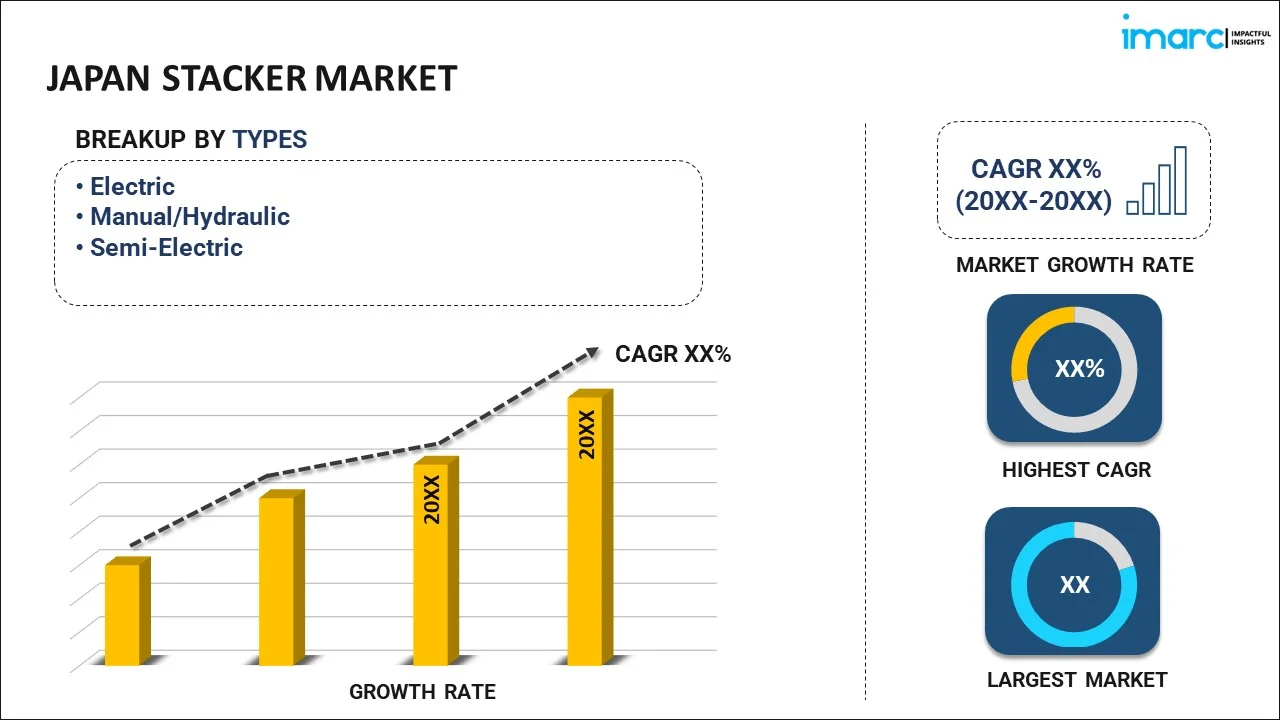
To get detailed segment analysis of this market Request Sample
- Electric
- Manual/Hydraulic
- Semi-Electric
Electric dominates with a market share of 45% of the total Japan stacker market in 2025.
The electric segment commands the largest share of the Japan stacker market, driven by their operational advantages including zero tailpipe emissions, lower noise output, and significantly reduced energy consumption compared to conventional alternatives. Japan’s corporate sustainability mandates and national carbon neutrality targets are compelling warehouse operators to replace aging combustion-powered equipment with electric variants. Advanced lithium-ion battery systems now offer extended run times and rapid opportunity charging, enabling continuous multi-shift operations without the downtime associated with traditional lead-acid batteries.
Electric stackers are particularly suited for indoor warehouse environments where emission-free operation is essential for worker health and regulatory compliance. The integration of regenerative braking systems, intelligent power management controls, and IoT-enabled telematics platforms enhances fleet efficiency and enables predictive maintenance scheduling. As Japan’s manufacturing and logistics sectors continue to prioritize operational cost reduction and environmental responsibility, electric stackers are increasingly becoming the default specification for new warehouse installations and fleet renewal programs across the country’s major industrial corridors.
.webp)
End User Insights:
- Retail and Wholesale
- Logistics
- Automobile
- Food and Beverages
- Others
Retail and wholesale lead with a share of 30% of the total Japan stacker market in 2025.
The retail and wholesale segment maintains the largest share of the Japan stacker market, driven by the exponential growth of e-commerce fulfillment operations and the modernization of brick-and-mortar distribution networks. Major retailers and wholesale distributors are investing heavily in warehouse infrastructure equipped with advanced material handling equipment to meet consumer expectations for rapid order processing and same-day delivery. The proliferation of omnichannel retail strategies requires seamless inventory management across multiple distribution points, creating sustained demand for versatile stacking solutions.
Retail distribution centers are increasingly deploying electric walkie stackers and ride-on stackers capable of efficiently managing diverse product categories ranging from consumer electronics and apparel to household goods and food items. The trend toward high-density storage configurations with narrow-aisle layouts is further accelerating the adoption of compact, maneuverable stacking equipment. Additionally, the seasonal demand fluctuations inherent in the retail sector drive preferences for flexible fleet configurations that combine owned equipment with rental solutions, supporting both permanent and peak-season operational requirements throughout Japan’s extensive retail supply chain.
Regional Insights:
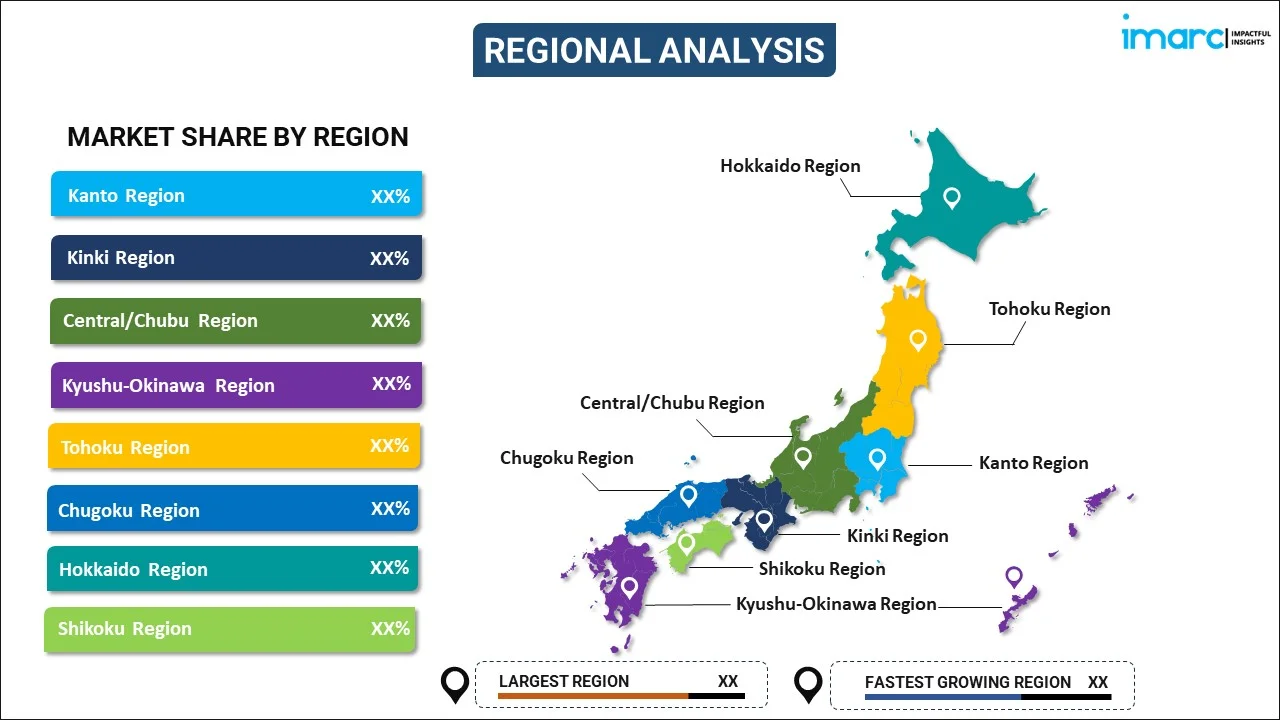
To get detailed regional analysis of this market Request Sample
- Kanto Region
- Kinki Region
- Central/ Chubu Region
- Kyushu-Okinawa Region
- Tohoku Region
- Chugoku Region
- Hokkaido Region
- Shikoku Region
The Kanto Region is centered around Tokyo and Yokohama, serving as the biggest logistics hub in Japan, with a wide reach of warehouse and distribution center infrastructure. Its high density of major e-commerce fulfillment operations, third-party logistics providers, and retail distribution networks creates very strong demand for electric and semi-electric stackers. The presence of Narita Airport and the Port of Tokyo adds to the connectivity, facilitating high-throughput material handling across the commercial and industrial corridors of the region.
Kinki Region is one of the most important gateways for imports and exports through maritime logistics. The presence of a robust manufacturing base for industries such as automobiles, electrical machinery, and consumer goods within the region creates a certain demand for efficient stacking equipment. Continuous warehouse renovation along with expanding automated distributing facilities near Kansai International Airport will increase the adoption of advanced electric stackers in this region's logistics infrastructure.
The Central/Chubu Region, dominated by Nagoya’s automotive manufacturing ecosystem, is a major contributor to stacker demand in Japan. The region hosts production facilities for leading automobile manufacturers and their extensive supplier networks, requiring robust material handling equipment for parts management and finished goods distribution. The integration of Industry 4.0 technologies across Chubu’s manufacturing plants is driving adoption of intelligent, connected stacking solutions that optimize warehouse throughput and inventory accuracy.
The Kyushu-Okinawa Region is emerging as a strategic logistics node benefiting from expanding semiconductor fabrication facilities and growing trade connections with Southeast Asian markets. The region’s port infrastructure, particularly in Fukuoka and Kitakyushu, supports substantial cargo handling operations requiring efficient stacking equipment. Increasing investments in cold chain logistics for the food processing industry and the development of modern distribution centers are creating new demand channels for electric stackers.
The Tohoku Region contributes to the stacker market through its agricultural processing, food manufacturing, and growing logistics infrastructure. Post-reconstruction development efforts have modernized warehousing facilities across the region, incorporating advanced material handling technologies. The seasonal agricultural output demands flexible stacking solutions for cold storage and distribution operations, while the expansion of regional e-commerce delivery networks is creating additional requirements for compact, efficient stackers.
The Chugoku Region, with Hiroshima as its industrial center, supports stacker demand through its diversified manufacturing sector encompassing automotive components, machinery, and chemical production. The region’s strategic position along the Seto Inland Sea facilitates maritime trade operations requiring efficient cargo handling equipment. Ongoing investments in logistics facility upgrades and the adoption of lean manufacturing principles are encouraging the replacement of older material handling equipment with modern electric alternatives.
The Hokkaido Region’s stacker market is attributed to the large quantity of food processing activities and agriculture-related distribution that occurs within the region. Seasonal variations of agriculture sometimes require stacker machines during the processing stage. Additionally, retail distribution due to tourism and the expansion of logistics infrastructure due to the penetration of e-commerce in northern Japan are creating steady demand for stacker machines due to their necessary application in cold weather conditions.
Shikoku Region has a smaller-scale stacker market but is sustained by the region’s paper manufacturing industry, chemical processing plants, as well as the food production industry. It is connected to Honshu via bridges as well as ferry routes, thus facilitating distribution activities. Ongoing activities to enhance the manufacturing plants as well as warehousing are positively influencing the uptake of electric stackers as a move towards lowering costs as well as complying with environmental laws.
Market Dynamics:
Growth Drivers:
Why is the Japan Stacker Market Growing?
Escalating Labor Shortages Driving Automation Investments
Japan’s rapidly aging population and persistent demographic decline are creating severe labor shortages across the logistics and warehousing sectors, fundamentally transforming the demand landscape for material handling equipment including stackers. Companies are increasingly deploying electric stackers equipped with advanced safety features and ergonomic designs to maximize the productivity of a shrinking workforce while maintaining operational safety standards. The integration of assisted-driving technologies, proximity sensors, and automated speed controls reduces operator fatigue and minimizes accident risks, enabling fewer workers to manage larger warehouse operations effectively. As per the industry report, Japan’s job-to-applicant ratio remains elevated with 124 job openings available for every 100 job seekers, underscoring the structural nature of these workforce challenges and reinforcing the long-term growth trajectory for stacker equipment investments.
Rapid Expansion of E-Commerce Fulfillment Infrastructure
The sustained growth of Japan’s e-commerce sector is generating unprecedented demand for warehouse capacity and advanced material handling equipment, directly benefiting the stacker market. The proliferation of online shopping platforms, rising consumer expectations for same-day and next-day delivery, and the expansion of omnichannel retail strategies are compelling logistics operators to invest in high-efficiency stacking solutions. Modern fulfillment centers require versatile equipment capable of handling diverse product categories, navigating narrow aisles, and operating across multiple shifts with minimal downtime. Electric stackers with lithium-ion batteries meet these requirements by providing consistent performance, opportunity charging capabilities, and integration with warehouse management systems. The Japan e-commerce market size reached USD 258.0 Billion in 2024. Looking forward, IMARC Group expects the market to reach USD 692.8 Billion by 2033, exhibiting a growth rate (CAGR) of 11.02% during 2025-2033, sustaining robust demand for material handling equipment as fulfillment networks expand across the country.
National Decarbonization Mandates Accelerating Fleet Electrification
Japan’s comprehensive Green Transformation policy, aimed at reducing its greenhouse gas emissions by net zero by the year 2050, is thereby providing an economic driver for the electrification of warehouse equipment fleets, including stackers. Sustainability reporting, along with current pressures to decarbonize global supply chains, is prompting warehouse fleets to look beyond traditional internal combustion engine-based equipment in favor of electric vehicle alternatives. This move is also motivated by the fact that electric stackers offer zero emissions, eliminating any chances of indoor air quality degradations, while also reducing their contribution to environmental noise pollution. The current incentive scheme to promote clean energy technologies and industrial modernization is thereby also making the financial case for electrifying warehouse equipment fleets, including electric stackers, increasingly compelling through advances in state-of-the-art technologies in lithium-ion batteries.
Market Restraints:
What Challenges the Japan Stacker Market is Facing?
High Initial Acquisition Costs of Advanced Electric Stackers
The upfront capital expenditure required for advanced electric stackers, particularly those equipped with lithium-ion battery systems, autonomous navigation capabilities, and integrated telematics platforms, remains significantly higher than conventional manual or hydraulic alternatives. This cost differential poses a substantial barrier for small and medium-sized enterprises with constrained capital budgets, limiting their ability to modernize material handling fleets despite recognizing long-term operational cost advantages. While lifecycle cost analyses demonstrate favorable total cost of ownership for electric models, the initial investment burden continues to delay adoption among price-sensitive operators.
Complexity of Integrating Automation with Legacy Warehouse Infrastructure
Many of Japan’s existing warehouse facilities were designed and constructed before the current era of automated material handling, presenting significant challenges when integrating modern autonomous or semi-autonomous stackers. Legacy infrastructure often features irregular floor surfaces, insufficient ceiling heights, non-standardized racking systems, and limited digital connectivity, requiring substantial facility modifications before advanced stacking equipment can be effectively deployed. These retrofit requirements increase project timelines, elevate total implementation costs, and create operational disruptions that discourage some facility operators from pursuing automation.
Supply Chain Vulnerabilities for Critical Battery Components
The Japan stacker market’s increasing dependence on lithium-ion battery technology exposes manufacturers and end users to supply chain vulnerabilities associated with critical raw materials including lithium, cobalt, and nickel. Global competition for battery-grade materials, geopolitical tensions affecting mineral supply routes, and production concentration in limited geographic regions create pricing volatility and potential supply disruptions. These factors can increase battery replacement costs, extend equipment lead times, and introduce uncertainty into fleet planning decisions, particularly for operators managing large stacker deployments.
Competitive Landscape:
The competitive scenario in the Japan stacker industry is marked by the presence of both established local players and international players in material handling equipment. The major players in this industry seem to be differentiating their competencies in electric powertrains, autonomous driving capabilities, and intelligent fleet solutions. The competition in this industry is growing with regards to lithium-ion batteries that provide better energy efficiency and lower overall cost of ownership. The major players in this industry are shifting their focus towards providing better aftersales service capabilities and making special fleet solutions. Partnerships between industry equipment providers and emerging technology players are boosting innovation in artificial intelligence-powered safety solutions and IoT technology-enabled predictive maintenance tools.
Recent Developments:
- In August 2025, Hangcha officially launched its operations in Shiba, Japan, unveiling a 2,500 square meter warehouse and logistics center featuring a showroom, AGV demonstration area, training facilities, and after-sales service capabilities, with a strategic focus on new energy forklifts and smart logistics solutions for the Japanese market.
Japan Stacker Market Report Coverage:
| Report Features | Details |
|---|---|
| Base Year of the Analysis | 2025 |
| Historical Period | 2020-2025 |
| Forecast Period | 2026-2034 |
| Units | Million USD |
| Scope of the Report | Exploration of Historical and Forecast Trends, Industry Catalysts and Challenges, Segment-Wise Historical and Predictive Market Assessment:
|
| Types Covered | Electric, Manual/Hydraulic, Semi-Electric |
| End Users Covered | Retail and Wholesale, Logistics, Automobile, Food and Beverages, Others |
| Regions Covered | Kanto Region, Kinki Region, Central/ Chubu Region, Kyushu-Okinawa Region, Tohoku Region, Chugoku Region, Hokkaido Region, Shikoku Region |
| Customization Scope | 10% Free Customization |
| Post-Sale Analyst Support | 10-12 Weeks |
| Delivery Format | PDF and Excel through Email (We can also provide the editable version of the report in PPT/Word format on special request) |
Frequently Asked Questions About the Japan Stacker Market Report
The Japan stacker market size was valued at USD 144.40 Million in 2025.
The Japan stacker market is expected to grow at a compound annual growth rate of 5.2% from 2026-2034 to reach USD 227.57 Million by 2034.
Electric, holding the largest market share of 45%, remains pivotal for Japan’s stacker market, driven by zero-emission operations, advanced lithium-ion battery efficiency, regulatory compliance advantages, and growing demand across automated warehouse environments.
Key factors driving the Japan stacker market include escalating labor shortages in logistics, rapid e-commerce fulfillment expansion, national decarbonization mandates accelerating fleet electrification, warehouse automation adoption, and advancing battery technologies.
Major challenges include high initial acquisition costs of advanced electric stackers, complexity of integrating automation with legacy warehouse infrastructure, supply chain vulnerabilities for critical battery components, and extended lead times for customized equipment configurations.
Need more help?
- Speak to our experienced analysts for insights on the current market scenarios.
- Include additional segments and countries to customize the report as per your requirement.
- Gain an unparalleled competitive advantage in your domain by understanding how to utilize the report and positively impacting your operations and revenue.
- For further assistance, please connect with our analysts.
 Request Customization
 Speak to an Analyst
 Request Brochure
 Inquire Before Buying
Benefits of Customization
- Personalize this research
- Triangulate with your data
- Get data as per your format and definition
- Gain a deeper dive into a specific application, geography, customer, or competitor
- Any level of personalization
Get in Touch With Us
UNITED STATES
Phone: +1-201-971-6302
INDIA
Phone: +91-120-433-0800
UNITED KINGDOM
Phone: +44-753-714-6104
Email: [email protected]
Client Testimonials




.webp)




.webp)













Related Reports

Choose your plan
*Please note that the prices mentioned below are starting prices for each bundle type. Kindly contact our team for further details.*
Single User License
- 1 User License, Access on 2 Devices
- PDF Report + Excel Dataset (Password Protected)
- Lifetime Access
- No Printing Rights
- 10% Free Report Customization
- 10–12 Weeks of Analyst Support
Five User License
- Access for 5 Users, 2 Devices per User
- PDF Report + Excel Dataset (Password Protected)
- Lifetime Access
- Dedicated Account Manager
- 12–14 Weeks of Analyst Support
- No Printing Rights
- 15% Free Report Customization
- 25% Discount on Your Next Purchase
Corporate User License
- Unlimited User Access (Within Your Organization)
- PDF Report + Excel Dataset
- Lifetime Access
- Dedicated Account Manager
- 14–20 Weeks of Analyst Support
- No Printing Rights
- 20% Free Report Customization
- 30% Discount on Your Next Purchase
Essential Insights
What's included:
3 reports
- Lifetime Access
- PDF Reports
- Excel Datasets
- 2 Weeks of Free Analyst Support
- 2 User Licenses
- Access on 2 Devices
- Printing Rights
- Complimentary PowerPoint (PPT) Version
- Complimentary License Upgrade
Professional Access
What's included:
5 reports
- Lifetime Access
- PDF Reports
- Excel Datasets
- 8 Weeks of Free Analyst Support
- 2 User Licenses
- Access on 2 Devices
- Printing Rights
- Complimentary PowerPoint (PPT) Version
- Complimentary License Upgrade
Business Advantage
What's included:
8 reports
- Lifetime Access
- PDF Reports
- Excel Datasets
- 14 Weeks of Free Analyst Support
- 2 User Licenses
- Access on 2 Devices
- Printing Rights
- Complimentary PowerPoint (PPT) Version
- Complimentary License Upgrade
Enterprise Intelligence
What's included:
10 reports
- Lifetime Access
- PDF Reports
- Excel Datasets
- 20 Weeks of Free Analyst Support
- 2 User Licenses
- Access on 2 Devices
- Printing Rights
- Complimentary PowerPoint (PPT) Version
- Complimentary License Upgrade