
Japan Swine Feed Market Size, Share, Trends and Forecast by Product Type, Feed Essence, Feed Additive Type, and Region, 2026-2034
Japan Swine Feed Market Summary:
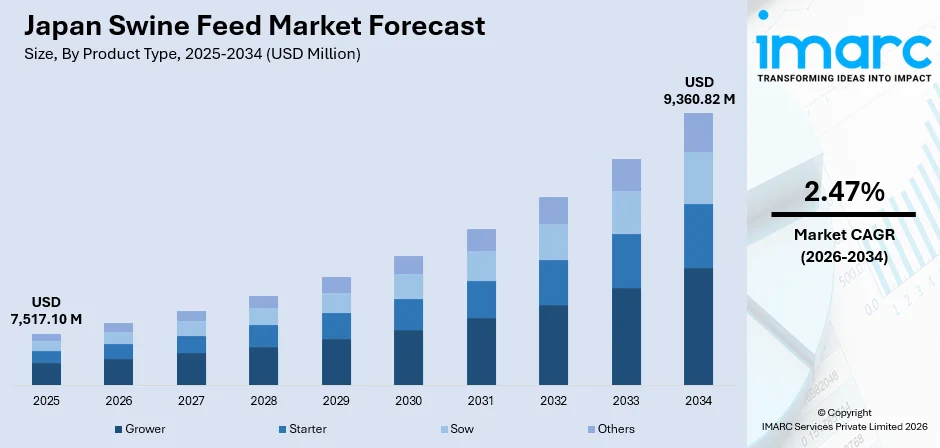
The Japan swine feed market size was valued at USD 7,517.10 Million in 2025 and is projected to reach USD 9,360.82 Million by 2034, growing at a compound annual growth rate of 2.47% from 2026-2034.
The Japan swine feed market is registering a steady growth with the increasing domestic demand for quality pork products and the adoption of advanced animal nutrition technology. The increasing preference for protein-rich foods and the modernization of pig farming facilities in the country are also contributing to the steady growth of the market. The shift towards precision feeding practices and the incorporation of scientifically designed compositions in the animal feed are also adding to the market's positive outlook.
Key Takeaways and Insights:
- By Product Type: Grower dominates the market with a share of 39.6% in 2025, owing to its critical role in maximizing feed conversion efficiency during the key growth phase of swine development. Increasing adoption of precision nutrition strategies by Japanese pig farmers is propelling grower feed consumption across commercial operations.
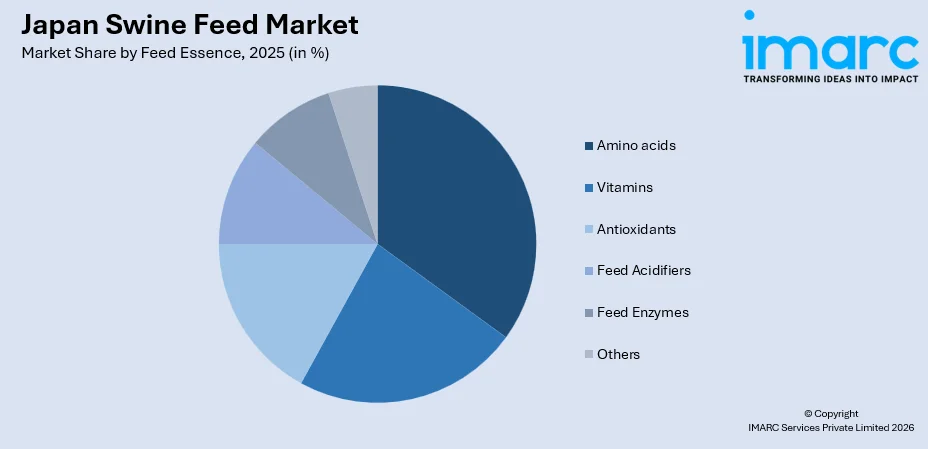
- By Feed Essence: Amino acids lead the market with a share of 28.4% in 2025. This dominance is driven by the essential function of amino acids in protein synthesis, muscle development, and overall swine health, with lysine and threonine being particularly vital in optimizing feed formulations across Japanese livestock operations.
- By Feed Additive Type: Nutritional feed additives represent the largest segment with a market share of 46.9% in 2025, reflecting the growing emphasis on balanced nutritional supplementation to enhance growth performance, immunity, and feed efficiency in swine production systems throughout Japan.
- By Region: Kanto Region represents the largest region with 27.3% share in 2025, driven by the concentration of large-scale swine farming operations and proximity to major consumer markets in the Tokyo metropolitan area, facilitating efficient feed distribution and procurement networks.
- Key Players: Key players drive the Japan swine feed market by expanding product portfolios, improving nutritional formulation technologies, and strengthening nationwide distribution. Their investments in research, precision feeding solutions, and partnerships with livestock producers boost productivity, accelerate adoption of advanced feed additives, and ensure consistent product availability across diverse farming segments.
To get more information on this market Request Sample
The Japan swine feed market is driven by a combination of structural and demand-related trends that are transforming the landscape of livestock feeding in Japan. The rising per capita meat consumption, especially pork, in Japan is creating a demand for scientifically developed feed products that can improve growth rates and meat quality. The Japan food safety regulatory framework requires strict quality standards for animal feed ingredients, and this is pushing manufacturers to develop high-quality feed products that are rich in essential nutrients, vitamins, and functional additives. The trend of consolidating pig farming operations from small family-owned farms to larger-scale operations is creating a demand for standardized compound feed products that can provide consistent nutritional benefits. The government’s initiative to cut the country’s dependence on imported feed by promoting rice-based feed production and recycling food waste is also diversifying the sources of feed ingredients. The increasing concern about the need for antibiotic-free meat production is fueling the use of alternative additives such as probiotics, prebiotics, and organic acidifiers, which is also expanding the market for innovative swine feed products in Japan.
Japan Swine Feed Market Trends:
Rising Adoption of Precision Feeding Technologies in Swine Operations
The Japan swine feed market is undergoing a major transition towards precision feeding technology that would allow the farmer to precisely target the nutritional needs of the individual animal or production stage. High-tech feeding systems with sensors and automated dispensing systems are being increasingly adopted in medium to large-scale pig farms to optimize feed usage and reduce wastage. This is particularly being adopted in the Kanto and Kyushu regions, where commercial farms are adopting digital monitoring systems to track the growth parameters of the animals in real-time, enabling them to make dynamic changes to the composition and quantity of the feed being supplied.
Growing Integration of Sustainable and Alternative Feed Ingredients
Japanese swine feed manufacturers are increasingly adopting sustainable and alternative ingredients in their formulation in response to environmental concerns and price fluctuations of raw materials. The use of byproducts of food processing, recycled food waste, and indigenous feed rice as partial substitutes for imported corn is gaining popularity in Japan. This is in line with the country’s sustainability strategy, MIDORI, which aims to achieve lower environmental impact in agricultural production. The use of insect proteins and algae nutrients as supplementary ingredients in swine feed formulation is further broadening the ingredient base for swine feed manufacturing.
Expanding Focus on Antibiotic-Free Feed Formulations
The Japan swine feed market is experiencing a notable transition toward antibiotic-free formulations as regulatory scrutiny intensifies and consumer demand for clean-label meat products grows. Feed manufacturers are developing sophisticated alternatives incorporating probiotics, prebiotics, organic acids, and phytogenic compounds that support gut health and disease resistance without relying on antimicrobial growth promoters. This shift is particularly evident in the premium pork segment where producers seek to differentiate their products through enhanced food safety credentials. The trend is accelerating innovation in functional feed additive development, positioning Japan as a leader in antibiotic-free swine nutrition across the region.
Market Outlook 2026-2034:
The Japan swine feed market is set to grow steadily throughout the forecast period, thanks to a stable domestic pork consumption structure and the ongoing improvement of pig farming infrastructure in the country. The trend of swine farming being consolidated into larger-scale commercial operations is also expected to boost the demand for high-quality compound feed products with optimized nutritional content. Improvements in the field of feed formulation science, such as the integration of functional additives and precision nutrition technologies, are also expected to improve the efficiency of feed use and the productivity of farm animals. Government policies aimed at encouraging the domestic production of feed ingredients and the recycling of food waste are also expected to create new opportunities for market participants. The market generated a revenue of USD 7,517.10 Million in 2025 and is projected to reach a revenue of USD 9,360.82 Million by 2034, growing at a compound annual growth rate of 2.47% from 2026-2034.
Japan Swine Feed Market Report Segmentation:
|
Segment Category |
Leading Segment |
Market Share |
|
Product Type |
Grower |
39.6% |
|
Feed Essence |
Amino Acids |
28.4% |
|
Feed Additive Type |
Nutritional Feed Additives |
46.9% |
|
Region |
Kanto Region |
27.3% |
Product Type Insights:
- Grower
- Starter
- Sow
- Others
Grower dominates with a market share of 39.6% of the total Japan swine feed market in 2025.
Grower feed holds the leading position in the Japan swine feed market owing to its indispensable role during the critical growth phase when pigs require optimized nutritional intake for maximum weight gain and feed conversion efficiency. Japanese pig farmers prioritize grower feed formulations that deliver balanced protein, energy, and essential micronutrient profiles to support rapid muscle development and skeletal growth. The country's expanding commercial swine operations continue to sustain consistent demand for growth-stage feed, reinforcing its dominant market position nationwide.
The dominance of grower feed is further reinforced by the structural characteristics of Japanese swine farming, where the majority of operations follow a farrow-to-finish model that necessitates large volumes of growth-stage nutrition. Feed manufacturers have responded by developing advanced grower formulations incorporating digestibility-enhancing enzymes and amino acid supplements that optimize nutrient absorption and reduce feed waste. The ongoing transition toward larger-scale farming operations across Japan is intensifying demand for standardized, high-performance grower feeds that deliver predictable outcomes in terms of daily weight gain and overall production efficiency.
Feed Essence Insights:
Access the comprehensive market breakdown Request Sample
- Vitamins
- Antioxidants
- Feed Acidifiers
- Feed Enzymes
- Amino Acids
- Others
Amino acids lead with a share of 28.4% of the total Japan swine feed market in 2025.
Amino acids lead the market with the highest share in the feed essence market due to their pivotal role in protein biosynthesis, muscle growth, and metabolism in pigs. Lysine, methionine, and threonine are the three most commonly used amino acids in Japanese swine feed, as they cannot be produced by the body and hence must be supplied through the diet. The extensive use of precise amino acid supplementation in commercial feed mills in Japan reflects their pivotal role in swine nutrition.
The unending supremacy of amino acids is reinforced by the increasing focus on the adoption of precision nutrition approaches that seek to optimize feed efficiency and reduce nitrogen excretion and environmental damage. Japanese feed manufacturers are using advanced fermentation technology to produce high-purity amino acid supplements with superior bioavailability and quality. The ban on the use of antibiotic growth promoters has also increased the importance of amino acids as functional feed ingredients that promote gut health, immune function, and growth performance in commercial swine production in Japan.
Feed Additive Type Insights:
- Zootechnical Feed Additives
- Sensory Feed Additives
- Nutritional Feed Additives
Nutritional feed additives exhibit a clear dominance with a 46.9% share of the total Japan swine feed market in 2025.
Nutritional feed additives hold the dominant position in the feed additive type segment, reflecting the emphasis Japanese swine producers place on delivering comprehensive nutritional supplementation that enhances growth performance and animal health. These additives encompass vitamins, minerals, amino acids, and essential fatty acids that address specific dietary deficiencies and optimize metabolic processes in swine. The country's steadily rising per capita meat consumption, particularly pork, is driving increased demand for nutritionally enriched feed formulations that support superior carcass quality and overall livestock productivity across commercial farming operations.
The sustained leadership of nutritional feed additives is underpinned by Japan’s stringent food safety regulations that mandate high-quality nutritional standards in livestock production. Feed manufacturers are developing sophisticated multi-component additive premixes that combine vitamins, trace minerals, and bioactive compounds in precisely calibrated ratios to support optimal swine development across different life stages. The growing consumer preference for premium-quality pork with enhanced marbling and flavor profiles is further incentivizing producers to invest in advanced nutritional additive programs that directly influence carcass quality and meat characteristics.
Regional Insights:
- Kanto Region
- Kansai/Kinki Region
- Central/Chubu Region
- Kyushu-Okinawa Region
- Tohoku Region
- Chugoku Region
- Hokkaido Region
- Shikoku Region
Kanto Region represents the leading region with a 27.3% share of the total Japan swine feed market in 2025.
The Kanto Region dominates the market share in Japan's swine feed sector because of its extensive commercial pig farming and its closeness to the main consumer markets situated in and near the Tokyo metropolitan area. The prefectures within the Kanto Region, including Ibaraki, Gunma, and Chiba, possess a significant population of pigs, resulting in a consistent need for compound feed products. The Kanto Region's historical status as one of the nation's two major pork-producing areas continues to bolster robust feed procurement across its vast array of pig farming enterprises.
The Kanto Region's dominance in the market is further strengthened by its advanced logistics infrastructure and the existence of substantial feed manufacturing plants that enhance effective supply chain management. The existence of extensive integrated pig farming enterprises in the Kanto Region has propelled the use of premium compound feed products that include sophisticated nutritional additives and precise feeding technology. The area's closeness to research institutions and agricultural tech centers has fostered innovation in feed formulation, enabling Kanto Region producers to take advantage of the newest developments in nutritional technology that enhance overall productivity and competitiveness.
Market Dynamics:
Growth Drivers:
Why is the Japan Swine Feed Market Growing?
Increasing Domestic Pork Consumption Driving Sustained Feed Demand
The Japan swine feed market is experiencing significant growth momentum fueled by the country’s steadily increasing pork consumption, which has become the most affordable and widely consumed meat protein alongside poultry. Japanese consumers are increasingly shifting their dietary preferences toward pork as rising beef prices make it a less accessible protein source, particularly during periods of sustained inflation. The country’s rich culinary tradition featuring pork-centric dishes such as tonkatsu, ramen, gyoza, and shabu-shabu continues to sustain robust household demand for fresh and processed pork products throughout the year. The foodservice sector, comprising restaurants, convenience stores, and institutional caterers, represents a major consumption channel that relies on consistent supplies of domestically produced and imported pork. This sustained consumer demand directly translates into higher requirements for quality swine feed that supports optimal animal growth, carcass weight, and meat quality attributes. Furthermore, the growing consumer awareness regarding food safety and traceability is encouraging pork producers to invest in premium feed formulations that meet stringent quality standards, thereby expanding the addressable market for scientifically engineered swine feed products across all segments.
Consolidation of Pig Farming Operations into Larger Commercial Enterprises
The structural change occurring in the pig farming industry in Japan, involving the consolidation of smaller family-owned pig farming businesses into larger commercial ventures, is proving to be a highly influential factor in the growth of the swine feed market. The reduction in the number of pig farms, due to the aging pig farmer population and difficulties in attracting younger successors to carry on the family business, has led to the remaining farms increasing their herd sizes to sustain the country’s total production. This phenomenon of consolidation is especially important, as it means that the larger farms demand standardized and commercially produced compound feed formulations, as opposed to individually formulated mixtures prepared in-house, thereby contributing to the growing demand for professionally formulated swine feed. Large meat producers are increasing the size of their company-owned pig farming businesses, incorporating sophisticated feeding systems and automated distribution networks that depend on high-quality compound feed supplies. The shift towards larger-scale production also facilitates the efficient implementation of precision nutrition technologies, specialized feed additive programs, and stage-specific feeding approaches that can improve overall production performance.
Government Initiatives Promoting Feed Self-Sufficiency and Innovation
The Japanese government’s proactive policy measures aimed at reducing the country’s heavy dependence on imported feed ingredients are creating significant growth opportunities within the swine feed market. In response, the Ministry of Agriculture, Forestry and Fisheries has implemented comprehensive programs to promote domestic feed rice production, incentivize the utilization of food processing byproducts as feed ingredients, and support research into alternative protein sources including insect meal and algae-based nutrients. The Compound Feed Price Stabilization System provides direct compensation payments to livestock producers during periods of elevated feed costs, ensuring operational viability and maintaining demand for compound feed products. Additionally, the MIDORI Strategy for sustainable agriculture is driving innovation in feed formulation by encouraging the development of environmentally responsible feed solutions that reduce greenhouse gas emissions from livestock production. These government-backed initiatives are stimulating investment in feed manufacturing infrastructure, research and development activities, and supply chain optimization programs that collectively contribute to sustained market expansion.
Market Restraints:
High Dependency on Imported Raw Materials Exposing Market to Price Volatility
The Japan swine feed market is also expected to experience a substantial level of restraining factors owing to the massive reliance of the country on imported feed ingredients such as corn, soybean meal, and wheat, which are the major constituents of compound feed formulations. World commodity price volatility, further fueled by geopolitical events, the devaluation of the Japanese yen, and supply chain disruptions, affect feed production costs.
Declining Number of Pig Farming Operations Limiting Market Expansion
The ongoing trend of a reduced total number of pig farming operations in Japan, due to the aging demographic of pig farmers, is a structural impediment to market expansion. The lack of appeal to the younger generation to pursue swine farming as an occupation is resulting in a reduced total number of operating units, although the trend of consolidation is mitigating this impact by increasing the average herd size.
Rising Production Costs Compressing Farmer Profitability and Feed Expenditure
The rising production costs in the swine production chain, including feed, labor, energy, and veterinary costs, are currently hindering farmer profitability and their ability to invest in high-quality feed. The current high prices of compound feeds, which are higher than the prices before the recent global commodity market disruptions, are particularly challenging for small and medium-scale swine farmers who do not have the economies of scale to easily absorb the rising costs.
Competitive Landscape:
The swine feed market in Japan features a moderately consolidated competitive landscape, marked by both established domestic producers and international feed companies functioning via local subsidiaries and distribution partnerships. The market competes among themselves based on the quality of feed formulations, nutritional content, pricing, and the extent of their distribution channels in the primary swine-producing regions. Key stakeholders are significantly investing in research and development to create innovative feed additive technologies, tailored nutrition solutions, and eco-friendly ingredient alternatives that will differentiate their product offerings. Collaborative partnerships between feed manufacturers and pig producers are increasingly common, facilitating the creation of tailored swine feed solutions aligned with specific production objectives. Additionally, several niche additive manufacturers exist in the market that provide functional components like amino acids, enzymes, probiotics, and organic acidifiers to animal feed manufacturers.
Recent Developments:
- In December 2025, Japan authorized the importation of chilled and processed pork from the African Swine Fever containment zone, which is located close to Barcelona, Spain. The head of Catalonia's regional agriculture department confirmed the decision, which demonstrated Japan's strategic strategy to diversifying its import sources of pork while upholding stringent food safety regulations to guarantee a steady domestic supply.
Japan Swine Feed Market Report Coverage:
|
Report Features |
Details |
|
Base Year of the Analysis |
2025 |
|
Historical Period |
2020-2025 |
|
Forecast Period |
2026-2034 |
|
Units |
Million USD |
|
Scope of the Report |
Exploration of Historical Trends and Market Outlook, Industry Catalysts and Challenges, Segment-Wise Historical and Future Market Assessment:
|
|
Product Types Covered |
Grower, Starter, Sow, Others |
|
Feed Essences Covered |
Vitamins, Antioxidants, Feed Acidifiers, Feed Enzymes, Amino Acids, Others |
|
Feed Additive Types Covered |
Zootechnical Feed Additives, Sensory Feed Additives, Nutritional Feed Additives |
|
Regions Covered |
Kanto Region, Kansai/Kinki Region, Central/Chubu Region, Kyushu-Okinawa Region, Tohoku Region, Chugoku Region, Hokkaido Region, Shikoku Region |
|
Customization Scope |
10% Free Customization |
|
Post-Sale Analyst Support |
10-12 Weeks |
|
Delivery Format |
PDF and Excel through Email (We can also provide the editable version of the report in PPT/Word format on special request) |
Frequently Asked Questions About the Japan Swine Feed Market Report
The Japan swine feed market size was valued at USD 7,517.10 Million in 2025.
The Japan swine feed market is expected to grow at a compound annual growth rate of 2.47% from 2026-2034 to reach USD 9,360.82 Million by 2034.
Grower dominated the market with a share of 39.6%, owing to its essential role in supporting the critical growth phase of swine development where feed conversion efficiency and daily weight gain are maximized across commercial farming operations.
Key factors driving the Japan swine feed market include increasing domestic pork consumption, consolidation of pig farming operations, government initiatives promoting feed self-sufficiency, and growing adoption of precision nutrition technologies.
Major challenges include high dependency on imported raw materials exposing the market to price volatility, declining number of pig farming operations due to aging demographics, rising production costs compressing farmer profitability, currency depreciation increasing import expenses, and limited domestic feed grain production capacity.
Need more help?
- Speak to our experienced analysts for insights on the current market scenarios.
- Include additional segments and countries to customize the report as per your requirement.
- Gain an unparalleled competitive advantage in your domain by understanding how to utilize the report and positively impacting your operations and revenue.
- For further assistance, please connect with our analysts.
 Request Customization
 Speak to an Analyst
 Request Brochure
 Inquire Before Buying
Benefits of Customization
- Personalize this research
- Triangulate with your data
- Get data as per your format and definition
- Gain a deeper dive into a specific application, geography, customer, or competitor
- Any level of personalization
Get in Touch With Us
UNITED STATES
Phone: +1-201-971-6302
INDIA
Phone: +91-120-433-0800
UNITED KINGDOM
Phone: +44-753-714-6104
Email: [email protected]
Client Testimonials




.webp)




.webp)













Related Reports

Choose your plan
*Please note that the prices mentioned below are starting prices for each bundle type. Kindly contact our team for further details.*
Single User License
- 1 User License, Access on 2 Devices
- PDF Report + Excel Dataset (Password Protected)
- Lifetime Access
- No Printing Rights
- 10% Free Report Customization
- 10–12 Weeks of Analyst Support
Five User License
- Access for 5 Users, 2 Devices per User
- PDF Report + Excel Dataset (Password Protected)
- Lifetime Access
- Dedicated Account Manager
- 12–14 Weeks of Analyst Support
- No Printing Rights
- 15% Free Report Customization
- 25% Discount on Your Next Purchase
Corporate User License
- Unlimited User Access (Within Your Organization)
- PDF Report + Excel Dataset
- Lifetime Access
- Dedicated Account Manager
- 14–20 Weeks of Analyst Support
- No Printing Rights
- 20% Free Report Customization
- 30% Discount on Your Next Purchase
Essential Insights
What's included:
3 reports
- Lifetime Access
- PDF Reports
- Excel Datasets
- 2 Weeks of Free Analyst Support
- 2 User Licenses
- Access on 2 Devices
- Printing Rights
- Complimentary PowerPoint (PPT) Version
- Complimentary License Upgrade
Professional Access
What's included:
5 reports
- Lifetime Access
- PDF Reports
- Excel Datasets
- 8 Weeks of Free Analyst Support
- 2 User Licenses
- Access on 2 Devices
- Printing Rights
- Complimentary PowerPoint (PPT) Version
- Complimentary License Upgrade
Business Advantage
What's included:
8 reports
- Lifetime Access
- PDF Reports
- Excel Datasets
- 14 Weeks of Free Analyst Support
- 2 User Licenses
- Access on 2 Devices
- Printing Rights
- Complimentary PowerPoint (PPT) Version
- Complimentary License Upgrade
Enterprise Intelligence
What's included:
10 reports
- Lifetime Access
- PDF Reports
- Excel Datasets
- 20 Weeks of Free Analyst Support
- 2 User Licenses
- Access on 2 Devices
- Printing Rights
- Complimentary PowerPoint (PPT) Version
- Complimentary License Upgrade