
Japan Toys Market Size, Share, Trends and Forecast by Product Type, Age Group, Sales Channel, and Region, 2026-2034
Japan Toys Market Size, Share, Trends & Forecast (2026-2034)
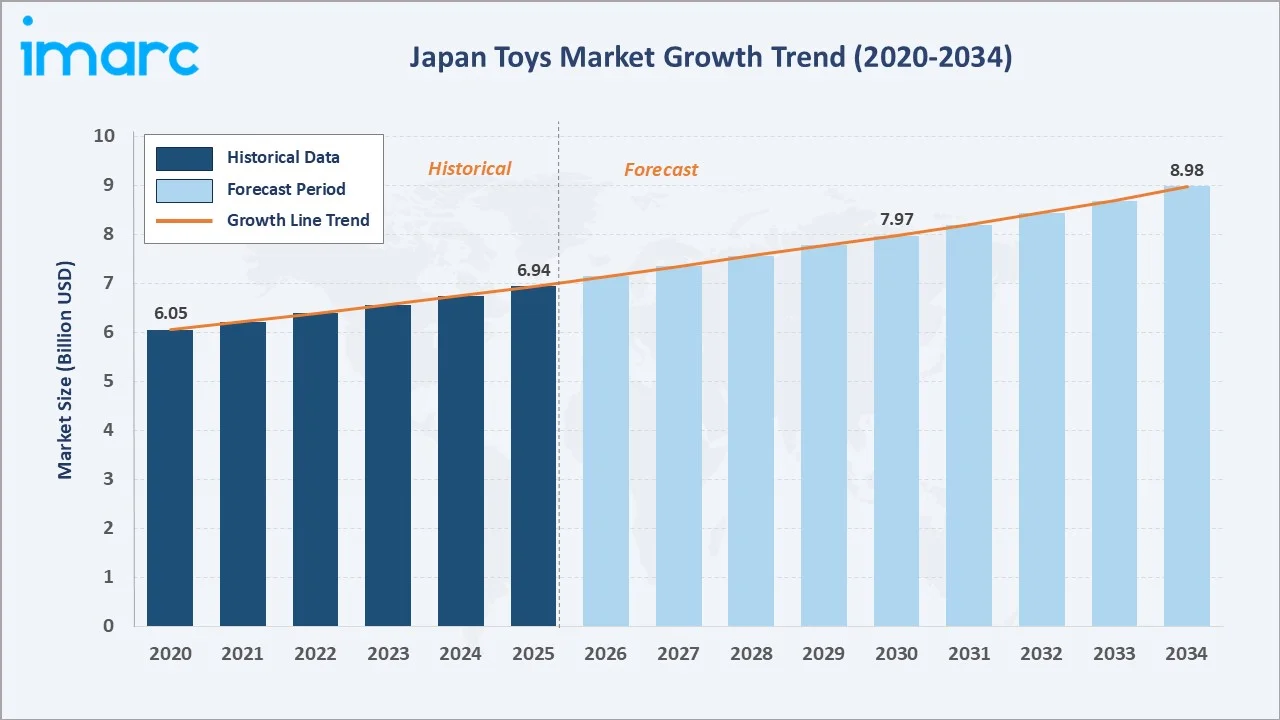
The Japan toys market grew from USD 6.94 Billion in 2025 to USD 7.19 Billion in 2026 and is projected to reach USD 8.98 Billion by 2034, exhibiting a growth rate (CAGR) of 2.81% during 2026-2034. The market is driven by the growing demand for educational toys and play-based learning tools among the masses, alongside the introduction of a diverse array of interactive product variants and the integration of cutting-edge technologies in toy design and manufacturing.
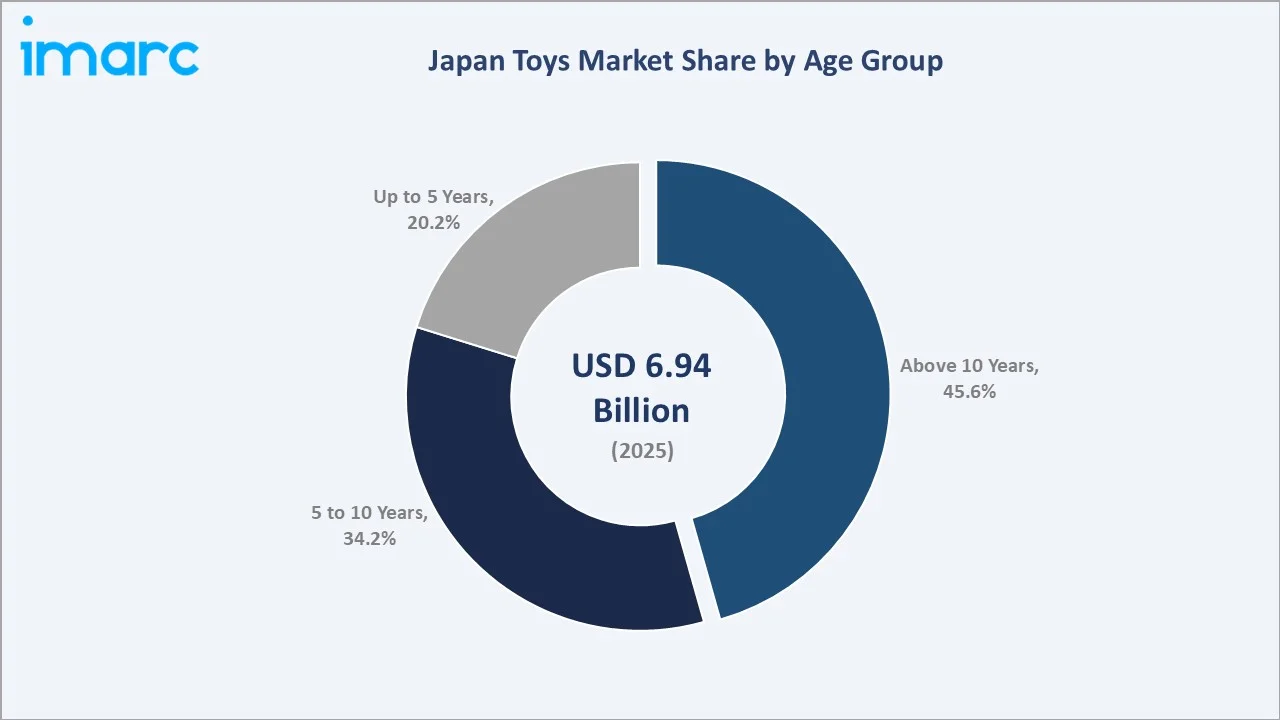
Above 10 Years dominates the age group segment at 45.6% in 2025, reflecting Japan's strong otaku and adult-collector culture and the enduring popularity of franchise-linked collectible merchandise. Online Stores lead the sales channel segment at 37.5%, supported by rising e-commerce penetration and dedicated franchise platforms, while Kanto Region leads regionally at 35.8%, anchored by Tokyo's dense retail, licensing, and media infrastructure.
Market Snapshot
|
Metric |
Value |
|
Base Year Market Size (2025) |
USD 6.94 Billion |
| Market Size (2026) | USD 7.19 Billion |
|
Forecast Market Size (2034) |
USD 8.98 Billion |
|
CAGR (2026-2034) |
2.81% |
|
Base Year |
2025 |
|
Historical Period |
2020-2025 |
|
Forecast Period |
2026-2034 |
|
Dominant Age Group |
Above 10 Years (45.6%, 2025) |
|
Dominant Sales Channel |
Online Stores (37.5%, 2025) |
|
Leading Region |
Kanto Region (35.8%, 2025) |
The market expanded from an estimated USD 6.05 Billion in 2020 to USD 6.94 Billion in 2025 and an estimated USD 7.19 Billion in 2026, more than recovering from pandemic-era retail disruption as consumer discretionary spending normalized and toy retail activity strengthened across Japan. The market is anchored at an estimated USD 7.97 Billion in 2030 and is forecast to reach USD 8.98 Billion by 2034, with growth building steadily rather than accelerating sharply, consistent with a mature, demographically constrained consumer market.
To get more information on this market, Request Sample
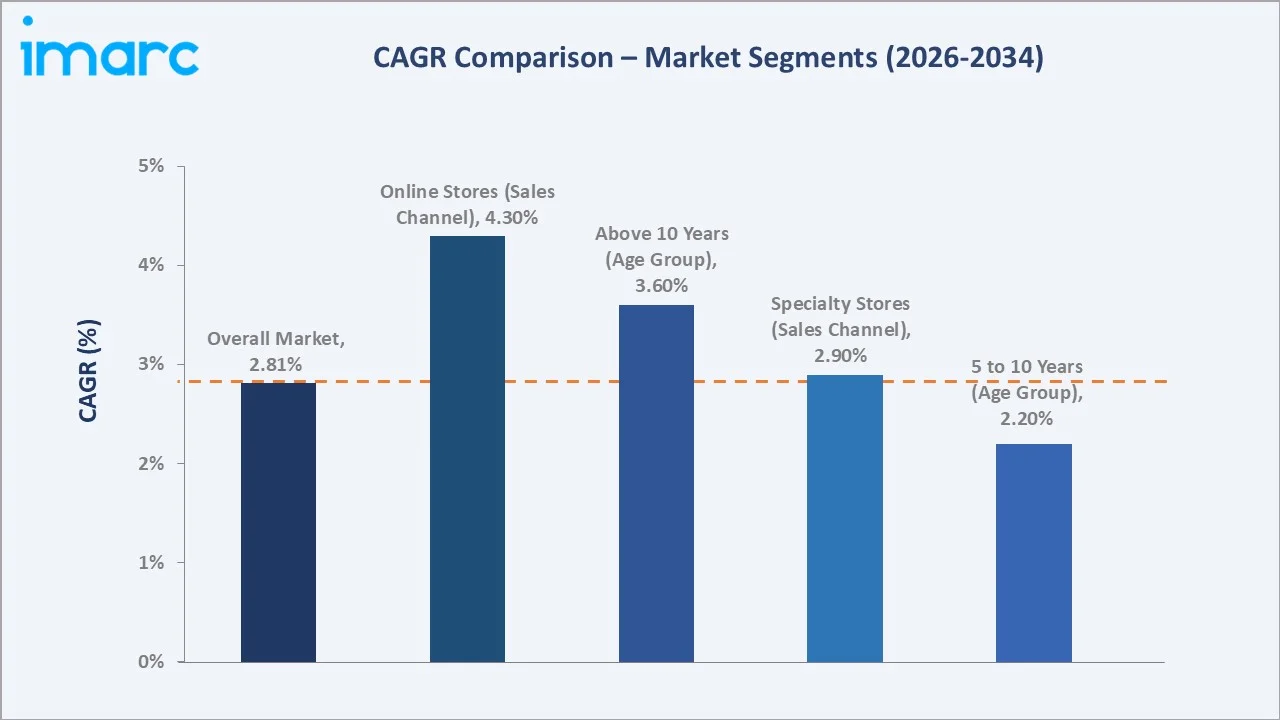
Online Stores and the Above 10 Years age group are set to grow fastest through 2034, outpacing the overall market CAGR of 2.81% as e-commerce penetration deepens and the adult-collector segment continues to expand. Specialty Stores also grow above the market average as curated, collector-focused retail experiences gain traction, while the youngest age bands and traditional offline channels grow more slowly amid Japan's shrinking child population.
Executive Summary
The Japan toys market expanded from USD 6.94 Billion in 2025 to an estimated USD 7.19 Billion in 2026, representing one of Asia's most mature and culturally distinctive toy markets, underpinned by the fundamental strength of domestic anime, manga, and gaming intellectual property. The toy product in Japan performs a role extending well beyond childhood play, functioning as collectible art, lifestyle merchandise, and franchise memorabilia across a broad, multi-generational consumer base. The market is projected to reach USD 8.98 Billion by 2034.
Above 10 Years at 45.6% dominates by capturing Japan's expansive adult-collector and otaku demographic, which sustains premium demand for figures, model kits, and franchise merchandise well beyond conventional childhood age brackets. Online Stores at 37.5% leads through e-commerce convenience, wide product availability, and franchise-specific platforms. Kanto Region at 35.8% leads nationally through Tokyo's retail density, licensing concentration, and proximity to Japan's largest toy manufacturers and flagship stores.
Key Market Insights
|
Insight |
Data |
|
Dominant Age Group |
Above 10 Years - 45.6% share (2025) |
|
Dominant Sales Channel |
Online Stores - 37.5% share (2025) |
|
Leading Region |
Kanto Region - 35.8% share (2025) |
|
Market Opportunity |
AR/VR-enabled smart toys; sustainable materials; collector figures; app-connected products |
Key Analytical Observations Supporting The Above Data:
- Above 10 Years at 45.6%: This segment dominates as Japan's expanding adult-collector base drives sustained demand for premium figures, model kits, and franchise merchandise. Its widespread appeal across otaku communities and casual collectors alike, reinforced by high-detail product lines from major franchises such as Gundam, further strengthens segment demand.
- Online Stores at 37.5%: The online channel dominates due to the convenience of e-commerce, wide product availability, and the increasing digital literacy of Japanese consumers. Major platforms such as Amazon Japan and Rakuten, alongside specialized sites like Premium Bandai, cater directly to collector and franchise-driven demand for exclusive merchandise.
- Kanto Region at 35.8%: The Kanto region dominates the Japan toys market due to its large-scale retail infrastructure and strong consumer demand, led primarily by Tokyo. The region's dense concentration of flagship stores, licensing headquarters, and manufacturer offices generates substantial demand across all toy categories.
Japan Toys Market Overview
The Japan toys market encompasses the design, manufacture, licensing, and distribution of playthings across all age groups, including action figures, building sets, dolls, games and puzzles, sports and outdoor toys, plush toys, and collectible merchandise tied to domestic anime, manga, and gaming franchises. Toys in this market range from mass-market children's products to premium, limited-edition collectibles targeted at adult enthusiasts.
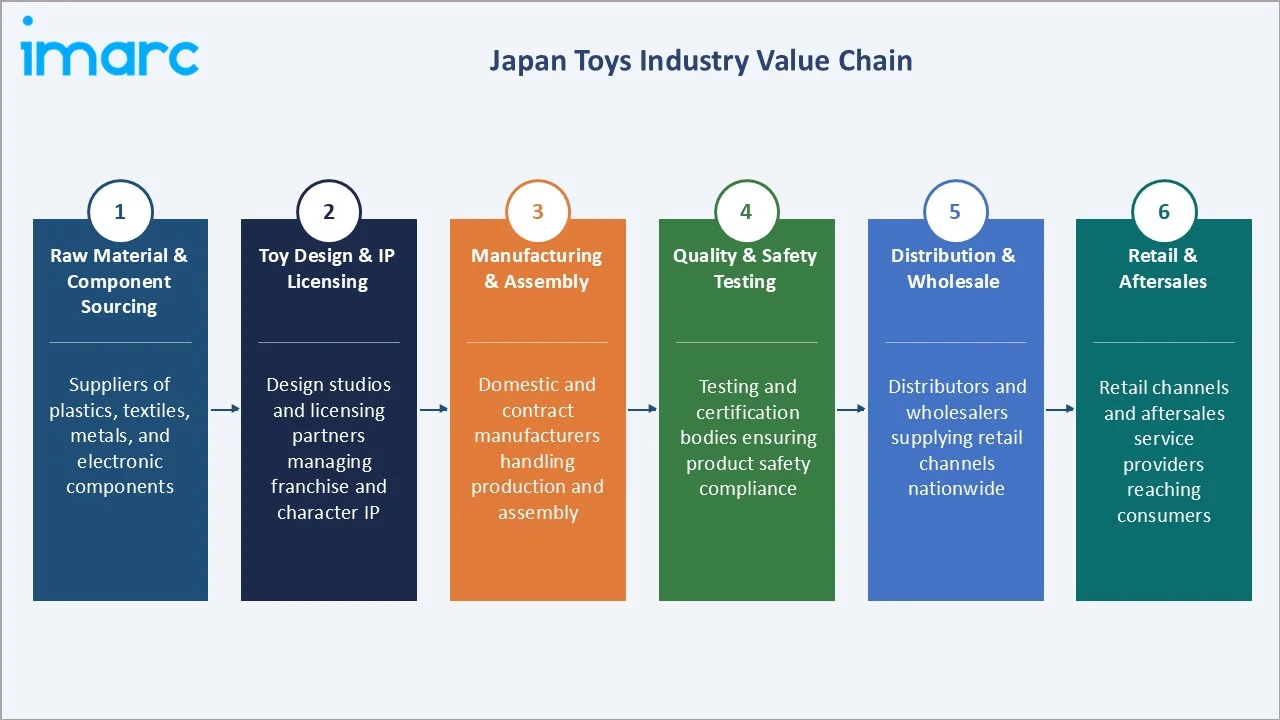
The ecosystem integrates IP and licensing studios, raw-material and component suppliers, domestic and contract manufacturers, distributors and wholesalers, and online and offline retail channels, all operating under the safety and quality standards set by Japan's Toy Association ST Mark certification system. Macroeconomic factors shaping the market include Japan's demographic structure, disposable income trends, urbanization, and the country's globally influential entertainment and licensing industries.
Market Dynamics
To evaluate market opportunities, Request Sample
Market Drivers
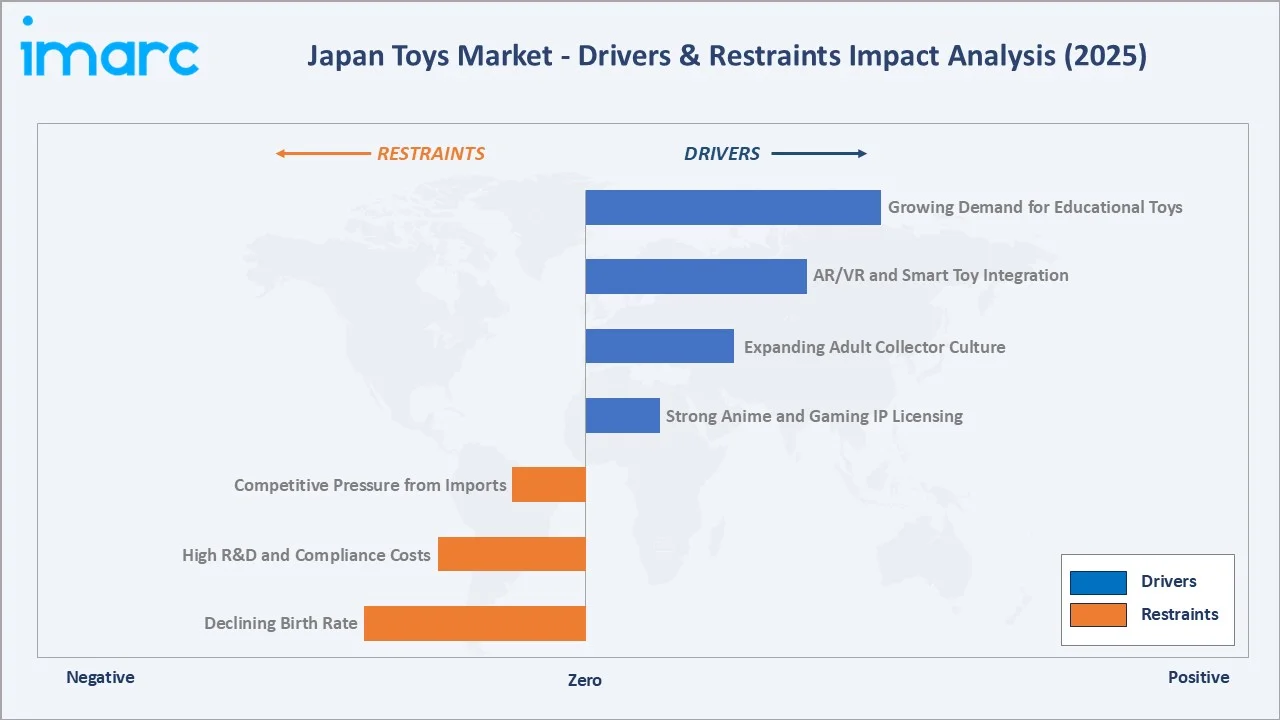
- Growing Demand for Educational Toys: Rising parental focus on cognitive and developmental value is driving demand for STEM and play-based learning toys. Manufacturers are responding with a diverse array of interactive product variants that combine entertainment with skill-building, encouraging wider adoption of educational toy lines across the Up to 5 Years and 5 to 10 Years age brackets.
- AR/VR and Smart Toy Integration: The integration of augmented reality, companion mobile applications, and interactive electronics is enhancing engagement and creating recurring digital touchpoints beyond the initial purchase. This technology-forward approach is attracting both technology-oriented children and adult hobbyists seeking richer, more immersive play experiences.
- Expanding Adult Collector Culture: Japan's otaku and collector community is fueling strong demand for premium figures and model kits. Franchises such as Gundam have recorded record-high net sales driven by adult collectors, validating manufacturers' strategic focus on high-detail, premium-priced product lines aimed squarely at this demographic.
- Strong Anime and Gaming IP Licensing: Popular franchises spanning anime, manga, and video games, including long-running properties tied to Pokémon, Gundam, and Hello Kitty, continue to generate consistent cross-category merchandise demand. This IP-driven demand diversifies toy sales beyond simple play items into lifestyle and collectible products.
Market Restraints
- Declining Birth Rate: Japan's persistently low birth rate is directly shrinking the core child population, constraining volume growth in traditional play-category segments. This demographic pressure is forcing manufacturers to diversify their portfolios toward adult and family-oriented products to sustain long-term growth.
- High R&D and Compliance Costs: Rigorous ST Mark safety-testing requirements and continuous product-development costs raise entry barriers for new product lines, particularly for smaller domestic manufacturers competing against larger, better-capitalized conglomerates with established compliance infrastructure.
- Competitive Pressure from Imports: Low-cost imported toys and expanding global multinationals such as Hasbro, Mattel, and Lego intensify pricing pressure on domestic manufacturers, requiring continuous innovation and brand differentiation to defend market share and profitability.
Market Opportunities
- Sustainable Materials and Packaging: Adoption of biodegradable plastics, recycled materials, and eco-friendly packaging is becoming a defining industry trend, exemplified by Bandai Namco's Plastic Environmental Consideration Policy and long-standing Gunpla Recycling Project, which align product design with Japan's environmental policy direction.
- Digital and App-Connected Toys: Expanding AR/VR and IoT-enabled toy categories present significant opportunities for manufacturers to differentiate through interactive, tech-forward product design that attracts technology-accustomed younger generations while opening new premium price points.
Market Challenges
- Demographic Headwinds: A persistently shrinking child population is forcing manufacturers to diversify product portfolios toward adult, collector, and family-oriented categories to maintain overall revenue growth, adding complexity to long-term retail planning and store-format decisions.
- Intense Competitive Landscape: Domestic manufacturers face sustained pressure from global toy multinationals expanding their localized Japan product offerings, requiring sustained investment in innovation, sustainability, and franchise collaboration to preserve market share and profitability.
Emerging Market Trends
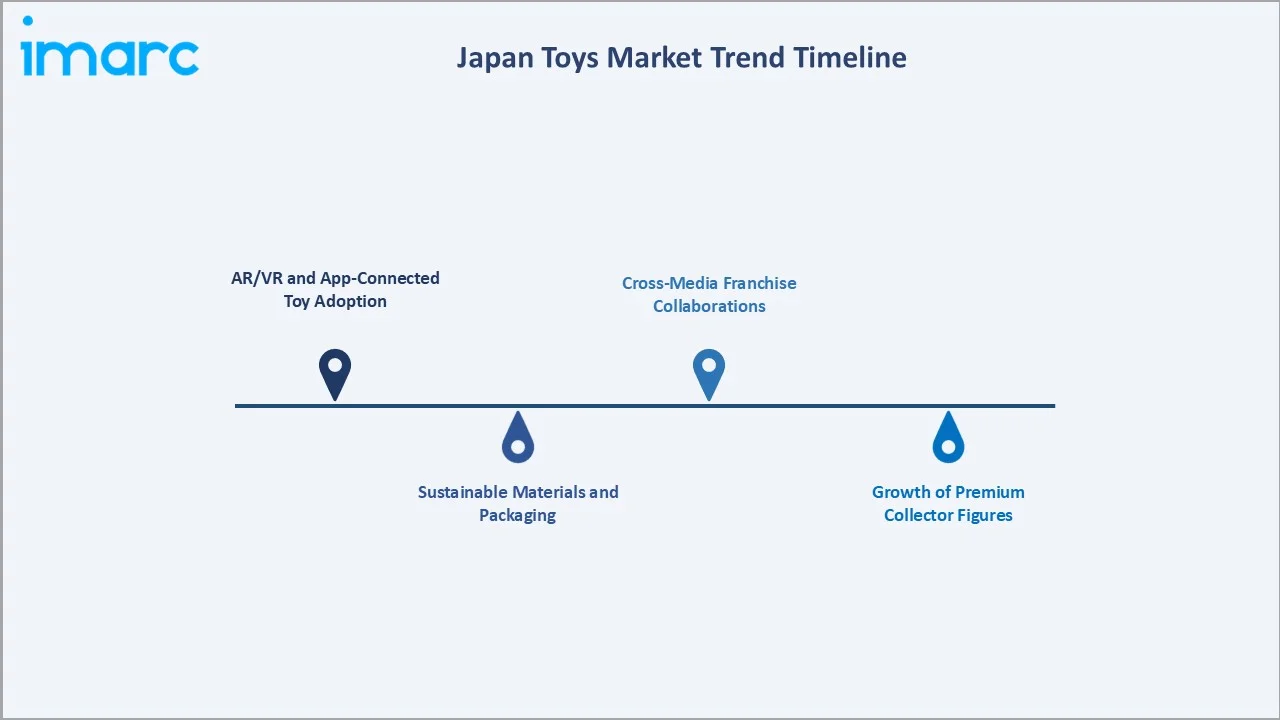
1. AR/VR and App-Connected Toy Adoption
Toy makers are integrating augmented reality and companion mobile applications into core product lines, enhancing interactivity and creating recurring digital engagement alongside physical play. This shift toward connected, app-enabled toys is reshaping product roadmaps across both children's and collector-oriented categories, as brands seek to extend engagement well beyond the point of purchase.
2. Sustainable Materials and Packaging
Sustainability is becoming a defining industry trend, with manufacturers adopting biodegradable plastics, recycled materials, and eco-friendly packaging. Bandai Namco's Plastic Environmental Consideration Policy, and its long-standing Gunpla Recycling Project illustrate how leading players are re-engineering designs to minimize waste while maintaining durability and safety standards.
3. Growth of Premium Collector Figures
Premium collectible figures and model kits linked to anime and gaming franchises are commanding increasingly higher price points, supported by a loyal and growing adult-collector base. High-detail Gunpla model kits and limited-edition figure releases continue to validate manufacturers' strategic focus on premium, collector-first product lines.
4. Cross-Media Franchise Collaborations
Toy launches increasingly align with anime, gaming, and streaming releases, extending franchise lifecycles and driving coordinated merchandise demand across categories. In December 2024, an Evangelion anime tie-in with McDonald's Japan introduced transforming fast-food toy robots through a lottery system, illustrating how cross-media collaborations continue to generate novel, high-engagement product formats.
Industry Value Chain Analysis
The Japan toys value chain spans raw material and component sourcing, product design and IP licensing, manufacturing and assembly, quality and safety testing, distribution and wholesale, and retail and aftersales, with strong emphasis on franchise and licensing integration at every stage. Domestic production is concentrated in high-end collectibles and character-based merchandise tied to domestically created IP, while the broader mass-market segment remains substantially import-dependent.
|
Stage |
Key Participants |
|
Raw Material & Component Sourcing |
Suppliers of plastics, textiles, metals, and electronic components |
|
Toy Design & IP Licensing |
Design studios and licensing partners managing franchise and character IP |
|
Manufacturing & Assembly |
Domestic and contract manufacturers handling production and assembly |
|
Quality & Safety Testing |
Testing and certification bodies ensuring product safety compliance |
|
Distribution & Wholesale |
Distributors and wholesalers supplying retail channels nationwide |
|
Retail & Aftersales |
Retail channels and aftersales service providers reaching consumers |
The toy design and IP licensing stage is the value chain's most commercially critical tier, as franchise strength directly determines merchandise demand across the manufacturing and retail stages. The quality and safety testing stage is also central to consumer trust, with the domestic ST Mark certification system providing a rigorous, Japan-specific benchmark for physical and chemical product safety.
Technology Landscape in the Japan Toys Industry
AR/VR-Enabled Smart Toys
Augmented and virtual reality features are being embedded into mainstream toy lines, offering immersive play experiences that blend physical products with digital content. This technology enables longer engagement cycles, compact interactive designs, and improved personalization, making AR/VR-enabled toys increasingly attractive to both children and adult hobbyists seeking richer play experiences.
App-Connected and IoT Toys
Companion mobile applications and IoT connectivity enable personalized, evolving play experiences, strengthening brand engagement well beyond the initial purchase. In April 2024, Takara Tomy introduced an accessibility-focused driving game using voice-guided prompts, illustrating how app-connected features are also being applied to expand inclusivity and broaden the addressable toy-consumer base.
Digital Design in Collectible Figures
Advanced 3D modeling and digital sculpting tools are improving design precision and production efficiency for high-detail collectible figures and model kits. Their compatibility with premium, limited-edition collector releases is accelerating innovation cycles and supporting faster time-to-market for franchise-tied merchandise.
Market Segmentation Analysis
The report covers the following segments:
|
Segment Category |
Leading Segment |
Market Share |
Year |
|
Product Type |
🔒 |
🔒 |
2025 |
|
Age Group |
Above 10 Years |
45.6% |
2025 |
|
Sales Channel |
Online Stores |
37.5% |
2025 |
|
Region |
Kanto Region |
35.8% |
2025 |

By Age Group
Above 10 Years leads at 45.6% in 2025, encompassing Japan's expansive adult-collector and otaku demographic, the most commercially significant and highest-value consumer category in the Japan toys market. This segment's above-market growth trajectory reflects the compounding strength of anime, manga, and gaming IP tied to premium figures and model kits.
To access detailed market analysis, Request Sample
5 to 10 Years follows at 34.2%, driven by core character-merchandise, building sets, and interactive-toy demand among primary-school-age children. Up to 5 Years at 20.2% represents the educational and developmental toy category, capturing early-learning and play-based cognitive-development products aimed at Japan's youngest consumers.
By Sales Channel
Online Stores lead at 37.5% in 2025, supported by e-commerce convenience, wide product availability, and the increasing digital literacy of Japanese consumers. Major online retailers such as Amazon Japan and Rakuten, alongside specialized franchise platforms like Premium Bandai, dominate this space, offering a wide variety of toys ranging from traditional items to the latest interactive and collectible products.
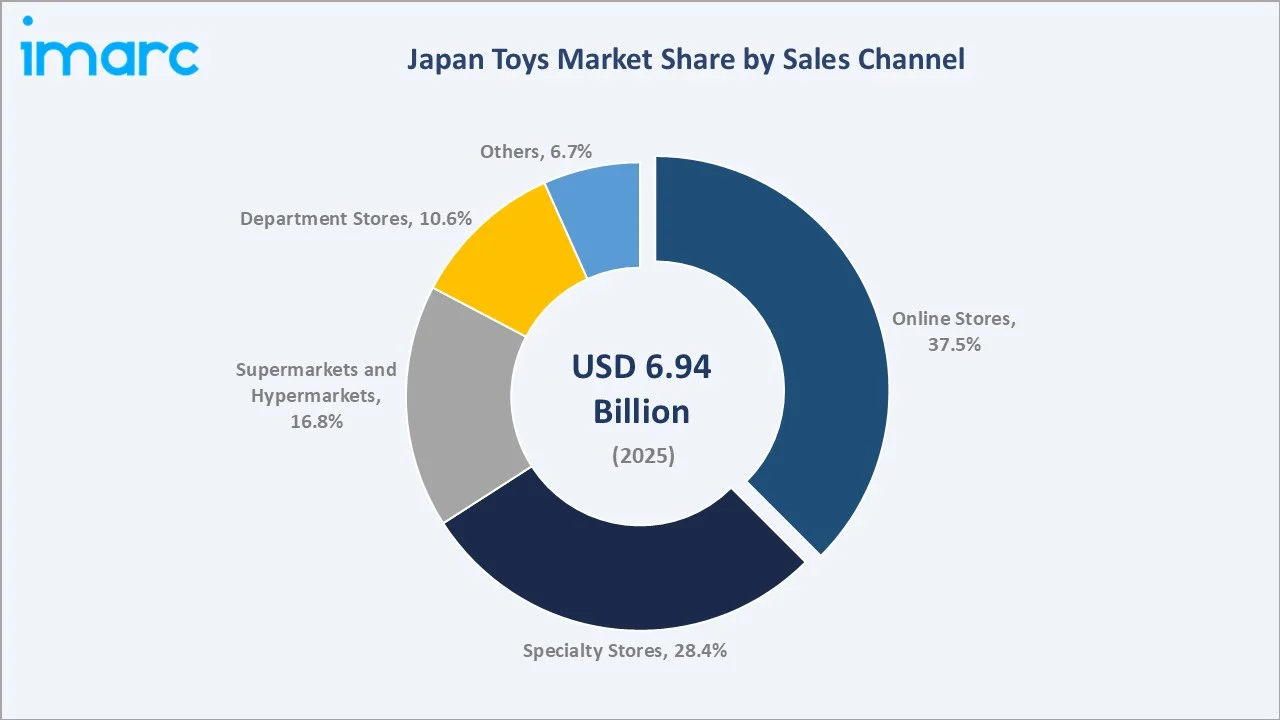
Specialty Stores hold 28.4% through curated, collector-focused retail experiences and franchise-specific storefronts, while Supermarkets and Hypermarkets at 16.8% and Department Stores at 10.6% continue to serve mainstream family purchases and gifting occasions; Others, including convenience stores and event-based sales, account for the remaining 6.7%.
Regional Market Insights
|
Region |
Share (2025) |
Key Characteristics |
|
Kanto Region |
35.8% |
Driven by high population density, strong retail infrastructure, and concentrated media presence |
|
Kinki Region |
18.4% |
Supported by a large urban consumer base and well-established retail networks |
|
Central/Chubu Region |
15.2% |
Driven by steady family and educational toy demand across the region |
|
Kyushu-Okinawa Region |
9.4% |
Supported by growing online retail penetration and expanding store presence |
|
Tohoku Region |
7.6% |
Driven by steady demand across family and educational toy categories |
|
Chugoku Region |
5.8% |
Supported by moderate growth across regional retail networks |
|
Hokkaido Region |
4.5% |
Driven by seasonal demand and gift-purchase activity through retail stores |
|
Shikoku Region |
3.3% |
Reflects steady demand through specialty and online retail channels |
Kanto Region, at 35.8%, leads through Tokyo's unmatched retail concentration, its proximity to major licensors and manufacturer headquarters, and its role as Japan's primary media and entertainment hub. Kinki Region, at 18.4%, follows on Osaka's strong urban retail base and the region's blend of commercial density and cultural tourism.
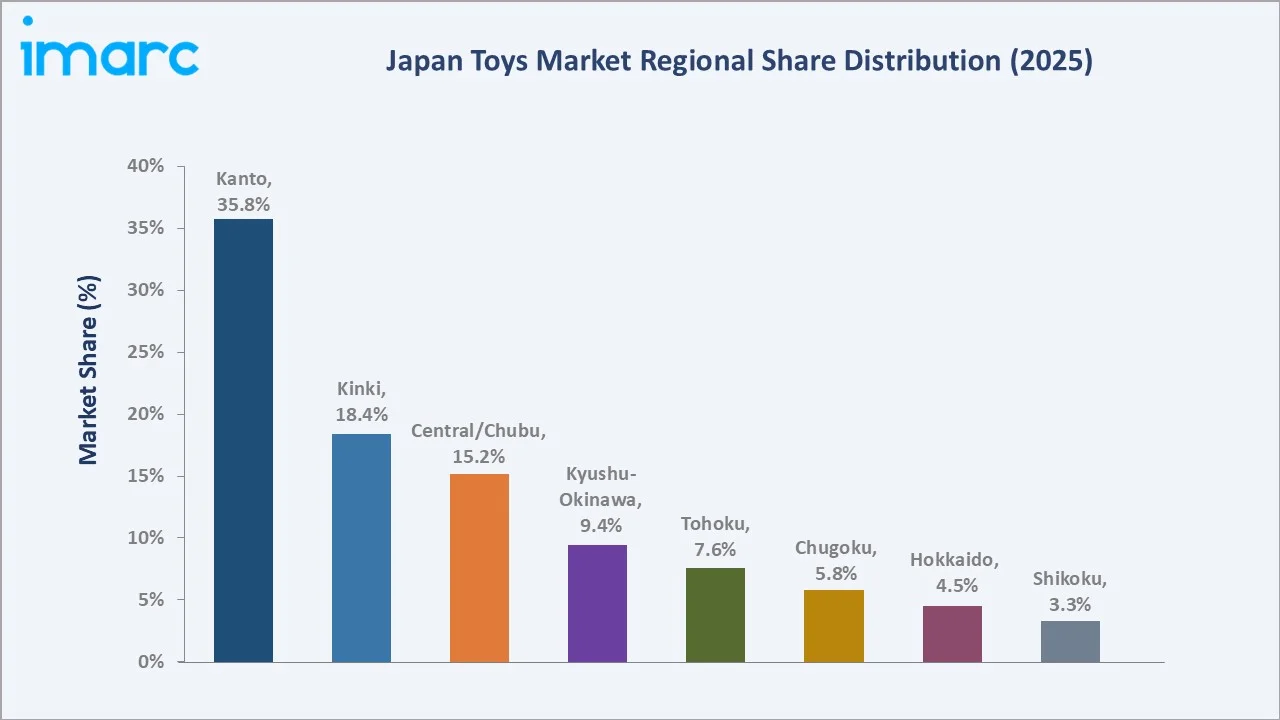
Central/Chubu Region, at 15.2%, reflects Nagoya's industrial and family-retail base, while Kyushu-Okinawa, at 9.4%, benefits from growing specialty and online retail penetration. Tohoku, Chugoku, Hokkaido, and Shikoku collectively represent Japan's remaining regional toy retail base, together contributing 21.2% of national market share through steady family, tourism, and specialty-store demand.
Competitive Landscape
The Japan toys market competitive landscape is highly competitive, with global and domestic brands vying for market leadership. It features three distinct competitive tiers: major domestic conglomerates with deep IP portfolios and vertically integrated operations, specialized niche manufacturers focused on premium collectibles, and global toy multinationals maintaining localized product lines within Japan.
|
Company Name |
Key Products |
Market Position |
Core Strength |
|
Bandai Namco Holdings Inc. |
Gundam, Gunpla Model Kits |
Market Leader |
Bandai Namco Holdings Inc. holds the industry's strongest anime and gaming IP portfolio. |
|
TOMY |
Toy Cars, Toy Train, Doll Toys, Educational toys and learning toys, Robot toys, Trading card game (TCG) toys, Stuffed toys, Play kitchen toys, Communication toys, Battle toys |
Market Leader |
Tomy combines technology-integrated design with broad age-group appeal. |
|
SANRIO CO., LTD. |
Hello Kitty Merchandise, My Melody, Little Twin Stars, Kuromi, Marumofubiyori |
Strong Challenger |
Sanrio leverages lifestyle-brand integration across toy and merchandise categories. |
|
EPOCH |
Sylvanian Families, Aquabeads, Pati-school, SUPER MARIO, minions |
Niche Leader |
Epoch anchors stable, long-tail evergreen product franchises. |
|
Good Smile Company |
Nendoroid, Figma, Scale Figures, Mecha Smile, POP UP PARADE, Harmonia Series |
Niche Leader |
Good Smile Company leads the premium collectible figure segment. |
|
Medicom Toy Corporation |
Be@rbrick Collectibles |
Niche Player |
Medicom Toy Corporation specializes in designer and collector-driven collectibles. |
Key players include Bandai Namco Holdings Inc., TOMY, SANRIO CO., LTD., EPOCH, Good Smile Company, Medicom Toy Corporation, and others.
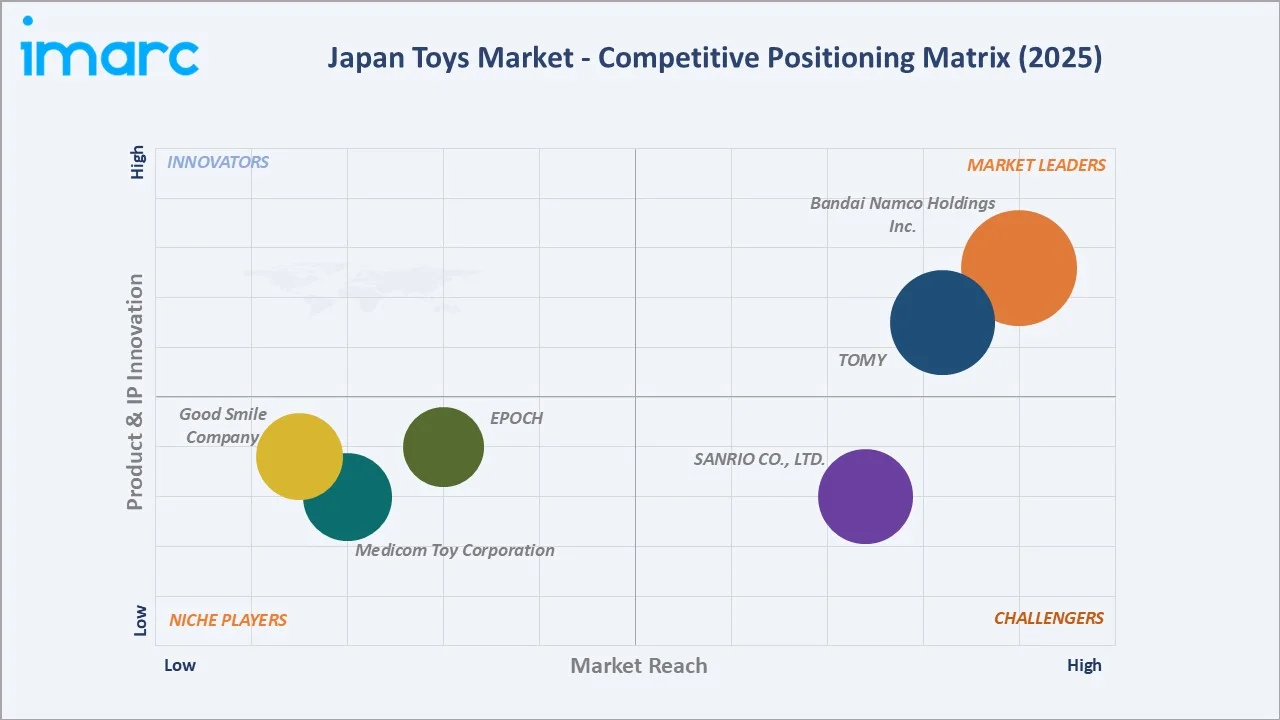
Key Company Profiles
Bandai Namco Holdings Inc.
Bandai Namco Holdings Inc. is a Japan-based entertainment and toy conglomerate with the industry's strongest presence in the toys market through its Gundam and Gunpla model-kit franchises, alongside its Banpresto prize-figure and MegaHouse collectible subsidiaries.
- Key Products: Gundam Gunpla model kits, Banpresto prize figures, MegaHouse collectible figurines.
- Strategic Focus: Expanding premium collector model-kit lines while strengthening sustainable packaging and materials initiatives across its global manufacturing footprint.
Tomy
Tomy is a leading Japanese toy manufacturer known for designing toys that combine play and technology across a broad, multi-age product portfolio spanning die-cast vehicles, battling-top systems, and character dolls with global brand recognition.
- Key Products: Beyblade, Zoids, Tomica die-cast cars, Plarail train sets, Licca-chan dolls.
- Strategic Focus: Broadening technology-integrated toy lines while reinforcing its global-brand distribution network and expanding recurring-purchase product systems.
Market Concentration Analysis
The Japan toys market is moderately concentrated at the domestic conglomerate level, with the top two key players jointly commanding a leading share of national revenue through strong franchise ownership, vertically integrated design and distribution, and extensive omnichannel retail presence. Niche collectible specialists sustain differentiated positions in the high-value premium collector segment. Market concentration is expected to remain broadly stable through the forecast period as franchise strength continues to be the primary determinant of competitive positioning.
Investment & Growth Opportunities
Highest Growth Segments
Online Stores (~4.3% CAGR) and the Above 10 Years age group (~3.6% CAGR) represent the market's highest-growth investment vectors through 2034, outpacing the overall market average of 2.81% as e-commerce penetration and adult-collector demand continue to compound faster than the broader toy market.
Emerging Investment Opportunities
Premium collectible figures and AR/VR-enabled smart toys represent the market's highest per-unit-value emerging opportunities, supported by Japan's deep collector culture and rapid technology adoption. Sustainable-material product lines also represent a structurally growing opportunity as manufacturers respond to shifting consumer and regulatory expectations around packaging and materials.
Investment Themes
- Sustainable Manufacturing Investment: Capacity investment in recycled and biodegradable toy materials offers a structural cost and brand advantage as sustainability expectations tighten across both domestic and export markets, positioning early movers favorably against slower-adapting competitors.
- E-Commerce and Digital Platform Expansion: Investment in direct-to-collector digital platforms and companion mobile applications captures Japan's fastest-growing sales channel while strengthening long-term brand engagement beyond the initial toy purchase.
Future Market Outlook (2026-2034)
The Japan toys market is projected to grow from USD 6.94 Billion in 2025 to USD 7.19 Billion in 2026, reaching USD 8.98 Billion by 2034, delivering a steady 2.81% CAGR over the forecast period. The market's anchor value of an estimated USD 7.97 Billion in 2030 represents a toys industry in steady, demographically constrained expansion, with online retail and adult-collector demand anchoring growth even as the core child population continues to contract.
AR/VR-enabled smart toys and sustainable materials are expected to achieve wider mainstream adoption by the end of the forecast period, while premium collectible figures continue to command a growing share of overall market value. Three structural forces will define market growth through 2034: the compounding strength of Japan's anime and gaming IP ecosystem, the continued shift of consumer spending toward online and specialty retail channels, and the ongoing diversification of manufacturer portfolios toward adult and collector-focused product categories.
Research Methodology
Primary Research
Primary research comprised structured interviews with senior toy-manufacturer executives, retail and e-commerce channel leads, IP-licensing specialists, and industry association representatives across Japan's toy value chain, providing first-hand insight into demand trends, pricing dynamics, and competitive positioning.
Secondary Research
Secondary research encompassed company annual reports, Japan Toy Association data and ST Mark certification records, industry publications, franchise and licensing disclosures, and government demographic and retail statistics, cross-verified across multiple independent sources to ensure data reliability.
Forecasting Models
Market revenue forecasts were developed using a bottom-up retail-demand model incorporating Japan's demographic trends by age cohort, per-capita discretionary spending, channel-wise sales growth by segment, and franchise-cycle adjustments reflecting the timing of major anime, gaming, and entertainment releases.
Japan Toys Market Report Coverage:
| Report Features | Details |
|---|---|
| Base Year of the Analysis | 2025 |
| Historical Period | 2020-2025 |
| Forecast Period | 2026-2034 |
| Units | Billion USD |
| Scope of the Report | Exploration of Historical Trends and Market Outlook, Industry Catalysts and Challenges, Segment-Wise Historical and Future Market Assessment:
|
| Product Types Covered | Action Figures, Building Sets, Dolls, Games and Puzzles, Sports and Outdoor Toys, Plush, Others |
| Age Groups Covered | Up to 5 Years, 5 to 10 Years, Above 10 Years |
| Sales Channels Covered | Supermarket and Hypermarket, Specialty Stores, Department Stores, Online Stores, Others |
| Regions Covered | Kanto Region, Kinki Region, Central/ Chubu Region, Kyushu-Okinawa Region, Tohoku Region, Chugoku Region, Hokkaido Region, Shikoku Region |
| Companies Covered | Bandai Namco Holdings Inc., TOMY, SANRIO CO., LTD., EPOCH, Good Smile Company, Medicom Toy Corporation, etc. |
| Customization Scope | 10% Free Customization |
| Post-Sale Analyst Support | 10-12 Weeks |
| Delivery Format | PDF and Excel through Email (We can also provide the editable version of the report in PPT/Word format on special request) |
Key Benefits for Stakeholders:
- IMARC’s report offers a comprehensive quantitative analysis of various market segments, historical and current market trends, market forecasts, and dynamics of the Japan toys market from 2020-2034.
- The research study provides the latest information on the market drivers, challenges, and opportunities in the Japan toys market.
- Porter's five forces analysis assist stakeholders in assessing the impact of new entrants, competitive rivalry, supplier power, buyer power, and the threat of substitution. It helps stakeholders to analyze the level of competition within the Japan toys industry and its attractiveness.
- Competitive landscape allows stakeholders to understand their competitive environment and provides an insight into the current positions of key players in the market.
Frequently Asked Questions About the Japan Toys Market Report
The Japan toys market size is estimated at USD 7.19 Billion in 2026, driven by the Above 10 Years age group dominant at 45.6%, Online Stores leading sales channels at 37.5%, strong anime and gaming IP licensing, and Japan's large and growing adult-collector consumer base.
The Japan toys market grows at a 2.81% CAGR during 2026-2034, reaching USD 8.98 Billion by 2034. This growth reflects steady e-commerce channel expansion, sustained adult-collector demand, and continued strength in franchise-linked merchandise despite Japan's contracting child population.
Above 10 Years leads at 45.6%, capturing Japan's expansive otaku and adult-collector demographic. This segment grows at an above-market CAGR of approximately 3.6% through premium figure and model-kit demand tied to major anime and gaming franchises.
Online Stores lead at 37.5% through the highest per-transaction convenience and the widest product access among all channels, creating sustained procurement growth. Online Stores grow fastest at approximately 4.3% CAGR through 2034 as e-commerce penetration deepens further.
Kanto Region leads at 35.8% through Tokyo's high annual retail turnover, its concentration of licensing headquarters, and its role as Japan's largest media and entertainment hub, alongside strong secondary contribution from the Kinki Region at 18.4%.
Leading companies include Bandai Namco Holdings Inc., TOMY, SANRIO CO., LTD., EPOCH, Good Smile Company, Medicom Toy Corporation, and others.
The Japan toys market is projected to reach approximately USD 7.97 Billion by 2030, with online retail and collector-segment growth continuing to outpace the broader market, and AR/VR-enabled smart toys beginning wider mainstream adoption across product categories.
Three priority investment opportunities stand out: sustainable-materials manufacturing capacity, direct-to-collector e-commerce and digital-platform expansion, and premium collectible-figure production capturing Japan's fastest-growing, highest per-unit-value consumer segments.
Need more help?
- Speak to our experienced analysts for insights on the current market scenarios.
- Include additional segments and countries to customize the report as per your requirement.
- Gain an unparalleled competitive advantage in your domain by understanding how to utilize the report and positively impacting your operations and revenue.
- For further assistance, please connect with our analysts.
 Request Customization
 Speak to an Analyst
 Request Brochure
 Inquire Before Buying
Benefits of Customization
- Personalize this research
- Triangulate with your data
- Get data as per your format and definition
- Gain a deeper dive into a specific application, geography, customer, or competitor
- Any level of personalization
Get in Touch With Us
UNITED STATES
Phone: +1-201-971-6302
INDIA
Phone: +91-120-433-0800
UNITED KINGDOM
Phone: +44-753-714-6104
Email: [email protected]
Client Testimonials




.webp)




.webp)













Related Reports

Choose your plan
*Please note that the prices mentioned below are starting prices for each bundle type. Kindly contact our team for further details.*
Single User License
- 1 User License, Access on 2 Devices
- PDF Report + Excel Dataset (Password Protected)
- Lifetime Access
- No Printing Rights
- 10% Free Report Customization
- 10–12 Weeks of Analyst Support
Five User License
- Access for 5 Users, 2 Devices per User
- PDF Report + Excel Dataset (Password Protected)
- Lifetime Access
- Dedicated Account Manager
- 12–14 Weeks of Analyst Support
- No Printing Rights
- 15% Free Report Customization
- 25% Discount on Your Next Purchase
Corporate User License
- Unlimited User Access (Within Your Organization)
- PDF Report + Excel Dataset
- Lifetime Access
- Dedicated Account Manager
- 14–20 Weeks of Analyst Support
- No Printing Rights
- 20% Free Report Customization
- 30% Discount on Your Next Purchase
Essential Insights
What's included:
3 reports
- Lifetime Access
- PDF Reports
- Excel Datasets
- 2 Weeks of Free Analyst Support
- 2 User Licenses
- Access on 2 Devices
- Printing Rights
- Complimentary PowerPoint (PPT) Version
- Complimentary License Upgrade
Professional Access
What's included:
5 reports
- Lifetime Access
- PDF Reports
- Excel Datasets
- 8 Weeks of Free Analyst Support
- 2 User Licenses
- Access on 2 Devices
- Printing Rights
- Complimentary PowerPoint (PPT) Version
- Complimentary License Upgrade
Business Advantage
What's included:
8 reports
- Lifetime Access
- PDF Reports
- Excel Datasets
- 14 Weeks of Free Analyst Support
- 2 User Licenses
- Access on 2 Devices
- Printing Rights
- Complimentary PowerPoint (PPT) Version
- Complimentary License Upgrade
Enterprise Intelligence
What's included:
10 reports
- Lifetime Access
- PDF Reports
- Excel Datasets
- 20 Weeks of Free Analyst Support
- 2 User Licenses
- Access on 2 Devices
- Printing Rights
- Complimentary PowerPoint (PPT) Version
- Complimentary License Upgrade