
Japan Wireless Charging Market Report by Technology (Inductive Charging, Resonant Charging, Radio Frequency Based Charging, and Others), Transmission Range (Short Range, Medium Range, Long Range), Application (Consumer Electronics, Automotive, Healthcare, Industrial, Defense, and Others), and Region 2026-2034
Market Overview:
Japan wireless charging market size reached USD 1,505.4 Million in 2025. Looking forward, IMARC Group expects the market to reach USD 12,491.6 Million by 2034, exhibiting a growth rate (CAGR) of 26.51% during 2026-2034. The increasing demand for wireless charging stations in public spaces, such as airports, coffee shops, hotels, etc., that encourages users to adopt wireless charging technology, is primarily driving the market.
|
Report Attribute
|
Key Statistics
|
|---|---|
|
Base Year
|
2025
|
|
Forecast Years
|
2026-2034
|
|
Historical Years
|
2020-2025
|
|
Market Size in 2025
|
USD 1,505.4 Million |
|
Market Forecast in 2034
|
USD 12,491.6 Million |
| Market Growth Rate 2026-2034 | 26.51% |
Wireless charging is a convenient and innovative technology that enables the transfer of electrical power to electronic devices without the need for physical cables or connectors. It relies on electromagnetic fields to transmit energy from a charging pad or base station to a compatible device, such as a smartphone or wearable gadget. The process involves two main components: a transmitter (the charging pad) and a receiver (the device being charged). The transmitter generates an alternating current, which creates an electromagnetic field around it. When the receiver (often embedded in the device's back cover or case) comes into close proximity with the transmitter, it converts the electromagnetic energy back into electrical power, which charges the device's battery. Wireless charging offers several advantages, including the elimination of tangled cords, ease of use, and the potential for waterproof and dustproof designs. It is a promising technology that is gaining popularity in various consumer electronics and automotive applications.
Japan Wireless Charging Market Trends:
High Smartphone Penetration and Device Replacement Cycles
Japan has one of the world’s most sophisticated smartphone user bases, with consumers frequently upgrading devices to access the latest features and design improvements. As per industry reports, in 2025, smartphone penetration stands at 95.2%. As premium smartphones increasingly adopt wireless charging as a standard feature, the demand is naturally rising for compatible chargers in homes, offices, and public spaces. Japanese consumers value convenience and minimalism, making cable-free charging appealing for daily use. Additionally, frequent device replacement cycles ensure a continuous influx of new users adopting wireless charging technology. Retailers and electronics brands promote wireless charging as a core lifestyle accessory, enhancing visibility and acceptance. As accessories are often bought soon after new phone purchases, wireless chargers benefit from strong cross-selling opportunities. The combination of device upgrades, brand-driven adoption, and user preference for sleek technology is fueling the Japan wireless charging market share.
Expansion of Electric Vehicle (EV) Wireless Charging Research
Japan’s leadership in automotive innovation is contributing to the growth of wireless charging through research into EV charging systems. Automakers and technology companies are exploring wireless charging pads that enable EVs to charge simply by parking over a designated ground unit. This development reduces dependence on cables, improves safety, and enhances user experience. As EV adoption is increasing, interest in convenient charging methods is growing as well. According to the Japan Automobile Dealer Association, BYD surpassed Toyota in all-EV sales for the first time in 2024. Japan saw sales of 59,736 all-EVs. Public infrastructure trials and testing programs further promote awareness about wireless power transfer technology among consumers and enterprises. Even before widespread commercialization, investments in research and development (R&D) activities build confidence in the long-term relevance of wireless charging. The spillover effect also boosts smaller-scale wireless charging solutions, such as for consumer electronics, reinforcing the overall ecosystem and supporting sustained market growth.
Growth of Smart Homes and Internet of Things (IoT) Ecosystems
The expanding smart home and IoT ecosystem is fueling the Japan wireless charging market demand. As per the IMARC Group, the Japan smart homes market size reached USD 8.1 Billion in 2024. Connected devices, such as smart speakers, sensors, security systems, and wearables, require frequent powering, and wireless charging simplifies energy management within compact living spaces. Consumers prefer clutter-free environments, making wireless charging stations ideal for modern Japanese homes where space efficiency is critical. Smart furniture integrated with charging pads is gaining interest, enabling charging through tables, lamps, or desks. As homes are becoming increasingly automated, consumers are seeking seamless systems that minimize manual intervention, including plugging and unplugging cords. Wireless charging fits perfectly into this automation trend by providing continuous and reliable energy without cables. The integration of power technology into smart environments ensures steady demand across residential and commercial segments alike.
Key Growth Drivers of Japan Wireless Charging Market:
Increasing Adoption of Wearables and Medical Devices
Rising use of wearable electronics and healthcare monitoring devices is significantly boosting the Japan wireless charging market growth. Fitness trackers, smartwatches, hearing aids, and health monitoring sensors are becoming common among elderly and younger populations alike. Wireless charging is especially suited for compact medical devices that require sealed designs for hygiene, water resistance, and durability. Cables and external ports pose contamination and maintenance risks in healthcare environments, making wireless power transfer a more reliable solution. Hospitals and care centers increasingly favor charging solutions that reduce physical contact and operational complexity. For aging population relying on health devices, wireless charging offers convenience and safety. As digital healthcare is expanding, the demand for reliable and easy-to-use power solutions keeps rising, positioning wireless charging as a preferred technology in healthcare settings.
Retail Innovations and Public Charging Infrastructure
As per Japan wireless charging market analysis, the broadening of retail and transportation infrastructure is propelling the industry expansion. Shopping malls, cafes, airports, and railway stations increasingly install wireless charging zones to enhance customer experience. Consumers expect seamless digital access while traveling or shopping, and wireless charging adds value without requiring users to carry cables. Retailers benefit from extended customer dwell time when charging services are available, making it a strategic business tool. Public charging also normalizes the technology, making consumers more comfortable adopting wireless chargers at home. Small restaurants and convenience stores integrate charging stations to attract young, tech-savvy customers. As public spaces are evolving to become more technology-friendly, wireless charging is becoming part of the standard service environment, accelerating adoption and creating steady infrastructure-driven market expansion.
Rising Demand for Cable-Free and Minimalist Design
Japanese consumers strongly favor clean design and functional minimalism, and wireless charging aligns perfectly with these lifestyle preferences. Eliminating tangled wires improves aesthetics and reduces maintenance, which appeals to both residential and corporate users. Offices increasingly adopt wireless charging desks and conference tables to support flexible work setups. In homes, wireless charging pads fit seamlessly into modern interiors, reinforcing the visual appeal of living spaces. Manufacturers market wireless charging as more than a utility—it is becoming a design statement. This emphasis on form and function is driving higher acceptance across fashion-conscious and professional consumers who value organized environments. As lifestyle-focused electronics are gaining popularity, wireless charging is being viewed as an enhancement rather than just infrastructure. The desire for simplicity in everyday technology is strongly propelling the market forward in Japan.
Opportunities of Japan Wireless Charging Market:
Wireless Charging Integration in Public Transportation Systems
Japan’s extensive public transportation network presents a major opportunity for wireless charging expansion. Trains, buses, stations, and waiting areas can be equipped with wireless charging zones to serve millions of daily commuters. Installing charging pads on station benches, café tables, and inside carriages enhances passenger convenience and improves travel experience. With commuters heavily dependent on mobile devices for navigation, payments, and communication, access to charging becomes a valuable service. Transport operators can also use wireless charging as a branding and customer retention tool. Digital advertising and sponsorship models can further increase revenue potential around charging hubs. As urban mobility is becoming more technology-driven, transportation-linked wireless charging is positioned as a practical infrastructure upgrade. This opportunity allows service providers to target large user volumes daily, creating long-term and stable revenue streams.
Enterprise and Office Infrastructure Modernization
Corporate offices across Japan present a strong opportunity for wireless charging growth through infrastructure modernization. Companies increasingly adopt flexible work environments, hot-desking systems, and collaborative spaces, which benefit from cord-free charging solutions. Wireless charging desks, conference tables, and common-area stations improve productivity by simplifying employee access to power. Enterprises also value cleaner office layouts and reduced hardware maintenance costs. As businesses are investing in smart office upgrades, wireless charging is becoming part of broader digital transformation initiatives. Facility managers see wireless power as a long-term solution that reduces cable replacement and improves safety. In technology-driven industries, providing wireless charging improves employer branding and employee satisfaction. Corporate real estate developers can integrate wireless charging in new projects as a standard feature, strengthening demand from both tenants and service providers while supporting large-scale commercial deployment.
Development of Multi-Device and Long-Range Charging Solutions
Innovations in multi-device and long-range wireless charging introduce a major market growth opportunity in Japan. Consumers increasingly own multiple electronic devices, including smartphones, earbuds, watches, and tablets, creating demand for chargers that power several devices simultaneously. Long-range charging technologies that allow charging without direct contact offer new applications in offices, hospitals, and industrial settings. These solutions could enable continuous low-power charging for sensors, tags, and smart systems. Japanese consumers value advanced functionality, making them more open to adopting next-generation charging methods. Manufacturers that innovate around faster speeds, broader coverage zones, and safer energy transfer can gain competitive advantage. As ecosystems are expanding, charging systems will evolve into smart power networks rather than standalone products. This opportunity allows technology providers to move beyond accessories into integrated infrastructure and premium product categories.
Japan Wireless Charging Market Segmentation:
IMARC Group provides an analysis of the key trends in each segment of the market, along with forecasts at the country level for 2026-2034. Our report has categorized the market based on technology, transmission range, and application.
Technology Insights:
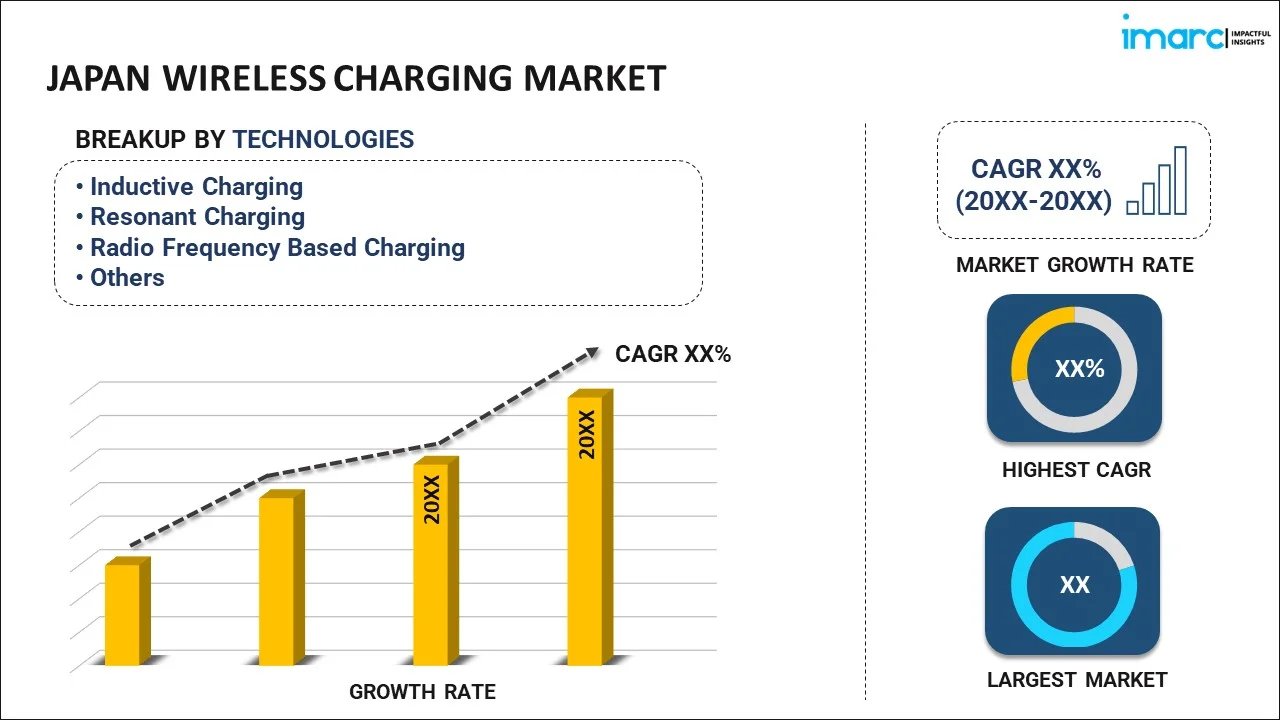
To get more information on this market, Request Sample
- Inductive Charging
- Resonant Charging
- Radio Frequency Based Charging
- Others
The report has provided a detailed breakup and analysis of the market based on the technology. This includes inductive charging, resonant charging, radio frequency based charging, and others.
Transmission Range Insights:
- Short Range
- Medium Range
- Long Range
A detailed breakup and analysis of the market based on the transmission range have also been provided in the report. This includes short range, medium range, and long range.
Application Insights:
- Consumer Electronics
- Automotive
- Healthcare
- Industrial
- Defense
- Others
The report has provided a detailed breakup and analysis of the market based on the application. This includes consumer electronics, automotive, healthcare, industrial, defense, and others.
Regional Insights:
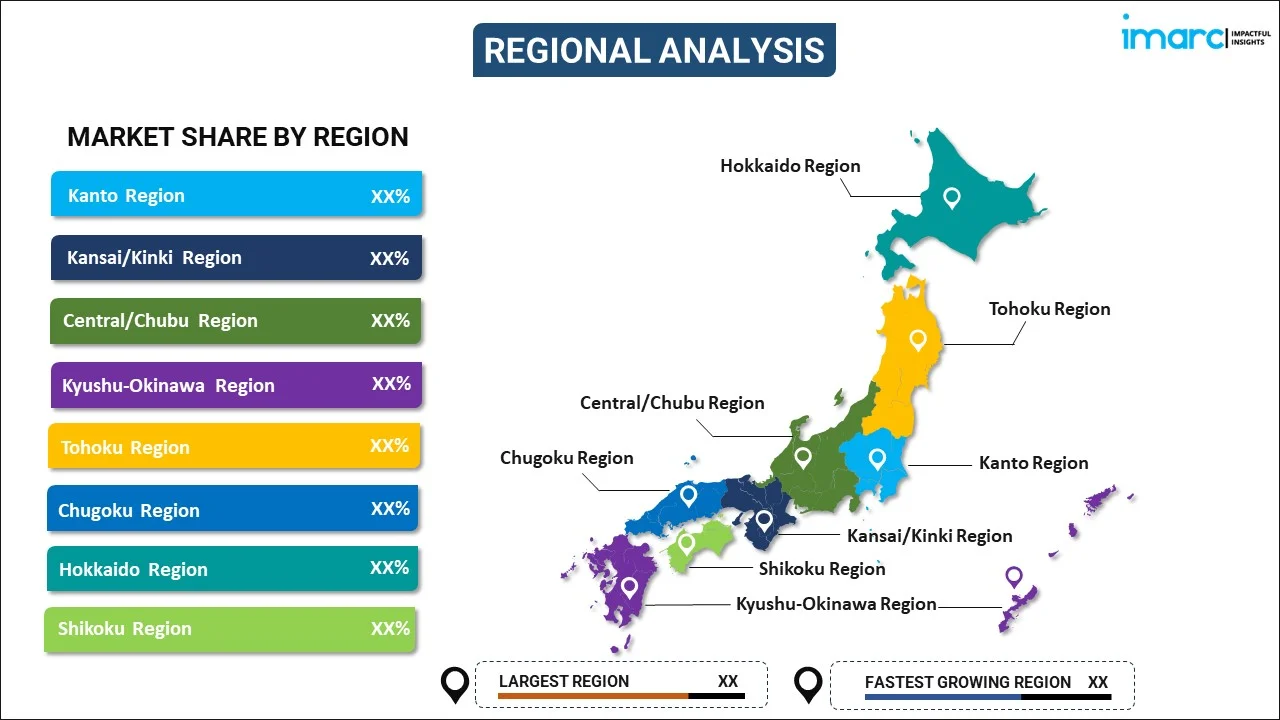
- Kanto Region
- Kansai/Kinki Region
- Central/ Chubu Region
- Kyushu-Okinawa Region
- Tohoku Region
- Chugoku Region
- Hokkaido Region
- Shikoku Region
The report has also provided a comprehensive analysis of all the major regional markets, which include Kanto Region, Kansai/Kinki Region, Central/ Chubu Region, Kyushu-Okinawa Region, Tohoku Region, Chugoku Region, Hokkaido Region, and Shikoku Region.
Competitive Landscape:
The market research report has also provided a comprehensive analysis of the competitive landscape in the market. Competitive analysis such as market structure, key player positioning, top winning strategies, competitive dashboard, and company evaluation quadrant has been covered in the report. Also, detailed profiles of all major companies have been provided.
Japan Wireless Charging Market News:
- In August 2025, Scientists at Chiba University in Japan created a machine learning (ML) technique that greatly enhanced wireless power transfer systems. The team stated that their load-independent design maintained stable voltage despite devices drawing different levels of current, a longstanding technical challenge for wireless charging technology.
- In July 2025, Granite River Labs (GRL) Japan received official approval from the Wireless Power Consortium (WPC) to conduct certification testing for both Qi v2.2.0 and v2.2.1 wireless charging. This encompassed assistance for the newest 25W Application Power Profile (APP) utilizing moving coil technology, an essential facilitator for advanced in-vehicle wireless charging.
Japan Wireless Charging Market Report Coverage:
| Report Features | Details |
|---|---|
| Base Year of the Analysis | 2025 |
| Historical Period | 2020-2025 |
| Forecast Period | 2026-2034 |
| Units | Million USD |
| Scope of the Report | Exploration of Historical and Forecast Trends, Industry Catalysts and Challenges, Segment-Wise Historical and Predictive Market Assessment:
|
| Technologies Covered | Inductive Charging, Resonant Charging, Radio Frequency Based Charging, Others |
| Transmission Ranges Covered | Short Range, Medium Range, Long Range |
| Applications Covered | Consumer Electronics, Automotive, Healthcare, Industrial, Defense, Others |
| Regions Covered | Kanto Region, Kansai/Kinki Region, Central/ Chubu Region, Kyushu-Okinawa Region, Tohoku Region, Chugoku Region, Hokkaido Region, Shikoku Region |
| Customization Scope | 10% Free Customization |
| Post-Sale Analyst Support | 10-12 Weeks |
| Delivery Format | PDF and Excel through Email (We can also provide the editable version of the report in PPT/Word format on special request) |
Key Benefits for Stakeholders:
- IMARC’s industry report offers a comprehensive quantitative analysis of various market segments, historical and current market trends, market forecasts, and dynamics of the Japan wireless charging market from 2020-2034.
- The research report provides the latest information on the market drivers, challenges, and opportunities in the Japan wireless charging market.
- Porter's five forces analysis assist stakeholders in assessing the impact of new entrants, competitive rivalry, supplier power, buyer power, and the threat of substitution. It helps stakeholders to analyze the level of competition within the Japan wireless charging industry and its attractiveness.
- Competitive landscape allows stakeholders to understand their competitive environment and provides an insight into the current positions of key players in the market.
Frequently Asked Questions About the Japan Wireless Charging Market Report
The wireless charging market in Japan was valued at USD 1,505.4 Million in 2025.
Consumer preferences for mobility, minimalistic design, and seamless integration across devices are fueling the adoption. Government and industry initiatives to support EV infrastructure are further boosting wireless charging applications in the automotive sector. Advancements in fast-charging technology, magnetic resonance, and safety improvements are making solutions more efficient and reliable.
The Japan wireless charging market is projected to exhibit a CAGR of 26.51% during 2026-2034, reaching a value of USD 12,491.6 Million by 2034.
Need more help?
- Speak to our experienced analysts for insights on the current market scenarios.
- Include additional segments and countries to customize the report as per your requirement.
- Gain an unparalleled competitive advantage in your domain by understanding how to utilize the report and positively impacting your operations and revenue.
- For further assistance, please connect with our analysts.
 Request Customization
 Speak to an Analyst
 Request Brochure
 Inquire Before Buying
Benefits of Customization
- Personalize this research
- Triangulate with your data
- Get data as per your format and definition
- Gain a deeper dive into a specific application, geography, customer, or competitor
- Any level of personalization
Get in Touch With Us
UNITED STATES
Phone: +1-201-971-6302
INDIA
Phone: +91-120-433-0800
UNITED KINGDOM
Phone: +44-753-714-6104
Email: [email protected]
Client Testimonials




.webp)




.webp)













Related Reports

Choose your plan
*Please note that the prices mentioned below are starting prices for each bundle type. Kindly contact our team for further details.*
Single User License
- 1 User License, Access on 2 Devices
- PDF Report + Excel Dataset (Password Protected)
- Lifetime Access
- No Printing Rights
- 10% Free Report Customization
- 10–12 Weeks of Analyst Support
Five User License
- Access for 5 Users, 2 Devices per User
- PDF Report + Excel Dataset (Password Protected)
- Lifetime Access
- Dedicated Account Manager
- 12–14 Weeks of Analyst Support
- No Printing Rights
- 15% Free Report Customization
- 25% Discount on Your Next Purchase
Corporate User License
- Unlimited User Access (Within Your Organization)
- PDF Report + Excel Dataset
- Lifetime Access
- Dedicated Account Manager
- 14–20 Weeks of Analyst Support
- No Printing Rights
- 20% Free Report Customization
- 30% Discount on Your Next Purchase
Essential Insights
What's included:
3 reports
- Lifetime Access
- PDF Reports
- Excel Datasets
- 2 Weeks of Free Analyst Support
- 2 User Licenses
- Access on 2 Devices
- Printing Rights
- Complimentary PowerPoint (PPT) Version
- Complimentary License Upgrade
Professional Access
What's included:
5 reports
- Lifetime Access
- PDF Reports
- Excel Datasets
- 8 Weeks of Free Analyst Support
- 2 User Licenses
- Access on 2 Devices
- Printing Rights
- Complimentary PowerPoint (PPT) Version
- Complimentary License Upgrade
Business Advantage
What's included:
8 reports
- Lifetime Access
- PDF Reports
- Excel Datasets
- 14 Weeks of Free Analyst Support
- 2 User Licenses
- Access on 2 Devices
- Printing Rights
- Complimentary PowerPoint (PPT) Version
- Complimentary License Upgrade
Enterprise Intelligence
What's included:
10 reports
- Lifetime Access
- PDF Reports
- Excel Datasets
- 20 Weeks of Free Analyst Support
- 2 User Licenses
- Access on 2 Devices
- Printing Rights
- Complimentary PowerPoint (PPT) Version
- Complimentary License Upgrade