
Laser Sensor Market Size, Share, Trends and Forecast by Type, Component, Application, End User, and Region, 2026-2034
Laser Sensor Market Size and Share:
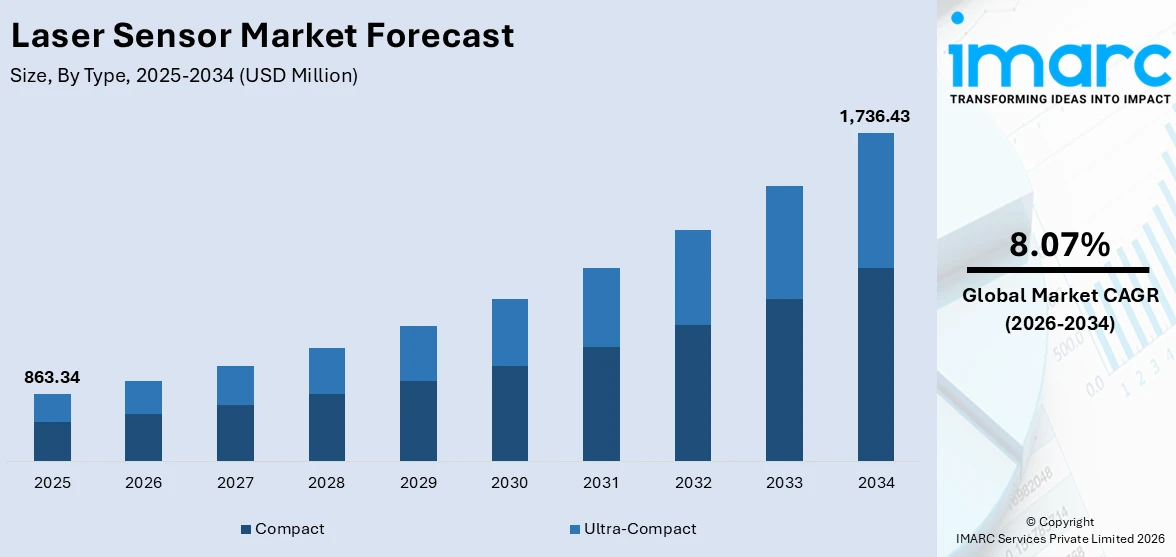
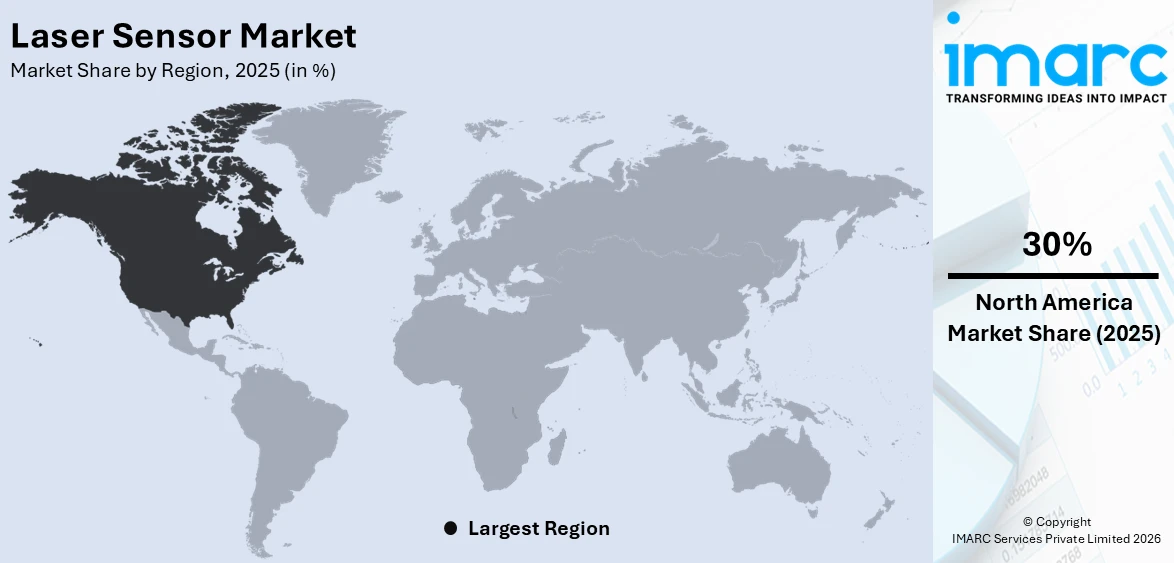
The global laser sensor market size was valued at USD 863.34 Million in 2025. Looking forward, IMARC Group estimates the market to reach USD 1,736.43 Million by 2034, exhibiting a CAGR of 8.07% from 2026-2034. North America currently dominates the market, holding a market share of 30% in 2025. The region benefits from its advanced technological infrastructure, strong presence of key industry players, and substantial investments in research and development (R&D) across the automotive, aerospace, and healthcare sectors, with the growing adoption of automation and smart manufacturing technologies further strengthening the laser sensor market share.
The global laser sensor market is experiencing growth driven by the increasing adoption of automation and Industry 4.0 principles across diverse manufacturing sectors. Laser sensors play a critical role in enabling high-precision measurement, non-contact inspection, and real-time quality control, which are essential for modern automated production lines. Additionally, rapid advancements in laser technology, including miniaturization, enhanced sensitivity, and improved signal processing capabilities, are enabling the development of more versatile and cost-effective sensor solutions that cater to evolving industrial requirements. The rising demand for advanced driver-assistance systems (ADAS) and autonomous vehicle technologies is accelerating the deployment of laser-based sensing and light detection and ranging (LiDAR) systems across the automotive industry. The expanding applications of laser sensors in healthcare for non-invasive diagnostics, in consumer electronics for 3D sensing, and in construction for precise distance measurement are also contributing to the laser sensor market growth.
The United States is emerging as a major region in the laser sensor market, supported by its advanced manufacturing base across automotive, aerospace, and electronics industries, where precision sensing is essential for process optimization, robotic guidance, and quality assurance. Strong adoption of industrial automation and smart factory systems is further accelerating the demand for high-performance laser sensors in production environments. This trend is reflected in rising automation investments, as North American robot orders increased significantly in the third quarter of 2025. According to the Association for Advancing Automation (A3), 8,806 robots valued at USD 574 Million were ordered in Q3, representing an 11.6% rise in units and a 17.2% increase in revenue compared to the same period the previous year. Such growth highlights the expanding deployment of robotics and advanced inspection technologies, reinforcing the United States’ leading role in influencing laser sensor market through industrial modernization.
To get more information on this market Request Sample
Laser Sensor Market Trends:
Advancements in High-Precision Long-Range Measurement Technologies
Continuous innovation in high-precision and long-range measurement capabilities is a significant factor influencing the growth of the laser sensor market. Industries, such as automation, logistics, metals, and heavy manufacturing increasingly require accurate distance measurement over extended ranges to enhance operational safety, optimize material handling, and improve process control. Modern production environments demand sensors capable of maintaining stability, accuracy, and reliability under challenging industrial and outdoor conditions. Reflecting this trend, in 2025 Micro-Epsilon introduced the optoNCDT ILR3800-100 laser distance sensor, designed to measure distances up to 150 meters with a reflector and 100 meters without, while delivering 0.1 mm resolution at a 20 Hz measuring rate. The sensor’s IP67 protection rating and optional heated variant enable consistent performance in harsh environments, including steel processing and outdoor logistics operations. Such advancements in durable, high-resolution long-distance sensing solutions are expanding application possibilities and reinforcing sustained demand across industrial sectors.
Expanding Use of LiDAR Laser Sensors in Remote Mapping
The growing adoption of LiDAR-based laser sensor technology in archaeological exploration and large-scale terrain mapping is offering a favorable laser sensor market outlook. LiDAR systems enable high-resolution, non-invasive scanning of landscapes, allowing researchers to detect structures and topographical features that are invisible through conventional ground surveys or satellite imagery. This capability is particularly valuable in dense forests and remote regions where physical excavation is difficult. A notable example occurred in 2024, when archaeologists applied LiDAR laser-sensor technology to uncover traces of a previously unknown ancient Mayan city, Valeriana, hidden in the jungle of southern Mexico. Airborne laser pulses revealed nearly 6,500 structures, including temple platforms, ball courts, terraces, and a possible dam dating back to 250–900 A.D. Such discoveries demonstrate the powerful role of laser sensing in cultural heritage research, expanding demand beyond industrial applications into scientific, environmental, and geospatial fields.
Rising Demand in Industrial Manufacturing
The increasing use of high-power lasers in industrial manufacturing is a key factor driving growth in the laser sensor market, as manufacturers require precise solutions to ensure operational safety. Applications like metal cutting, welding, additive manufacturing, and surface treatment require precise monitoring of laser output to ensure process stability, safety, and consistent product quality. As laser-based production systems operate at higher power levels, manufacturers are investing in advanced sensors capable of delivering fast, accurate power measurement and integrated protection features. This trend was highlighted in 2024, when Coherent Corp. introduced the PM10K+ high-power laser sensor, designed to measure continuous-wave lasers up to 10 kW in under three seconds. The sensor reduced measurement time by up to 500% and incorporated a large active area with built-in laser interlock protection for safer operation. With multiple connectivity options, including USB, DB25, and RS-232, such innovations support real-time industrial monitoring and reinforce the demand for high-performance laser sensing solutions.
Laser Sensor Industry Segmentation:
IMARC Group provides an analysis of the key trends in each segment of the global laser sensor market, along with forecast at the global, regional, and country levels from 2026-2034. The market has been categorized based on type, component, application, and end user.

Analysis by Type:
- Compact
- Ultra-Compact
Compact holds 55% of the market share, driven by its adaptability, ease of integration, and suitability for space-constrained industrial applications. Its small footprint allows seamless installation within automated production lines, robotics systems, and precision equipment without compromising measurement accuracy. This type of sensor is widely deployed in automotive assembly, consumer electronics manufacturing, and medical device production, where consistent, high-resolution detection is essential. Technological advancements continue to enhance miniaturization while maintaining durability and performance stability in demanding environments. Reflecting this trend, in 2024 Panasonic Industry introduced the ultra-compact SN-GCQB1 air quality sensor, incorporating a Time-of-Flight laser to measure particulate matter, temperature, humidity, and volatile organic compounds with high precision. Designed with auto-calibration and protective casing, the device measures just 37 × 37 × 12 mm, demonstrating how compact laser-based sensing solutions are expanding into advanced environmental and industrial monitoring applications, reinforcing the segment’s leading position in the market.
Analysis by Component:
- Hardware and Software
- Services
Hardware and software lead the market with a share of 68%, reflecting the continued reliance of industries on integrated laser sensing solutions for precision measurement and automation. This segment’s dominance is supported by strong demand for ruggedized laser emitters, detectors, and processing modules that form the essential infrastructure of advanced sensing systems. Manufacturing, automotive, and electronics sectors depend on these physical components combined with intelligent software platforms to support process control, dimensional inspection, and high-accuracy quality analysis. Software integration is becoming increasingly important, enabling real-time monitoring, statistical process control dashboards, and automated decision-making within production environments. Cloud-enabled analytics and predictive maintenance tools are further enhancing operational efficiency by identifying performance deviations before failures occur. The combination of durable hardware with advanced software capabilities strengthens the overall functionality, scalability, and return on investment of laser sensor deployments. As smart manufacturing adoption accelerates, integrated hardware-software laser sensor systems remain central to industrial modernization and productivity improvement.
Analysis by Application:
Access the comprehensive market breakdown Request Sample
- Security and Surveillance
- Motion and Guidance
- Process Monitoring and Quality Control
- Distance Measurement
- Manufacturing Plant Management
- Others
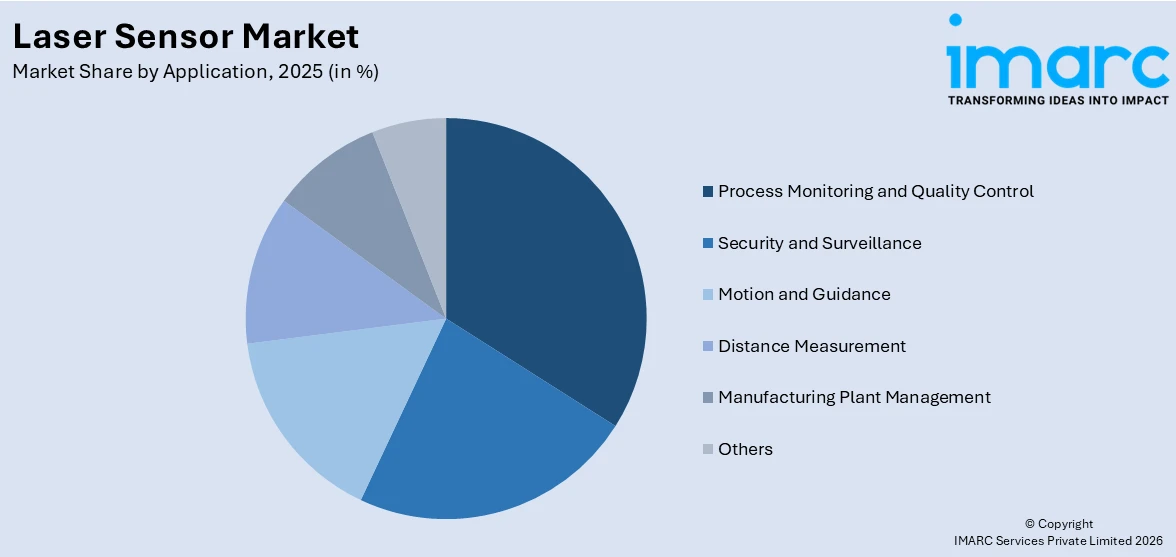
Process monitoring and quality control dominate the market, accounting for 23% of total share, driven by the growing emphasis on precision, consistency, and real-time oversight in modern manufacturing environments. Industries are increasingly adopting automated inspection systems to detect dimensional variations, surface irregularities, and alignment inaccuracies during production, reducing defects and limiting material waste. Laser sensors play a central role in these applications by providing non-contact, high-speed measurements that ensure strict adherence to quality standards without interrupting workflow. Their capability to function reliably in demanding industrial conditions, including high temperatures, vibrations, and complex geometries, further supports widespread deployment. The transition toward smart factories and Industry 4.0 frameworks is catalyzing the demand for integrated sensing technologies that enable continuous data collection, predictive maintenance, and closed-loop quality management. As manufacturers seek higher efficiency, reduced downtime, and improved product consistency, laser-based process monitoring solutions continue to strengthen their position as essential tools within advanced industrial production systems.
Analysis by End User:
- Automotive
- Aerospace and Defense
- Food and Beverages
- Consumer Electronics
- Chemical
- Healthcare
- Others
Automotive represents the leading segment, with a market share of 21%, supported by the industry’s strong dependence on precision measurement technologies for vehicle production, quality assurance, and the advancement of modern mobility systems. Laser sensors are widely used across automotive assembly lines for component inspection, robotic positioning, weld seam verification, and panel alignment measurement, ensuring consistent dimensional accuracy in high-volume manufacturing environments. Their ability to deliver non-contact, high-speed, and highly accurate measurements makes them essential for maintaining strict production tolerances and reducing defects. The accelerating shift toward electric vehicles (EVs), autonomous driving solutions, and connected vehicle architectures is further strengthening the demand for laser sensors in battery module production, LiDAR integration, and advanced safety system calibration. In addition, next-generation automotive platforms require enhanced quality control processes to support lightweight materials, complex geometries, and automated manufacturing operations. The laser sensor market forecast indicates continued growth as automotive manufacturers expand automation and adopt advanced sensing technologies.
Regional Analysis:
To get more information on the regional analysis of this market Request Sample
- North America
- United States
- Canada
- Asia-Pacific
- China
- Japan
- India
- South Korea
- Australia
- Indonesia
- Others
- Europe
- Germany
- France
- United Kingdom
- Italy
- Spain
- Russia
- Others
- Latin America
- Brazil
- Mexico
- Others
- Middle East and Africa
North America, accounting for 30% of the market share, holds a leading position due to its advanced technological ecosystem, strong industrial foundation, and the presence of major laser sensor manufacturers that actively support innovation and commercialization. The region benefits from significant investment in research operations, enabling rapid adoption of laser-based sensing solutions across industrial automation, aerospace, defense, and advanced communication systems. Strong collaboration between research institutions, government agencies, and private enterprises further accelerates technology validation and deployment. In June 2025, Canadian researchers from the National Research Council and the University of Ottawa advanced free-space optical laser communication systems designed to deliver high-speed connectivity and power transmission for sensors and drones. Their experiments relied on laser links and specialized sensors to assess performance under varying atmospheric and distance conditions. Such developments highlight North America’s leadership in sensor-enabled technologies, reinforcing sustained demand for advanced laser sensors across emerging and high-value applications.
Key Regional Takeaways:
United States Laser Sensor Market Analysis
The United States represents the largest and most technologically advanced laser sensor market in North America, supported by its extensive manufacturing infrastructure and strong focus on automation-led productivity gains across key industrial sectors. Demand is particularly strong in automotive manufacturing, where the transition toward electric and autonomous vehicles is increasing the need for high-precision laser sensors in battery production, LiDAR system integration, and advanced dimensional inspection. The aerospace and defense industries also contribute significantly, deploying laser sensors for aircraft component verification, complex measurement requirements, and high-reliability applications in defense systems. This emphasis on industrial modernization is reinforced by major investments in smart manufacturing capacity. In 2025, Rockwell Automation announced plans to develop a new greenfield manufacturing site in Southeastern Wisconsin as part of a USD 2 Billion initiative to expand US manufacturing, digital infrastructure, and workforce capabilities. The facility, expected to exceed one million square feet, will integrate advanced automation, robotics, AI, and analytics technologies to improve production precision and efficiency. Such developments highlight the country’s leadership in adopting laser sensor-enabled automation solutions, reinforcing sustained market growth and technological advancement.
Europe Laser Sensor Market Analysis
Europe represents a mature and innovation-oriented market for laser sensors, supported by a strong regional focus on industrial automation, precision engineering, and sustainable manufacturing standards. The region generates substantial demand across automotive, machinery, and aerospace production, particularly within Industry 4.0 initiatives that emphasize intelligent and interconnected manufacturing systems. Industrial players are steadily expanding the adoption of automated inspection and high-accuracy measurement technologies to enhance productivity and ensure strict quality compliance. This trend is reflected in data from the International Federation of Robotics, which reported that robot installations in the European automotive sector reached 23,000 units in 2024, highlighting accelerating automation across production lines. The European Union’s regulatory environment, characterized by stringent quality requirements and policies promoting digital transformation, continues to encourage the uptake of advanced laser sensing solutions. Additionally, the growing use of laser sensors for digital twin modeling, infrastructure documentation, and environmental monitoring is broadening application areas beyond traditional industrial manufacturing.
Asia-Pacific Laser Sensor Market Analysis
Asia-Pacific represents a crucial regional market for laser sensors, driven by rapid industrial expansion, strengthening manufacturing capabilities, and sustained government support for automation and smart factory initiatives. The region is witnessing rising adoption of precision measurement technologies to improve production efficiency, ensure quality compliance, and enable advanced inspection across high-growth industries. This momentum is reflected in 2025, when Hikrobot introduced its 3D Laser Profile Sensor in India, designed for consumer electronics, lithium battery, and PCB manufacturing applications. The sensor employed laser triangulation to generate real-time micrometer-level point clouds, depth, and intensity images, supporting multiple exposure and filtering modes for complex inspection needs. With submicron accuracy and high-speed processing up to 49 kHz, such innovations highlight the expanding role of laser sensing solutions in modern manufacturing, reinforcing Asia-Pacific’s strong growth trajectory in the market.
Latin America Laser Sensor Market Analysis
Latin America is emerging as a growing market for laser sensors, supported by expanding manufacturing activities, rising foreign direct investment, and gradual adoption of automation technologies across industrial sectors. Increasing demand for precision measurement and quality inspection solutions is strengthening the use of laser sensors in automotive production, electronics assembly, and packaging operations. Industries are investing in modernized production lines to improve efficiency, reduce defects, and meet international quality standards. These developments align with evolving laser sensor market trends focused on automation, precision manufacturing, and industrial modernization.
Middle East and Africa Laser Sensor Market Analysis
The Middle East and Africa laser sensor market is supported by infrastructure development, the growing industrial activity, and increasing adoption of automation technologies across transportation and public safety sectors. Demand is expanding for advanced sensing solutions that enable accurate monitoring and structural assessment in large-scale projects. In 2025, the Roads General Authority deployed the world’s largest AI-powered road inspection fleet, consisting of 18 advanced vehicles ahead of the Hajj season, integrating laser sensors for surface damage detection and road roughness measurement. This initiative enhanced infrastructure reliability for more than 1.6 million pilgrims traveling to Mecca.
Competitive Landscape:
The global laser sensor market features a moderately consolidated competitive landscape, with leading manufacturers focusing on continuous innovation, strategic partnerships, and geographic expansion to strengthen their market positions. Major players are investing significantly in research operations to enhance sensor accuracy, miniaturization, and robustness, catering to evolving demands across automotive, healthcare, and industrial automation applications. Companies are increasingly developing AI-integrated and IoT-enabled sensor platforms that offer real-time analytics, predictive maintenance capabilities, and seamless connectivity with enterprise-level manufacturing execution systems. The competitive dynamics are characterized by product differentiation through vertical-specific bundles that pair hardware sensors with analytics software and cloud dashboards, enabling comprehensive measurement solutions. Strategic acquisitions and collaborations among industry participants are facilitating technology transfers and expanding product portfolios to address emerging applications in autonomous vehicles, renewable energy, and smart infrastructure.
The report provides a comprehensive analysis of the competitive landscape in the laser sensor market with detailed profiles of all major companies, including:
- Baumer Electric AG
- First Sensor AG (TE Connectivity Ltd.)
- IFM Electronic GmbH
- Keyence Corporation
- Laser Technology Inc.
- Micro-Epsilon Messtechnik GmbH & Co. KG
- MTI Instruments Inc. (Mechanical Technology Incorporated)
- OMRON Corporation
- Optex Co. Ltd.
- Panasonic Corporation
- Rockwell Automation Inc.
- Schmitt Industries Inc
- SmartRay GmbH
Latest News and Developments:
- In January 2026, Wenglor Sensoric Group expanded its portfolio with the new P1PC series laser distance sensors for precise and resource-efficient industrial measurement. Based on triangulation technology, the sensors deliver up to 2,500 measurements per second and ensure stable detection regardless of object colour or reflectivity. Designed for dynamic processes and series machines, they feature NFC configuration, IO-Link integration, and a real-time display for easy setup and monitoring.
- In July 2025, Meskernel launched a 1000Hz high-speed Time-of-Flight (ToF) laser distance sensor designed for robotics, industrial automation, and precision measurement applications. The sensor delivered real-time, high-frequency distance measurements with advanced filtering algorithms to ensure accuracy even in complex and dynamic environments. Compact and easy to integrate, it supported Industry 4.0 needs by enhancing responsiveness, operational efficiency, and smart factory automation.
- In March 2025, OMRON Corporation introduced the E3AS-HF long-range Time-of-Flight (ToF) laser sensor, offering reliable detection from 5 cm to 6 m with a wide ±85° angle. The sensor used ultra-fast sampling and advanced APD technology to ensure stable detection regardless of object color or material, even in harsh industrial environments. Designed for automotive, packaging, and logistics applications, it featured IP67/IP69K protection, 2ms response time, and seamless IO-Link integration.
Laser Sensor Market Report Scope:
| Report Features | Details |
|---|---|
| Base Year of the Analysis | 2025 |
| Historical Period | 2020-2025 |
| Forecast Period | 2026-2034 |
| Units | Million USD |
| Scope of the Report | Exploration of Historical Trends and Market Outlook, Industry Catalysts and Challenges, Segment-Wise Historical and Future Market Assessment:
|
| Types Covered | Compact, Ultra-Compact |
| Components Covered | Hardware and Software, Services |
| Applications Covered | Security and Surveillance, Motion and Guidance, Process Monitoring and Quality Control, Distance Measurement, Manufacturing Plant Management, Others |
| End Users Covered | Automotive, Aerospace and Defense, Food and Beverages, Consumer Electronics, Chemical, Healthcare, Others |
| Regions Covered | North America, Asia-Pacific, Europe, Latin America, Middle East and Africa |
| Countries Covered | United States, Canada, China, Japan, India, South Korea, Australia, Indonesia, Germany, France, United Kingdom, Italy, Spain, Russia, Brazil, Mexico |
| Companies Covered | Baumer Electric AG, First Sensor AG (TE Connectivity Ltd.), IFM Electronic GmbH, Keyence Corporation, Laser Technology Inc., Micro-Epsilon Messtechnik GmbH & Co. KG, MTI Instruments Inc. (Mechanical Technology Incorporated), OMRON Corporation, Optex Co. Ltd., Panasonic Corporation, Rockwell Automation Inc., Schmitt Industries Inc, SmartRay GmbH, etc. |
| Customization Scope | 10% Free Customization |
| Post-Sale Analyst Support | 10-12 Weeks |
| Delivery Format | PDF and Excel through Email (We can also provide the editable version of the report in PPT/Word format on special request) |
Key Benefits for Stakeholders:
- IMARC’s report offers a comprehensive quantitative analysis of various market segments, historical and current market trends, market forecasts, and dynamics of the laser sensor market from 2020-2034.
- The research study provides the latest information on the market drivers, challenges, and opportunities in the global laser sensor market.
- The study maps the leading, as well as the fastest-growing, regional markets. It further enables stakeholders to identify the key country-level markets within each region.
- Porter’s Five Forces analysis assists stakeholders in assessing the impact of new entrants, competitive rivalry, supplier power, buyer power, and the threat of substitution. It helps stakeholders to analyze the level of competition within the laser sensor industry and its attractiveness.
- Competitive landscape allows stakeholders to understand their competitive environment and provides an insight into the current positions of key players in the market.
Frequently Asked Questions About the Laser Sensor Market Report
The laser sensor market was valued at USD 863.34 Million in 2025.
The laser sensor market is projected to exhibit a CAGR of 8.07% during 2026-2034, reaching a value of USD 1,736.43 Million by 2034.
The laser sensor market is primarily driven by the advancements in high-precision long-range measurement technologies, expanding use of LiDAR laser sensors in remote mapping and geospatial research, and rising demand for high-power laser monitoring in industrial manufacturing, as industries increasingly require accurate, durable, and real-time sensing solutions across diverse applications.
North America dominates the laser sensor market, accounting for a share of 30%. The region benefits from advanced technological infrastructure, a strong industrial base spanning automotive, aerospace, and electronics sectors, substantial investments in R&D, and the increasing adoption of automation and smart manufacturing technologies.
Some of the major players in the laser sensor market include Baumer Electric AG, First Sensor AG (TE Connectivity Ltd.), IFM Electronic GmbH, Keyence Corporation, Laser Technology Inc., Micro-Epsilon Messtechnik GmbH & Co. KG, MTI Instruments Inc. (Mechanical Technology Incorporated), OMRON Corporation, Optex Co. Ltd., Panasonic Corporation, Rockwell Automation Inc., Schmitt Industries Inc, SmartRay GmbH, etc.
Need more help?
- Speak to our experienced analysts for insights on the current market scenarios.
- Include additional segments and countries to customize the report as per your requirement.
- Gain an unparalleled competitive advantage in your domain by understanding how to utilize the report and positively impacting your operations and revenue.
- For further assistance, please connect with our analysts.
 Request Customization
 Speak to an Analyst
 Request Brochure
 Inquire Before Buying
Benefits of Customization
- Personalize this research
- Triangulate with your data
- Get data as per your format and definition
- Gain a deeper dive into a specific application, geography, customer, or competitor
- Any level of personalization
Get in Touch With Us
UNITED STATES
Phone: +1-201-971-6302
INDIA
Phone: +91-120-433-0800
UNITED KINGDOM
Phone: +44-753-714-6104
Email: [email protected]
Client Testimonials




.webp)




.webp)













Related Reports

Choose your plan
*Please note that the prices mentioned below are starting prices for each bundle type. Kindly contact our team for further details.*
Single User License
- 1 User License, Access on 2 Devices
- PDF Report + Excel Dataset (Password Protected)
- Lifetime Access
- No Printing Rights
- 10% Free Report Customization
- 10–12 Weeks of Analyst Support
Five User License
- Access for 5 Users, 2 Devices per User
- PDF Report + Excel Dataset (Password Protected)
- Lifetime Access
- Dedicated Account Manager
- 12–14 Weeks of Analyst Support
- No Printing Rights
- 15% Free Report Customization
- 25% Discount on Your Next Purchase
Corporate User License
- Unlimited User Access (Within Your Organization)
- PDF Report + Excel Dataset
- Lifetime Access
- Dedicated Account Manager
- 14–20 Weeks of Analyst Support
- No Printing Rights
- 20% Free Report Customization
- 30% Discount on Your Next Purchase
Essential Insights
What's included:
3 reports
- Lifetime Access
- PDF Reports
- Excel Datasets
- 2 Weeks of Free Analyst Support
- 2 User Licenses
- Access on 2 Devices
- Printing Rights
- Complimentary PowerPoint (PPT) Version
- Complimentary License Upgrade
Professional Access
What's included:
5 reports
- Lifetime Access
- PDF Reports
- Excel Datasets
- 8 Weeks of Free Analyst Support
- 2 User Licenses
- Access on 2 Devices
- Printing Rights
- Complimentary PowerPoint (PPT) Version
- Complimentary License Upgrade
Business Advantage
What's included:
8 reports
- Lifetime Access
- PDF Reports
- Excel Datasets
- 14 Weeks of Free Analyst Support
- 2 User Licenses
- Access on 2 Devices
- Printing Rights
- Complimentary PowerPoint (PPT) Version
- Complimentary License Upgrade
Enterprise Intelligence
What's included:
10 reports
- Lifetime Access
- PDF Reports
- Excel Datasets
- 20 Weeks of Free Analyst Support
- 2 User Licenses
- Access on 2 Devices
- Printing Rights
- Complimentary PowerPoint (PPT) Version
- Complimentary License Upgrade