
Lightweight Materials Market Size, Share, Trends and Forecast by Type, Distribution Channel, Application, and Region, 2026-2034
Lightweight Materials Market Size, Share, Trends & Forecast (2026-2034)
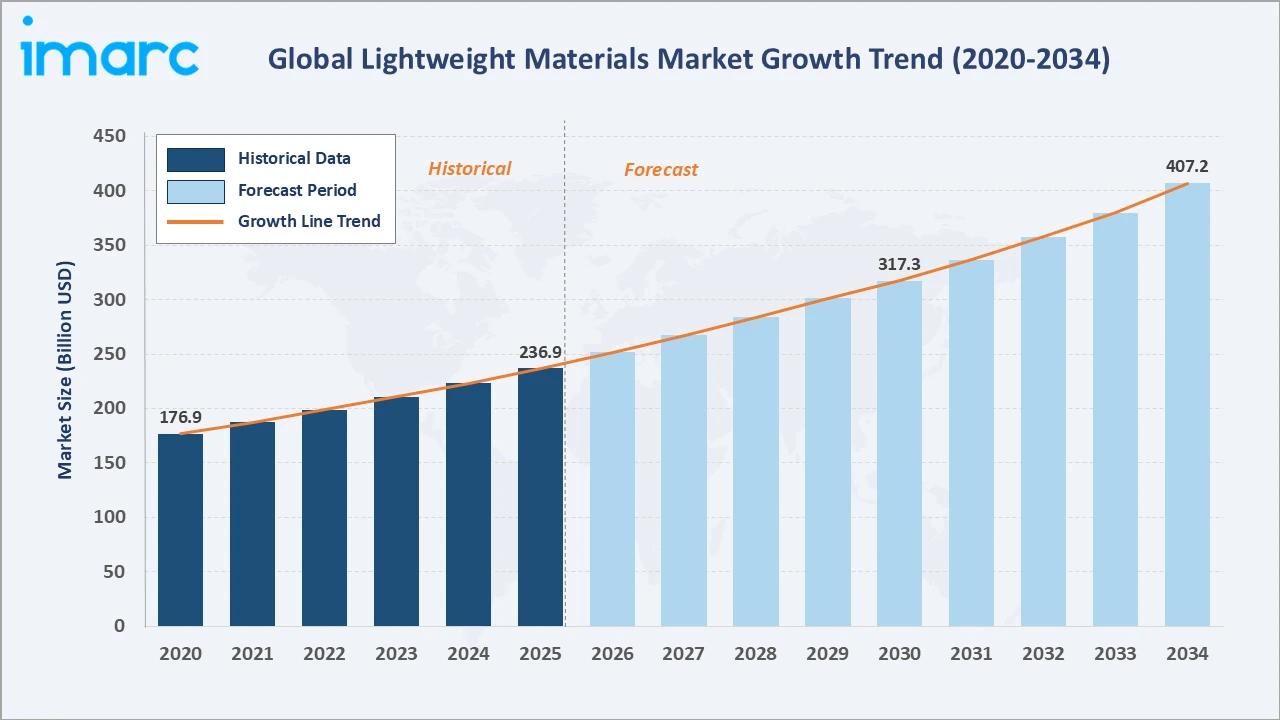
The lightweight materials market grew from USD 236.9 Billion in 2025 to USD 255.2 Billion in 2026 and is projected to reach USD 407.2 Billion by 2034, exhibiting a CAGR of 6.02% during 2026-2034. Rising demand for fuel-efficient vehicles, sustainable construction materials, and high-performance industrial applications continue to support long-term market expansion.
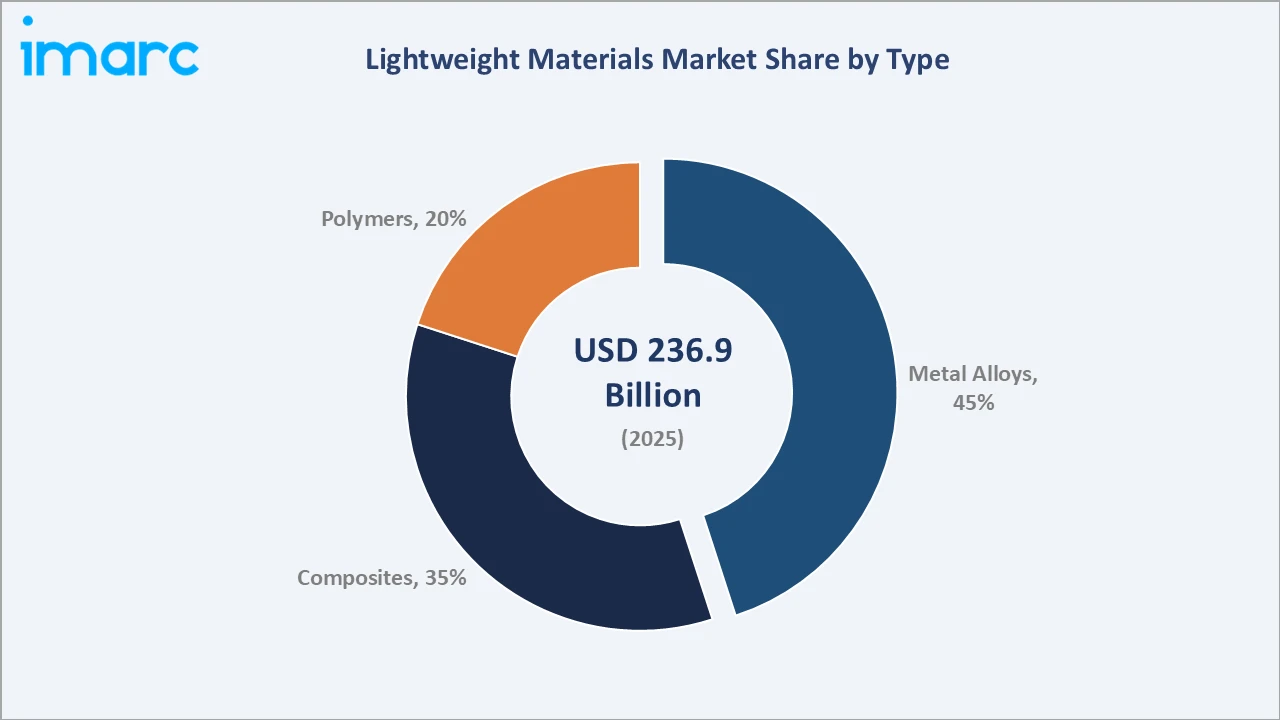
Metal alloys lead the type segment at 45%, direct commands 62% of distribution channel, and Asia-Pacific holds 41% regional share.
Market Snapshot
|
Metric |
Value |
|
Base Year Market Size (2025) |
USD 236.9 Billion |
|
Market Size (2026) |
USD 255.2 Billion |
|
Forecast Market Size (2034) |
USD 407.2 Billion |
|
CAGR (2026-2034) |
6.02% |
|
Base Year |
2025 |
|
Historical Period |
2020-2025 |
|
Forecast Period |
2026-2034 |
|
Largest Region |
Asia-Pacific (41%, 2025) |
|
Second Largest Region |
Europe (27%, 2025) |
|
Leading Type |
Metal Alloys (45%, 2025) |
|
Leading Distribution Channel |
Direct (62%, 2025) |
The lightweight materials market expanded from USD 176.9 Billion in 2020 to USD 236.9 Billion in 2025 and an estimated USD 255.2 Billion in 2026, driven by widening automotive lightweighting programs, growing aerospace demand, and rapid adoption of advanced high-strength steel and composite solutions. Anchored at USD 317.3 Billion in 2030, the forecast to USD 407.2 Billion by 2034 is supported by accelerating electric vehicle (EV) production, expanding composite material adoption, and a more structured regulatory environment for emission reduction.
To get more information on this market, Request Sample
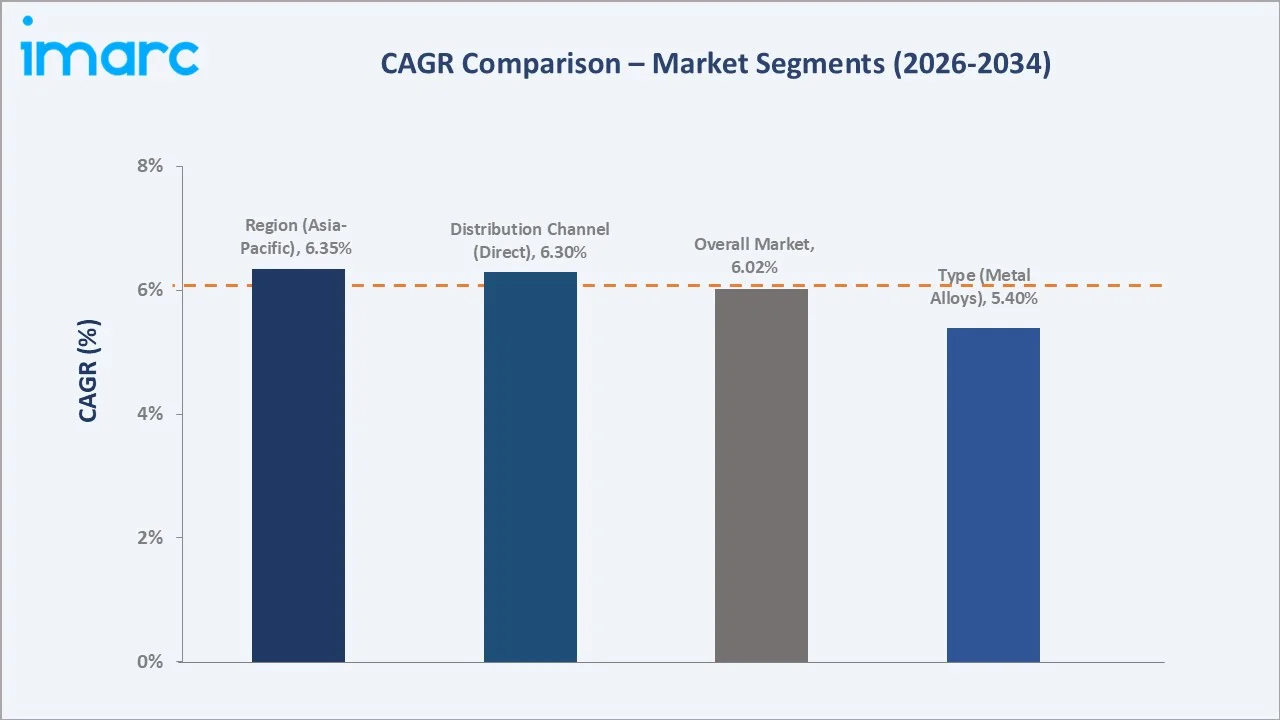
CAGR trajectories across type, distribution channel, and regional sub-segments show composites and Latin America expanding faster than the overall 6.02% market CAGR, driven by demand for high-performance materials, deeper OEM integration, and growing multi-industry participation across regions.
Executive Summary
The lightweight materials market is on a steady growth trajectory from USD 176.9 Billion in 2020 to USD 255.2 Billion in 2026 and further to USD 407.2 Billion by 2034. The industry has moved from conventional steel-intensive designs toward multi-material, weight-optimized engineering across automotive, aerospace, and renewable energy applications. Advanced alloys, engineered composites, and high-performance polymers are encouraging manufacturers to redesign components for efficiency.
Metal alloys dominate the type segment at 45% in 2025, supported by established manufacturing infrastructure, cost efficiency, and recyclability. Direct leads distribution channel at 62%, fueled by long-term OEM supply agreements and integrated supply chains. Asia-Pacific commands 41% of the regional share, led by large-scale automotive and industrial manufacturing bases across the region. India recorded 2.55 Million EV sales in FY2025-26, marking a 25% increase from FY2024-25, with total vehicle registrations hitting 30.84 Million for the financial year, as per the 'India’s Mobility Report FY2025-2026' published by the India Energy Storage Alliance (IESA).
Key Market Insights
|
Insight |
Data |
|
Leading Type |
Metal Alloys - 45% share (2025) |
|
Second Largest Type |
Composites - 35% share (2025) |
|
Leading Distribution Channel |
Direct - 62% share (2025) |
|
Second Largest Distribution Channel |
Indirect - 38% share (2025) |
|
Leading Region |
Asia-Pacific - 41% share (2025) |
|
Second Largest Region |
Europe - 27% share (2025) |
|
Top Companies |
Alcoa Corporation, ArcelorMittal, Toray Industries, Inc., Constellium SE, Hexcel Corporation |
Key Analytical Observations Supporting the Above Data:
- Metal alloys dominance at 45% is anchored by extensive aluminum and advanced high-strength steel production infrastructure across automotive and industrial manufacturing hubs.
- Composites momentum at 35% reflects growing adoption of carbon fiber and glass fiber reinforced polymers in aerospace structures, EV battery enclosures, and wind turbine blades.
- Direct leadership at 62% is sustained by long-term supply contracts between material producers and OEMs, enabling tighter quality control and just-in-time delivery.
- Indirect at 38% continues to serve smaller fabricators, regional distributors, and aftermarket component suppliers that lack direct OEM relationships.
- Asia-Pacific at 41% dominates regional share, anchored by large automotive and electronics manufacturing bases across China, Japan, South Korea, and India.
Lightweight Materials Market Overview
Lightweight materials refer to metals, composites, and polymers engineered to reduce component and vehicle weight while maintaining or improving structural strength, including aluminum and magnesium alloys, advanced high-strength steel, carbon and glass fiber composites, and engineering plastics used across automotive, aerospace, and industrial applications.
The lightweight materials ecosystem integrates raw material suppliers, material processors and fabricators, component manufacturers, automotive and aerospace OEMs, distribution partners, and research and testing laboratories. Together, they enable the delivery of weight-reduction solutions within an evolving regulatory and sustainability framework.
Market Dynamics
To evaluate market opportunities, Request Sample
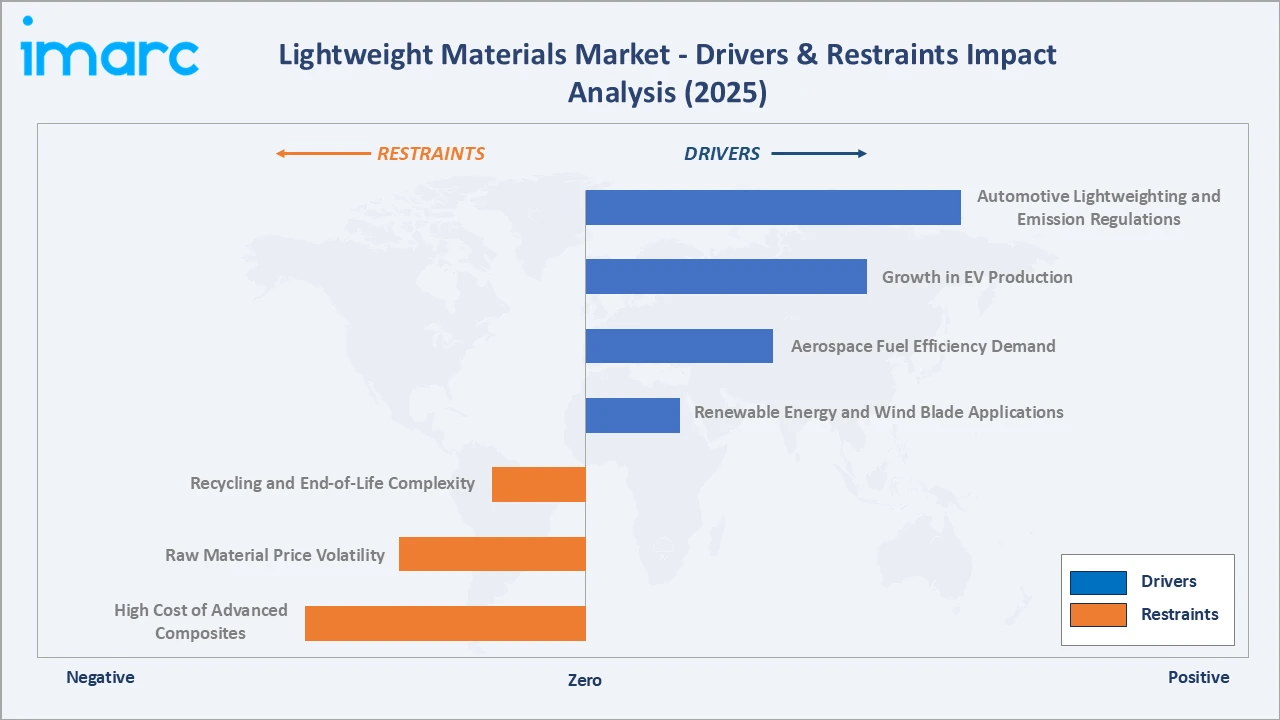
Market Drivers
- Automotive Lightweighting and Emission Regulations: Tightening fuel economy and CO2 emission standards across major automotive markets are compelling manufacturers to substitute conventional steel with aluminum, advanced high-strength steel, and composite components.
- Growth in EV Production: Expanding EV output is increasing demand for lightweight battery enclosures, body structures, and chassis components that help offset battery pack weight and extend driving range. As per IMARC Group, the global EV market size was valued at USD 917.3 Billion in 2025.
- Aerospace Fuel Efficiency Demand: Commercial and defense aircraft manufacturers continue to prioritize carbon fiber composites and titanium alloys to reduce airframe weight, lower fuel consumption, and cut emissions across fleets.
- Renewable Energy and Wind Blade Applications: According to the Global Wind Energy Council, global wind power installations reached 117 Gigawatts in 2024, sustaining demand for lightweight composite blades that improve energy capture efficiency.
Market Restraints
- High Cost of Advanced Composites: Carbon fiber and specialty composite materials carry significantly higher production costs than conventional steel, limiting adoption to premium vehicle segments and high-value aerospace applications.
- Raw Material Price Volatility: Fluctuating prices of key raw materials, such as aluminum and other lightweight metals, create cost uncertainty for manufacturers, making production planning and pricing strategies more challenging.
- Recycling and End-of-Life Complexity: Multi-material assemblies combining metals, composites, and polymers are difficult to separate and recycle efficiently, raising sustainability and end-of-life management concerns.
Market Opportunities
- Circular Economy and Recycled Aluminum Adoption: Growing investment in closed-loop aluminum recycling presents opportunities for producers to lower carbon footprints while maintaining material performance for automotive and packaging applications.
- Emerging Markets in Renewable Energy and Rail Transport: Expanding wind energy installations and lightweight rail car development in emerging economies create new demand pools beyond traditional automotive and aerospace end uses.
Market Challenges
- Technical Integration Across Multi-Material Assemblies: Joining dissimilar materials, such as aluminum, composites, and steel, within a single structure requires specialized bonding, welding, and fastening techniques that add engineering complexity.
- Skilled Workforce and Manufacturing Capability Gaps: Composite layup, advanced forming, and precision joining processes require specialized labor and capital-intensive equipment, constraining capacity expansion in some regions.
Emerging Market Trends
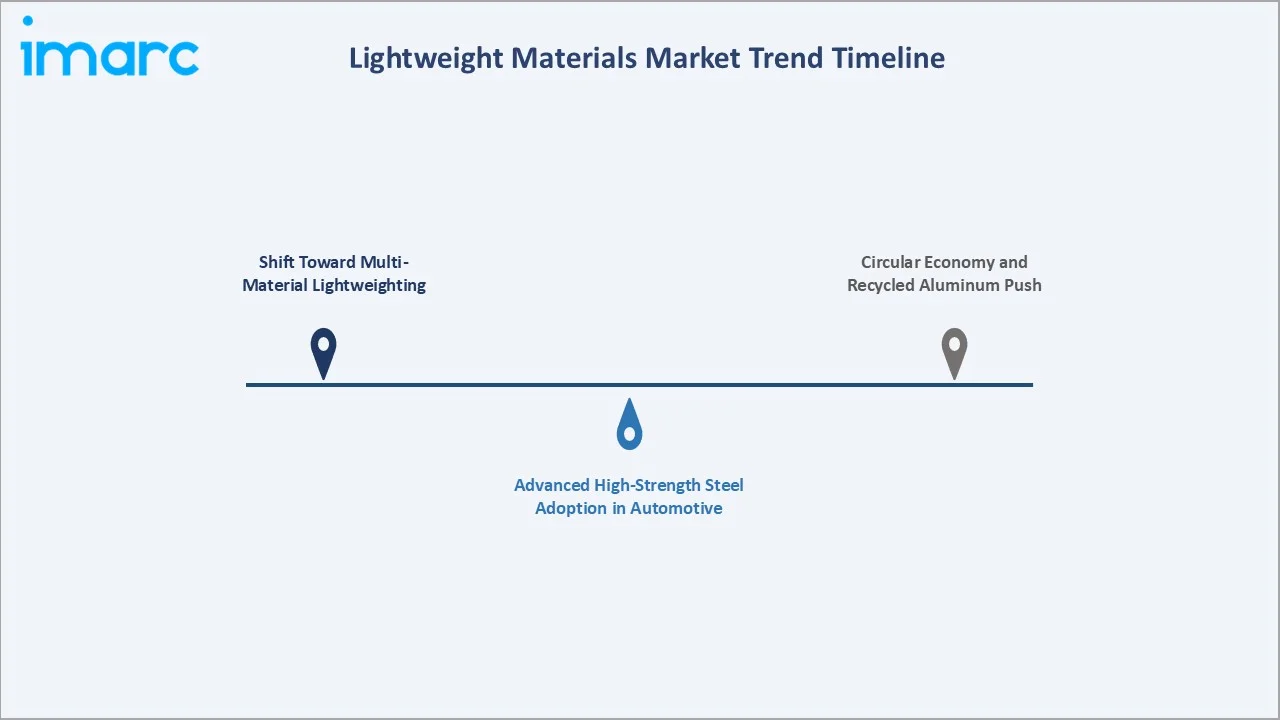
1. Shift Toward Multi-Material Lightweighting
Manufacturers are increasingly combining aluminum, advanced high-strength steel, and composites within a single structure to optimize weight, cost, and performance simultaneously. This multi-material approach is becoming the default engineering strategy across automotive and industrial platforms.
2. Advanced High-Strength Steel Adoption in Automotive
Advanced high-strength steel grades are gaining share as a cost-effective lightweighting alternative to aluminum, offering strength-to-weight improvements while leveraging existing stamping and welding infrastructure across automotive plants.
3. Circular Economy and Recycled Aluminum Push
Producers are scaling closed-loop recycling programs to recover aluminum scrap from automotive and packaging streams, reducing energy intensity and carbon emissions associated with primary aluminum production.
Industry Value Chain Analysis
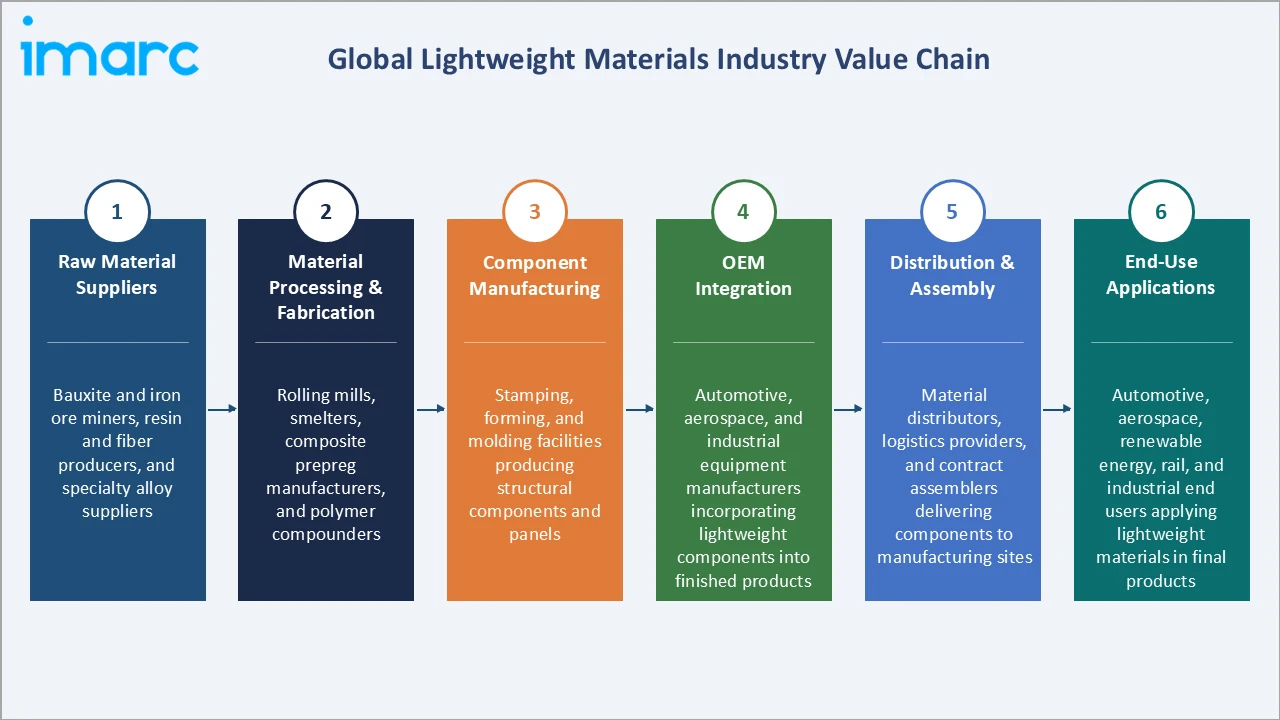
The lightweight materials value chain spans six stages from raw material extraction through end-use application. Material processing, component manufacturing, and OEM integration capture the highest value-add, while distribution and end-use support capabilities increasingly determine sustainable competitive position across this evolving category.
|
Stage |
Key Players / Examples |
|
Raw Material Suppliers |
Bauxite and iron ore miners, resin and fiber producers, and specialty alloy suppliers providing base inputs for downstream processing |
|
Material Processing & Fabrication |
Rolling mills, smelters, composite prepreg manufacturers, and polymer compounders converting raw inputs into usable material forms |
|
Component Manufacturing |
Stamping, forming, and molding facilities producing structural components, panels, and sub-assemblies for OEM integration |
|
OEM Integration |
Automotive, aerospace, and industrial equipment manufacturers incorporating lightweight components into finished products |
|
Distribution & Assembly |
Material distributors, logistics providers, and contract assemblers delivering components to manufacturing sites |
|
End-Use Applications |
Automotive, aerospace, renewable energy, rail, and industrial end users applying lightweight materials in final products |
Vertically integrated players, especially those owning proprietary alloy formulations, composite manufacturing capacity, and direct OEM relationships, are positioned to capture greater value than partners reliant on third-party infrastructure.
Technology Landscape in the Lightweight Materials Industry
Advanced Alloy Development and Processing
Producers are developing next-generation aluminum-lithium and magnesium alloys alongside advanced high-strength steel grades that deliver improved strength-to-weight ratios. Precision rolling, hot stamping, and heat treatment technologies are enabling tighter tolerances and consistent mechanical properties.
Composite Manufacturing and Automation
Automated fiber placement, resin transfer molding, and high-pressure resin transfer molding are reducing composite production cycle times, supporting higher-volume applications in automotive and industrial segments beyond traditional aerospace use.
Digital Design, Simulation, and Recycling Technologies
Generative design software, finite element simulation, and digital twins are helping engineers optimize multi-material structures before physical prototyping. Parallel advances in sorting and alloy-separation technologies are improving recycled material quality and closed-loop recovery rates.
Market Segmentation Analysis
The report covers the following segments:
|
Segment Category |
Leading Segment |
Market Share |
Year |
|
Type |
Metal Alloys |
45% |
2025 |
|
Distribution Channel |
Direct |
62% |
2025 |
|
Application |
Automotive |
🔒 |
2025 |
|
Region |
Asia-Pacific |
41% |
2025 |

By Type
Metal alloys dominate with 45% share in 2025, reflecting established manufacturing infrastructure, cost efficiency relative to composites, and broad compatibility with existing stamping and forming equipment across automotive and industrial applications.
To access detailed market analysis, Request Sample
Composites at 35% are expanding through growing adoption in aerospace structures, EV components, and wind energy applications, supported by continuous improvements in manufacturing automation that are gradually lowering production costs.
By Distribution Channel
Direct commands a 62% majority share in 2025, driven by long-term supply agreements between material producers and automotive, aerospace, and industrial OEMs. The channel benefits from tighter quality control, integrated logistics, and just-in-time delivery models that reduce inventory costs for large-scale manufacturers.
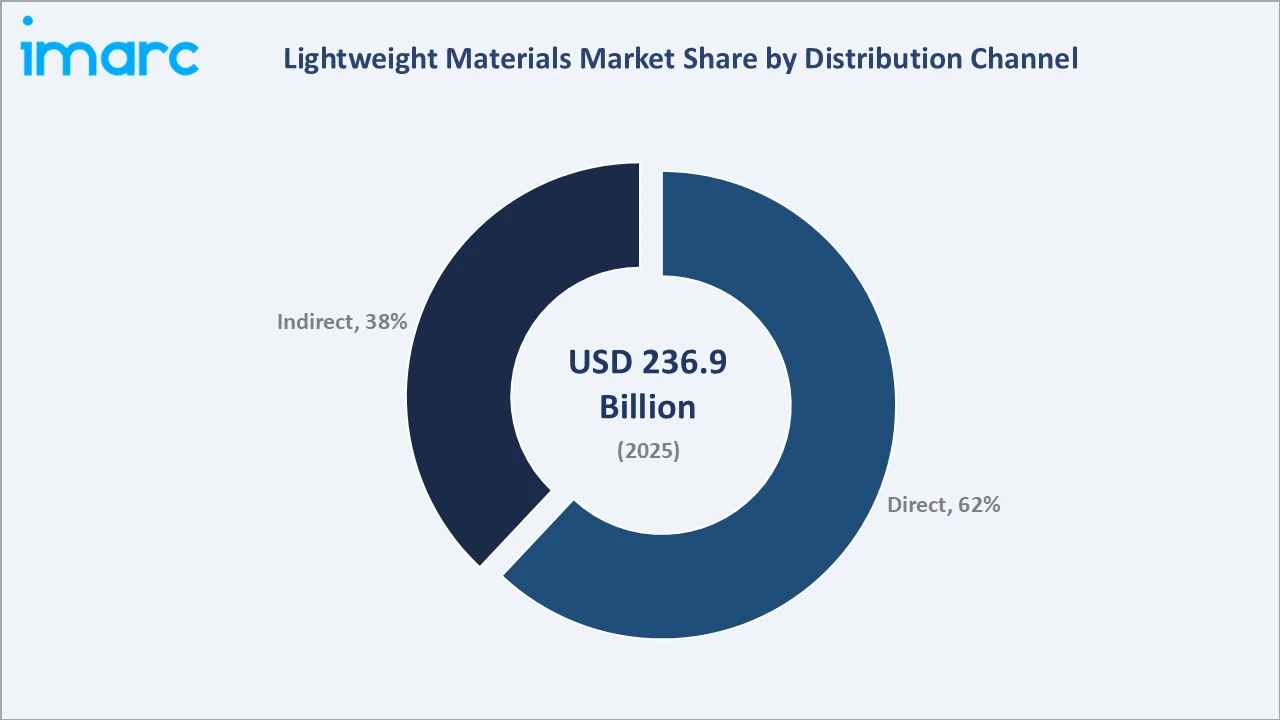
Indirect at 38% in 2025 serves smaller fabricators, regional distributors, and aftermarket component suppliers that source materials through intermediaries rather than direct producer relationships. The channel remains relevant for smaller-volume buyers without the scale to negotiate direct supply contracts.
Regional Market Insights
|
Region |
Share (2025) |
Key Growth Drivers |
|
Asia-Pacific |
41% |
Large automotive and electronics manufacturing base, expanding industrial infrastructure, and growing local material processing capacity |
|
Europe |
27% |
Stringent emission regulations, established automotive and aerospace manufacturing base, and strong focus on recycled material adoption |
|
North America |
21% |
Advanced aerospace manufacturing, growing EV production, and supportive investment in domestic material processing capacity |
|
Latin America |
6% |
Expanding automotive assembly operations, growing industrial investment, and rising demand for cost-efficient lightweighting solutions |
|
Middle East and Africa |
5% |
Emerging industrial and infrastructure development, growing renewable energy investment, and expanding manufacturing partnerships |
Asia-Pacific at 41% in 2025 leads the regional landscape, anchored by large automotive and electronics manufacturing bases across China, Japan, South Korea, and India. Extensive local material processing capacity and integrated supply chains support sustained regional leadership across metal alloy and composite segments.
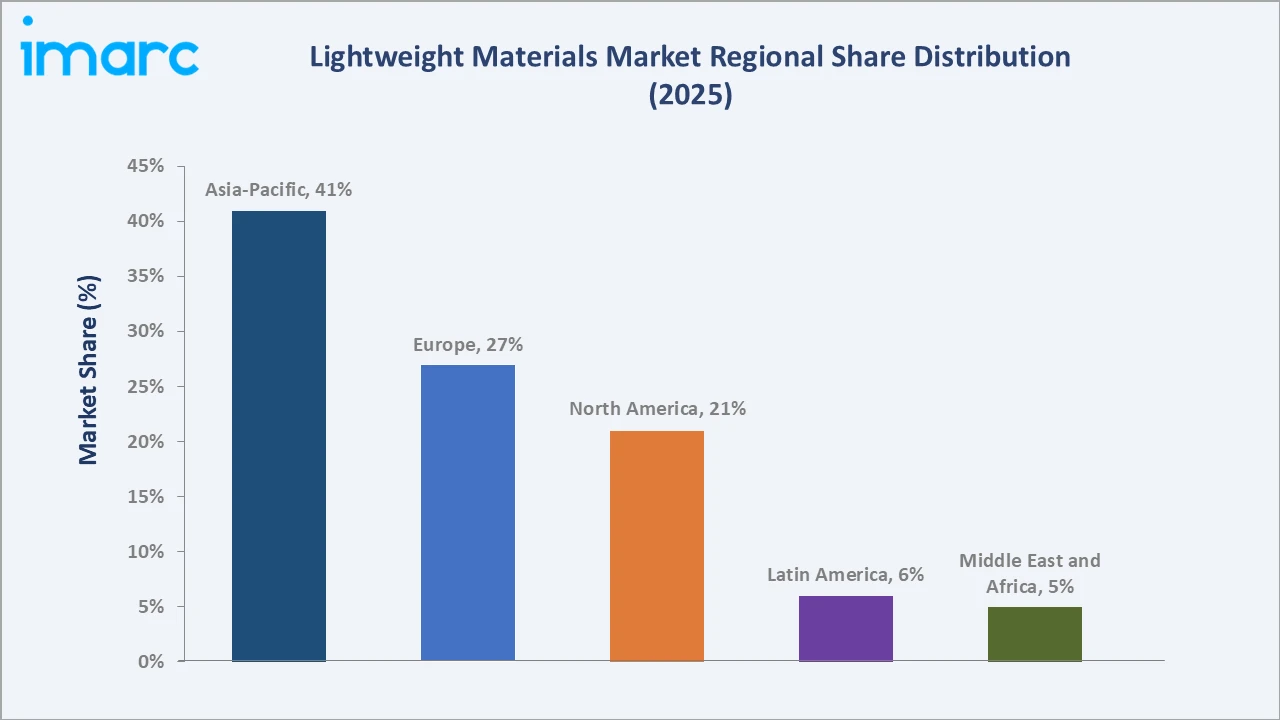
Europe at 27% is the second largest regional market, driven by stringent vehicle emission regulations, a strong automotive manufacturing base, and increasing adoption of lightweight materials across the transportation, aerospace, and industrial sectors.
Competitive Landscape
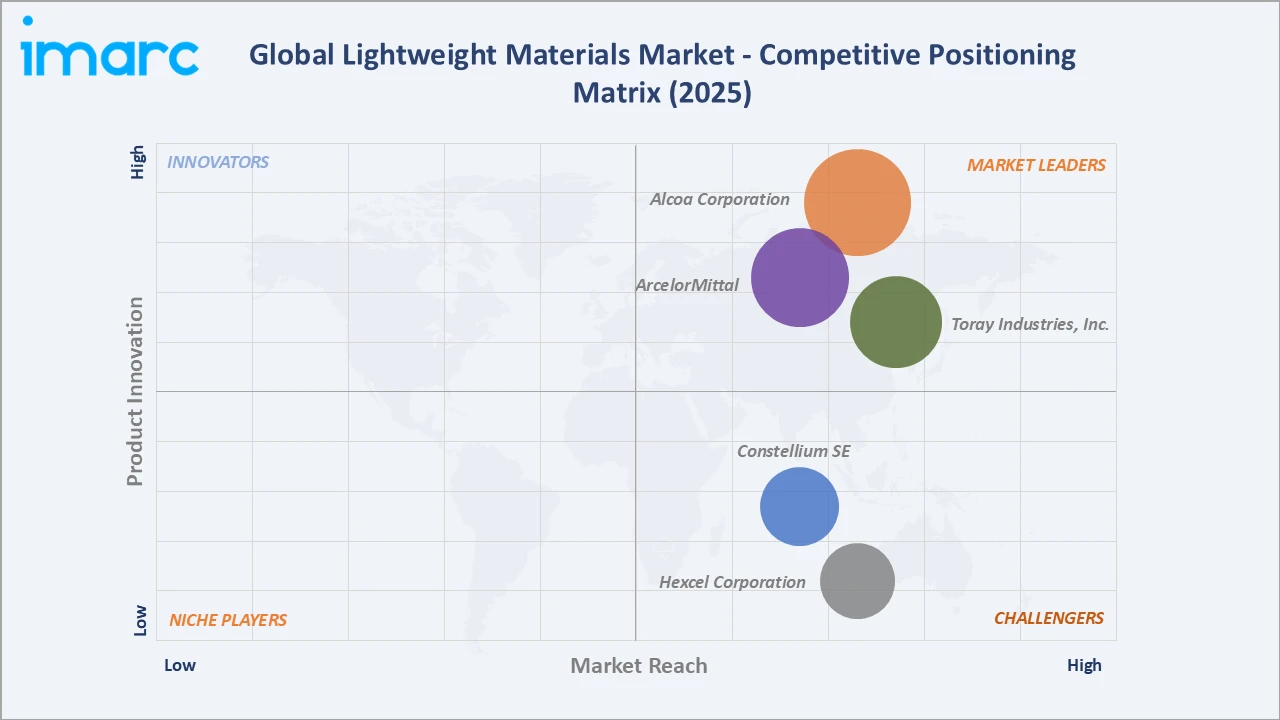
The lightweight materials market is moderately fragmented, with established metal and composite producers leading production scale and technical capability while emerging specialists compete on innovation and niche applications. Manufacturing scale, material science expertise, and OEM relationships form the key competitive moats across this category.
|
Company Name |
Brand / Key Product |
Position |
Strategic Focus |
|
Alcoa Corporation |
Sustana® |
Leader |
Global-scale primary aluminum and alumina producer focused on expanding low-carbon production capacity |
|
ArcelorMittal |
Usibor® |
Leader |
Leading steel producer investing in advanced high-strength steel grades for automotive lightweighting |
|
Toray Industries, Inc. |
Torayca Carbon Fiber |
Leader |
Diversified materials company expanding carbon fiber capacity for aerospace and automotive applications |
|
Constellium SE |
Airware® |
Challenger |
Specialty aluminum producer serving automotive, aerospace, and packaging end markets |
|
Hexcel Corporation |
HexTow Continuous Carbon Fiber |
Challenger |
Advanced composites manufacturer focused on aerospace and industrial reinforcement materials |
Key players include Alcoa Corporation, ArcelorMittal, Toray Industries, Inc., Constellium SE, and Hexcel Corporation, among others.
Key Company Profiles
Alcoa Corporation
Alcoa Corporation is a global producer of bauxite, alumina, and primary aluminum, headquartered in Pittsburgh, Pennsylvania, with operations spanning mining, refining, and smelting across multiple countries.
- Product Portfolio: Sustana® low-carbon aluminum and alumina products, including primary aluminum, value-added castings, and specialty alloys supplied to automotive, aerospace, and industrial customers.
- Recent Developments: In June 2026, the company agreed to acquire South32's bauxite, alumina, and aluminum smelter interests in a USD 4.1 Billion transaction.
- Strategic Focus: Expanding low-carbon aluminum production capacity, strengthening upstream integration, and deepening customer relationships across automotive and aerospace lightweighting programs.
ArcelorMittal
ArcelorMittal is one of the world's leading integrated steel and mining companies, headquartered in Luxembourg City, with production facilities across Europe, the Americas, and Asia serving diverse industrial end markets.
- Product Portfolio: Usibor® press-hardened steel and other advanced high-strength steel grades designed for automotive body-in-white and structural lightweighting applications.
- Recent Developments: The company has continued to expand its advanced high-strength steel product range and invest in lower-emission steelmaking processes to support automotive customer sustainability targets.
- Strategic Focus: Growing advanced high-strength steel adoption in automotive lightweighting, expanding low-carbon steel production, and deepening OEM collaboration on next-generation body structures.
Toray Industries, Inc.
Toray Industries, Inc. is a diversified Japanese materials science company with a long-established position in carbon fiber and advanced composite materials serving aerospace, automotive, and industrial markets globally.
- Product Portfolio: Torayca carbon fiber and prepreg composite materials used in aircraft structures, automotive components, and industrial applications.
- Recent Developments: The company has continued to expand carbon fiber production capacity and strengthen partnerships with aerospace and automotive manufacturers seeking lightweight structural solutions.
- Strategic Focus: Scaling global carbon fiber capacity, deepening aerospace and automotive partnerships, and advancing recycling technologies for composite materials.
Market Concentration Analysis
The lightweight materials market is moderately concentrated, with the top players including Alcoa Corporation, ArcelorMittal, and Toray Industries, Inc. accounting for a meaningful share of global metal alloy and composite production capacity across automotive and aerospace end markets.
Barriers to entry include high capital intensity for smelting and composite manufacturing facilities, the need for material qualification with automotive and aerospace customers, and established long-term supply relationships. These factors favor well-capitalized incumbents with diversified product portfolios and global manufacturing footprints.
Consolidation continues as producers pursue vertical integration into recycling and specialty alloy development, while smaller composite and polymer specialists compete on niche applications and material innovation. Strategic partnerships with automotive and aerospace OEMs are reinforcing competitive positioning across the value chain.
Investment & Growth Opportunities
Fastest-Growing Segments
Composites are expanding the fastest among type segments, driven by growing EV, aerospace, and wind energy applications. Direct continues to outpace the indirect distribution channel, as OEMs increasingly favor integrated, long-term supply arrangements with material producers.
Emerging Markets
Middle East and Africa, alongside Latin America, represent emerging opportunities anchored by expanding industrial diversification, growing automotive assembly investment, and rising renewable energy development. These markets offer untapped potential for producers able to establish local processing and distribution capability.
Venture & Investment Trends
Investment is concentrated in recycled aluminum processing, next-generation composite manufacturing automation, and advanced alloy research and development. Capital is also flowing into digital design and simulation platforms that accelerate multi-material product development cycles.
Future Market Outlook (2026-2034)
The lightweight materials market is forecast to expand from USD 236.9 Billion in 2025 to USD 255.2 Billion in 2026 and further to USD 407.2 Billion by 2034 at a CAGR of 6.02%, adding roughly USD 170.3 Billion in incremental market value over the forecast period.
Four forces will shape the market through 2034: tightening global emission and fuel efficiency regulations; the rise of EV and composite-intensive platforms; deeper integration of recycled and low-carbon materials; and continued advancement in multi-material joining and manufacturing technologies.
By 2034, the lightweight materials industry is expected to be defined by increasingly integrated multi-material designs, with composites and recycled metal alloys accounting for a significantly higher share of overall material consumption. Regulatory alignment, sustainability commitments, and manufacturing automation are expected to further accelerate the evolution of the lightweighting ecosystem.
Research Methodology
Primary Research
Primary research included structured interviews with material producers, OEM procurement executives, composite fabricators, and industry association representatives, validating market sizing, segment mix, and regional demand patterns.
Secondary Research
Secondary sources included industry association publications, government trade and manufacturing statistics, company annual reports, investor presentations, and regulatory filings from listed material producers.
Forecasting Models
Market forecasts used top-down and bottom-up models combining automotive and aerospace production volumes, material substitution rates, regulatory transition scenarios, and macroeconomic variables. Scenario analysis addressed raw material price volatility and regional manufacturing capacity expansion.
Report Coverage:
| Report Features | Details |
|---|---|
| Base Year of the Analysis | 2025 |
| Historical Period | 2020-2025 |
| Forecast Period | 2026-2034 |
| Units | Billion USD |
| Scope of the Report | Exploration of Historical Trends and Market Outlook, Industry Catalysts and Challenges, Segment-Wise Historical and Future Market Assessment:
|
| Types Coverage | Metal Alloys, Composites, Polymers |
| Distribution Channels Coverage | Direct, Indirect |
| Applications Coverage | Automotive, Aerospace, Wind, Marine, Electronics, Construction, Consumer Goods, Others |
| Regions Covered | Asia Pacific, Europe, North America, Latin America, Middle East and Africa |
| Countries Covered | United States, Canada, Germany, France, United Kingdom, Italy, Spain, Russia, China, Japan, India, South Korea, Australia, Indonesia, Brazil, Mexico |
| Companies Covered | Alcoa Corporation, ArcelorMittal, Toray Industries, Inc., Constellium SE, Hexcel Corporation, etc. |
| Customization Scope | 10% Free Customization |
| Post-Sale Analyst Support | 10-12 Weeks |
| Delivery Format | PDF and Excel through Email (We can also provide the editable version of the report in PPT/Word format on special request) |
Frequently Asked Questions About the Lightweight Materials Market Report
The lightweight materials market size is estimated at USD 255.2 Billion in 2026, driven by automotive lightweighting, aerospace fuel efficiency demand, and growing composite adoption.
The market is projected to grow at a CAGR of 6.02% from 2026-2034, reaching USD 407.2 Billion, supported by rising EV production and expanding composite applications.
Metal alloys lead at 45% in 2025, supported by established manufacturing infrastructure. Their high strength-to-weight ratio, recyclability, and compatibility with existing production processes make them the preferred choice across automotive, aerospace, and industrial applications.
Direct dominates at 62% in 2025, driven by long-term OEM supply agreements. This channel enables customized supply, consistent product quality, and closer collaboration between manufacturers and end users for large-volume procurement.
Asia-Pacific commands 41% share in 2025, led by large automotive and electronics manufacturing bases across China, Japan, South Korea, and India.
Leading players include Alcoa Corporation, ArcelorMittal, Toray Industries, Inc., Constellium SE, and Hexcel Corporation, among others.
Advances in automated composite manufacturing, digital design simulation, and alloy-separation recycling technologies are improving production efficiency and expanding material application scope.
High costs of advanced composites, raw material price volatility, and end-of-life recycling complexity for multi-material assemblies remain key restraints across the industry.
Need more help?
- Speak to our experienced analysts for insights on the current market scenarios.
- Include additional segments and countries to customize the report as per your requirement.
- Gain an unparalleled competitive advantage in your domain by understanding how to utilize the report and positively impacting your operations and revenue.
- For further assistance, please connect with our analysts.
 Request Customization
 Speak to an Analyst
 Request Brochure
 Inquire Before Buying
Benefits of Customization
- Personalize this research
- Triangulate with your data
- Get data as per your format and definition
- Gain a deeper dive into a specific application, geography, customer, or competitor
- Any level of personalization
Get in Touch With Us
UNITED STATES
Phone: +1-201-971-6302
INDIA
Phone: +91-120-433-0800
UNITED KINGDOM
Phone: +44-753-714-6104
Email: [email protected]
Client Testimonials




.webp)




.webp)













Related Reports

Choose your plan
*Please note that the prices mentioned below are starting prices for each bundle type. Kindly contact our team for further details.*
Single User License
- 1 User License, Access on 2 Devices
- PDF Report + Excel Dataset (Password Protected)
- Lifetime Access
- No Printing Rights
- 10% Free Report Customization
- 10–12 Weeks of Analyst Support
Five User License
- Access for 5 Users, 2 Devices per User
- PDF Report + Excel Dataset (Password Protected)
- Lifetime Access
- Dedicated Account Manager
- 12–14 Weeks of Analyst Support
- No Printing Rights
- 15% Free Report Customization
- 25% Discount on Your Next Purchase
Corporate User License
- Unlimited User Access (Within Your Organization)
- PDF Report + Excel Dataset
- Lifetime Access
- Dedicated Account Manager
- 14–20 Weeks of Analyst Support
- No Printing Rights
- 20% Free Report Customization
- 30% Discount on Your Next Purchase
Essential Insights
What's included:
3 reports
- Lifetime Access
- PDF Reports
- Excel Datasets
- 2 Weeks of Free Analyst Support
- 2 User Licenses
- Access on 2 Devices
- Printing Rights
- Complimentary PowerPoint (PPT) Version
- Complimentary License Upgrade
Professional Access
What's included:
5 reports
- Lifetime Access
- PDF Reports
- Excel Datasets
- 8 Weeks of Free Analyst Support
- 2 User Licenses
- Access on 2 Devices
- Printing Rights
- Complimentary PowerPoint (PPT) Version
- Complimentary License Upgrade
Business Advantage
What's included:
8 reports
- Lifetime Access
- PDF Reports
- Excel Datasets
- 14 Weeks of Free Analyst Support
- 2 User Licenses
- Access on 2 Devices
- Printing Rights
- Complimentary PowerPoint (PPT) Version
- Complimentary License Upgrade
Enterprise Intelligence
What's included:
10 reports
- Lifetime Access
- PDF Reports
- Excel Datasets
- 20 Weeks of Free Analyst Support
- 2 User Licenses
- Access on 2 Devices
- Printing Rights
- Complimentary PowerPoint (PPT) Version
- Complimentary License Upgrade